




06 Mar Why Subscription Businesses Like Adult Diapers Generate the Highest ROI on Every Marketing Dollar Spent
Let’s start with something that will make you uncomfortable and then make you rich.
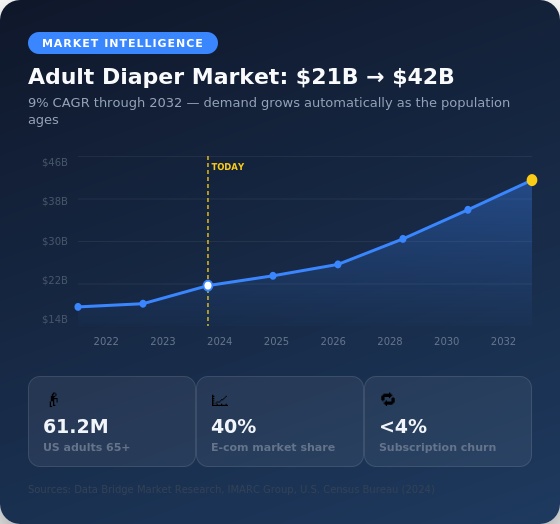
Adult diapers. Not the sexiest product category in the world. No influencer is building a lifestyle around them. There’s no aesthetic, no aspirational identity, no viral unboxing moment. And yet, the global adult diaper market was valued at over $21 billion in 2024 and is projected to reach $42 billion by 2032 — growing at a CAGR of nearly 9%. The companies selling them on subscription are sitting on some of the most resilient, defensible, high-margin revenue streams in consumer commerce.
That’s the thesis. The category doesn’t have to be glamorous. It has to be consumable, recurring, and necessary. Once you internalize that, you stop looking at subscription businesses the same way. You start seeing them everywhere — and you start understanding why every marketing dollar you spend on a subscription model works 3x to 6x harder than the same dollar spent on a one-time transaction business.
Here are the seven reasons why. Here at Amra and Elma, a leading marketing agency in New York, we have DISECTED are the mechanics. The ones that top operators know and most marketers have never had spelled out for them.
ROI of Adult Diaper Subscription Businesses: Why Recurring Healthcare Products Generate Exceptional Marketing Returns (Editor’s Choice)
| Metric | Subscription | One-Time | Edge |
|---|---|---|---|
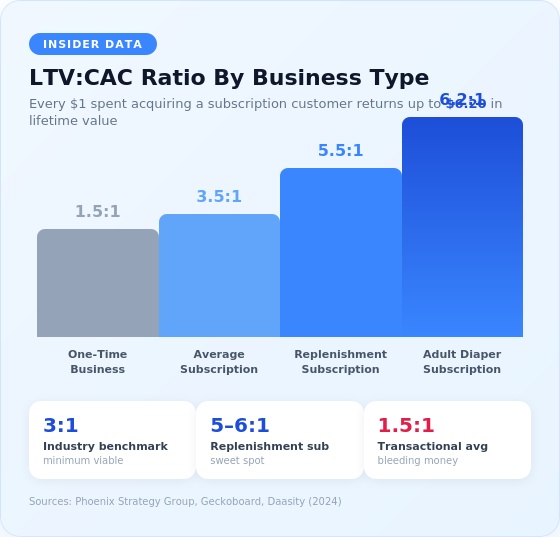
| LTV:CAC Ratio | 5:1 – 6:1 | 1:1 – 2:1 | +200% |
| Revenue from Existing Customers | 70% | ~20% | 3.5× more |
| Customer Lifetime Value | 3–5× higher | Baseline | ↑ 70% |
| Monthly Churn (Replenishment) | <4% | N/A | Sticky |
| Upsell CAC | ~$0 | Full CAC again | Near-free |
| Revenue Predictability | High (MRR) | None | Forecastable |
| Referral Conversion Lift | +31% | Minimal | +31% |
| Adult Diaper Market by 2032 | $42B growing at 9% CAGR | Tailwind | |
The insider’s breakdown of the most efficient business model in modern commerce — and why the “unglamorous” categories are quietly minting the most money.
ROI of Subscription Businesses Insight #1. The CAC You Pay Once Pays You Back Forever
In a transactional business, Customer Acquisition Cost (CAC) is an expense. You pay it, you get a sale, and then you have to pay it again for the next one. Every unit of revenue requires a proportional unit of marketing spend. The model is inherently inefficient by design.
Subscription businesses flip this entirely. Your CAC becomes an investment amortized across an indefinitely long revenue stream. The math here is not subtle — it is violent.
A 3:1 LTV-to-CAC ratio is considered “good” for most businesses. For subscription-based businesses, that ratio routinely climbs to 5:1 or 6:1, according to benchmarking data from Phoenix Strategy Group. That means for every dollar you spend acquiring a customer, you’re generating $5 to $6 in lifetime value. Now consider that subscription customers generate 3x to 5x more revenue over their lifetime compared to one-time transactional buyers (Swell, 2024). The same ad dollar. The same email sequence. The same influencer post. But multiplied by years of automatic repurchase.
For a category like adult incontinence, the compounding effect is even more extreme. These are not discretionary products that someone stops buying when a trend changes. Approximately 51% of adults with incontinence conditions use products daily, and that usage does not decline with time — it typically increases. When a customer subscribes to the best adult diapers for their household or care facility (because of their right absorption, quality, etc), you are not acquiring a customer for one transaction. You are acquiring a revenue stream that, absent a catastrophic brand failure, runs for years.
The AHA moment: Stop calculating CAC against the first purchase. Start calculating it against the 18-month LTV. The number that felt too expensive to justify suddenly looks like the best investment you ever made.
ROI of Subscription Businesses Insight #2. Retention Is the Silent Revenue Engine That Requires Zero Additional Spend
Here’s the number that changes how you think about everything: 70% of subscription revenue comes from existing customers, not new acquisitions (Swell, 2024).
Read that again. Seventy percent. That means the majority of your revenue on any given month requires no ad spend, no new creative, no new pitch. It is money that arrives because you did the work of acquiring the customer previously — and your product didn’t fail them.
In transactional commerce, retention is a nice-to-have. In subscription commerce, retention is the entire business. A one-percentage-point improvement in monthly churn doesn’t sound exciting until you model it out. At 5% monthly churn, your average customer stays 20 months. At 4% monthly churn, they stay 25 months. That’s a 25% increase in LTV from a single point of churn reduction — without touching your acquisition funnel, your ad spend, or your conversion rate.
The average monthly churn rate across subscriptions is 4.1% (Recurly, 2024), but replenishment subscriptions — the category adult incontinence squarely belongs to — churn below 4%. Why? Because these are habit-forming, necessity-driven products – they are also thoughtfully constructed products (think that modern adult diapers use layered absorbent systems with superabsorbent polymers to move moisture away from the skin and reduce leakage during extended wear). Pausing a beauty subscription is easy. Pausing your incontinence supply order is not a real option. That structural stickiness is not accidental — it’s the reason smart operators deliberately build subscription businesses around consumable necessities rather than aspirational goods.
The AHA moment: Your retention rate is your marketing ROI multiplier. A 96% monthly retention rate doesn’t just sound good. It means your acquisition spend from 12 months ago is still generating revenue today with zero incremental cost.
ROI of Subscription Businesses Insight #3. Predictable Revenue Makes Every Marketing Decision Smarter and Cheaper
One of the most underestimated advantages of the subscription model is what it does to your decision-making process. Transactional businesses operate in a fog. They know roughly what they earned last month but cannot reliably forecast next month. That uncertainty forces conservative marketing spend — because nobody wants to over-invest in a month that turns out soft.
Subscription businesses have Monthly Recurring Revenue (MRR). They know, with high accuracy, what next month looks like before the month begins. Subscription merchants reported 7% MRR growth throughout 2022, even during significant economic volatility (Swell, 2024). That predictability is not just a comfort metric — it is a competitive weapon.
When you know your baseline revenue with precision, you can make aggressive, confident marketing investments. You can commit to media buys farther in advance, negotiate better rates, test more boldly, and scale faster. You are not flinching at the spend because the revenue floor is visible. Transactional businesses perpetually underinvest in marketing because the future is opaque. Subscription businesses can invest with conviction because the MRR model gives them a floor.
This is also why subscription businesses attract higher valuations. Public SaaS firms benefit from robust equity multiples driven by their Annual Recurring Revenue (ARR), and the same logic applies across categories. Predictable cash flows justify more aggressive marketing bets — and more aggressive marketing bets compound the subscriber base further.
The AHA moment: MRR doesn’t just make your CFO happy. It makes your marketing team fearless. Fearless marketing teams spend smarter, move faster, and win more.
ROI of Subscription Businesses Insight #4. The Product Innovation Loop Creates Upsell Revenue That Costs Almost Nothing to Capture
Subscription businesses have a structural advantage that one-time sellers can never replicate: an ongoing, consented relationship with the customer. That relationship is a permission-based channel to introduce new products, higher-margin variants, and upsells to a warm audience — at near-zero incremental CAC.
In the adult incontinence category, this dynamic is unusually powerful. The product category is scientifically complex. Modern incontinence products feature layered absorbent systems with superabsorbent polymers that can retain 10 to 20 times their weight in fluid, incorporating moisture-wicking topsheets, odor-neutralizing compounds, and skin-safe elastics. That complexity creates a natural upgrade ladder — from basic protection to overnight protection, from standard to premium, from individual packs to family/facility bulk tiers.
A subscriber who starts with a basic daytime product can be educated, nurtured, and upgraded through email and content marketing to a higher-margin premium product — without ever re-entering the acquisition funnel. Cross-sells generate 22% in additional revenue for subscription businesses (Marketing LTB, 2024). Auto-ship discount structures increase retention by 29%. This is not theoretical — it is measurable, repeatable, and compound.
The brands that understand this build their subscription tiers the way SaaS companies build their pricing pages: entry-level to get the customer in, with clear value-driven pathways to higher-margin tiers. Every upsell closed to an existing subscriber carries a CAC of approximately zero, making it the highest-ROI revenue your business can generate.
The AHA moment: Your product line is not just a catalog. In a subscription model, it’s a revenue escalator. Design it like one.

ROI of Subscription Businesses Insight #5. The Data Flywheel Compounds Your Marketing Intelligence Over Time
Subscription businesses generate something transactional businesses never can: longitudinal behavioral data on individual customers at scale. Every replenishment cycle, every product switch, every pause, every reactivation — these are data signals that build a progressively sharper picture of your customer.
This matters for marketing in a very specific way. The longer a customer stays on subscription, the better your model understands the predictors of churn, the triggers for upgrade, the moments of maximum engagement. That intelligence gets applied back to acquisition — you build lookalike audiences based not on one-time buyers but on your most retained, highest-LTV subscribers. Your paid media improves not because you spent more on creative, but because the data quality behind the targeting gets richer with every passing month.
Customers who use a product weekly have 85% higher retention rates, and the top 20% of subscribers generate 72% of total revenue (Marketing LTB, 2024). Identifying that top 20% early — through behavioral signals from your subscriber data — allows you to concentrate retention investment where it creates the most value, and to optimize acquisition to bring in customers who look like that top tier.
In the adult incontinence market, this data advantage is compounded by the nature of the buyer. Many purchases are made by adult children for aging parents, by care facility administrators, or by home care providers managing multiple patients and looking for “best adult diapers.” Those buyers are high-frequency, high-volume, high-loyalty — and their behavioral profiles, once captured, give you extraordinary targeting precision.
The AHA moment: In a subscription business, your oldest customers are not just your most profitable — they are your marketing intelligence department. Mine them accordingly.
ROI of Subscription Businesses Insight #6. Word-of-Mouth Economics Are Structurally Superior in Subscription Categories
The subscription model fundamentally changes who is talking about your product and what they say. In transactional commerce, a customer who bought once has limited social proof to offer. They made a purchase. They may or may not have been satisfied. Their advocacy is weak and short-lived.
A subscription customer who has been on auto-ship for 14 months is a different kind of advocate. They have demonstrated, through repeated purchase, that the product works for them. Their recommendation carries the implicit weight of sustained commitment. And because subscription customers are in a more intimate, ongoing relationship with a brand, they are more likely to refer — especially when incentivized. Referral programs increase subscription growth by 18%, and referral incentives specifically increase subscription growth by 31% (Marketing LTB, 2024).
In the adult incontinence category, word-of-mouth follows specific high-trust pathways: caregiver networks, eldercare Facebook groups, medical social workers, and discharge planners at hospitals and rehab facilities. These are not influencer audiences — they are professional and semi-professional recommendation networks with enormous reach and extraordinarily high conversion rates. A discharge planner who recommends your subscription service to families of newly incontinent patients is worth 50 Instagram posts from someone who has never experienced the product.
The subscription model enables you to invest in building these referral relationships because you can calculate the LTV of each referred customer with precision. You know what a referred subscriber is worth over 18 months. That means you can afford to pay significantly more per referred acquisition than a transactional brand ever could — which means you can win these referral channels while your competition cannot even afford to play.
The AHA moment: Not all word-of-mouth is equal. Find the referral pathways specific to your category and build a machine around them. In subscription, you can afford to pay for referrals that would bankrupt a transactional competitor.
ROI of Subscription Businesses Insight #7. The Aging Demographics Are a 30-Year Tailwind That Makes the Marketing Thesis Permanent
Every marketing argument above works for subscriptions generically. But the adult incontinence category adds a macroeconomic layer that turns an already-strong model into something extraordinary: one of the most reliable demographic growth curves in modern history.
The U.S. population aged 65 and older reached approximately 61.2 million in 2024 (U.S. Census Bureau). By 2025, that number will reach 82 million, constituting 23% of the total U.S. population (Population Reference Bureau). Globally, one in six people worldwide will be over 65 by 2050. Urinary incontinence affects 15% to 20% of elderly people generally, climbing to 70% among nursing home residents (Allied Market Research). These are not trends. They are demographic certainties built into the age distribution of the current population.
For a marketer, this is the equivalent of being handed a demand forecast with 30 years of visibility. The addressable market for adult incontinence subscriptions grows automatically, every year, as the boomer generation ages. You do not need to create demand. You do not need to educate consumers about a new behavior. The demand creates itself. Your job is simply to be in front of it with a better subscription product, a better fulfillment model, and a sharper customer experience than the players who are still selling in pharmacies at full retail.
The global adult diapers market is expected to nearly double from $21 billion in 2024 to $42 billion by 2032 (Data Bridge Market Research). E-commerce and online stores already lead with 40% market share in distribution (IMARC Group, 2025), and subscription-based distribution is the fastest-growing channel within that. The brands that build subscription infrastructure now are not just capturing today’s market — they are building the moat that will dominate the next three decades of compounding demand growth.
The AHA moment: Demographic tailwinds don’t just support your business — they do your marketing for you. When the addressable market expands automatically every year, every retained subscriber is compounded by the new customers your category generates simply by the passage of time.
The Summary That Should Make You Rethink Everything
Here is the honest summary of what you just read:
Subscription businesses generate higher ROI on every marketing dollar because the CAC is amortized across years of recurring revenue instead of a single transaction. Retention creates a revenue floor that requires no additional spend. Predictable MRR enables bolder, more efficient marketing investment. Product innovation and upsells occur at near-zero incremental cost. Customer data compounds over time, sharpening acquisition targeting. Word-of-mouth advocacy is deeper, more trusted, and more persistent. And in the right categories, demographic trends do your demand generation for you indefinitely.
The adult incontinence category is not interesting because it’s edgy or glamorous. It’s interesting because it is a near-perfect intersection of all seven of these forces simultaneously. The product is a non-discretionary consumable. The customer base is structurally growing. The repurchase cycle is monthly and non-negotiable. The data is rich. The referral networks are high-trust. And the market is doubling within the decade.
The marketers who are winning right now are not the ones chasing the most exciting categories. They are the ones who understand the mechanics of what makes a marketing dollar work — and then finding the places where those mechanics operate at maximum efficiency.
Subscription businesses are those places. The “boring” ones especially.
SOURCES:
- Data Bridge Market Research — Global Adult Diapers Market Report 2024–2032 https://www.databridgemarketresearch.com/reports/global-adult-diapers-market
- IMARC Group — United States Adult Diaper Market Report 2025 https://www.imarcgroup.com/united-states-adult-diaper-market
- IMARC Group — Global Adult Diaper Market Size Report 2024–2033 https://www.imarcgroup.com/adult-diaper-market
- Allied Market Research — Adult Diapers Market Size, Share, Growth and Forecast to 2032 https://www.alliedmarketresearch.com/adult-diapers-market
- Swell Commerce — 40 Subscription Commerce Statistics for 2025 https://www.swell.is/content/subscription-commerce-statistics
- Marketing LTB — Subscription Statistics 2025: 92+ Stats & Insights https://marketingltb.com/blog/statistics/subscription-statistics/
- Recurly — State of Subscriptions Report 2024 https://recurly.com/blog/state-of-subscriptions-report-chapter-breakout/
- Phoenix Strategy Group — How to Compare CAC Benchmarks by Industry https://www.phoenixstrategy.group/blog/how-to-compare-cac-benchmarks-by-industry
- Geckoboard — LTV:CAC Ratio KPI Examples and Benchmarks https://www.geckoboard.com/best-practice/kpi-examples/ltv-cac-ratio/
- Daasity — LTV:CAC Ratio: What It Is & How To Calculate It https://www.daasity.com/post/ltv-cac-ratio
- Grand View Research — Subscription Economy Market Report 2025–2033 https://www.grandviewresearch.com/industry-analysis/subscription-economy-market-report
- Zuora — Subscription Economy Index 2025 https://www.zuora.com/resource/subscription-economy-index/
- U.S. Census Bureau — Population 65 and Older in the United States https://www.census.gov/topics/population/older-aging.html
- Population Reference Bureau — Aging in the United States https://www.prb.org/resources/fact-sheet-aging-in-the-united-states/
- TechTarget — Rise of the Subscription Economy https://www.techtarget.com/whatis/feature/Rise-of-the-subscription-economy-What-it-is-and-how-it-works