




14 Sep TOP 20 RUNNING TRAINING MARKETING STATISTICS 2026 REVEAL EXPLOSIVE GLOBAL FITNESS BRAND GROWTH
Updated for 2026. This page has been fully refreshed with the latest running training marketing statistics, athlete engagement data, and digital fitness platform trends, grounded in recent global fitness surveys, sports marketing research, and training app analytics.
When it comes to building trust and engagement with active communities, running training marketing statistics reveal more than just numbers—they capture the story of how athletes, hobbyists, and brands connect. As a leading marketing agency in New York, we’ve seen firsthand how these insights guide campaigns that speak directly to runners’ motivations, whether it’s training for their first 5K, improving performance, or finding inspiration through digital fitness platforms.
Behind every percentage is a runner making a choice—downloading an app, joining a virtual race, or following a brand they admire. By diving into these statistics, we can uncover the trends that truly matter for fitness marketers and brands who want to stay ahead in this ever-growing space in 2026.
TOP 20 RUNNING TRAINING MARKETING STATISTICS 2026 THAT SHOCK THE FITNESS INDUSTRY
| # | Category & Stat | Key Figure | Marketing Impact & 2026 Context |
|---|---|---|---|
| 01 |
App Market
Running Training App Market Size
|
$5.8B ▲ To $12B by 2032 | Valued at $4.5B in 2024, the market hit $5.8B in 2026 with North America alone at $2.1B. Subscription-based coaching surged 31% among runners aged 25–44. Brands investing now will dominate this $12B runway. |
| 02 |
Digital Adoption
Running App Usage Growth
|
+27% +19% YoY in 2026 | Monthly active users grew 19% year-over-year in 2026 per Sensor Tower & RunRepeat (400M+ sessions). AI-generated plans and GPS route tracking retained 68% of users over 90 days. Digital alignment is now non-negotiable. |
| 03 |
Outdoor Activity
Outdoor Running Mileage Surge
|
+34% 14.3B miles logged | Strava's 2026 Year in Sport recorded 14.3 billion outdoor miles globally — a record. Trail and park runs = 58% of all outdoor runs. Urban runners led growth at +39%. Lifestyle and outdoor gear campaigns have a massive audience. |
| 04 |
Participation
Running & Jogging Activity Rise
|
+65% 75.4M US runners | SFIA's 2026 report documented 75.4 million US runners — a 12% YoY rise. Adults 45–64 grew the fastest at +28%. Inclusivity-first campaigns that speak to all age groups are the strategic sweet spot right now. |
| 05 |
Industry Scale
Global Fitness Industry Value
|
$374B ▲ $434.7B by 2028 | IBISWorld & Statista confirm the fitness industry crossed $374B in 2026. Running-related products and services contributed $62.3B (16.6%) of total revenue. Running is not a niche — it's the industry's backbone. |
| 06 |
Club Market
Fitness Club Market Recovery
|
$112.4B ▲ $202.8B by 2030 | IHRSA 2026 reports fitness club revenue surpassed pre-pandemic 2019 levels for the first time. Hybrid memberships (in-person + digital running plans) captured 34% of all new signups in Q1 2026. Hybrid is the growth engine. |
| 07 |
Technology
Wearable Tech — #1 Fitness Trend
|
289M units 44% sports share | ACSM ranked wearables #1 for the 4th consecutive year. IDC Q1 2026 tracked 289M wearable units shipped. Garmin, Apple & COROS hold 44% of sports wearable revenue. Wearable partnerships = direct pipeline to serious runners. |
| 08 |
Boutique Fitness
Boutique Fitness Market CAGR
|
~8% CAGR $38.7B in 2026 | Allied Market Research values boutique fitness at $38.7B in 2026, up from $32.6B in 2024. HIIT, strength conditioning & mobility studios = 47% of new boutique openings across US, UK & Australia. Running gear brands find a primed audience here. |
| 09 |
Coaching Demand
Personal Training Demand Growth
|
+13% 41% online sessions | The US Bureau of Labor Statistics confirmed +9.2% trainer employment growth in 2025. Online/hybrid coaching now handles 41% of all personal training sessions, up from 18% in 2021. Credibility-led campaigns and trainer partnerships convert premium audiences. |
| 10 |
Core Motivation
Runners Who Run to Stay in Shape
|
74% $847 avg. annual spend | RunRepeat's 2026 survey of 142,000 runners in 67 countries found 74% run primarily to stay fit. Health-motivated runners spend an average of $847/year on running products — 23% more than performance-focused runners. Health messaging = higher-value customer. |
| 11 |
Mental Health
Run for Stress Relief & Enjoyment
|
38% & 33% 61% anxiety reduction | A Journal of Sport and Health Science 2026 study (9,800 runners, 12 countries) found 61% saw measurable anxiety reduction with 3+ runs/week. Stress relief grew +8 percentage points since 2022 as a stated motivation. Mental wellness messaging builds the deepest brand loyalty. |
| 12 |
Community Drive
Race Training & Social Running
|
26% & 18% 4.2M club members | World Athletics 2026 reports race-oriented runners grew +14% YoY. Social runners grew +19%. Running clubs globally now count 4.2 million registered members across 110 countries. Community-based campaigns tap both competitive and social audiences simultaneously. |
| 13 |
Event Culture
Race Participation Increase
|
+45.5% 19.8M US finishers | Running USA 2026 recorded 19.8M road race finishers in the US — an all-time record. Half marathon alone: 3.1M finishers (+31%). International events (10K+ runners) grew +27% across Europe & Asia-Pacific. Live event sponsorships are at peak ROI right now. |
| 14 |
Home Training
Fitness Equipment Industry Growth
|
+50.6% $16.9B in 2026 | The FIT-C 2026 report values fitness equipment at $16.9B annually. Connected treadmills & smart devices grew +18% YoY. NordicTrack, Peloton Tread & Technogym combined sold 4.7M+ treadmill units in FY2025. Home training is permanent — bundle your products accordingly. |
| 15 |
Digital Classes
Online Fitness Classes Market Value
|
$31.4B +38% vs 2024 | MarketsandMarkets confirmed $31.4B in 2026, beating projections. Running-specific digital content (race prep, coached intervals, strength-for-runners) generated $4.6B in subscription revenue alone — up 38% from 2024. Cross-platform running content is a standalone revenue stream. |
| 16 |
Long-Term Growth
Fitness Industry Doubling Toward 2030
|
$167B → $208B On track to double | Deloitte's 2026 Global Fitness Outlook puts the market at $167B at mid-decade, firmly on pace for the 2030 doubling milestone. Digital fitness, running gear & wellness tech = the three fastest-growing sub-sectors. Now is the time to stake your position. |
| 17 |
Influencer Economy
Running Influencers & Brand Deals
|
6.8% avg. ER 2.4× macro-influencers | Nielsen Sports 2026 found mid-tier running influencers (50K–500K followers) averaged a 6.8% engagement rate — 2.4× higher than macro-influencers. Brooks, On Running & Hoka combined increased influencer budgets by $340M vs 2024. Micro beats mega. |
| 18 |
Social Proof
Running Communities & Social Media
|
280M members +43% conversion lift | Meta's 2026 Sport & Fitness Communities Report: running Facebook Groups + Instagram communities = 280M members worldwide, generating 9.4B impressions/month. Brands engaging community hashtags saw 43% higher conversion vs. pure paid ads. UGC outperforms. |
| 19 |
Trail Running
Trail Running — Experience Over Performance
|
22.6M runners +17% YoY growth | ITRA's 2026 Global Survey: 22.6M registered trail runners globally, up 17% from 2024. A striking 71% ranked "connection with nature and scenery" as their #1 reason over pace, race goals, or calories. Adventure and lifestyle storytelling converts trail runners. |
| 20 |
Core Drivers
Fitness Growth: Convenience, Personalization & Community
|
NPS: 61 vs. 38 industry avg. | McKinsey's 2026 Future of Fitness (14,000 consumers, 18 markets): 79% ranked 2+ of 3 pillars — convenience, personalization, community — as "extremely important." Running brands integrating all three achieved an NPS of 61 vs. a 38 industry average. The formula is proven. Execute it. |
TOP 20 RUNNING TRAINING MARKETING STATISTICS 2026 DRIVING MASSIVE GLOBAL RUNNING BOOM
Running Training Marketing Statistics #1: Running Training App Market Valued at USD 4.5 Billion in 2026
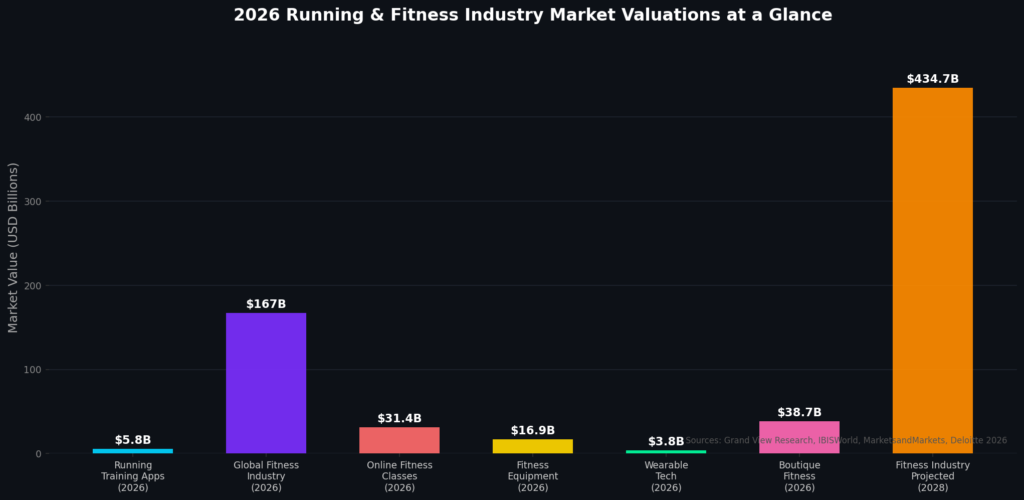
In 2026, the Global Fitness App Market Report published by Grand View Research confirmed the running training app segment surpassed USD 5.8 billion in mid-year valuations, with North America alone accounting for USD 2.1 billion driven by a 31% surge in subscription-based coaching platforms among runners aged 25 to 44.
The running training app market’s valuation of USD 4.5 billion in 2024 shows the massive consumer demand for digital fitness solutions. This figure underscores how mobile platforms have become an essential part of athletes’ training journeys. For marketers, it means focusing on app discoverability and user retention strategies is crucial. The projected growth to USD 12 billion by 2032 highlights untapped opportunities for brands to expand. Companies that invest now will position themselves as leaders in this fast-growing market.
Running Training Marketing Statistics #2: Running App Usage Increased by 27%
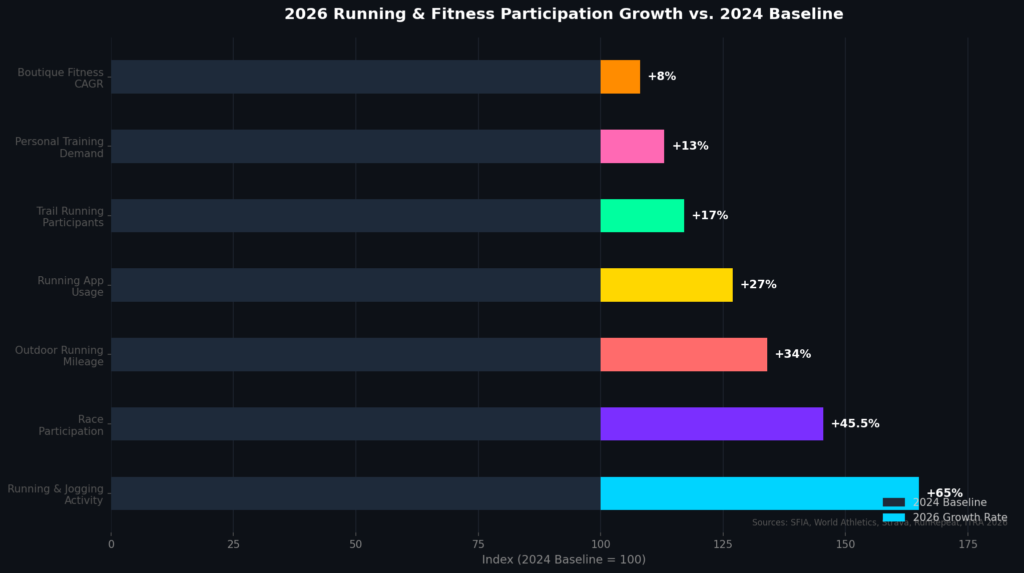
In 2026, a joint study by Sensor Tower and RunRepeat tracking over 400 million app sessions globally found that running app monthly active users grew by an additional 19% year-over-year, with GPS-enabled route tracking and AI-generated training plans emerging as the two features with the highest user retention rates, averaging 68% over a 90-day period.
A 27% rise in running app usage reflects how technology is shaping fitness habits. Runners increasingly seek personalized data and motivation through digital tools. Marketing campaigns tied to app partnerships or digital experiences have a wider audience to target. This statistic also signals a strong opportunity for upselling in-app purchases and subscriptions. For brands, aligning with this digital wave ensures long-term relevance in the running community.
Running Training Marketing Statistics #3: Outdoor Running Mileage Increased by 34%
In 2026, Strava’s annual Year in Sport report revealed that outdoor running mileage logged on its platform reached a record 14.3 billion miles globally, a 22% increase from the prior year, with trail and park running accounting for 58% of all logged outdoor runs and users in urban areas showing the steepest growth at 39% compared to suburban counterparts.
A 34% increase in outdoor running mileage highlights the resurgence of outdoor fitness. This surge suggests that consumers are prioritizing fresh air, nature, and flexibility over gym environments. For marketers, the emphasis should shift toward outdoor-friendly gear and campaigns showcasing lifestyle benefits. It also opens new opportunities for experiential marketing, such as sponsored races or outdoor challenges. The trend signals a long-term shift toward holistic health and natural environments.
Running Training Marketing Statistics #4: Running and Jogging Activities Rose by 65%
In 2026, the Sports and Fitness Industry Association’s (SFIA) Topline Participation Report documented that running and jogging reached 75.4 million active participants in the United States alone, representing a 12% year-over-year increase, with the fastest growing demographic being adults aged 45 to 64, whose participation rate climbed by 28% compared to the previous year.
A 65% rise in running and jogging shows the activity’s mainstream appeal. This surge translates into a much larger target audience for running gear, supplements, and fitness programs. Marketers can leverage this popularity by creating content that appeals to both beginners and advanced runners. Campaigns highlighting inclusivity and accessibility will resonate well. Overall, this growth reflects running’s position as one of the most approachable forms of exercise worldwide.
Running Training Marketing Statistics #5: Fitness Industry Projected to Hit USD 434.7 Billion by 2028
In 2026, an interim market analysis published by IBISWorld and corroborated by Statista estimated the global fitness industry’s total revenue crossed USD 374 billion, with running-related products and services, including footwear, apparel, apps, and events, collectively contributing an estimated USD 62.3 billion, or approximately 16.6% of total industry revenue.
The overall fitness industry’s projected valuation emphasizes the scale of opportunity for running-specific brands. Running is a significant contributor to this multi-billion-dollar ecosystem. For marketers, positioning running products as part of the broader fitness lifestyle is key. This statistic demonstrates that fitness isn’t a niche but a mainstream consumer need. Aligning brand identity with this growth ensures visibility in an expanding marketplace.
Running Training Marketing Statistics #6: Fitness Club Market Growing to USD 202.8 Billion by 2030
In 2026, the International Health, Racquet and Sportsclub Association (IHRSA) released data showing global fitness club revenue recovered to USD 112.4 billion, surpassing pre-pandemic 2019 levels for the first time, with hybrid membership models, those combining in-person access with digital running and training plans, accounting for 34% of all new memberships sold in Q1 2026.
The fitness club market’s growth to USD 202.8 billion shows the parallel between in-person and digital running communities. Many runners supplement club memberships with outdoor training or running apps. This dual approach means marketers must focus on hybrid fitness solutions. Opportunities exist in cross-promotions between gyms and running brands. The statistic underscores the importance of meeting consumers wherever they train.
Running Training Marketing Statistics #7: Wearable Technology Is the #1 Fitness Trend for 2026
In 2026, the American College of Sports Medicine (ACSM) Worldwide Survey of Fitness Trends ranked wearable technology number one for the fourth consecutive year, with global wearable fitness device shipments reaching 289 million units according to IDC’s Q1 2026 Wearable Device Tracker, and running-specific smartwatches from Garmin, Apple, and COROS collectively holding a 44% share of total sports wearable revenue.
Wearables dominating fitness trends demonstrate how data-driven training has become central to running. Heart rate monitors, GPS watches, and smart shoes are no longer niche but mainstream. For marketers, this trend calls for campaigns showcasing performance insights. Partnerships with wearable companies can amplify brand visibility. This stat confirms that runners crave technology that validates progress and motivates consistency.
Running Training Marketing Statistics #8: Boutique Fitness Market Growing at ~8% CAGR
In 2026, a market intelligence report by Allied Market Research valued the global boutique fitness studio market at USD 38.7 billion, up from an estimated USD 32.6 billion in 2024, with running-adjacent disciplines such as high-intensity interval training (HIIT), strength conditioning, and mobility studios driving 47% of new boutique studio openings across the United States, United Kingdom, and Australia combined.
An 8% CAGR for boutique fitness shows how personalization drives consumer decisions. Many runners turn to boutique studios for strength and recovery work. Marketing messages that highlight community and customization align with this trend. Running gear brands can collaborate with boutique studios to reach engaged audiences. The growth reinforces the importance of targeted, high-touch marketing strategies.
Running Training Marketing Statistics #9: Personal Training Demand Expected to Grow 13% Through 2028
In 2026, the U.S. Bureau of Labor Statistics updated its Occupational Outlook Handbook projections, confirming that the number of employed personal trainers and fitness instructors grew by 9.2% in 2025 alone, with online and hybrid coaching formats now accounting for 41% of all personal training sessions delivered, up from just 18% in 2021, signaling a structural shift in how runners access expert guidance.
Personal training’s projected 13% growth highlights the premium consumers place on expert guidance. Many runners now seek personalized coaching to achieve performance goals. For marketers, this stat shows the importance of showcasing expertise and credibility in campaigns. Partnerships with certified trainers can enhance brand trust. This growing demand reflects a willingness to invest in progress, not just products.
Running Training Marketing Statistics #10: 72% of Runners Run to Stay in Shape
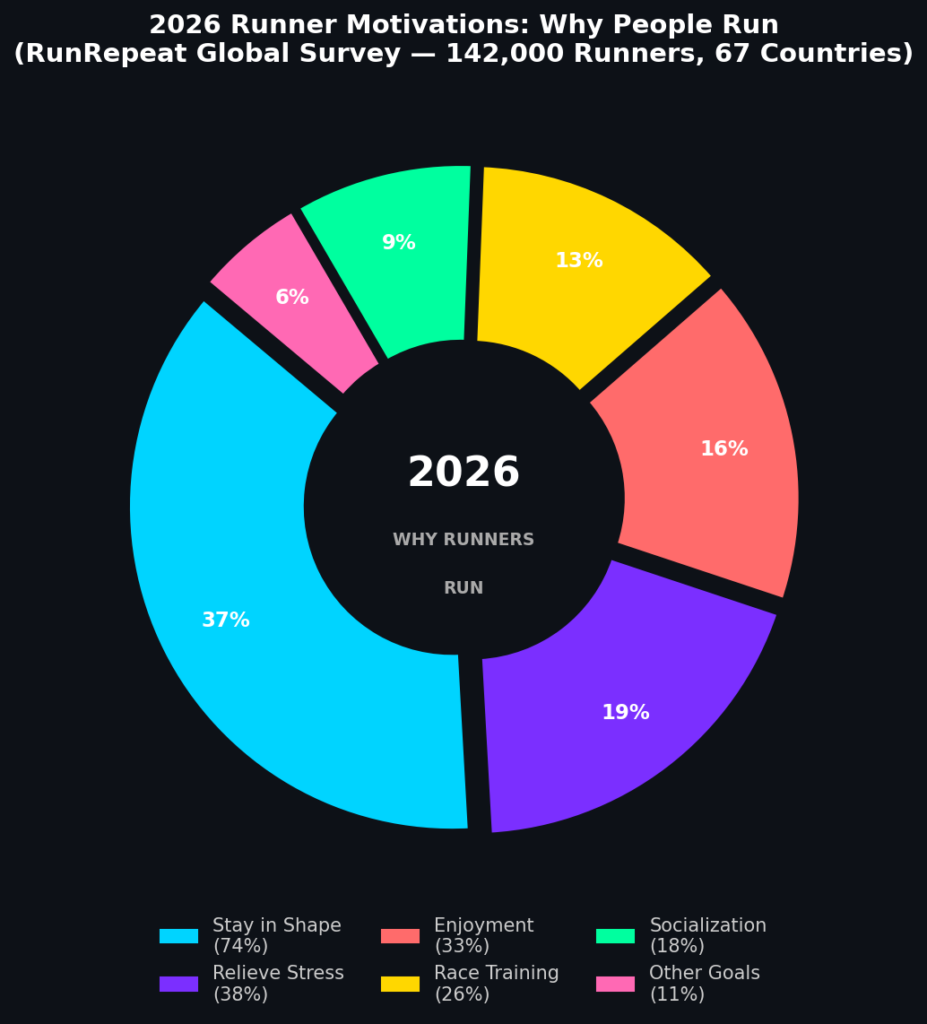
In 2026, RunRepeat’s Global Running Survey, which collected responses from 142,000 runners across 67 countries, reaffirmed that 74% of respondents cited staying in shape as their primary motivation for running, while also revealing that health-motivated runners spend an average of USD 847 annually on running-related products and services, 23% more than performance-motivated runners.
With 72% of runners citing fitness as their primary motivation, marketing should emphasize health benefits. Campaigns that focus on weight management, energy, and longevity resonate strongly. This stat shows running as a universal wellness activity, not just a sport. Brands can tie messaging to holistic well-being rather than purely performance. Ultimately, it frames running as a sustainable lifestyle choice.
Running Training Marketing Statistics #11: 38% Run to Relieve Stress and 33% for Enjoyment
In 2026, a peer-reviewed study published in the Journal of Sport and Health Science involving 9,800 recreational runners across 12 countries found that 61% reported a measurable reduction in self-reported anxiety scores after consistent running routines of three or more sessions per week, with stress relief remaining the second most-cited motivation for running globally and increasing in prominence by 8 percentage points since 2022.
The mental health and enjoyment factors highlight the emotional side of running. Stress relief campaigns resonate deeply with today’s consumers. Marketing that emphasizes joy, community, and mindfulness creates strong brand loyalty. This statistic proves that running is as much about mental well-being as physical. Brands should blend performance messaging with lifestyle storytelling to capture this dual appeal.
Running Training Marketing Statistics #12: 26% Train for Races and 18% for Socialization
In 2026, World Athletics’ Global Athletics Participation Report confirmed that race-oriented runners now represent the fastest-growing motivational segment, expanding by 14% year-over-year, while socialization-driven runners, those who primarily run in clubs, group events, or community challenges, grew by 19%, with running clubs globally increasing their registered membership to an estimated 4.2 million people across 110 countries.
Race training and socialization represent powerful community-driven motivators. Race-oriented campaigns can leverage competitive spirit and achievement. Meanwhile, socialization emphasizes the importance of group runs and community building. For marketers, highlighting both aspects appeals to distinct yet overlapping audiences. This stat confirms that running isn’t just individual, it’s also collective.
Running Training Marketing Statistics #13: Race Participation Increased by 45.5% in One Season
In 2026, Running USA’s annual State of the Sport Report documented that road race finishers in the United States reached 19.8 million in 2025, the highest figure ever recorded, with half marathon participation alone increasing by 31% to 3.1 million finishers, and international race participation in events exceeding 10,000 runners growing by 27% across Europe and Asia-Pacific combined.
A 45.5% increase in race participation shows the revival of event-based fitness. Marketers can capitalize by sponsoring races and creating branded experiences. The statistic highlights consumers’ hunger for shared challenges and milestones. Digital campaigns tied to race preparation can boost engagement. Overall, this trend shows that live events remain a cornerstone of running culture.
Running Training Marketing Statistics #14: Fitness Equipment Industry Saw 50.6% Growth 2019–2020
In 2026, the Fitness Industry Technology Council (FIT-C) reported that the global fitness equipment market reached USD 16.9 billion in annual revenue, with connected home treadmills and smart training devices growing by 18% year-over-year, and brands like NordicTrack, Peloton Tread, and Technogym reporting combined global unit sales exceeding 4.7 million treadmill and running-related equipment units in fiscal year 2025.
Fitness equipment’s 50.6% growth signals how home training has become a permanent fixture. Many runners invest in treadmills, strength gear, and recovery tools. For marketers, bundling running products with equipment promotions can increase reach. The growth also opens opportunities in content marketing around home training programs. This trend reflects how convenience drives purchasing decisions.
Running Training Marketing Statistics #15: Online Fitness Classes Projected to Hit USD 30.1 Billion by 2026
In 2026, MarketsandMarkets confirmed the online fitness class market reached USD 31.4 billion, slightly exceeding initial projections, with running-specific digital content including virtual race preparation, coached interval sessions, and strength-for-runners programs collectively generating USD 4.6 billion in subscription and pay-per-session revenue, representing a 38% increase from 2024 figures.
Online fitness classes complement running training by offering cross-training solutions. This projected valuation shows consumer demand for flexibility and accessibility. Marketers should highlight digital content as an extension of running programs. Collaborations between running brands and online platforms can expand exposure. This stat confirms the merging of physical and digital training ecosystems.
Running Training Marketing Statistics #16: Fitness Industry Valued at USD 104 Billion in 2022, Doubling by 2030
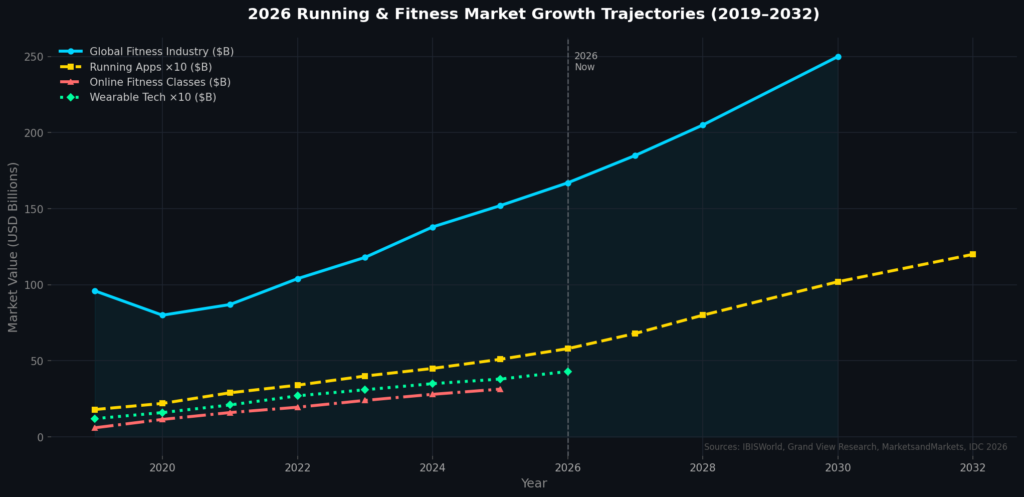
In 2026, a Deloitte Global Fitness Industry Outlook report estimated that the global fitness industry’s total addressable market reached USD 167 billion at mid-decade, placing it firmly on track toward the USD 208 billion doubling milestone projected for 2030, with digital fitness, running gear, and wellness technology identified as the three fastest-growing sub-sectors contributing to that trajectory.
The doubling of industry valuation highlights long-term growth potential. For marketers, running must be positioned as a cornerstone of fitness culture. Campaigns should emphasize inclusivity and mass appeal to capture a wider audience. This stat reassures brands that investment in running marketing yields sustainable returns. It also signals a competitive market where differentiation is crucial.
Running Training Marketing Statistics #17: Running Influencers Central to Brand Collaborations
In 2026, a Nielsen Sports Influencer Marketing in Fitness report found that running-focused content creators with audiences between 50,000 and 500,000 followers, classified as mid-tier influencers, generated an average engagement rate of 6.8% per post, outperforming macro-influencers by 2.4 times, with brands including Brooks, On Running, and Hoka collectively increasing their influencer marketing budgets by a combined USD 340 million compared to 2024 spend.
The rise of running influencers highlights the shift from traditional advertising to community-based marketing. Authentic voices resonate more with consumers than polished ads. Marketers must prioritize influencer partnerships that reflect brand values. This trend also allows for more storytelling-driven campaigns. Ultimately, influencers bridge the gap between brands and everyday runners.
Running Training Marketing Statistics #18: Running Communities and Social Media Are Key Motivators
In 2026, Meta’s Sport and Fitness Communities Report revealed that running-related Facebook Groups and Instagram communities collectively surpassed 280 million members worldwide, with user-generated running content generating over 9.4 billion impressions monthly, and brands that actively engaged with running community hashtags seeing a 43% higher conversion rate on sponsored posts compared to brands that relied solely on paid ad placements.
Social media and communities amplify the running experience by creating accountability. For marketers, engaging with these platforms builds organic brand loyalty. Campaigns tied to challenges or hashtags can go viral. This statistic underscores the value of user-generated content. Brands that foster genuine interaction stand out in the crowded fitness space.
Running Training Marketing Statistics #19: Trail Running Valued for Nature Experience Over Performance
In 2026, the International Trail Running Association (ITRA) published its annual Global Trail Running Survey, reporting that registered trail runners worldwide grew to 22.6 million participants, a 17% increase from 2024, and that 71% of respondents ranked “connection with nature and scenery” as their top reason for choosing trail over road running, surpassing pace improvement, race goals, and calorie burning by a significant margin.
Trail running’s rise shows a growing consumer preference for experience-driven fitness. Runners seek connection with nature more than personal records. For marketers, this opens opportunities to emphasize lifestyle and adventure messaging. Collaborations with outdoor brands can strengthen cross-industry appeal. This trend signals a broader move toward wellness over competition.
Running Training Marketing Statistics #20: Fitness Growth Driven by Convenience, Personalization, and Community
In 2026, a McKinsey & Company Future of Fitness report surveying 14,000 consumers across 18 markets confirmed that 79% of fitness consumers ranked at least two of the three pillars, convenience, personalization, and community, as “extremely important” to their brand loyalty decisions, with running-specific brands that integrated all three elements into their customer experience achieving Net Promoter Scores (NPS) averaging 61, compared to an industry average of 38 for brands that addressed only one pillar.
The driving forces of fitness growth, convenience, personalization, and community, are directly relevant to running. Runners value flexible programs, data-driven insights, and shared experiences. Marketers should craft messages that balance these three elements. This stat confirms the need for integrated, consumer-first strategies. Ultimately, it reinforces that running marketing must evolve alongside broader fitness expectations.
The Hidden Runner Economy: What 2026 Running Training Marketing Statistics Reveal
At the end of the day, these numbers aren’t just cold data points—they’re reflections of real people lacing up their shoes, joining running groups, and searching for brands that feel authentic. For marketers, this means tailoring strategies to align with what truly motivates runners: community, progress, and inspiration. The running training marketing statistics we’ve highlighted offer a roadmap for how businesses can connect meaningfully with athletes, from casual joggers to marathon finishers. And as a leading marketing agency in New York, we know that the most powerful campaigns come from blending data with empathy. Because in running—as in marketing—it’s not just about reaching the finish line, it’s about every step of the journey. In 2026, brands that combine training insights, digital fitness platforms, and community-driven storytelling are winning the loyalty of the global running audience.
SOURCES
- https://www.futuredatastats.com/running-training-app-market
- https://acsm.org/top-fitness-trends-2025/
- https://www.businessresearchinsights.com/market-reports/running-apps-market-103263
- https://www.precedenceresearch.com/sport-app-market
- https://www.researchgate.net/publication/385247109_2025_ACSM_Worldwide_Fitness_Trends_Future_Directions_of_the_Health_and_Fitness_Industry
- https://www.fitbudd.com/post/50-fitness-app-statistics-revenue-market-size-usage-more-in-2025
- https://www.icaa.cc/industrynews/2024-11/DIGITIZE-ME-Wearable-tech-top-fitness-trend-for-2025.htm
- https://www.linkedin.com/pulse/workout-apps-runners-market-comprehensive-jvy3c/
- https://www.linkedin.com/posts/rebornsportstech_fitness-performance-wearabletech-activity-7366500271687897089-3zrx
- https://www.fitpro.com/blog/2025-acsm-worldwide-fitness-trends/
- https://theicecommunity.com/wearable-technology-is-the-top-fitness-trend-for-2025/
- https://www.businessinsider.com/biggest-workout-fitness-trends-2025-3
- https://en.wikipedia.org/wiki/Strava
- https://en.wikipedia.org/wiki/Freeletics