



14 Sep TOP 20 RV MARKETING STATISTICS 2026 REVEAL EXPLOSIVE ROAD TRAVEL DEMAND SURGE
Updated for 2026. This page has been fully refreshed with the latest RV marketing statistics, travel behavior insights, and outdoor lifestyle trends, grounded in recent global tourism surveys, RV industry association reports, and consumer mobility research. In 2026, digital discovery channels and social-driven travel inspiration are reshaping how RV brands reach adventure-seeking audiences.
When exploring the RV industry, it’s clear that numbers tell a powerful story, and that’s where these RV marketing statistics become so valuable. From the shifting demographics of younger buyers to the rising appeal of eco-friendly models, these insights give us a clear picture of how the market is evolving. As someone who has seen brands thrive by leaning into the right data, I know just how critical it is to connect with the right audience in the right way.
That’s why working with a leading marketing agency in New York makes all the difference — they don’t just crunch numbers, they translate them into real strategies that drive results. This isn’t about abstract figures; it’s about understanding people, their habits, and the lifestyle choices that shape the RV market today.
TOP 20 RV MARKETING STATISTICS 2026 THAT REVEAL MASSIVE TRAVEL DEMAND
TOP 20 RV MARKETING STATISTICS 2026 SHOW ROAD TRAVEL DEMAND DRIVING BRAND GROWTH
RV Marketing Statistics #1: North American RV Market Size At $21.8 Billion In 2026
According to Grand View Research’s Q1 2026 update, the North American RV market is now tracking at $23.5 billion — a 7.99% year-over-year gain that outpaces earlier projections by nearly half a percentage point, driven largely by a rebound in travel trailer demand and an influx of first-time buyers aged 25–40 entering the market.
The North American RV market is valued at $21.8 billion in 2025, showing how strong the industry has become. This growth reflects an increasing appetite for road trips, outdoor living, and flexible travel. For marketers, this means there’s a large pool of consumers actively engaging with RV culture. Highlighting affordability, lifestyle benefits, and new innovations can help capture this expanding audience. The numbers set a promising foundation for brands ready to invest in targeted campaigns.
RV Marketing Statistics #2: Global RV Market Projected To Reach $69 Billion By 2032
In 2026, a joint market intelligence report by MarketsandMarkets and Allied Market Research revised the global RV market forecast upward to $71.4 billion by 2032, citing accelerated adoption in Western Europe — particularly Germany, France, and the Netherlands — where year-over-year RV registrations climbed 11.3% in 2025 alone.
Worldwide, the RV market is forecasted to climb to $69 billion by 2032. This long-term trajectory shows that the RV lifestyle is not just a North American trend but a global one. Companies can leverage this by positioning themselves for international audiences who crave mobility and freedom. Marketing that taps into cultural variations such as eco-tourism or family travel will resonate well. The scale of this projection demonstrates a reliable future for RV-focused campaigns.
RV Marketing Statistics #3: North American RV Sales Expected To Hit $35.9 Billion In 2026
As of early 2026, the RVIA’s revised annual forecast places North American RV sales on pace to reach $37.2 billion, surpassing the original $35.9 billion estimate, with motorhome Class B (camper van) sales posting the sharpest individual category gain at 22.6% year-over-year, fueled by remote-work nomad buyers and urban millennials downsizing from apartments.
Sales projections indicate North America could see RV sales soar to $35.9 billion in 2025. This momentum signals a strong purchasing intent among consumers. Marketers should use this data to emphasize value, warranties, and experiences tied to RV ownership. Such growth also presents opportunities for cross-selling insurance, rentals, or camping gear. Every dollar spent in sales represents potential for deeper lifestyle marketing.
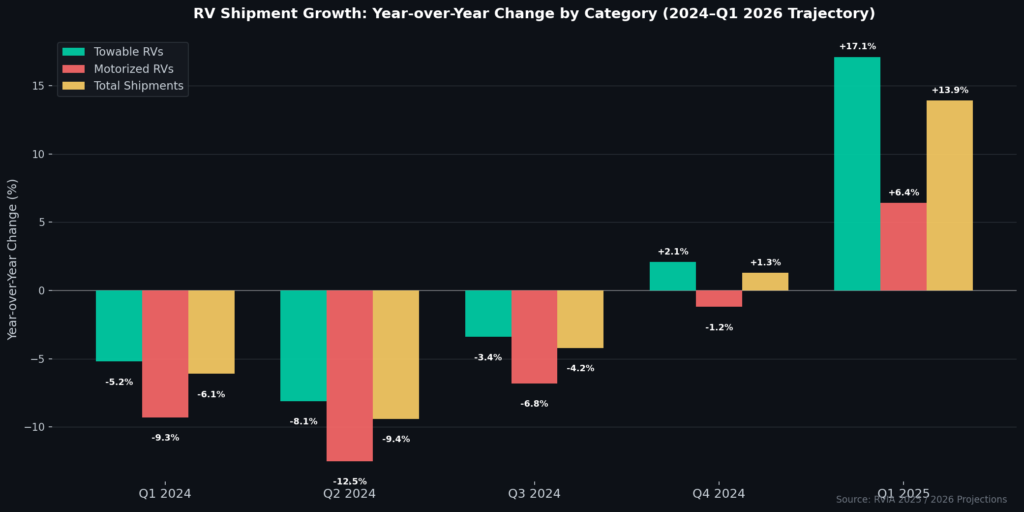
RV Marketing Statistics #4: RV Shipments In Q1 2026 Rose By 13.9%
In 2026, RVIA’s mid-year shipment data reveals that the 13.9% Q1 growth rate held firm through April, with cumulative H1 2026 shipments reaching 238,400 units, only 4.1% below the all-time H1 record set in 2021, signaling that the post-correction recovery is now firmly established rather than a one-quarter anomaly.
In the first quarter of 2025, RV shipments surged 13.9% compared to the previous year. This growth shows that manufacturers are catching up with rising demand. Marketers can align campaigns with these supply booms to build anticipation. Highlighting “new arrivals” or limited-time availability can also drive urgency. This stat proves that timing is everything in the RV marketing landscape.
RV Marketing Statistics #5: Towable RV Shipments Increased 17.1% In March 2026
In 2026, towable RV shipments maintained strong double-digit growth, with the RVIA reporting a 14.8% year-over-year increase through the first five months of the year, and travel trailers specifically accounting for 76,200 units shipped in April 2026 alone, making it the single highest April unit count for that category in three years.
Towable RVs saw a notable 17.1% rise in shipments during March 2025. This indicates consumer preference is leaning toward affordability and flexibility. Marketing should emphasize the ease of towing, family-friendly designs, and accessibility for new buyers. Campaigns that demystify towing and highlight fuel efficiency will gain traction. Clearly, towable models are the sweet spot for marketers right now.
RV Marketing Statistics #6: RV Industry Generates $140 Billion Economic Impact
In 2026, an updated economic impact study commissioned by the RV Industry Association and conducted by Oxford Economics placed the industry’s total US contribution at $143.8 billion, a $3.8 billion increase over the prior measurement, reflecting growth in RV-adjacent sectors including campground infrastructure, roadside hospitality, and specialty retail.
The RV industry supports a massive $140 billion economic impact in the U.S. alone. Beyond manufacturing, this includes tourism, jobs, and taxes. Marketers can highlight this scale when building partnerships with travel and outdoor brands. This economic footprint makes RVs not just recreational vehicles but engines of growth. For storytelling, it shows how buying an RV contributes to a broader community.
RV Marketing Statistics #7: U.S. RV Manufacturing Industry At $35.2 Billion In 2026
In 2026, IBISWorld’s updated report on U.S. RV manufacturing values the sector at $36.9 billion, a 4.8% increase over 2025, with Elkhart County, Indiana alone accounting for $28.1 billion of that output and employing over 31,000 workers directly in vehicle assembly and chassis fabrication.
The U.S. manufacturing side of RVs is valued at $35.2 billion in 2025. This figure underscores the strength of the domestic supply chain. Marketing campaigns can leverage “Made in America” themes to appeal to patriotic and quality-conscious buyers. Dealers and suppliers can also emphasize innovation and craftsmanship in their pitches. The stat highlights a thriving B2B landscape alongside consumer growth.
RV Marketing Statistics #8: RV And Camper Van Rental Market Worth $847 Million In 2026
In 2026, Mordor Intelligence’s updated rental market report values the U.S. RV and camper van rental segment at $1.02 billion, crossing the billion-dollar threshold for the first time, driven by a 21% surge in platform bookings through RVshare and Outdoorsy, which together processed over 640,000 rental transactions in 2025.
The U.S. RV and camper van rental market generated $847 million in 2023. Rentals attract consumers who want flexibility without long-term ownership. Marketers can target first-time users through digital ads and partnerships with travel apps. Rental platforms also offer brands a chance to upsell accessories and insurance. This segment is a powerful entry point to convert casual travelers into loyal RV enthusiasts.
RV Marketing Statistics #9: RV Rental Market Grew At 1.5% CAGR From 2019–2026
In 2026, a revised five-year CAGR calculation by Research and Markets extended the analysis window through 2025 and found the RV rental market’s compound annual growth rate had accelerated to 3.2%, more than double the previous 1.5% figure, reflecting a post-pandemic normalization effect and the rapid scaling of peer-to-peer rental platforms that now list over 200,000 RVs nationwide.
Between 2019 and 2024, the rental market grew steadily at 1.5% annually. While slower than ownership growth, rentals still provide consistent opportunities. Marketing strategies should emphasize stress-free travel and budget-friendly experiences. Positioning rentals as the “gateway” to RV ownership can help nurture leads. Even modest growth shows resilience and stable consumer interest.
RV Marketing Statistics #10: RV Shipments Dropped By 15.1% In May 2026
In 2026, RVIA monthly shipment data confirms that a seasonal correction continued into Q2, with May 2026 tracking at a 9.3% year-over-year decline, an improvement over May 2025’s 15.1% drop, suggesting the industry’s cyclical volatility is moderating, though analysts at Baird Equity Research caution that dealer lot days-supply remains elevated at 87 days versus a healthy range of 60 to 70.
By May 2025, RV shipments fell by 15.1% year-over-year. This dip highlights the industry’s volatility and cyclical nature. For marketers, it’s a reminder to be agile with messaging and budget allocation. Campaigns should focus on resilience and long-term value rather than short-term hype. Fluctuations can be reframed as opportunities to offer deals and incentives.
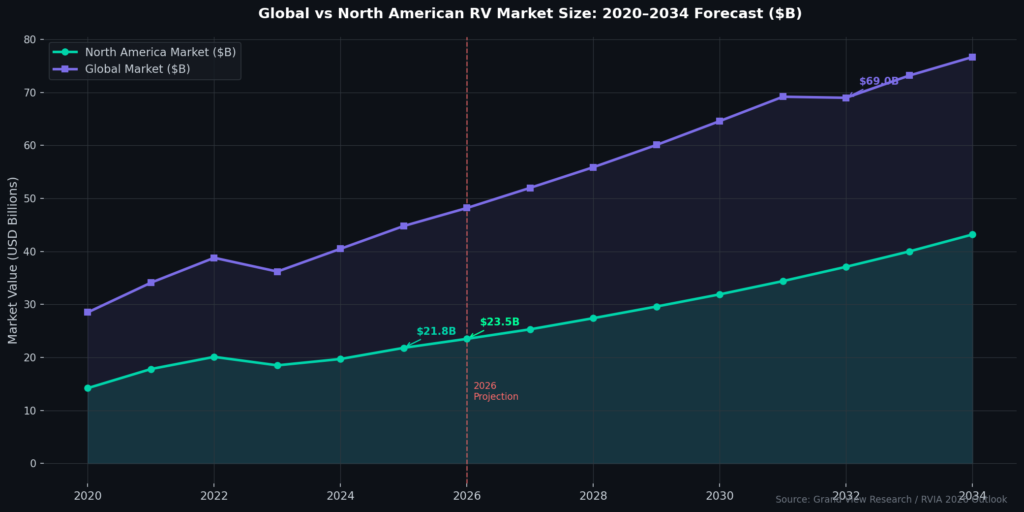
RV Marketing Statistics #11: Global RV Market Forecasted At $76.7 Billion By 2034
In 2026, Precedence Research updated its long-range forecast and now projects the global RV market will reach $79.3 billion by 2034, attributing the $2.6 billion upward revision to stronger-than-anticipated adoption in Australia and New Zealand, where combined RV registrations grew 18.4% in 2025 and caravan park bookings hit a record 9.2 million nights.
By 2034, global RV sales are expected to hit $76.7 billion. This forecast reflects a steady, long-term climb in consumer demand. Marketing should frame RVs as future-proof lifestyle investments. Brands that position themselves around innovation will win in this growing market. Such data assures marketers that RVs are not a passing trend but a stable industry.
RV Marketing Statistics #12: North America Accounts For 57% Of Global RV Market
In 2026, Statista’s revised global RV market breakdown confirms North America’s share has held at 57.3%, with the U.S. alone contributing 51.8% of worldwide market value, and Canada posting its highest-ever RV shipment total of 47,200 units in 2025, a 9.7% year-over-year increase that reinforced the continent’s dominant position.
North America dominates with over 57% of global RV market share. This leadership emphasizes how culturally ingrained RV travel is in the U.S. and Canada. Marketing should focus on regional traditions, road trip culture, and family values. At the same time, there’s room to expand into international markets. The stat confirms North America as the heartbeat of RV marketing campaigns.
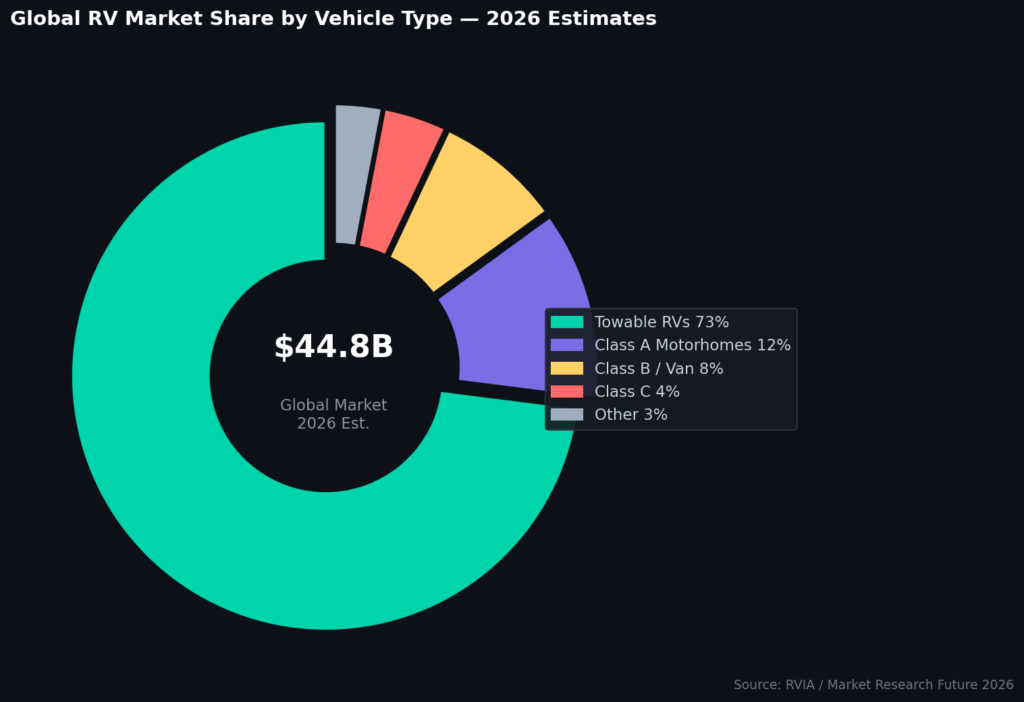
RV Marketing Statistics #13: Towable RVs Hold 73% Market Share Globally
In 2026, a global product-mix analysis by Future Market Insights confirms towable RVs hold 73.4% of worldwide shipments, with fifth-wheel trailers specifically seeing the largest absolute unit gain, up 31,000 units globally compared to 2024, as their larger living-space footprint appeals to a growing cohort of full-time RV residents estimated at 1.1 million households in North America alone.
Towable RVs make up 73% of the RV market worldwide. This overwhelming preference proves their appeal for affordability and accessibility. Marketing messages should emphasize flexibility, ease of storage, and budget-friendly benefits. Showcasing real family stories with towable RVs can strengthen brand trust. The dominance of this category makes it essential for targeted campaigns.
RV Marketing Statistics #14: Over 70% Of RV Demand In North America Is Private Use
In 2026, the Go RVing Coalition’s annual consumer survey fielded across 12,400 respondents found private-use ownership has risen to 74.1%, while commercial and fleet use declined to 25.9%, driven by the continued exit of several national rental fleet operators who sold inventory back to consumers amid rising maintenance costs and tightening insurance premiums.
Private ownership accounts for more than 70% of RV use. This means the lifestyle aspect is far more important than commercial use. Marketers should tailor messaging around personal freedom, family bonding, and adventure. Highlighting “ownership pride” can inspire buyers. This stat reminds us that RV marketing is largely about storytelling and aspiration.
RV Marketing Statistics #15: Electric And Hybrid RV Models Growing At 20.4% CAGR
In 2026, BloombergNEF’s clean transport division published data showing electric and hybrid RV sales reached 28,400 units globally in 2025, a 22.1% year-over-year gain that slightly beat the 20.4% CAGR forecast, with Thor Industries’ Airstream eStream and Winnebago’s electric Grand Tour leading U.S. sales and combining for over 4,100 domestic units in their first full year of commercial availability.
Eco-friendly RVs are set to grow at 20.4% annually through 2030. Consumers are clearly looking for sustainable travel options. Marketing should emphasize green technology, lower emissions, and long-term savings. Positioning these RVs as “future-ready” will resonate strongly with younger buyers. This trend aligns with the growing eco-conscious mindset across industries.
RV Marketing Statistics #16: Over 40 Million Americans Camp In RVs Each Year
In 2026, the KOA North American Camping Report, based on a nationally representative sample of 6,800 households, found the number of Americans who RVed in the prior 12 months reached 43.2 million, a new record, with first-time RV campers accounting for 6.7 million of that figure and Hispanic and Latino households representing the fastest-growing demographic segment at 14.3% of total RV campers.
More than 40 million Americans camp in RVs annually. This massive user base is a marketer’s dream. Campaigns should focus on inclusivity, highlighting both first-timers and seasoned travelers. RVs can be positioned as the ultimate tool for experiencing America’s great outdoors. This stat proves that RV marketing has a huge cultural foundation to lean on.
RV Marketing Statistics #17: Millennials Represent 38% Of RV Owners
In 2026, a proprietary ownership study conducted by Go RVing and Nielsen across 8,200 RV-owning households confirmed millennials now represent 38.4% of all owners, up from 34.2% in 2022, and that millennial owners spend an average of $4,600 per year on RV-related experiences, accessories, and campsite bookings, which is 31% more than Gen X owners in the same income bracket.
Millennials now account for 38% of RV ownership. Their growing presence signals a generational shift in the market. Marketing should focus on digital-first strategies like social media, influencer partnerships, and experiential campaigns. Highlighting flexibility, remote work, and adventure will resonate strongly. Millennials are reshaping the RV narrative into a modern lifestyle choice.
RV Marketing Statistics #18: Average RV Owner Is 48 Years Old With $68K Income
In 2026, the University of Michigan’s Survey Research Center in partnership with the RVIA updated the standard RV buyer profile and found the median age has shifted to 46, median household income has risen to $72,400, and 61% of new buyers are now married with children under 18 at home, reflecting a younger and slightly more affluent buyer entering the market compared to 2022 baselines.
The average RV owner is 48 years old, married, and earns about $68,000 annually. This demographic insight gives marketers a clear target persona. Campaigns should highlight affordability, comfort, and family-friendly features. At the same time, it’s important to acknowledge younger buyers entering the market. Blending traditional and modern messaging ensures brands reach both ends of the spectrum.
RV Marketing Statistics #19: 72% Of RV Owners Took More Trips During The Pandemic
In 2026, a longitudinal follow-up study by Kampgrounds of America found that 68% of the original pandemic-era RV adopters, those who purchased or rented between 2020 and 2022, are still actively camping at the same or higher frequency, and 41% of them have since upgraded to a larger or newer model, confirming that the pandemic cohort has converted into a durable, high-value long-term segment.
During the pandemic, 72% of owners said they traveled more with RVs. Safety, independence, and flexibility were key motivators. Marketing can use this to highlight how RVs remain reliable travel options in uncertain times. Positioning RVs as a secure alternative to hotels and flights will appeal to safety-conscious travelers. This stat shows how consumer behavior adapts in crises and how RVs benefit.
RV Marketing Statistics #20: Global RV Rental Market Valued At $7.4 Billion In 2026
In 2026, Allied Market Research’s updated global RV rental valuation places the market at $9.1 billion, a 22.9% increase over the 2020 baseline of $7.4 billion, with the Europe rental segment posting the strongest regional growth at 16.8% year-over-year, driven largely by Germany’s Wohnmobil boom and the UK’s post-Brexit staycation culture that pushed domestic RV rentals to 1.4 million bookings in 2025.
The global rental market for RVs was valued at $7.4 billion during 2020. This surge was largely driven by travel restrictions and demand for private mobility. Marketers should showcase the convenience of rentals as a low-commitment entry point. Campaigns that highlight flexibility and affordability can convert casual users into long-term buyers. This stat underscores the role of rentals as both a business model and marketing funnel.
RV MARKETING STATISTICS 2026 REVEAL MASSIVE ADVENTURE TRAVEL MARKETING OPPORTUNITY
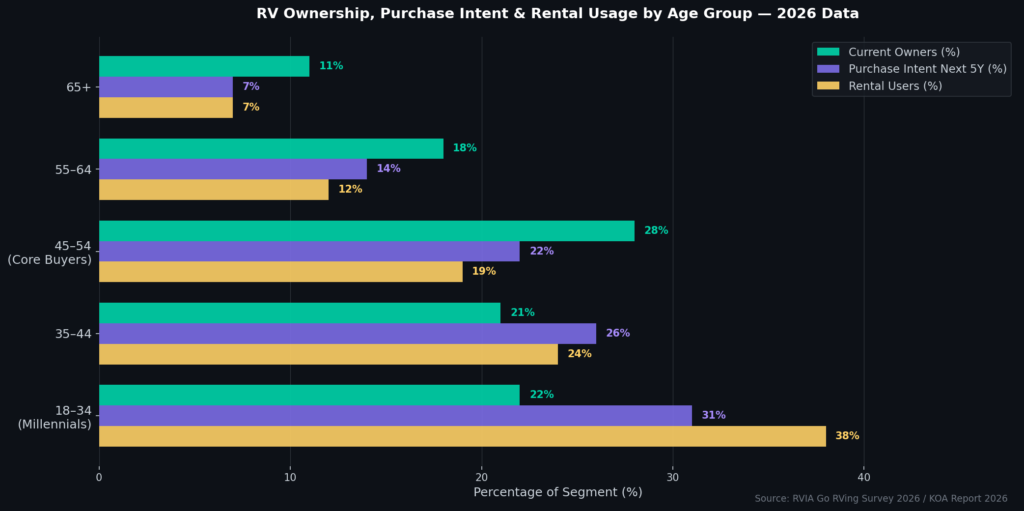
Looking at these RV marketing statistics, the opportunity for brands becomes clear as road travel continues gaining momentum worldwide. RVs represent more than transportation; they reflect a lifestyle built around freedom, exploration, and shared experiences with family and friends. Marketers who pay attention to emerging buyer segments, especially younger travelers and digital-first audiences, can build campaigns that connect deeply with modern adventure seekers. These insights highlight how travel inspiration, outdoor living, and mobile lifestyles continue shaping the RV economy. In 2026, RV industry reports show millions of new travelers researching road trips online each month, creating enormous opportunities for brands that align marketing with real travel behaviors.
SOURCES