



18 Sep TOP 20 SAAS MARKETING STATISTICS 2025
When I first started diving deep into SaaS marketing statistics, I realized just how quickly the digital landscape is shifting for software companies everywhere. The numbers don’t just highlight growth—they tell stories of businesses reshaping how they connect with customers, optimize revenue, and leverage new technologies like AI. As someone who follows these trends closely, I find it inspiring to see how marketing strategies evolve alongside customer expectations. Working with a leading marketing agency in New York, I’ve seen firsthand how vital it is to stay aligned with these insights, because every stat reveals a new opportunity to adapt, refine, and get ahead of the competition.
Top 20 SaaS Marketing Statistics 2025 (Editor’s Choice)
🚀 Top 20 SaaS Marketing Statistics
Essential Data-Driven Insights for 2024-2025
| Category | Key Statistic | Business Impact |
|---|---|---|
Market Growth |
SaaS market to reach $716.52B by 2028 | Massive growth opportunity with 27.5% CAGR - the industry shows no signs of slowing |
Market Growth |
2025 revenue projected at $390.60B | Immediate market size indicates strong demand and investment opportunities |
Market Growth |
Marketing SaaS: $69.65B → $280.67B by 2033 | Marketing tools specifically growing at 15.5% CAGR - huge automation demand |
Adoption |
99% of companies will use SaaS by end of 2024 | Near-universal adoption makes SaaS essential, not optional for business operations |
Adoption |
SaaS makes up 70% of corporate software | Cloud-first approach dominates enterprise software decisions |
Adoption |
Organizations use 112 SaaS tools on average | Tool sprawl creates integration challenges but shows deep SaaS penetration |
Adoption |
Large enterprises use 447 SaaS apps average | Enterprise complexity drives massive SaaS adoption and management needs |
Investment |
Content marketing: $342K - $1.09M annually | Significant investment shows content's critical role in SaaS customer acquisition |
Investment |
75% of revenue on sales & marketing (first 3 years) | Early-stage SaaS requires massive marketing investment for growth |
Investment |
15% of annual budget invested in marketing | Mature SaaS companies maintain substantial marketing investment for growth |
Acquisition Cost |
Average CAC: $702 | Industry benchmark for customer acquisition investment and ROI planning |
Acquisition Cost |
CAC increased by 180% | Rising competition makes customer acquisition significantly more expensive |
Acquisition Cost |
Payback period extended 150% | Takes much longer to recover acquisition investments, impacting cash flow |
Content Performance |
Content marketing drives 400% lead growth | Quality content strategy delivers exceptional ROI for SaaS companies |
Content Performance |
98% have blogs, 42% update existing content | Blogging is universal, but content optimization is competitive advantage |
Content Performance |
Blogs generate 434% more indexed pages | Content marketing dramatically improves search visibility and organic reach |
Content Performance |
SEO brings 14.3% of leads from organic search | Organic search remains crucial channel for cost-effective lead generation |
Sales Cycle |
B2B sales cycle: 134 days (vs 107 in 2022) | Longer decision cycles require sustained nurturing and patient sales strategies |
Sales Cycle |
80% of B2B sales will be fully online by 2025 | Digital-first sales process demands strong online presence and automation |
Challenges |
37% struggle with consistent visual content | Content creation remains top challenge despite proven ROI benefits |
Top 20 SaaS Marketing Statistics 2025
SaaS Marketing Statistics #1: Global SaaS Market To Reach $300 Billion By 2025
The global SaaS market is projected to hit nearly $300 billion by the end of 2025, showing just how strong demand has become. This rapid growth is driven by cloud adoption, subscription models, and the need for flexible digital solutions. For marketers, it highlights a competitive but opportunity-rich environment. The figure also underscores the shift away from traditional software models toward scalable, recurring revenue streams. Businesses that embrace this change now position themselves to capture long-term customer loyalty.
SaaS Marketing Statistics #2: SaaS Market Projected To Hit $793.1 Billion By 2029
Looking further ahead, SaaS is expected to nearly triple in value, reaching $793.1 billion by 2029. This makes it one of the fastest-growing segments in the digital economy. Such growth emphasizes the importance of marketing strategies that can scale globally. Companies that invest in brand visibility and retention strategies now will benefit most. The statistic shows the future potential of SaaS remains incredibly strong.
SaaS Marketing Statistics #3: India’s SaaS Market Forecast To Reach $9.22 Billion By 2029
India’s SaaS ecosystem is booming, with projections estimating a $9.22 billion market size by 2029. This reflects both rising domestic demand and India’s role as a global SaaS exporter. For marketers, localized campaigns tailored to Indian businesses and consumers are crucial. The growth also positions India as a leading hub for SaaS innovation. This makes India a key focus market for global SaaS brands looking to expand.
SaaS Marketing Statistics #4: Over 30,800 SaaS Companies Globally
As of 2025, there are more than 30,800 SaaS companies worldwide. This number shows just how crowded the SaaS market has become. Marketers face the challenge of differentiation in a saturated space. Strong positioning, storytelling, and clear value propositions are critical. This statistic reminds us that competition is fierce, but opportunities still abound.
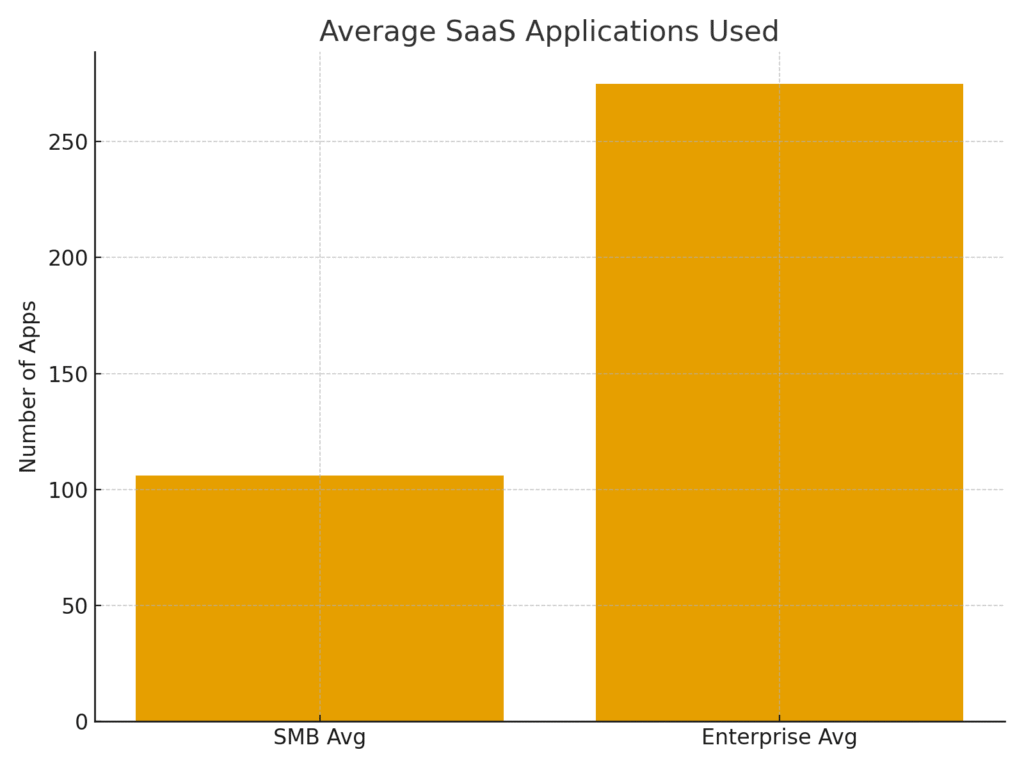
SaaS Marketing Statistics #5: Companies Use An Average Of 106 SaaS Apps
The average company now relies on 106 SaaS applications. This shows how embedded SaaS has become in everyday business operations. For marketers, this highlights cross-selling opportunities and the need to show integration value. It also emphasizes the importance of standing out in a sea of tools. The number proves SaaS is no longer a niche—it’s foundational to modern business.
SaaS Marketing Statistics #6: 30% Of SaaS Spend Is Wasted On Inefficiencies
On average, 30% of SaaS spending goes to waste due to duplicate tools and underutilized licenses. This creates a strong case for better SaaS management and marketing transparency. Companies want clear ROI before investing in yet another product. For marketers, positioning a tool as cost-effective and efficient can make a big difference. This statistic highlights how waste is both a challenge and an opportunity for SaaS brands.
SaaS Marketing Statistics #7: Marketing SaaS Spend To Exceed $20 Billion By 2025
Marketing SaaS tools themselves are expected to surpass $20 billion in annual spend by 2025. This reflects the growing need for CRMs, automation platforms, and analytics. Marketers in this space must compete with established players while finding ways to stand out. The growth also shows businesses prioritize marketing technology investments. For SaaS brands, this is proof that marketing the marketers is a booming industry.
SaaS Marketing Statistics #8: AI-SaaS Market Valued At $101.73 Billion In 2025
AI-SaaS is now worth over $101 billion in 2025. This growth demonstrates how AI is transforming the SaaS landscape. For marketers, this opens opportunities to highlight innovation and efficiency. Companies want SaaS tools that don’t just manage but also predict and optimize. The stat proves that AI is not just a trend—it’s a core part of SaaS now.
SaaS Marketing Statistics #9: 70% Of SaaS Companies Monetize Or Experiment With AI
Nearly 70% of SaaS businesses are already monetizing AI features or testing them. This shows a clear shift toward AI-driven products. For marketers, showcasing AI capabilities has become a strong differentiator. Customers are more likely to engage with solutions that seem future-ready. This stat reflects the growing demand for smarter, not just simpler, tools.
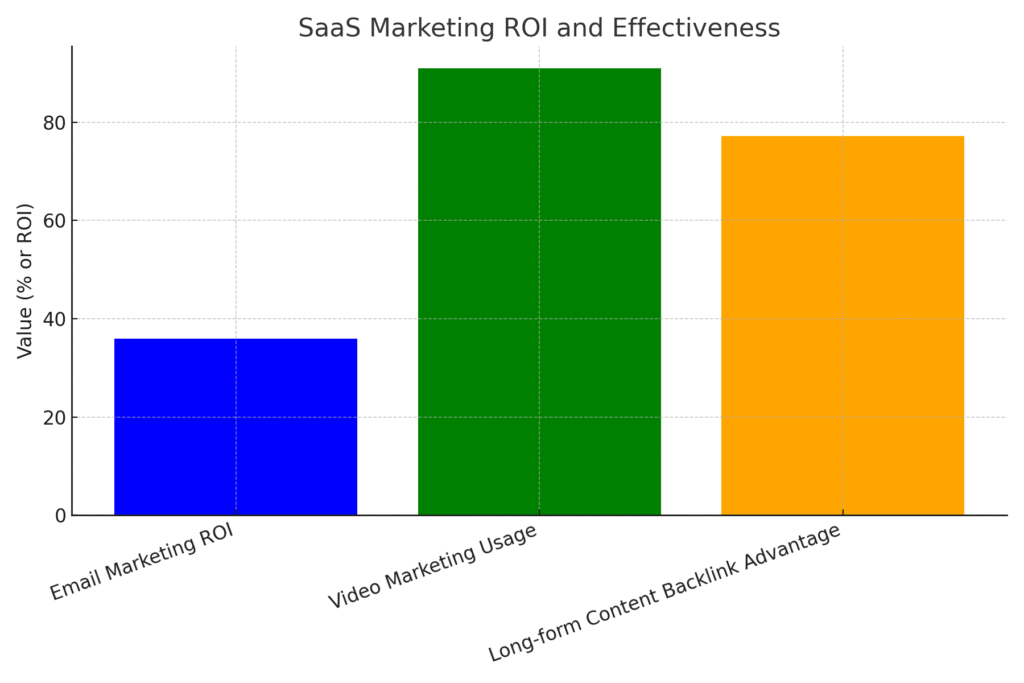
SaaS Marketing Statistics #10: Email Marketing ROI Averages $36 Per $1 Spent
Email marketing continues to deliver massive returns, averaging $36 per dollar spent. For SaaS, this is a reminder that email remains one of the most effective acquisition and retention channels. Personalized campaigns can drive even higher results. Marketers should focus on segmentation, automation, and engagement. This stat underscores email’s timeless value in SaaS marketing.
SaaS Marketing Statistics #11: Welcome Emails Generate 320% More Revenue
Welcome emails are exceptionally powerful, generating 320% more revenue than standard emails. This proves the importance of first impressions in SaaS. A well-crafted onboarding email sets the stage for long-term customer engagement. Marketers should focus on tone, value delivery, and next steps. This stat is a clear reminder that the customer journey starts strong—or not at all.
SaaS Marketing Statistics #12: 91% Of Businesses Use Video Marketing
Video has become the go-to medium, with 91% of businesses using it. SaaS marketers can leverage video to demonstrate product value quickly. Tutorials, demos, and customer stories resonate with audiences. With attention spans shrinking, video offers clarity and engagement. This stat shows video isn’t optional anymore—it’s essential.
SaaS Marketing Statistics #13: Long-Form Content Gets 77% More Backlinks
Long-form content earns 77.2% more backlinks compared to shorter posts. For SaaS companies, this is key for SEO and authority building. In-depth guides and case studies attract both readers and links. Marketers should prioritize quality over quantity in their content strategy. This stat shows why investing in longer, richer content pays off.
SaaS Marketing Statistics #14: Key Metrics Include Churn, CAC, LTV, And NPS
The top metrics for SaaS marketing are churn rate, customer acquisition cost, lifetime value, net promoter score, and recurring revenue. Tracking these numbers helps marketers refine their strategies. They provide insights into both growth and customer satisfaction. Companies that monitor these KPIs adapt faster. This stat proves success in SaaS requires a data-driven mindset.
SaaS Marketing Statistics #15: Enterprises Use An Average Of 275 SaaS Apps
Large enterprises rely on an average of 275 SaaS applications. This highlights both the dependency and complexity of SaaS ecosystems. For marketers, integration and consolidation messaging is powerful. Businesses want tools that reduce friction and increase efficiency. The number demonstrates just how embedded SaaS is in enterprise workflows.
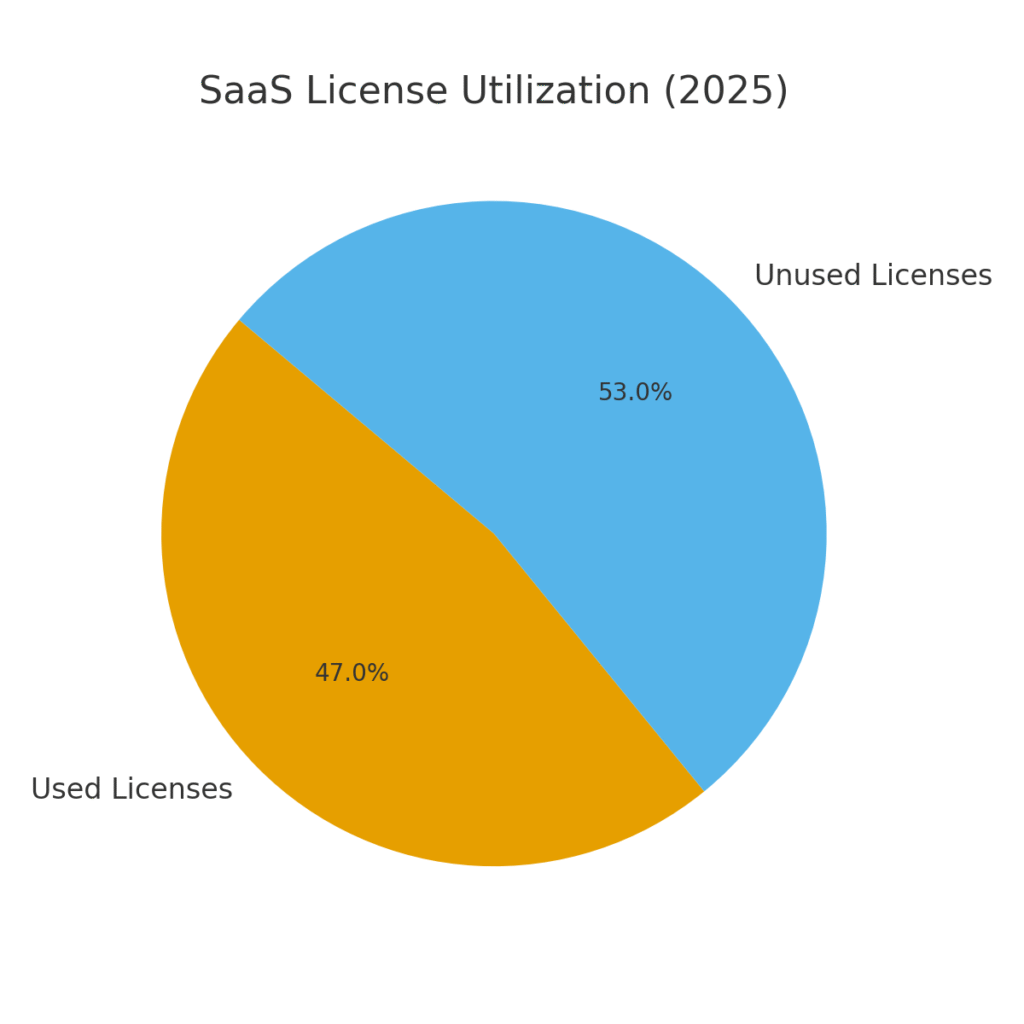
SaaS Marketing Statistics #16: Only 47% Of SaaS Licenses Are Used
On average, organizations use less than half of their SaaS licenses. This underlines the problem of wasted spend and poor adoption. For marketers, showcasing adoption success stories can help win deals. It also opens opportunities for upselling with engagement-focused features. The statistic shows SaaS success depends on activation as much as acquisition.
SaaS Marketing Statistics #17: Companies Handle 247 SaaS Renewals Annually
Organizations manage nearly 250 SaaS renewals each year. This is a staggering workload for IT and procurement teams. For marketers, renewal messaging and loyalty programs matter just as much as acquisition. Retention is where revenue compounds. This stat reminds SaaS companies that renewals are critical moments in the customer lifecycle.
SaaS Marketing Statistics #18: Only 23% Of SaaS Contracts Are Multi-Year
Just 23% of SaaS contracts are multi-year, with most being annual or shorter. This gives customers flexibility but increases churn risk for vendors. For marketers, creating trust and value early is essential. Encouraging multi-year commitments requires clear ROI proof. The statistic highlights the importance of retention-focused marketing.
SaaS Marketing Statistics #19: US SaaS Companies Generated $401.6 Billion Revenue In 2023
In 2023, US-based SaaS companies brought in $401.6 billion in revenue. This shows how dominant the US is in the SaaS market. For marketers, it highlights a mature but still rapidly growing ecosystem. Competition is fierce, but brand positioning is equally powerful. The number demonstrates the global strength of American SaaS.
SaaS Marketing Statistics #20: SaaS Will Represent 85% Of All Business Software By 2025
By the end of 2025, SaaS is projected to account for 85% of all business software. This shows how far cloud-based tools have come in displacing on-premise software. For marketers, this means nearly every company is a potential SaaS customer. The challenge is standing out, not proving relevance. This statistic signals the total dominance of SaaS as the new normal.
Final Thoughts on SaaS Marketing Statistics
Looking through these SaaS marketing statistics makes me more certain than ever that success in this space depends on being adaptable, curious, and data-driven. For me, it’s not just about memorizing figures—it’s about understanding what they mean for real companies trying to grow and thrive. I know from experience that small tweaks, guided by the right numbers, can lead to big shifts in results. That’s why I believe keeping up with these trends is less of an option and more of a responsibility for anyone serious about SaaS. At the end of the day, these insights remind me that behind every statistic is a chance to innovate, connect better with customers, and build something that lasts.
SOURCES
https://www.growthmarketingpro.com/ultimate-list-of-saas-statistics/
https://www.spendesk.com/blog/saas-statistics/
https://revenuezen.com/saas-content-marketing-statistics/
https://www.venasolutions.com/blog/saas-statistics
https://userp.io/organic-growth/updated-list-of-top-saas-marketing-statistics/
https://www.omnius.so/blog/saas-marketing-statistics
https://blogsaas.com/blog/saas-content-writing-statistics/
https://www.sixthcitymarketing.com/2024/04/17/saas-marketing-stats/
https://www.encharge.io/saas-marketing-blogs/
https://www.digitalsilk.com/digital-trends/saas-statistics/
https://citrusbug.com/blog/saas-marketing-statistics/
https://www.zylo.com/blog/saas-statistics/
https://blacksmith.agency/resources/web-development/top-saas-statistics/