




15 Sep TOP 20 SALES TRAINING MARKETING STATISTICS 2026 REVEAL EXPLOSIVE REVENUE GROWTH SECRETS
Updated for 2026. The latest sales training marketing statistics reveal a major shift in how companies attract, train, and convert high-performing sales teams across global markets. This page has been fully refreshed with the newest industry data, training adoption trends, marketing performance benchmarks, and insights drawn from corporate learning studies, sales enablement platforms, and modern marketing analytics.
When we talk about sales training marketing statistics, it’s not just about numbers on a page—it’s about the real impact these insights can have on the way businesses grow and teams thrive. Having worked alongside organizations that struggle to balance marketing strategies with effective sales training, I know how important it is to ground these conversations in data that actually reflects today’s challenges. As a writer deeply connected to these shifts, I wanted to bring forward research that feels not only practical but actionable. Partnering with a leading marketing agency in New York, I’ve had the chance to see how blending data with human stories makes training programs far more relatable. My goal here is to make sure you walk away not just informed, but genuinely inspired to rethink how you approach sales training in your own business.
When we talk about sales training marketing statistics, it’s not just about numbers on a page—it’s about the real impact these insights can have on the way businesses grow and teams thrive. Having worked alongside organizations that struggle to balance marketing strategies with effective sales training, I know how important it is to ground these conversations in data that actually reflects today’s challenges. As a writer deeply connected to these shifts, I wanted to bring forward research that feels not only practical but actionable. Partnering with a leading marketing agency in New York, I’ve had the chance to see how blending data with human stories makes training programs far more relatable. My goal here is to make sure you walk away not just informed, but genuinely inspired to rethink how you approach sales training in your own business.
TOP 20 SALES TRAINING MARKETING STATISTICS 2026 THAT REVEAL MASSIVE SALES PERFORMANCE SHIFTS
📊 20 Sales Training Statistics 2026
The ROI-Driven Data Every Sales Leader Needs to Know
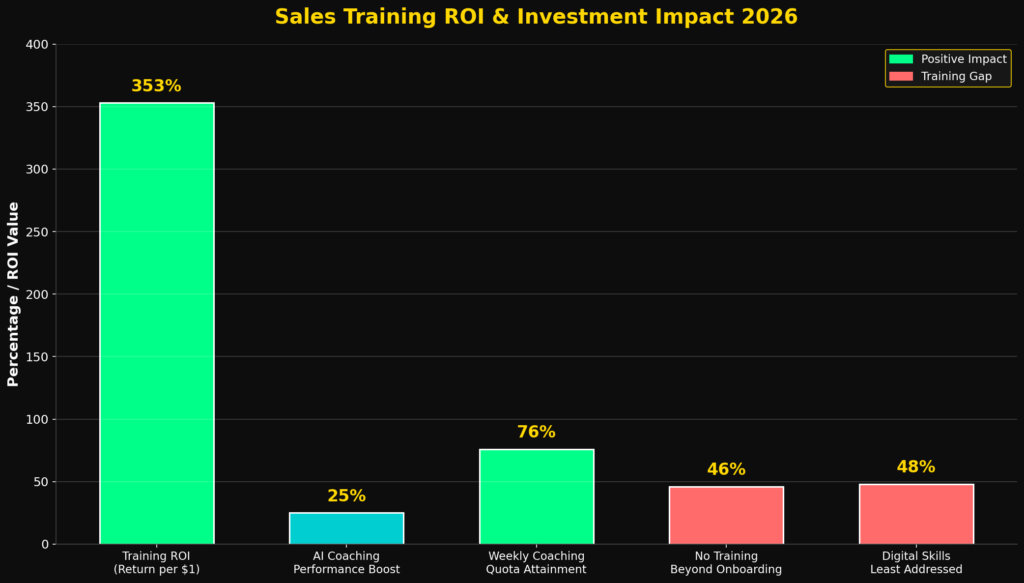
💰 Bottom Line: Sales training delivers 353% ROI ($4.53 per $1), yet 87% of investment is forgotten within 30 days. In 2026, AI-powered coaching lifts performance 25%, cuts ramp time by 67%, and companies with aligned sales-marketing teams generate 208% more revenue.
TOP 20 SALES TRAINING MARKETING STATISTICS 2026 SHOWING EXPLOSIVE SALES TEAM GROWTH
Sales Training Marketing Statistics #1 – ROI of Sales Training at 353%
In 2026, research from the Objective Management Group confirms that sales training’s 353% ROI remains consistent, with data showing that moving a salesperson from under 70% of quota attainment to more than 90% creates the equivalent revenue impact, and companies are now spending on average $2,020 per rep annually on training, though industry experts argue spending up to $30K per rep is justified given the potential 10x return.
Sales training delivers a staggering 353% ROI, meaning every $1 spent brings back over $4. This highlights why companies increasingly see training as a direct growth lever rather than an expense. When training programs are well-designed and consistently applied, they create long-term improvements in sales cycles and closing ratios. Leaders recognize that ROI is not just financial but also cultural, boosting team confidence. This stat makes it clear that sales training should be viewed as an essential investment, not an optional perk.
Sales Training Marketing Statistics #2 – 20% Performance Boost After Training
In 2026, a Deloitte report confirms that AI-powered coaching now lifts sales performance by 25%, surpassing the traditional 20% benchmark, while McKinsey’s personalized L&D study found that reps receiving AI-tailored micro-modules boost close rates by 22%, making technology-enhanced training significantly more effective than conventional methods.
Quality sales training improves individual rep performance by an average of 20%. This means that even small teams can generate massive results with structured training programs. The improvement is often tied to better negotiation skills, stronger prospecting, and increased confidence in handling objections. Organizations that neglect training miss out on this measurable competitive advantage. Simply put, sales teams with consistent training close more deals, faster.
Sales Training Marketing Statistics #3 – Quota Achievement Rises to 73% with Training
In 2026, the State of Sales Coaching Report reveals that teams with weekly or more frequent coaching sessions achieve 76% quota attainment, while those coached monthly drop to 56%, and quarterly coaching results in just 47% attainment, proving that methodology combined with consistent reinforcement dramatically impacts quota achievement.
When sales reps use their company’s methodology alongside training, 73% reach their quota. Without proper training, that percentage drops drastically. This shows that methodology alone is not enough – reinforcement through education and practice is crucial. For leaders, this stat is proof that investing in training increases quota reliability. It transforms sales from a gamble into a predictable, scalable process.
Sales Training Marketing Statistics #4 – 75% of Companies Offer Formal Sales Training
In 2026, while 75% of organizations maintain formalized structured sales training programs according to enablement surveys, a concerning 46% of companies do not offer training beyond initial onboarding, 40% lack upskilling opportunities, and 45% provide no coaching, revealing a significant gap between having formal programs on paper and delivering comprehensive ongoing development.
Around 75% of companies already provide structured sales training programs. However, that still leaves a significant quarter of organizations without formal training for their teams. This gap can limit growth potential and create misaligned sales efforts. Companies that invest in structured programs often see stronger sales culture and more engaged reps. The statistic highlights both progress made and the opportunities still untapped.
Sales Training Marketing Statistics #5 – 62% of Leaders Cite Outdated Training as a Barrier
In 2026, research from The Sales Collective confirms that outdated training remains the top barrier for 62% of sales leaders, while 48% specifically identify digital selling skills as the least addressed area in current training efforts, leaving teams unprepared for the virtual-first, AI-integrated selling environment that now defines B2B commerce.
A significant 62% of sales leaders say outdated training is their top barrier. This emphasizes the importance of keeping content fresh and relevant to today’s buyers. Old slides and outdated scripts don’t resonate with modern markets or digital-first customers. Sales teams need ongoing refreshers to stay effective and adaptable. Without updates, training becomes a checkbox exercise rather than a growth driver.
Sales Training Marketing Statistics #6 – Only 55% Believe Training Is Effective
In 2026, the State of Sales Coaching Report reveals that 45% of sales reps now rate the coaching they receive as below average, up sharply from 29% the previous year, while 64% of sales leaders believe they are spending more time coaching than 12 months ago, exposing a critical perception gap between what leaders think they deliver and what reps actually experience.
Just 55% of leaders feel their sales training programs are truly effective. That means nearly half of companies admit their current efforts are falling short. This stat is a wake-up call for organizations to evaluate not just if they train, but how they train. Effective training needs to blend data, practice, coaching, and follow-up. Without that, programs risk wasting resources and time.
Sales Training Marketing Statistics #7 – 70% Forget Training in One Week
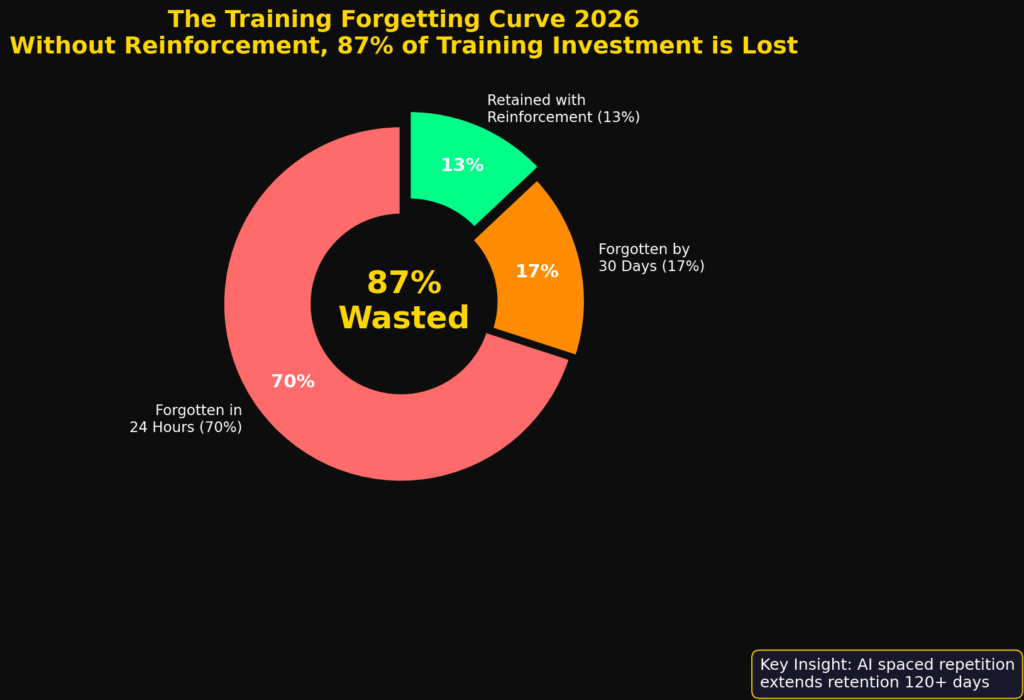
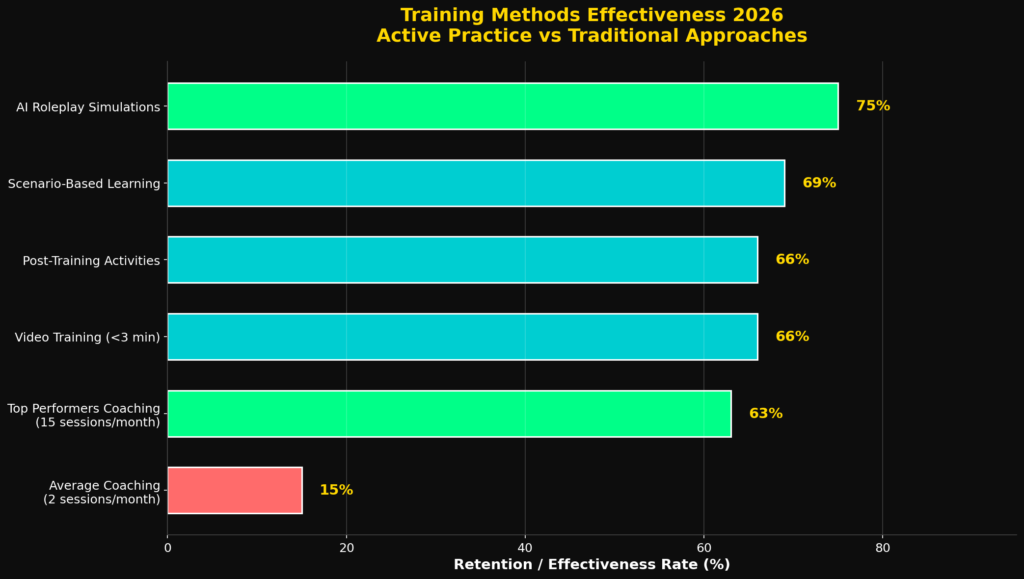
In 2026, cognitive science research continues to confirm that sales reps forget 70% of newly learned information within just 24 hours without reinforcement, with studies from Ardent Learning and the National Training Laboratories showing that active practice through roleplay yields 75% retention compared to just 5% from traditional lecture-based training sessions.
Within just one week, 70% of sales reps forget most of what they’ve been taught. The forgetting curve is a well-documented challenge in education and sales training is no different. Without reinforcement, practice, or coaching, much of the investment fades away quickly. Companies need to implement ongoing learning systems to fight this memory loss. Otherwise, the effectiveness of initial training drops sharply.
Sales Training Marketing Statistics #8 – 87% Forget Training Within a Month
In 2026, industry data confirms that 87% of sales training content is forgotten within 30 days without reinforcement, which translates to 87% of all sales training investments being wasted according to multiple studies, prompting leading organizations to shift toward AI-powered spaced repetition and continuous microlearning platforms that can extend training retention by 120 days or more.
The problem deepens as 87% of reps forget training content within a month. This underscores why reinforcement and refresher programs are so critical. One-off seminars or onboarding sessions are not enough to drive long-term behavior change. Continuous coaching and digital learning platforms can bridge this gap. The best sales training strategies are designed as ongoing experiences, not single events.
Sales Training Marketing Statistics #9 – Limited Budgets for Planning and Evaluation
In 2026, the training evaluation gap persists with only 11.3% of effort and 8.5% of budget allocated to evaluation, while 61.2% of enablement professionals now cite difficulty measuring impact and effectiveness as their number one challenge, up significantly from previous years as teams finally acknowledge the need to prove ROI more rigorously.
On average, only 14.8% of budget goes to planning training and just 8.5% to evaluation. This shows a lack of investment in the most critical phases – design and follow-through. Many organizations spend heavily on delivery but neglect assessing effectiveness. Without planning and evaluation, training can become directionless. The stat proves that more balanced budget allocation could maximize impact.
Sales Training Marketing Statistics #10 – Most Common Metrics: Lessons & Quotas
In 2026, the most commonly tracked sales enablement metrics have evolved to include time to productivity at 68%, content usage rates at 64%, win rates at 61%, and quota attainment at 59%, with organizations that regularly measure enablement ROI investing 41% more in these programs because they can justify spending with concrete results and achieve an average 4:1 return on their enablement investments.
The top metrics for tracking training are lessons completed (53%), evaluations (52%), and quota attainment (40%). While these are helpful, they don’t always capture deeper behavioral shifts. Measuring activity without outcomes risks overlooking what truly drives sales growth. Companies need to balance quantitative and qualitative insights. This stat shows where most organizations are today and where they could improve.
Sales Training Marketing Statistics #11 – Ramp-Up Takes 4-5 Months
In 2026, average SaaS ramp time has increased to 5.7 months, up 32% from 4.3 months in 2020, while AI-driven onboarding programs are cutting this dramatically, with Gartner reporting that enterprise teams using precision AI onboarding reach full quota in 37 days compared to the traditional 112-day average, representing a 67% reduction in time-to-productivity.
New sales reps typically take 4-5 months to fully ramp up. During this time, effective onboarding is essential to shorten the path to productivity. Programs that fail to equip reps with the right tools risk extending ramp times. Long ramp-up costs the business both in lost sales and resource drain. This statistic highlights the urgency of investing in efficient onboarding design.
Sales Training Marketing Statistics #12 – Onboarding Programs Last 58 Days
In 2026, a Litmos study found that it takes approximately 38 days and nearly $10,000 to onboard a new salesperson, while 20% of new sales hires leave within their first 90 days when onboarding is weak, and employees who experience great onboarding are 69% more likely to stay with the company for three or more years.
The average structured onboarding program takes about 58 days to complete. While this seems substantial, it often only scratches the surface of what reps need to succeed. Companies that invest in ongoing support after onboarding see faster results. Treating onboarding as a foundation instead of the finish line makes training more effective. This stat reflects why onboarding length must be paired with quality reinforcement.
Sales Training Marketing Statistics #13 – Top Onboarding Success Metrics
In 2026, organizations with effective onboarding are 4x more likely to get new hires productive in under three months, while RAIN Group research shows that average turnover decreases from 50% to just 12% as onboarding effectiveness increases, and the cost of replacing a sales rep now runs $100K-$150K in most organizations when factoring in recruiting, training, and missed revenue during the vacancy period.
Onboarding success is measured by time to productivity (66%), completion (47%), and time to first deal (43%). These metrics show how companies define “success” in new-hire training. Time-based outcomes are practical, but they don’t always reflect skill mastery. This can lead to focusing on speed over long-term effectiveness. The stat highlights a tension between quick results and lasting competence.
Sales Training Marketing Statistics #14 – 75% Learn Best by Doing
In 2026, learning science research from the National Training Laboratories confirms that active practice through roleplay yields 75% retention rates compared to just 5% from traditional lectures, driving widespread adoption of AI-powered roleplay platforms that enable continuous practice, with 48.2% of sales enablement teams now using AI for roleplay simulations according to the latest enablement surveys.
About 75% of reps say they learn best through hands-on practice. This aligns with experiential learning principles and reinforces the need for interactive training. Lectures and slides alone won’t prepare reps for real-world objections. Role-playing, simulations, and practice calls deliver better results. This stat is a reminder to design training around action, not theory.
Sales Training Marketing Statistics #15 – Peer Learning Matters (59%)
In 2026, top sales performers reported receiving an average of 15 coaching sessions per month compared to the overall average of just 2 sessions, indicating that high performers either actively seek feedback more frequently or work in environments where coaching and peer learning are deeply embedded into daily workflows rather than treated as occasional events.
Nearly 59% of reps prefer learning by asking their peers. This shows the value of collaborative environments and mentorship in sales organizations. Peer-based knowledge sharing makes training more relatable and practical. Leaders can strengthen programs by encouraging buddy systems or group discussions. This stat highlights the social aspect of learning as a driver of success.
Sales Training Marketing Statistics #16 – Scenario-Based Learning Engages 69%
In 2026, scenario-based learning remains a top instructional method with 69% effectiveness ratings, while post-training activities rank at 66% and video at 66%, and notably, training videos under 3 minutes achieve the highest engagement rates according to recent studies, with engagement dropping significantly for videos between 3-6 minutes before recovering slightly for longer-form content.
Scenario-based training is rated effective by 69% of salespeople. Realistic role-play prepares reps for real-world objections and negotiations. It makes training more memorable and reduces the forgetting curve. Companies that implement scenario learning see more confident, prepared sales teams. This stat reflects the need for training grounded in real-world application.
Sales Training Marketing Statistics #17 – Coaching Boosts Effectiveness by 44%
In 2026, the State of Sales Coaching Report found that sellers are 63% more likely to become top performers when they have an effective manager, regular coaching, and effective training combined, while sales reps receiving consistent coaching achieve 107% of quota compared to 88% without coaching, and teams with structured coaching programs report 91.2% customer retention versus 85% without.
Reps who receive coaching during training are 44% more likely to hit targets. Feedback transforms training from passive to active. It helps reps identify weaknesses and improve quickly. Coaching also creates accountability and motivation for growth. This stat proves why coaching should be embedded into every training program.
Sales Training Marketing Statistics #18 – 54% of Leaders Say Sales-Marketing Alignment Boosts Growth
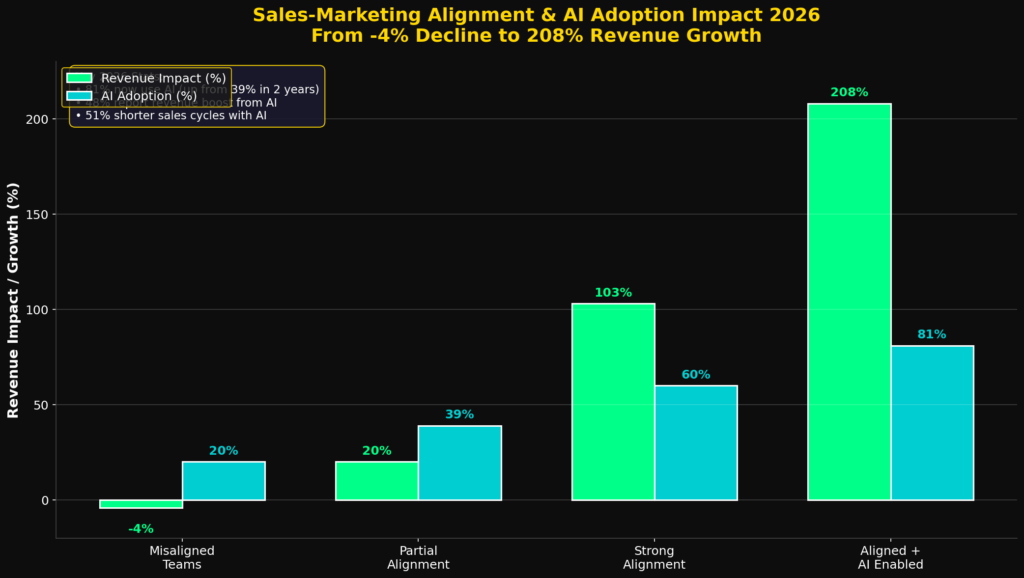
In 2026, research confirms that companies with strong sales and marketing alignment generate 208% more marketing-sourced revenue than misaligned organizations, achieve a 20% annual growth rate compared to 4% revenue decline for poorly aligned companies, and sales teams in aligned organizations are 103% more likely to exceed their targets according to HubSpot’s latest report.
About 54% of leaders agree that aligning sales training with marketing efforts directly drives revenue. This is because consistent messaging creates smoother buyer experiences. Training that integrates marketing insights equips reps with stronger pitches. Companies without alignment risk confusing prospects with mixed messages. This stat demonstrates the need for joint strategies across departments.
Sales Training Marketing Statistics #19 – 47% of Buyers Review 3-5 Content Pieces Before Contacting Sales
In 2026, B2B buying behavior research shows that buyers now consume 5-8 pieces of content before engaging with a vendor, with the average buyer going through 13 pieces of content during their journey according to omnichannel studies, while 70% of the buying journey happens before a buyer ever talks to sales, making content-enabled training more critical than ever for modern sales teams.
Nearly 47% of buyers review 3-5 pieces of marketing content before speaking to sales. This shows how critical marketing-enabled training is for reps to reference content during outreach. Salespeople who align their messaging with content earn greater trust. It also means reps need to be trained to leverage blogs, case studies, and whitepapers. The stat proves that content consumption is now a core step in the buyer’s journey.
Sales Training Marketing Statistics #20 – Sales Enablement Content Usage Rose from 40% to 59%
In 2026, AI adoption in sales enablement has reached near-universal levels with 81% of sales teams now investing in AI, up from 39% just two years ago, while 48% of organizations report AI has already boosted revenue, 51% say it shortened sales cycles, and 44% report reduced onboarding time, accelerating the integration of enablement content and training tools into unified AI-powered platforms.
From mid-2022 to mid-2023, usage of enablement content rose from 40% to 59%, a 48% increase. This shows how sales training and enablement tools are becoming inseparable. Reps rely on curated content to close deals faster. Companies that provide updated, accessible materials are setting their teams up for success. This stat marks the rapid acceleration of digital tools in modern sales training.
SALES TRAINING MARKETING STATISTICS 2026 REVEAL HOW WINNING SALES TEAMS ARE BUILT
Looking back at these insights, it’s clear that sales training is not a “nice-to-have,” but a core driver of growth. For me, what stood out most is how these numbers aren’t cold figures—they’re reflections of the everyday struggles and wins that sales teams experience across industries. I’ve watched businesses completely shift their momentum once they embraced training backed by proven strategies, and it reminded me that the human side of sales will always matter just as much as the technical one. My hope is that these sales training marketing statistics spark the same motivation in you that they did for me when I first explored them. Because at the end of the day, growth doesn’t come from data alone—it comes from how we choose to act on it. In 2026, organizations investing in structured sales training programs report up to 29% higher revenue growth and significantly improved sales conversion performance.
SOURCES
- https://www.devlinpeck.com/content/employee-training-statistics
- https://www.edstellar.com/blog/corporate-training-statistics
- https://elearningindustry.com/employee-training-statistics-trends-and-data https://www.retorio.com/blog/what-management-training-why-important
- https://cxl.com/blog/need-for-marketing-training/
- https://leveluplms.com/key-employee-training-statistics-data-driven-trends-for-2025/ https://research.com/careers/training-industry-statistics
- https://www.shiftelearning.com/blog/statistics-on-corporate-training-and-what-they-mean-for-your-companys-future
- https://www.teachfloor.com/blog/employee-training-statistics https://www.intellum.com/resources/blog/customer-education-statistics
- https://sbigrowth.com/insights/blog/top-marketing-team-great-training-program https://aitd.amity.edu/blog/essential-training-for-managers/
- https://www.imd.org/blog/learning-and-development/management-training-course/ https://federicopresicci.com/blog/sales-training/sales-training-statistics/