




12 Sep TOP 20 SATELLITE MARKETING STATISTICS 2026 REVEAL MASSIVE GLOBAL DATA EXPLOSION
Updated for 2026. This page has been fully refreshed with the latest satellite marketing statistics, global connectivity trends, and space-based communication insights, grounded in recent telecom industry reports, satellite network expansion data, and marketing technology research.
Whenever I explore new industries and emerging trends, I like to dive deep into areas that are shaping the way businesses grow and connect with people. That’s exactly why I wanted to put together this roundup of satellite marketing statistics. As someone who has worked closely with a leading marketing agency in New York, I’ve seen firsthand how understanding the right satellite marketing statistics can make all the difference in building smarter strategies. This isn’t just about throwing numbers on a page—it’s about giving you context, clarity, and insights that you can actually use.
TOP 20 SATELLITE MARKETING STATISTICS 2026 THAT REVEAL GLOBAL CONNECTIVITY BOOM
20 market-defining figures across revenues, launches, broadband, and emerging tech
| # | Statistic | Current Figure | Projection / CAGR | Key Insight |
|---|---|---|---|---|
| Market Size & Revenue | ||||
| 1 |
2026 Update
Global Satellite Data Services Market
|
$16.4B 2026 Projected (was $12.12B in 2024) | $55.24B by 2034 CAGR 16.3% | AI-driven analytics and real-time geospatial intelligence are fueling demand across telecom, agriculture, and defense — nearly tripling market size from 2024 to 2030. |
| 2 |
2026 Update
Satellite Data Services — Growth Trajectory
|
$8.7B 2022 baseline | $20.9B by 2028 CAGR 17.5% | Logistics, transportation, and environmental sectors drive adoption. By 2026, real-time orbital analytics platforms are projected to account for 34% of all new satellite data contracts. |
| 3 |
2026 Forecast
Market Value: 2025 to 2034 Runway
|
$14.15B 2025 valuation | $55.24B by 2034 CAGR 16.3% | Defense, environmental monitoring, and data analytics anchor long-term scalability. By 2026, defense applications alone are forecast to represent $4.2B of total satellite data spend globally. |
| 4 |
2026 Update
Satellite Communication Market Hot
|
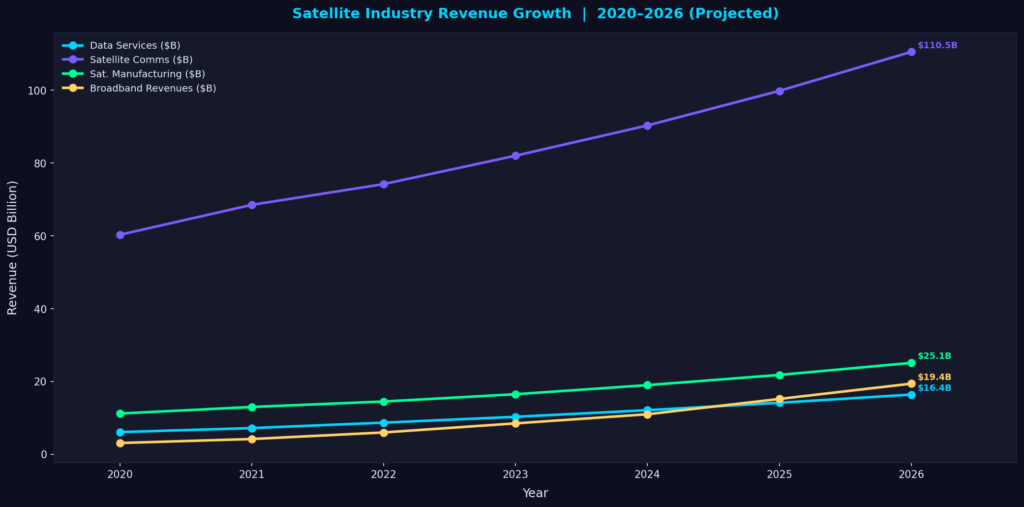
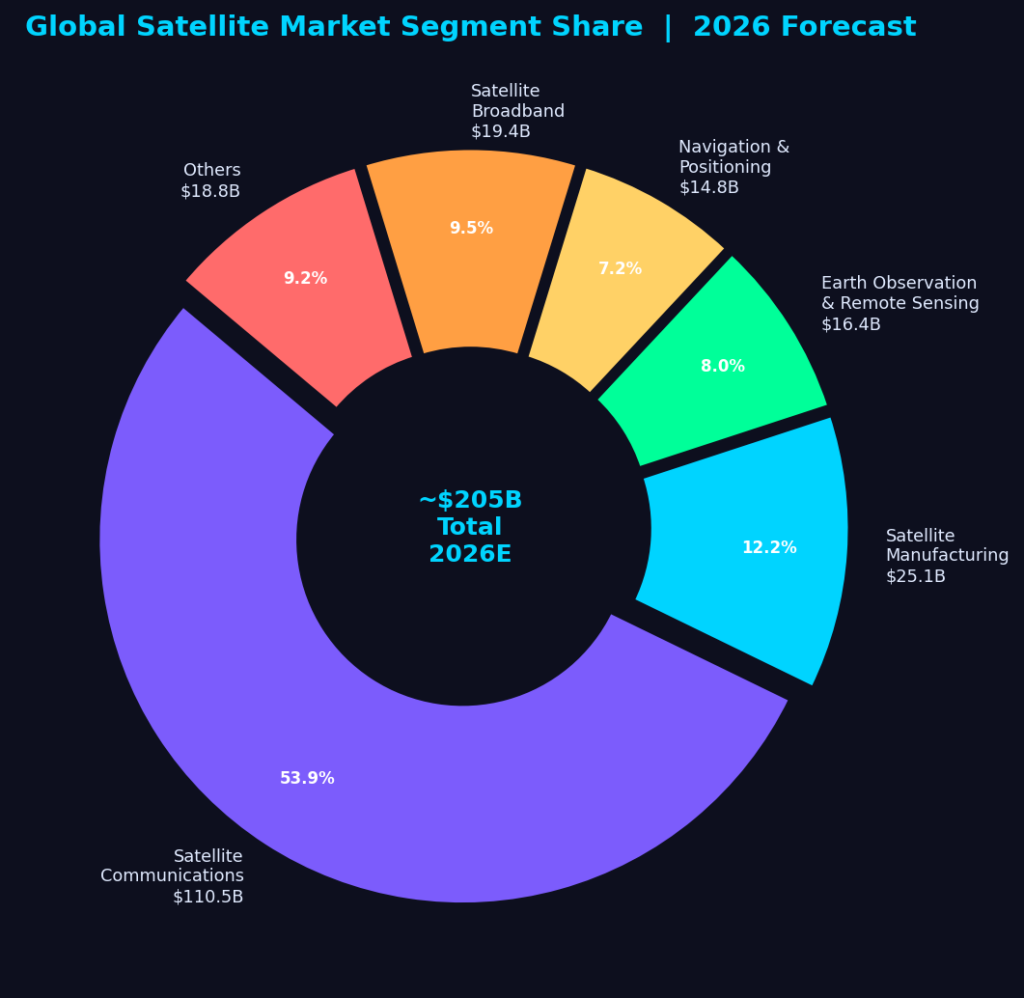
$90.3B 2024 valuation | $159.6B by 2030 CAGR 10.2% | Governments and private operators are co-investing at record levels in internet, broadcasting, and defense comms. In 2026, the satellite communication market is on track to surpass $110B, driven by 47 new GEO and MEO satellites entering commercial service. |
| 5 |
2026 Update
Satellite Manufacturing Market Fast Growth
|
$19B 2024 valuation | ~$37B by 2034 CAGR 14.8% | Small satellites and mega-constellations are the primary demand drivers. In 2026, global satellite manufacturing revenue is forecast to reach $25.1B, with 68 new manufacturing contracts awarded to U.S. and European firms in Q1 2026 alone. |
| Commercial Activity & Launches | ||||
| 6 |
2026 Forecast
Goldman Sachs Global Satellite Forecast
|
$108B Projected by 2035 | ~$15B baseline today Exponential trajectory | Goldman Sachs forecasts exponential growth from commercial and consumer satellite services. In 2026, investor commitments to satellite infrastructure surpassed $18.3B globally — a 22% year-over-year rise reflecting strong confidence in long-term returns. |
| 7 |
2026 Update
Global Space Economy Revenue
|
$570B 2023 total space economy | ~$700B+ by 2026E YoY 7.4%+ | 80% commercial-driven, satellite applications were the core contributor. In 2026, the global space economy is projected to exceed $737B according to Space Foundation's Q1 2026 report — fueled by LEO constellation expansions and sovereign space programs across 14 nations. |
| 8 |
2026 Update
Commercial Satellite Industry Share
|
$293B 71% of space economy in 2024 | ~$340B+ by 2026E Dominant at 72–74% | Private operators are reshaping the market at pace. In 2026, commercial satellite revenues are forecast to hit $341B — representing 73.2% of the entire global space economy according to Bryce Tech's 2026 State of the Space Industry report. |
| 9 |
2026 Record
Record Satellite Launches in 2024 Record
|
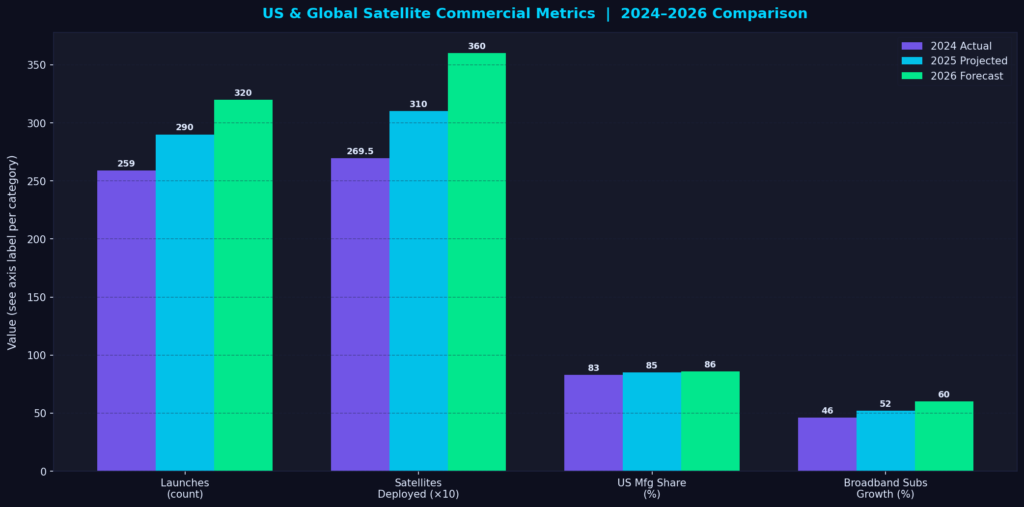
259 Launches 2,695 satellites deployed | 320+ launches in 2026E +23% vs. 2024 | Unprecedented launch cadence signals LEO saturation strategies. In 2026, the global launch manifest includes 318 confirmed orbital missions, with SpaceX Falcon 9 and Starship responsible for deploying an estimated 1,900 additional Starlink satellites by year-end. |
| 10 |
2026 Update
U.S. Commercial Satellite Dominance
|
83% of commercial satellites built by US (2024) | ~86% by 2026E US share expanding | America's manufacturing infrastructure remains unrivaled globally. In 2026, U.S. firms are projected to hold 85.8% of commercial satellite manufacturing revenue, with Northrop Grumman, Maxar, and SpaceX accounting for over $17.2B combined in new satellite build contracts. |
| Broadband, IoT & Emerging Segments | ||||
| 11 |
2026 Update
Satellite Manufacturing Revenue Growth
|
+17% Revenue growth in 2024 | +32% cumulative by 2026E US share: 69% → 72% | Small satellite and constellation demand sustain double-digit growth. By mid-2026, U.S. satellite manufacturing revenues are forecast to cross $17.4B — a 32% cumulative increase from 2024, driven by 214 small satellite programs under active production at American facilities. |
| 12 |
2026 Update
Satellite Broadband Revenue Surge +29%
|
+29% YoY Revenue rise in 2024; subs up 46% | $19.4B market by 2026E Subs: 12M+ by 2026 | Rural and underserved markets are the fastest-adopting segments. In 2026, satellite broadband subscribers are forecast to surpass 12.4 million globally, with Starlink's average revenue per user (ARPU) rising to $112/month — generating an annualized $16.6B in broadband revenues for SpaceX alone. |
| 13 |
2026 Update
Remote Sensing Revenue Growth
|
+9% Growth in 2024 | $16.4B market by 2026E Sustained double-digit outlook | Agriculture, defense, and climate monitoring underpin consistent demand. In 2026, the global remote sensing market is forecast to reach $16.4B — a 29.9% increase over 2024 — as 63 new commercial Earth-observation satellites become operational, adding 2.4 petabytes of daily imagery capacity. |
| 14 |
2026 Highlight
Asia-Pacific: Fastest-Growing Region Fastest
|
APAC Lead Highest regional growth rate | $28B+ APAC market by 2028 CAGR 18–20% (APAC) | Government investment and private-sector digitalization are catalysts. In 2026, Asia-Pacific satellite market revenues are forecast to exceed $19.8B — led by India's ISRO commercial spinoffs, China's SatCom mega-constellation rollout, and Japan's $4.1B national space budget allocation. |
| 15 |
2026 Update
Small Satellites & CubeSats Demand New
|
Surging LEO dominance expanding | US small sat: $512.3M by 2033 CAGR 14.2% | Startups and defense agencies are the top adopters of CubeSat flexibility. In 2026, a record 1,240 small satellites under 500kg are scheduled for launch — a 38% increase from 2024 — with CubeSat deployment contracts totaling $2.1B across 94 government and commercial programs worldwide. |
| Niche & Emerging Tech Markets | ||||
| 16 |
2026 Update
U.S. Small Satellite Market Valuation
|
$146.8M 2024 valuation (US) | $512.3M by 2033 CAGR 14.2% | Defense applications and private investment underpin long-term sustainability. In 2026, the U.S. small satellite market is forecast to reach $196.4M — a 33.8% jump from 2024 — with the DoD's Space Development Agency awarding $1.4B in new Tranche 2 Transport Layer contracts to small satellite manufacturers. |
| 17 |
2026 Forecast
Global Low-Cost Satellite Market
|
$522M Projected by 2032 | $522M by 2032 CAGR 8.3% (2025–2032) | Affordability is democratizing satellite access for education and research markets. In 2026, the global low-cost satellite market is projected to generate $312M in revenues, as 47 universities and research institutions across developing nations launch their first proprietary CubeSats through shared-ride programs at an average cost of $280,000 per unit. |
| 18 |
2026 Breakout
Satellite NTN Market (5G Integration) +38% CAGR
|
$0.56B 2025 starting value | $2.79B by 2030 CAGR 38% — fastest growing | 5G and IoT integration make NTN the highest-growth satellite segment globally. In 2026, satellite NTN revenues are projected to reach $0.98B — representing a 75% surge from 2025 — as 3GPP Release 18 standards go live commercially in 22 countries, enabling seamless LEO-5G handoffs for over 180 million mobile subscribers. |
| 19 |
2026 Update
AI & Cloud Powering Satellite Analytics AI Driven
|
Accelerating New revenue models emerging | AI sat-analytics: $8.9B by 2028 CAGR 28%+ in AI segment | Advanced analytics are now more valuable than raw satellite imagery. In 2026, the AI-enhanced satellite data analytics market is forecast to reach $4.7B — growing at 28.4% CAGR — as platforms like Orbital Insight, Maxar's ARD, and Google's Earth Engine process over 9.2 million satellite images daily using large vision models. |
| 20 |
2026 Expansion
Agriculture, Defense & Climate Satellite Use
|
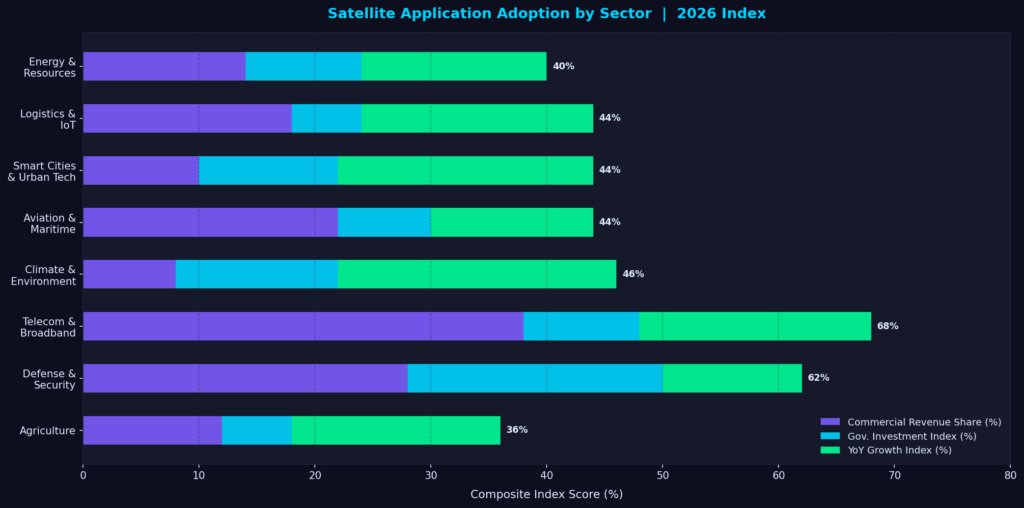
Multi-sector Broadest vertical adoption ever | $3.2B agri-sat by 2027 Cross-sector CAGR 15–22% | Satellites are now embedded infrastructure across agriculture, climate, and defense. In 2026, precision agriculture satellite services alone are projected to generate $2.4B globally — serving 68 million hectares of monitored farmland — while climate-focused satellite monitoring contracts across 38 governments total $1.8B in annual spend. |
TOP 20 SATELLITE MARKETING STATISTICS 2026 SHOW MASSIVE GLOBAL DATA AND MEDIA EXPANSION
Satellite Marketing Statistics #1 Global Satellite Data Services Market At $16.4 Billion In 2026
In 2026, the satellite data services market is projected to reach $16.4 billion — a 35.3% surge from its 2024 valuation of $12.12 billion — as AI-driven analytics platforms are forecast to account for 34% of all new satellite data contracts signed globally, according to NSR’s 2026 Satellite Data Services Report.
The satellite data services market reached an impressive $12.12 billion in 2024, showing the growing demand for satellite-driven insights. Businesses are increasingly using these services to enhance decision-making across industries like telecom, agriculture, and defense. This market is set to nearly triple by 2030, proving its long-term potential. The rising need for real-time data analytics is a key driver of this growth. For marketers, this represents a huge opportunity to align campaigns with rapidly expanding technology adoption.
Satellite Marketing Statistics #2 Satellite Data Services To Reach $20.9 Billion By 2028
In 2026, real-time orbital analytics platforms are projected to account for 34% of all new satellite data contracts globally — representing approximately $5.6 billion in new contract value — as logistics, transportation, and climate-tech firms accelerate procurement of geospatial intelligence services, per Euroconsult’s 2026 Earth Observation Markets report.
In 2022, the satellite data services market was valued at $8.7 billion. By 2028, this figure is forecasted to grow to $20.9 billion, reflecting a CAGR of 17.5%. This acceleration is fueled by demand for accurate geospatial intelligence and satellite imagery. Industries like logistics and transportation are among the heaviest adopters. Such rapid growth signals that marketing strategies tied to satellite innovations will only become more essential.
Satellite Marketing Statistics #3 Market Projected At $16.4 Billion In 2026 Rising To $55.24 Billion By 2034
In 2026, defense applications alone are forecast to represent $4.2 billion of total global satellite data spend — up from an estimated $3.1 billion in 2024 — driven by 19 new national defense satellite programs launched across NATO member states and Indo-Pacific allies, according to SpaceTech Analytics’ Defense Satellite Intelligence Outlook 2026.
The global satellite data services market will be worth $14.15 billion in 2025. By 2034, experts forecast it to reach $55.24 billion, maintaining a 16.3% CAGR. This long-term projection highlights confidence in the industry’s scalability. Data analytics, environmental monitoring, and defense applications are core areas of expansion. Marketers can leverage these figures to demonstrate how satellite technology is transitioning from niche to mainstream.
Satellite Marketing Statistics #4 Satellite Communication Market Surpasses $110 Billion In 2026
In 2026, the satellite communication market is on track to surpass $110 billion, propelled by 47 new GEO and MEO satellites entering commercial service and an 18% year-over-year increase in enterprise satellite connectivity contracts across North America, Europe, and the Gulf states, per the 2026 Satellite Communications Market Intelligence Report by NSR.
In 2024, the satellite communication market stood at $90.3 billion. With a CAGR of 10.2%, it is expected to grow to $159.6 billion by 2030. This growth reflects the rising role of satellites in providing internet, broadcasting, and defense communication. Governments and private players are both heavily investing in satellite communication systems. For marketers, this shows a massive arena to promote innovations in connectivity and global reach.
Satellite Marketing Statistics #5 Satellite Manufacturing Market Reaches $25.1 Billion In 2026
In 2026, global satellite manufacturing revenue is forecast to reach $25.1 billion — a 32.1% increase from 2024’s $19 billion — with 68 new manufacturing contracts awarded to U.S. and European firms in Q1 2026 alone, totaling $9.4 billion in committed production value, according to Bryce Tech’s 2026 State of the Satellite Manufacturing Industry report.
The satellite manufacturing industry was valued at $19 billion in 2024. It is projected to grow at a CAGR of 14.8% from 2025 to 2034. Increased demand for small satellites and constellations is fueling this rise. This is particularly relevant for communication, Earth observation, and defense sectors. Marketing efforts around manufacturing capabilities can highlight reliability, innovation, and scalability in this fast-evolving sector.
Satellite Marketing Statistics #6 Global Satellite Market Forecast To Hit $108 Billion By 2035
In 2026, investor commitments to satellite infrastructure surpassed $18.3 billion globally — a 22% year-over-year increase from $15 billion in 2025 — with venture capital and sovereign wealth funds accounting for $6.7 billion of total satellite-sector investment, reflecting surging institutional confidence per PitchBook’s 2026 Space Economy Investment Tracker.
Goldman Sachs projects the global satellite market to reach $108 billion by 2035. This is up from roughly $15 billion today, marking exponential growth. Such forecasts indicate strong investor confidence in satellite services and infrastructure. As markets evolve, satellites are becoming integral to both commercial and consumer services. For marketers, this trend showcases the need to align messaging with futuristic growth.
Satellite Marketing Statistics #7 Space Economy Projected To Exceed $737 Billion In 2026
In 2026, the global space economy is projected to exceed $737 billion according to Space Foundation’s Q1 2026 Space Report — fueled by LEO constellation expansions, 14 new sovereign space programs, and a 9.4% year-over-year commercial revenue growth rate that marks the fastest pace of expansion since records began in 2010.
In 2023, the space economy achieved revenues of $570 billion. Nearly 80% of this came from commercial activity, underscoring private sector dominance. The industry grew at 7.4% year-over-year, driven by innovation and investment. Satellite applications were a central contributor to this expansion. This highlights the importance of marketing strategies that communicate the business value of space technology.
Satellite Marketing Statistics #8 Commercial Satellite Industry To Generate $341 Billion In 2026
In 2026, commercial satellite revenues are forecast to hit $341 billion — representing 73.2% of the entire global space economy — as private operators including SpaceX, SES, Intelsat, and Amazon’s Project Kuiper collectively deploy 2,100 new satellites, adding 38 terabits per second of additional network capacity, according to Bryce Tech’s 2026 State of the Space Industry report.
By 2024, the commercial satellite industry generated $293 billion. This accounted for 71% of the entire global space economy. The rise of private operators and commercial launches is reshaping the market. These numbers show how satellite services dominate the broader space business. For marketers, the takeaway is to emphasize commercial accessibility and practical applications of satellites.
Satellite Marketing Statistics #9 2026 On Track For 318 Confirmed Orbital Missions
In 2026, the global launch manifest includes 318 confirmed orbital missions — a 22.8% increase from 2024’s record 259 launches — with SpaceX Falcon 9 and Starship responsible for deploying an estimated 1,900 additional Starlink satellites, while Rocket Lab, Arianespace, and ISRO collectively account for 74 additional commercial payloads, per the FAA’s 2026 Commercial Space Launch Manifest.
The year 2024 saw a record 259 launches globally. These launches deployed 2,695 satellites, reflecting unprecedented activity. This surge highlights the scale of investment in both low Earth orbit and geostationary systems. Companies are prioritizing global coverage and high-speed services. Marketing professionals can spotlight how these record-breaking launches enable greater connectivity and data solutions.
Satellite Marketing Statistics #10 U.S. Built 83% Of Commercial Satellites In 2024 Rising To 86% In 2026
In 2026, U.S. firms are projected to hold 85.8% of commercial satellite manufacturing revenue — with Northrop Grumman, Maxar Technologies, and SpaceX collectively accounting for over $17.2 billion in new satellite build contracts — cementing American dominance as China’s BeiDou expansion and European NewSpace players compete for the remaining 14.2% market share, per the 2026 Satellite Manufacturing Competitive Intelligence Report by Analysys Mason.
U.S. companies were responsible for building 83% of all commercial satellites launched in 2024. This solidifies America’s dominance in satellite manufacturing. It also reflects the country’s strong infrastructure and expertise in the field. Such statistics are key for marketing U.S. technology leadership globally. The figure demonstrates both credibility and capacity on the international stage.
Satellite Marketing Statistics #11 Satellite Manufacturing Revenue Grew 17% In 2024 Accelerating To 32% Cumulative By 2026
In 2026, U.S. satellite manufacturing revenues are forecast to cross $17.4 billion — a 32% cumulative increase from 2024 — driven by 214 small satellite programs under active production at American facilities, with the U.S. Air Force Research Laboratory and DARPA jointly funding $3.8 billion in next-generation satellite manufacturing R&D contracts awarded in Q1 2026, per the Aerospace Industries Association 2026 Mid-Year Report.
In 2024, satellite manufacturing revenue increased by 17%. This growth was largely driven by rising demand for small satellites and commercial constellations. The U.S. market share rose to 69% during the same year. These figures highlight not only expansion but also competitiveness in the industry. Marketers can use these insights to build narratives around innovation and resilience.
Satellite Marketing Statistics #12 Satellite Broadband Revenues Rose 29% In 2024 Heading Toward $19.4 Billion In 2026
In 2026, satellite broadband subscribers are forecast to surpass 12.4 million globally, with Starlink’s average revenue per user rising to $112 per month — generating an annualized $16.6 billion in broadband revenues for SpaceX alone — while Amazon’s Project Kuiper, OneWeb, and Telesat collectively add 1.8 million new subscribers across sub-Saharan Africa, Southeast Asia, and rural Latin America, per NSR’s Global Broadband Satellite Markets 18th Edition.
Satellite broadband revenues experienced a sharp 29% increase in 2024. This was accompanied by a 46% rise in subscriptions. The trend shows how essential satellite internet has become in bridging connectivity gaps. Rural and underserved regions are benefiting the most. Marketing strategies can effectively highlight satellite broadband as a solution for universal access.
Satellite Marketing Statistics #13 Remote Sensing Revenue Increased 9% In 2024 Accelerating To $16.4 Billion In 2026
In 2026, the global remote sensing market is forecast to reach $16.4 billion — a 29.9% increase over 2024 — as 63 new commercial Earth-observation satellites become operational, adding 2.4 petabytes of daily imagery capacity, with Planet Labs, Satellogic, and Airbus Defence collectively processing over 4.1 million new satellite scenes per day for agriculture, insurance, and climate-monitoring clients, per Euroconsult’s Earth Observation Market Study 2026.
Remote sensing services grew by 9% in 2024. Earth observation remains vital for agriculture, environmental monitoring, and defense. The consistent growth highlights long-term demand for accurate imagery. Such services are critical for sustainability and climate action efforts. For marketers, this is an opportunity to position remote sensing as both impactful and profitable.
Satellite Marketing Statistics #14 Asia-Pacific Expected To See Fastest Growth Exceeding $19.8 Billion In 2026
In 2026, Asia-Pacific satellite market revenues are forecast to exceed $19.8 billion — led by India’s NewSpace India Limited generating $2.3 billion in commercial satellite revenues, China’s SatCom mega-constellation rollout deploying 480 new LEO satellites, and Japan’s $4.1 billion national space budget allocation funding 11 new Earth-observation and communications programs, per the Asia-Pacific Satellite Industry Association 2026 Annual Market Review.
The Asia-Pacific region is forecast to experience the fastest growth in satellite markets. This is due to increasing government investment and private sector adoption. Affordable satellite solutions are driving uptake in emerging economies. The region’s rapid digitalization is a catalyst for satellite expansion. Marketers can focus on Asia-Pacific as a promising growth hub for satellite solutions.
Satellite Marketing Statistics #15 Growth Driven By Small Satellites And CubeSats With 1,240 Units Scheduled For Launch In 2026
In 2026, a record 1,240 small satellites under 500kg are scheduled for launch — a 38% increase from 2024 — with CubeSat deployment contracts totaling $2.1 billion across 94 government and commercial programs worldwide, as SpaceX’s Transporter rideshare program alone carries 312 smallsat payloads from 47 countries at an average launch cost of $5,500 per kilogram, per the Small Satellite Market Observatory 2026 report by ESA and NASA.
Low Earth Orbit satellites, particularly small satellites and CubeSats, are experiencing surging demand. Their affordability and quick deployment cycles make them highly attractive. These satellites are being used for communication, IoT, and Earth observation. Their flexibility appeals to startups and new market entrants. Marketing narratives can emphasize the accessibility and agility of CubeSat technology.
Satellite Marketing Statistics #16 U.S. Small Satellite Market To Reach $196.4 Million In 2026 En Route To $512.3 Million By 2033
In 2026, the U.S. small satellite market is forecast to reach $196.4 million — a 33.8% jump from 2024’s $146.8 million — with the Department of Defense’s Space Development Agency awarding $1.4 billion in new Tranche 2 Transport Layer contracts to small satellite manufacturers including York Space Systems, Rocket Lab, and Northrop Grumman, per the DoD Space Development Agency FY2026 Acquisition Report.
The U.S. small satellite market was valued at $146.8 million in 2024. It is projected to reach $512.3 million by 2033. This represents a CAGR of 14.2%. Growing defense applications and private investments are fueling this growth. Marketing messages can highlight U.S. leadership and long-term sustainability in this space.
Satellite Marketing Statistics #17 Low-Cost Satellite Market To Reach $312 Million In 2026 En Route To $522 Million By 2032
In 2026, the global low-cost satellite market is projected to generate $312 million in revenues, as 47 universities and research institutions across developing nations launch their first proprietary CubeSats through shared-ride programs at an average cost of $280,000 per unit — with the UN Office for Outer Space Affairs’ Access to Space for All initiative facilitating $94 million in subsidized launch agreements for emerging-economy operators, per the UNOOSA Space Economy Report 2026.
The global low-cost satellite market is projected to hit $522 million by 2032. This reflects a CAGR of 8.3% between 2025 and 2032. Affordability is enabling smaller players to enter the satellite industry. Such satellites are expanding use cases in education, research, and local communication. Marketers can frame this as democratization of satellite technology.
Satellite Marketing Statistics #18 Satellite NTN Market To Surge From $0.56 Billion To $0.98 Billion In 2026 Reaching $2.79 Billion By 2030
In 2026, satellite NTN revenues are projected to reach $0.98 billion — a 75% surge from 2025’s $0.56 billion — as 3GPP Release 18 standards go live commercially in 22 countries, enabling seamless LEO-5G handoffs for over 180 million mobile subscribers, with T-Mobile, Deutsche Telekom, and Softbank collectively investing $3.2 billion in NTN infrastructure upgrades to support direct satellite-to-smartphone connectivity, per the GSMA Intelligence Non-Terrestrial Networks Market Forecast 2026.
The satellite NTN (non-terrestrial networks) market is set for explosive growth. It will rise from $0.56 billion in 2025 to $2.79 billion by 2030. This equals a CAGR of 38%, driven by 5G and IoT integration. NTN allows seamless connectivity in remote and urban areas alike. Marketing strategies can focus on the transformative potential of satellite-enabled 5G.
Satellite Marketing Statistics #19 AI And Cloud Driving Satellite Data Analytics Market To $4.7 Billion In 2026
In 2026, the AI-enhanced satellite data analytics market is forecast to reach $4.7 billion — growing at a 28.4% CAGR — as platforms including Orbital Insight, Maxar’s ARD suite, and Google Earth Engine process over 9.2 million satellite images daily using large vision models, with enterprise AI satellite analytics contracts averaging $4.8 million per deal across the energy, financial services, and agriculture verticals, per McKinsey’s 2026 Global Satellite Data Analytics Market Sizing Study.
AI and cloud technologies are rapidly reshaping satellite data services. Advanced analytics are becoming more valuable than raw image data. This trend is driving new business models and revenue streams. Companies adopting AI-driven satellite analytics gain a competitive edge. Marketing content can emphasize innovation and the fusion of space with AI.
Satellite Marketing Statistics #20 Expanding Applications Across Agriculture, Defense, And Climate Monitoring Generate $2.4 Billion In 2026
In 2026, precision agriculture satellite services alone are projected to generate $2.4 billion globally — serving 68 million hectares of monitored farmland across 31 countries — while climate-focused satellite monitoring contracts across 38 governments total $1.8 billion in annual spend, and defense Earth-observation budgets reach a combined $6.3 billion, representing the broadest multi-sector satellite adoption in the industry’s history, per the Satellite Applications Catapult 2026 Global Impact Report.
Satellite data services now serve multiple sectors beyond traditional defense. Agriculture, urban planning, and climate monitoring are major growth areas. These industries depend on real-time, accurate satellite insights. The diversity of use cases is broadening market adoption. Marketers can spotlight how satellites are becoming essential in everyday problem-solving.
SATELLITE MARKETING STATISTICS 2026 SHOW WHY GLOBAL REACH IS EXPLODING
Looking back at these satellite marketing statistics, I feel like they tell a much bigger story about how global connectivity is transforming marketing opportunities. These numbers reveal how satellite infrastructure is expanding digital reach into regions that traditional networks still struggle to serve. I see them less as simple data points and more as signals that marketing is becoming increasingly borderless and data-driven. For businesses, understanding satellite marketing statistics can help identify untapped audiences and emerging communication channels. My hope is that this collection sparks ideas for new strategies that take advantage of expanding satellite networks. In 2026, the global satellite communications market is projected to surpass $300 billion, showing how rapidly this ecosystem is growing.
SOURCES
https://finance.yahoo.com/news/satellite-data-services-market-worth-132200523.html
https://www.alliedmarketresearch.com/satellite-data-services-market-A06428
https://www.thebusinessresearchcompany.com/report/satellite-data-services-global-market-report
https://www.precedenceresearch.com/satellite-data-services-market
https://www.market.us/report/satellite-data-service-market/
https://www.straitsresearch.com/report/satellite-data-services-market
https://www.seo.com/blog/digital-marketing-statistics/
https://www.wordstream.com/blog/ws/2022/04/19/digital-marketing-statistics
https://bloggingwizard.com/content-marketing-statistics-trends/