




29 Sep TOP 20 SATELLITE TV MARKETING STATISTICS 2025
When I first started diving into satellite TV marketing statistics, I realized just how dynamic and competitive this industry has become. As someone who keeps a close eye on evolving marketing trends, I’ve seen firsthand how traditional satellite TV providers are adjusting to the rise of streaming, digital ads, and shifting consumer behaviors. Working with a leading marketing agency in New York has given me unique insights into how advertisers and broadcasters are leveraging these changes to refine their strategies. What fascinates me most is the balance between legacy media strength and the fresh wave of innovation in targeted TV advertising. In this blog, I want to share some of the most important numbers that highlight where satellite TV stands today and where it’s heading.
Top 20 Satellite TV Marketing Statistics 2025 (Editor’s Choice)
📡 Top 20 Satellite TV Marketing Statistics
Key Insights & Market Trends for 2024-2025
| # | Statistic Category | Key Data & Insights |
|---|---|---|
| 1 | Global Market Size 2024 | The global satellite TV market was valued at $93.6 billion in 2024, with projections showing a decline to $86.85 billion by 2033 |
| 2 | Market Growth Rate | The satellite TV market is experiencing a negative CAGR of -1.23% from 2024 to 2033 due to streaming competition |
| 3 | US Market Size | The US satellite TV providers industry generated $40.2 billion in revenue in 2024, declining at a CAGR of 6.4% over five years |
| 4 | Satellite TV Market Share | Satellite TV holds approximately 42.7% of the broadcasting and cable TV market share in 2024, the largest technology segment |
| 5 | North American Dominance | North America commands over 40% of the global satellite TV market share with a market size of $38.06 billion in 2024 |
| 6 | Subscriber Decline Rate | Traditional pay TV (including satellite) lost 6 million subscribers year-over-year, with an 11% annual decline rate in Q1 2025 |
| 7 | Current US Subscribers | There are approximately 49.6 million traditional pay TV subscriptions in the US as of Q1 2025, down from 101 million eleven years ago |
| 8 | Household Penetration | Only 36-38% of US households currently subscribe to cable or satellite TV, compared to 88% penetration in 2010 |
| 9 | Advertising Revenue Share | Advertising accounts for 74.8% of broadcasting revenue in 2024, remaining a critical income stream for satellite TV providers |
| 10 | Asia Pacific Growth | Asia Pacific had 798 million pay TV subscribers in 2023, with India and China accounting for the majority, expected to grow at 4.5% CAGR |
| 11 | 4K Content Demand | The personal/residential segment dominates 74% of the 4K satellite broadcasting market, driven by sports and premium content demand |
| 12 | Major Market Players | AT&T and Dish Network control nearly 50% of the US satellite TV market, giving them significant competitive advantage |
| 13 | Rural Market Advantage | Satellite TV remains the preferred choice in rural and remote areas where cable infrastructure is limited or unavailable |
| 14 | Age Demographics | 63% of cable/satellite TV subscribers are 68+ years old, while only 46% are aged 18-37, showing a significant generation gap |
| 15 | Cord-Cutting Trend | The number of cord-cutters reached 95.1 million by 2023, up from 87 million in 2022, accelerating the industry decline |
| 16 | Revenue Loss Impact | Pay TV lost an estimated $10.5 billion in revenue between 2020 and 2025, with projections showing further decline to $81.33 billion by 2027 |
| 17 | Hybrid Service Integration | Major providers are integrating OTT streaming services with satellite offerings, bundling Netflix, Hulu, and other platforms to retain subscribers |
| 18 | Europe Market Share | Europe holds over 30% of global satellite TV revenue at $28.54 billion, with strong demand for live sports and news content |
| 19 | Sky's Market Leadership | Sky serves over 17 million households across UK and Ireland through the Astra satellite system, maintaining market dominance in the region |
| 20 | HD/UHD Content Growth | Investment in high-throughput satellites (HTS) and 4K/8K broadcasting is driving premium content delivery and customer retention strategies |
Top 20 Satellite TV Marketing Statistics 2025
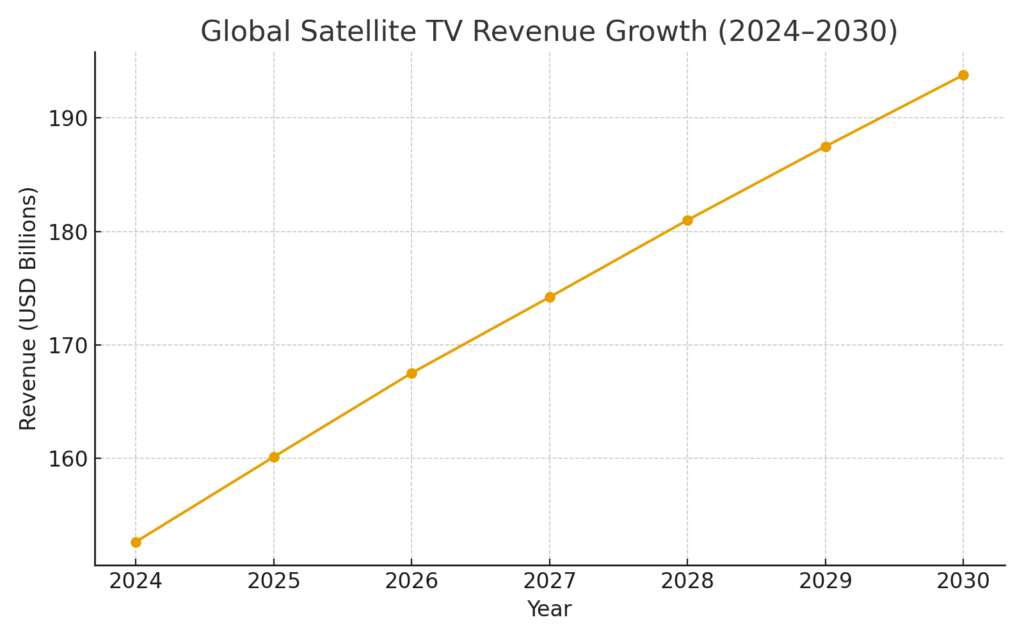
Satellite TV Marketing Statistics #1 – Global Satellite TV Revenue at $152.6 Billion in 2024
The global satellite TV segment generated about $152.6 billion in 2024, showing the resilience of traditional broadcasting in the digital age. Despite growing competition from OTT and streaming services, satellite TV continues to serve millions of households worldwide. Marketers should pay attention to this revenue figure as it highlights the sheer scale of opportunity for advertisers still leveraging TV. With projections pointing toward growth, campaigns on this platform can remain profitable for years ahead. This statistic proves that while streaming is surging, satellite TV marketing still commands a massive audience.
Satellite TV Marketing Statistics #2 – Revenue Expected to Reach $193.8 Billion by 2030
Forecasts suggest satellite TV revenue will rise to about $193.8 billion by 2030. This growth trajectory reflects ongoing investment in technology, better content delivery, and improved advertising formats. Marketers can expect more opportunities in both regional and global markets as satellite broadcasting expands. Brands that continue to use TV in their marketing mix will benefit from this sustained relevance. It’s an encouraging sign that satellite advertising still has a significant role to play.
Satellite TV Marketing Statistics #3 – Satellite Pay-TV Market Valued at $120 Billion in 2023
In 2023, the satellite pay-TV market stood at $120 billion, underlining the consistent demand for premium television services. With subscription bundles and exclusive channels, satellite providers remain attractive despite rising streaming alternatives. Advertisers still find this space valuable because it delivers large, captive audiences. The marketing potential remains especially strong in emerging markets where broadband access lags. For brands, this means satellite TV is still a dependable platform to reach millions.
Satellite TV Marketing Statistics #4 – Market Decline Projection of –1.23% CAGR by 2035
While some forecasts predict growth, others indicate a possible decline to $84.7 billion by 2035. A negative CAGR of –1.23% highlights the pressure satellite TV faces from digital-first competitors. This trend means marketers need to be cautious and adapt their strategies accordingly. It also emphasizes the importance of blending satellite campaigns with digital channels for maximum ROI. The takeaway is clear: satellite TV remains important but requires careful positioning in the marketing mix.
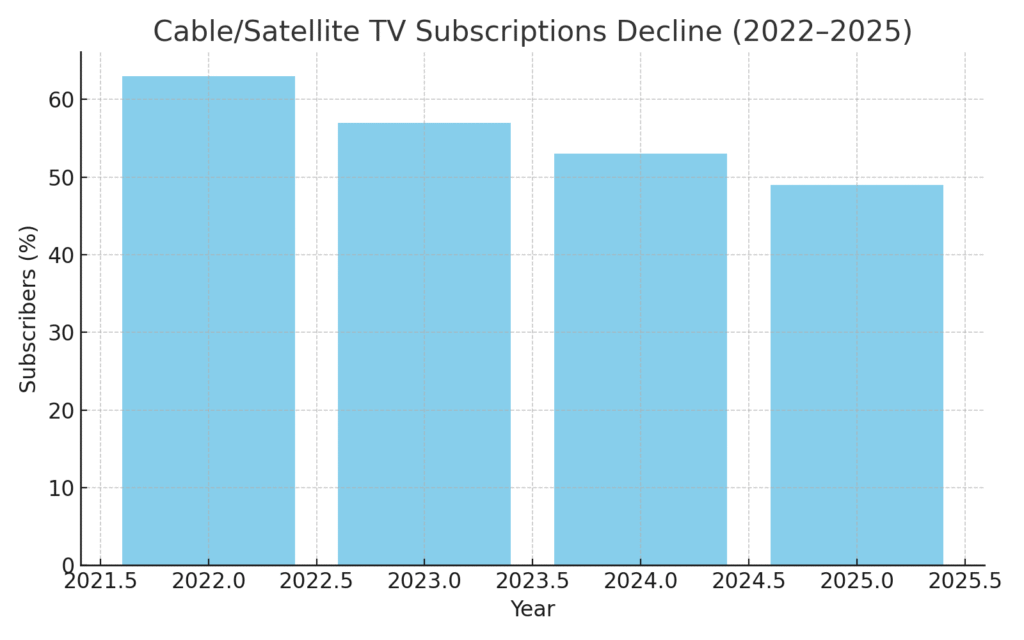
Satellite TV Marketing Statistics #5 – 49% of Consumers Still Subscribe to Cable or Satellite
A 2025 survey revealed that 49% of consumers still hold a cable or satellite subscription. This is a decline from 63% just three years ago, showcasing the gradual shift toward streaming. For marketers, this means satellite still reaches nearly half of households. Advertisers should view this as a substantial share worth targeting. It’s proof that satellite TV marketing remains relevant in today’s fragmented media landscape.
Satellite TV Marketing Statistics #6 – 23% of Gen Z Satellite Subscribers Plan to Cancel
Younger viewers are showing more willingness to cancel satellite subscriptions. About 23% of Gen Z and 18% of Millennials with satellite or cable plan to cut the cord within a year. This shift underlines generational differences in media consumption habits. For marketers, reaching younger demographics through satellite alone is increasingly difficult. It suggests campaigns should integrate digital video ads for a balanced approach.
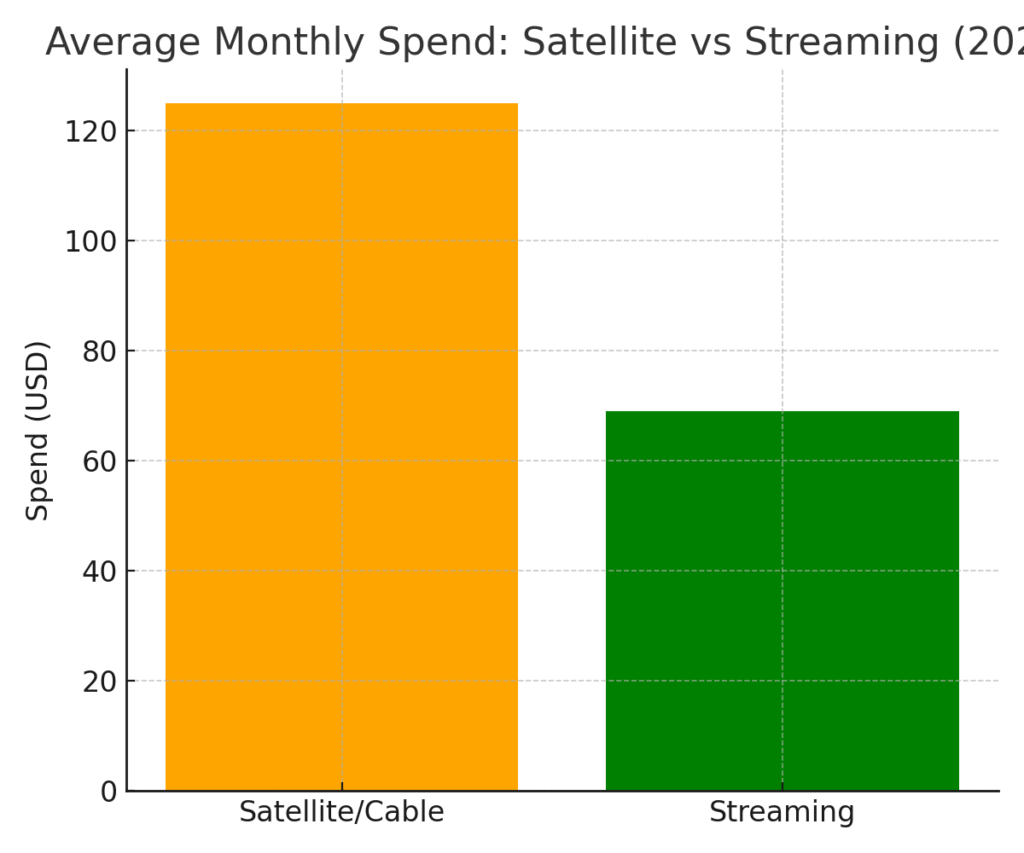
Satellite TV Marketing Statistics #7 – Average Monthly Spend of $125 on Satellite or Cable
Subscribers pay an average of $125 per month on satellite or cable TV, compared to $69 on streaming services. This higher cost highlights why many customers reconsider their subscriptions. For advertisers, it means households sticking with satellite tend to have higher disposable incomes. This makes them attractive targets for premium product marketing. It also signals the value advertisers can derive from a still-loyal paying audience.
Satellite TV Marketing Statistics #8 – U.S. Industry Decline of –6.4% CAGR (2019–2024)
The U.S. satellite TV providers industry has shrunk at about –6.4% CAGR between 2019 and 2024. This decline reflects cord-cutting trends and increased competition from streaming. Despite this, satellite still serves millions across the country. For marketers, this indicates the need to be selective about targeting and optimize campaigns for regions with stronger retention. A well-crafted satellite TV marketing campaign can still succeed, but it requires strategic precision.
Satellite TV Marketing Statistics #9 – 4K Satellite Broadcasting Market Worth $33.9 Billion in 2024
High-quality broadcasting is fueling growth, with 4K satellite broadcasting valued at $33.9 billion in 2024. This segment is growing rapidly at a 14.2% CAGR through 2034. It shows that consumers are still interested in premium, crystal-clear viewing experiences. Advertisers can leverage this by aligning their ads with top-tier broadcast content. The demand for higher quality creates new opportunities in premium ad slots.
Satellite TV Marketing Statistics #10 – SES Transmits Over 8,000 Channels Worldwide
Global operators like SES distribute over 8,000 TV channels, including more than 3,000 in HD and UHD. This massive footprint covers 369 million homes worldwide. For marketers, this scale provides unmatched reach across diverse audiences. Satellite remains a global powerhouse in delivering content to millions. With such scale, advertising opportunities continue to grow across regions.
Satellite TV Marketing Statistics #11 – Global TV Advertising Market at $201.9 Billion in 2025
TV advertising across platforms is valued at about $201.9 billion in 2025. Satellite TV is still an important contributor to this figure, with prime-time slots being particularly powerful. For marketers, this highlights TV’s enduring role as a key marketing channel. Brands that combine TV advertising with digital campaigns gain maximum exposure. Despite industry shifts, television still commands significant ad budgets.
Satellite TV Marketing Statistics #12 – Connected TV Advertising Growing at 12.8% CAGR
Connected TV, which complements satellite services, is growing fast at a 12.8% CAGR through 2030. This trend shows how traditional and digital viewing experiences are blending. Marketers can use this to their advantage by pairing satellite campaigns with CTV targeting. The result is a more data-driven, measurable approach. Satellite TV marketing will benefit by adapting to this hybrid model.
Satellite TV Marketing Statistics #13 – Prime-Time Ads Control 52% of the Market
Prime-time advertising slots account for around 52% of the total TV ad market. Satellite advertisers rely heavily on these high-impact periods. Brands competing for attention know these time slots deliver strong visibility. The takeaway for marketers is the continued importance of prime-time buys. Campaigns designed for peak viewing hours can still achieve significant reach.
Satellite TV Marketing Statistics #14 – Sponsorships Growing at 8.9% CAGR
Sponsorship and co-branding formats in satellite and TV advertising are growing at an 8.9% CAGR through 2030. This reflects brands’ desire for deeper, more integrated exposure. For marketers, sponsorship deals can enhance brand recognition beyond standard ad slots. Satellite provides unique opportunities to pair with sports, events, and lifestyle programming. It’s a reminder that non-traditional ad strategies are gaining traction.
Satellite TV Marketing Statistics #15 – Multichannel Cable/Satellite Advertising at 46% Share
Multichannel cable and satellite collectively hold about 46% of the TV advertising market in 2024. This large share confirms that traditional broadcasting is still a powerhouse. For marketers, investing here means guaranteed exposure to mass audiences. While streaming rises, satellite maintains a central role in media spending. This consistency is what keeps advertisers engaged.
Satellite TV Marketing Statistics #16 – Total TV Advertising at $231.7 Billion in 2024
By 2024, the total TV advertising market reached $231.7 billion globally. Satellite continues to account for a big slice of this figure. For advertisers, it proves the resilience of television in the face of digital disruption. Campaigns on satellite TV still bring measurable returns. It underlines the importance of not abandoning this channel too quickly.
Satellite TV Marketing Statistics #17 – 56% of U.S. Adults Subscribe to Cable or Satellite
In 2024, 56% of U.S. adults reported maintaining a cable or satellite subscription. This majority confirms that satellite remains deeply embedded in American households. For marketers, this is a reminder of satellite’s continued relevance in a key global market. Even with streaming rising, the platform remains a trusted staple. Brands seeking reach across demographics can still count on this medium.
Satellite TV Marketing Statistics #18 – TV Analytics Market Valued at $3.66 Billion in 2022
The global TV analytics market, covering satellite as well, was worth $3.66 billion in 2022. It’s forecast to grow rapidly at 17.9% CAGR, reaching $11.6 billion by 2029. This surge reflects advertisers’ need for better measurement and ROI tracking. For marketers, analytics ensures satellite TV campaigns become more data-driven. The integration of analytics tools makes satellite advertising more effective than ever.
Satellite TV Marketing Statistics #19 – TV Distribution Model Market Valued at $208 Billion in 2024
In 2024, the TV distribution model market (satellite, cable, IPTV, OTT) was worth $208 billion. It’s projected to hit nearly $286 billion by 2033 at a 3.6% CAGR. For marketers, this statistic underscores the combined strength of traditional and digital TV. Satellite remains a core part of this ecosystem. Advertisers should consider it when building multi-channel campaigns.
Satellite TV Marketing Statistics #20 – Asia-Pacific Holds 31% of Satellite TV Market Share
The Asia-Pacific region accounts for about 31% of the global satellite TV market. This dominance reflects the region’s vast population and demand for broadcasting services. For marketers, Asia offers enormous growth opportunities through satellite campaigns. It’s also a reminder of how regional variations shape global strategies. Brands looking for expansion should not ignore Asia’s satellite TV landscape.

Why Satellite TV Marketing Still Matters
Looking at these satellite TV marketing statistics, it’s clear that this medium is far from irrelevant. While streaming continues to grow, satellite TV still commands billions in revenue, millions of households, and a significant share of global advertising. Personally, I believe marketers who write it off completely are missing a valuable piece of the puzzle. By blending satellite advertising with digital targeting, brands can reach both traditional and tech-savvy audiences. That’s the beauty of modern marketing: it’s about combining the old and the new in creative ways.
SOURCES
-
https://www.verifiedmarketreports.com/product/satellite-pay-tv-market/
-
https://www.businessresearchinsights.com/market-reports/satellite-tv-market-121009
-
https://www.ibisworld.com/united-states/industry/satellite-tv-providers/2012/
-
https://www.gminsights.com/industry-analysis/4k-satellite-broadcasting-market
-
https://www.mordorintelligence.com/industry-reports/tv-advertising-market
-
https://www.marketresearchfuture.com/reports/tv-advertising-market-24401
-
https://www.maximizemarketresearch.com/market-report/global-tv-analytics-market-2/23037/
-
https://straitsresearch.com/report/tv-distribution-model-market