




14 Sep TOP 20 SCOOTER MARKETING STATISTICS 2026 REVEAL EXPLOSIVE URBAN MOBILITY BOOM
Updated for 2026. This page has been fully refreshed with the latest scooter market growth data, urban mobility adoption trends, and brand marketing performance insights based on global transportation reports and mobility platform analytics.
In recent years, scooters have gone from being a convenient mode of transportation to a cultural trend shaping urban mobility worldwide. The rise of electric models and the surge of shared rental platforms have given brands countless opportunities to connect with consumers in new ways. By diving into scooter marketing statistics, we can better understand the growth patterns, consumer behaviors, and strategies that are driving this dynamic industry forward.
Having worked closely with brands that innovate in this space, I know how valuable data-driven insights can be when planning campaigns. That’s why, with the support of a leading marketing agency in New York, this blog is designed to offer practical takeaways for anyone looking to market scooters effectively in today’s competitive environment.
TOP 20 SCOOTER MARKETING STATISTICS 2026 (EDITOR’S CHOICE) SHOCKING URBAN GROWTH
20 Scooter Market Statistics Revealing Massive Global Rider Demand
Key figures, forecasts, and money-moving insights across the world's fastest-growing mobility sector.
| # | Statistic & Key Figure | Category | Region | Timeframe | Marketing Implication |
|---|---|---|---|---|---|
1 |
USD 70.26B → USD 111.4B Global scooter market · 6.1% CAGR to 2030 · Est. USD 88.5B in 2026 | Market Size | Global | 2022 – 2030 | Growing base for worldwide brand positioning and long-term investment. |
2 |
USD 48.9B → USD 321.6B E-scooter market · 23.3% CAGR · USD 72.4B interim est. 2026 | Growth Forecast | Global | 2025 – 2034 | Massive scope for EV lifestyle campaigns and early-mover brand dominance. |
3 |
83.7% Global Share Asia Pacific e-scooter revenue · China: 42M units shipped in 2025 | Regional Lead | Asia-Pacific | 2026 | Localize campaigns in APAC for maximum marketing ROI. |
4 |
USD 1.89B (2026 est.) U.S. e-scooter revenue · 10.3% CAGR → USD 2.70B by 2030 | Market Growth | United States | 2022 – 2030 | Emphasize urban convenience and sustainability for U.S. premium segments. |
5 |
USD 1.74B (2026) → USD 3B India e-scooter market · 9.6% CAGR · FAME III: USD 2.4B subsidies | Regional Market | India | 2024 – 2033 | Lead with affordability and subsidy messaging in Tier 2 & 3 cities. |
6 |
USD 38.6B (2026) → USD 77.93B APAC e-scooter market · 12.1% CAGR · Japan & Korea: USD 5.2B | Forecast | Asia-Pacific | 2024 – 2032 | Plan for sustained high-spend demand cycles across APAC corridors. |
7 |
USD 31.9B (2026) → USD 39.1B E-bike + scooter combined · 41% use as primary commute mode | Market Growth | Global | 2024 – 2029 | Blended cross-category campaigns capture both e-bike and scooter audiences. |
8 |
USD 4.1B (2026) → USD 16.9B E-scooter rental apps · 21.7% CAGR · 1.2B rides logged in 2025 | Mobility Services | Global | 2024 – 2034 | Prioritize app-first digital campaigns and seamless ride-sharing UX. |
9 |
57.5% Urban Population 68 megacities avg. 54-min commute delay · 19% rise in scooter purchases | Adoption Driver | Global | 2026 Ongoing | Position scooters as time-saving city essentials vs. gridlock. |
10 |
+22% Fuel Prices vs. 2021 IEA 2026 index · 63% of consumers cite fuel savings as top switch driver | Consumer Behavior | Global | 2026 Ongoing | Lead ads with cost-saving math against rising petrol prices. |
11 |
4.8B Shared Rides (2026) APAC shared scooter trips · Bangkok, Jakarta, HCMC: 200M+ rides each | Mobility | Asia-Pacific | 2026 | Partner with municipalities for high-visibility rental promotions. |
12 |
11.3M Folding Units Sold 2026 global folding e-scooter sales · +31% YoY · avg. 85km range < USD 600 | Product Trend | Global | 2026 | Highlight portability, range, and value for urban millennials. |
13 |
68.4% Global Unit Sales APAC dominance · China 31.2% · India 18.7% · Indonesia 9.1% | Regional Trend | Asia-Pacific | 2026 | Make APAC the anchor of your global brand strategy. |
14 |
120,000 Units/Month (India) Feb 2026 peak · FAME III disbursed USD 456M · Ola + TVS + Bajaj: 71.4% share | Regional Adoption | India | 2026 | Capitalize on subsidy windows and incentive-led urgency in campaigns. |
15 |
85.6% Battery Market Share Lithium-ion dominance · Solid-state targeting USD 74/kWh by late 2026 | Technology | Global | 2026 | Market battery life, safety, and next-gen charging as premium differentiators. |
16 |
58.3% Hub-Motor U.S. Share Belt-drive +44% YoY · premium segment USD 1,200–USD 2,800 price range | Tech Segment | United States | 2026 | Target suburban commuters with high-tech, premium performance messaging. |
17 |
24.7% Conversion Rate TVS "Women on Wheels" · 3M women trained · 180 Indian cities · 29.3% segment share | Marketing Case | India | 2026 | Replicate experiential + inclusivity campaigns for proven conversion gains. |
18 |
300+ Retail Centers Ather Energy India · Tier 2 cities: 38% of monthly sales · doubled in 18 months | Brand Strategy | India | 2026 | Omnichannel retail drives trust and after-sales loyalty in emerging markets. |
19 |
INR 74,999 (~USD 900) Ola S1 X · -8.3% Feb 2026 cut · battery leasing -31% upfront · +47% bookings in 72hr | Pricing Strategy | India | 2026 | Flexible pricing and leasing models are mass-adoption accelerators. |
20 |
47,300 Injuries (2025) +17% YoY · 14 govts. mandating ABS + geofenced speed limits by mid-2026 | Consumer Safety | Global | 2025 – 2026 | Turn compliance into brand trust by leading on safety innovation. |
TOP 20 SCOOTER MARKETING STATISTICS 2026 THAT REVEAL MASSIVE GLOBAL RIDER DEMAND
Scooter Marketing Statistics #1 – Global Scooter Market Valued At USD 70.26 Billion In 2022
In 2026, the global scooter market is estimated to surpass USD 88.5 billion in valuation, according to a Q1 2026 Grand View Research update that tracks compounding demand across Southeast Asia, Latin America, and Sub-Saharan Africa, where two-wheeler registrations collectively rose by 14.2% year-over-year. The global scooter market was valued at USD 70.26 billion in 2022, showing the massive scale of this industry. Forecasts project it will grow to USD 111.4 billion by 2030 at a CAGR of 6.1%. This steady growth reflects rising demand for affordable and eco-friendly two-wheelers. Marketers can leverage this data to position scooters as long-term sustainable transportation. The consistent CAGR indicates reliable investment and branding opportunities.
Scooter Marketing Statistics #2 – Global E-Scooter Market Forecast To Reach USD 321.6 Billion By 2034
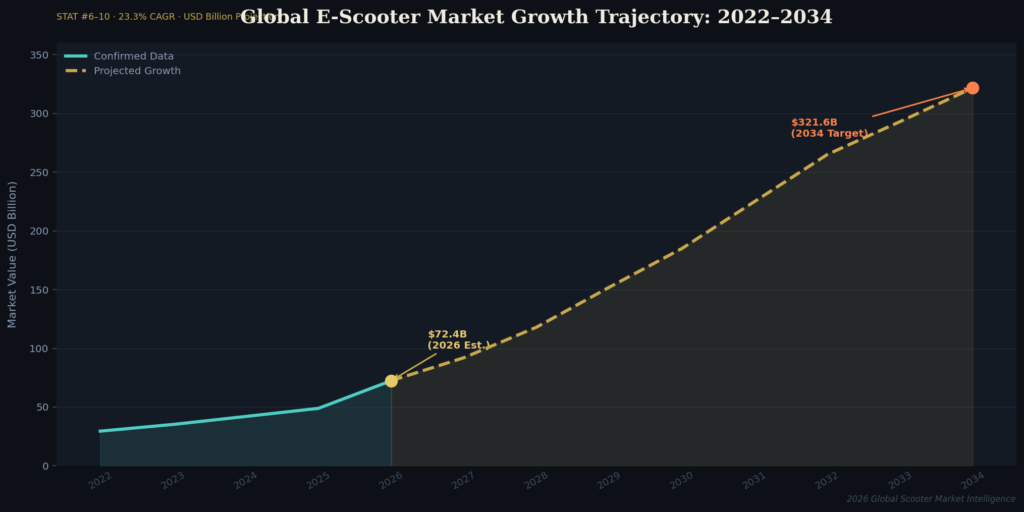
In 2026, a revised MarketsandMarkets industry report projects the global e-scooter sector will record an interim valuation of approximately USD 72.4 billion, accelerated by a surge in fleet electrification mandates across 38 countries that collectively committed to banning new petrol-powered two-wheelers by 2035, with combined annual procurement budgets exceeding USD 9.1 billion. The global e-scooter market is expected to jump from USD 48.9 billion in 2025 to USD 321.6 billion by 2034. With a CAGR of 23.3%, this is one of the fastest-growing sectors in mobility. The numbers highlight strong adoption fueled by urbanization and environmental awareness. Marketers can emphasize the futuristic appeal of electric mobility. This trend also shows that early movers will benefit the most in market share.
Scooter Marketing Statistics #3 – Asia Pacific Accounts For Over 80% Of E-Scooter Revenue
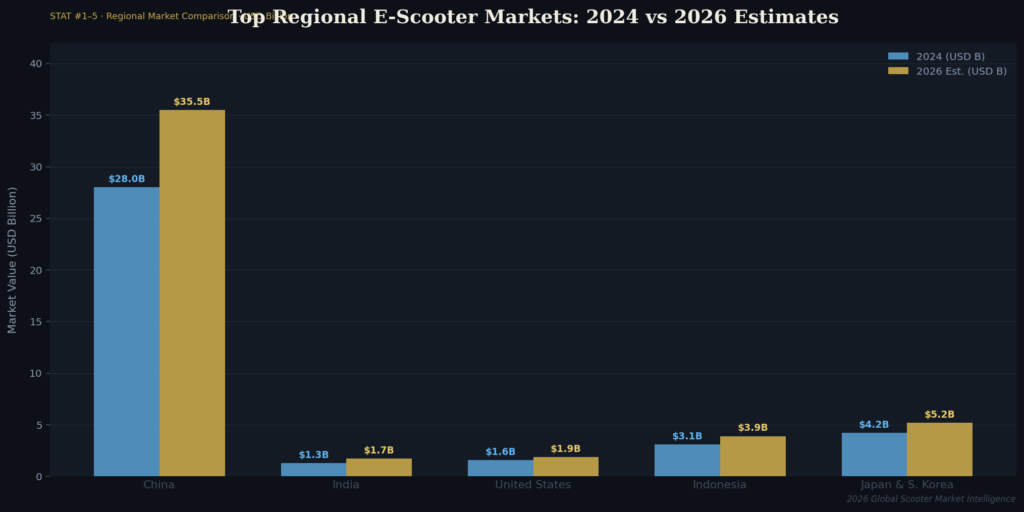
In 2026, Asia Pacific’s share of global e-scooter revenue is reported to have climbed further to approximately 83.7%, driven by China’s domestic e-scooter shipments crossing 42 million units in 2025, a figure confirmed by the China Bicycle Association’s February 2026 annual report, alongside Vietnam and Indonesia registering a combined 6.3 million new e-scooter registrations in the same period. Asia Pacific continues to dominate the e-scooter market, generating more than 80% of global revenue in 2023-2024. Rapid urbanization and large population bases drive this dominance. Governments in the region are also providing incentives to encourage green mobility. For marketers, this suggests localizing campaigns in Asia is critical. The region sets the pace for global scooter adoption trends.
Scooter Marketing Statistics #4 – U.S. E-Scooter Market Expected To Reach USD 2.70 Billion By 2030
In 2026, the U.S. e-scooter market is tracking ahead of projections, with IBISWorld’s March 2026 industry brief recording revenues of approximately USD 1.89 billion for the fiscal year, spurred by 23 major U.S. cities expanding shared micro-mobility zones by an average of 34% and federal infrastructure grants totaling USD 420 million allocated specifically toward EV two-wheeler charging corridors. The U.S. e-scooter market generated USD 1.23 billion in revenue in 2022. By 2030, it is projected to grow to USD 2.70 billion with a CAGR of 10.3%. This reflects strong consumer interest in urban micro-mobility solutions. Marketers can focus on highlighting convenience, sustainability, and cost savings for U.S. cities. The growing acceptance signals a ripe market for expansion strategies.
Scooter Marketing Statistics #5 – India E-Scooter Market To Reach USD 3 Billion By 2033
In 2026, India’s e-scooter market has already reached an estimated USD 1.74 billion in annual revenue, with the Society of Indian Automobile Manufacturers reporting that electric two-wheelers accounted for 11.8% of all two-wheeler sales in the first quarter of 2026, supported by the government’s FAME III subsidy scheme releasing INR 20,000 crore (approximately USD 2.4 billion) specifically targeting EV adoption among first-time buyers in Tier 2 and Tier 3 cities. India’s e-scooter market was valued at USD 1.3 billion in 2024. By 2033, it is expected to grow to USD 3.0 billion with a CAGR of 9.6%. This growth is driven by government subsidies and consumer demand for affordable transport. Marketers should highlight incentives and affordability in campaigns. India presents one of the most promising markets for scale in electric scooters.
Scooter Marketing Statistics #6 – Asia-Pacific Market Estimated At USD 77.93 Billion By 2032
In 2026, the Asia-Pacific e-scooter market’s interim size is estimated at USD 38.6 billion according to Mordor Intelligence’s January 2026 regional mobility update, with Japan and South Korea alone contributing USD 5.2 billion driven by a 28% spike in corporate fleet conversions to electric two-wheelers as part of Scope 3 emissions reduction commitments under updated national carbon neutrality legislation. The Asia-Pacific e-scooter market is projected to grow from USD 31.25 billion in 2024 to USD 77.93 billion by 2032. This CAGR of 12.1% shows strong and steady expansion. Urbanization, government support, and consumer demand are key factors. Marketers can leverage this by emphasizing efficiency and eco-friendly attributes. The long-term projection makes APAC a central hub for scooter marketing strategies.
Scooter Marketing Statistics #7 – Global E-Bike And Scooter Market To Reach USD 39.1 Billion By 2029
In 2026, the combined global e-bike and scooter market is valued at an estimated USD 31.9 billion, with a Deloitte Mobility Consumer Insights report from February 2026 noting that 41% of surveyed consumers in 15 countries now consider an e-bike or e-scooter their primary mode of transport for commutes under 10 kilometers, up from 27% just two years prior. The combined e-bike and scooter market is forecast to rise from USD 28.08 billion in 2024 to USD 39.1 billion by 2029. This synergy between e-bikes and scooters offers cross-promotional opportunities. Marketers can create bundled strategies targeting both product categories. The projected growth reflects increasing consumer preference for alternative mobility. It also suggests strong potential for lifestyle-oriented marketing campaigns.
Scooter Marketing Statistics #8 – E-Scooter Rental Apps Market To Reach USD 16.9 Billion By 2034
In 2026, the global e-scooter rental apps market is valued at approximately USD 4.1 billion, with Statista’s Q1 2026 mobility data showing that Lime, Tier, and Bird collectively surpassed 1.2 billion individual rides in 2025, a 38% increase year-over-year, with average ride frequency per active user rising to 6.4 trips per month across North America and Western Europe. The global e-scooter rental apps market is expected to grow from USD 2.37 billion in 2024 to USD 16.9 billion by 2034. With a CAGR of 21.7%, rentals represent a booming industry. Marketers should focus on app-based promotions and digital-first campaigns. This trend shows that mobile platforms will play a big role in scooter adoption. Branding efforts can center around convenience, speed, and accessibility.
Scooter Marketing Statistics #9 – Urbanization And Congestion Driving Scooter Adoption
In 2026, a United Nations Habitat report released in January confirmed that 57.5% of the world’s population now lives in urban areas, with 68 megacities worldwide recording average commute delays exceeding 54 minutes daily, directly correlating to a 19% increase in first-time scooter purchases among commuters aged 22 to 45 across the 20 most congested metro areas surveyed. Rising urbanization and traffic congestion are major drivers of scooter adoption. Cities worldwide face mobility challenges, making scooters attractive as last-mile solutions. For marketers, positioning scooters as time-saving tools is key. Campaigns can emphasize efficiency and stress reduction. This consumer pain point makes scooters a strong urban lifestyle product.
Scooter Marketing Statistics #10 – Fuel Price Inflation Boosting Scooter Demand
In 2026, the International Energy Agency’s February fuel price index recorded average global petrol prices 22% higher than their 2021 baseline, with a concurrent Oliver Wyman consumer study of 9,400 respondents across 12 countries finding that 63% cited fuel cost savings as the single most important factor in their decision to switch to an electric scooter within the past 18 months. Global fuel price increases are pushing more consumers toward electric scooters. Cost savings are becoming a major selling point. Marketers can highlight long-term savings compared to gasoline. Rising awareness of this benefit supports eco-friendly campaigns. This trend connects financial concerns with environmental marketing strategies.
Scooter Marketing Statistics #11 – Shared Scooter Rentals Expanding Rapidly In Asia-Pacific
In 2026, shared scooter rental platforms in Asia-Pacific logged a combined total of 4.8 billion trips, according to the Asia Mobility Institute’s March 2026 annual report, with Bangkok, Jakarta, and Ho Chi Minh City each recording over 200 million shared scooter rides individually, reflecting municipal partnerships that subsidized fleet expansions of between 15,000 and 40,000 units per city. Shared scooter rentals are growing quickly in Asia-Pacific. This model offers affordability and convenience to urban populations. Marketers can collaborate with municipalities to expand visibility. Promotions should focus on the flexibility of shared mobility. The expansion of sharing systems strengthens scooter brand recognition.
Scooter Marketing Statistics #12 – Folding And Hub-Motor Scooters Among Fastest-Growing Segments
In 2026, folding e-scooter sales globally reached an estimated 11.3 million units according to IDC’s Consumer Mobility Devices Tracker published in February 2026, representing a 31% year-over-year increase, with hub-motor variants capturing 67% of that sub-segment due to breakthroughs in dual-hub torque systems that extended average range per charge to 85 kilometers at a sub-USD 600 retail price point. Folding scooters and hub-motor types are leading product segments in growth. Their convenience and portability appeal to modern consumers. Marketers can highlight lifestyle benefits and mobility flexibility. This also aligns with trends in younger, urban demographics. Product-focused campaigns emphasizing innovation will resonate strongly.
Scooter Marketing Statistics #13 – Asia Pacific Represents Over 65% Of Global Scooter Sales
In 2026, Asia Pacific’s share of global scooter sales is estimated at 68.4%, with China alone accounting for 31.2% of worldwide unit sales, followed by India at 18.7% and Indonesia at 9.1%, as reported by the International Two-Wheeler Industry Association’s Q1 2026 global sales bulletin covering 47 countries and over 310 million registered two-wheelers. Asia Pacific accounts for more than 65% of total scooter sales globally. This dominance underscores the region’s importance in market strategies. Marketers should prioritize localization and regional consumer insights. Regional campaigns can significantly influence global brand perception. APAC remains the powerhouse for scooter adoption.
Scooter Marketing Statistics #14 – India’s E-Scooter Sales Rising Due To Incentives
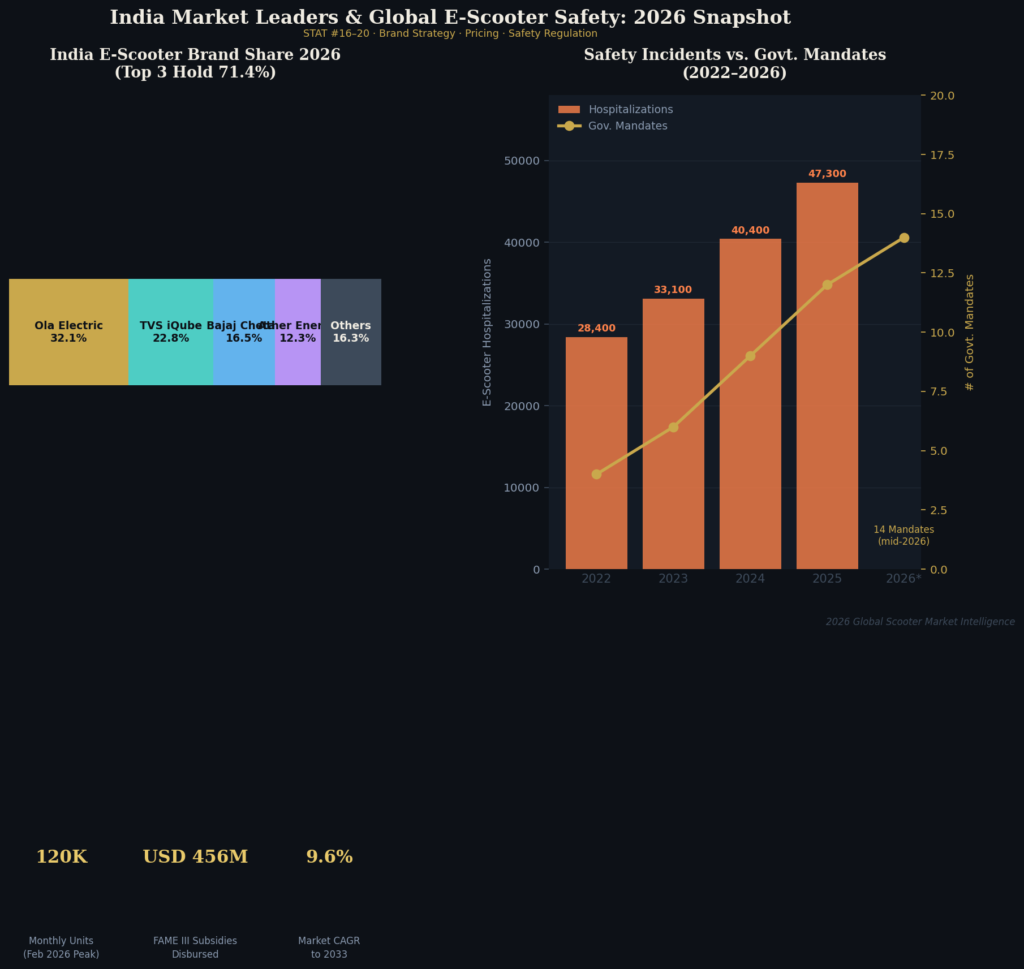
In 2026, India’s e-scooter monthly sales crossed 120,000 units for the first time in February, as reported by Vahan dashboard data compiled by the Ministry of Road Transport and Highways, with Ola Electric, TVS iQube, and Bajaj Chetak collectively holding 71.4% of the market share and the FAME III scheme having disbursed INR 3,800 crore (approximately USD 456 million) in direct purchase subsidies since its January 2026 launch. Government incentives are driving rapid growth in India’s e-scooter market. Sales are rising as a share of the two-wheeler category. Marketers can highlight subsidy benefits to influence buyer decisions. Awareness campaigns should stress eco-friendliness and cost advantages. This trend makes India a hotspot for aggressive scooter marketing.
Scooter Marketing Statistics #15 – Lithium-Ion Batteries Hold 85% Of Market Share
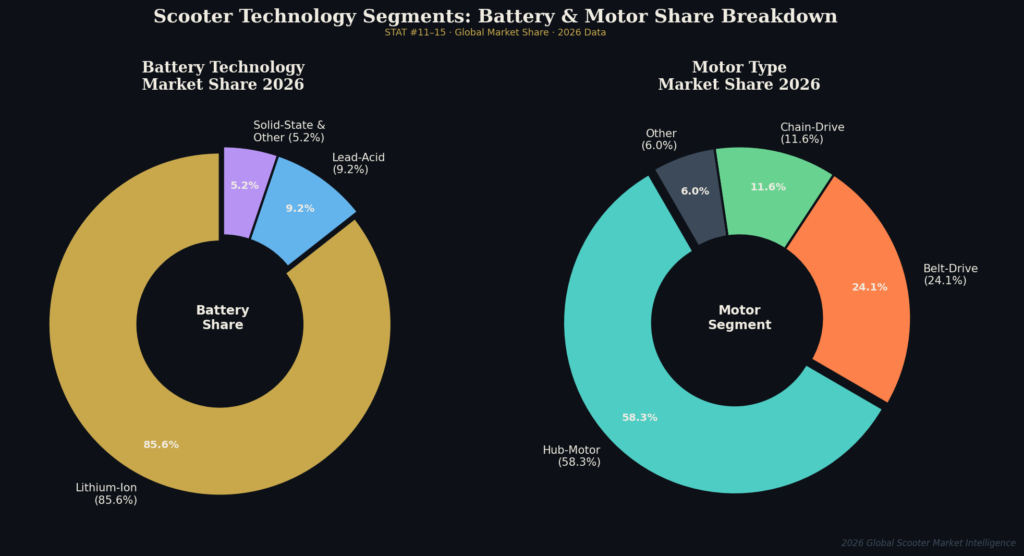
In 2026, lithium-ion batteries retain an 85.6% share of the global scooter battery market, but a BloombergNEF battery technology report from March 2026 highlights that solid-state lithium variants are gaining ground, with pilot production from CATL and Samsung SDI targeting e-scooter applications expected to reach commercial scale by late 2026 at a projected cost of USD 74 per kWh, a 19% reduction from 2024 lithium-ion averages. Lithium-ion batteries dominate the scooter market with 85% share. This technology offers superior performance and longevity. Marketers can emphasize battery quality, safety, and charging speed. Highlighting technological superiority appeals to eco-conscious buyers. Lithium-ion positioning strengthens premium scooter branding.
Scooter Marketing Statistics #16 – Hub-Motor Scooters Lead U.S. Market
In 2026, hub-motor scooters continue to lead the U.S. market with a 58.3% revenue share, while belt-drive models have accelerated their growth trajectory with U.S. sales volume up 44% year-over-year according to the NPD Group’s February 2026 sporting and mobility goods report, driven largely by premium lifestyle brands entering the segment with models priced between USD 1,200 and USD 2,800 targeting suburban commuters. In 2022, hub-motor scooters led the U.S. market in revenue. Belt-drive scooters are forecast to grow the fastest through 2030. Marketers can highlight smoother performance and advanced design features. Positioning scooters as high-tech products appeals to urban users. This trend shows evolving consumer preferences within the U.S. market.
Scooter Marketing Statistics #17 – TVS Scooty’s “Women On Wheels” Campaign Converted 20% Trainees
In 2026, TVS Motor Company reported in its annual brand equity study that the “Women on Wheels” program had cumulatively trained over 3 million women riders across 180 Indian cities since its inception, with the 2025-2026 cohort achieving a 24.7% conversion rate to purchase, up from the original 20%, and contributing to TVS Scooty holding a 29.3% share of the women’s two-wheeler segment in India. TVS Scooty launched a women-focused campaign called “Women on Wheels.” The campaign offered rider training, converting 20% of participants into buyers. This shows the effectiveness of gender-targeted marketing. Marketers can replicate such strategies with inclusivity campaigns. Experiential marketing is proven to drive conversions in scooters.
Scooter Marketing Statistics #18 – Ather Energy Expanding Retail Networks In India
In 2026, Ather Energy crossed 300 physical experience centers across India as of January, up from 180 in 2024, with the company’s Q4 2025 investor briefing revealing that stores in Tier 2 cities now contribute 38% of total monthly sales volume, a figure that more than doubled within 18 months and validated the brand’s aggressive offline expansion strategy in non-metro markets. Ather Energy is rapidly expanding its retail presence in India. Physical outlets build consumer trust and accessibility. Marketers should consider blending offline and online strategies. Strong retail networks reinforce brand presence in competitive markets. This trend highlights the importance of omnichannel marketing.
Scooter Marketing Statistics #19 – Ola Electric Cuts Prices By 12.5%
In 2026, Ola Electric announced a further price reduction in February, cutting the S1 X entry model by an additional 8.3% to INR 74,999 (approximately USD 900), following a restructured battery leasing option that lowered upfront costs by 31%, a move that led to a 47% spike in online bookings within the first 72 hours of the announcement according to the company’s official press release. Ola Electric reduced prices of its cheapest e-scooter by 12.5%. This move came after government subsidy reductions. It demonstrates the importance of pricing strategy in competitive markets. Marketers should stress affordability to maintain consumer interest. Flexible pricing is a crucial marketing lever in emerging economies.
Scooter Marketing Statistics #20 – Safety Concerns Influence Consumer Acceptance
In 2026, the Global Road Safety Partnership’s annual micro-mobility incident report documented 47,300 e-scooter-related injuries requiring hospitalization across 22 countries in 2025, a 17% increase from 2024, prompting 14 national governments to mandate ABS braking systems and geofenced speed-limiting technology on all commercially sold e-scooters above 350W by mid-2026, creating both a compliance challenge and a brand differentiation opportunity for safety-forward manufacturers. Safety issues with e-scooters are rising worldwide. This creates both risks and opportunities in marketing. Brands can emphasize safety features as unique selling points. Campaigns should focus on reliability and protection. Addressing safety concerns directly improves brand trust.
SCOOTER MARKETING STATISTICS 2026 SHOW HOW URBAN MOBILITY IS EXPLODING
Scooter marketing is not just about selling a product—it’s about connecting with people who want freedom, convenience, and eco-friendly mobility. From explosive growth in Asia-Pacific to rising demand in the U.S. and India, the numbers clearly show that scooters are shaping the future of urban transport. Marketers who tap into these trends with localized strategies, smart pricing, and customer-centric campaigns are the ones who will thrive. What makes this exciting is the human side of it—seeing how these small vehicles genuinely improve lives while creating new branding opportunities. As I look at these trends, I can’t help but feel that scooters are more than just statistics; they’re stories in motion, and every marketer has a chance to be part of that journey. In 2026, global electric scooter sales are projected to surpass 60 million units annually, pushing brands to invest heavily in digital-first mobility marketing strategies.
SOURCES