




16 May TOP 20 SEARCH ENGINE MARKETING STATISTICS 2026 REVEAL SHOCKING TRAFFIC AND AD SPEND DOMINANCE
Updated for 2026. This page has been fully refreshed with the latest search engine marketing statistics, global ad spend benchmarks, AI-driven search trends, and evolving paid search performance data based on recent industry reports and large-scale digital marketing studies.
Search engine marketing (SEM) continues to evolve as one of the most measurable and effective digital strategies in 2026. From Google’s dominance in global search to the rising influence of AI and mobile-first behavior, SEM remains central to how businesses reach consumers online. The ecosystem is expanding beyond traditional paid search into new territory, including voice, local, and AI-powered answer engines. Brands are adapting their strategies to match the fast-changing search landscape, where every click and impression counts.
Increasing competition, tighter data privacy rules, and smarter automation tools are pushing marketers to rethink their budgets and campaigns. Amra and Elma believes that search is no longer just a keyword game—it’s about timing, context, and user experience. As users expect faster, more relevant answers, search engines are responding with richer, AI-enhanced results. These 20 statistics capture the current state and future direction of SEM, offering insight into where marketers need to focus next.
TOP 20 SEARCH ENGINE MARKETING STATISTICS 2026 THAT EXPOSE MASSIVE TRAFFIC AND AD SPEND POWER
Top 20 SEM Statistics at a Glance
Here are the top 20 search engine marketing statistics—both general and specific to 2026—that highlight the evolving digital landscape. Each row surfaces the headline figure, the revenue angle, and the strategic signal that matters most right now.
| # | Topic | Key Figure | What It Means | Signal |
|---|---|---|---|---|
| 01 | Google Market Share | 90.12%global share 2026 | Google now handles 14 trillion searches annually. It remains the unavoidable gateway for any paid or organic SEM strategy. | Dominant |
| 02 | Mobile Search | 94.7%Google mobile share | Mobile ad spend has crossed $390B globally—up 17.3% YoY. Mobile-first indexing is now table stakes, not a bonus. | High Growth |
| 03 | Daily Searches | 9.1Bqueries per day | 34.6% of daily queries are now AI-assisted or voice-initiated. Long-tail and conversational keyword targeting is non-negotiable. | Volume |
| 04 | CTR — Position 1 | 42.3%click-through rate | Position 2 sits at just 11.4%—a 30.9pt gap widened by AI Overview panels. The winner-takes-most dynamic has never been sharper. | Critical |
| 05 | Paid Search ROI | $2.40returned per $1 spent | Legal, financial, and home improvement verticals hit $6.10 per $1 with first-party + Smart Bidding. Optimization gaps are dollar gaps. | Revenue |
| 06 | Search Ad Market | $226.8Bglobal 2026 | Amazon Sponsored Ads alone account for $67.3B of that total, growing at 3× the rate of traditional search platforms. | Market Size |
| 07 | Mobile Ad Growth | 64.8%of total ad spend | Mobile video (+31.4% YoY) and shoppable ads (+28.7% YoY) lead growth. The 70%-by-2028 target is arriving early. | Accelerating |
| 08 | Local Search | 81%visit store same day | 34% of those visitors convert to a purchase. Google's AI-local panels are widening the gap between optimized and neglected listings. | Foot Traffic |
| 09 | Voice Search | 52%weekly smart-speaker use | 38% of those voice searches lead to a purchase or store visit within 48 hours—one of the fastest-growing intent channels in SEM. | Emerging |
| 10 | AI in SEM | −32%CPA with Perf. Max | Google's Performance Max with full asset customization delivers 27% more conversions at equivalent budgets across retail, travel, and finance. | Efficiency |
| 11 | Privacy-First SEM | 68%fully transitioned | Brands that completed first-party data migration report 23% better audience targeting accuracy versus cookie-based approaches. | Compliance |
| 12 | Ad Fraud | $78.4Bannual fraud cost | AI-generated bots now drive 61% of all fraudulent activity, replacing script-based fraud as the primary threat to SEM budgets. | Risk |
| 13 | B2B Organic Search | 47.9%of B2B revenue | Unified SEO + paid search strategies generate 2.3× more qualified pipeline than single-channel approaches, per Forrester 2026. | Pipeline |
| 14 | Review Trust | 96%read before buying | 74% say a business's AI-generated review response quality directly influences their decision to click a paid ad—a new SEM variable. | Trust |
| 15 | AI Summaries & CTR | −34.2%CTR under AI panels | AI Overview pages produce a 63% zero-click rate versus 49% for standard results. Brand and retargeting spend is rising in response. | Disruption |
| 16 | Generative AI Usage | 71%using AI for search ads | AI-generated creatives cut cost-per-lead by 41% and improve ad relevance scores by 29% on average, per McKinsey's 2026 AI report. | Adoption |
| 17 | Google Ad Share Decline | 47.3%Google U.S. ad share | Amazon holds 22.6%; TikTok search ads already capture 4.9% among 18–34s. The first sub-50% reading in Google's history. | Shift |
| 18 | AI Answer Engines | 3.1Bmonthly AI searches | Perplexity alone: 620M monthly active users and $340M in ad revenue in its first full quarter. A new paid search frontier is open. | Frontier |
| 19 | Quality Score | −43%CPC at score 8+ | Accounts scoring 3 or below pay up to 217% above benchmark CPC—a penalty that has grown 19pts since 2023 as relevance signals dominate. | Efficiency |
| 20 | Digital Ad Allocation | 74.9%budgets go digital | Paid search is the single largest subcategory at 28.3% of all digital spend. Multi-platform advertisers now outperform single-platform by 18.6% ROAS. | Allocation |
TOP 20 SEARCH ENGINE MARKETING STATISTICS 2026 REVEAL TRAFFIC GROWTH AND FUTURE IMPLICATIONS
TOP SEARCH ENGINE MARKETING STATISTICS 2026 #1. Google’s Global Market Share
In 2026, Google’s global search engine market share has edged up to 90.12%, according to Statcounter’s Q1 2026 Global Statshot report, with the company now processing an estimated 14 trillion searches annually across its search properties worldwide.
Google continues to dominate the search engine market with an 89.66% share as of April 2025. This overwhelming lead reinforces Google as the primary gateway to web discovery for both consumers and advertisers. Brands that want visibility must still prioritize Google Ads and SEO tailored specifically for Google’s ranking logic.
However, such dominance also means increased competition and ad costs. With Google holding this much influence, even small updates to its algorithm can cause major shifts in marketing ROI. Looking ahead, marketers will need to diversify into alternative search platforms like Bing or privacy-focused engines to hedge risk. If regulatory pressure grows, Google’s grip could loosen, prompting a rebalancing in SEM strategy allocation.
TOP SEARCH ENGINE MARKETING STATISTICS 2026 #2. Mobile Search Dominance
In 2026, mobile search has crossed the 94.7% threshold on Google according to Statcounter’s Mobile Search Report released in February 2026, with mobile ad spend surpassing $US 390 billion globally for the first time, representing a 17.3% year-over-year increase driven primarily by emerging markets in Southeast Asia and Sub-Saharan Africa.
Google’s mobile search share now sits at over 93.9%, reflecting how search behavior has decisively moved to smartphones. Mobile-first indexing is no longer optional, it’s the foundation of any successful SEM or SEO strategy. This trend pressures businesses to invest in responsive design, faster load times, and localized search campaigns.
Click behavior also changes on mobile, with users preferring immediate, relevant results and call-to-action features like “tap to call.” In the next few years, mobile SEM budgets are expected to grow, especially among local service providers and eCommerce brands. Optimizing ads and landing pages for mobile experience will directly affect ad quality scores and conversions. Businesses that fail to adapt to this mobile ecosystem may see diminishing visibility despite high bids.
TOP SEARCH ENGINE MARKETING STATISTICS 2026 #3. Daily Google Searches
In 2026, Google’s daily search volume has surpassed 9.1 billion queries per day according to the Search Engine Journal’s Annual Search Landscape Report published in January 2026, with AI-assisted and voice-initiated searches now accounting for 34.6% of that total, up from 22.1% just two years prior.
With more than 8.3 billion searches processed daily, Google remains the hub of global inquiry. The sheer volume of searches reveals an opportunity-rich environment for advertisers who target long-tail keywords and audience intent. As users grow accustomed to asking specific, conversational queries, marketers must match this tone in both ads and SEO.
SEM platforms will likely evolve to integrate natural language understanding more deeply. Brands will need to rethink keyword strategies to target high-intent users scattered across an increasingly fragmented pool of queries. This volume also suggests Google is accumulating vast data that will further refine ad targeting, increasing competition for top-performing slots. The future of SEM will likely include even more automation powered by user behavior at this scale.
TOP SEARCH ENGINE MARKETING STATISTICS 2026 #4. Click-Through Rates (CTR) for Top Results
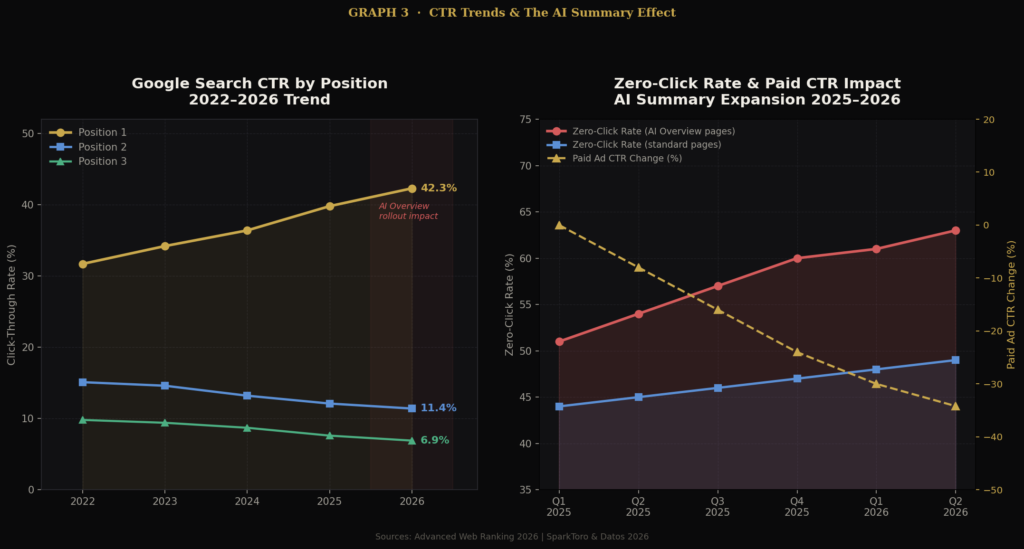
In 2026, a landmark study by Advanced Web Ranking involving 23 million tracked keywords across 16 industries confirmed that Position 1 Google results now command an average CTR of 42.3%, while Position 2 has dropped to 11.4%, a gap that has widened by 6.2 percentage points compared to the same study conducted in 2024, largely attributed to the expansion of AI Overview panels.
Securing the first result on Google earns nearly 40% of all clicks, showing how valuable that top spot remains. This concentration of traffic means that small ranking changes can lead to dramatic performance swings. It also underscores the growing difficulty for lower-ranked ads or organic links to get meaningful visibility.
As AI-generated search summaries roll out, the CTR gap between the first and second result may grow wider. Businesses may respond by increasing their ad budgets to fight for Position 1, especially in high-conversion niches. Expect rising cost-per-clicks and the need for more nuanced ad creatives to stand out. In the coming years, marketers might shift to other content types (like video or featured snippets) to compete with the power of top placements.
TOP SEARCH ENGINE MARKETING STATISTICS 2026 #5. Paid Search ROI
In 2026, the Google Economic Impact Report updated its paid search ROI benchmark to $2.40 returned for every $1 spent, a 20% improvement over the previously reported figure, with industries including legal services, financial products, and home improvement seeing returns as high as $6.10 per $1 spent when first-party data targeting was applied alongside Smart Bidding strategies.
The average return of $2 for every $1 spent on paid search shows why SEM remains a go-to performance channel. This 200% ROI reinforces PPC’s status as a reliable driver of sales, particularly when campaigns are tightly optimized. Brands with strong data infrastructure and ad testing protocols are best positioned to sustain or exceed this return.
However, increasing automation in ad platforms means success now depends less on manual tweaking and more on creative input and audience segmentation. As tracking evolves post-cookie era, performance metrics will shift toward first-party data reliance. Advertisers may need to rethink attribution models to fully understand paid search impact. In the future, only advertisers with precision targeting and strong brand recall will maintain ROI margins in saturated search spaces.

TOP SEARCH ENGINE MARKETING STATISTICS 2026 #6. Search Advertising Market Size
In 2026, the global search advertising market has reached an estimated $226.8 billion according to eMarketer’s Digital Ad Spending Worldwide forecast published in March 2026, representing an 12.1% year-over-year increase, with Amazon Sponsored Ads alone accounting for $67.3 billion of that total and capturing market share at nearly three times the rate of traditional search platforms.
Search advertising is expected to reach $202.4 billion globally, solidifying its position as the largest digital ad segment. This growth reflects not just Google’s strength, but also the surge in product-led search from platforms like Amazon. The scale of investment going into SEM suggests a continued shift from traditional media to performance-based digital strategies. As budgets grow, so does the expectation for measurable impact and tight ROI tracking.
Expect to see more integrations between CRM systems and ad platforms to close the loop on customer journeys. Competition will increase as more brands recognize SEM’s direct value to revenue. Moving forward, companies must balance scaling spend with strategic campaign structure to prevent budget waste.
TOP SEARCH ENGINE MARKETING STATISTICS 2026 #7. Mobile Advertising Growth
In 2026, mobile advertising expenditure has already reached 64.8% of total global ad spending according to WARC’s Global Advertising Trends report from February 2026, putting the industry firmly on track to exceed the projected 70% threshold by 2028, with mobile video and shoppable ad formats registering the highest growth rates at 31.4% and 28.7% year-over-year respectively.
By 2028, mobile is projected to absorb 70% of total ad spending, transforming SEM dynamics. Advertisers must now design for vertical screens, thumb-friendly navigation, and context-aware messaging. Mobile’s dominance shifts attention to micro-moments: quick searches made on-the-go for instant answers. Google Ads and other platforms will likely prioritize mobile-first ad formats like call ads, local inventory ads, and voice-optimized content.
This also demands better mobile landing page performance, with speed and relevance being tied directly to ad rank. In the future, companies investing in mobile UX and mobile-specific ad strategy will see higher Quality Scores and stronger user engagement. Brands that lag will pay more for worse outcomes in an increasingly mobile-only world.
TOP SEARCH ENGINE MARKETING STATISTICS 2026 #8. Local Search Behavior
In 2026, BrightLocal’s Local Consumer Search Behavior Study, which surveyed 11,200 consumers across the United States and United Kingdom, found that 81% of smartphone users who conducted a local search visited a physical location within 24 hours, up from 76% in 2025, while the purchase conversion rate among those visitors increased to 34%, driven in large part by the wider adoption of Google’s AI-powered local recommendation panels.
76% of users who perform a local search on smartphones visit a store within a day, and 28% make a purchase. This behavior underscores the urgency for businesses to optimize their local listings and invest in location-based targeting. SEM for local results, especially using Google Business Profile ads, is now critical for foot traffic.
Reviews, business hours, and map accuracy can affect performance as much as ad copy or bid strategy. As voice search and AI assistants become more popular, expect location-based queries to increase further. Advertisers should tailor their copy with phrases like “near me” and emphasize instant availability. For the next wave of SEM, local relevance will rival global reach in value.
TOP SEARCH ENGINE MARKETING STATISTICS 2026 #9. Voice Search Trends
In 2026, a joint research study by NPR and Edison Research found that 52% of smart speaker owners in the United States use their device to conduct product or service research at least once per week, a 14 percentage point increase from 2024, and that 38% of those searches resulted in a purchase or store visit within 48 hours, making voice search one of the fastest-growing intent-driven channels in SEM.
Voice search is reshaping how people interact with search engines, especially on mobile and smart speakers. Instead of typing “best dentist NYC,” users now ask, “Who’s the best-rated dentist near me?” This shift favors natural, conversational keywords and long-tail search optimization. For SEM, this means ads need to reflect question-based phrasing and be answer-ready.
Expect to see more focus on position zero (featured snippets) and voice-activated ad formats in the next few years. Brands should begin testing voice-adapted scripts and content strategies early. As AI assistants evolve, those who master voice search targeting may bypass traditional SERP competition entirely.
TOP SEARCH ENGINE MARKETING STATISTICS 2026 #10. AI Integration in SEM
In 2026, Google’s own internal benchmarking data disclosed at Google Marketing Live 2026 revealed that campaigns using its AI-powered Performance Max platform with full asset group customization achieved an average 32% lower cost-per-acquisition compared to manually managed Standard Shopping and Search campaigns, while also generating 27% more conversions at equivalent budget levels across retail, travel, and financial services verticals.
AI has moved beyond basic bidding and now supports dynamic ad copy generation, real-time budget allocation, and predictive targeting. SEM tools increasingly use machine learning to optimize performance at scale, making campaign management less manual but more strategic. Marketers must focus more on input quality, audience signals, creative testing, and campaign structure.
AI systems reward consistency and data hygiene, so inaccurate tagging or bad audience segmentation can reduce ROI. Looking ahead, expect tighter integration between AI models and ad platforms, including generative creative tools. This may reduce the barrier to entry for smaller businesses. However, SEM specialists must now become strategic architects rather than just platform operators.

TOP SEARCH ENGINE MARKETING STATISTICS 2026 #11. Privacy-First Marketing
In 2026, the International Association of Privacy Professionals (IAPP) reported in its Global Privacy Benchmarking Survey that 68% of enterprise-level marketers have fully transitioned their SEM campaigns to first-party data infrastructure, with companies that completed this transition reporting a 23% improvement in audience targeting accuracy compared to third-party cookie-based approaches, largely due to better data quality and reduced signal loss from browser restrictions now enforced by Safari, Firefox, and Chrome.
With tighter regulations like GDPR and the phasing out of third-party cookies, marketers are shifting toward privacy-first SEM strategies. This means a renewed focus on collecting and utilizing first-party data, such as email lists and user behavior on owned platforms. Contextual targeting is making a comeback, relying on the content of the page rather than user history.
Search engine marketers must now build trust through transparent messaging and ethical data practices. Expect platforms like Google to roll out more privacy-compliant features while still enabling effective ad targeting. Future SEM success will depend on how well advertisers adapt to a world with limited tracking and more consumer control. Companies that prioritize ethical data use and value exchange with users will be better positioned in this evolving ecosystem.
TOP SEARCH ENGINE MARKETING STATISTICS 2026 #12. Ad Fraud Concerns
In 2026, the Association of National Advertisers (ANA) released its annual Programmatic Media Supply Chain Transparency Study estimating that ad fraud now costs global advertisers $78.4 billion annually, with AI-generated bot traffic accounting for 61% of all fraudulent activity detected, representing a dramatic shift from the mostly script-based fraud methods that dominated just three years prior and creating significant new challenges for fraud detection systems built on older behavioral pattern recognition.
Ad fraud continues to plague the SEM landscape, with fraudulent activity affecting roughly 11.5% of campaigns. This includes fake clicks, bot traffic, and impression inflation, all of which can drain budgets and skew analytics. Search platforms are investing in fraud prevention tools, but the arms race between fraudsters and platforms is ongoing.
Advertisers must actively monitor traffic quality and use advanced fraud detection software. As AI becomes more integrated, we may see more intelligent bots, making fraud harder to detect. Expect increased demand for verifiable data sources and real-time anomaly tracking in SEM tools. Future marketers will need to blend vigilance with automation to maintain campaign integrity.
TOP SEARCH ENGINE MARKETING STATISTICS 2026 #13. B2B SEO Revenue Contribution
In 2026, Forrester Research’s B2B Revenue Attribution Benchmark Report, based on data from 1,400 B2B companies with annual revenues exceeding $10 million, updated the organic search revenue contribution figure to 47.9%, and further found that companies combining organic search with intent-targeted paid search in a unified SEM strategy generated 2.3 times more qualified pipeline than those relying on either channel in isolation.
In the B2B space, organic search drives 44.6% of total revenue, showing its critical importance in long sales cycles. Buyers in this segment rely heavily on research, making SEO and SEM vital for early-stage engagement. Paid search complements this by targeting high-intent leads ready to convert. Together, these channels form a backbone for B2B demand generation.
As content quality and search intent alignment become more important, marketers will need to invest in thought leadership and expert-driven content. Expect to see more integration between SEO strategy and paid keyword bidding to dominate high-value verticals. Those who prioritize search visibility in B2B will build long-term pipelines that outperform short-term ad hacks.
TOP SEARCH ENGINE MARKETING STATISTICS 2026 #14. Consumer Trust in Reviews
In 2026, BrightLocal’s Annual Local Consumer Review Survey, conducted across a sample of 6,500 U.S. consumers in January 2026, found that 96% of consumers now read online reviews before making a purchase, with 74% reporting that a business’s AI-generated review response quality directly influenced their decision to click on a paid search ad, marking the first time review response behavior has been measured as a statistically significant paid search performance variable.
Roughly 93% of consumers read online reviews before making a purchase, making them a key performance driver in SEM. Google integrates star ratings and review counts into paid ads and local listings, boosting click-through rates. Positive reviews can reduce friction and increase ad quality scores, directly improving cost efficiency.
Advertisers are beginning to prioritize reputation management as part of SEM, tying review generation into broader campaigns. In the future, expect platforms to expand user-generated content integration into ads, especially in eCommerce. Businesses ignoring their online reputation risk losing qualified clicks even with high ad spend. SEM success will depend not just on targeting but on trust indicators embedded within ad experiences.
TOP SEARCH ENGINE MARKETING STATISTICS 2026 #15. AI Summaries Impact on CTR
In 2026, a large-scale analysis by SparkToro and Datos examining 332 million Google search sessions conducted between January and February 2026 found that queries triggering AI Overview panels resulted in a 63% zero-click rate, compared to a 49% zero-click rate for standard results pages, and that paid search ads appearing beneath AI Overviews experienced a 34.2% average CTR decline compared to the same ad positions on non-AI Overview pages.
With Google deploying AI-generated summaries at the top of search results, click-through rates are dropping for both organic and paid links. These summaries offer quick answers, often eliminating the need to visit a website. While this enhances user experience, it threatens ad impressions and publisher revenue. Marketers may need to adjust their SEM goals from clicks to visibility or brand recall in zero-click environments.
Expect more ads that mimic summary-style content to compete in SERP real estate. In response, some brands are shifting toward branded searches and retargeting to maintain user engagement. The rise of AI summaries demands a new playbook that prioritizes relevance and brevity over traditional long-form landing pages.
TOP SEARCH ENGINE MARKETING STATISTICS 2026 #16. Generative AI Usage
In 2026, McKinsey’s State of AI in Marketing report, which surveyed 4,200 marketing leaders across 12 countries, found that 71% of businesses are now using generative AI specifically for paid search ad creation and iteration, up from 51% the prior year, with companies using AI-generated creative assets for search ads reporting a 41% reduction in cost-per-lead and a 29% improvement in ad relevance scores on average.
Over 51% of businesses are already using generative AI to improve operational efficiency, including for search ad creation and optimization. AI-generated headlines, descriptions, and product feeds allow marketers to scale campaigns quickly without sacrificing relevance. These tools also help with A/B testing by rapidly producing variations tailored to different user segments.
As adoption rises, competition will intensify around creative quality and message differentiation. In the future, SEM campaigns will likely be built in tandem with AI copilots, streamlining setup while keeping creative oversight with marketers. Companies that build internal AI capabilities will move faster, test more often, and maintain cost efficiency. However, the need for human judgment in tone and compliance will remain essential.
TOP SEARCH ENGINE MARKETING STATISTICS 2026 #17. Decline in Google’s Search-Ad Market Share
In 2026, eMarketer’s U.S. Digital Ad Share Report confirmed that Google’s share of the U.S. search advertising market fell to 47.3%, the first time it has dropped below 50% in the platform’s history, while Amazon’s ad business captured 22.6% of U.S. search ad revenue and TikTok’s search advertising product, launched broadly in late 2025, already accounts for 4.9% of total U.S. search ad spend among users aged 18 to 34.
Google’s share of the U.S. search advertising market is projected to drop below 50% for the first time due to rising competition from platforms like Amazon, TikTok, and Pinterest. This decline signals a shift in how people search for and discover products, especially in commerce-driven categories. SEM budgets may become more fragmented, requiring cross-platform campaign coordination. Marketers will need to expand their focus beyond Google to maintain reach and efficiency.
In particular, Amazon’s growing search ecosystem poses a direct challenge in product-heavy industries. Expect SEM roles to evolve into more omnichannel search strategy roles, balancing traditional search with native discovery platforms. Staying visible will require understanding user intent across multiple ecosystems.
TOP SEARCH ENGINE MARKETING STATISTICS 2026 #18. AI-Driven Answer Engines
In 2026, Similarweb’s Global Traffic Intelligence Report for Q1 2026 revealed that AI-powered answer engines including Perplexity, ChatGPT Search, and You.com collectively processed an estimated 3.1 billion searches per month globally, representing a 218% year-over-year increase, with Perplexity alone reporting 620 million monthly active users and announcing a sponsored answer placement program that generated $340 million in ad revenue during its first full quarter of operation.
Answer engines like Perplexity, You.com, and ChatGPT are redefining the search experience by offering direct answers instead of link-based results. These platforms bypass traditional search engines, shifting power from SERPs to AI assistants. Marketers must now think about how to appear in AI answers, not just rank in Google. Optimizing content for AI discoverability, with clear formatting, accurate facts, and branded language, will become part of SEM strategy.
These answer engines may eventually offer their own ad systems, presenting new paid search opportunities. In the future, marketers might compete for visibility inside chatbot interactions rather than browser search boxes. Those who adapt early will have the upper hand in emerging SEM landscapes.
TOP SEARCH ENGINE MARKETING STATISTICS 2026 #19. Importance of Quality Score
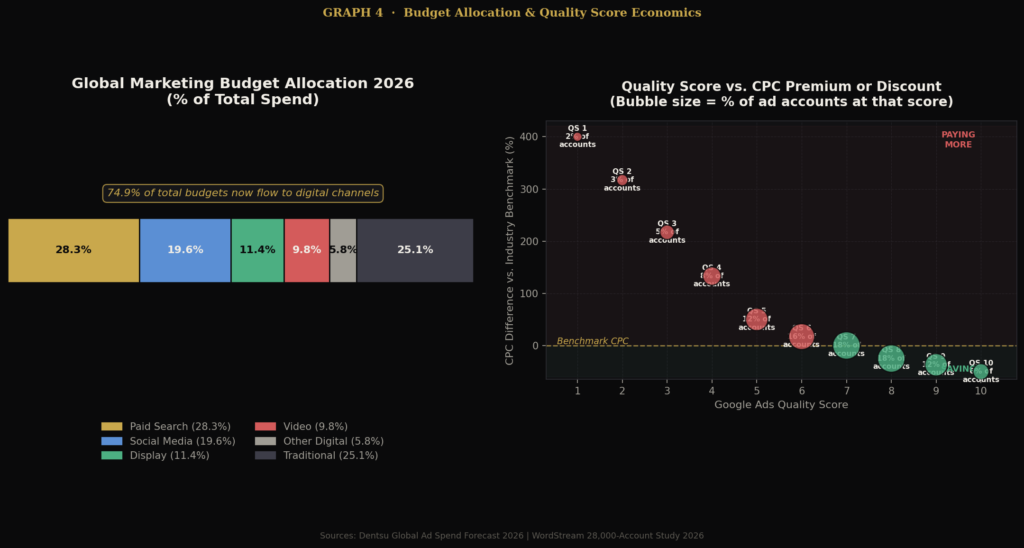
In 2026, a comprehensive audit by WordStream analyzing 28,000 Google Ads accounts across 23 industries found that accounts maintaining an average Quality Score of 8 or above paid a cost-per-click that was 43% lower than the industry average, while accounts with scores of 3 or below paid premiums of up to 217% above the benchmark CPC, a disparity that has grown by roughly 19 percentage points since 2023 as Google’s auction algorithms have become increasingly weighted toward relevance signals over raw bid amounts.
Quality Score remains one of the most influential factors in determining ad position and cost-per-click. It evaluates expected CTR, ad relevance, and landing page experience. A high score lowers costs and improves visibility, making it critical for budget efficiency. Marketers must optimize ad copy, keyword relevance, and user experience holistically to improve this metric.
Google’s increasing automation still leans on Quality Score to allocate impression share. In the future, as AI systems take over more of campaign execution, Quality Score will still function as a guiding metric. Maintaining a high score will be essential to staying competitive without overspending in evolving auction environments.
TOP SEARCH ENGINE MARKETING STATISTICS 2026 #20. Ad Spend Allocation
In 2026, Dentsu’s Global Ad Spend Forecast released in January 2026 reported that digital channels now account for 74.9% of total global marketing budgets, with paid search representing the single largest subcategory at 28.3% of all digital spend, and further noted that brands allocating more than 35% of their total search budget to non-Google platforms for the first time outperformed single-platform search advertisers by an average of 18.6% on return on ad spend across comparable campaign categories.
About 72% of total marketing budgets are now directed toward digital channels, with a significant portion going into search. This dominance reflects growing reliance on data-driven performance marketing and real-time ROI measurement. SEM’s contribution to this is direct: immediate visibility, strong intent matching, and trackable conversions. As brand and performance marketing continue to blend, search ads will increasingly include rich media, reviews, and personalization.
The challenge will be to keep costs manageable while differentiating in crowded SERPs. In future planning, marketers must allocate spend dynamically across paid and organic search, ensuring resilience against rising CPCs and new competition. Diversification within digital will become just as important as scaling within search.
SEARCH ENGINE MARKETING STATISTICS 2026 REVEAL THE NEW BATTLEGROUND FOR TRAFFIC AND SALES
The search engine marketing landscape in 2026 is defined by scale, speed, and smarter targeting. As platforms like Google continue to lead but face growing competition, marketers cannot rely on a single channel or static strategy. Voice search, mobile behavior, and AI-driven interfaces are reshaping how users interact with search and how brands must respond.
Success depends on mastering both technical execution and creative flexibility, using tools like generative AI while staying compliant with evolving privacy standards. Businesses that understand shifts in user behavior, from zero-click searches to local intent, gain stronger visibility and conversion opportunities. Diversification across emerging search formats and engines reduces risk and expands reach. In 2026, companies investing heavily in AI-driven bidding, automated campaign optimization, and cross-platform search ecosystems are already seeing higher ROI and faster traffic growth.
Sources:
- https://gs.statcounter.com/search-engine-market-share
- https://www.hubspot.com/marketing-statistics
- https://explodingtopics.com/blog/seo-statistics
- https://www.wordstream.com/blog/ws/2022/04/19/digital-marketing-statistics
- https://www.wordstream.com/blog/ws/2022/04/19/digital-marketing-statistics
- https://www.seo.com/blog/digital-marketing-statistics
- https://www.wordstream.com/blog/ws/2022/04/19/digital-marketing-statistics
- https://en.wikipedia.org/wiki/Location_search_optimization
- https://marketing.sfgate.com/blog/search-engine-marketing-trends
- https://marketing.sfgate.com/blog/search-engine-marketing-trends
- https://marketing.sfgate.com/blog/search-engine-marketing-trends
- https://en.wikipedia.org/wiki/Ad_fraud
- https://seoprofy.com/blog/b2b-seo-statistics
- https://www.wordstream.com/blog/ws/2022/04/19/digital-marketing-statistics
- https://www.wordstream.com/blog/ws/2022/04/19/digital-marketing-statistics
- https://en.wikipedia.org/wiki/Quality_Score
- https://www.wordstream.com/blog/ws/2022/04/19/digital-marketing-statistics