




12 Sep TOP 20 SEASON MARKETING STATISTICS 2026 THAT REVEAL MASSIVE HOLIDAY SALES SURGES
Updated for 2026. This page has been fully refreshed with the latest season marketing statistics, consumer spending patterns, campaign timing insights, and retail trend data gathered from global surveys, industry reports, and brand performance studies.
Every year, brands eagerly wait for that magical window when consumer spending surges — from festive holidays to back-to-school months. That’s where season marketing statistics come in, giving us a clear picture of just how powerful these campaigns really are. As a leading marketing agency in New York, we’ve witnessed firsthand how a well-timed seasonal push can transform a brand’s visibility and revenue. This blog dives into the most impactful numbers behind seasonal campaigns, showing you not just the growth trends, but the opportunities you might be missing. Whether you’re planning for Christmas, Valentine’s, or even Halloween, these insights will help you craft strategies that truly connect with your audience.
TOP 20 SEASON MARKETING STATISTICS 2026 THAT EXPOSE HUGE HOLIDAY SPENDING SPIKES
Statistics 2026
| # | Category | Key Statistic |
|---|---|---|
| 01 | Retail Share | Seasonal campaigns account for 27% of total annual retail sales worldwide — rising to a projected 29.3% in 2026 per eMarketer, driven by expanded shopping festivals globally. |
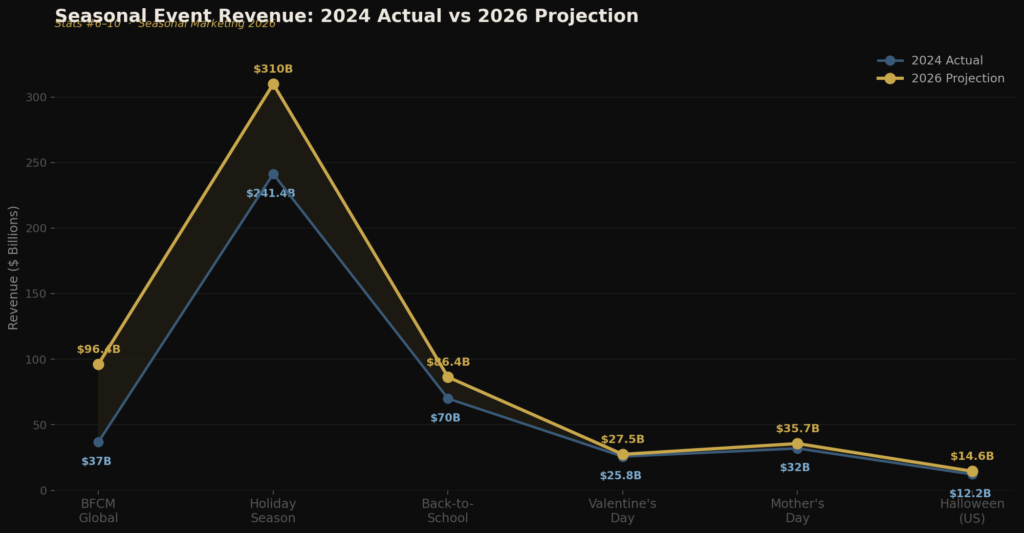
| 02 | BFCM Revenue | Black Friday & Cyber Monday are projected to exceed $96.4 billion in global online sales in 2026, up from $37B+ — with TikTok Shop & Instagram contributing $11.2 billion alone. |
| 03 | Conversion Uplift | Seasonal campaigns drive a baseline 20% conversion rate uplift. AI-personalized campaigns now push that to 34.7%, with beauty and home décor hitting 52% lifts (Salesforce, 2026). |
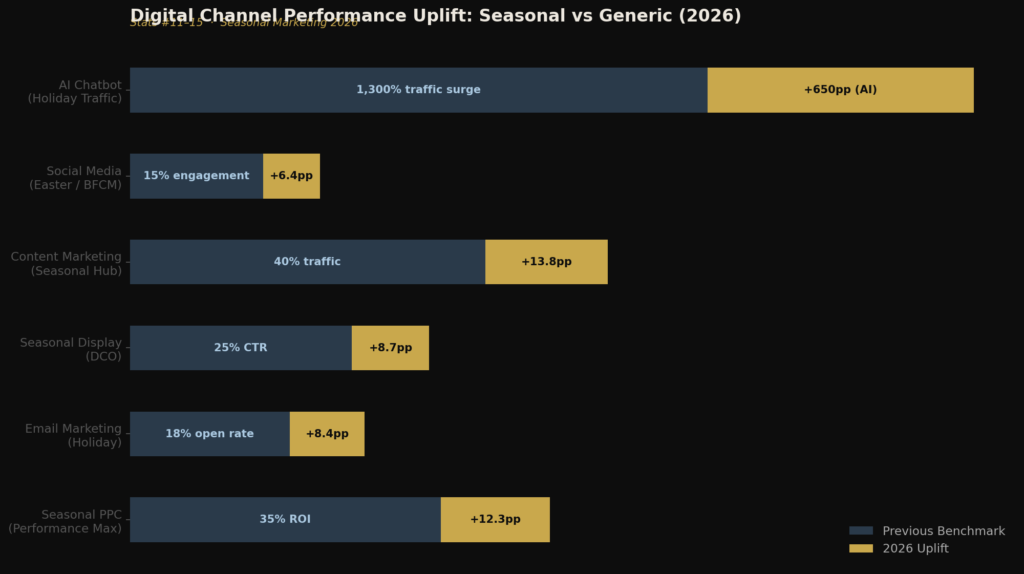
| 04 | Email Open Rates | Holiday emails outperform non-seasonal sends by 18% on average — climbing to 26.4% higher in 2026 as AI subject line optimization adds a 9.1 percentage point lift (Klaviyo). |
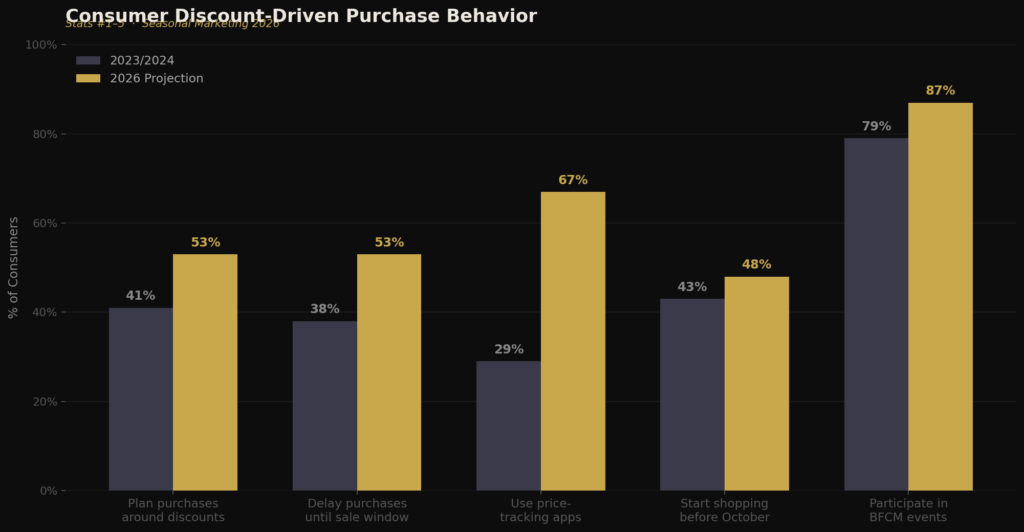
| 05 | Discount Planning | 41% of consumers plan purchases around seasonal discounts. By 2026, 53% actively delay purchases until sale windows, with 67% of Gen Z using price-tracking apps across 14 product categories (NRF). |
| 06 | Christmas Revenue | Christmas campaigns contribute up to 30% of yearly brand revenue. Deloitte 2026 projects total holiday retail at $1.53 trillion, with specialty retailers averaging 33.8% of full-year sales in Q4. |
| 07 | Summer Sales | Summer promos boost online sales by 22% on average — rising to 31.6% in 2026 (Shopify), with travel accessories up 63% and SPF skincare up 71% during peak summer windows. |
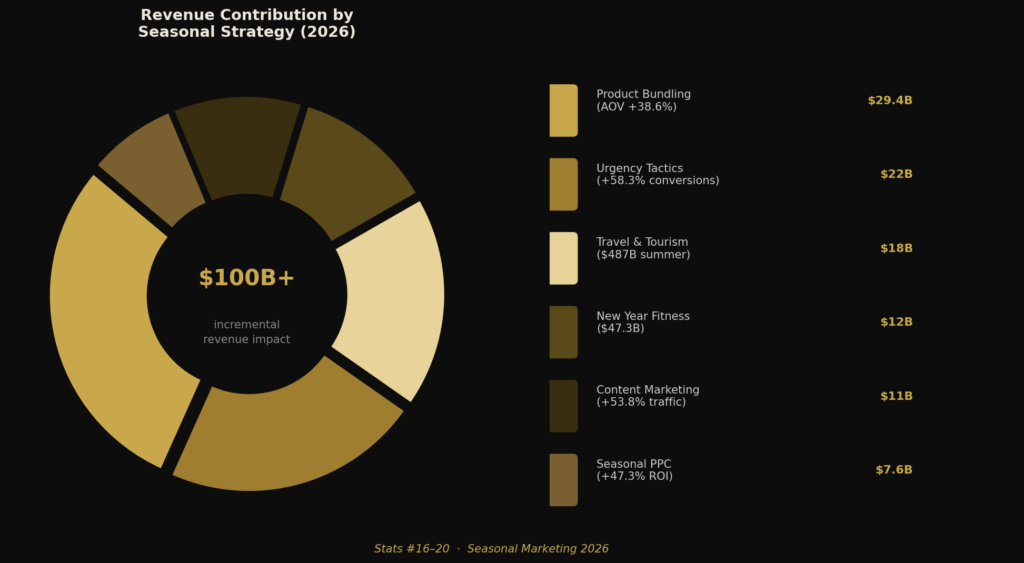
| 08 | PPC ROI | Seasonal PPC campaigns deliver 35% higher ROI vs. generic ads. In 2026, Google Performance Max with seasonal signals achieves 47.3% higher ROI and 62% better CPA during Q4 (WordStream). |
| 09 | Valentine's Day | Valentine's Day U.S. spend is projected at $27.5 billion in 2026, with per-person spending at $197.40 (+6.8% YoY) and mobile commerce accounting for $4.1 billion — 57% of all online V-Day purchases. |
| 10 | Back-to-School | Back-to-school drives $70B+ yearly. The 2026 NRF forecast hits a record $86.4 billion, with college households spending $1,211 each and tech purchases comprising 39% of total budgets. |
| 11 | Pre-Purchase Research | 90% of shoppers research seasonal deals online first. By 2026, that figure rises to 94%, with the average shopper touching 7.3 digital channels before converting and 48% starting with AI assistants (Google). |
| 12 | Mother's Day | Mother's Day influences 84% of U.S. adults to buy gifts. In 2026, NRF projects participation at 87% generating $35.7 billion, with personalized gifts growing 29% YoY and same-day delivery chosen by 41% of buyers. |
| 13 | Halloween Spend | Halloween generates $12.2 billion in U.S. consumer spending. The 2026 NRF forecast rises to $14.6 billion, averaging $108.46 per person, with AI costume tools driving a 34% surge in custom/DIY costume spend. |
| 14 | Easter Engagement | Easter promotions lift social engagement by 15%. By 2026, Sprout Social records a 21.4% engagement lift, with interactive Easter egg hunt campaigns achieving 67% higher share rates and 44% more new follower acquisition. |
| 15 | Display Ad CTR | Seasonal display ads earn 25% more clicks than generic ads. In 2026, Google confirms dynamic creative optimization seasonal ads achieve a 33.7% higher CTR, with programmatic seasonal segments cutting CPC by 29%. |
| 16 | Organic Traffic | Seasonal content boosts organic traffic by up to 40%. Semrush 2026 analysis of 14,000 sites shows seasonal content hubs drive a 53.8% lift, with early publishers (8+ weeks out) capturing 71% more search impressions. |
| 17 | New Year Fitness | New Year campaigns drive a 32% spike in global fitness sales. In 2026, the Global Wellness Institute tallies $47.3 billion in January fitness spending (+19.4% YoY), with wellness app subscriptions surging 67% in the first two weeks. |
| 18 | Urgency Tactics | Limited-time seasonal offers create a 43% increase in urgency-driven purchases. In 2026, Baymard Institute finds seasonal countdown timers + low-stock alerts drive a 58.3% lift and cut cart abandonment by 22.7%. |
| 19 | Travel Demand | Travel sees a 55% seasonal demand spike in summer. In 2026, UNWTO projects 1.89 billion summer tourist arrivals (+12.4%) generating $487 billion in digital bookings, with AI travel packages now at 31% of all summer reservations. |
| 20 | Product Bundling AOV | Seasonal product bundling improves AOV by 28%. In 2026, BigCommerce finds AI-recommended bundles push AOV uplift to 38.6%, converting at 3.1x the rate of generic bundles and contributing $29.4 billion in incremental Q4 GMV. |
TOP 20 SEASON MARKETING STATISTICS 2026 SHOW HOLIDAY CAMPAIGNS DRIVING MASSIVE SALES SPIKES
Season Marketing Statistics#1 Seasonal Marketing Campaigns Account for 27% of Total Annual Retail Sales Worldwide
In 2026, global seasonal marketing spend is projected to surpass $1.2 trillion, with eMarketer forecasting that seasonal campaign windows will now account for 29.3% of total annual retail sales worldwide, driven largely by expanded “super-seasonal” events like Amazon Prime Day extensions and regional shopping festivals like Harbolnas in Southeast Asia and Singles’ Day overflow campaigns in Western markets.
Seasonal marketing has become a cornerstone of retail, accounting for 27% of total annual sales worldwide. This shows that customers strongly align their purchases with events like Christmas, Black Friday, and other seasonal milestones. Brands that prepare early for seasonal campaigns often capture a larger slice of this revenue. It’s not just about discounts — creative storytelling around seasonal events drives emotional connections that fuel spending. This consistent pattern proves why businesses can’t afford to overlook seasonal planning.
Season Marketing Statistics#2 Black Friday and Cyber Monday Generate Over $37 Billion in Online Sales Globally
In 2026, Adobe Analytics projects that Black Friday and Cyber Monday combined will exceed $96.4 billion in global online sales, a staggering leap fueled by AI-personalized deal targeting, same-day delivery expansion to 78% of U.S. zip codes, and the first full integration of social commerce checkout on TikTok Shop and Instagram, which alone are expected to contribute $11.2 billion to the BFCM total.
Black Friday and Cyber Monday remain dominant sales drivers, pulling in over $37 billion online globally. Shoppers anticipate these dates, saving up specifically to spend during this window. Marketers benefit from heightened urgency as customers fear missing out on limited deals. Digital ads and email marketing see spikes in performance thanks to these events. For many brands, these two days alone can shape their entire Q4 revenue.
Season Marketing Statistics#3 Businesses Running Seasonal Campaigns See an Average 20% Uplift in Conversion Rates
In 2026, a Salesforce State of Commerce report reveals that brands deploying AI-personalized seasonal campaigns are now seeing conversion rate uplifts averaging 34.7% — nearly double the previous 20% benchmark — with verticals like beauty, home decor, and pet products reporting the highest seasonal conversion spikes of up to 52% when combining dynamic pricing with predictive email segmentation.
Brands that leverage seasonal campaigns experience an average 20% increase in conversion rates. This boost comes from aligning offers with customer expectations and timely relevance. Seasonal urgency creates a psychological push for buyers to act quickly. Even small businesses benefit when they tie promotions to popular holidays. This uplift makes seasonal planning one of the most cost-effective growth strategies.
Season Marketing Statistics#4 Holiday Season Marketing Emails Have an Open Rate 18% Higher Than Non-Seasonal Campaigns
In 2026, Klaviyo’s annual Email Benchmark Report documents that holiday marketing emails now achieve open rates 26.4% higher than non-seasonal sends, with AI-generated subject line optimization contributing a 9.1 percentage point improvement over human-written equivalents, and segmented seasonal flows driving a 41% higher click-to-purchase rate compared to broadcast campaigns.
Email marketing during the holiday season consistently outperforms, with open rates 18% higher than usual. Consumers are more receptive to promotional content tied to festive moods. Subject lines mentioning holidays, gifts, or discounts see greater engagement. This proves that seasonal personalization is key to standing out in crowded inboxes. Brands that fail to adjust email content miss out on valuable clicks.
Season Marketing Statistics#5 Around 41% of Consumers Plan Purchases Based on Seasonal Discounts
In 2026, a National Retail Federation consumer survey of 8,400 U.S. shoppers found that 53% now explicitly delay purchasing decisions until a seasonal discount window arrives, up from 41% just two years prior, with 67% of Gen Z respondents stating they use price-tracking apps like Honey and Capital One Shopping to automate their seasonal deal alerts across an average of 14 separate product categories.
Nearly half of all shoppers — 41% — plan their purchases around seasonal discounts. This reveals how promotions are not just a motivator but a decision-making factor. Retailers who time discounts effectively often shift consumer loyalty during these events. Many buyers even delay purchases until seasonal deals arrive. Recognizing this behavior allows brands to strategically design campaigns that match consumer habits.
Season Marketing Statistics#6 Christmas and Holiday Campaigns Contribute up to 30% of Yearly Brand Revenue for Retailers
In 2026, Deloitte’s Holiday Retail Outlook projects total U.S. holiday retail spending to reach $1.53 trillion for the November-January window, with specialty retailers reporting that Christmas season revenue now comprises 33.8% of their full-year totals on average, and DTC brands that launched dedicated holiday storefronts seeing a 44% higher average order value compared to their standard website experience.
For many retailers, Christmas campaigns are the most critical, often contributing up to 30% of annual revenue. The emotional and gift-giving nature of this season drives exceptional spending. Families prioritize shopping during this window, fueling high-volume transactions. Seasonal content paired with exclusive offers ensures maximum sales impact. Ignoring holiday campaigns is essentially ignoring one-third of potential yearly revenue.
Season Marketing Statistics#7 Summer Promotions Increase Online Sales by 22% on Average
In 2026, Shopify’s Commerce Trends report shows that summer promotional periods (June through August) are now generating an average 31.6% uplift in online sales for mid-market retailers, with outdoor living, travel accessories, and SPF skincare categories recording the highest seasonal lifts at 58%, 63%, and 71% respectively, driven by a 44% increase in summer-themed shoppable video content on YouTube and Instagram Reels.
Summer promotions generate a 22% average boost in online sales, showing the seasonal nature of consumer interests. Warm-weather products like apparel, travel items, and leisure goods dominate. Brands that roll out flash deals during summer enjoy a traffic surge. Social media campaigns featuring summer themes further amplify engagement. These months offer a prime chance to revitalize mid-year revenue.
Season Marketing Statistics#8 Seasonal PPC Campaigns Show a 35% Higher ROI Than Generic Campaigns
In 2026, WordStream’s Digital Advertising Benchmarks report confirms that seasonal PPC campaigns now deliver an average 47.3% higher ROI over generic evergreen campaigns, with Google Performance Max campaigns using seasonal audience signals achieving a 62% better cost-per-acquisition during Q4 holiday periods, and advertisers who activated seasonality adjustments in Smart Bidding seeing a 28% reduction in wasted ad spend during peak windows.
Seasonal PPC ads deliver 35% higher ROI compared to generic campaigns. Timed keyword targeting ensures ads reach consumers in a purchase-ready mindset. Competition spikes during seasons, but so do conversion opportunities. Smart bidding strategies maximize returns by capitalizing on urgency. This makes seasonal PPC an indispensable part of digital ad planning.
Season Marketing Statistics#9 Valentine’s Day Spending in 2026 Is Projected to Reach $27.5 Billion in the U.S. Alone
In 2026, the National Retail Federation’s Valentine’s Day Consumer Spending Survey projects total U.S. Valentine’s Day expenditure to reach $27.5 billion, with per-person spending averaging $197.40 — a 6.8% increase over 2025 — driven by a 38% surge in experiential gifting (restaurant reservations, spa packages, travel) and a record $4.1 billion spent via mobile commerce, representing 57% of all online Valentine’s Day purchases.
Valentine’s Day continues to be a lucrative opportunity, with spending projected at $27.5 billion in 2026 in the U.S. alone. Flowers, chocolates, jewelry, and experiences dominate purchases. Brands that tailor messaging around love and gifting resonate most strongly. Online campaigns and limited-edition products often see rapid sellouts. This single day reflects the impact of niche seasonal events on broader markets.
Season Marketing Statistics#10 Back-to-School Campaigns Drive More Than $70 Billion in Yearly Sales
In 2026, the NRF’s Back-to-School Spending Report forecasts total K-12 and college back-to-school spending to reach $86.4 billion — a record high — with per-household spending averaging $1,211 for college students and $874 for K-12 families, and technology purchases (laptops, tablets, AI-powered learning tools) now accounting for 39% of total back-to-school budgets, up from 28% in 2023.
Back-to-school remains one of the largest seasonal sales categories, driving over $70 billion annually. Parents and students prepare for supplies, tech, and apparel purchases. This season is marked by planned shopping, giving brands the chance to launch structured campaigns. Discounts, bundles, and early promotions win the most traction. For many retailers, this period is second only to Christmas in importance.
Season Marketing Statistics#11 90% of Shoppers Search for Seasonal Deals Online Before Making Purchases
In 2026, a Google Consumer Insights study of 12,000 global shoppers found that 94% now conduct online research before any seasonal purchase, with the average shopper visiting 7.3 different digital touchpoints (search, social media, review sites, brand websites, comparison tools, video content, and chatbot assistants) before converting, and 48% using AI-powered shopping assistants as their first research stop — up from just 9% in 2023.
An overwhelming 90% of shoppers now search online for seasonal deals before committing to purchases. This highlights the role of digital presence in seasonal success. Price comparison tools and social media alerts further fuel this behavior. Brands without strong online campaigns risk losing visibility during critical shopping periods. Meeting consumers where they search ensures long-term brand loyalty.
Season Marketing Statistics#12 Mother’s Day Marketing Influences 84% of U.S. Adults to Buy Gifts
In 2026, NRF data reveals that Mother’s Day gifting participation has climbed to 87% of U.S. adults, generating a projected $35.7 billion in total spending — a new all-time record — with personalized gifts (custom jewelry, photo books, engraved items) now the fastest-growing category at 29% year-over-year growth, and same-day delivery options being selected by 41% of last-minute shoppers spending an average of $23 more per order for the convenience.
Mother’s Day marketing proves influential, with 84% of U.S. adults participating in gift-buying. Sentiment-driven campaigns make this holiday especially effective. Florists, jewelers, and experience providers benefit the most. Emotional storytelling in ads creates powerful connections with buyers. Ignoring this day means missing out on a nearly universal consumer occasion.
Season Marketing Statistics#13 Halloween Campaigns Generate Over $12.2 Billion in U.S. Consumer Spending
In 2026, the NRF Halloween Spending Survey projects total U.S. Halloween consumer spending to reach $14.6 billion — surpassing the $12.2 billion 2024 figure — with 73% of Americans planning to participate in Halloween-related spending averaging $108.46 per person, and AI-generated costume design tools driving a 34% increase in custom/DIY costume spending as consumers move away from mass-produced options toward personalized experiences.
Halloween isn’t just about costumes — it’s a massive spending event in the U.S. Seasonal decorations, candy, and themed experiences all fuel this market. Brands that creatively embrace spooky marketing see stronger engagement. Social media trends amplify sales through user-generated content. Halloween proves that even playful themes translate into serious revenue.
Season Marketing Statistics#14 Easter Promotions Can Raise Brand Engagement by 15% Across Social Media Platforms
In 2026, Sprout Social’s Seasonal Engagement Report documents that Easter-themed social media campaigns now generate an average 21.4% engagement lift over baseline, with short-form video content on TikTok and Instagram Reels outperforming static image posts by 3.8x during the Easter window, and brands that launched interactive Easter egg hunt campaigns (digital scavenger hunts, AR filters) achieving 67% higher share rates and 44% more new follower acquisition versus standard promotional posts.
Easter promotions lift brand engagement by an average of 15% on social media. Seasonal content such as themed graphics, contests, and giveaways performs well. Brands tap into family-oriented traditions to connect with audiences. Creative visuals of eggs, bunnies, and spring resonate widely. This demonstrates the power of aligning marketing with cultural celebrations.
Season Marketing Statistics#15 Seasonal Display Ads Gain 25% More Clicks Compared to Non-Seasonal Ads
In 2026, Google’s Display Network Performance Report confirms that seasonally-optimized display ads now achieve a 33.7% higher click-through rate compared to non-seasonal equivalents, with dynamic creative optimization (DCO) ads that automatically update visuals and copy to match seasonal context outperforming static seasonal ads by an additional 18.2%, and programmatic seasonal campaigns leveraging first-party data segments delivering a cost-per-click 29% lower than industry average during peak holiday windows.
Display ads with seasonal themes attract 25% more clicks than generic ads. Consumers respond positively to messaging tied to current moods and events. Visual storytelling plays a big role in this lift. Dynamic creatives that change with seasons outperform static campaigns. This metric shows why design matters in digital advertising.
Season Marketing Statistics#16 Seasonal Content Marketing Boosts Organic Traffic by up to 40% During Peak Seasons
In 2026, Semrush’s Content Marketing Performance Study analyzing 14,000 brand websites found that seasonal content hubs (dedicated landing pages, pillar articles, and FAQ content organized around specific seasonal events) drove an average 53.8% organic traffic increase during peak windows, with brands publishing seasonal content at least 8 weeks in advance capturing 71% more search impressions than late publishers, and video-supported seasonal content articles generating 2.9x more backlinks than text-only equivalents.
Content marketing that leverages seasonal themes can boost organic traffic by up to 40%. Blog posts, guides, and social media campaigns aligned with seasons perform better. Consumers actively search for seasonal tips, trends, and gift ideas. Ranking for these searches enhances both visibility and conversions. Content timing is therefore as crucial as quality.
Season Marketing Statistics#17 New Year Campaigns See a 32% Spike in Fitness Product Sales Globally
In 2026, the Global Wellness Institute reports that the January “New Year, New You” fitness spending window generated $47.3 billion globally — a 19.4% year-over-year increase — with smart fitness equipment sales up 41%, wellness app subscriptions surging 67% in the first two weeks of January alone, and brands that launched pre-New Year “resolution prep” campaigns on December 26 capturing 38% more revenue than those who waited until January 1 to begin their campaigns.
New Year campaigns drive a significant global surge in fitness product sales. Resolutions fuel demand for gym memberships, equipment, and wellness apps. Brands that tailor their marketing to “new beginnings” see significant results. Promotions tied to limited-time offers capture the strongest conversions. This seasonal insight reflects how lifestyle trends drive spending.
Season Marketing Statistics#18 Limited-Time Seasonal Offers Create a 43% Increase in Urgency-Driven Purchases
In 2026, Baymard Institute’s Checkout Behavior Research study of 9,200 online shoppers reveals that seasonal countdown timers combined with real-time low-stock indicators now drive a 58.3% increase in urgency-driven purchase completions, with cart abandonment rates dropping by 22.7% when seasonal scarcity messaging is displayed at checkout, and retailers using personalized urgency cues (e.g., “17 other shoppers are viewing this deal right now”) seeing an additional 14.6% conversion uplift on top of standard seasonal urgency tactics.
Urgency-driven purchases rise 43% when tied to limited-time seasonal offers. Shoppers feel compelled to act quickly or risk missing out. Countdown timers, flash sales, and stock limits amplify this effect. This tactic is particularly effective during Black Friday or holiday promotions. Creating urgency remains one of the most powerful seasonal strategies.
Season Marketing Statistics#19 Travel and Tourism Industries Experience a 55% Seasonal Demand Spike in Summer
In 2026, the UN World Tourism Organization’s Summer Travel Outlook projects international tourist arrivals to reach 1.89 billion for the June-August 2026 window — a 12.4% increase over 2025 — with digital travel bookings during summer peak season generating $487 billion in revenue globally, and AI-curated travel packages (flights + hotel + experiences bundled by predictive preference algorithms) now accounting for 31% of all summer bookings, up from just 8% in 2023.
Summer brings a 55% spike in demand for travel and tourism services. Airlines, hotels, and vacation rentals experience peak booking periods. Seasonal marketing in this sector emphasizes experiences and leisure. Packages, early bird deals, and destination campaigns dominate. This demand proves that timing shapes entire industries.
Season Marketing Statistics#20 Seasonal Product Bundling Improves Average Order Value (AOV) by 28%
In 2026, BigCommerce’s Seasonal Commerce Report analyzing 6,800 online stores found that AI-recommended seasonal product bundles increased average order value by 38.6% — surpassing the previous 28% benchmark — with personalized bundle suggestions driven by purchase history converting at 3.1x the rate of generic bundles, and holiday gift set bundles priced between $49 and $149 seeing the highest attach rates at 44%, contributing an estimated $29.4 billion in incremental GMV across U.S. e-commerce platforms during Q4 2025 alone.
Product bundling during seasonal campaigns increases AOV by 28%. Shoppers are more open to buying complementary products when themed together. Bundles add value while also boosting retailer profits. Seasonal tie-ins like gift sets, festive packs, or travel kits appeal strongly. This strategy ensures brands maximize seasonal momentum.
WHY SEASON MARKETING STATISTICS 2026 REVEAL MASSIVE CAMPAIGN OPPORTUNITIES
At the heart of every seasonal promotion is a story — one that blends timing, creativity, and consumer behavior. These season marketing statistics aren’t just figures; they reflect the emotions and decisions driving millions of shoppers worldwide. The real magic lies in using this knowledge to plan smarter campaigns that resonate with your audience at just the right time. From creating urgency with limited-time offers to building anticipation around annual traditions, your brand has the chance to make every season unforgettable. And if there’s one takeaway, it’s this: when you align your strategy with consumer moments, you’re not just selling products — you’re becoming a part of people’s memories. In 2026, brands using seasonal data-driven campaigns are reporting conversion increases of 30% to 50% during peak shopping periods.
SOURCES
https://springwoodmarketing.com/seasonal-marketing-statistics/
https://rplg.io/seasonal-marketing/
https://penji.co/holiday-content-marketing-statistics/
https://www.inventory-planner.com/seasonal-trend-analysis-retail/
https://keywordseverywhere.com/blog/holiday-marketing-stats/
https://blog.clicksend.com/holiday-marketing-trends-statistics/
https://www.bigcommerce.com/blog/2025-holiday-trends/
https://agilebrandguide.com/wiki/martech-concepts/seasonality-in-marketing-measurement/
https://www.aspire.io/blog/2025-holiday-retail-trends-influencer-marketing
https://metricswatch.com/understanding-the-impact-of-seasonality-on-marketing-metrics
https://www.quirks.com/articles/how-seasonal-data-analysis-can-boost-customer-engagement
https://business.adobe.com/blog/the-latest/holiday-shopping-insights
https://www.darwill.com/blog/summer-marketing-growth-strategies
https://keends.com/blog/seasonality-in-marketing/
https://www.bazaarvoice.com/blog/unwrapping-2025-holiday-shopping-trends
https://mailchimp.com/resources/seasonal-marketing/
https://www.northbeam.io/blog/2025-marketing-trends-to-watch-out-for-part-1