



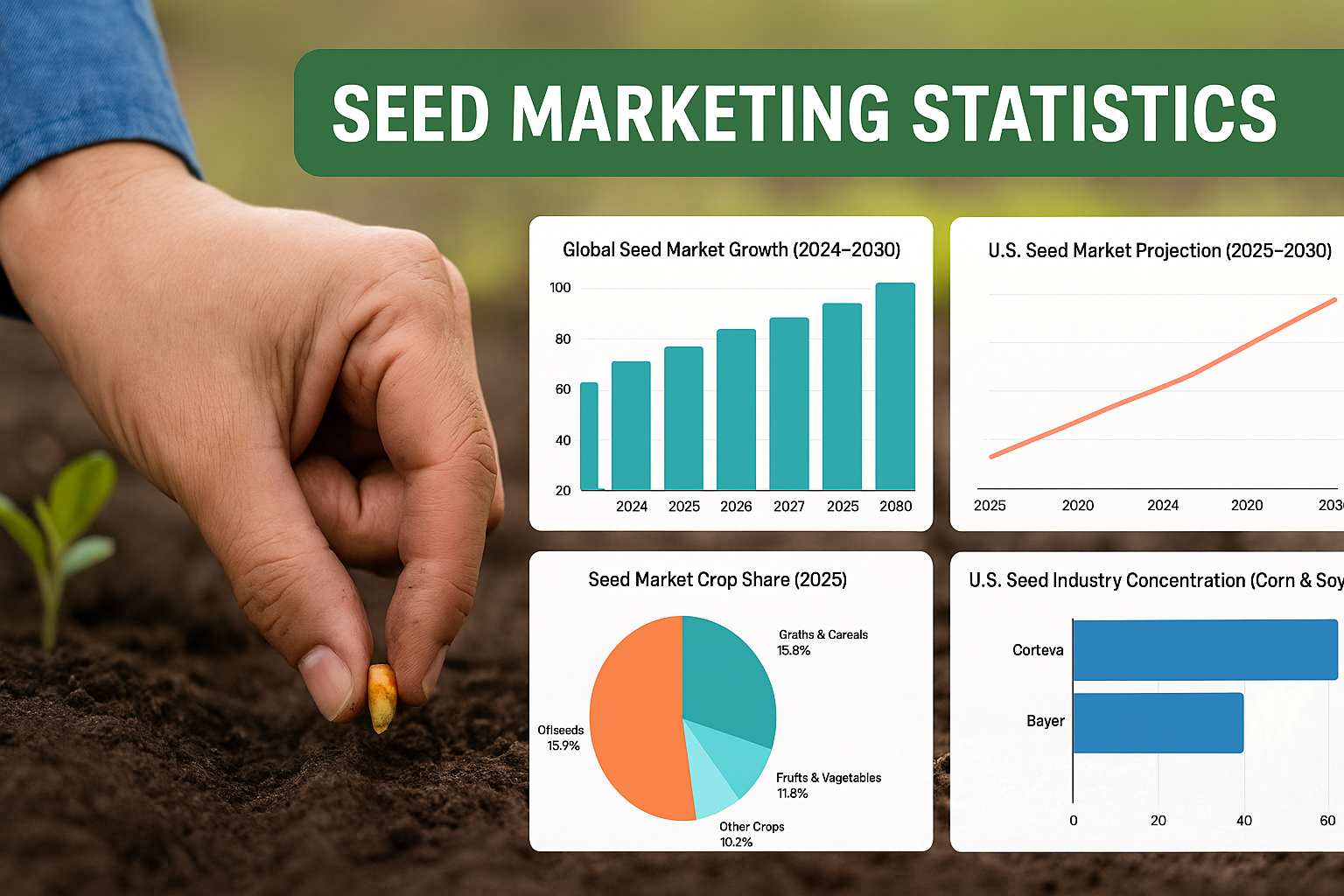
18 Sep TOP 20 SEED MARKETING STATISTICS 2025
When I first started exploring the world of agribusiness trends, I never imagined how much insight could be uncovered through something as specific as seed marketing statistics. Working closely with a leading marketing agency in New York, I’ve learned that these numbers aren’t just about market size or percentages—they tell a story about innovation, global food security, and the people behind the fields. To me, sharing these statistics is more than just data; it’s about connecting with the passion of growers, marketers, and innovators who are shaping the future of agriculture.
Top 20 Seed Marketing Statistics 2025 (Editor’s Choice)
Top 20 Seed Marketing Statistics
Comprehensive Industry Data & Market Insights for 2025
| Rank | Category | Key Statistic |
|---|---|---|
| 1 |
Market Growth
Global Market CAGR
|
Seeds market growing at 7.2% CAGR from 2023-2028, reaching $83.3 billion USD |
| 2 |
Market Size
2025-2030 Projection
|
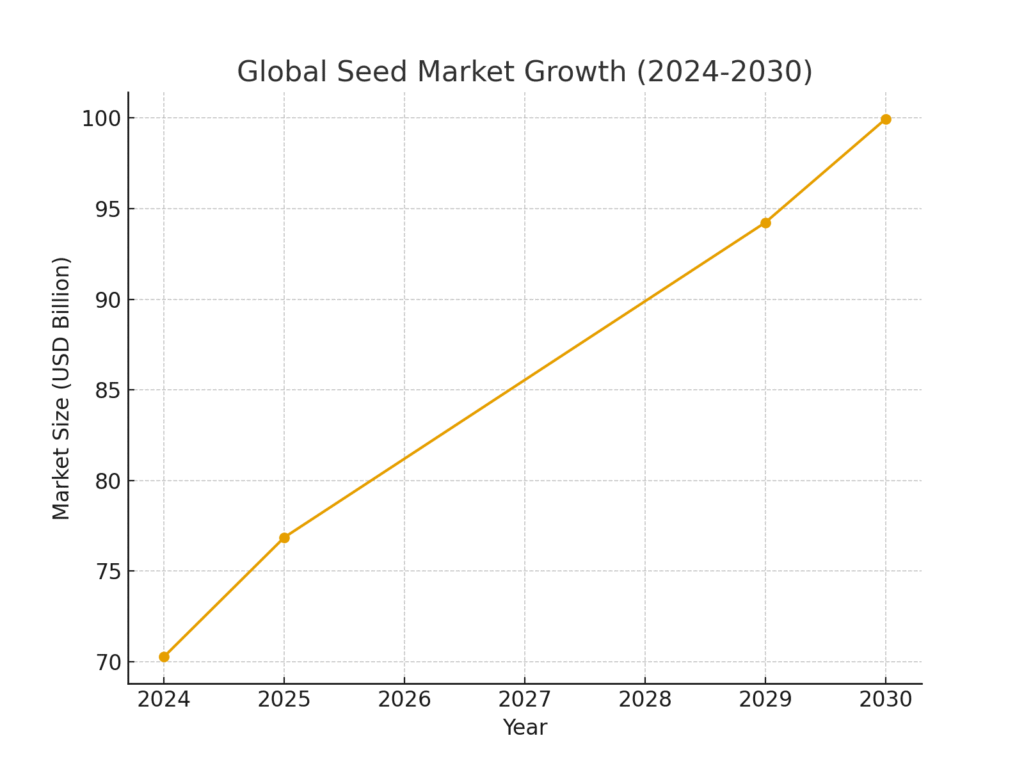
Global seed market expected to reach $76.86 billion in 2025 and grow to $99.94 billion by 2030 |
| 3 |
Commercial Seeds
Market Expansion
|
Commercial seeds market valued at $85.42 billion in 2024, projected to reach $138.32 billion by 2030 |
| 4 |
North America
Regional Market Size
|
North America seed market: $27.13 billion in 2025, growing to $36.98 billion by 2030 |
| 5 |
United States
US Market Dominance
|
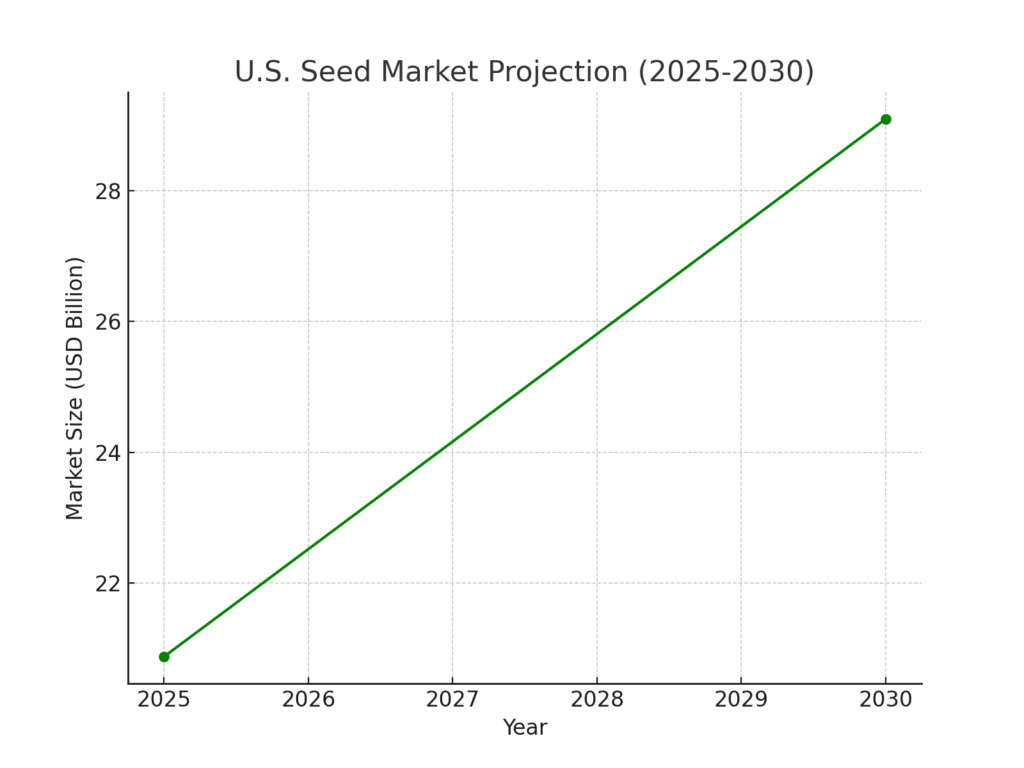
US seed market: $20.88 billion in 2025, reaching $29.09 billion by 2030 at 6.85% CAGR |
| 6 |
Hybrid Seeds
Technology Adoption
|
Hybrid seed varieties account for 84% of US market in 2022, preferred for higher yields and pest resistance |
| 7 |
Global Hybrids
Market Dominance
|
Hybrids dominated with 73% share of global seed market in 2022 |
| 8 |
Digital Distribution
Technology Trend
|
Increasing use of digital platforms for seed distribution, enabling easier farmer access |
| 9 |
Digital Investment
Industry Investment
|
Major companies investing in digital agriculture - Syngenta acquired Cropio Group in 2019 |
| 10 |
GM Soybeans
Adoption Rate
|
Herbicide-tolerant soybean seeds grew from 17% in 1997 to 96% in 2024 |
| 11 |
GM Growth
Fastest Growing Segment
|
Genetically modified seeds expanding at highest growth rate due to yield and resistance benefits |
| 12 |
North America
Global Market Share
|
North America accounts for 33.5% of global commercial seeds revenue in 2024 |
| 13 |
Asia-Pacific
Growth Leader
|
Asia-Pacific expected to show highest growth rate during 2022-2031 due to population surge |
| 14 |
Corn/Maize
Leading Crop
|
Maize segment accounts for 35.9% of global commercial seeds revenue in 2024 |
| 15 |
Corn Acres
Planting Increase
|
USDA forecasts 1.4% rise in corn planted area to 92 million acres |
| 16 |
Fruits & Vegetables
Fastest Growth
|
Fruits and vegetables segment showing fastest growth rate due to health consciousness |
| 17 |
Organic Seeds
Market Shift
|
Seed market shifting focus to organic production due to consumer demand for sustainable foods |
| 18 |
Precision Agriculture
Technology Impact
|
GPS-guided planting and data analytics enabling optimized seed placement and higher yields |
| 19 |
Protected Cultivation
Growing Trend
|
Protected cultivation gaining prominence for controlled growing conditions and yield maximization |
| 20 |
Farmer Strategy
Market Behavior
|
Growers evaluating all management options to maximize profitability and ensure operational success |
Top 20 Seed Marketing Statistics 2025
Seed Marketing Statistics #1: Global Seed Market Size Reaches USD 76.86 Billion In 2025
The global seed market is projected to hit USD 76.86 billion in 2025, which highlights the scale of its economic importance. This figure reflects not just sales, but also innovation in seed technology and distribution. Companies worldwide are investing heavily to meet growing food demand. Such growth emphasizes how seeds are central to sustainability conversations. It shows how marketing efforts are increasingly tied to global food security.
Seed Marketing Statistics #2: Market Expected To Grow To USD 99.94 Billion By 2030
By 2030, the seed market is expected to climb to nearly USD 100 billion. This projection demonstrates strong long-term confidence in the sector. Marketing strategies will need to evolve to support this growth. For businesses, the opportunity lies in branding seeds not just as products, but as solutions. This future-focused trend highlights the power of positioning within agricultural marketing.
Seed Marketing Statistics #3: Seed Market Valued At USD 70.28 Billion In 2024
In 2024, the seed market was already worth USD 70.28 billion. This valuation underscores the rapid acceleration of growth into 2025. It reflects both increased adoption of high-yielding varieties and better seed distribution. Marketing campaigns can leverage this data to appeal to investors. Ultimately, it shows agriculture is one of the most investable markets today.
Seed Marketing Statistics #4: CAGR Of 6.2% From 2024 To 2029
The compound annual growth rate (CAGR) for seeds is projected at 6.2% between 2024 and 2029. This figure signals reliable, sustained growth for years ahead. Marketing professionals can position seed companies as stable and lucrative opportunities. Farmers also gain reassurance that innovation is ongoing. This trend helps bridge the gap between industry confidence and consumer trust.
Seed Marketing Statistics #5: Oilseeds Fastest Growing Crop Segment
Oilseeds are emerging as the fastest-growing crop segment in the seed industry. This is largely due to soaring demand for soybeans worldwide. The rise of plant-based foods and oils fuels this trajectory. Marketing strategies targeting health-conscious consumers can capitalize on this. It also signals a shift toward promoting seeds as part of lifestyle and nutrition trends.
Seed Marketing Statistics #6: Seed Treatments Becoming More Popular
Demand for advanced seed treatments and biological enhancements is climbing. Farmers are looking for solutions that boost resilience and yield. For marketers, this creates a chance to spotlight innovation. It also reinforces the message that seeds are more than raw inputs—they’re science-backed solutions. This focus makes the market more appealing to investors and buyers alike.
Seed Marketing Statistics #7: U.S. Seed Market Worth USD 20.88 Billion In 2025
The U.S. seed market alone is valued at USD 20.88 billion in 2025. This shows how dominant the country remains in agriculture. It offers marketers opportunities to highlight America’s leadership in seed innovation. With such a strong base, local marketing campaigns can focus on both tradition and modernity. This balance helps brands resonate with both farmers and consumers.
Seed Marketing Statistics #8: U.S. Market Projected To Reach USD 29.09 Billion By 2030
By 2030, the U.S. market is expected to grow to USD 29.09 billion. This trajectory reflects not only demand but also technological innovation. Marketing agencies can leverage this growth story to attract global partners. For local players, it’s a reminder that scalability matters. Every number points to the need for better storytelling in agricultural branding.
Seed Marketing Statistics #9: Hybrid Seeds Dominate U.S. Market
Hybrid seeds are the backbone of the American seed industry. Farmers rely on their yield consistency and performance. This dominance offers a marketing edge when promoting proven reliability. Brands can position hybrids as essential tools for sustainable farming. It’s a clear case where product features align perfectly with market messaging.
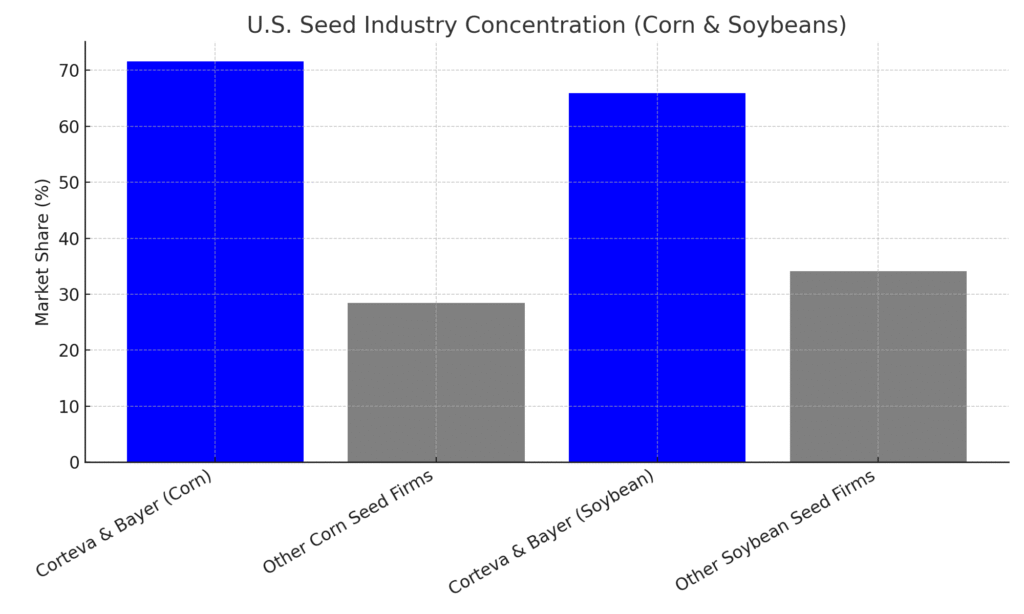
Seed Marketing Statistics #10: Corteva And Bayer Hold 71.6% Corn Seed Share
In U.S. corn seed sales, Corteva and Bayer jointly control 71.6%. Their influence demonstrates how concentrated the market has become. For marketers, this means brand recognition and trust are critical. Smaller players must emphasize niche strengths. The statistic underscores the challenge of competing with giants through marketing creativity.
Seed Marketing Statistics #11: Top Firms Control 65.9% Of Soybean Seed Sales
In soybean seeds, Corteva and Bayer again dominate, holding nearly two-thirds of the market. This figure highlights the limited space for smaller competitors. For marketers, it’s about finding differentiation strategies. Storytelling about local quality or sustainability can help. It proves that brand positioning matters as much as market share.
Seed Marketing Statistics #12: Top Four Firms Dominate Global Market
The top four companies—Bayer, Corteva, Syngenta, and BASF—dominate both seed and agrochemical markets. This concentration makes marketing partnerships more crucial than ever. Collaborations help smaller firms survive in such a landscape. Marketing agencies can showcase how alliances bring value. It demonstrates how seed marketing is tied directly to global strategy.
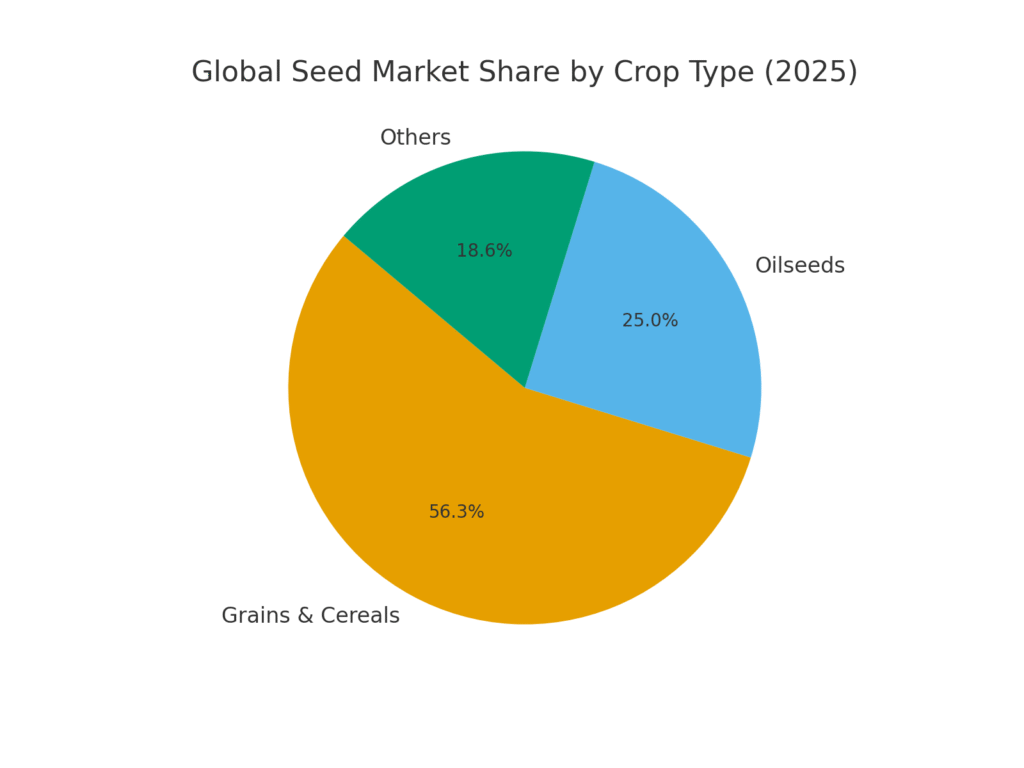
Seed Marketing Statistics #13: Grains And Cereals Hold 56.35% Market Share
Grains and cereals represent over half the global seed market by value. This dominance reflects their role as staple foods worldwide. For marketers, it’s an opportunity to align campaigns with food security narratives. Positioning cereals as the backbone of global diets is effective. It’s a chance to highlight how seed technology supports billions of lives.
Seed Marketing Statistics #14: North America Leads Regional Market Share
North America currently holds the largest regional share of the seed market. Its technological advancements and strong infrastructure drive this. Marketing messages can spotlight leadership and innovation. It also reassures investors that the region is stable and profitable. Such dominance makes it easier to promote North America as an agricultural hub.
Seed Marketing Statistics #15: Europe Strong In Forage Seed Market
Europe has a significant share of the forage seed market. This reflects the region’s emphasis on animal feed and sustainable practices. Marketing here can emphasize tradition and environmental care. Highlighting Europe’s eco-friendly agriculture boosts brand identity. It’s a reminder that regional marketing should always align with cultural values.
Seed Marketing Statistics #16: China Expands Biotech Seed Adoption
China is rapidly increasing its use of biotech seeds, especially in corn. This reflects a national push for innovation and food security. Marketing efforts can frame this as modernization in agriculture. It positions biotech as not only efficient but also essential. The trend highlights the importance of tailoring messages to regional priorities.
Seed Marketing Statistics #17: Biotech Traits Driving Seed Innovation
Genetically modified traits like herbicide tolerance and insect resistance are in high demand. These traits define modern seed innovation. For marketers, it’s about building trust around science and safety. Campaigns can emphasize both farmer efficiency and consumer benefits. This reinforces seeds as a technology story, not just a farming story.
Seed Marketing Statistics #18: Rising R&D Investment In Seeds
Seed companies are investing heavily in research and development. This funding supports new breeding technologies and resilient traits. Marketing can frame these investments as a commitment to the future. It reassures stakeholders that the industry isn’t stagnant. It shows progress is baked into the very DNA of the business.
Seed Marketing Statistics #19: Market Concentration Continues To Increase
Market concentration is steadily increasing across the seed sector. This creates challenges for new entrants. For marketers, it means differentiation and storytelling are critical survival tools. Niche branding becomes a way to fight against consolidation. It’s proof that creativity can balance even the most unequal markets.
Seed Marketing Statistics #20: Seed Industry Linked To Food Security Messaging
The seed industry is more closely tied than ever to global food security conversations. Marketing strategies can tap into this by highlighting responsibility and sustainability. It makes seed marketing not just commercial, but ethical. Brands that link their story to global challenges gain credibility. This statistic shows how seeds connect economics with humanity.
Final Thoughts on Seed Marketing Statistics
As I wrap up this journey through seed marketing statistics, I can honestly say it’s opened my eyes to how deeply connected our everyday lives are to these seemingly small details. From global growth projections to the dominance of key players, each stat reflects not just industry dynamics but also the resilience and adaptability of farmers and businesses alike. Personally, I feel inspired by the possibilities these trends highlight, and I hope you feel the same sense of curiosity and motivation. At the end of the day, marketing seeds isn’t just about agriculture—it’s about planting ideas, growth, and opportunity in ways that go far beyond the soil.
SOURCES