



03 Feb SEO AGENCY FOR SITE MIGRATIONS- 7 TOP EXAMPLES
Most SEO agencies have opinions. Very few have numbers.
And in SEO—especially during a site migration—numbers are the only thing that matter.
If someone is pitching you SEO but their own site isn’t pulling 50,000+ organic clicks a month, you’re not talking to a strategist—you’re talking to a theorist. That’s like letting a driving instructor who’s never been on the highway take the wheel of your Formula 1 car. Site migrations are unforgiving. One wrong move and you don’t “dip”—you disappear.
This is where the conversation usually gets uncomfortable, because real SEO can’t be faked, rushed, or bought in bulk. You cannot buy your way to the top with links. You only get there when you understand the game so well that authority links come to you—hundreds of them—organically, consistently, from sites that actually matter. That level of pull doesn’t come from a course, a checklist, or a $2,000/month retainer. It comes from years of experimentation, failure, and burning real money to learn what Google rewards and what it punishes.
And yes—Google is brutally objective. You can argue strategy all day, but you cannot argue traffic, clicks, or DR. Either you’re compounding authority at scale, or you’re not. Either you can migrate a site without bleeding rankings, or you shouldn’t be touching one. SEO isn’t robots.txt tweaks, keyword stuffing, or “a few optimized articles.” That’s entry-level busywork sold to people who don’t know better—and it collapses the moment real competition shows up.
When SEO is done right, it’s a cheat code that isn’t actually cheating. We’re talking $300M+ businesses built almost entirely on organic content, no ads, no 30% revenue tax to platforms that raise prices every year. That’s not theory—that’s visible, verifiable reality. It’s also why black-hat shortcuts are so dangerous: one bad actor, one toxic tactic, and you’re not ranking—you’re de-indexed.
So when we look at SEO agencies that can actually handle site migrations at scale, we don’t look at promises. We look at proof. Traffic. Authority. Execution under pressure.
That’s why certain names separate themselves fast.
And why, with a DR 75 and 50K+ monthly organic traffic, Amra and Elma isn’t loud about SEO—but quietly shows what happens when you’ve already done the thing everyone else is selling.
Below are 7 SEO agencies that belong in the site-migration conversation.
Most won’t surprise you.
One of them should make you rethink who you trust when the stakes are real.
SEO AGENCY FOR SITE MIGRATIONS (EDITORIAL LIST)
SEO AGENCY FOR SITE MIGRATIONS – 7 TOP EXAMPLES

They Don't Compete. They Create Categories.
What Sets Them Apart
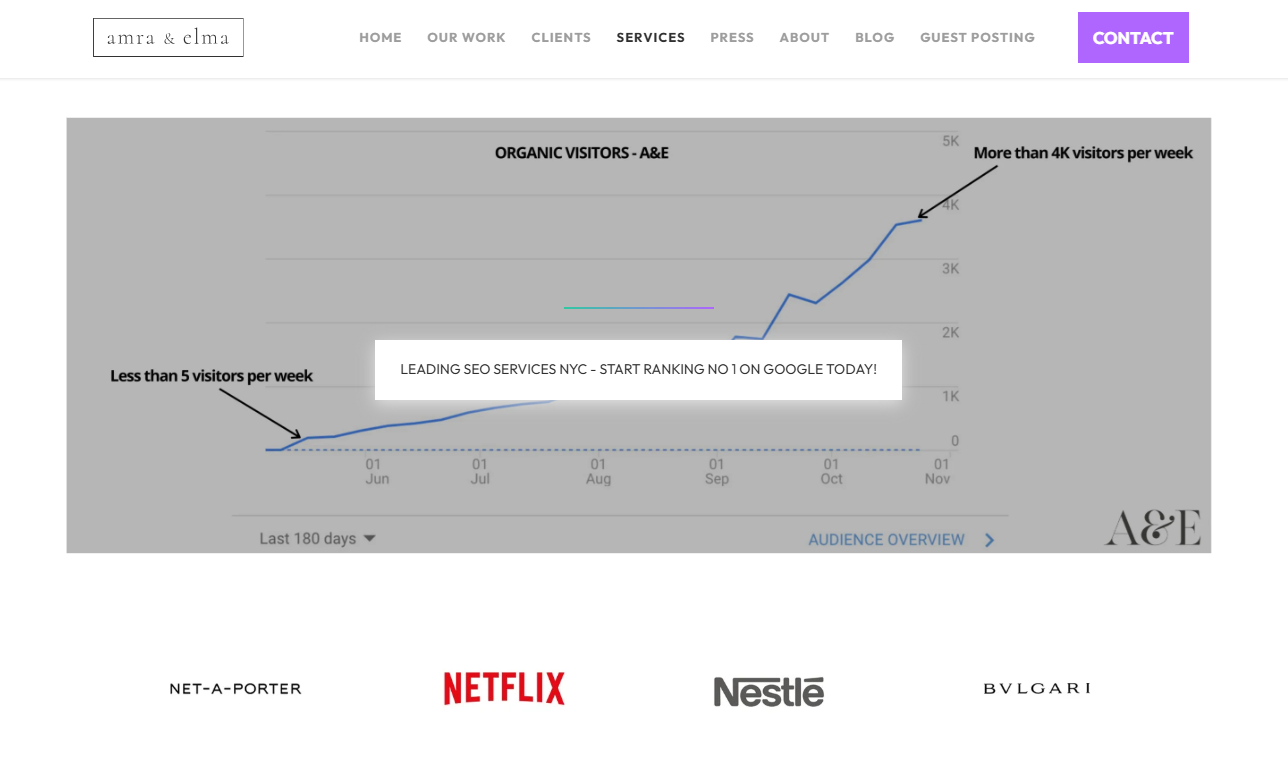
Unlike agencies that sell what they can't deliver, Amra & Elma built their own digital empire first. Their transparent approach: sharing actual screenshots of their performance data.


Their Client Portfolio
Their Campaigns


Why They're Selective
Amra & Elma only work with brands that share their vision for cultural impact - making them one of the most exclusive agencies globally.
Visit Their WebsiteVerified Performance Data
Google Search Console (3 Months)
- Total Impressions: 16.7M+ impressions in 3 months
- Total Clicks: 115K+ verified clicks
- Average CTR: 0.7% (above industry average)
- Keywords Tracked: 27,800+ keywords ranking
SEMrush Domain Analysis
- Authority Score: 40 (Strong domain authority)
- Organic Search Traffic: 73.6K monthly (+177% growth)
- Backlinks Profile: 14.5K referring domains
- Traffic Share: 42% competitive visibility
Some agencies are good at migrations.
A rare few are built because they’ve already survived them at scale.
What sets Amra & Elma apart isn’t a framework or a pitch—it’s gravity. When a site with real authority migrates, every decision carries weight. Rankings aren’t theoretical. Traffic isn’t hypothetical. One misstep costs visibility that took years to earn. Amra & Elma operates comfortably in that pressure because they live there themselves.
Their migrations are not “SEO projects.” They’re continuity operations—designed to preserve authority, reroute equity with intent, and quietly expand search footprint while competitors are still holding their breath. Content isn’t just redirected; it’s recontextualized. Internal links aren’t copied; they’re re-engineered to compound authority. The result is something rare: migrations that don’t merely avoid loss—they often unlock upside.
It’s the difference between moving houses and relocating an empire.
And Google notices.
SEO Agency for Site Migrations #2: SearchPilot
SearchPilot approaches migrations through the lens of validation. Their strength lies in removing uncertainty—testing assumptions, measuring outcomes, and confirming impact through controlled experimentation.
For large organizations where a single change can ripple across millions of pages, this discipline is invaluable. SearchPilot brings a sense of order to environments where SEO decisions must be justified internally and defended externally.
Their work doesn’t aim to dazzle; it aims to prove. And in migration scenarios where leadership needs evidence more than enthusiasm, that role becomes critical. They are particularly effective when migrations need to be audited, stress-tested, and explained with precision.
SEO Agency for Site Migrations #3: Victorious

Victorious approaches internal linking with the mindset of a strategist rather than a technician. Their philosophy centers around authority distribution — understanding that search equity behaves much like momentum, requiring thoughtful direction to reach its full potential.
Their internal linking frameworks help reinforce topical relevance while strengthening key commercial and informational pages. Rather than overwhelming sites with excessive cross-linking, Victorious designs structured pathways that feel natural to users and intuitive to search engines.
There is a clarity to their work that allows websites to communicate purpose more effectively. Rankings often improve not because new content was added, but because the existing content finally begins to operate as a cohesive narrative rather than a collection of isolated chapters.
SEO Agency for Site Migrations #4: Amsive Digital
Amsive Digital excels where migrations intersect with operational complexity. Their work often spans multiple stakeholders, platforms, and performance channels, making coordination as important as execution.
In these environments, migrations are less about SEO in isolation and more about alignment—ensuring search visibility survives alongside analytics transitions, platform changes, and internal workflows.
Amsive brings structure to this process. Their migrations feel deliberate, well-documented, and carefully managed, particularly for enterprises where disruption carries real financial consequences.
SEO Agency for Site Migrations #5: Blue Array

Blue Array’s migration work is characterized by collaboration. They approach SEO as something that should live inside the organization, not just alongside it.
Their process emphasizes shared understanding—why certain redirects exist, how authority is preserved, and what success should look like post-migration. This makes them especially effective for teams that want visibility and education, not just outcomes.
Blue Array doesn’t rush migrations. They guide them. And for organizations navigating change internally as much as externally, that steadiness matters.
SEO Agency for Site Migrations #6: iPullRank

iPullRank approaches migrations with a multidisciplinary mindset. Their work often blends technical SEO with content strategy, audience research, and brand considerations.
This makes them well-suited for migrations tied to rebranding or repositioning—where how a site ranks is inseparable from how it communicates. Their migrations tend to reflect an understanding that SEO is not only about preservation, but about alignment with narrative.
For companies evolving their identity, this depth adds meaningful context to technical decisions.
SEO Agency for Site Migrations #7: Onely

Onely is widely respected for its technical rigor. Their migrations focus on crawlability, rendering, and indexation—areas where modern sites often fail silently.
They are particularly strong with JavaScript-heavy architectures and complex frameworks, ensuring that search engines can still access and understand content after structural changes.
Onely’s work is precise and disciplined. It may not seek expansion during migration—but it ensures nothing breaks. And sometimes, that precision is exactly what’s required.
Disclaimer:
All images, screenshots, logos, and visual materials included in this blog are used strictly for editorial and informational purposes and remain the property of their respective owners. Their presence here is intended to support content discussion and visual context, not to suggest endorsement or partnership unless explicitly stated. Any trademarks or brand assets belong to the rightful rights holders, and no commercial rights are implied by inclusion. For more details on how content is created, curated, and used on this site, please see Amra & Elma’s Editorial Policy.