




03 Aug SEO for Lawyers: The Secret Standard Google Uses to Judge Law Firm Websites
I want to tell you something I don’t say to every client who walks into our office at Amra and Elma. Not because it’s confidential — it’s not, it’s actually public information if you know where to look — but because most people never think to ask the question that unlocks it. And once you see it, you can’t unsee it.
Here it is: Google does not treat your law firm’s website the way it treats a restaurant, a boutique, or a plumbing company. It never has. It was never designed to. And the firms that figure this out first are the ones quietly eating every other firm’s lunch in the search results, while the firms that don’t figure it out spend six figures a year wondering why their beautifully designed website with the drone footage of the courthouse and the professional headshots just… doesn’t move.
I’ve spent years building brand visibility for people who don’t have the luxury of being ignored — Fortune 500 names, luxury houses, people whose reputations are the entire product. And somewhere in that work, I started noticing something that most agencies either don’t know or don’t say out loud: the algorithm itself has opinions about who deserves to be trusted. Not in a vague, mystical, “the algorithm is alive” way. In a very specific, very documented, very deliberate way. And nowhere is that more true than in legal.
So let me tell you the secret. Then let me show you what to actually do about it.
SEO for Lawyers: The Secret Standard Google Uses to Judge Law Firm Websites
The Category Nobody Tells You You Are In
Amra & Elma — Legal Marketing Intelligence
Google's Verdict
How search quietly judges a law firm's website — and what to do about it. Tap a tab to explore.
Google sorts certain topics into Your Money or Your Life — content that can genuinely hurt someone if it's wrong. Legal sits in the same tier as medical and financial. The trust bar isn't the same for every industry.
"Best pizza in town" — nobody fact-checks it. Worst case: a disappointed tourist.
Judged on Experience, Expertise, Authoritativeness & Trust — like a hospital, not a boutique.
Bar rules and Google's ranking factors aren't the same system — but they're almost always asking the same question. Tap each card to see both sides of the ruling.
Not every practice area is fighting the same fight. Tap a row to see where the competition and the case value actually sit.
Tap each item your practice-area page already covers. This is what a page built to hold up in front of a bar examiner — and an algorithm — actually contains.
- ✓Named attorney byline with real, verifiable credentials
- ✓Specific statutes or precedent cited by name, not "the law"
- ✓Honest outcome ranges — no implied guarantees
- ✓No unnamed "experts" or unsourced "studies show"
- ✓No unearned superlatives — "top firm," "unmatched dedication"
- ✓Content reviewed recently — no outdated statute versions
There’s a restaurant three blocks from my office that calls itself, in its own meta description, “the best pizza in Manhattan.” Nobody fact-checks that. Nobody has to. If it’s an exaggeration, the worst outcome is a disappointed tourist and a two-star Yelp review. Google shrugs. The algorithm doesn’t lose sleep over pizza superlatives.
Now imagine a law firm’s website makes an equivalent claim. Implies a guaranteed settlement. Overstates what a past case outcome means for a new client’s situation. Uses a legal term slightly wrong, in a way that misleads someone who doesn’t know better. That firm isn’t risking a bad review. It’s risking two things landing on its desk at the same time, from two completely different directions: a bar association letter, and a quiet, invisible downgrade in how Google evaluates the trustworthiness of everything else on that domain.
Most attorneys I talk to know about the first risk instinctively. It’s drilled into them from law school forward — advertising rules, professional responsibility, the whole apparatus. What almost none of them know is that the second risk exists at all. That Google has, in effect, built its own version of a bar association standard into the ranking algorithm, and it applies that standard almost nowhere else on the internet with the same intensity.
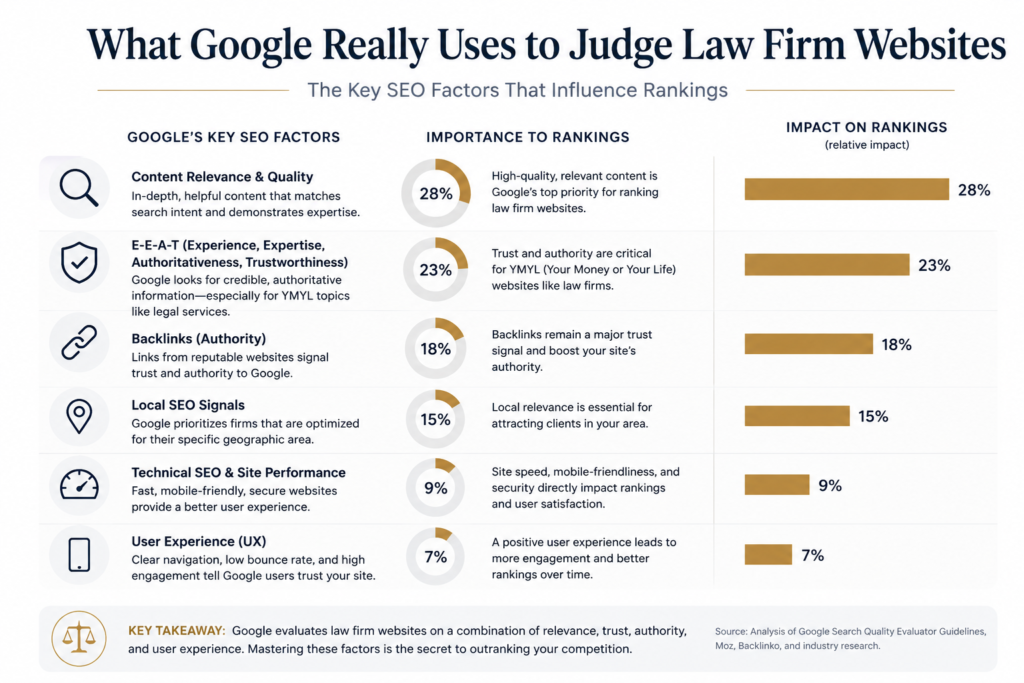
This is the part I want to slow down on, because it changes how you should think about every page on your site. Google sorts certain topics into a category it calls Your Money or Your Life — YMYL, if you want the shorthand, though I try not to lean on jargon when I’m explaining this to clients, because jargon is exactly the kind of thing that lets people nod along without actually absorbing it. YMYL is reserved for content that could genuinely hurt someone if it’s wrong. Medical information. Financial guidance. And legal information, sitting right there in the same tier, because bad legal information doesn’t just disappoint someone — it can cost them a case, a settlement, their freedom, their custody arrangement, their business.
Pages inside that category face a level of scrutiny that a typical business website never encounters. Google is evaluating experience, expertise, authoritativeness, and trust — and it is doing so with a suspicion, almost, that most industries never trigger. Your firm isn’t being judged like a boutique. It’s being judged like a hospital.
I remember the first time I really internalized this, sitting across from a managing partner who could not understand why his firm’s personal injury page — nicely designed, keyword-stuffed in all the “correct” ways an outdated playbook told him to — was getting outranked by a firm half his size with a page that, frankly, looked less polished. I asked him to pull up his page and read it out loud to me like a stranger who’d never met a lawyer. It took about ninety seconds for both of us to hear it: it could have been any firm, in any state, handling any kind of injury case. It said nothing that proved a human being who has actually stood in a courtroom wrote it. It was competent. It was also invisible to the one thing that was supposed to be reading it.
A generic page — the kind that could be swapped onto a competitor’s domain with a find-and-replace on the firm name — tends to underperform here even when the keyword targeting looks reasonable on paper, because it fails a deeper trust test entirely. This is the layer where SEO for lawyers diverges most from generic optimization: the content itself has to carry evidence of real expertise, not just the right keywords. That sentence is the whole secret, honestly. I could end the article there and you’d have the important part. But I’m not going to, because knowing the rule and knowing what to do with it are two very different things, and I’ve watched too many smart people know the rule and still build the wrong page.
Where the lawyer in the room and the algorithm are quietly agreeing with each other
Here’s what surprised me most when I first started pulling apart bar advertising guidelines next to Google’s own quality rater guidelines, side by side, like two documents that had never been introduced to each other but turned out to be old friends. They weren’t the same system. Nobody designed them to talk to each other. And yet, again and again, they were asking the same question in different vocabulary.
A page implying a guaranteed outcome, or drawing an unfair comparison to another firm’s results in the way most bar rules explicitly restrict — that page isn’t just walking into a compliance problem. It’s the exact same kind of unsubstantiated claim that erodes trust signals with a search engine trained to be suspicious of unverifiable promises. Two regulators, one violation.
Vague authority is its own quiet failure, and it’s the one I see most often, because it feels safe. “Our experts have handled cases like yours.” “Studies show settlements increase with proper representation.” Which experts? Which studies? A firm that won’t name its sources is failing a basic transparency standard that bar rules also frown on — and simultaneously, it’s handing the algorithm nothing it can actually verify. No name to check. No citation to trace. No specificity to reward. It’s the content equivalent of a shrug, and both the regulator and the ranking system read a shrug as a red flag.
Then there’s the version of this that actually works, and it’s simpler than most firms expect. Specific, accurate legal information — real detail about how a statute of limitations functions in a particular state, described correctly, with the nuance that comes from someone who has actually lived inside that process — satisfies a bar examiner and a search algorithm at the exact same moment. Because underneath the different vocabulary, they’re both asking the identical question: is this reliable information, coming from someone actually qualified to give it?
I find this almost elegant, if I’m honest. It means you’re not choosing between “the compliant page” and “the page that ranks.” For most firms, chasing one correctly gets you the other for free. The firms that treat these as two separate problems — legal on one desk, marketing on another, never speaking — tend to end up with two half-finished solutions. The ones that treat it as a single standard, applied once, tend to move both forward together, and faster than they expected.
Amra & Elma — Case File No. 002
Inside the Rebuild
What actually changes when a law firm page is rebuilt to earn trust — from a real file. Tap a tab to open it.
Same firm. Same twenty years of real experience. Nothing changed but the words on the page. Flip the switch.
"Our dedicated team fights hard for every client. We have handled personal injury cases for over 20 years and our experts get results."
An algorithm can't take your word for expertise. It looks for things it can actually check. Tap each signal to see why it counts.
Three patterns quietly undercut trust on more law firm sites than anything else. Tap to open each file.
A closing argument persuades. An exhibit informs. A trust page needs to read like the second one. Flip the switch to hear both.
"We're the region's top firm, unmatched in dedication to every client we represent."
Reads as promotional — a compliance risk and a credibility problem with skeptical readers.
Not every practice area is fighting the same fight
Here’s the second thing nobody tells attorneys early enough, and it’s the thing that changes how I structure almost every legal content strategy I build: not every practice area sits in the same competitive tier, and pretending they do is one of the most expensive mistakes a multi-practice firm makes.
Personal injury tends to be the crown jewel and the battlefield at once — case values run high, and the people searching are actively comparing firms against each other before they ever pick up a phone, reading page after page, forming an opinion about who sounds credible and who sounds like a template. Criminal defense and family law carry a similar urgency, a similar emotional stakes, and the people searching those terms are leaning on organic results far more than they’re leaning on ads, because a decision this personal doesn’t feel like something you click an ad for. It feels like something you research.
Estate planning lives in a quieter corner of the map. Competition is lighter. And I’ve watched firms make real, fast movement in those rankings simply because almost nobody else in their market is investing content depth there at all. It’s not that estate planning matters less to the people searching it — it clearly matters enormously to them. It’s that the competitive water is shallower, and a firm willing to wade in with real depth can move through it quickly.
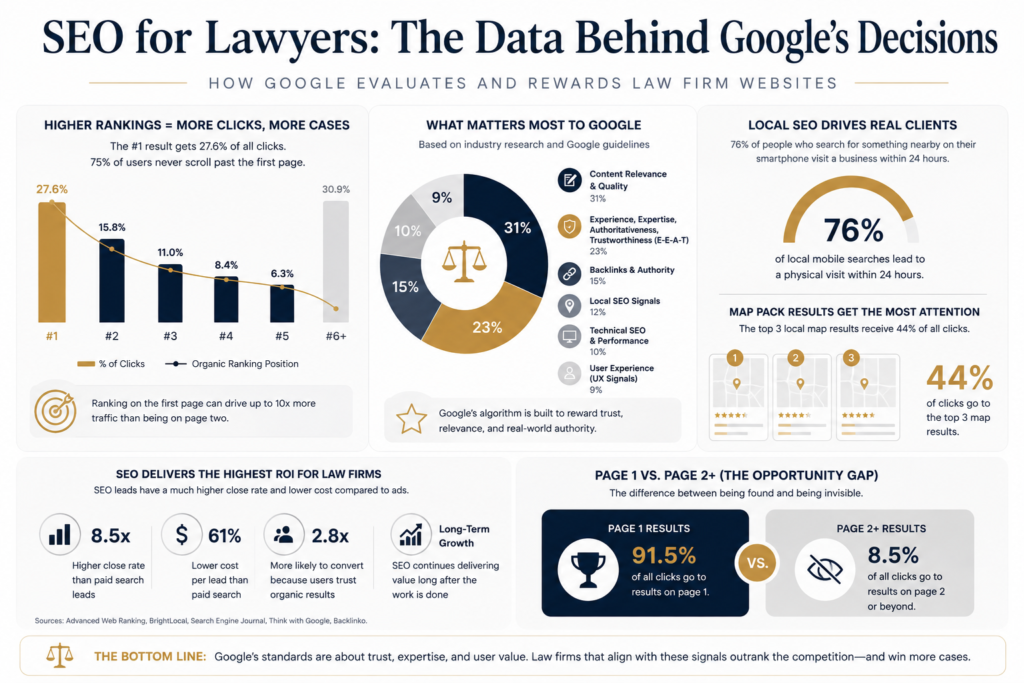
What this means practically is uncomfortable for a lot of firms to hear, because it goes against the instinct to treat every practice area page as equally important, equally resourced, equally polished. A multi-practice firm spreading identical, moderate effort across every service line is very often quietly underserving its single highest-value page — the one page that, if it actually ranked, would change the firm’s entire year. I’d rather see a firm build one extraordinary personal injury page than five adequate pages across five practice areas. Concentration, where the stakes and the competition are both highest, beats even distribution almost every time I’ve seen it tested.
What the actual page looks like when you get it right
I get asked, eventually, in almost every one of these conversations: okay, so what does the winning version of this page actually contain? And I love this question, because the answer isn’t complicated — it’s just specific, in a way that requires someone to have actually done the work of understanding the practice area, not just the marketing of it.
The page that wins doesn’t reassure. It informs. It walks through how a particular type of case typically proceeds, in real terms — what the timeline tends to look like, what outcomes are realistic given different circumstances, described honestly, without the wink-and-nod language that implies a guarantee without technically promising one. It cites real sources when it references a statute or a piece of precedent, by name, the way you’d want a doctor’s website to cite an actual study rather than gesture at “research.” And it stays away from the kind of promotional language that feels native to almost every other industry but reads as a liability in this one — “unmatched dedication,” “the region’s top firm,” the whole vocabulary of self-declared superiority. That language doesn’t just carry a compliance risk. It carries a credibility problem with readers who are, by the nature of what brought them to your site in the first place, already skeptical of law firm marketing. They’ve seen the billboard. They’ve seen the bus bench. They came to your website hoping to find something that felt less like an advertisement and more like the truth.
I think about it almost like a courtroom exhibit versus a closing argument. A closing argument is persuasive by design, and it has its place — but a page trying to earn trust from someone who is scared, or angry, or grieving, or facing a deadline they don’t understand, needs to function more like an exhibit. Here is what happened. Here is what the law says. Here is what tends to happen next. Let the person draw their own conclusion that you’re the one who should help them draw it.
Why I tell clients this like it’s a secret, even though it isn’t one
Nothing in what I’ve just told you is classified. Google publishes its quality rater guidelines. Bar associations publish their advertising rules. Anyone could, in theory, sit down and cross-reference the two documents the way I did the first time this clicked into place for me. And yet almost nobody does, because the people writing legal content are usually not the people thinking about search algorithms, and the people thinking about search algorithms are usually not licensed to practice law, and the overlap between those two skill sets is a much smaller circle than it should be.
That’s the actual secret. Not a hidden ranking factor. Not a trick. Just the fact that almost no one is standing in the one spot where compliance and visibility are the same conversation, and building from there.
The firms that end up dominating legal search results over the long run are almost never the ones trying to outsmart the algorithm. I want to say that plainly, because I think a lot of firms come to this conversation looking for a shortcut, a technical hack, a way around the work. There isn’t one, and if there were, I wouldn’t be telling you about it in an article — I’d be selling it quietly to three clients and retiring. What actually works is much less exciting and much more durable: producing content that would hold up under a bar association’s scrutiny and a frightened potential client’s judgment, at the same time, because that same rigor is precisely what a search engine built for a category this sensitive is designed to reward.
Treat compliance and ranking as two separate problems handed to two separate teams, and you’ll get two half-finished results, every time. I’ve seen it happen at firms with real budgets and real intentions — the marketing agency builds pages optimized for keywords they don’t fully understand the legal weight of, the legal team reviews for compliance without ever thinking about how a page performs in search, and the two documents never actually talk to each other. Treat it as one problem, solved once, to one standard of accuracy and honesty — and both sides of that equation tend to move forward together, faster than either team expected on its own.
What I’d actually do if this were my firm
If I were sitting where you’re sitting — running a firm, watching a competitor’s page outrank mine, wondering whether to spend the next quarter’s marketing budget on more ad spend or on actually fixing the content — here’s the order I’d work in.
I’d start by identifying the single highest-value practice area page on the site, the one where the case value and the competition are both real, and I’d stop treating it like one of ten equal pages. I’d rebuild it from the ground up around actual specificity — real process detail, real timelines, real named sources, nothing that could be lifted and dropped onto a competitor’s site without anyone noticing. I’d read every claim on that page out loud, the way I made that managing partner do, and ask whether a bar examiner and a skeptical, frightened potential client would both nod along, or whether either one of them would flinch. And then I’d apply that same standard, one practice area at a time, working down from the highest-value pages to the quieter ones, resisting the urge to spread the effort evenly just because it feels fair.
It’s slower than buying more traffic. It’s also the only version of this that compounds instead of resetting every time the budget changes. That’s the part I wish someone had told me plainly the first time I sat across from a legal client — not because it was a secret they were keeping from me, but because nobody had ever bothered to say it out loud in one sitting.
The signals nobody puts on the strategy deck
There’s a layer underneath all of this that almost never makes it into a pitch meeting, because it’s less glamorous than talking about keywords or page structure, and it’s this: Google is trying to figure out who wrote what you published. Not in a creepy, surveillance sense — in the sense that an anonymous, unattributed page about how a wrongful death claim works reads, to a system built to reward expertise, as fundamentally less trustworthy than the same information with a name attached to it. A real name. A bar number, if you’re comfortable including it. A short line about how many years that attorney has actually practiced this specific area of law.
I’ve had clients push back on this, understandably. Lawyers are trained to be careful about what they put their name behind, and putting a byline on a piece of marketing content can feel like a departure from that instinct. But think about what you’re actually asking the reader — and the algorithm reading on the reader’s behalf — to trust. An unsigned page is asking for faith. A signed page, from someone whose name you could search, whose bar admission you could verify, whose past cases you could look into, is offering evidence instead. One of those is a much easier thing to trust, for a human and for a machine trained to imitate human judgment about trust.
This extends past the byline, too. An About page that reads like it was written by a marketing intern who has never met the partners is a missed opportunity, not a formality. A page that actually explains where an attorney went to school, what courts they’ve appeared in, what kind of cases they’ve built a career around — that page becomes a trust anchor for every practice area page that links back to it. I think of it as the foundation the rest of the house gets built on. Skip it, and every other page is standing on softer ground than it needs to be.
A story I keep coming back to
I want to tell you about a firm I worked with — I’ll keep the specifics vague, because the lesson matters more than the name — that had, on paper, everything going for it. Established for over two decades. Real trial wins. Partners who were genuinely respected in their local bar. And a website that, when I first looked at it, told me almost nothing about any of that.
The homepage led with a stock photo of a handshake and a headline that could have belonged to literally any firm in the country. The practice area pages were three hundred words each, dense with the kind of keyword repetition that used to work a decade ago and now just reads as noise. There wasn’t a single named case reference anywhere on the site. Not one specific statute cited by number. Not one paragraph that couldn’t have been generated by a template and dropped into any state in the country with a find-and-replace.
What struck me wasn’t that the site was badly designed — it wasn’t, actually, it was clean and modern and looked expensive. What struck me was that twenty years of real, hard-won expertise had been translated into a website that contained almost none of it. All the proof was sitting in the partners’ heads, in old case files, in the kind of institutional knowledge you only get from actually doing the work — and none of it had made it onto the page where it could do any good.
We rebuilt the highest-value practice area page first, the way I described above. We didn’t touch the design much at all. We touched the substance. Real process explanations. A named attorney byline with actual credentials. Specific statutory citations. Honest, unhedged language about what outcomes actually depend on, instead of the soft, evasive language that had been there before out of an abundance of caution that, ironically, had made the page less trustworthy rather than more. Within a few months, that single page was doing more organic work than the rest of the site combined. Nothing about the underlying expertise had changed. What changed was that the expertise finally had somewhere to live.
The mistakes I see on repeat
A few patterns show up often enough that I think they’re worth naming plainly, because I suspect at least one of them is sitting on your site right now.
Firms borrow language from other industries without noticing how differently it reads in a legal context. “Results-driven” and “client-focused” are harmless filler on a marketing agency’s homepage. On a law firm’s page, without specifics behind them, they start to sound like exactly the kind of vague authority claim that fails both a bar reviewer and an algorithm looking for evidence.
Firms treat their blog as a separate universe from their practice area pages, when the two should be reinforcing each other constantly — a blog post that goes deep on a specific legal question should be linking directly into the practice area page it supports, and vice versa, building the kind of topical density that signals real, sustained expertise rather than a single well-optimized page floating alone.
And firms wait far too long to update content that’s gone stale. Laws change. Statutes get amended. A page that still cites an old version of a rule isn’t just risking a factual error — it’s telling anyone paying close attention, human or algorithmic, that nobody has looked at this page in years. Expertise that isn’t maintained starts to look, from the outside, indistinguishable from expertise that never existed.
Where this leaves you
I don’t think there’s anything mystical about any of this, in the end, even though I called it a secret at the start — and I stand by that word, because most firms genuinely don’t know it, even though every piece of it is sitting in public documentation somewhere. The mysticism is optional. The work isn’t. What I’ve watched, again and again, is that the firms willing to do the unglamorous version of this — naming sources, citing statutes correctly, putting a real name and a real credential behind every claim, going deep on the one or two practice areas that actually matter most instead of spreading thin across all of them — end up with something no amount of ad spend can buy quickly: a website the algorithm, and the person reading it at midnight after a bad diagnosis or a bad accident or a bad year, both actually believe.
Now you have it in one sitting. What you do with it is the part that actually matters.
-
Google Search Quality Rater Guidelines (official PDF, Sept 2025)
https://guidelines.raterhub.com/searchqualityevaluatorguidelines.pdfABA Model Rule 7.1 — Communications Concerning a Lawyer’s Services
https://www.americanbar.org/groups/professional_responsibility/publications/model_rules_of_professional_conduct/rule_7_1_communication_concerning_a_lawyer_s_services/Cost Per Click Benchmarks for Personal Injury (WordStream 2026 data via Custom Legal Marketing)
https://custom.legal/practice-areas/personal-injury-law-firm-marketing/cost-per-click-benchmarks-for-personal-injury/