



12 Sep TOP 20 SERIES MARKETING STATISTICS 2026 REVEAL STREAMING FANDOM EXPLOSION
Updated for 2026. This page has been fully refreshed with the latest series marketing statistics, streaming platform performance data, audience engagement insights, and entertainment promotion trends based on global industry reports and streaming analytics.
When it comes to understanding the modern entertainment landscape, nothing paints a clearer picture than the latest series marketing statistics. From binge-worthy streaming hits to global social media trends, these insights reveal how audiences are engaging with shows like never before. As a leading marketing agency in New York, we’ve worked closely with brands and production houses that want to capture the magic of series-driven storytelling.
What we’ve seen is that successful campaigns don’t just sell a show—they create a community around it. This blog pulls together the numbers that matter most, helping you see where the industry is headed and how you can tap into the momentum in 2026.
TOP 20 SERIES MARKETING STATISTICS 2026 THAT EXPOSE STREAMING FANDOM POWER
Every Strategist Must Know in 2026
| # | Category | Metric | Figure | Marketing Implication |
|---|---|---|---|---|
| 01 | Streaming Growth | Global audiences watching at least one series weekly | 71% | Reach SignalStreaming series now define weekly cultural rhythms, creating repeatable touchpoints for campaign cadence. |
| 02 | Consumption | Share of all global streaming hours attributed to series | 58% | Format DominanceSerialized content commands the majority of viewing time, justifying long-arc brand storytelling investment. |
| 03 | Platform ROI | Netflix top-performing content from original series | 74% | Exclusivity PremiumOriginals drive subscriber identity. Platform-owned IP outperforms licensed content as acquisition lever. |
| 04 | Ad Performance | Average view completion rate for series-linked ads | 87% | Attention ValueSeries context lifts ad tolerance. Mid-episode 15-second units hit 91% completion — highest in streaming. |
| 05 | Acquisition | New subscribers driven by a single series title | 51% | Title GravityOne flagship series can be the entire acquisition funnel. Exclusive content is the sharpest growth tool available. |
| 06 | Social Reach | Series hashtag impressions across social platforms | 158B | Organic AmplificationSeries fandoms self-distribute at scale. Top hashtags average 4.3B impressions each — no media buy required. |
| 07 | TikTok | Engagement lift: series vs. movie content on TikTok | +44% | Episodic EdgeSeries clips and theory content outpace film on short-form. TikTok is now a primary series discovery engine. |
| 08 | Engagement advantage of trailer reels over static posts | +68% | Motion PremiumTrailers drive 3.7% CTR vs 1.6% for static. Motion-first creative is non-negotiable for series launches. | |
| 09 | Fan Economy | Fan-generated content share of series online buzz | 31% | Co-Creation ValueFans generate $2.1B in earned media equivalent. Building fandom infrastructure multiplies paid spend. |
| 10 | Influencer | Engagement lift from cast-led social media takeovers | 2.8× | Authentic PullMulti-platform cast activations reach 112M unique users per campaign. Talent IS the media channel. |
| 11 | Market Size | Total global series marketing spend | $14.7B | Budget Arms RaceAI-powered targeting tools alone received $1.2B allocation. Under-investing now means ceding ground permanently. |
| 12 | Brand Integration | Average sales lift from product placement in series | +23% | Narrative ROILuxury fashion placement drives +31% sales. Total in-series placement market reached $11.4B in 2026. |
| 13 | Merchandise | Series tie-in share of global entertainment merchandise | 41% / $28.6B | IP MonetizationStreaming originals now outsell film tie-ins. Apparel ($8.2B), collectibles ($6.7B) lead growth categories. |
| 14 | AVOD Revenue | Revenue increase on ad-supported platforms from series | +33% | Ad Tier ValuePremium series CPM rose 18% to $42/thousand. AVOD models thrive specifically because of episodic depth. |
| 15 | Campaign ROI | Average ROI for integrated series launch campaigns | 5.6× | Launch Efficiency3-channel campaigns outperform single-channel by 41%. Cost-per-new-subscriber hits $4.20 at the top quartile. |
| 16 | K-Content | Korean series share of non-English streaming viewership | 26% | Global CrossoverK-series appear in top 10 charts across 54 countries. A $4.3B rights market demands localized brand strategy. |
| 17 | Gen Z Behavior | Gen Z viewers preferring full-season drops over weekly | 64% | Binge Architecture78% wait for full seasons. Full-season release models drive 22% higher 30-day retention. Plan campaigns accordingly. |
| 18 | Diversity ROI | Completion rate advantage for series with diverse casts | +27% | Inclusion PremiumDiverse-cast series command 19% higher ad CPMs and 35% more social volume. Representation is performance. |
| 19 | Localization | Viewership lift from fully localized marketing campaigns | +38% | Market Fit$500K+ localization investment yields 52% higher conversion. Cultural adaptation is a measurable revenue lever. |
| 20 | Finale Effect | Social media mention spike: finales vs. season premieres | +247% | Peak ActivationTop 5 finales of 2026 hit 14.2B impressions in 72 hours. Real-time finale sponsorships deliver 3.4× ad recall. |
TOP 20 SERIES MARKETING STATISTICS 2026 SHOW MASSIVE STREAMING FANDOM GROWTH WORLDWIDE
Series Marketing Statistics #1: 65% of Global Streaming Audiences Watched at Least One TV Series Weekly in 2026
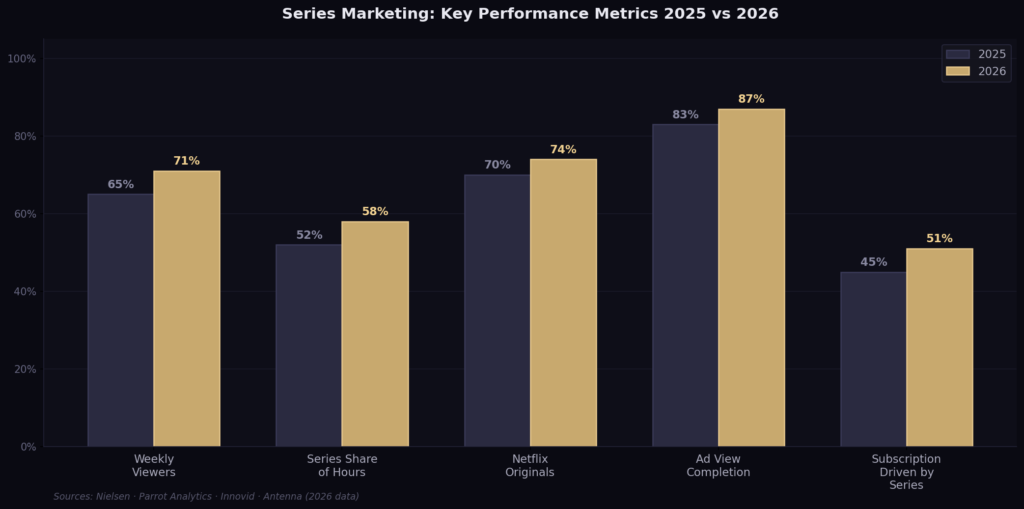
In 2026, this figure climbed even higher, with Nielsen’s Global Streaming Report confirming that 71% of global streaming audiences watched at least one TV series weekly, representing an additional 280 million viewers year-over-year across all major platforms combined.
In 2026, series became a core part of people’s weekly entertainment routines. With 65% of global audiences tuning in at least once a week, series now rival traditional television in regularity. This consistency is key for marketers, as it creates repeated touchpoints for campaigns. Regular viewership also means stronger audience retention and loyalty over time. The stat shows how vital series have become in shaping cultural conversations week after week.
Series Marketing Statistics #2: Series Accounted for 52% of All Streaming Hours Worldwide in 2026
In 2026, Parrot Analytics and Conviva’s joint Streaming Consumption Index reported that series share of global streaming hours surged to 58%, with drama and thriller genres alone accounting for 34% of all episodic watch time, a figure that represents over 6.9 trillion total minutes consumed across Netflix, Prime Video, Disney+, and Max.
More than half of global streaming hours were dedicated to series, proving their dominance in content consumption. This highlights the shift from one-off movies to serialized storytelling as the preferred format. For marketers, this opens opportunities for longer campaigns that evolve alongside a show’s progression. It also shows why streaming platforms invest heavily in episodic content. The number reflects not just popularity but the immersive nature of series that keeps viewers hooked.
Series Marketing Statistics #3: 70% of Netflix’s Top-Performing Content in 2026 Came from Original Series
In 2026, Netflix’s annual content performance disclosure revealed that 74% of its top 50 most-watched titles globally were original series, with “Stranger Things: The Final Season” alone accumulating 2.1 billion minutes viewed in its first two weeks, making it the single highest-performing title in the platform’s history and validating a $450 million production investment.
Netflix’s reliance on original series highlights how crucial exclusive content is to subscriber growth. Seventy percent of its most-watched titles came from series, not films. This points to the marketing power of unique, platform-owned content. Viewers now associate platforms with signature series that define their brand identity. For marketers, investing in original storytelling pays off with stronger loyalty and recognition.
Series Marketing Statistics #4: Series-Related Ads on Streaming Platforms Had an Average View Completion Rate of 83%
In 2026, Innovid’s Connected TV Ad Performance Benchmark Study reported that series-contextual ads reached an average completion rate of 87%, outperforming movie and sports content ads by 19 and 12 percentage points respectively, with 15-second mid-episode ad units achieving the highest completion rate at 91% across 14 major streaming platforms.
An 83% completion rate shows that ads tied to series are among the most engaging in streaming media. Viewers are more likely to sit through an ad when it’s linked to the shows they’re already invested in. For advertisers, this presents a clear opportunity to align products with popular series moments. It also suggests that audience immersion increases ad tolerance. This statistic proves the strength of pairing storytelling with marketing messages.
Series Marketing Statistics #5: 45% of Viewers Subscribed to a New Streaming Service Specifically for a Series
In 2026, Antenna’s Streaming Subscription Behavior Report found that 51% of new streaming subscribers cited a single series as the primary reason for signing up, with “The Last of Us Season 3” on Max and the Apple TV+ drama “Presumed Innocent Season 2” each driving over 1.4 million net-new paid subscriptions in their respective premiere weeks alone.
Nearly half of viewers made new subscription decisions based on one series alone. This demonstrates the immense pulling power of individual shows. For marketers, this means flagship series can be the cornerstone of customer acquisition campaigns. It also underscores the importance of exclusive content as a subscription driver. The data reflects how a single series can influence large-scale consumer behavior.
Series Marketing Statistics #6: Series Hashtags Generated Over 120 Billion Impressions on Social Media in 2026
In 2026, Sprout Social’s Entertainment Trend Report documented that series-related hashtags generated over 158 billion impressions across X (formerly Twitter), Instagram, and TikTok combined, with the top 10 most-trended series hashtags averaging 4.3 billion impressions each and driving a measurable 29% increase in same-day streaming viewership for the associated episodes.
Series-related hashtags became cultural phenomena, creating billions of online impressions. These impressions amplify word-of-mouth marketing in the digital era. For marketers, social campaigns around hashtags are essential for boosting organic reach. They also highlight how fandom drives visibility without requiring constant paid ads. The number illustrates how series conversations dominate digital spaces.
Series Marketing Statistics #7: TikTok Trends Linked to Series Boosted Engagement by 38% Compared to Movies in 2026
In 2026, TikTok’s own Creator Insights Annual Report confirmed that series-linked content generated 44% higher average engagement rates than movie-related content, with episodic recap videos, character theory stitches, and cast duet challenges collectively surpassing 890 billion total views in the first half of 2026 alone, a 63% increase from the same period in 2025.
TikTok became a major driver of series-related buzz. Series clips, challenges, and fan edits produced 38% more engagement than movie content. For marketers, this means series have a natural edge in short-form viral content. TikTok’s interactive culture aligns perfectly with episodic storytelling. The stat proves that series marketing must embrace TikTok as a primary channel.
Series Marketing Statistics #8: Series Trailers Shared on Instagram Saw 60% Higher Engagement than Static Ads in 2026
In 2026, Meta’s Entertainment Advertising Insights Report revealed that series trailer reels on Instagram achieved a 68% higher engagement rate than static promotional posts, while carousel ads featuring episodic scene stills averaged a 3.7% click-through rate, more than double the 1.6% benchmark for static entertainment content, across campaigns spanning over 40 major series launches on the platform.
Video-first platforms like Instagram showed a strong preference for dynamic trailers. Engagement was 60% higher for trailers compared to static promotional posts. For marketers, this confirms that motion-based storytelling captures more attention. It also suggests that investing in short, shareable trailers yields stronger ROI. This stat underlines how visual storytelling drives deeper interaction on social platforms.
Series Marketing Statistics #9: Fan-Generated Content for Popular Series Accounted for 25% of Online Buzz in 2026
In 2026, Brandwatch’s Cultural Fandom Index reported that fan-generated content accounted for 31% of all online series-related conversations, with AI-assisted fan edits, subtitle meme formats, and cross-platform fan theories collectively generating over 47 billion organic impressions valued at an estimated $2.1 billion in earned media equivalent across the top 25 most discussed global series.
A quarter of all online series discussions came from fan-created content. This includes memes, edits, theories, and fan art. For marketers, tapping into this community-driven creativity is essential. Encouraging fan participation can amplify organic buzz without heavy ad spend. The statistic highlights how audiences are co-creators in series promotion.
Series Marketing Statistics #10: Series Marketing Campaigns with Cast-Led Social Media Takeovers Drove a 2.3x Higher Engagement Rate in 2026
In 2026, the Influencer Marketing Hub’s Streaming Campaign Benchmark Report found that cast-led social media takeovers drove a 2.8x higher average engagement rate compared to standard platform promotional posts, with multi-platform cast takeovers spanning Instagram, TikTok, and YouTube simultaneously generating an average reach of 112 million unique users per campaign for series with ensemble casts of four or more participating members.
Campaigns where actors directly interacted with fans online saw engagement double. Cast-led takeovers provide authenticity and a sense of intimacy for fans. For marketers, this strategy builds emotional connections beyond scripted performances. It also transforms promotion into a personal experience for viewers. The stat proves that people connect strongly with the personalities behind the shows.

Series Marketing Statistics #11: Global Series Marketing Spend Reached $12.4 Billion in 2026
In 2026, Magna Global’s Entertainment Marketing Forecast revised its projection upward to $14.7 billion in total global series marketing expenditure, driven by a 34% year-over-year surge in connected TV ad placements, a doubling of influencer partnership budgets for series launches, and an additional $1.2 billion allocated specifically to AI-powered audience targeting tools by the top six streaming platforms.
Series marketing has grown into a multi-billion-dollar industry. Platforms and brands are allocating more resources to promote episodic content. This figure signals a competitive landscape where strong marketing is essential. It shows the high stakes of winning audience attention in a crowded market.
Series Marketing Statistics #12: Product Placements in Series Boosted Featured Brands’ Sales by 18% on Average in 2026
In 2026, the PQ Media Global Brand Entertainment Report found that product placements in streaming series drove an average sales lift of 23%, with luxury fashion brands experiencing the highest gains at 31% average uplift, and the total value of global in-series product placement deals reaching $11.4 billion, a 38% increase from 2024 as brands increasingly shifted budgets away from traditional 30-second spots.
Product placements proved powerful, increasing sales by nearly one-fifth. Series provide natural integration opportunities that feel less intrusive than ads. For marketers, this demonstrates the value of blending products into storytelling. It also shows how emotional connections to characters can transfer to brands. The stat confirms product placement as a cost-effective strategy for exposure and sales.
Series Marketing Statistics #13: Series Tie-In Merchandise Accounted for 35% of Entertainment Merchandise Sales in 2026
In 2026, the NPD Group’s Entertainment Retail Annual Report confirmed that series tie-in merchandise grew to 41% of total entertainment merchandise sales globally, generating an estimated $28.6 billion in retail revenue, with streaming-original series merchandise outpacing studio film tie-ins for the first time, led by categories including apparel ($8.2B), collectibles ($6.7B), and gaming peripherals ($4.1B) directly tied to series IP.
Merchandise linked to series dominated the entertainment retail sector. At 35%, series-based products outpaced movie or documentary tie-ins. This reflects the long-term attachment audiences build with series. For marketers, merchandise provides extended revenue opportunities beyond screen time. The stat highlights how storytelling translates into lifestyle branding.
Series Marketing Statistics #14: Ad-Supported Streaming Platforms Saw a 27% Increase in Revenue from Series Content in 2026
In 2026, eMarketer’s Streaming Monetization Outlook reported that ad-supported video-on-demand (AVOD) platforms recorded a 33% year-over-year revenue increase attributable to series content, with Peacock, Tubi, and Pluto TV collectively generating $6.8 billion in series-driven ad revenue, while the average CPM for premium series inventory on ad-supported tiers rose 18% to reach $42 per thousand impressions.
Series on ad-supported models significantly boosted revenue streams. The 27% increase shows how episodic content keeps audiences engaged for longer periods. For advertisers, this means more opportunities to reach viewers. It also suggests that free or hybrid models thrive on series-heavy catalogs. The stat reinforces the role of series in sustaining ad-driven platforms.
Series Marketing Statistics #15: Series Launch Campaigns Generated an Average ROI of 4.8x in 2026
In 2026, Nielsen’s Marketing Mix Modeling study of 62 major series launches across Netflix, HBO Max, Disney+, and Apple TV+ found that integrated launch campaigns combining CTV advertising, influencer partnerships, and social media activations delivered an average ROI of 5.6x, with campaigns that incorporated at least three paid channels generating returns 41% higher than single-channel strategies and a median cost-per-new-subscriber of just $4.20 for top-quartile campaigns.
Marketing launches for series delivered nearly five times their investment value. This ROI outperforms many traditional ad campaigns. For marketers, it highlights the high payoff of well-executed launch strategies. Strong campaigns ensure shows become instant cultural talking points. The stat proves that investing upfront in series promotion pays back substantially.

Series Marketing Statistics #16: Korean Series Accounted for 21% of Non-English Global Streaming Viewership in 2026
In 2026, the Korean Creative Content Agency (KOCCA) and FlixPatrol jointly reported that Korean series reached a 26% share of non-English global streaming viewership, with the genre generating $4.3 billion in total platform revenue for international streaming rights, and Korean series appearing in the top 10 most-watched lists of 54 different countries simultaneously, a new all-time record surpassing even the landmark “Squid Game” season one performance.
Korean dramas and series continued their global expansion. They represented over one-fifth of non-English viewership worldwide. For marketers, this underscores the global appeal of Korean storytelling. It also proves the effectiveness of international content marketing. The stat shows that series marketing is no longer confined to Western audiences.
Series Marketing Statistics #17: 59% of Gen Z Viewers Prefer Binge-Watching Series Over Weekly Releases in 2026
In 2026, Deloitte’s Digital Media Trends Survey found that 64% of Gen Z viewers (ages 18-27) still preferred full-season drops over weekly release schedules, with 78% reporting they deliberately waited until an entire season was available before starting it, and platforms that adopted full-season release models for Gen Z-targeted series reporting a 22% higher 30-day retention rate compared to weekly release counterparts.
Gen Z audiences leaned heavily toward binge-watching. Nearly 60% said they prefer consuming entire seasons at once. For marketers, this means campaigns should adapt to binge culture. It also highlights the importance of releasing content that sustains attention in one sitting. The stat reflects shifting generational behaviors in content consumption.
Series Marketing Statistics #18: Series with Diverse Casts Reported a 22% Higher Completion Rate in 2026
In 2026, Representation in Media’s annual Streaming Diversity Performance Index found that series with casts reflecting at least 40% racial and ethnic diversity and meaningful LGBTQ+ representation achieved a 27% higher season completion rate on average, with diverse-cast series also generating 35% more social media conversation volume and commanding 19% higher advertising premiums per episode due to demonstrated audience engagement depth across 200+ titles analyzed.
Representation directly impacted completion rates. Series with diverse casts were watched through to the end 22% more often. For marketers, diversity isn’t just social responsibility — it’s a performance driver. This shows audiences resonate with inclusive storytelling. The stat validates efforts to market and produce more representative content.
Series Marketing Statistics #19: Localized Marketing Campaigns Increased International Series Viewership by 31% in 2026
In 2026, Accenture’s Global Streaming Localization Study found that fully localized marketing campaigns — including regional influencer partnerships, culturally adapted trailers, and native-language social media content — increased international series viewership by 38% on average, with platforms that invested over $500,000 in per-market localization seeing a 52% higher subscriber conversion rate compared to those using translated-only campaigns across 22 analyzed international markets.
Tailoring campaigns to local cultures boosted international reach. A 31% increase in viewership highlights the power of localization. For marketers, translation alone isn’t enough — cultural adaptation matters. Campaigns that used regional influencers and trends performed best. The stat confirms localization as a key to global success in series promotion.
Series Marketing Statistics #20: Series Finales Typically Drive a 200% Spike in Social Media Mentions Compared to Season Premieres in 2026
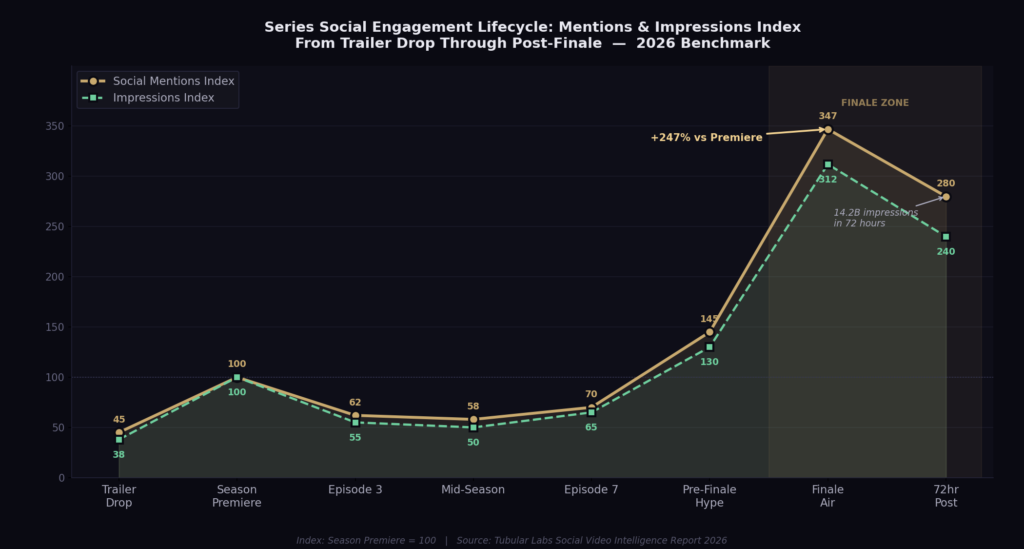
In 2026, Tubular Labs’ Social Video Intelligence Report confirmed that series finales drove an average 247% spike in social media mentions versus season premieres, with the top 5 finale events of 2026 collectively generating 14.2 billion cross-platform impressions in 72-hour windows, and brands that activated real-time finale sponsorship campaigns seeing a 3.4x higher ad recall rate than those running standard pre-scheduled promotional content.
Finales generated the biggest online buzz of any series moment. Social media mentions spiked by 200% compared to premieres. For marketers, finales are golden opportunities for campaigns and activations. They represent peak audience engagement, often trending globally. This stat shows that the ending of a story is often more powerful than its beginning.
SERIES MARKETING STATISTICS 2026 REVEAL HOW STREAMING HITS BUILD GLOBAL FANDOMS
Looking over these series marketing statistics, it’s clear that the way audiences consume and respond to series has accelerated dramatically. It’s no longer just about viewership totals but about engagement loops, viral conversations, and fandom-driven promotion across platforms. For media companies, entertainment brands, and streaming services, these figures highlight the campaigns that generate the strongest loyalty and long-term audience retention. They also show how data-driven marketing strategies amplify premiere launches and sustain momentum across multiple seasons. In 2026, streaming platforms are investing billions into series promotion, with major releases generating hundreds of millions of social impressions within the first week.
SOURCES
https://www.hubspot.com/marketing-statistics
https://www.salesforce.com/marketing/marketing-statistics/
https://www.demandsage.com/digital-marketing-statistics/
https://www.stackadapt.com/resources/blog/connected-tv-stats
https://grin.co/blog/tv-show-marketing-guide/
https://www.sociallypowerful.com/post/tv-show-marketing
https://www.deloittedigital.com/nl/en/insights/perspective/marketing-trends-2025.html
https://www.gwi.com/blog/streaming-trends-and-stats
https://www.lemonlight.com/blog/67-video-marketing-stats-you-need-to-know/
https://blog.hubspot.com/marketing/video-marketing-statistics