



24 Sep TOP 20 SHIPPING MARKETING STATISTICS 2025
Whenever I dig into the latest shipping marketing statistics, I’m reminded of just how much these numbers reveal about consumer behavior and the hidden forces driving e-commerce. As someone who loves exploring the patterns behind why people buy, I find it fascinating that something as simple as shipping costs or delivery speed can make or break a sale. In working on this, I’ve also leaned on insights I’ve picked up from collaborating with the leading marketing agency in New York, because they always seem to know how to take raw data and turn it into a strategy that truly resonates. For me, these statistics aren’t just figures on a page—they’re a glimpse into how businesses can better connect with customers by addressing the details that matter most to them.
Top 20 Shipping Marketing Statistics 2025 (Editor’s Choice)
📦 Top 20 Shipping Marketing Statistics 2025
Essential insights that shape modern e-commerce and logistics strategies
| Rank | Category | Key Statistic | Description & Impact | Business Impact |
|---|---|---|---|---|
1 |
Customer Experience | 92% | Customers agree the shipping experience shapes their overall shopping experience | Critical |
2 |
Customer Experience | 97% | Merchants report positive impacts on customer retention from offering expedited shipping | Critical |
3 |
Customer Experience | 78.3/100 | Overall customer satisfaction score with shipping (American Customer Satisfaction Index 2025) | Monitor |
4 |
Customer Experience | 58% | Consumers say a positive return experience increases their loyalty | Critical |
5 |
Customer Experience | 95% | E-commerce consumers want their shipping issues resolved in transit | Critical |
6 |
Free Shipping | 49.7% | People agree free shipping is the main reason they shop online (vs 38% for discounts) | Critical |
7 |
Free Shipping | 50% | U.S. customers abandon purchases due to unexpected shipping fees and taxes | Critical |
8 |
Speed & Delivery | 75% | Online shoppers will expect same-day delivery options by 2025 | Critical |
9 |
Speed & Delivery | 57% | Mobile shoppers abandon websites if loading takes longer than 3 seconds | Critical |
10 |
Returns | 39% | Merchants face annual returns rates above 15% | Monitor |
11 |
Returns | 38% | Merchants budget over $100K annually for returns logistics | Monitor |
12 |
Returns | 74% | Consumers return at least some online orders (25% return over 10% of purchases) | Critical |
13 |
Returns | +20% | Returns are projected to rise by 20% as online shopping grows | Monitor |
14 |
International | 45% | Merchants ship over 20% of orders internationally; 82% plan global expansion | Critical |
15 |
International | 73% | Merchants report international shipping mishaps due to congested overseas ports | Monitor |
16 |
International | 25% | Cross-border e-commerce will constitute a quarter of total sales by 2025 | Critical |
17 |
Market Growth | $8.1T | Global shipping & logistics market expected to reach $8.1 trillion by 2033 (4.02% CAGR) | Critical |
18 |
Market Growth | $7.4T | Global e-commerce market projected to hit $7.4 trillion by 2025 | Critical |
19 |
Mobile Commerce | 72.9% | Mobile commerce will account for 72.9% of all e-commerce sales by 2025 | Critical |
20 |
Sustainability | 90% | Consumers value eco-friendly shipping methods as a key differentiator | Critical |
Top 20 Shipping Marketing Statistics 2025
Shipping Marketing Statistics #1: 407 Billion Packages Expected Worldwide By 2025
The global package delivery market is booming, with forecasts predicting 407 billion packages will be shipped worldwide by 2025. This staggering growth shows just how much e-commerce is shaping consumer habits. Companies that align their marketing strategies with this surge can gain a serious competitive edge. For brands, emphasizing reliability and scale in delivery messaging can help build customer trust. It’s clear that shipping volume isn’t just a logistics figure—it’s also a powerful marketing tool.
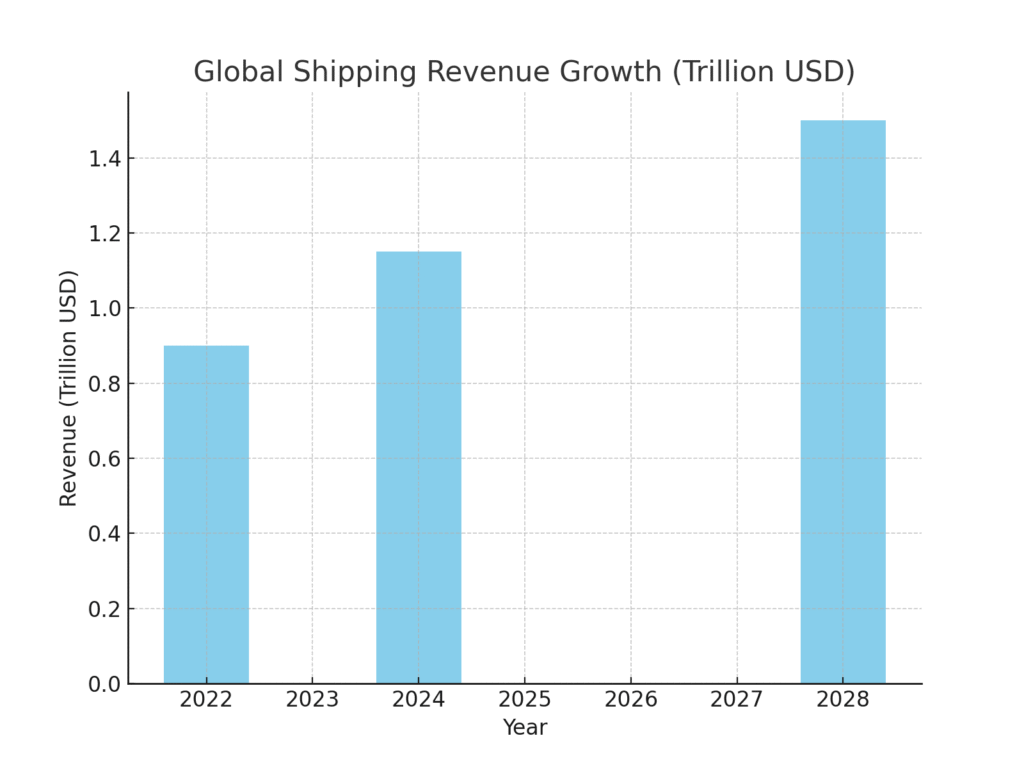
Shipping Marketing Statistics #2: Global Shipping Revenue Hit $1.15 Trillion In 2024
In 2024, the shipping and delivery sector generated $1.15 trillion in revenue. This number reflects how critical shipping has become to global trade and consumer spending. From a marketing standpoint, it reinforces the importance of positioning shipping as part of the value proposition. Highlighting dependable delivery options can directly tie into consumer trust. Brands that communicate shipping benefits effectively can ride the wave of this trillion-dollar industry.
Shipping Marketing Statistics #3: Revenue Projected To Reach $1.5 Trillion By 2028
By 2028, global shipping revenue is projected to grow to $1.5 trillion. This rise demonstrates both increasing consumer demand and the higher value placed on efficient logistics. Marketing teams can use this forecast to highlight innovation in shipping processes. Businesses that showcase their future-readiness will appeal strongly to customers. The growth potential makes shipping not only a necessity but also a marketable advantage.
Shipping Marketing Statistics #4: 49.7% Shop Online Because Of Free Shipping
Nearly half of online shoppers—49.7%—say they shop online primarily because of free shipping. This proves that shipping costs can directly influence buying behavior. Marketers can leverage this by promoting free shipping offers in their campaigns. A simple banner or ad highlighting “free shipping” can drastically boost conversions. Consumers see shipping savings as a tangible reward, making it one of the most powerful motivators in digital marketing.
Shipping Marketing Statistics #5: 95% Want Issues Resolved During Transit
A massive 95% of e-commerce customers expect their shipping issues to be resolved while the package is still in transit. This highlights how shipping is now viewed as part of customer service. From a marketing perspective, promising proactive solutions can be a huge selling point. Companies that emphasize real-time tracking and quick resolutions stand out. This stat shows that customer experience doesn’t end at checkout—it continues until delivery.
Shipping Marketing Statistics #6: 70% Cart Abandonment Linked To Extra Costs
About 70% of shopping carts are abandoned, and unexpected costs like shipping fees are a leading reason. This is a crucial reminder that transparency in shipping is essential. Brands that remove surprises at checkout gain customer loyalty. Marketing campaigns that openly highlight “no hidden fees” can reduce abandonment. In many cases, shipping is the final push or barrier in the buying journey.
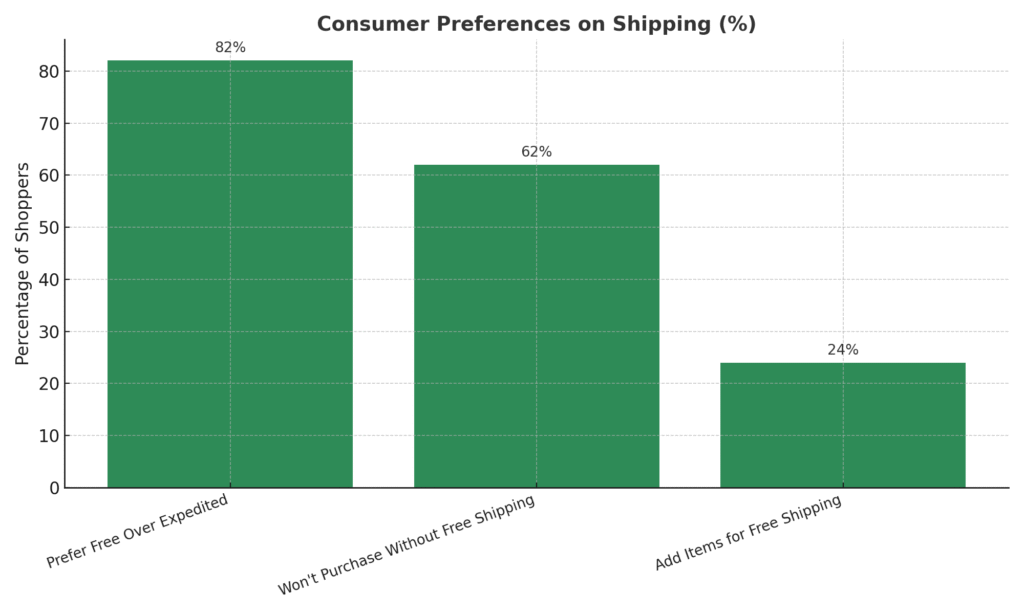
Shipping Marketing Statistics #7: 24% Add More Items To Qualify For Free Shipping
Around 24% of shoppers are willing to add extra items to their carts just to qualify for free shipping. This shows how free shipping can boost average order value. Marketers can design campaigns around minimum spend thresholds to encourage upselling. Communicating this clearly at checkout helps customers make faster decisions. In essence, free shipping isn’t just about savings—it’s also about increasing sales.
Shipping Marketing Statistics #8: 67.77% Value Two-Day Shipping In The U.S.
Over two-thirds of U.S. consumers (67.77%) see two-day shipping as a priority when shopping online. Amazon has set this expectation, and other retailers are under pressure to match it. Marketing efforts that highlight fast shipping times can directly influence purchase decisions. Customers perceive quick delivery as part of brand reliability. Speed isn’t just logistics—it’s a branding statement.
Shipping Marketing Statistics #9: Average Shipping Cost Is $7.96 Per Order
On average, it costs $7.96 to ship an e-commerce order. For retailers, this cost needs to be factored into pricing and promotions. Offering free shipping while absorbing this cost can be challenging but effective. Marketing campaigns should highlight free shipping carefully, ensuring it feels like added value. This stat underscores how logistics expenses shape both strategy and messaging.
Shipping Marketing Statistics #10: 62% Won’t Purchase Without Free Shipping
About 62% of online shoppers admit they won’t purchase if free shipping isn’t available. This shows how non-negotiable free shipping has become. Retailers can’t afford to ignore this when crafting offers. Including free shipping in promotional materials can be the deciding factor. Consumers view it as a baseline expectation, not a perk.

Shipping Marketing Statistics #11: 82% Prefer Free Over Expedited Shipping
Interestingly, 82% of shoppers would rather have free shipping than expedited options. This shows that cost matters more than speed for most consumers. Marketers should focus on emphasizing cost savings over same-day delivery. Campaigns that highlight “free delivery every time” resonate more widely. Affordability wins hearts even in a fast-paced digital world.
Shipping Marketing Statistics #12: 48% Abandon Carts Due To Extra Shipping Costs
Nearly half of shoppers (48%) will abandon their cart if unexpected shipping costs appear. This reinforces the need for transparent and upfront communication. Marketing messages should emphasize clarity and honesty. Free shipping promotions can reduce abandonment dramatically. Essentially, hidden shipping fees are a deal-breaker for many consumers.
Shipping Marketing Statistics #13: 70% Shop Online Because Of Free Shipping
Around 70% of consumers say free shipping is why they choose online shopping. This indicates that shipping offers are central to the e-commerce experience. Brands can use this as a cornerstone of their marketing campaigns. Simple messaging like “always free shipping” can drive long-term loyalty. This isn’t just a perk—it’s a decisive factor in channel preference.
Shipping Marketing Statistics #14: 45% Value Free Return Shipping
Almost half of shoppers (45%) place importance on free return shipping when making a purchase decision. This means return policies are as critical as outbound shipping. Marketers can promote “free returns” as a trust-building factor. Offering hassle-free returns can remove doubts at checkout. Customers feel safer purchasing when return costs are covered.
Shipping Marketing Statistics #15: 42% Would Cancel Subscriptions Without Free Shipping
About 42% of e-commerce subscription users say they’d cancel if free shipping were removed. This highlights how shipping perks drive retention. Marketing teams should emphasize continued free shipping as part of loyalty messaging. Subscription-based businesses can position it as a “member benefit.” Clearly, shipping incentives are vital for long-term engagement.
Shipping Marketing Statistics #16: 62% Would Buy More With Free Shipping
Over 62% of customers say they’d increase purchases if free shipping was offered. This shows that shipping perks don’t just encourage initial purchases—they drive higher volumes. For marketers, this is an opportunity to link free shipping to “shop more, save more” campaigns. Upselling becomes easier when consumers feel they’re saving. Free shipping creates a cycle of increased buying behavior.
Shipping Marketing Statistics #17: Only 17.5% Offer Free Shipping On All Orders
Globally, only 17.5% of online retailers provide unconditional free shipping. This creates a competitive opportunity for brands to stand out. Marketing campaigns can highlight “no minimum spend” as a differentiator. Since consumers expect free shipping, offering it without limits can build strong loyalty. It’s a rare but effective selling point in a crowded market.
Shipping Marketing Statistics #18: 189 Million TEUs Shipped Per Year
Every year, global container shipping moves about 189 million TEUs (twenty-foot equivalent units). This massive volume shows the backbone of international trade. For marketers, showcasing scale and reliability can resonate with B2B clients. Highlighting logistics capacity reassures partners of stability. These numbers represent the trust businesses place in shipping networks.
Shipping Marketing Statistics #19: Cargo Shipping Tonnage Reached 11.61 Billion Tons In 2023
In 2023, cargo shipping hit 11.61 billion tons, with projections to reach 14.72 billion tons by 2032. This reflects steady growth in global demand. For marketing teams, tying messages to growth and expansion can resonate with business clients. Shipping’s scale underscores its role as an economic driver. Companies that market themselves as part of this growth story can build credibility.
Shipping Marketing Statistics #20: 5.9% General Rate Increase By Carriers In 2025
In 2025, major parcel carriers announced a 5.9% general rate increase (GRI). This shows how shipping costs continue to rise for businesses and consumers. From a marketing perspective, retailers can stand out by absorbing or reducing these increases. Campaigns that highlight “no price hikes on shipping” could attract attention. It’s proof that even small changes in shipping rates have big consumer impact.

Final Thoughts on Shipping Marketing Statistics
Looking over these stats, I can’t help but think about the countless times I’ve personally hesitated at checkout because of shipping costs or delivery timelines. It makes sense that so many others do the same, and it’s a powerful reminder that shipping isn’t just a back-end process—it’s part of the customer experience. What excites me most is how brands can use this data to not only improve their logistics but also to build stronger trust with their audience. For me, this is more than just marketing; it’s about understanding people on a deeper level and making their online shopping experience as seamless as possible. And that’s exactly why I wanted to share these shipping marketing statistics with you—I believe they hold the key to bridging the gap between convenience and connection.
SOURCES