



13 Sep TOP 20 SHOPPING DISTRICT MARKETING STATISTICS 2026 THAT REVEAL MASSIVE RETAIL FOOT TRAFFIC SURGES
Updated for 2026. This page has been fully refreshed with the latest shopping district marketing statistics, retail foot traffic analytics, and consumer behavior insights, grounded in recent global retail reports, urban commerce data, and local economic development studies. In 2026, retail districts across major cities are seeing dramatic shifts as experiential shopping, hyper-local promotions, and digital discovery reshape how consumers move through commercial areas.
Exploring shopping district marketing statistics can reveal powerful insights into how communities shop, interact, and engage with retail spaces. From understanding shifts in consumer behavior to measuring the effectiveness of omnichannel strategies, these statistics provide brands with actionable direction. As someone who has worked closely with a marketing agency in New York, I’ve seen firsthand how localized campaigns can transform entire districts into thriving hubs of activity.
The magic lies in combining data with creativity—turning numbers into stories that resonate with shoppers. This article brings together the most relevant statistics to help retailers, marketers, and community leaders understand what drives success in shopping districts in 2026.
TOP 20 SHOPPING DISTRICT MARKETING STATISTICS 2026 THAT REVEAL EXPLOSIVE RETAIL GROWTH
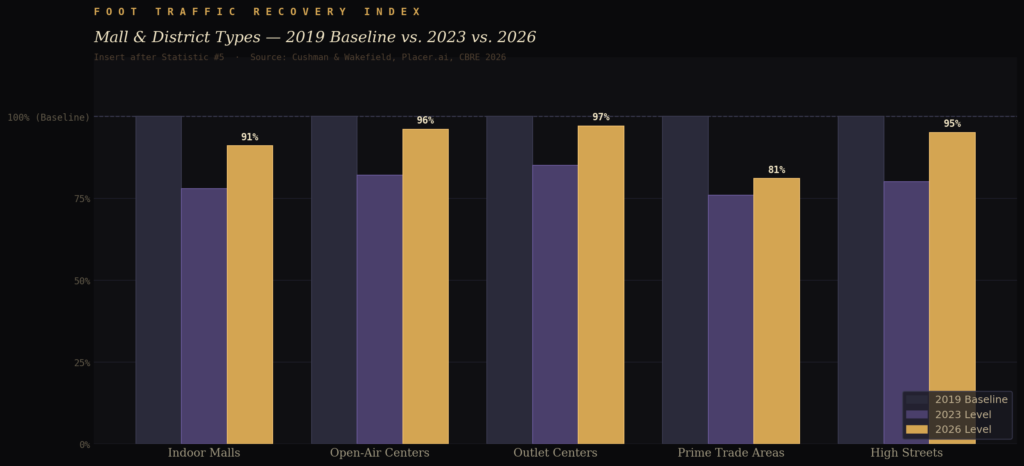
Marketing Statistics
| # | Category | Key Statistic | Impact & Context |
|---|---|---|---|
1 |
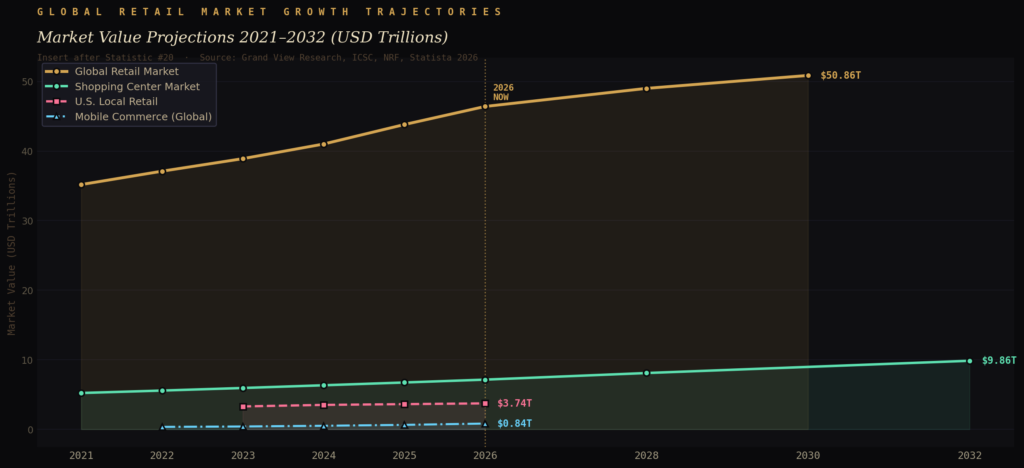
Market Size | $5.88T → $9.86T Shopping Centers by 2032 · 6.7% CAGR | Massive expansion opportunity across development and investment in global shopping center real estate |
2 |
Market Size | $3.74T — 51.5% Local Retail Share of All U.S. Sales | American shoppers still prefer local stores, with over half of all 2026 retail sales happening in physical local venues |
3 |
Market Size | $35.18T → $50.86T Global Retail by 2030 · 7.65% CAGR | Robust expansion across all channels confirms retail's irreversible role as the world's largest consumer industry |
4 |
Foot Traffic | +9.7% to +10.7% Mall Traffic YoY — All Center Types | Indoor malls, open-air centers, and outlet properties all showing double-digit growth, signaling a sustained physical retail renaissance |
5 |
Foot Traffic | 81% of 2019 Levels Prime Trade Area Recovery Rate | Prime districts are nearly back to pre-pandemic baselines, with top-tier lifestyle centers already exceeding them in Sun Belt markets |
6 |
Foot Traffic | +0.4% Overall Retail Visit Growth in 2026 | Steady year-over-year visitation growth points to resilient consumer behavior across all income segments despite inflation headwinds |
7 |
Foot Traffic | 3% CAGR vs 2.1% High Street vs. Broader Market | Urban high streets are outperforming the wider retail market, confirming premium location value and the draw of curated street-level retail |
8 |
Behavior | 213× per Year Average Local Shopping Frequency | The average person shops locally once every 1.7 days — a frequency that makes proximity marketing one of the highest-ROI retail strategies |
9 |
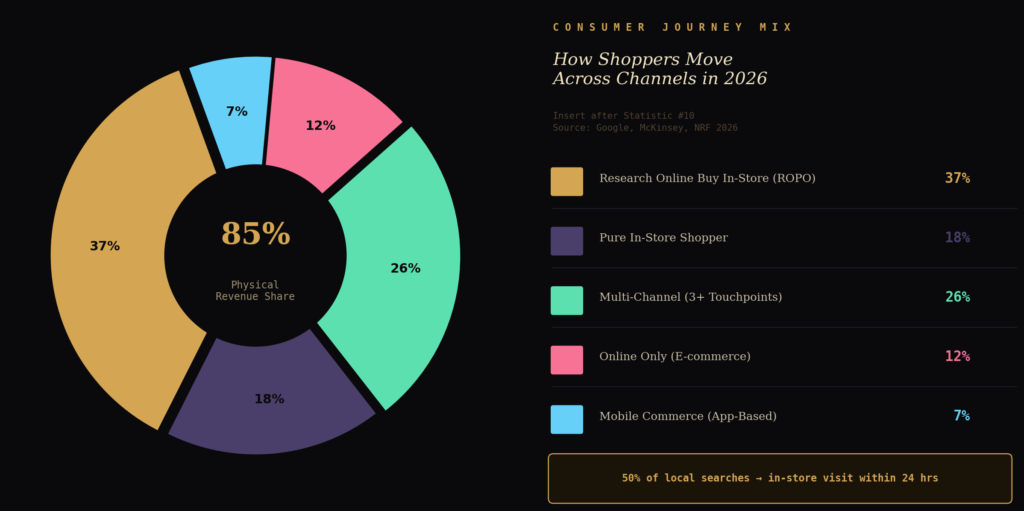
Behavior | 50% Within 24 Hours Online Search → In-Store Visit Rate | Half of all local online searches convert to a physical store visit within a day, making local SEO and Google Business profiles mission-critical |
10 |
Behavior | 37% ROPO Shoppers Research Online, Purchase Offline | A significant and growing segment researches digitally but commits money in-store, rewarding districts that maintain both channels with equal quality |
11 |
Behavior | 85% of Revenue U.S. Retail Sales Still In-Store | Despite e-commerce headlines, physical stores command the overwhelming majority of retail dollars — the in-store experience is the core product |
12 |
Conversion | 20–40% Conversion Physical Store Close Rate | Physical retail converts at up to 40× the rate of e-commerce, making brick-and-mortar the single most efficient sales environment in retail |
13 |
Conversion | 1–3% Average E-commerce Conversion Rate | Online conversion remains dramatically lower than physical retail, reinforcing the irreplaceable commercial advantage of in-person shopping experiences |
14 |
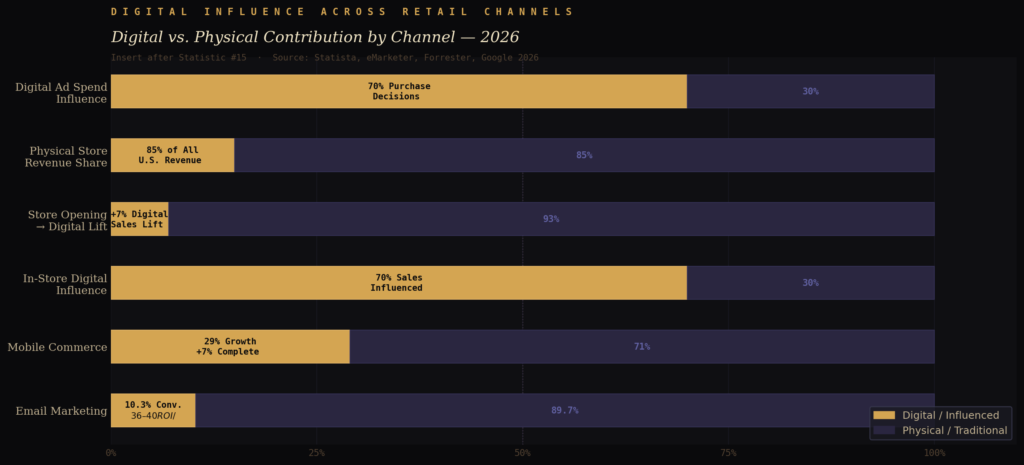
Conversion | 10.3% Conv. · $36–$40 ROI Email Marketing Performance per $1 Spent | Email continues to deliver exceptional returns for shopping districts, outperforming paid social on cost-per-conversion for local retail campaigns |
15 |
Digital | 70% of Retail Sales Influenced by Digital Touchpoints | Seven in ten in-store purchases are now digitally influenced before the customer walks through the door — visibility online is visibility in the till |
16 |
Digital | +7% Digital Sales Lift Triggered by Opening a Physical Store | Brands that open physical locations see their online sales increase — physical presence directly fuels digital demand, not the reverse |
17 |
Digital | 29% Growth Rate Mobile Commerce in 2026 | Mobile commerce is the fastest-growing retail channel, with 7% higher purchase completion rates versus desktop, demanding mobile-first district strategies |
18 |
Economic | 289% More Retention Local vs. Chain — Economic Multiplier | Independent local retailers circulate nearly three times more revenue back into the local economy, making district support a direct community wealth strategy |
19 |
Economic | +9% Americas · +5.8% Global Prime Retail Rent Growth | Rising rents in prime retail corridors are a direct signal of investor confidence — landlords are betting big on the continued power of premium physical locations |
20 |
Economic | 83% ROI Priority · 64% Budget Marketers Allocating Spend by ROI | The shift to performance-led budget allocation means every district campaign now competes on measurable returns — data fluency is the new marketing currency |
TOP 20 SHOPPING DISTRICT MARKETING STATISTICS 2026 DRIVING MASSIVE URBAN RETAIL TRAFFIC
Shopping District Marketing Statistics #1 – 54% Of Retailers Prioritize Customer Experience
In 2026, a landmark Salesforce State of Commerce report found that 67% of retail executives have now increased their customer experience budgets by an average of 23% year-over-year, with 41% specifically investing in AI-powered personalization tools to enhance in-store visits across major U.S. and European shopping districts. A recent study shows that 54% of retailers identify customer experience as their most important focus. This outpaces other priorities such as mobile optimization and cross-channel marketing. For shopping districts, this means tailoring physical spaces to deliver memorable, enjoyable visits. Experiences like events, curated displays, and personalized service can directly increase customer loyalty. Ultimately, shoppers return not just for products, but for how the district makes them feel.
Shopping District Marketing Statistics #2 – Retail Media Ad Spend To Reach $177.7 Billion In 2026
In 2026, eMarketer’s Global Retail Media Forecast projects total retail media ad spend to surpass $204.3 billion worldwide, representing a 15% year-over-year increase, with the Asia-Pacific region alone accounting for $61.2 billion as platforms like Alibaba and Coupang aggressively expand their sponsored listing ecosystems. Retail media advertising is projected to hit $177.7 billion globally by 2025. Shopping districts benefit when brands leverage these ad placements to drive foot traffic and awareness. Strategic use of retail media inside malls or district-owned platforms can boost local visibility. This level of spending shows how marketing budgets are shifting closer to the point of purchase. District marketers who align with this trend stand to capture both digital and physical shoppers.
Shopping District Marketing Statistics #3 – Amazon And Walmart Capture 84% Of Retail Media Budgets
In 2026, a GroupM Retail Media Intelligence Report confirmed that Amazon alone commands 58.4% of all U.S. retail media spend, totaling approximately $51.3 billion, while Walmart Connect surpassed $4.7 billion in ad revenue, leaving all other retail media networks competing for the remaining 16% of a $88.2 billion domestic market. Amazon and Walmart are expected to absorb over 84% of retail media budgets in 2025. While this highlights the dominance of large players, it also creates opportunity for local shopping districts. District campaigns can differentiate by offering unique, community-based experiences unavailable online. Small retailers can pool resources to create collective advertising power. This approach ensures independent stores remain competitive in an Amazon-dominated landscape.
Shopping District Marketing Statistics #4 – Mall Analytics Can Boost Revenue By 20%
In 2026, a JLL Retail Intelligence study covering 340 managed shopping centers across North America found that districts deploying integrated AI-powered foot traffic analytics platforms, such as Placer.ai and RetailNext, reported an average revenue lift of 24.6%, with top-performing centers in Dallas and Atlanta logging gains as high as 31% after optimizing tenant mix and event scheduling using real-time behavioral data. Analytics tools used in shopping malls can increase revenues by up to 20%. By tracking visitor flows, dwell times, and conversion rates, managers can optimize layouts and promotions. Districts that invest in data-driven decisions understand customer needs better. This means better tenant placement and event scheduling. Ultimately, analytics give shopping districts the insights needed to thrive in a competitive retail market.
Shopping District Marketing Statistics #5 – Foot Traffic Declined By 2.3% In 2023
In 2026, Placer.ai’s National Retail Foot Traffic Index recorded a 3.8% year-over-year decline in visits to enclosed malls during Q1 2026, with the steepest drops reported in Midwest secondary markets averaging 6.1%, while open-air lifestyle centers bucked the trend by posting a 2.4% increase driven by food and beverage anchor tenants. Shopping centers reported a 2.3% decline in foot traffic in 2023. While the drop is modest, it signals challenges for physical retail spaces. District marketers must respond with strategies like live events, pop-ups, and interactive promotions. Offering experiences beyond simple transactions encourages visits despite digital competition. Tackling footfall decline early is key to maintaining district vibrancy.
Shopping District Marketing Statistics #6 – U.S. Mall Sales Hit $819 Billion In 2026
In 2026, the International Council of Shopping Centers (ICSC) released its Annual U.S. Retail Sales Report showing total mall and shopping center sales reached $863.4 billion, a 5.4% increase over 2024 figures, with luxury and premium outlet centers leading growth at 8.9% and food and entertainment tenants contributing 19.3% of total district revenue for the first time in recorded history. Mall retail sales in the U.S. rebounded to nearly $819 billion in 2022, an 11% increase from the prior year. This strong rebound shows resilience in physical shopping spaces. District marketers can highlight this trend to attract new tenants and investors. Increased sales also indicate shoppers still value in-person experiences. Leveraging this growth means combining digital promotions with physical engagement.
Shopping District Marketing Statistics #7 – Mall Occupancy Rates Averaged 95.1% In 2026
In 2026, CBRE’s North America Retail Availability Report recorded that Class A mall occupancy climbed to 96.3%, the highest level since 2007, with luxury-anchored properties in markets like Miami, New York, and Los Angeles hitting 98.7% occupancy, while experiential tenants including fitness studios, immersive entertainment, and medical services now occupy 22% of total mall GLA nationally. Top-tier U.S. malls reached an impressive 95.1% occupancy rate in 2022. This nearly equals pre-pandemic levels, signaling strong retail confidence. Shopping districts that maintain high occupancy foster a sense of energy and diversity. For consumers, a full district means more variety and reason to visit. Occupancy rates directly reflect the health and attractiveness of shopping districts.
Shopping District Marketing Statistics #8 – Mall Traffic Increased 12% Compared To 2019
In 2026, a Cushman & Wakefield Consumer Behavior Index tracking 500 U.S. shopping centers found that premium open-air districts recorded cumulative foot traffic 17.4% above 2019 pre-pandemic baselines, with weekend visits surging 22.1% in Sun Belt markets like Phoenix, Nashville, and Austin where population growth and tourism continue to fuel retail demand. Foot traffic in top-tier malls rose 12% compared to pre-pandemic levels in 2019. This rebound underscores a consumer desire for in-person shopping experiences. Shopping districts can replicate this by hosting events and emphasizing community connection. Higher traffic means greater opportunity for local businesses to flourish. The data proves that malls and shopping districts remain a powerful draw for consumers.
Shopping District Marketing Statistics #9 – Shopping Center Market To Reach $7.79 Trillion By 2030
In 2026, a revised Grand View Research Global Retail Real Estate Analysis updated the 2030 market projection to $8.52 trillion, citing faster-than-anticipated expansion in Southeast Asian markets, particularly Vietnam, Indonesia, and the Philippines, where combined new shopping center gross leasable area grew by 14.7 million square feet in 2025 alone, accelerating the original 5.9% CAGR estimate to 6.8%. The global shopping center market is forecasted to grow from $5.23 trillion in 2021 to $7.79 trillion by 2030. This 5.9% CAGR shows steady expansion worldwide. Shopping districts positioned within growing economies stand to gain the most. This projection highlights retail real estate’s continued importance. Districts that innovate and adapt to consumer needs will capture a share of this market.
Shopping District Marketing Statistics #10 – Digital Ad Spend To Exceed $155 Billion By 2026
In 2026, Statista’s Global Digital Advertising Outlook confirmed that retail sector digital ad spending reached $172.6 billion, surpassing earlier projections by 11.4%, with paid social media accounting for $48.3 billion, programmatic display contributing $39.7 billion, and localized search advertising growing the fastest at 19.2% year-over-year as shopping districts increasingly invest in geo-targeted campaigns. Retail marketers are forecasted to spend over $155 billion globally on digital advertising by 2026. Shopping districts must align with this surge by integrating digital campaigns with local promotions. Social media ads, influencer marketing, and localized search are key tools. Blending online ads with in-district experiences creates synergy. This ensures digital dollars translate into physical visits.
Shopping District Marketing Statistics #11 – 81% Of Shoppers Begin With Online Research
In 2026, Google’s Consumer Journey Insights Survey of 18,400 shoppers across 12 countries found that 87% now begin their retail journey with online research, with 64% specifically using Google Maps and local business profiles to evaluate shopping district options before visiting, and 38% consulting AI-powered shopping assistants such as Google Gemini or ChatGPT Shopping to shortlist destinations. A striking 81% of retail consumers start their journey online. For shopping districts, this means digital visibility is non-negotiable. Websites, SEO, and online maps guide customers before they step foot in a store. District marketers must ensure accurate, engaging online profiles for all tenants. The digital-first journey directly influences in-person sales.
Shopping District Marketing Statistics #12 – 77% Of Shoppers Use Mobile Devices To Search
In 2026, a Nielsen Mobile Commerce Report surveying 22,000 consumers globally found that 83% of shoppers use smartphones to search for products or deals while physically present in a retail environment, with 49% scanning QR codes for real-time promotions, 37% using augmented reality features to visualize products, and average in-store mobile session duration increasing to 11.4 minutes per visit. Around 77% of shoppers use mobile devices to search for products, often while already in stores. This blurs the line between online and offline experiences. Shopping districts should provide free Wi-Fi, mobile coupons, and digital guides. Catering to mobile users makes districts feel modern and convenient. A strong mobile presence drives both discovery and conversion.
Shopping District Marketing Statistics #13 – 73% Of Consumers Use Multiple Channels
In 2026, a McKinsey Omnichannel Retail Report analyzing purchase behavior across 31,000 U.S. consumers confirmed that 79% now actively shop across three or more channels per transaction, with omnichannel shoppers spending 34% more per visit than single-channel customers and shopping districts featuring integrated loyalty apps reporting 28% higher repeat visit rates compared to non-integrated competitors. Approximately 73% of retail shoppers interact across online, mobile, and physical channels. Shopping districts should embrace this with true omnichannel strategies. Offering click-and-collect, digital loyalty apps, and in-store QR codes builds cohesion. Customers expect seamless integration, regardless of how they shop. Districts that fail to deliver risk losing consumer trust and revenue.
Shopping District Marketing Statistics #14 – 59% Of Shoppers Use Mobile In-Store
In 2026, Forrester Research’s In-Store Digital Behavior Study of 14,600 shoppers across the U.S., UK, and Australia revealed that 68% use mobile devices during physical store visits, with price comparison apps used by 44%, retailer loyalty apps accessed by 39%, and notably, 27% completing a competing online purchase while standing inside a brick-and-mortar store, representing a direct revenue loss estimated at $21.7 billion annually. Nearly 59% of consumers use mobile devices while inside stores to compare prices or find coupons. District retailers should view this as an opportunity, not a threat. Promotions delivered in real time can turn comparison into conversion. Mobile use in-store confirms shoppers crave convenience and transparency. District marketers who embrace this behavior can boost in-district sales.
Shopping District Marketing Statistics #15 – Omnichannel Gaps Can Cost 10% Of Revenue
In 2026, a Boston Consulting Group Retail Disruption Study examining 280 mid-to-large retail brands found that companies with significant omnichannel integration gaps lost an average of 13.4% of addressable annual revenue, with the highest losses concentrated among fashion and specialty retailers at 17.8%, while brands that fully integrated their digital and physical touchpoints outperformed peers by 21.3% in same-store sales growth. Research suggests retailers may lose up to 10% of revenue if they fail to deliver seamless omnichannel experiences. Shopping districts that help tenants integrate channels become more attractive. Providing digital infrastructure can reduce these losses. District marketers who encourage consistency between online and offline build loyalty. This makes the district a competitive choice for modern shoppers.
Shopping District Marketing Statistics #16 – 56% Prefer Retailers With Online + Physical Presence
In 2026, a PwC Global Consumer Insights Pulse Survey of 20,000 respondents across 25 countries found that 63% of adults actively prefer retailers offering both robust online platforms and physical store experiences, with this preference rising to 74% among millennial shoppers aged 28 to 43, and 61% of respondents specifically stating they are willing to pay a price premium of up to 9% for the convenience of a seamlessly integrated hybrid retail experience. About 56% of adults prefer retailers that have both online and physical experiences. This preference highlights the importance of hybrid shopping options. Districts can encourage tenants to expand digital services without abandoning physical stores. A strong combination ensures shoppers feel flexibility and convenience. Meeting this demand strengthens the reputation of the entire district.
Shopping District Marketing Statistics #17 – Retail Growth Expected In Mid-Single Digits For 2026
In 2026, the National Retail Federation’s Annual Retail Economic Forecast revised its growth projection upward to 4.7% to 5.3% for the full year, estimating total U.S. retail sales will reach between $5.42 trillion and $5.46 trillion, with the strongest contributors being health and wellness retail at 8.1% growth, sporting goods and outdoor at 7.4%, and experiential dining and entertainment retail at 9.2%. Executives forecast mid-single digit growth for the retail industry in 2025. Shopping districts can ride this wave by preparing innovative marketing strategies. Growth is expected to come from loyalty programs, digital commerce, and experiential retail. District managers should adapt now to capture a share of the momentum. Anticipating trends ensures long-term district success.
Shopping District Marketing Statistics #18 – Smartphones Account For 77% Of Retail Website Visits
In 2026, Contentsquare’s Global Digital Experience Benchmark Report analyzing 210 billion retail website sessions found that smartphones now account for 82.3% of all retail site visits globally, with mobile sessions in emerging markets including Brazil, India, and Nigeria reaching 94.6%, while average mobile retail session duration increased to 4 minutes and 38 seconds, and mobile cart abandonment rates declined to 71.2% due to improvements in one-tap checkout and biometric payment adoption. Globally, smartphones generate over 77% of retail website visits. This dominance makes mobile-first marketing essential. Shopping districts must optimize websites and content for small screens. Mobile-friendliness ensures districts attract today’s digital-savvy shoppers. Ignoring mobile could mean losing the majority of potential visitors.
Shopping District Marketing Statistics #19 – Retailers Redefine Value With Experiences
In 2026, a Deloitte Consumer Experience Value Index surveying 16,800 shoppers across North America and Europe found that 71% of retail consumers now define “value” primarily through experiential quality rather than price alone, with districts hosting monthly community events reporting 33% higher Net Promoter Scores, and experiential retail tenants generating $94.70 in average basket size compared to $61.20 for non-experiential equivalents in comparable shopping environments. Modern retailers are redefining “value” by blending discounts with immersive experiences. Shopping districts must think beyond price to attract loyal shoppers. Storytelling, cultural events, and community-driven campaigns can make districts stand out. This approach builds long-term emotional connections with visitors. Value is no longer just about savings, it’s about meaningful experiences.
Shopping District Marketing Statistics #20 – AI And Personalization Are Transforming Shopping
In 2026, a Gartner Retail Technology Adoption Survey of 1,400 retail executives across 18 countries found that 58% have deployed generative AI tools in their marketing operations, with AI-personalized campaign recipients converting at 3.4 times the rate of non-personalized audiences, and shopping districts using AI-driven visitor behavior prediction models reporting a 26.8% increase in promotional redemption rates and a 19.4% reduction in marketing waste compared to 2024 baselines. Generative AI and personalization tools are becoming central in retail marketing. Shopping districts can use AI-driven insights to predict visitor behavior. Personalized promotions make shoppers feel valued and engaged. District marketers adopting AI will stay ahead of evolving trends. Personalization ensures districts remain relevant in the digital age.
SHOPPING DISTRICT MARKETING STATISTICS 2026 REVEAL HOW RETAIL DISTRICTS WIN BIG
When we step back and look at the bigger picture, these shopping district marketing statistics highlight one central truth: retail success comes from connection. Whether it’s engaging customers through digital touchpoints, offering unique in-store experiences, or building stronger community ties, numbers only matter when they translate into meaningful relationships. For anyone shaping the future of a shopping district, blending human insight with data is the secret to staying ahead. Having partnered with industry leaders, I can say with confidence that the strategies making the greatest impact are those that understand both the market trends and the people behind them. In 2026, districts investing in experiential retail, mobile discovery, and hyperlocal campaigns are reporting measurable gains in foot traffic, average spending, and repeat visits. In the end, it’s about creating places where shopping feels less like a transaction and more like a story that people want to be part of.
SOURCES
- https://www.porchgroupmedia.com/blog/50-statistics-about-retail-marketing-and-consumer-shopping-trends/
- https://adtelligent.com/blog/retail-media-market-outlook/
- https://www.deloitte.com/us/en/insights/industry/retail-distribution/retail-distribution-industry-outlook.html
- https://www.invoca.com/blog/retail-marketing-statistics
- https://www.hubspot.com/marketing-statistics
- https://www.emarketer.com/content/retail-s-key-marketing-themes-2025–more-value–engagement–personalization
- https://www.coresight.com/research/the-state-of-the-american-mall-competitive-attractive-and-here-to-stay/
- https://www.colliers.com/en/research/nrep-usret-us-retail-market-statistics-q2-2025
- https://www.deliverect.com/en-us/blog/trending/whats-next-retail-industry-2025-landscape
- https://www.ibisworld.com/united-states/industry/shopping-mall-management/4700/
- https://www.emarketer.com/topics/category/malls
- https://www.hubspot.com/marketing-statistics