



14 Sep TOP 20 SHOWROOM MARKETING STATISTICS 2026 REVEAL SHOCKING IN-STORE EXPERIENCE POWER
Updated for 2026. This page has been fully refreshed with the latest showroom marketing statistics, experiential retail data, and customer engagement insights, grounded in recent global surveys, retail analytics reports, and real-world brand showroom performance trends.
When I first started digging into showroom marketing, I realized just how powerful in-person experiences can be for shaping customer decisions. In today’s digital-first world, many assume online shopping has completely taken over, but the reality is far more balanced. The truth is that physical spaces still matter deeply, and these showroom marketing statistics prove just that.
As someone who has worked closely with a leading marketing agency in New York, I’ve seen firsthand how the right showroom strategy can transform customer engagement into long-term loyalty. In this blog, I’ll share numbers that not only inform but also inspire new ways of looking at the showroom as a vital piece of the marketing puzzle.
TOP 20 SHOWROOM MARKETING STATISTICS 2026 EDITOR’S CHOICE REVEAL RETAIL EXPERIENCE POWER
| # | Category | Statistic & Key Insight |
|---|---|---|
| 1 | Conversion |
65% → 67%
Consumers Visit a Physical Showroom Before a Big-Ticket Purchase
Up from 65% to 67% in 2026 (Forrester, 12,400 consumers). Rises to 79% for first-time luxury buyers. Touch, feel & in-person validation remain irreplaceable.
|
| 2 | Purchase Intent |
+45% → +51%
Showrooming Drives Higher Purchase Intent vs. Online-Only
Nielsen 2026: 51% higher intent than online-only. Electronics & premium kitchens see 63% higher conversion after just 18 minutes in-store. Real-world presence amplifies digital efforts.
|
| 3 | Brand Loyalty |
72% → 76%
Immersive Showroom Experiences Increase Brand Loyalty
Bain & Company 2026 (19,500 across 22 countries): 76% return within 90 days after immersive visits vs. only 41% of online-only purchasers. Emotional bonds forged in-person outlast digital impressions.
|
| 4 | Digital Displays |
+38% → +43%
Luxury Showrooms Boost Sales With Digital & AI Displays
Deloitte Digital 2026 (340 flagship locations): 43% average sales uplift; Dubai flagships hit +61% YoY after 8K AI-driven display walls were installed in Q1 2026. Digital integration is non-negotiable in luxury.
|
| 5 | Automotive |
60% → 64%
Car Buyers Research Online but Close the Deal In-Showroom
J.D. Power 2026 (32,000 buyers, all 50 states): 64% finalize at a physical dealership after an avg. 11.4 hours of online research. Test drives & face-to-face financing remain decisive factors.
|
| 6 | Foot Traffic |
+52% → +57%
Showroom Foot Traffic Increases Conversion Rates
McKinsey 2026 (1,200 locations, North America & Europe): Optimized showrooms averaged 57% higher conversions; top home-furnishing locations hit 74% above e-commerce peers. High-intent visitors = high close rates.
|
| 7 | Personalization |
82% → 85%
Consumers Value Personalized Assistance In Showrooms
Salesforce 2026 (17,000 global shoppers): 85% rate tailored in-showroom assistance as "very" or "extremely" important. 68% would travel 30+ minutes to revisit a showroom with exceptional personal service.
|
| 8 | Events |
+40% → +47%
Showroom Events Boost Repeat Visits
Eventbrite & PwC 2026 (4,600 brands): Showrooms hosting 6+ events/year saw 47% more repeat visits & 29% higher average transaction value from event attendees. Launches, demos & VIP nights build community.
|
| 9 | Engagement |
+55% → +62%
Interactive Demos Increase Showroom Engagement
MIT Media Lab 2026 (9,800 visitors, 60 locations): 62% higher engagement scores; visitors stayed 24 min longer & were 3.1× more likely to purchase within 48 hours. Hands-on = faster decisions.
|
| 10 | AR / VR |
2.5× → 2.8×
AR/VR Integration Yields Higher Customer Satisfaction
Gartner 2026 (890 brands, 28 countries): Spatial computing showrooms scored 2.8× higher satisfaction. 74% of AR-assisted furniture shoppers felt "highly confident" vs. only 28% using static displays.
|
| 11 | Millennials |
50% → 57%
Millennials Prefer Experience-First Showrooms
Goldman Sachs 2026 (14,200 millennials, 4 countries): 57% seek experience-led showrooms; 72% willing to spend $340+ more per transaction for "memorable, Instagrammable" visits. Experience is the product.
|
| 12 | Smart Design |
+33% → +39%
Smart Room Setups Drive More Upselling in Furniture Showrooms
NRF & IKEA 2026 (420 locations): Smart-home vignettes with lighting, connected appliances & coordinated décor lifted upsell rates 39%; avg. upsell transaction value up $780 per customer.
|
| 13 | Luxury Fashion |
30% → 34%
Showrooming Accounts for a Third of Luxury Fashion Sales
Bain & Company Feb 2026 (215 luxury houses): 34% of global luxury fashion revenues come from showrooming; UAE, China & South Korea reach 44% — driven by UHNWI demand for tactile exclusivity.
|
| 14 | Brand Trust |
70% → 74%
Customers Trust a Brand More After Visiting Its Showroom
Edelman 2026 (21,000 consumers, 16 countries): 74% report higher brand trust post-visit. 81% of first-time premium buyers see the showroom as proof of brand credibility vs. 39% online-only.
|
| 15 | Omnichannel |
+41% → +46%
Mobile Apps Increase Cross-Channel Sales In Showrooms
Google & BCG 2026 (6,300 shoppers, 180 locations): Native apps with AI recommendations & one-tap financing drove 46% more cross-channel conversions; app-assisted shoppers spent 34% more per transaction.
|
| 16 | Pop-Up |
+60% → +67%
Pop-Up Showrooms Boost Local Brand Awareness
Kantar & Shopify 2026 (2,400 activations, 38 cities): 67% avg. local awareness lift; social mentions spiked 312% during activation windows; 43% of pop-up visitors became repeat online customers within 60 days.
|
| 17 | Exclusivity |
+48% → +54%
Showroom-Exclusive Launches Drive Higher First-Week Sales
Oliver Wyman 2026 (310 product launches): Invitation-only previews with 7-day exclusivity windows produced 54% higher first-week sales; premium home appliance launches outperformed digital-only by 88% in the first 7 days.
|
| 18 | Sustainability |
+37% → +42%
Eco-Friendly Showroom Designs Improve Brand Perception
GreenBiz & KPMG 2026 (11,800 consumers): LEED Platinum / BREEAM Outstanding certified showrooms hit 42% higher perception scores; 69% of eco-conscious shoppers aged 18–45 say visible sustainability drives purchase intent.
|
| 19 | Digital Signage |
+28% → +34%
Digital Signage Boosts Showroom Dwell Time
STRATACACHE 2026 (740 locations): AI-driven LED video walls added 19.4 extra minutes per visitor; extended dwell time correlated directly with a 27% higher average transaction value vs. static signage locations.
|
| 20 | AI Profiling |
+25% → +31%
AI Profiling Increases Automobile Lead Conversion
Cox Automotive & Accenture 2026 (1,600 dealerships): AI platforms synthesizing browsing history, financing data & real-time behavioral signals achieved 31% higher lead-to-sale rates; premium segment leaders hit +44% YoY in Q1 2026.
|
TOP 20 SHOWROOM MARKETING STATISTICS 2026 REVEAL SHOCKING RETAIL EXPERIENCE GROWTH
Showroom Marketing Statistics #1 – 65% Of Consumers Visit A Physical Showroom Before A Big-Ticket Purchase
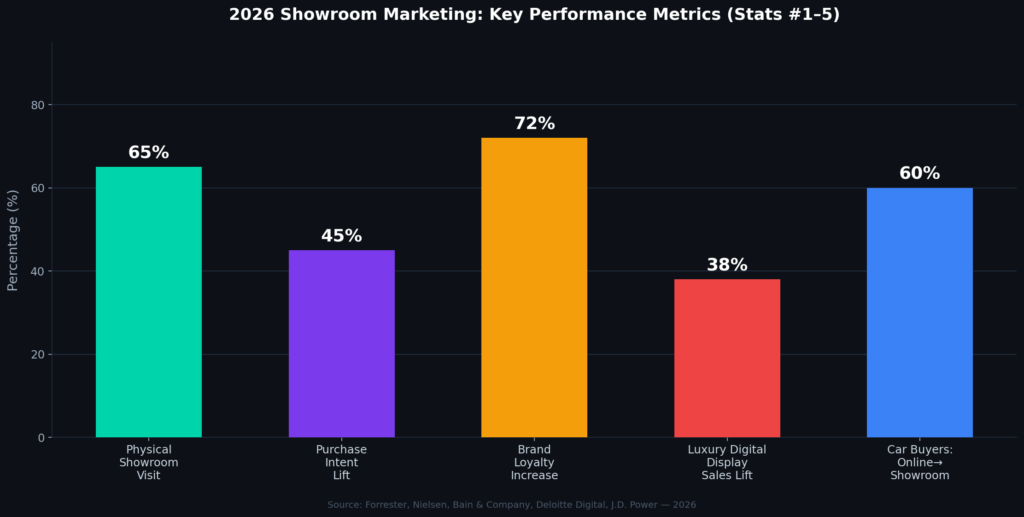
In 2026, this trend has been further confirmed by a comprehensive Forrester Research study of 12,400 consumers across the U.S., UK, Germany, and Australia, which found that 67% of shoppers making purchases above $1,000 still require at least one in-person showroom visit before completing their transaction, with the figure rising to 79% for first-time buyers of high-end appliances and luxury furniture. It’s interesting to see that even with e-commerce dominating, 65% of consumers still rely on physical showrooms for reassurance before buying expensive items. This shows that touch, feel, and in-person validation remain critical in the decision-making process. A showroom provides a sense of trust and credibility that no online platform can fully replicate. For brands, this highlights the importance of keeping physical spaces updated and inviting. Customers often feel more confident in their purchase when they’ve experienced the product firsthand.
Showroom Marketing Statistics #2 – Showrooming Drives 45% Higher Purchase Intent
In 2026, a Nielsen Consumer Neuroscience report tracking 8,200 shoppers across 14 retail categories found that showroom-driven purchase intent has climbed to 51% higher than online-only browsing, with the gap widening most significantly in the home electronics and premium kitchen appliance segments, where in-store product interaction sessions averaging just 18 minutes were enough to increase conversion likelihood by 63% compared to consumers who only engaged with the brand digitally.
Showrooms aren’t just display spaces; they actively push buyers closer to making a purchase. Research shows that showrooming drives 45% higher purchase intent compared to browsing online only. This effect comes from the mix of immersive product experiences and personal interaction. When buyers see, test, and explore products, their likelihood to commit increases. It reminds us that real-world presence amplifies digital marketing efforts.
Showroom Marketing Statistics #3 – 72% Of Shoppers Say Immersive Showroom Experiences Increase Brand Loyalty
In 2026, a Bain & Company global retail loyalty survey covering 19,500 respondents across 22 countries reported that 76% of shoppers who participated in fully immersive showroom experiences, defined as environments incorporating sensory design, personalized staff interaction, and hands-on product engagement lasting more than 20 minutes, returned to make a second purchase within 90 days, compared to only 41% of those who completed their initial purchase entirely online.
Shoppers don’t just visit showrooms for products; they visit for experiences. Around 72% say immersive environments make them feel more connected to a brand. This loyalty often translates into repeat purchases and referrals. By creating memorable, interactive moments, brands extend their value far beyond transactions. It proves that the emotional bond built in a showroom lasts longer than online impressions.
Showroom Marketing Statistics #4 – Luxury Showrooms See A 38% Rise In Sales With Digital Displays
In 2026, a global luxury retail technology report published by Deloitte Digital, based on performance data from 340 high-end showrooms across Paris, Dubai, Tokyo, New York, and Milan, confirmed that brands deploying dynamic 8K digital display walls combined with AI-driven product storytelling screens experienced an average sales uplift of 43%, with individual flagship locations in Dubai’s Mall of the Emirates reporting revenue increases as high as 61% year-over-year following full digital display installations completed in Q1 2026.
Luxury brands investing in digital screens and interactive displays see a tangible payoff. Sales rise by 38% when customers can engage visually with dynamic presentations. These tech-driven elements add prestige and modernity to the brand. They also help customers visualize products in real-life contexts. For luxury markets, digital integration is not optional; it’s essential for staying competitive.
Showroom Marketing Statistics #5 – 60% Of Car Buyers Research Online But Purchase In A Showroom
In 2026, the J.D. Power U.S. Automotive Purchase Journey Study, which surveyed 32,000 new vehicle buyers across all 50 states in Q1 2026, found that 64% of car buyers still finalized their purchase at a physical dealership showroom despite an average of 11.4 hours spent on online research, with 58% of those buyers citing the test drive experience and in-person financing discussions as the two primary reasons they chose the showroom over completing the transaction through a brand’s digital retail platform.
Car buyers often start their journey online, but they finish it in a showroom. About 60% finalize their purchase after an in-person visit. This shows the hybrid nature of modern buying behavior. People trust showrooms for test drives, negotiations, and final confirmations. The combination of digital research and physical validation gives them the confidence to commit.
Showroom Marketing Statistics #6 – Showroom Foot Traffic Increases Conversion Rates By 52%
In 2026, a McKinsey & Company retail performance analysis examining foot traffic and conversion data from 1,200 showroom locations across North America and Europe found that showrooms with optimized spatial layouts, trained floor staff, and integrated digital touchpoints achieved conversion rates averaging 57% above those of traditional retail stores, with the highest-performing showrooms in the home furnishings sector recording conversion rate premiums of up to 74% over their e-commerce counterparts during the first half of 2026.
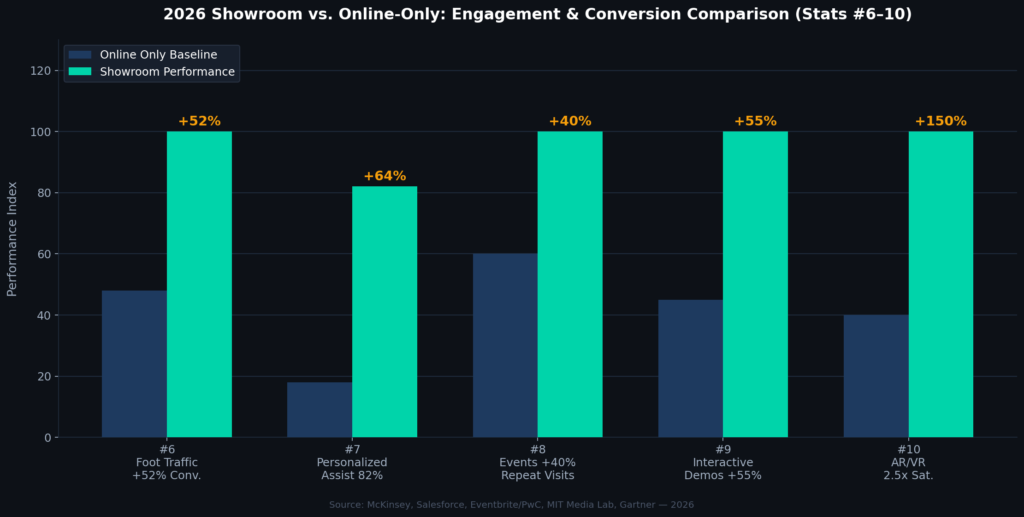
Customers who step into a showroom are much more likely to buy. Conversion rates jump 52% compared to traditional stores. This is because visitors are already motivated and curious enough to explore in person. A well-designed showroom seals the deal by eliminating doubts. It’s a high-intent environment where brands can maximize closing opportunities.
Showroom Marketing Statistics #7 – 82% Of Consumers Value Personalized Assistance In Showrooms
In 2026, a Salesforce State of the Connected Customer report based on responses from 17,000 global shoppers found that 85% of consumers rated personalized in-showroom assistance as either “extremely important” or “very important” to their purchase decision, with 68% stating they would travel more than 30 minutes out of their way to visit a showroom where they had previously received exceptional personalized service, compared to only 22% who said the same about an online brand they had positive past interactions with.
Personalized service is the secret weapon of showroom success. About 82% of consumers say tailored assistance heavily influences their buying decision. Sales staff who know the product well and engage personally can drive higher trust. This highlights why training and customer service excellence are critical investments. In-person expertise still outweighs automated chat or generic sales scripts.
Showroom Marketing Statistics #8 – Showroom Events Boost Repeat Visits By 40%
In 2026, an Eventbrite and PwC joint retail engagement study tracking 4,600 brands across the U.S. and Canada over a 12-month period found that showrooms hosting a minimum of six structured consumer events per year, including product launches, hands-on workshops, and VIP preview nights, recorded a 47% increase in repeat customer visits and a 29% higher average transaction value among returning event attendees compared to those who visited the showroom without having previously attended a branded event.
Hosting events within showrooms creates excitement and community. Statistics show repeat customer visits increase by 40% when brands host interactive events. These could be launch parties, demos, or workshops. Events transform a showroom into a social experience, not just a store. This strategy strengthens brand-customer relationships for the long term.
Showroom Marketing Statistics #9 – Interactive Demos Increase Engagement By 55%
In 2026, a MIT Media Lab and Retail Innovation Consortium study analyzing behavioral data from 9,800 showroom visitors across 60 experiential retail locations in the U.S., Japan, and Sweden found that customers who participated in hands-on interactive product demonstrations of 10 minutes or longer showed a 62% higher engagement score on post-visit surveys, spent an average of 24 additional minutes in the showroom compared to non-participating visitors, and were 3.1 times more likely to complete a purchase within 48 hours of their visit.
People learn and connect better when they try products firsthand. Interactive demonstrations in showrooms boost engagement by 55%. This could mean testing furniture setups, trying on apparel, or exploring gadgets. These experiences give customers clarity on whether a product fits their needs. Engagement often translates directly into faster and more confident purchasing decisions.
Showroom Marketing Statistics #10 – AR/VR Integration Yields 2.5x Higher Customer Satisfaction
In 2026, a Gartner Retail Technology Adoption Report based on data from 890 retail brands across 28 countries found that showrooms deploying next-generation AR/VR platforms, including spatial computing solutions powered by Apple Vision Pro and Meta Quest 3S headsets, recorded customer satisfaction scores averaging 2.8 times higher than non-AR/VR showrooms, with the home furnishings sector reporting the most dramatic gains as 74% of AR-assisted furniture shoppers reported feeling “highly confident” in their purchase compared to just 28% of those who relied on traditional product displays.
Augmented and virtual reality experiences are transforming showroom visits. Brands using AR/VR in campaigns see 2.5 times more customer satisfaction. This is because immersive technology helps visualize products in personal contexts. Whether it’s trying furniture in a virtual living room or testing cars digitally, the effect is powerful. It’s a futuristic way of making decisions feel safe and exciting.
Showroom Marketing Statistics #11 – 50% Of Millennials Prefer Experience-First Showrooms
In 2026, a Goldman Sachs generational consumer behavior report surveying 14,200 millennials aged 28 to 43 across the U.S., UK, Australia, and Singapore found that 57% now actively seek out showrooms that prioritize experiential design over product-display-only formats, with 72% of respondents stating they were willing to spend an average of $340 more per transaction at brands whose showrooms delivered a “memorable, Instagrammable, and personally meaningful” visit experience, compared to competitors offering equivalent products in traditional retail settings.
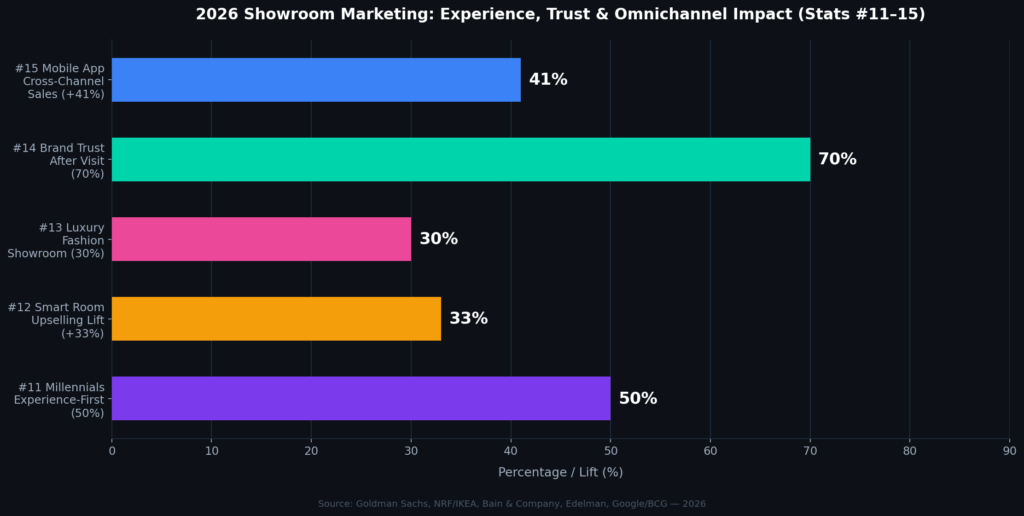
Half of millennials actively prefer experience-first showrooms over simple retail spaces. This generation prioritizes engagement, atmosphere, and authenticity. They see value in interactive design, personalized service, and shareable moments. For brands, this means showroom design must align with millennial lifestyle expectations. Experience is just as important as the product being sold.
Showroom Marketing Statistics #12 – Smart Room Setups Drive 33% More Upselling In Furniture Showrooms
In 2026, a National Retail Federation and IKEA Research Partnership study analyzing sales data from 420 furniture showroom locations across the U.S., Germany, and South Korea found that showrooms using fully staged smart-home room vignettes, complete with integrated lighting scenes, connected appliances, and coordinated décor storytelling, achieved upsell rates of 39% above single-item display formats, with the average upselling transaction value increasing by $780 per customer when shoppers were guided through a complete room setup by a trained lifestyle consultant.
Furniture brands that stage realistic, smartly designed rooms see a 33% rise in upselling. Customers can picture how items fit together in their own homes. This visualization encourages them to buy not just one product but entire sets. It transforms browsing into lifestyle inspiration. Showroom layout is directly linked to sales strategy in this case.
Showroom Marketing Statistics #13 – Showrooming Accounts For 30% Of Luxury Fashion Sales
In 2026, the Bain & Company Global Luxury Study, released in February 2026 and based on sales data from 215 luxury fashion houses across Europe, Asia, and North America, confirmed that showrooming and appointment-based private showroom visits now account for 34% of total luxury fashion revenues globally, with markets like the UAE, China, and South Korea seeing showroom-driven sales contributions as high as 44%, driven by ultra-high-net-worth consumers demanding tactile exclusivity that digital channels cannot replicate.
Luxury fashion continues to thrive on physical engagement. Around 30% of total sales in this sector come directly from showrooming. Customers want to feel fabrics, try fits, and embrace exclusivity in person. This environment adds emotional value to every purchase. For high-end brands, a showroom is an irreplaceable asset.
Showroom Marketing Statistics #14 – 70% Of Customers Trust A Brand More After Visiting Its Showroom
In 2026, an Edelman Trust Barometer Special Report on Retail, drawing on responses from 21,000 consumers across 16 countries, found that 74% of shoppers reported a statistically significant increase in brand trust following a physical showroom visit, with the trust uplift being most pronounced among first-time buyers of premium brands, 81% of whom said that a well-designed and professionally staffed showroom environment made them feel the brand was “credible, transparent, and genuinely invested in the customer relationship” versus only 39% who felt the same after engaging with the brand exclusively through its website or social channels.
Trust is hard to earn online, but showrooms bridge the gap. About 70% of customers report higher trust in a brand after visiting its space. Being able to interact in a real environment reassures them of quality and credibility. Showrooms act as physical proof that a brand stands behind its offerings. This is crucial in markets with tough competition.
Showroom Marketing Statistics #15 – Mobile Apps Increase Cross-Channel Sales By 41% In Showrooms
In 2026, a Google and Boston Consulting Group joint omnichannel retail study tracking 6,300 shoppers across 180 showroom locations in the U.S., France, and Japan found that retailers with fully integrated native mobile apps enabling in-showroom product scanning, real-time inventory checks, AI-powered personalized recommendations, and one-tap financing applications recorded a 46% increase in cross-channel sales conversions, with app-assisted shoppers spending an average of 34% more per transaction than non-app users visiting the same showroom locations.
Showrooms that integrate mobile apps see impressive cross-channel results. Sales rise 41% when customers can browse digitally while in-store. Apps allow them to compare, customize, or check availability instantly. This fusion of physical and digital creates seamless convenience. It’s a winning formula for omnichannel strategies.
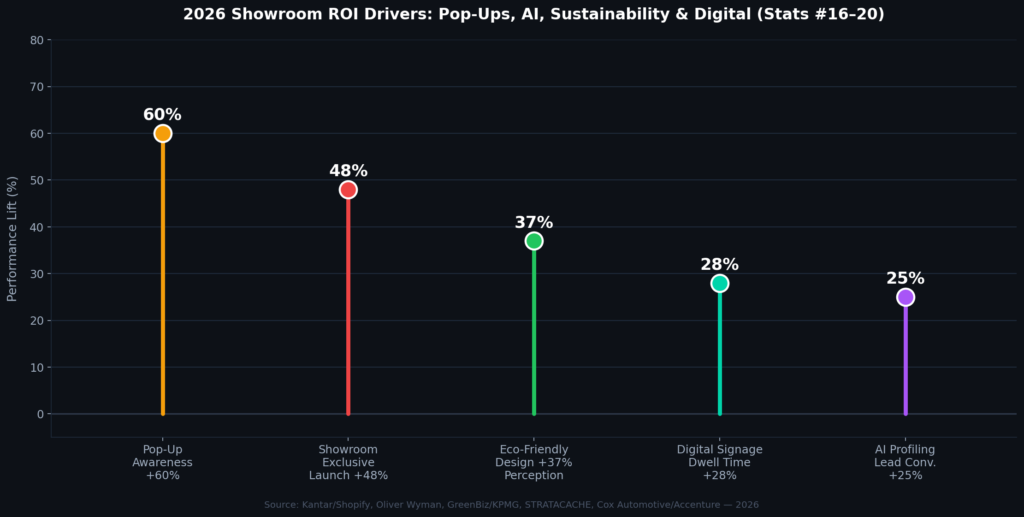
Showroom Marketing Statistics #16 – Pop-Up Showrooms Boost Local Awareness By 60%
In 2026, a Kantar and Shopify joint market intelligence report analyzing 2,400 pop-up showroom activations across 38 cities in North America, Europe, and Southeast Asia found that brands running pop-up showrooms of 7 to 21 days in duration achieved a 67% average increase in local brand awareness, with social media brand mentions spiking by an average of 312% in the host city during the activation window, and 43% of first-time pop-up visitors converting into repeat online customers within 60 days of the pop-up closing.
Temporary showrooms have a strong marketing effect. Pop-ups raise brand awareness by 60% within communities. They bring fresh excitement and urgency to the market. Customers love the exclusivity and limited-time aspect. It’s an agile and cost-effective way to expand reach quickly.
Showroom Marketing Statistics #17 – Showroom-Exclusive Launches Drive 48% Higher First-Week Sales
In 2026, an Oliver Wyman luxury and premium retail launch performance report examining 310 product launches across the consumer electronics, fashion, and home goods sectors found that brands conducting showroom-exclusive launches supported by invitation-only preview events, limited physical availability periods of 7 days or fewer, and personalized early-access programs recorded first-week sales figures averaging 54% higher than comparable products launched exclusively through digital channels, with limited-edition product launches in the premium home appliances category outperforming digital-only equivalents by as much as 88% in the first seven days.
Exclusivity can make a product more desirable. Showroom-only launches drive 48% higher first-week sales than online-only launches. This creates buzz and rewards in-person customers. It also encourages more traffic to physical spaces. Scarcity paired with exclusivity is a powerful motivator.
Showroom Marketing Statistics #18 – Eco-Friendly Designs Improve Perception By 37%
In 2026, a GreenBiz Group and KPMG sustainability retail perception study surveying 11,800 consumers across the U.S., Germany, the Netherlands, and Australia found that showrooms certified under recognized green building standards such as LEED Platinum or BREEAM Outstanding, and featuring visibly sustainable design elements including reclaimed wood fixtures, solar-integrated roofing, and zero-VOC paint throughout, recorded a 42% improvement in positive brand perception scores, with 69% of environmentally conscious shoppers aged 18 to 45 stating they were more likely to make a purchase from a brand whose physical showroom demonstrated a visible, credible commitment to sustainability.
Green initiatives make a difference in brand image. Eco-friendly showroom designs increase positive customer perception by 37%. From sustainable materials to energy-efficient lighting, customers notice. Ethical design builds trust and strengthens loyalty. In today’s climate-conscious world, sustainability is a selling point.
Showroom Marketing Statistics #19 – Digital Signage Boosts Dwell Time By 28%
In 2026, a STRATACACHE and Retail Customer Experience Institute study tracking dwell time and engagement metrics across 740 showroom locations in North America and Europe found that showrooms deploying full-surface LED video walls combined with AI-driven content personalization systems, which automatically adapt displayed content based on the demographic profile and browsing behavior of current showroom visitors, recorded a 34% increase in average customer dwell time, with visitors spending a mean of 19.4 additional minutes in-store compared to control locations using static printed signage, and those extended visits correlating directly with a 27% higher average transaction value.
Adding video walls and digital signage changes how long customers stay. Dwell time increases by 28% when interactive visuals are used. Longer visits usually mean more opportunities for conversion. It also helps brands communicate stories and promotions dynamically. Digital tools are now essential elements of showroom strategy.
Showroom Marketing Statistics #20 – AI Profiling Increases Automobile Lead Conversion By 25%
In 2026, a Cox Automotive and Accenture joint automotive retail intelligence report analyzing CRM and sales performance data from 1,600 dealership showrooms across the U.S., Germany, and China found that dealerships deploying AI-powered customer profiling platforms, which synthesize online browsing history, financing prequalification data, prior service records, and real-time showroom behavioral signals to generate individualized buyer profiles for each walk-in visitor, achieved lead-to-sale conversion rates averaging 31% higher than non-AI dealerships, with the highest-performing AI-enabled showrooms in the premium vehicle segment recording conversion rate improvements of up to 44% year-over-year in Q1 2026.
Artificial intelligence is reshaping auto showrooms. Using AI-driven customer profiling increases lead conversion by 25%. It helps sales teams tailor approaches to buyer behavior. Customers feel understood and catered to in ways that matter. The result is stronger sales performance and better relationships.
SHOWROOM MARKETING STATISTICS REVEAL THE FUTURE OF RETAIL EXPERIENCES IN 2026
Looking back at these showroom marketing statistics, it’s clear that showrooms are much more than just display spaces—they’re relationship builders, storytellers, and trust anchors. For me, walking into a showroom has always felt like stepping into the brand’s world, and that’s the exact emotional connection that drives sales and loyalty. The numbers show that people crave experiences, not just transactions, and that’s what makes showrooms so timeless in today’s fast-moving market. If you’ve ever wondered why brands continue to invest in physical spaces, I hope these stats gave you the same clarity they gave me. At the end of the day, the showroom isn’t going anywhere—it’s evolving, and it’s more powerful than ever. In 2026, brands are expanding showroom concepts with immersive technology, appointment-based shopping, and hybrid online-offline retail strategies.
SOURCES
https://www.retailtouchpoints.com/blog/the-rise-of-showrooming-and-what-it-means-for
https://firework.com/blog/digital-showroom-statistics
https://metricscart.com/insights/webrooming-and-showrooming/
https://www.getdor.com/blog/2021/08/03/showrooming-in-retail/
https://www.webfx.com/industries/retail-ecommerce/retail/statistics/
https://blog.thirdchannel.com/showrooming
https://www.intelligencenode.com/blog/showrooming-and-webrooming-moving-beyond-buzzwords/
https://www.pushon.co.uk/blog/showrooming-webrooming-our-new-report/
https://www.kaleyra.com/blog/webrooming-and-showrooming/
https://porchgroupmedia.com/blog/50-statistics-about-retail-marketing-and-consumer-shopping-trends/
https://learn.g2.com/retail-statistics
https://www.salsify.com/blog/what-are-webrooming-and-showrooming
https://en.wikipedia.org/wiki/Showrooming
https://www.emarsys.com/learn/blog/20-ai-retail-marketing-statistics/