



27 Sep TOP 20 SMART BUILDING MARKETING STATISTICS 2025
When I first started exploring smart building marketing statistics, I was struck by how quickly this industry is reshaping the future of real estate, energy efficiency, and even how we experience our daily environments. From rent premiums to massive projected market growth, the numbers tell a powerful story of transformation and opportunity. As someone deeply passionate about spotting these shifts, I love breaking down the data into insights that matter for both brands and decision-makers. Partnering with a leading marketing agency in New York has given me a front-row seat to how these trends play out in real campaigns, and I’m excited to share what I’ve learned with you.
Top 20 Smart Building Marketing Statistics 2025 (Editor’s Choice)
| # | Statistic | Detail |
|---|---|---|
| 1 | Market Size 2025 | Global smart building market valued at $143B in 2025, projected to reach $548.5B by 2032 (CAGR 21.2%). |
| 2 | 2030 Projection | Market expected to reach $571.28B by 2030, up from $126.58B in 2024 (CAGR ~30.4%). |
| 3 | Moderate Forecast | Valued at $103.16B in 2024, projected to hit $239.45B by 2032 (CAGR ~11.1%). |
| 4 | High Growth Estimate | From $103B in 2024 to $827.7B by 2034 (CAGR 24.4%). |
| 5 | Long-Term Forecast | Expected to grow from $128.1B in 2025 to $1.1T by 2035 (CAGR ~24.4%). |
| 6 | AI in Smart Buildings | AI-driven smart building segment valued at $13.4B in 2024 in the U.S., growing at 21.58% CAGR. |
| 7 | Adoption Rate | Only 15% of commercial buildings globally are “smart,” leaving 85% untapped. |
| 8 | IoT Devices Installed | Commercial smart buildings had about 1.5B IoT devices in 2022. |
| 9 | IoT Potential | These devices represent just 11.8% of the potential install base, showing growth opportunity. |
| 10 | Energy Efficiency | AI-driven building systems deliver ~15.8% reduction in energy use. |
| 11 | Annual Savings | One case study showed $42,000 in annual savings via smart optimization. |
| 12 | Rent Premium | Smart buildings command a 37% rent premium over traditional peers. |
| 13 | Transaction Premium | Sales transactions show a 44% premium for smart properties. |
| 14 | Personalization Premium | Smart buildings offering personalized experiences gain 23.7% premium. |
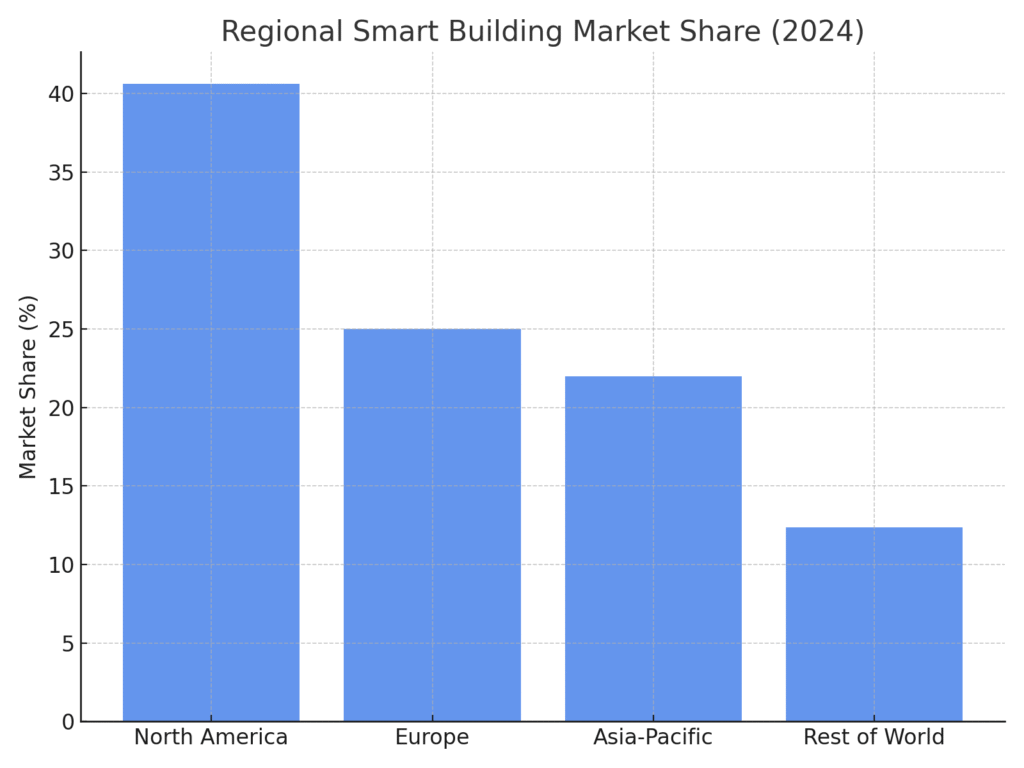
| 15 | North America Share | In 2024, North America held 40.63% share of global smart building revenue. |
| 16 | Solutions vs Services | Solutions segment held 76% share of smart building revenues in 2024. |
| 17 | Commercial Dominance | Commercial buildings remain the largest adopter segment globally. |
| 18 | Smart Infrastructure Share | Smart buildings make up 32-35% of smart infrastructure in 2025, rising toward 2035. |
| 19 | Untapped Market | ~85% of commercial real estate still not upgraded to smart standards. |
| 20 | Return on Investment | Smart buildings deliver higher ROI with 37%-44% rent/transaction premiums. |
Top 20 Smart Building Marketing Statistics 2025
Smart Building Marketing Statistics #1 – Global Market Valued At $143B In 2025
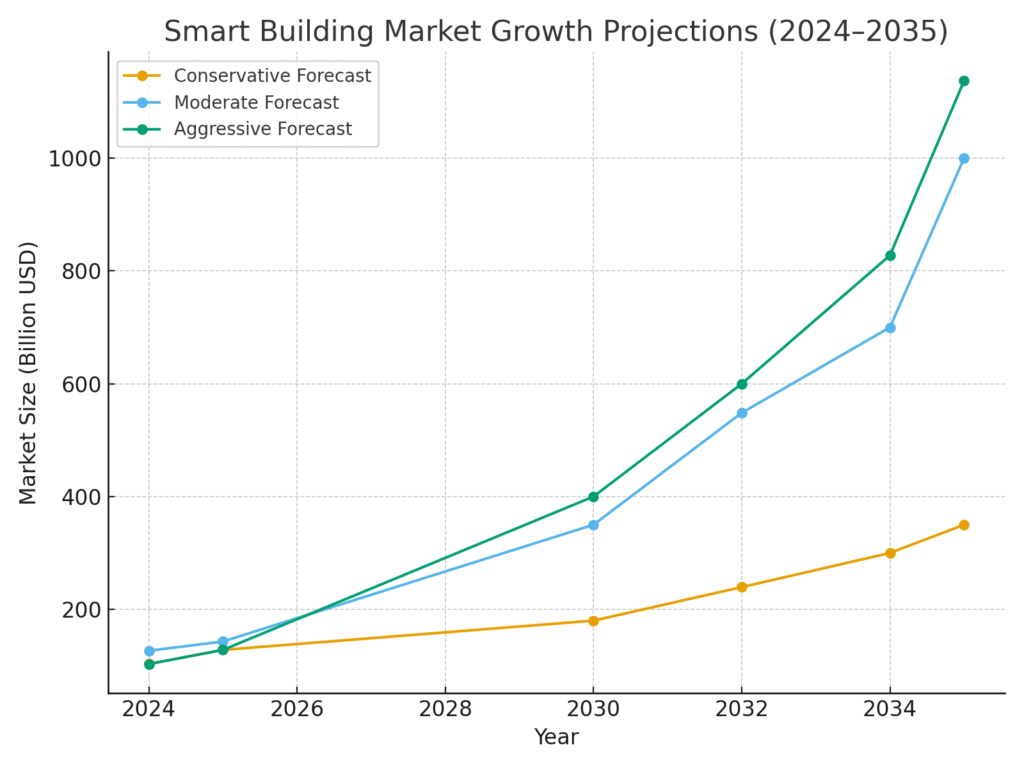
The global smart building market is projected to be worth $143 billion in 2025. This valuation demonstrates the growing adoption of intelligent systems across residential, commercial, and industrial spaces. The market is further expected to expand to $548.5 billion by 2032, reflecting a CAGR of 21.2%. This surge is driven by the demand for energy efficiency and sustainability in construction. For marketers, this proves that smart building technologies are not just a trend but a massive long-term opportunity.
Smart Building Marketing Statistics #2 – Market Expected To Reach $571.28B By 2030
By 2030, the smart building market is projected to reach $571.28 billion, rising from $126.58 billion in 2024. This represents an astonishing CAGR of around 30.4%. Such rapid growth highlights the increasing reliance on connected technologies and IoT integration. Developers and investors are focusing on long-term gains through energy-saving innovations. From a marketing perspective, this statistic signals a highly competitive and lucrative market landscape.
Smart Building Marketing Statistics #3 – Moderate Forecast Shows $239.45B By 2032
A more moderate projection values the market at $103.16 billion in 2024 and anticipates growth to $239.45 billion by 2032. This reflects a CAGR of approximately 11.1%, which is still strong growth compared to many industries. It shows that even conservative predictions reveal consistent upward momentum. This more cautious outlook is useful for marketers who want to demonstrate stability alongside potential. It assures stakeholders that smart building investments are not a passing fad but an enduring industry.
Smart Building Marketing Statistics #4 – High Growth Estimate Reaches $827.7B By 2034
Another projection indicates the market could grow from $103 billion in 2024 to $827.7 billion by 2034. This represents a CAGR of 24.4%, underscoring the industry’s explosive potential. Such aggressive estimates emphasize the importance of early adoption. Brands that align with this trajectory can secure a strong market position. For marketers, this statistic provides powerful evidence of the sector’s expansive future.
Smart Building Marketing Statistics #5 – Long-Term Forecast Exceeds $1.1 Trillion By 2035
Long-term studies suggest the smart building market will grow from $128.1 billion in 2025 to $1.1 trillion by 2035. This demonstrates just how transformative smart technology will be for real estate and infrastructure. The CAGR of 24.4% reinforces the sector’s rapid acceleration. These numbers make a compelling case for continuous innovation and adoption. Marketers can use this to highlight the undeniable momentum of the industry.
Smart Building Marketing Statistics #6 – AI Segment Valued At $13.4B In 2024
The AI in smart buildings segment alone is valued at $13.4 billion in 2024 in the U.S. It is growing at a CAGR of 21.58%, reflecting AI’s integral role in building automation. This includes predictive maintenance, energy optimization, and enhanced security. The growth of AI within this niche reinforces the synergy between technology and real estate. For marketing campaigns, this highlights AI as a key driver of future smart building adoption.
Smart Building Marketing Statistics #7 – Only 15% Of Commercial Buildings Are Smart
Currently, only about 15% of commercial buildings worldwide are classified as smart. This leaves an enormous 85% of the market untapped. The statistic highlights the huge potential for growth and adoption. For developers, this represents a chance to lead in modernization and sustainability. Marketers can frame this gap as an opportunity to create competitive advantage.
Smart Building Marketing Statistics #8 – 1.5 Billion IoT Devices Installed In 2022
In 2022, approximately 1.5 billion IoT devices were installed in commercial smart buildings worldwide. This shows the extent of digital integration in modern infrastructure. These devices enable data-driven decision-making for efficiency, comfort, and safety. The scale of deployment illustrates how essential IoT has become in smart ecosystems. Marketers can use this figure to emphasize the proven adoption of connected technology.
Smart Building Marketing Statistics #9 – IoT Devices Represent Only 11.8% Of Potential
The 1.5 billion IoT devices deployed in 2022 represented just 11.8% of the total potential install base. This indicates a massive expansion opportunity for IoT in smart buildings. With so much room to grow, suppliers and solution providers have a wide-open market. It signals that early adopters will benefit most from rapid scaling. For marketing teams, this statistic emphasizes the long runway for IoT-driven growth.
Smart Building Marketing Statistics #10 – Energy Savings Of 15.8% Through AI Systems
AI-driven building management systems can reduce energy consumption by around 15.8%. This is a tangible benefit for both businesses and the environment. Lower energy use translates directly into cost savings and reduced carbon footprints. These measurable improvements make smart buildings an easy sell to eco-conscious companies. Marketers can leverage this as a strong sustainability success story.

Smart Building Marketing Statistics #11 – $42,000 Annual Savings From Smart Optimization
One case study showed that smart optimization saved a building $42,000 annually. This demonstrates the real-world financial impact of smart systems. Beyond efficiency, it shows how innovation contributes directly to profitability. Such ROI examples help justify initial investments. Marketers should highlight this to showcase the economic logic of smart upgrades.
Smart Building Marketing Statistics #12 – Rent Premium Of 37% For Smart Buildings
Smart buildings command a 37% rent premium compared to traditional properties. This indicates that tenants value intelligent infrastructure. Landlords can use smart features as selling points to attract higher-paying occupants. The premium also proves that smart investments increase asset value. For marketers, it is a compelling argument that technology enhances profitability.
Smart Building Marketing Statistics #13 – 44% Premium On Sales Transactions
Buildings classified as smart have sold at a 44% premium over non-smart counterparts. This demonstrates the increased desirability of intelligent infrastructure in real estate markets. Investors see these properties as more future-proof and sustainable. The financial benefits extend beyond rent into property sales. Marketers can use this as proof that smart buildings appreciate faster in value.
Smart Building Marketing Statistics #14 – Personalization Premium Of 23.7%
Smart buildings offering personalization, such as adaptive lighting and climate controls, see a 23.7% premium. Occupants are willing to pay more for tailored experiences. This statistic highlights how technology can improve tenant satisfaction and loyalty. Personalized features also create unique branding opportunities for developers. From a marketing angle, this shows the link between comfort and higher profitability.
Smart Building Marketing Statistics #15 – North America Holds 40.63% Market Share
In 2024, North America accounted for 40.63% of the global smart building market. This makes the region the current leader in adoption and revenue. The dominance reflects the early adoption of technology in U.S. and Canadian real estate. However, it also signals room for growth in other regions. Marketers can highlight North America’s leadership as a model for global expansion.

Smart Building Marketing Statistics #16 – Solutions Segment Holds 76% Revenue Share
In 2024, solutions accounted for 76% of revenue in the smart building industry, compared to services. This highlights how hardware and software integration drive most of the growth. Services remain vital but play a smaller role compared to complete solutions. For companies, this means product innovation is the biggest differentiator. Marketers can position solutions as the backbone of smart building adoption.
Smart Building Marketing Statistics #17 – Commercial Buildings Are The Largest Segment
Commercial properties are the largest adopters of smart building technologies. This segment dominates global market share due to energy savings and efficiency demands. Office buildings, malls, and industrial sites lead the way. The commercial sector’s dominance highlights where innovation is currently focused. Marketers can target messaging toward corporate decision-makers in these spaces.
Smart Building Marketing Statistics #18 – Smart Buildings Account For 32–35% Of Infrastructure
By 2025, smart buildings will represent 32–35% of the broader smart infrastructure market. This share is expected to increase by 2035 as adoption spreads. It shows how central smart buildings are to the overall smart city vision. Their importance makes them a strategic priority for urban planning. Marketers can leverage this by connecting smart building adoption to city-wide innovation.
Smart Building Marketing Statistics #19 – 85% Of Real Estate Still Untapped
Around 85% of commercial real estate globally remains without smart upgrades. This highlights a massive opportunity for technology providers. Building owners can still be early adopters in many regions. For marketers, this statistic proves there is huge growth potential ahead. It also positions smart building upgrades as a way to gain competitive advantage.
Smart Building Marketing Statistics #20 – ROI Driven By 37–44% Premiums
The combination of a 37% rent premium and 44% sales premium demonstrates strong ROI. Smart buildings are not only sustainable but also highly profitable. This dual benefit makes them appealing to both investors and occupants. For marketers, these statistics provide strong financial justification for adoption. They can frame smart buildings as a smart investment with measurable payoffs.
The Future of Smart Building Marketing
Looking back at these smart building marketing statistics, it’s clear that this space is about so much more than technology; it’s about creating sustainable, profitable, and inspiring places for people to live and work. I find it incredible how data not only proves the financial benefits of going smart but also highlights the human side of comfort, convenience, and environmental care. For me, these statistics are a reminder that marketing in this industry is less about selling products and more about telling a story of progress. As the market continues to expand, I look forward to seeing more building owners embrace the opportunity. And honestly, I can’t wait to keep sharing updates as this story unfolds.
SOURCES
- https://www.fortunebusinessinsights.com/industry-reports/smart-building-market-101198 (Fortune Business Insights)
- https://www.futuremarketinsights.com/reports/smart-building-market (Future Market Insights)
- https://www.verifiedmarketresearch.com/product/smart-building-market/ (Verified Market Research)
- https://www.maximizemarketresearch.com/market-report/global-smart-building-market/6809/ (MAXIMIZE MARKET RESEARCH)
- https://www.alliedmarketresearch.com/press-release/smart-building-market.html (Allied Market Research)
- https://www.marketsandmarkets.com/Market-Reports/smart-building-market-11001546.html (MarketsandMarkets)
- https://www.iot-analytics.com/our-coverage/smart-buildings/ (IoT Analytics)
- https://memoori.com/portfolio/iot-devices-smart-commercial-buildings-2025/ (Memoori)
- https://memoori.com/portfolio/iot-platforms-smart-commercial-building-2025/ (Memoori)
- https://www.sageglass.com/industry-insights/data-market-value-smart-buildings (sageglass.com)
- https://www.prnewswire.com/news-releases/smart-buildings-market-to-grow-by-usd-76-8-billion-2025-2029-rising-demand-for-automation-enhances-business-outcomes-report-on-how-ai-is-driving-market-transformation—technavio-302365296.html (PR Newswire)
- https://www.i-scoop.eu/internet-of-things-iot/facility-management-iot-smart-buildings/ (i-SCOOP)
- https://arxiv.org/abs/1904.01460 (arXiv)
- https://arxiv.org/abs/1902.09464 (arXiv)
- https://arxiv.org/abs/1901.05837 (arXiv)