



27 Sep TOP 20 SMART GRID MARKETING STATISTICS 2025
As I was going through the latest smart grid marketing statistics, I couldn’t help but reflect on how quickly this industry is evolving and reshaping the way we think about energy. The shift towards smarter, more efficient grids isn’t just a technological leap—it’s a story about innovation, sustainability, and the way companies connect with their audiences. As someone who follows these changes closely, I’ve found that working with a leading marketing agency in New York has given me deeper insight into how brands can position themselves in this dynamic space. In this blog, I want to share some of the most exciting numbers that highlight both the growth potential and the challenges that marketers need to keep in mind when navigating the smart grid sector.
Top 20 Smart Meter Marketing Statistics 2025 (Editor’s Choice)
| # | Smart Grid Marketing Statistic | Details |
|---|---|---|
| 1 | Global Market Size 2023 | Valued at USD 40.61 billion in 2023, projected to reach USD 203.92 billion by 2032. |
| 2 | Market Growth (2024–2030) | Expected to grow from USD 55.54 billion in 2024 to USD 145.42 billion by 2030. |
| 3 | Market Forecast (2024–2034) | Estimated at USD 66.1 billion in 2024, projected to reach USD 180.3 billion by 2034. |
| 4 | Data Analytics Growth | Smart grid data analytics projected to grow from USD 6.7 billion in 2025 to USD 21.2 billion by 2035. |
| 5 | Analytics CAGR | Market valued at USD 2.72 billion in 2024, expected to hit USD 6.16 billion by 2033 (CAGR ~9%). |
| 6 | Analytics Expansion | Projected to reach USD 14.04 billion by 2030 from USD 4.19 billion in 2020. |
| 7 | Global Coverage 2025 | Smart grid coverage projected at 24.2% in 2025, rising to 42.7% by 2030. |
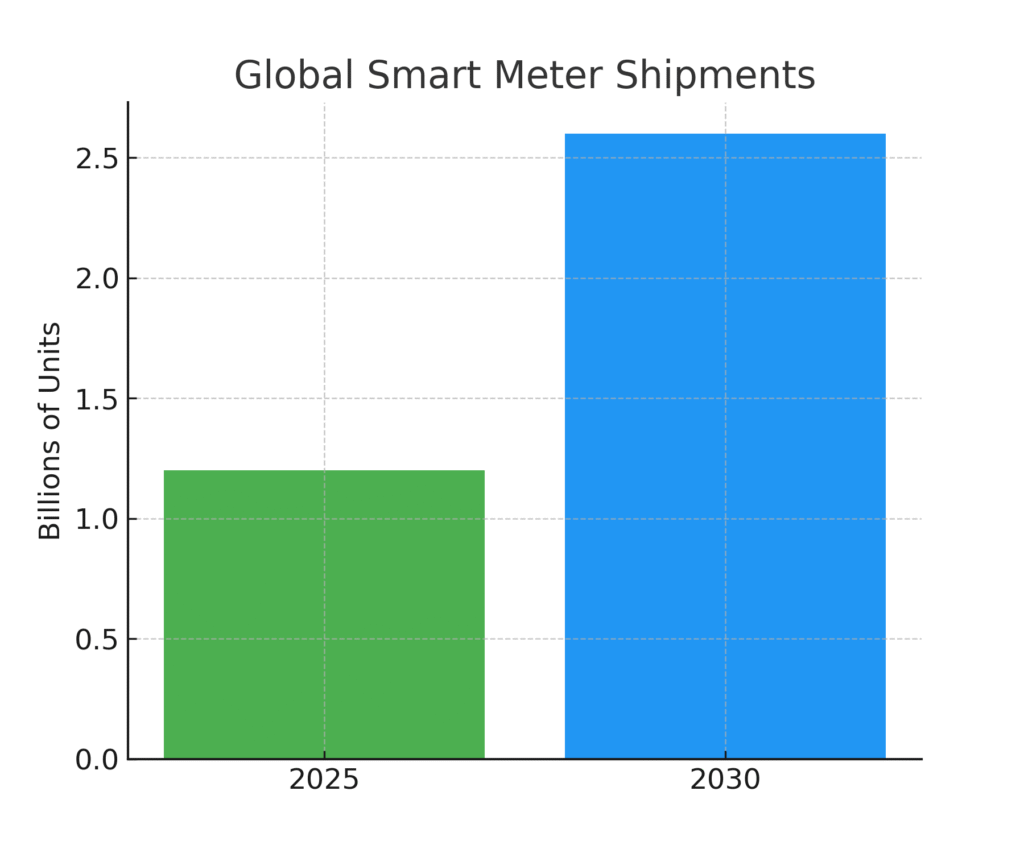
| 8 | Smart Meters 2030 | 2.6 billion smart meters projected to be shipped globally by 2030. |
| 9 | Distribution Investment | 75% of digital grid investment is directed at distribution (meters, sensors, automation). |
| 10 | U.S. Market CAGR | U.S. smart grid market projected CAGR of 15.49% from 2025–2033. |
| 11 | Customer Awareness | 72% of customers have heard of smart meters; 70% are aware of the smart grid. |
| 12 | Green Champions | 44% of customers identify as “always engaged – green champions.” |
| 13 | Selective Engagement | 40% of customers are “selectively engaged” with smart grid adoption. |
| 14 | Program Interest | 40% of customers express interest in smart-grid–enabled programs. |
| 15 | China Investment | China to invest USD 50 billion in grid modernization (2021–2025). |
| 16 | India Investment | India launched USD 38 billion scheme for power distribution improvements. |
| 17 | Forecast Growth 2029 | Smart grid market forecast CAGR of 16.9% between 2024–2029. |
| 18 | Digitalization Trend | Distribution grid digitalization (automation, IoT, sensors) is the main growth driver. |
| 19 | Adoption Barrier | Lack of awareness about interoperability and protocols hinders adoption. |
| 20 | Data Challenge | Smart grid devices generate massive data requiring robust analytics & processing. |
Top 20 Smart Grid Marketing Statistics 2025
Smart Grid Marketing Statistics #1: Global Market Size 2023
The global smart grid market reached USD 40.61 billion in 2023, showcasing the rapid adoption of advanced energy solutions. This size reflects a growing demand for digital technologies that make energy distribution more efficient and reliable. Businesses and governments alike are pouring investment into smarter infrastructures. The projected growth to USD 203.92 billion by 2032 highlights the immense potential of this sector. For marketers, these figures are an opportunity to frame campaigns around innovation, sustainability, and the economic benefits of smart grids.
Smart Grid Marketing Statistics #2: Market Growth (2024–2030)
Between 2024 and 2030, the smart grid market is forecasted to expand from USD 55.54 billion to USD 145.42 billion. This surge demonstrates confidence in the role of smart grids in tackling energy challenges. As global populations grow, energy demands are becoming harder to manage with traditional grids. Smart solutions offer resilience, flexibility, and efficiency, making them an attractive investment. From a marketing perspective, the CAGR provides a compelling narrative for highlighting smart grids as future-proof technologies.
Smart Grid Marketing Statistics #3: Market Forecast (2024–2034)
Another estimate suggests the smart grid market will climb from USD 66.1 billion in 2024 to USD 180.3 billion by 2034. These variations in forecasts reflect different scenarios, yet all point to strong double-digit growth. Investors are recognizing the long-term value of smart infrastructure. Such projections help marketers stress the consistency of demand and the inevitability of adoption. It positions smart grids as not just a trend but a necessity in modern energy systems.
Smart Grid Marketing Statistics #4: Data Analytics Growth
Smart grid data analytics is projected to grow from USD 6.7 billion in 2025 to USD 21.2 billion by 2035. This growth highlights the importance of turning raw energy data into actionable insights. Utilities increasingly rely on analytics to predict outages, improve distribution, and enhance efficiency. Marketing messages can emphasize how data turns grids into intelligent, adaptable systems. For B2B campaigns, this is a chance to showcase software and solutions that power smarter decision-making.
Smart Grid Marketing Statistics #5: Analytics CAGR
In 2024, the analytics market was valued at USD 2.72 billion and is expected to hit USD 6.16 billion by 2033. This represents a steady CAGR of about 9%, reinforcing data’s central role in smart energy. As more devices connect to the grid, the data load increases exponentially. Businesses must invest in platforms that can handle this influx. Marketers can position analytics solutions as critical for future scalability and efficiency.

Smart Grid Marketing Statistics #6: Analytics Expansion
By 2030, smart grid data analytics is projected to reach USD 14.04 billion, up from USD 4.19 billion in 2020. This tripling of value illustrates how analytics has shifted from optional to essential. Utilities are focusing heavily on predictive insights to reduce costs and maximize energy efficiency. The expansion reflects how data has become the new “currency” of the energy world. For marketers, it’s a strong argument for investing in smarter tools to future-proof energy infrastructure.
Smart Grid Marketing Statistics #7: Global Coverage 2025
Smart grid coverage is estimated to be 24.2% in 2025, with projections of 42.7% by 2030. This shows a near doubling within five years. Global adoption is accelerating, driven by energy transition goals and climate commitments. The rise in coverage presents new opportunities for businesses to enter untapped markets. Marketing efforts can emphasize this growth as proof of mainstream adoption.
Smart Grid Marketing Statistics #8: Smart Meters 2030
By 2030, 2.6 billion smart meters are expected to be shipped worldwide. These devices are at the heart of smart grids, providing real-time energy usage data. With more meters deployed, consumers gain control over their energy consumption. The widespread roll-out signals a cultural shift toward energy awareness. Marketers can highlight smart meters as tools that empower consumers and drive greener lifestyles.
Smart Grid Marketing Statistics #9: Distribution Investment
Around 75% of all investment in grid digital infrastructure is directed at distribution. This means smart meters, sensors, and automation dominate spending priorities. Distribution improvements ensure efficiency from the consumer’s side of the grid. For businesses, this focus provides clear cues for where to direct product development. Marketing strategies should emphasize solutions that improve the distribution layer of energy systems.
Smart Grid Marketing Statistics #10: U.S. Market CAGR
In the U.S., the smart grid market is projected to grow at a CAGR of 15.49% from 2025 to 2033. This shows strong national support for grid modernization. Federal funding and policy shifts are major drivers behind this rapid expansion. For marketers, it underscores the importance of aligning with regulatory incentives. Messaging can focus on how U.S. adoption leads global energy innovation.
Smart Grid Marketing Statistics #11: Customer Awareness
A study found that 72% of customers have heard of smart meters, while 70% are aware of the smart grid. This shows encouraging levels of public awareness. Consumer familiarity provides a strong base for promoting new solutions. Yet, awareness does not always equal understanding, leaving space for educational marketing. Campaigns that simplify technical concepts will likely resonate more with audiences.
Smart Grid Marketing Statistics #12: Green Champions
About 44% of customers identify as “always engaged – green champions.” These consumers are highly motivated by sustainability and innovation. They actively seek solutions that help reduce environmental impact. For marketers, this audience is a clear target for smart grid messaging. Positioning products as eco-friendly and future-focused is key to winning their loyalty.
Smart Grid Marketing Statistics #13: Selective Engagement
40% of customers are “selectively engaged” with smart grids. They are interested in saving energy but may lack clarity on how smart systems work. Education becomes a central marketing strategy for this segment. By breaking down benefits in simple, relatable ways, businesses can convert curiosity into adoption. These consumers represent a major growth opportunity if engaged effectively.
Smart Grid Marketing Statistics #14: Program Interest
Roughly 40% of customers expressed interest in smart-grid–enabled programs. This shows consistent appeal across multiple service types. The diversity of interest suggests that consumers are open to experimenting with new tools. Programs that emphasize cost savings and convenience may win faster adoption. For marketers, it highlights the importance of offering multiple entry points into smart grid solutions.
Smart Grid Marketing Statistics #15: China Investment
China plans to invest USD 50 billion in grid modernization between 2021 and 2025. This reflects the nation’s aggressive push toward sustainable energy. As one of the largest energy consumers, its policies set global benchmarks. Such investment creates opportunities for companies involved in technology, analytics, and hardware. Marketers can spotlight these numbers to demonstrate global momentum toward smart grids.

Smart Grid Marketing Statistics #16: India Investment
India has launched a USD 38 billion scheme to improve power distribution. This investment underscores the country’s commitment to upgrading energy infrastructure. With rapid urbanization, India needs robust energy solutions. For marketers, India represents one of the fastest-growing demand markets. Campaigns can highlight both the scale and urgency of adoption in this region.
Smart Grid Marketing Statistics #17: Forecast Growth 2029
Between 2024 and 2029, the global smart grid market is forecast to grow at a CAGR of 16.9%. This demonstrates consistent confidence in the sector. Growth at this pace outperforms many traditional energy industries. It shows that smart grids are being prioritized worldwide. Marketers can use this data to position products as part of a high-growth movement.
Smart Grid Marketing Statistics #18: Digitalization Trend
Distribution grid digitalization, including sensors, IoT, and automation, is the main growth driver. These technologies improve resilience and reduce downtime. They also enable more efficient use of renewable energy sources. This highlights the integration of smart grids into broader digital ecosystems. Marketing can stress how digitalization creates smarter, more sustainable cities.
Smart Grid Marketing Statistics #19: Adoption Barrier
A major barrier to smart grid adoption is low awareness of interoperability and standards. Many consumers and even some businesses do not understand compatibility issues. This slows the roll-out of universal solutions. Marketers have an important role in clarifying these benefits. By addressing complexity, campaigns can build trust and accelerate adoption.
Smart Grid Marketing Statistics #20: Data Challenge
Smart grid devices generate massive volumes of data that must be analyzed in real time. Without proper analytics, this information becomes overwhelming. Utilities face the challenge of storing, processing, and interpreting insights effectively. This creates opportunities for advanced analytics providers. Marketing strategies should position data solutions as essential for managing the “brain” of the smart grid.

Why These Smart Grid Insights Matter
Looking over these smart grid marketing statistics, I feel both inspired and motivated. They aren’t just numbers on a page—they represent opportunities for businesses to innovate, for communities to benefit from sustainable energy, and for marketers to tell stories that resonate. Personally, I see these trends as a reminder of why it’s so important to stay ahead, keep learning, and lean into strategies that truly make a difference. My hope is that these insights give you the same spark of curiosity and motivation that they’ve given me, and that together we can better understand where the future of smart grid technology is headed.
SOURCES
- https://engineeringonline.ucr.edu/blog/the-future-of-smart-grid-technologies
- https://blog.se.com/infrastructure-and-grid/smart-grid/
- https://www.marketsandmarkets.com/Market-Reports/smart-grid-market-208777577.html
- https://www.astracanyon.com/blog/the-future-of-smart-grids
- https://www.frontiersin.org/journals/energy-research/articles/10.3389/fenrg.2022.944798/full
- https://eleks.com/blog/guide-smart-grids-benefits-challenges/
- https://www.futureelectronics.com/blog/article/smart-grid-and-smart-meter-business-trends-and-opportunities/
- https://www.sciencedirect.com/science/article/pii/S0301421525001259
- https://www.sciencedirect.com/science/article/abs/pii/S2214629621003364
- https://www.energy.gov/oe/articles/smart-grid-enabler-new-energy-economy
- https://blogs.oracle.com/digitalassistant/post/transforming-the-smart-grid-how-oracle-digital-assistant-enhances-customer-engagement-and-operational-efficiency
- https://www.sciencedirect.com/science/article/abs/pii/S2214629621003364
- https://www.gevernova.com/software/blog/what-role-data-analytics-smart-grid
- https://www.iea.org/energy-system/electricity/smart-grids
- https://montel.energy/resources/blog/smart-grids-trends-in-smart-grid-technology
- https://pmc.ncbi.nlm.nih.gov/articles/PMC8587637/
- https://arxiv.org/abs/2103.11657
- https://arxiv.org/abs/1611.07722