




27 Sep TOP 20 SMART OFFICE MARKETING STATISTICS 2025
When I first began exploring how technology transforms the modern workplace, I realized how essential it is to understand the growing impact of smart office marketing statistics. These numbers not only highlight emerging trends but also reveal how businesses are reshaping productivity, employee engagement, and efficiency in the digital age. As someone deeply invested in following these shifts, I often turn to trusted resources like a leading marketing agency in New York to understand how brands adapt to these innovations. With smart office solutions becoming a standard rather than a luxury, I’m excited to share the insights that matter most for 2025.
Top 20 Smart Office Marketing Statistics 2025 (Editor’s Choice)
| # | Statistic | Insight |
|---|---|---|
| 1 | Global smart office market projected to reach $92 billion by 2025 | Rapid growth driven by automation and workplace efficiency demands. |
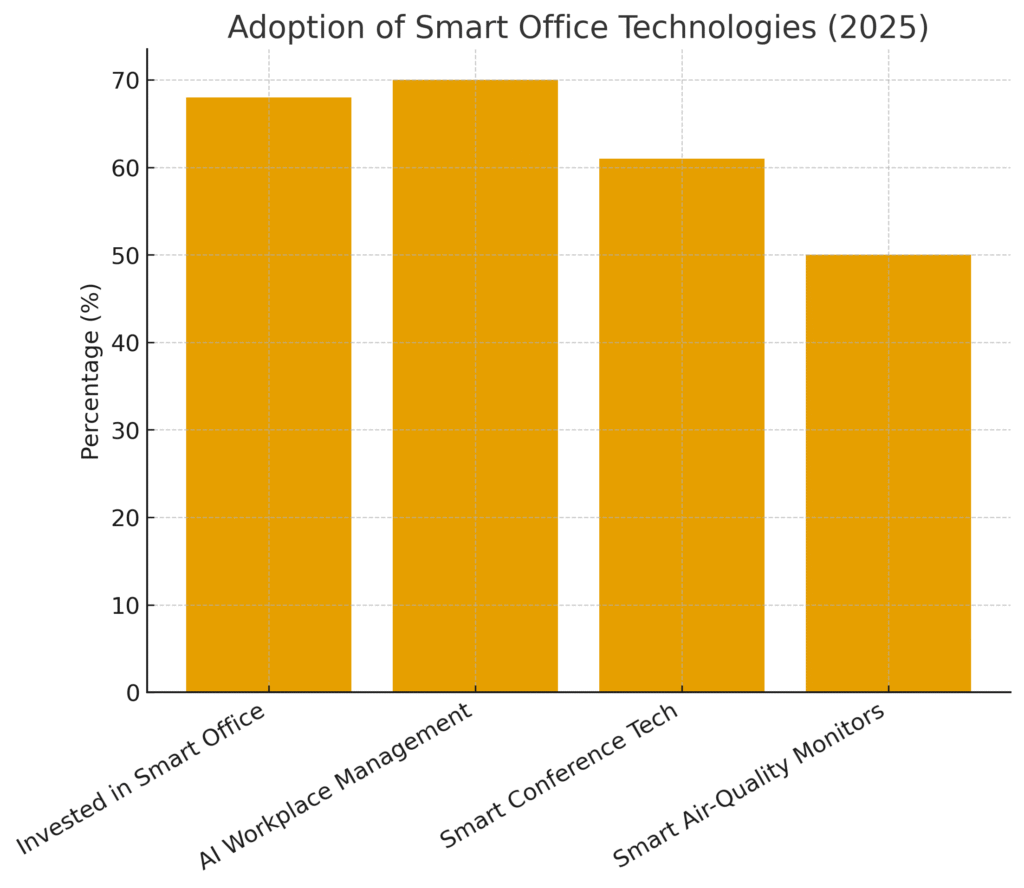
| 2 | 68% of enterprises invest in smart office solutions | Businesses aim to improve productivity and collaboration. |
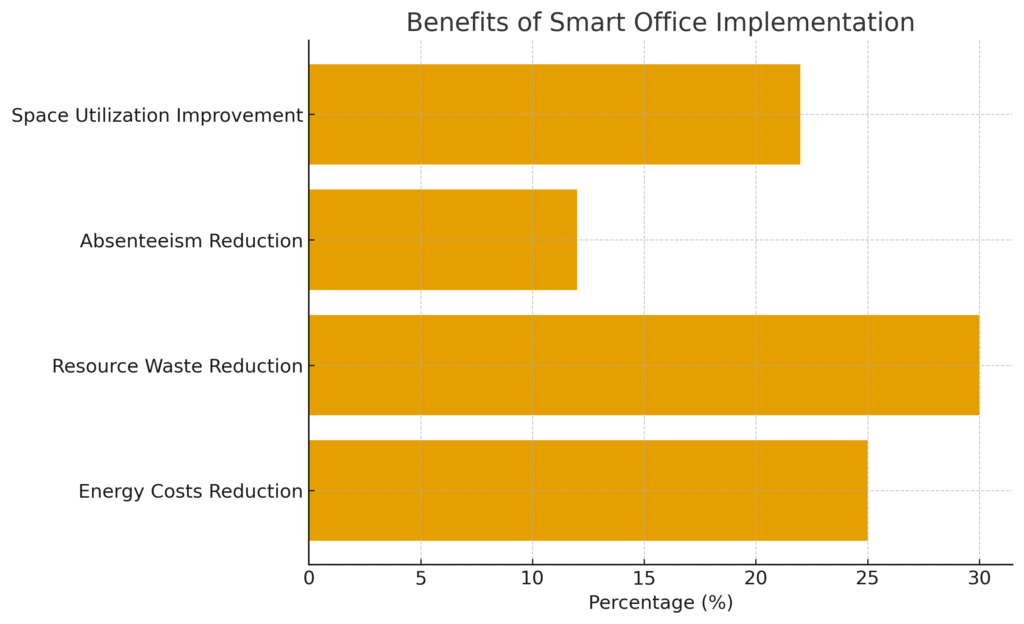
| 3 | 25% average reduction in energy costs | Smart office adoption leads to measurable savings. |
| 4 | 54% of businesses link smart offices to employee well-being | Positive impact on job satisfaction and morale. |
| 5 | Smart lighting & climate control improve efficiency by 35% | Energy optimization through automation. |
| 6 | Smart office IoT device market CAGR 13.6% | Strong growth forecast through 2030. |
| 7 | 40% of remote-first companies using smart office hubs | Hybrid work drives adoption. |
| 8 | Smart conference tech adoption up 61% since 2020 | Video & collaboration tools booming. |
| 9 | 70% of corporations use AI workplace management | AI takes center stage in office operations. |
| 10 | Smart sensors reduce wastage by 30% | Lower costs and resource efficiency. |
| 11 | 45% of employees feel more engaged in smart offices | Technology boosts workplace connection. |
| 12 | 55% of new installations are cloud-connected | Smart platforms dominate upgrades. |
| 13 | Absenteeism reduced by 12% with smart solutions | Improved workplace conditions matter. |
| 14 | Smart office security adoption grows 20% yearly | Workplaces prioritize safety. |
| 15 | 80% of Fortune 500 have smart office facilities | Smart tech becomes the norm. |
| 16 | Smart furniture market to reach $4.6B by 2026 | Connected desks & chairs gain popularity. |
| 17 | 60% of leasing firms highlight smart features | Marketing differentiator in real estate. |
| 18 | 50% of offices install smart air-quality monitors | Health-focused workplace design. |
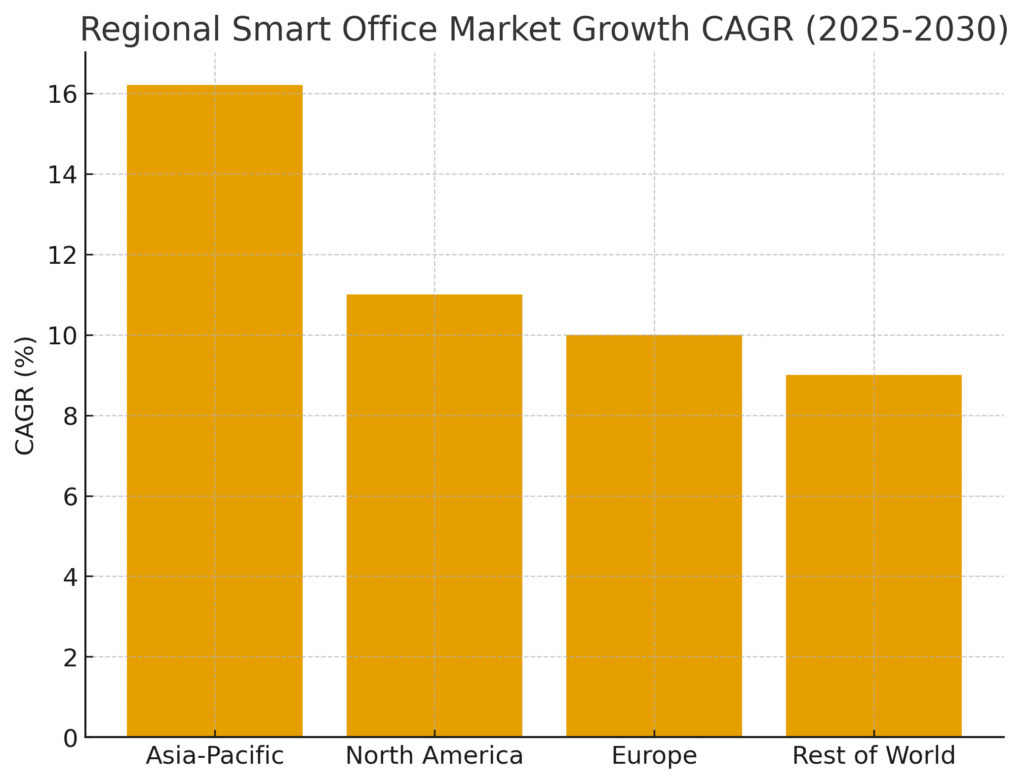
| 19 | Asia-Pacific adoption CAGR 16.2% | Region leads global growth. |
| 20 | Workplace analytics boost space use efficiency by 22% | Smarter data-driven decisions in offices. |
Top 20 Smart Office Marketing Statistics 2025
Smart Office Marketing Statistics #1 – Global Market Projected To Reach $92 Billion
The global smart office market is projected to reach $92 billion by 2025, highlighting how technology is transforming modern workplaces. This growth is driven by automation, energy efficiency, and employee-centric innovations. Companies are rapidly investing to stay competitive in a technology-first environment. The expansion reflects a shift in both developed and emerging economies. Smart offices are no longer optional; they are becoming a global standard.
Smart Office Marketing Statistics #2 – 68% Of Enterprises Invest In Smart Office Solutions
By 2025, 68% of enterprises will have invested in smart office solutions to enhance productivity. These tools include automated systems, IoT devices, and AI-driven platforms. Businesses see them as a way to cut costs while improving collaboration. This level of adoption shows that smart technology is now mainstream, not experimental. The percentage also suggests fierce competition among companies to provide the best employee experience.
Smart Office Marketing Statistics #3 – 25% Average Reduction In Energy Costs
Companies adopting smart office technologies report a 25% average reduction in energy costs. Automated lighting, smart HVAC, and IoT-enabled monitoring help cut down waste. This not only saves money but also supports sustainability goals. Lower operational costs mean higher profitability in the long run. Energy efficiency has become one of the strongest drivers for smart office investments.
Smart Office Marketing Statistics #4 – 54% Link Smart Offices To Employee Well-Being
More than 54% of businesses believe smart offices directly enhance employee well-being. Better air quality, comfortable lighting, and flexible spaces improve morale. Employees working in smart offices report less fatigue and greater focus. Organizations see this as a way to retain top talent. Workplace well-being is increasingly tied to technological investments.
Smart Office Marketing Statistics #5 – Smart Lighting & Climate Control Improve Efficiency By 35%
Smart lighting and climate control systems can boost energy efficiency by 35%. These systems adjust automatically to occupancy and conditions. As a result, they create an eco-friendly and cost-effective workspace. Employees also benefit from optimized comfort, which increases satisfaction. This dual benefit explains the rapid adoption of such technologies.

Smart Office Marketing Statistics #6 – IoT Devices Market CAGR 13.6%
The smart office IoT device market is expected to grow at a CAGR of 13.6% from 2024 to 2030. This growth includes sensors, smart furniture, and connected platforms. Businesses are increasingly leveraging IoT for data-driven decisions. The CAGR highlights long-term stability in demand. IoT is emerging as the backbone of smart workplaces.
Smart Office Marketing Statistics #7 – 40% Of Remote-First Companies Use Smart Office Hubs
By 2025, 40% of remote-first companies will rely on smart office hubs. These hubs provide collaborative spaces for employees who blend remote and office work. The trend supports hybrid work models that continue post-pandemic. Smart technology makes these hubs efficient, safe, and engaging. The shift demonstrates the future of flexible work arrangements.
Smart Office Marketing Statistics #8 – Smart Conference Tech Adoption Up 61% Since 2020
Smart conference technology adoption has surged by 61% since 2020. This includes AI-powered meeting software, smart displays, and integrated collaboration tools. Businesses realized the importance of seamless communication during remote work transitions. Today, conference tech has become a critical investment. The rise reflects the permanent shift to hybrid and digital-first workplaces.
Smart Office Marketing Statistics #9 – 70% Of Corporations Use AI Workplace Management
By 2025, 70% of corporations will rely on AI-powered workplace management systems. These systems optimize space, monitor usage, and improve resource allocation. AI brings predictive insights that allow businesses to plan efficiently. The statistic shows how deeply AI is embedded in corporate strategy. It marks a new level of intelligence in office environments.
Smart Office Marketing Statistics #10 – Smart Sensors Reduce Wastage By 30%
Smart sensors reduce workplace resource wastage by up to 30%. They monitor electricity, water, and heating to prevent overuse. This leads to lower operational costs and more sustainable practices. Companies benefit from better data insights and reduced bills. Sensors are a silent but powerful driver of office transformation.
Smart Office Marketing Statistics #11 – 45% Of Employees Feel More Engaged In Smart Offices
Surveys show that 45% of employees feel more engaged in smart offices. Interactive environments and flexible technology make work more enjoyable. Employees report improved collaboration and creativity. This proves that smart offices are not just cost-saving tools, but people-centric solutions. Engagement is key for retaining skilled talent in competitive industries.
Smart Office Marketing Statistics #12 – 55% Of New Installations Are Cloud-Connected
By 2025, 55% of new smart office installations will be cloud-connected. Cloud solutions provide scalability and easy integration with other systems. Companies prefer cloud-based platforms for flexibility and security. This trend reflects the growing role of remote access in hybrid work. Cloud connectivity is shaping the next generation of smart offices.
Smart Office Marketing Statistics #13 – Absenteeism Reduced By 12% With Smart Solutions
Organizations report a 12% reduction in absenteeism after adopting smart solutions. Better working conditions contribute to fewer sick days. Employees in optimized environments feel healthier and more productive. This statistic highlights the link between technology and workforce wellness. Reduced absenteeism also leads to significant cost savings.
Smart Office Marketing Statistics #14 – Smart Security Adoption Grows 20% Yearly
Smart office security adoption is growing at a rate of 20% year-over-year. Biometric access, surveillance AI, and smart locks are becoming common. Companies invest heavily to ensure both safety and compliance. Security is a critical concern as workplaces adopt digital-first operations. The growth rate shows how vital trust and safety are in smart offices.
Smart Office Marketing Statistics #15 – 80% Of Fortune 500 Have Smart Office Facilities
By 2025, 80% of Fortune 500 companies will feature at least one smart office facility. These corporations are setting benchmarks for innovation. Smart offices have become a status symbol for forward-thinking brands. Employees benefit from cutting-edge environments designed for peak performance. The trend will likely influence mid-sized companies to follow suit.
Smart Office Marketing Statistics #16 – Smart Furniture Market To Reach $4.6B By 2026
The smart furniture market is projected to reach $4.6 billion by 2026. Connected desks, chairs, and ergonomic tools are leading the way. These products improve posture, productivity, and comfort. Offices that adopt smart furniture see happier, healthier employees. It’s a growing niche that complements larger smart office investments.
Smart Office Marketing Statistics #17 – 60% Of Leasing Firms Highlight Smart Features
Over 60% of leasing firms now market properties by highlighting smart features. This shows how real estate has adapted to tenant expectations. Smart-ready offices have higher demand and value. Companies view these features as competitive differentiators. The statistic emphasizes how smart tech impacts property marketing strategies.
Smart Office Marketing Statistics #18 – 50% Of Offices Install Smart Air-Quality Monitors
By 2025, 50% of offices will use smart air-quality monitoring systems. Clean air is linked to better health and sharper focus at work. These systems detect pollutants, ensuring compliance with safety standards. Health-driven innovations are a priority for many organizations. Air quality has become a critical component of modern office design.
Smart Office Marketing Statistics #19 – Asia-Pacific Adoption CAGR 16.2%
Asia-Pacific is the fastest-growing smart office region, with a CAGR of 16.2% through 2030. Countries like China, Japan, and India are leading adoption. The region benefits from urbanization, large populations, and tech investment. This growth trajectory is significantly higher than global averages. APAC will likely dominate the future of smart office markets.
Smart Office Marketing Statistics #20 – Workplace Analytics Boost Space Use Efficiency By 22%
Smart workplace analytics boost space utilization efficiency by 22%. Data-driven insights help companies design better layouts. This reduces wasted space and improves collaboration opportunities. Offices become more flexible and employee-friendly. Analytics-driven decision-making is now essential for real estate and HR teams alike.
Final Thoughts on Smart Office Marketing Statistics
Looking at these smart office marketing statistics, I feel inspired by how much potential there is for businesses to create smarter, healthier, and more sustainable workplaces. These numbers are more than just data points—they tell the story of a new era of collaboration and innovation that I genuinely believe will define the future of work. Partnering with experts, like a leading marketing agency in New York, has shown me how essential it is to translate these trends into real business growth. As I reflect on these insights, I see not only the benefits for companies but also for employees who thrive in environments designed for both comfort and efficiency. This journey into the future of smart offices feels like just the beginning, and I can’t wait to see where it takes us.
SOURCES
- https://www.researchandmarkets.com/reports/6170558/smart-office-market-report
- https://www.imarcgroup.com/smart-office-market
- https://www.maximizemarketresearch.com/market-report/global-smart-office-market/24179/
- https://www.cognitivemarketresearch.com/smart-office-market-report
- https://www.technavio.com/report/smart-office-solutions-market-industry-analysis
- https://www.linkedin.com/pulse/smart-office-market-size-share-forecast-2025-2033-case-studie-s-ervwe
- https://finance.yahoo.com/news/103-75-bn-smart-office-091700319.html
- https://iot-analytics.com/iot-2024-review/
- https://iot-analytics.com/number-connected-iot-devices/
- https://www.viasat.com/perspectives/enterprise/2024/state-industrial-iot-2024/
- https://www.thebusinessresearchcompany.com/report/smart-workplace-global-market-report
- https://gobright.com/blogs-and-articles/smart-workplace-trends-for-2025/
- https://www.paloaltonetworks.com/resources/research/the-2024-benchmark-report-on-iot-security
- https://www.netgear.com/hub/network/2024-iot-threat-report/
- https://iot-analytics.com/iot-2024-review/
- https://www.maximizemarketresearch.com/market-report/global-smart-office-market/24179/
- https://www.technavio.com/report/smart-office-solutions-market-industry-analysis