




27 Sep TOP 20 SMART TV MARKETING STATISTICS 2025
When I first started diving into smart TV marketing statistics, I realized just how quickly this space is evolving and how much it impacts the way brands connect with audiences. With more households shifting from traditional cable to smart TVs, the opportunities for marketers have expanded in ways we couldn’t have imagined just a few years ago. From interactive ads to data-driven targeting, the smart TV landscape is shaping the future of consumer engagement. As someone who enjoys exploring these shifts, I find it fascinating to see how businesses are adapting, and I often turn to a leading marketing agency in New York for inspiration on strategies that truly work in this dynamic environment.
Top 20 Smart TV Marketing Statistics 2025 (Editor’s Choice)
| # | Smart TV Marketing Statistics 2025 | Details |
|---|---|---|
| 1 | Global Smart TV Market Value 2024 | The global smart TV market was valued at $227.52 billion in 2024 and is projected to reach $451.26 billion by 2030. |
| 2 | Connected TV Market Growth | The CTV market was $267.67 billion in 2024 and is expected to grow to $530.90 billion by 2030 (CAGR ~12.8%). |
| 3 | Household Penetration | Smart TV penetration has passed 54% of households, representing over 1.1 billion homes worldwide. |
| 4 | US Smart TV Ownership | In the U.S., 79% of homes now own a smart TV, up from 66% in 2020. |
| 5 | CTV Device Usage | 67.5 million U.S. households use smart TVs, making them the No.1 CTV device. |
| 6 | Global CTV Ad Spend | Global CTV ad spending will hit $48 billion in 2025, up from $36 billion in 2023. |
| 7 | U.S. CTV Ad Spending 2025 | CTV ad spending in the U.S. is projected to reach $28.75 billion in 2025. |
| 8 | U.S. CTV Ad Spend Surpassing | CTV ad spend is forecasted to surpass $33.48 billion by 2025 in the U.S. |
| 9 | CTV Display Ad Spending | CTV display ad spending is projected to hit $33.35 billion in 2025, with 98.4% going to video. |
| 10 | CTV Ad Spend 2028 | CTV ad spend is expected to grow to $46.89 billion by 2028, surpassing traditional TV ad budgets. |
| 11 | CTV Ad Spend 2024 | In 2024, U.S. CTV ad spend was $22.7 billion, growing ~12% that year alone. |
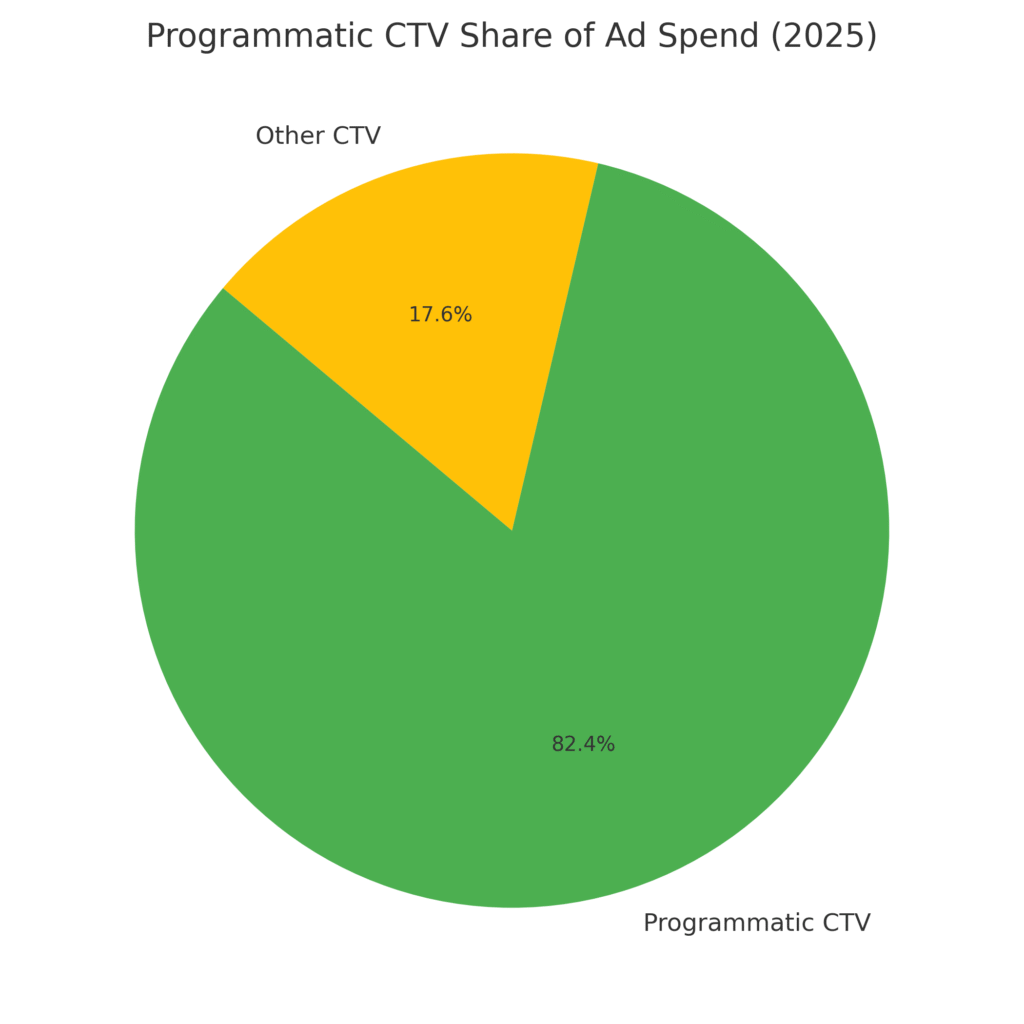
| 12 | Programmatic Dominance | Programmatic CTV spend will reach $27 billion in 2025, accounting for 84%+ of the market. |
| 13 | Marketer Intent | 56% of marketers plan to increase OTT/CTV ad spend in 2025. |
| 14 | Ad-Supported Platforms | In the U.S., 72.4% of viewing time is on ad-supported platforms, with streaming taking 42.4%. |
| 15 | Budget Shift | Over 40% of marketers have shifted budgets from linear TV to CTV. |
| 16 | Forecasted Growth 2025 | IAB forecasts CTV ad budgets will grow by 11.4% in 2025 in the U.S. |
| 17 | Ad Completion Rates | Non-skippable ads on smart TVs have a 95%+ completion rate. |
| 18 | FAST Channel Preference | 69% of CTV viewers prefer FAST (Free Ad-Supported Streaming TV) channels. |
| 19 | Interactive Ads Performance | Interactive CTV ads drive a 52% lift in viewer attention. |
| 20 | Top Advertisers Growth | 68% of top 100 advertisers increased their CTV impressions in the first half of 2025. |
Top 20 Smart TV Marketing Statistics 2025
Smart TV Marketing Statistics #1 – Global Smart TV Market Value 2024
The global smart TV market was valued at $227.52 billion in 2024, highlighting the rapid adoption of connected devices worldwide. This massive valuation reflects the consumer shift from traditional television to internet-enabled smart platforms. With projections reaching $451.26 billion by 2030, the market shows no signs of slowing down. The growth is being fueled by increasing internet penetration, rising disposable incomes, and consumer preference for on-demand content. Marketers should view this expansion as an opportunity to invest in smart TV campaigns early.
Smart TV Marketing Statistics #2 – Connected TV Market Growth
In 2024, the connected TV (CTV) market stood at $267.67 billion, a number that showcases the platform’s explosive potential. By 2030, the CTV market is expected to nearly double to $530.90 billion, with a CAGR of 12.8%. This strong growth indicates how consumers continue to shift their viewing habits toward digital screens. With such momentum, advertisers can confidently allocate more resources to CTV ad campaigns. Brands that fail to adopt connected TV marketing risk missing out on a rapidly expanding audience.
Smart TV Marketing Statistics #3 – Household Penetration
Smart TV penetration has now surpassed 54% of households globally. This equates to more than 1.1 billion homes worldwide using smart TVs. With more than half of households connected, smart TV adoption has become a mainstream phenomenon. For marketers, this presents an unprecedented opportunity to target large and diverse audiences. The sheer reach of this technology makes it essential for brands to include smart TVs in their digital marketing mix.
Smart TV Marketing Statistics #4 – US Smart TV Ownership
In the United States, 79% of homes now own a smart TV, compared to only 66% in 2020. This rapid growth demonstrates how quickly American households are embracing digital viewing options. Smart TVs are becoming a centerpiece of home entertainment, replacing traditional cable boxes. The jump in ownership also means advertisers can tap into nearly four out of five households nationwide. This level of saturation gives brands a powerful platform to deliver highly targeted campaigns.
Smart TV Marketing Statistics #5 – CTV Device Usage
Smart TVs remain the number one connected TV device in the U.S., with 67.5 million households using them. This dominance shows how consumers prefer the simplicity of built-in apps and streaming capabilities. While devices like Roku and Fire TV are popular, smart TVs continue to lead due to convenience. For marketers, focusing on smart TV audiences ensures maximum exposure to the largest CTV segment. As the preferred device, smart TVs will drive the majority of CTV advertising opportunities.

Smart TV Marketing Statistics #6 – Global CTV Ad Spend
Global CTV ad spending is projected to hit $48 billion in 2025, compared to $36 billion in 2023. This 33% growth in just two years highlights how brands are rapidly shifting budgets. The increase reflects advertisers’ confidence in CTV’s effectiveness at driving measurable results. With more households streaming, CTV has become one of the most attractive digital ad channels. This growth trajectory positions smart TV advertising as a critical part of modern marketing strategies.
Smart TV Marketing Statistics #7 – U.S. CTV Ad Spending 2025
In the U.S., CTV ad spending is expected to reach $28.75 billion in 2025. This represents nearly a 19% year-over-year growth rate. Such robust spending indicates how brands continue to migrate from linear TV to digital platforms. Advertisers are seeing higher ROI through more precise targeting options in CTV. With these results, more companies are increasing their share of budget toward smart TV advertising.
Smart TV Marketing Statistics #8 – U.S. CTV Ad Spend Surpassing
By 2025, U.S. CTV ad spend will surpass $33.48 billion. This milestone makes CTV one of the fastest-growing advertising channels in the U.S. The steady increase demonstrates confidence in smart TVs as a core marketing platform. As budgets continue to shift, CTV is rapidly catching up to traditional television in scale. This change reflects how viewers’ attention has permanently moved to digital-first viewing.
Smart TV Marketing Statistics #9 – CTV Display Ad Spending
CTV display ad spending is forecasted to hit $33.35 billion in 2025. An incredible 98.4% of this spending will be allocated to video content. This overwhelming share shows how central video remains in digital marketing strategies. Advertisers know that video ads on smart TVs have higher engagement and completion rates. As a result, CTV is becoming a cornerstone for brands seeking impactful, video-driven campaigns.
Smart TV Marketing Statistics #10 – CTV Ad Spend 2028
By 2028, CTV ad spend will reach $46.89 billion, overtaking traditional TV in many forecasts. This shift illustrates how quickly the market is evolving. Traditional TV, once the gold standard for advertising, is losing ground to digital-first platforms. Brands are reallocating budgets toward CTV due to its superior targeting and analytics. For marketers, this transition underscores the need to prioritize smart TV campaigns in long-term planning.

Smart TV Marketing Statistics #11 – CTV Ad Spend 2024
In 2024, U.S. CTV ad spend reached $22.7 billion. This represented a growth rate of about 12% in that single year. The sharp increase shows how rapidly the medium is being adopted by advertisers. With consumer attention firmly on streaming, these budgets are only expected to rise further. This strong year-over-year growth sets the foundation for even larger investments in 2025.
Smart TV Marketing Statistics #12 – Programmatic Dominance
Programmatic CTV ad spending is projected to hit $27 billion in 2025. This will account for more than 84% of total CTV ad spend. Programmatic advertising provides scale and efficiency, making it the preferred method for most advertisers. Automation allows for real-time targeting and adjustments to campaigns. For brands, embracing programmatic CTV is key to maximizing reach and cost-effectiveness.
Smart TV Marketing Statistics #13 – Marketer Intent
A global survey shows that 56% of marketers plan to increase their OTT/CTV spending in 2025. This marks a rise from 53% in 2024, showing steady growth in confidence. The willingness to increase spending reflects the strong performance of CTV campaigns. Marketers recognize that consumer behavior is favoring smart TVs over traditional channels. This intent signals further momentum in the shift to connected platforms.
Smart TV Marketing Statistics #14 – Ad-Supported Platforms
In the U.S., 72.4% of TV viewing time is spent on ad-supported platforms. Streaming accounts for 42.4% of that time, proving how important it is to audiences. Consumers are embracing free, ad-supported models instead of paying for subscriptions. This trend is great news for marketers, as it expands inventory for ad placements. Advertisers can reach wide audiences without the paywall barriers that subscription models impose.
Smart TV Marketing Statistics #15 – Budget Shift
More than four in ten marketers have shifted budgets from linear TV to CTV. This reallocation reflects the increasing trust in digital platforms. Advertisers are prioritizing CTV due to its stronger targeting and measurement capabilities. As linear TV audiences decline, marketers are following the viewers. This budget shift underscores the growing dominance of smart TVs in ad strategies.

Smart TV Marketing Statistics #16 – Forecasted Growth 2025
The IAB predicts U.S. CTV ad budgets will grow by 11.4% in 2025. This steady double-digit growth shows how strongly advertisers are backing CTV. Even during economic uncertainty, brands are investing in platforms that promise measurable ROI. Smart TVs are central to this growth, thanks to their household reach. For marketers, this forecast highlights the resilience of digital-first advertising.
Smart TV Marketing Statistics #17 – Ad Completion Rates
Non-skippable ads on smart TVs boast completion rates of over 95%. This figure is significantly higher than mobile or desktop averages. The lean-back environment of TV encourages viewers to finish ads without distractions. Advertisers benefit from having their full message delivered almost every time. This makes smart TVs an exceptionally effective channel for building brand awareness.
Smart TV Marketing Statistics #18 – FAST Channel Preference
A recent study found that 69% of CTV viewers prefer FAST channels over subscription-only options. FAST channels provide free content supported by ads, which appeals to cost-conscious audiences. This shift shows how ad-supported models are becoming mainstream. For advertisers, this means more opportunities to connect with viewers who avoid subscription fatigue. Smart TV marketers should prioritize FAST channels in their campaigns.
Smart TV Marketing Statistics #19 – Interactive Ads Performance
Interactive ad formats on smart TVs have been shown to drive a 52% increase in viewer attention. This highlights the power of engagement-focused campaigns. Features like clickable overlays and interactive storytelling make ads more memorable. Viewers are no longer passive participants—they can now interact directly with brands. For marketers, this interactivity creates stronger connections and higher engagement rates.
Smart TV Marketing Statistics #20 – Top Advertisers Growth
In the first half of 2025, 68% of the top 100 advertisers increased their CTV impressions. This indicates that major brands are doubling down on smart TV advertising. The growth shows a clear vote of confidence in the platform. As big players lead the way, smaller brands are likely to follow. This collective momentum further validates smart TVs as a primary advertising channel.
Final Thoughts on Smart TV Marketing Statistics
Looking back at these smart TV marketing statistics, I can honestly say it feels like we’re only scratching the surface of what’s possible in this field. For me, the most exciting part is how these platforms allow brands to merge creativity with precision, giving audiences content that feels both entertaining and relevant. As smart TV adoption continues to grow worldwide, I see a massive opportunity for businesses that are willing to embrace change and experiment with new ad formats. Personally, I’m inspired by how marketers are no longer confined to traditional boundaries and are instead reimagining what it means to connect with viewers. If you’re planning your next campaign, these insights can serve as a powerful guide to making smarter, data-backed decisions in the ever-evolving digital landscape.
SOURCES
- https://www.aidigital.com/blog/connected-tv-stats
- https://mountain.com/blog/connected-tv-statistics/
- https://www.stackadapt.com/resources/blog/connected-tv-stats
- https://www.socalnewsgroup.com/2025/05/06/connected-tv-marketing-stats-2025/
- https://www.awarity.com/blog/what-to-expect-from-connected-tv-advertising-in-2025
- https://www.simulmedia.com/blog/the-top-trends-that-help-brands-succeed-on-tv-in-2025
- https://mountain.com/blog/tv-advertising-statistics/
- https://www.marketingarchitects.com/blog/answering-your-biggest-questions-about-ctv-in-2025
- https://www.samsung.com/us/business/samsungads/blog/tv-lower-funnel/
- https://www.aidigital.com/blog/connected-tv-advertising
- https://www.indexexchange.com/en-au/2025/05/15/2025-newfronts-future-streaming-tv-advertising/
- https://www.viantinc.com/insights/blog/ctv-adveritsing-in-2025
- https://www.marketingarchitects.com/blog/tvs-future-is-much-more-than-connected
- https://www.strategus.com/blog/is-tv-advertising-still-effective
- https://www.comscore.com/fre/Perspectives/Blog/Smart-TVs-Streaming-s-Ultimate-Catalyst
- https://www.tvtechnology.com/news/nielsen-most-tv-viewing-is-on-ad-supported-services