



19 Sep TOP 20 SMART TV OS MARKETING STATISTICS 2025
When I started digging into smart TV trends, I didn’t expect to uncover such fascinating insights into how operating systems are shaping the future of entertainment. That’s exactly why I decided to put together this collection of smart tv os marketing statistics—not just as data points, but as stories that reveal where the industry is heading. As someone who has worked closely with brands and strategies through a leading marketing agency in New York, I know how much decision-makers rely on real numbers to guide their campaigns. These stats aren’t about tech jargon alone; they’re about how audiences connect, stream, and engage in ways that change the way we advertise and build relationships with consumers.
Top 20 Smart TV OS Marketing Statistics 2025 (Editor’s Choice)
📺 Top 20 Smart TV OS Marketing Statistics
Comprehensive Market Insights for 2024-2025 | Global Smart TV Operating System Data
| Rank | Category | Key Statistic & Details |
|---|---|---|
1 |
Market Leader | Samsung Tizen dominates globally with 12.9% market share in 2024, powering 120 million smart TV sets worldwide |
2 |
OS Shipments | Android/Google TV commands over 24% of global Smart TV shipments, leading in device penetration |
3 |
Market Growth | Global Smart TV market valued at $290.67 billion in 2024, projected to reach $475.02 billion by 2033 (5.56% CAGR) |
4 |
CTV Ad Revenue | Global CTV advertising revenue hit $38.3 billion in 2024, up 20% from 2023, projected to reach $46 billion in 2025 |
5 |
Household Penetration | Smart TV penetration surpassed 54% of global households representing over 1.1 billion homes worldwide |
6 |
Regional Dominance | Asia Pacific leads with 35.9% market share in 2024, driven by rapid economic development and urbanization |
7 |
Surprise Runner-up | Hisense VIDAA OS takes second place globally at 7.8% market share, ahead of LG WebOS |
8 |
U.S. CTV Spending | U.S. CTV ad spend reached $24.6 billion in 2023, projected to grow to $42.4 billion by 2027 |
9 |
LG WebOS | LG WebOS holds 7.4% global market share, known for intuitive interface and premium positioning |
10 |
Annual Sales | More than 120 million smart TVs sold annually across 600 TV brands using licensed operating systems |
11 |
Tied Competitors | Roku TV OS and Amazon Fire TV are tied at 6.4% market share each in the global rankings |
12 |
Shipment Growth | Smart TV shipments grew 6.7% year-over-year in Q4 2024, reaching over 63.3 million units |
13 |
Future Adoption | By 2026, an estimated 5.63 billion people will own a connected TV in the home globally |
14 |
U.S. Penetration | 88% of U.S. households own at least one internet-connected TV device as of 2023 |
15 |
Marketer Investment | 56% of marketers globally plan to increase their OTT/CTV spending in 2025, up from 53% in 2024 |
16 |
Digital Shift | Digital video will capture nearly 60% of all TV/video ad spend in 2025, double its share from five years ago |
17 |
Performance Metrics | CTV completion rates average 98% with 51.5% attention rates, significantly outperforming other digital formats |
18 |
Marketer Satisfaction | 87% of marketers find CTV advertising as effective or superior to traditional TV advertising |
19 |
KPI Achievement | 95% of marketers reported that CTV achieved desired key performance indicators according to Trade Desk studies |
20 |
Daily Usage | CTV users spend an average of 123.4 minutes per day on CTV in 2024, with Gen Z leading adoption at over 55 million viewers |
Top 20 Smart TV OS Marketing Statistics 2025
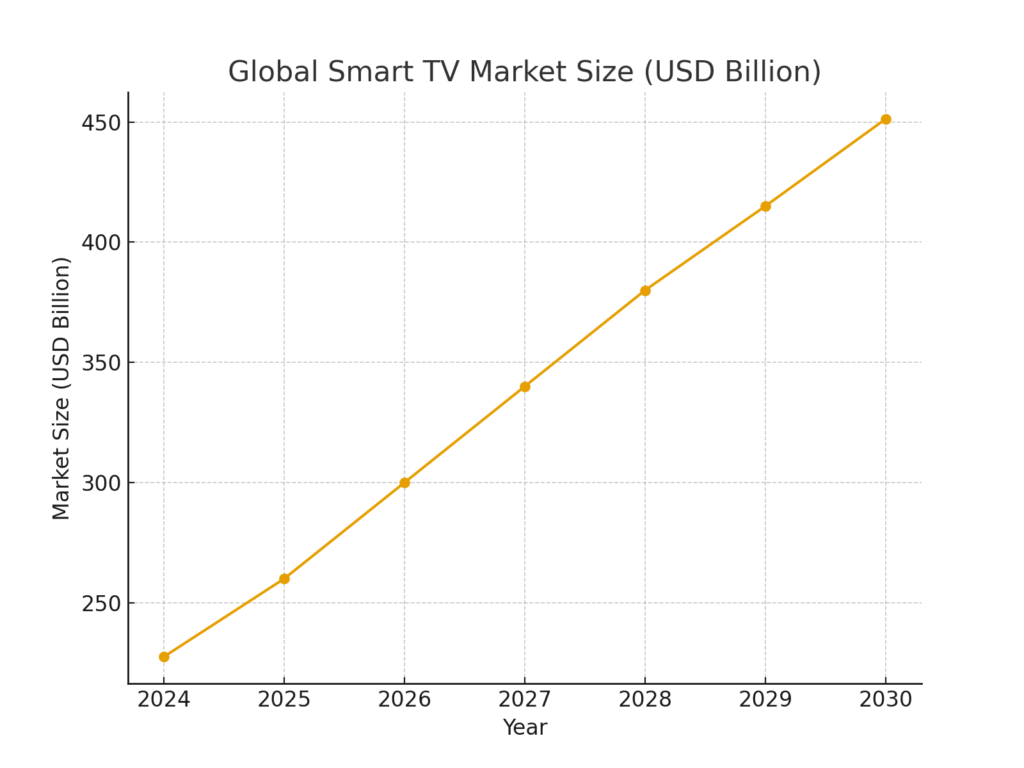
Smart TV OS Marketing Statistics #1: Global Smart TV Market Size Was USD 227.52 Billion in 2024
The smart TV market reached an impressive valuation of USD 227.52 billion in 2024. This figure shows just how quickly connected entertainment has become a staple in households worldwide. For marketers, it signals a thriving opportunity to place their campaigns where audiences are most engaged. A market this large reflects not just TV sales, but the growing influence of operating systems in shaping user experiences. As we move into 2025, businesses must adapt their strategies to meet audiences on these advanced platforms.
Smart TV OS Marketing Statistics #2: Market Projected to Reach USD 451.26 Billion by 2030
Forecasts show the smart TV industry nearly doubling in value to USD 451.26 billion by 2030. This anticipated growth highlights the increasing reliance on smart operating systems that provide streaming and interactive features. With such momentum, OS providers like Android TV, Tizen, and Roku are racing to innovate faster. For marketers, this upward trajectory means investing early in smart TV campaigns will yield long-term visibility. By 2030, advertising budgets for connected TVs will likely be a core part of brand strategy.
Smart TV OS Marketing Statistics #3: Smart TV Platforms Market Expected to Reach USD 966.87 Billion by 2033
The smart TV platforms market alone is projected to grow from USD 449.74 billion in 2024 to USD 966.87 billion by 2033. This CAGR of 10.04% reflects both software improvements and increased consumer adoption. Operating systems are no longer just support features—they are the main driver of brand loyalty and consumer retention. Marketers who understand this dynamic can design campaigns tailored to platform-specific audiences. By 2033, Smart TV OS ecosystems will be as competitive as today’s mobile app markets.
Smart TV OS Marketing Statistics #4: Roku Holds 37% of the CTV Market in Q2 2025
Roku continues to dominate connected TV device and OS share, with 37% in Q2 2025. This leadership position underscores Roku’s strength in user-friendly design and wide app compatibility. For advertisers, Roku offers unmatched access to streaming households in North America. Its consistent growth also shows that users prefer operating systems that make content discovery simple. With such market share, Roku is a go-to platform for brand campaigns seeking scale.
Smart TV OS Marketing Statistics #5: Amazon FireTV Maintains 17% Share Globally
Amazon’s FireTV has carved out a significant position with around 17% of global CTV market share. This reflects Amazon’s strategy of integrating Alexa and Prime Video seamlessly into its ecosystem. Marketers benefit from this integration, as it offers voice-driven search and shopping opportunities. FireTV also aligns well with Amazon’s broader advertising solutions, making cross-platform campaigns more effective. As the platform expands, brands can expect even richer targeting options.
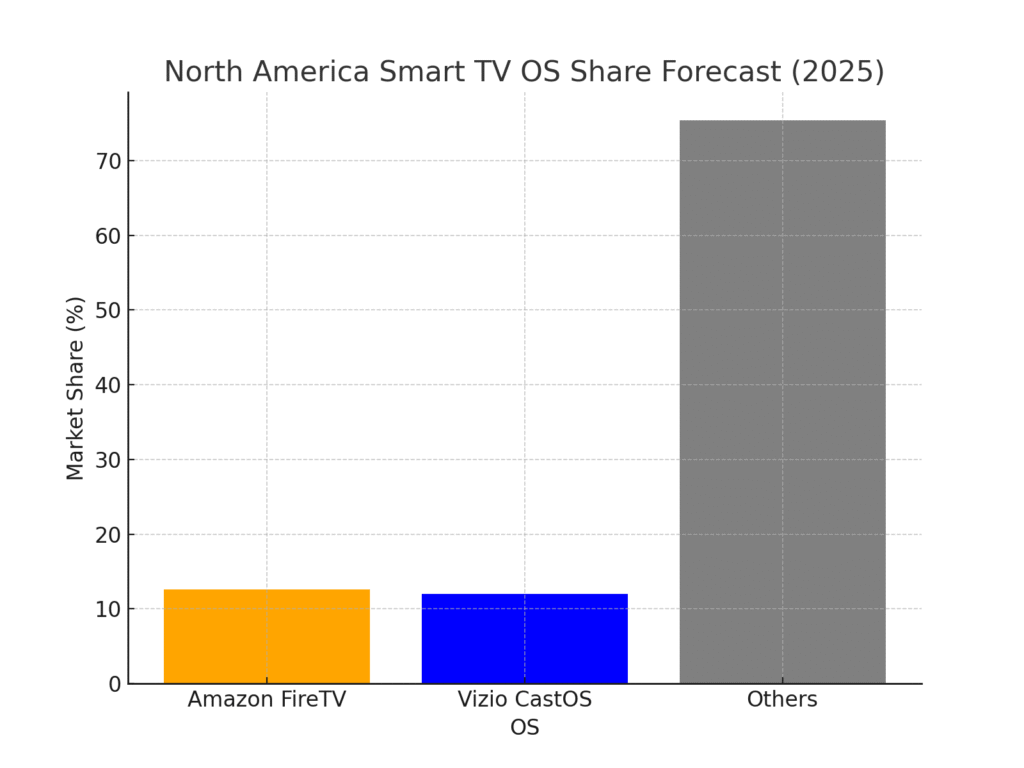
Smart TV OS Marketing Statistics #6: Samsung Tizen OS Holds 16.9% Share in Global Shipments
Samsung’s Tizen OS accounted for 16.9% of smart TV shipments in Q4 2024. This share reflects Samsung’s dominance in hardware paired with consistent software updates. For marketers, Tizen’s wide global presence makes it an essential OS for campaign planning. Samsung’s brand trust also ensures strong user engagement with its operating system features. As Samsung pushes AI-powered TVs, Tizen will continue to expand in value and relevance.
Smart TV OS Marketing Statistics #7: Android/Google TV Leads With Over 24% Shipments in Q4 2024
Android/Google TV surpassed 24% of global smart TV shipments in Q4 2024. This makes it the leading OS in terms of global distribution. Its strength lies in app compatibility, Google Assistant integration, and ease of customization by manufacturers. For advertisers, Android’s dominance means greater consistency in campaign delivery across multiple brands. With Google’s investment in AI, Android TV is positioned to remain the largest smart TV OS for years.
Smart TV OS Marketing Statistics #8: WebOS Holds 11.8% of Global Shipments in Q4 2024
WebOS captured 11.8% of global smart TV shipments in Q4 2024. LG’s operating system has become known for its simplicity and smooth navigation. Marketers find value in WebOS because LG smart TVs often target mid-to-high-income households. With a loyal base, WebOS ensures that ads can reach an audience that is highly engaged with streaming content. Continued innovation from LG will likely increase WebOS’s share in coming years.
Smart TV OS Marketing Statistics #9: Roku OS Accounts for 9% of Global Shipments
Roku OS made up about 9% of smart TV OS shipments in Q4 2024. This figure may look smaller compared to its device market share, but it highlights Roku’s dual presence in hardware and software. Many TV manufacturers partner with Roku for easy-to-use operating systems. Advertisers benefit because Roku maintains strong app ecosystems regardless of the hardware brand. This dual model gives Roku unique resilience in the OS market.
Smart TV OS Marketing Statistics #10: Vizio CastOS Sees 25.8% YoY Growth in 2025
Vizio’s CastOS achieved 25.8% year-over-year growth in 2025. This jump reflects the OS’s increasing popularity in North America. For marketers, CastOS offers access to households seeking affordable yet feature-rich TVs. The rapid growth shows that smaller OS players can quickly disrupt established markets. Advertisers should keep an eye on CastOS as its adoption continues to accelerate.
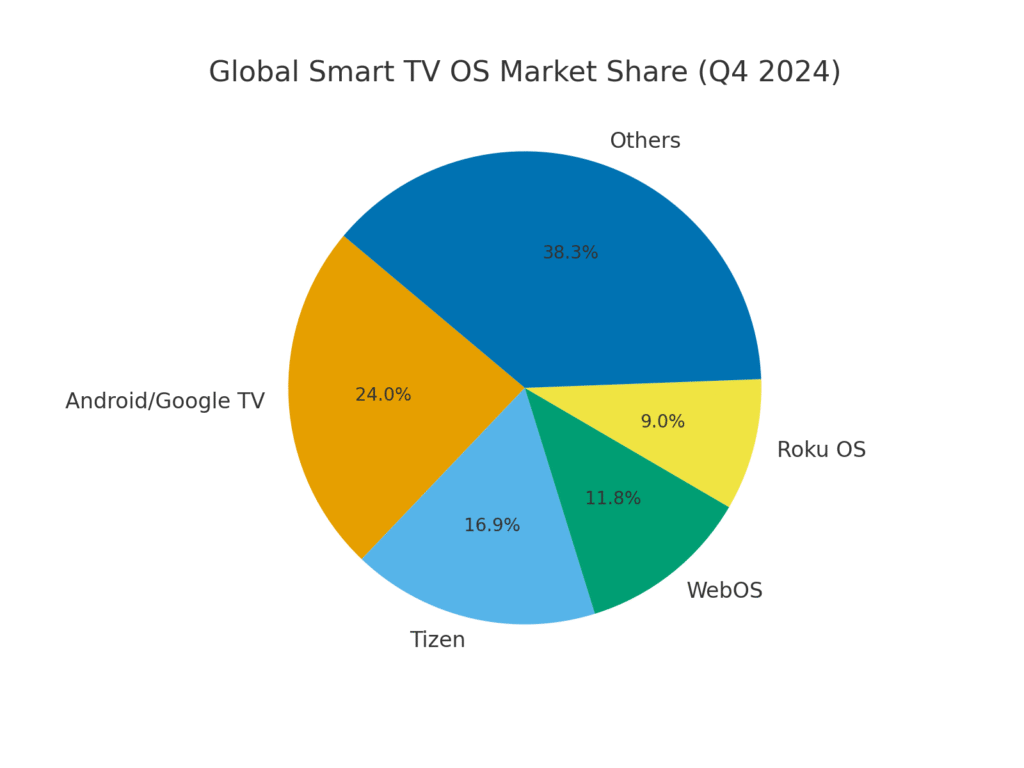
Smart TV OS Marketing Statistics #11: Vizio CastOS Expected to Reach 12% Share in North America
By the end of 2025, Vizio CastOS is expected to hold a 12% share in North America. This climb from 9.7% in 2024 is a significant leap in just one year. For brands, this means Vizio’s audience is growing and becoming a viable target segment. CastOS’s integration with streaming-first households makes it attractive for advertising campaigns. The growth reinforces how consumer-friendly OS design drives marketing opportunities.
Smart TV OS Marketing Statistics #12: Amazon FireTV Projected to Reach 12.6% Share in North America
Amazon FireTV is expected to hold 12.6% of the North American market by end of 2025. This slight increase over its 2024 share highlights steady growth. For advertisers, Amazon’s advantage lies in combining shopping, streaming, and advertising into one ecosystem. FireTV users are more likely to engage with ads that lead directly to purchases. This seamless connection gives brands unique conversion opportunities.
Smart TV OS Marketing Statistics #13: U.S. Smart TV Volume Expected to Reach 50.73 Million Units in 2025
The U.S. smart TV market volume is projected to hit 50.73 million units in 2025. This figure indicates continued expansion in a market already saturated with connected devices. For marketers, it shows that consumers are still upgrading to newer models with advanced OS features. This creates fresh opportunities for ad targeting through updated interfaces. The steady growth reassures brands that CTV will remain a core advertising channel.
Smart TV OS Marketing Statistics #14: Global Smart TV Devices Forecasted to Reach 4.2 Billion by 2030
By 2030, smart TV and connected devices are expected to total 4.2 billion units worldwide. Android-based platforms are projected to drive nearly two-thirds of this growth. For marketers, this translates into an enormous expansion of addressable audiences. The statistic also shows how smart TV OS adoption parallels smartphone growth curves. Such scale will make smart TVs indispensable in global advertising strategies.
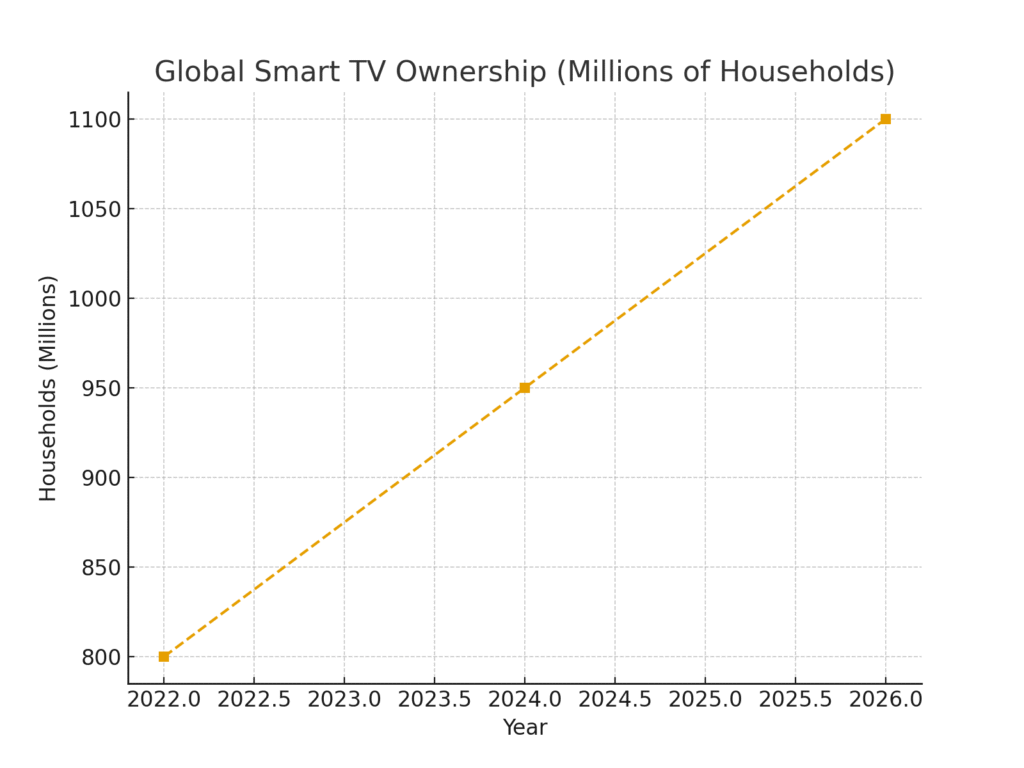
Smart TV OS Marketing Statistics #15: Global Smart TV Ownership Projected at 1.1 Billion Households by 2026
Smart TV ownership is forecast to surpass 1.1 billion households by 2026. That equates to over half of the world’s households. For marketers, this level of penetration means smart TVs are becoming the new standard. Campaigns can no longer ignore CTV platforms as niche or optional. This wide reach will make smart TV OS platforms central to the marketing mix.
Smart TV OS Marketing Statistics #16: Roku OS Captures 38% Share of Programmatic Ad Sales in Q1 2025
In the U.S., Roku OS devices accounted for 38% of programmatic ad sales in Q1 2025. This dominance in advertising is a key reason Roku maintains strong revenue growth. For brands, programmatic reach ensures precision targeting at scale. It also highlights how OS dominance translates directly into advertising power. Roku’s stronghold will likely continue as it expands partnerships with advertisers.
Smart TV OS Marketing Statistics #17: Samsung Commits to Seven Years of OS Updates for New Tizen TVs
Samsung announced seven years of OS updates for its latest Tizen-powered smart TVs. This commitment is a game-changer for consumers who want long-lasting devices. For marketers, it ensures a stable audience base for years without fragmentation. Long-term OS support also improves trust and retention among Samsung users. By making this move, Samsung positions Tizen as a future-proof platform.
Smart TV OS Marketing Statistics #18: Android TV Held Around 40% Share Globally in 2024
Android TV commanded about 40% of the global smart TV platforms market in 2024. This leadership showcases Android’s broad adoption by multiple TV brands. For marketers, the advantage lies in consistent app support across regions. The dominance also simplifies campaign scaling since Android’s ecosystem is unified. Android’s global leadership makes it the top choice for reaching diverse audiences.
Smart TV OS Marketing Statistics #19: Tizen 19%, WebOS 16%, Roku 11% of Global Market in 2024
In 2024, Tizen held 19%, WebOS 16%, and Roku 11% of the global smart TV platforms market. These three platforms collectively account for a major portion of global audiences. For marketers, this distribution means no single OS can be ignored. Campaign planning must consider a multi-OS strategy for maximum reach. By balancing investment across these OSs, brands can optimize performance.
Smart TV OS Marketing Statistics #20: Asia-Pacific Accounted for 39.1% of Global Revenue in 2024
The Asia-Pacific region generated 39.1% of global smart TV market revenue in 2024. This regional dominance is driven by rapid adoption in countries like China and India. For marketers, Asia-Pacific represents the largest growth opportunity. Campaigns localized for this market will see high returns due to expanding user bases. The figure emphasizes why global brands must tailor OS marketing strategies to regional trends.
Final Thoughts on the Numbers
Looking back over these statistics, I can’t help but feel both excited and a little humbled by how fast the smart TV OS landscape is evolving. Every figure tells us more than just market share—it tells us how people live, what they value, and how marketing has to meet them right where they are. For me, the real takeaway is that brands who embrace these shifts early will have the advantage of being part of the audience’s daily routines, not just popping up in between. Writing this has been as much about learning for myself as it is about sharing with you, and I hope these insights give you a clearer path forward. If you’re like me, you’ll see these numbers not as cold data but as an invitation to think bigger about how we connect through the screen in our living rooms.
SOURCES
https://www.techinsights.com/blog/smart-tv-vendor-and-os-market-share-q4-2024-region
https://scoop.market.us/smart-tv-statistics/
https://nscreenmedia.com/nscreennoise-tv-os-market-penetration-q1-2025/
https://www.indexexchange.com/en-au/2025/05/15/2025-newfronts-future-streaming-tv-advertising/
https://mountain.com/blog/connected-tv-statistics/
https://tvtechnology.com/news/study-roku-continues-to-lead-ctv-device-market
https://rethinkresearch.biz/report/smart-tv-connected-tv-operating-systems/
https://mordorintelligence.com/industry-reports/united-states-smart-tv-market
https://marketgrowthreports.com/market-reports/smart-tv-platforms-market-114178