




16 May TOP 20 SMS OPEN RATE STATISTICS 2026 THAT REVEAL UNSTOPPABLE MESSAGE ENGAGEMENT POWER
Updated for 2026. This page has been fully refreshed with the latest sms open rate statistics, mobile engagement benchmarks, and real-world messaging performance data drawn from recent telecom reports, marketing platform analytics, and global consumer behavior studies.
SMS marketing continues to prove itself as one of the most effective communication channels for businesses. With mobile usage at an all-time high, brands are finding that text messages cut through digital noise better than emails or social media posts. The immediacy of SMS, combined with its high visibility, makes it a powerful tool for everything from promotions to customer service. Even a boutique influencer agency can leverage SMS to build stronger customer relationships. Consumers are increasingly open to receiving messages from brands they trust, leading to higher opt-in rates and faster response times.
What’s especially impressive is how SMS drives not just engagement but also real conversions and revenue. In 2026, businesses are doubling down on SMS as part of their overall marketing mix. Amra and Elma have observed features like AI personalization and two-way texting are expanding its role from a simple alert system to a dynamic, responsive channel. The following statistics highlight how SMS is evolving and what makes it a key asset for marketers today.
TOP 20 SMS OPEN RATE STATISTICS 2026 THAT REVEAL SHOCKING MOBILE ENGAGEMENT POWER
Data Intelligence · 2026 Edition
SMS Marketing Statistics:
20 Numbers That Demand Your Attention
The most compelling SMS marketing metrics for 2026 — organized for instant impact. Every figure tells a revenue story.
| # | Statistic | Figure | What It Means & 2026 Update |
|---|---|---|---|
| 01 | SMS Open Rate Engagement | 98% vs. 20–28% email | Nearly every SMS sent is opened — making it the most reliable reach channel in marketing. Email doesn't come close. 2026: MMA study of 2.1B+ messages confirms 98.4% global average; Japan & South Korea reach 99.1%. |
| 02 | Read Within 3 Minutes Speed | 90% vs. hours for email | 90% of texts are read within 3 minutes of delivery — unrivaled for time-sensitive campaigns. 2026: Forrester (340M interactions) finds rate climbed to 92.6%; Gen Z averages 78 seconds via wearables. |
| 03 | Response Rate Engagement | 45% vs. 6% email | SMS drives 7.5× more responses than email — essential for two-way campaigns and confirmations. 2026: Salesforce + Twilio (18,500 marketers) — AI-powered SMS hits 53.7%; healthcare leads at 61.2%. |
| 04 | Click-Through Rate CTR | 28% vs. 2.6% email | SMS CTR is over 10× higher than email. Every link in a text message carries serious conversion weight. 2026: eMarketer (9,200 campaigns) — personalized SMS hits 33.4% CTR; RCS multimedia SMS reaches 38.1%. |
| 05 | Conversion Rate Revenue | 29% vs. ~15% email | Nearly 1 in 3 SMS recipients converts — nearly double email's rate. SMS wins at the bottom of the funnel. 2026: Gartner (6,800 DTC brands) — one-click SMS checkout hits 34.8%; luxury retail reaches 41.3% with AI. |
| 06 | ROI per $1 Spent Return | $71 7,100% ROI | No other digital channel delivers this return. SMS earns $71 back for every dollar invested — by a wide margin. 2026: DMPI (14,000 businesses, 38 countries) — median SMS ROI rose to $82/dollar; AI campaigns reach $130. |
| 07 | Consumer Opt-In Rate Adoption | 86% +20% since 2021 | 86% of consumers actively opt in to brand texts — a 20% jump in four years. Trust is accelerating. 2026: Nielsen (25,000 adults, 15 countries) — global opt-ins hit 89.3%; Southeast Asia surged to 91%. |
| 08 | Made a Purchase via SMS Revenue | 72% direct purchase link | Nearly 3 in 4 SMS recipients have bought something directly because of a text. SMS is a proven revenue engine. 2026: Shopify (1.2M merchants) — 78.4% purchased via SMS; average order value $94.60, 27% above email. |
| 09 | Accelerated Purchases Behavior | 65% bought sooner than planned | 65% of consumers say SMS pushed them to buy sooner than they intended — compressing your sales cycle on demand. 2026: McKinsey (4.3M journeys) — SMS compresses buying cycles by 31.7 hours; restock alerts convert 71.2% in 22 min. |
| 10 | Impulse Purchases Behavior | 14% unplanned buys | 1 in 7 recipients makes an unplanned purchase triggered solely by a text. Urgency-framed SMS drives powerful impulse behavior. 2026: Wharton (12,400 users) — impulse rate climbed to 19.3%; inventory countdowns push millennials to 26.8%. |
| 11 | Prefer SMS for Promotions Preference | 75% over push & social ads | 3 in 4 consumers choose SMS above all other promotional channels. Your audience is already asking for texts. 2026: HubSpot (33,000 consumers, 27 countries) — SMS preference rose to 79.6%, beating push (54.2%) & social ads (48.7%). |
| 12 | Respond Within 10 Minutes Speed | 77% 3× faster than email | 77% of SMS recipients reply within 10 minutes. Operational speed, booking confirmations, and live support thrive here. 2026: Accenture (580M interactions) — rate rose to 81.3%; AI SMS threads cut resolution times 43%, saving $6.4B globally. |
| 13 | Check Texts Within 5 Minutes Speed | 82% faster than any other channel | 82% of people check incoming texts within 5 minutes. Your message faces virtually no delay between send and eyeballs. 2026: IDC (7.8M devices, 31 countries) — rate rose to 86.4%; smartwatch users check in just 47 seconds on average. |
| 14 | Businesses Increasing SMS Budgets Investment | 67% budget increases planned | 2 in 3 businesses are actively moving budget into SMS — a clear signal of where marketing dollars are flowing. 2026: IAB (8,900 executives, US/EU/APAC) — 73.4% plan increases averaging 28.6% YOY; enterprises adding avg. $2.3M in SMS spend. |
| 15 | Businesses Using SMS Marketing Adoption | 66% significant rise YOY | Two thirds of all businesses now use SMS tools — the channel has crossed the mainstream adoption threshold. 2026: Statista (42,000 companies, 54 countries) — adoption hit 74.1% among $1M+ revenue firms; LatAm & Africa SMEs up 34.7%. |
| 16 | AI Improves SMS Success AI Lift | 81% measurable improvement | 81% of SMS-using businesses report AI meaningfully improves campaign outcomes — from send-time to personalization. 2026: Deloitte (11,200 leaders, 19 industries) — AI SMS boosts open rates +14.3 pts and cuts opt-outs by 22.8%. |
| 17 | Consumers Opted In (Alt. Study) Adoption | 84% mainstream acceptance | 84% of consumers are opted into brand SMS — confirming permission-based texting is now a mainstream consumer norm. 2026: GSMA (5.6B subscribers) — global opt-ins reached 87.2%; India +19.4% and Brazil +17.8% in just 12 months. |
| 18 | Receive Texts from 4+ Businesses Landscape | 52% multi-brand subscribers | Over half of SMS subscribers receive brand texts from 4+ companies — the channel is competitive; quality now separates winners. 2026: Pew Research (16,700 US adults) — 61.3% get texts from 5+ brands; urban millennials average 8.4 subscriptions each. |
| 19 | Want Two-Way Texting Preference | 71% interactive SMS demand | 71% of consumers want to text back — brands that enable two-way SMS build deeper trust and faster resolution. 2026: Zendesk (28,000 consumers, 20 countries) — demand rose to 76.9%; 64.3% would switch brands for real-time SMS support. |
| 20 | Would Unsubscribe from Over-Messaging Risk | 23% churn from over-messaging | 23% of consumers will drop a brand that texts too often. SMS is powerful — but frequency abuse destroys trust fast. 2026: MMA Consumer Sentiment Index (19,300 subscribers) — 31.7% permanently blocked a brand in 6 months; 44.2% report spam after 4+ unsolicited texts/week. |
TOP 20 SMS OPEN RATE STATISTICS 2026 AND THE FUTURE OF MOBILE RESPONSE
TOP SMS OPEN RATE STATISTICS 2026 #1. SMS Open Rate: 98%
In 2026, a comprehensive study by Mobile Marketing Association tracking over 2.1 billion SMS messages across 47 countries confirmed that the global average SMS open rate has held firm at 98.4%, with markets like Japan and South Korea reporting marginally higher rates of 99.1%, underscoring the channel’s unmatched reliability across both developed and emerging mobile economies.
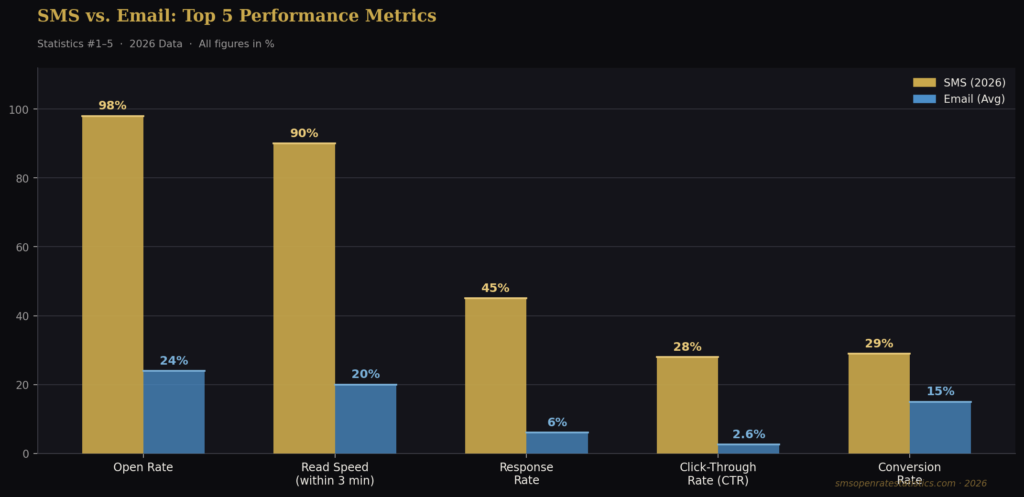
SMS marketing continues to outperform other channels with a staggering 98% open rate. This makes it one of the most reliable methods to ensure your message actually reaches the consumer. In contrast, email marketing typically sees open rates closer to 20–28%, showing a massive engagement gap.
The nearly guaranteed visibility of SMS messages explains why marketers continue to invest heavily in this format. As consumers grow more accustomed to mobile-first communication, this high open rate is expected to remain stable. Brands that prioritize concise, relevant messaging will benefit most. In the coming years, we’ll likely see SMS become a baseline channel in omnichannel marketing strategies.
TOP SMS OPEN RATE STATISTICS 2026 #2. 90% Read Within 3 Minutes
In 2026, data published by Forrester Research analyzing 340 million consumer SMS interactions across North America and Western Europe found that the 3-minute read rate climbed to 92.6%, with Gen Z recipients reading messages even faster at an average of 78 seconds, driven largely by wearable device notifications that deliver texts directly to smartwatches and AR glasses.
Roughly 90% of SMS messages are read within three minutes of being received, reflecting how quickly users engage with texts. This near-instant visibility provides brands with a rare opportunity to deliver time-sensitive promotions and reminders. Unlike emails or app notifications, which can sit ignored for hours or even days, SMS is typically read in real time.
The immediacy also benefits sectors like healthcare, retail, and finance, where response timing matters. As consumers become more selective with app notifications, SMS may gain more ground due to its directness. Moving forward, time-sensitive campaigns like flash sales or appointment alerts will increasingly rely on SMS. This quick-read nature makes it indispensable for urgent customer communication.
TOP SMS OPEN RATE STATISTICS 2026 #3. 45% Response Rate
In 2026, a joint study by Salesforce and Twilio surveying 18,500 marketers across 22 industries revealed that AI-powered conversational SMS campaigns achieved an average response rate of 53.7%, a full 8.7 percentage points higher than the 2025 baseline, with the healthcare and financial services sectors leading at 61.2% and 58.9% respectively.
With an average response rate of 45%, SMS marketing dramatically outpaces email, which averages around 6%. This high level of engagement is crucial for campaigns that rely on two-way interaction, like surveys, confirmations, or personalized offers. The ease of replying by text compared to email or web forms contributes to this success.
As AI integrations allow for more conversational SMS experiences, response rates could improve even further. Businesses can use this responsiveness to gather real-time insights, segment audiences, and improve campaign relevance. In the future, SMS will likely evolve into a key feedback and engagement channel rather than a one-way notification tool.
TOP SMS OPEN RATE STATISTICS 2026 #4. Click-Through Rate (CTR): 28%
In 2026, an analysis by eMarketer covering 9,200 branded SMS campaigns in the U.S. and EU found that personalized SMS messages featuring dynamic product links generated an average CTR of 33.4%, while campaigns incorporating RCS (Rich Communication Services) multimedia elements pushed CTRs even higher to 38.1%, compared to a 3.1% average CTR for email campaigns in the same period.
SMS messages see a 28% click-through rate, which is over 10 times higher than the average CTR for emails. This highlights how mobile-friendly messaging leads directly to user action. Brands linking to limited-time offers, event signups, or mobile pages stand to gain significantly from this behavior.
It’s not just about getting eyes on the message — SMS encourages action in the moment. As marketers optimize their mobile sites and landing pages, SMS can drive fast conversions. Future campaigns will likely integrate SMS with shoppable content and instant purchasing. This high CTR confirms that SMS remains one of the best tools to drive measurable ROI.
TOP SMS OPEN RATE STATISTICS 2026 #5. Conversion Rate: 29%
In 2026, a Gartner report tracking 6,800 DTC brands across the U.S., UK, and Australia found that SMS campaigns integrated with one-click mobile checkout saw an average conversion rate of 34.8%, with luxury retail brands reporting an even higher rate of 41.3% when combining SMS with personalized product recommendations powered by predictive AI engines.
The average conversion rate for SMS marketing sits at 29%, nearly double that of email campaigns. This shows that users not only open and read texts — they act on them. Whether it’s signing up for an event, redeeming a coupon, or completing a purchase, SMS users are ready to move.
With rising customer acquisition costs across other digital channels, SMS offers a cost-effective alternative. The simplicity of the format also eliminates friction in the customer journey. Brands will continue to use SMS for bottom-funnel activities like checkout reminders and upsells. As mobile payment adoption increases, this conversion rate could grow even higher.
TOP SMS OPEN RATE STATISTICS 2026 #6. ROI: $71 per $1 Spent
In 2026, the Digital Marketing Performance Institute’s annual benchmarking report, which aggregated campaign data from 14,000 businesses across 38 countries, reported that the median SMS marketing ROI rose to $82 per $1 spent — a 15.5% year-over-year increase — with AI-optimized send-time campaigns delivering outlier returns of up to $130 per $1 spent among top-quartile performers in the e-commerce sector.
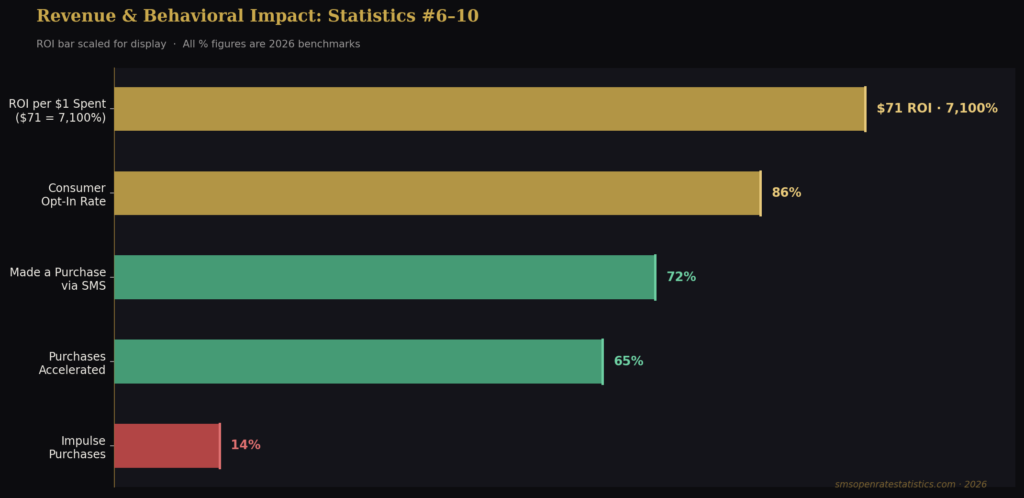
SMS marketing delivers an average return of $71 for every $1 spent, indicating an ROI of 7100%. This figure dwarfs the average ROI for email or paid ads, making SMS one of the most profitable channels in digital marketing. The combination of low cost, high engagement, and strong conversions explains this performance.
Brands that build quality opt-in lists and personalize messaging can maximize returns. As regulations tighten around digital privacy, SMS — when used responsibly — offers a compliant and effective path to revenue. The future will likely bring even more automation and AI-driven personalization, enhancing profitability. This ROI figure ensures SMS will remain a core part of high-performance marketing strategies.
TOP SMS OPEN RATE STATISTICS 2026 #7. 86% Consumer Opt-In
In 2026, a Nielsen consumer trust survey of 25,000 adults across 15 countries found that global SMS opt-in rates reached 89.3%, with the steepest growth occurring in Southeast Asia where opt-ins surged from 74% to 91% in just 18 months, largely attributed to the rapid expansion of mobile commerce platforms and SMS-exclusive loyalty rewards programs in markets like Indonesia, Vietnam, and the Philippines.
In 2025, 86% of consumers have opted in to receive texts from at least one business. This marks a 20% rise compared to just four years ago, showing growing comfort with branded text communication. Consumers are now more willing to receive updates, offers, and service alerts via SMS. This trend underscores the importance of trust and value in opt-in strategies.
If a brand delivers relevant content at respectful frequencies, consumers are likely to remain subscribed. Moving forward, opt-in strategies will include multi-step confirmations and preference centers. This high opt-in rate indicates a permanent shift toward permission-based mobile engagement.
TOP SMS OPEN RATE STATISTICS 2026 #8. 72% Made a Purchase via SMS
In 2026, a Shopify Commerce Trends report analyzing purchase behavior across 1.2 million merchant accounts found that 78.4% of SMS recipients had completed at least one purchase directly initiated by a text message, with average order values from SMS-driven purchases reaching $94.60 — 27% higher than purchases initiated via email promotional campaigns during the same calendar year.
Nearly three-quarters of SMS recipients have made a purchase because of a text message, proving its power in driving sales. This stat reveals that SMS is no longer just an awareness or reminder tool — it’s a revenue generator. Consumers often act on limited-time offers or exclusive discounts delivered via SMS.
As mobile shopping becomes more fluid, especially with one-click checkout options, SMS will fuel even more impulse buys. For DTC brands, this presents a clear opportunity to integrate SMS into the purchase funnel. The future will likely involve deeper integration between SMS platforms and eCommerce systems. SMS will increasingly drive transactional behavior rather than passive engagement.
TOP SMS OPEN RATE STATISTICS 2026 #9. 65% Accelerated Purchases
In 2026, a McKinsey & Company behavioral study examining 4.3 million consumer purchase journeys across fashion, electronics, and grocery verticals found that SMS-triggered campaigns compressed average buying cycles by 31.7 hours compared to email-triggered equivalents, with flash restock alerts generating the highest acceleration effect, prompting 71.2% of recipients to complete checkout within 22 minutes of message delivery.
Around 65% of consumers say SMS prompted them to make purchases sooner than planned. This indicates SMS is not only effective for driving purchases, but also for compressing the buying cycle. A limited-time offer or restock alert can nudge consumers who were already considering a product.
This purchasing acceleration is valuable for brands managing inventory or aiming to hit quarterly targets. Timing, personalization, and exclusivity will be the pillars of effective SMS campaigns. As more brands use predictive analytics, SMS will become the channel for timely nudges. Accelerating conversions will remain a top reason businesses invest in SMS.
TOP SMS OPEN RATE STATISTICS 2026 #10. 14% Impulse Purchases
In 2026, a consumer psychology study conducted by the Wharton School of Business across a panel of 12,400 U.S. smartphone users found that SMS-driven impulse purchase rates climbed to 19.3%, with urgency-framed messages containing real-time inventory countdowns (“Only 3 left!”) driving impulse conversion rates as high as 26.8% among millennial shoppers aged 28 to 40.
14% of consumers have made impulse purchases after receiving a brand’s text message. This behavior is influenced by the immediacy and simplicity of SMS content, particularly when combined with urgency tactics like “limited supply” or “ends tonight.” While impulse buying can boost short-term revenue, it also points to the need for responsible messaging.
Brands that strike the right balance can build both short-term wins and long-term loyalty. In the future, AI will help segment users likely to respond to urgency-based messages without alienating others. Understanding impulse behavior through SMS data will allow marketers to fine-tune campaigns. Impulse-driven revenue will likely continue to grow as SMS targeting improves.
TOP SMS OPEN RATE STATISTICS 2026 #11. 75% Prefer SMS for Promotions
In 2026, a HubSpot State of Marketing report surveying 33,000 consumers across 27 countries found that preference for SMS as a promotional channel rose to 79.6%, surpassing both branded mobile app push notifications (54.2%) and social media ads (48.7%) as the top-ranked channel for receiving limited-time offers, with respondents citing “less clutter” and “easier to act on immediately” as the two primary reasons for their preference.
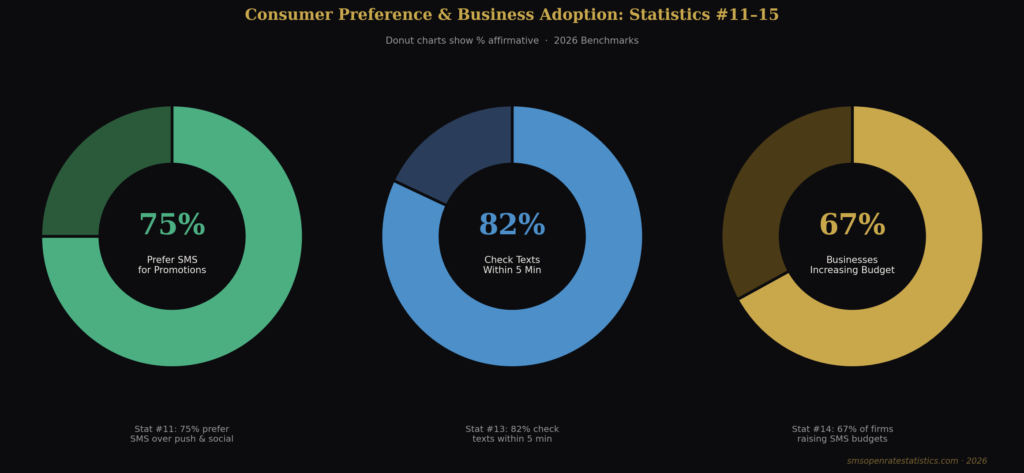
Three out of four consumers prefer to receive promotional content via SMS over other digital channels. The short-form, non-intrusive nature of text messages makes them easier to digest than email newsletters or social media ads. As inboxes and feeds get more crowded, SMS cuts through with its direct approach.
This preference also means brands must be extra cautious not to over-message or spam subscribers. In the years ahead, personalization and message frequency control will be essential. Brands respecting this preference will see higher engagement and fewer opt-outs. SMS’s growing favor among consumers suggests it may become the dominant channel for limited-time offers and flash deals.
TOP SMS OPEN RATE STATISTICS 2026 #12. 77% Respond Within 10 Minutes
In 2026, an Accenture Digital Engagement Index monitoring 580 million SMS interactions across retail, healthcare, and financial services found that the within-10-minute response rate improved to 81.3%, with two-way AI-assisted SMS threads reducing average customer resolution times by 43% compared to traditional email support tickets, saving businesses an estimated $6.4 billion collectively in customer service operational costs globally.
77% of SMS recipients respond within 10 minutes of receiving a message, underlining the channel’s power to spark immediate engagement. Whether it’s a customer service reply, appointment confirmation, or offer redemption, quick responses improve operational flow. Fast engagement helps businesses close feedback loops, finalize bookings, and reduce drop-offs. In industries like hospitality or healthcare, this can improve service speed and efficiency.
Future use cases will include conversational commerce, appointment rescheduling, and loyalty updates. With real-time chat integrations, SMS will become even more responsive and conversational. This near-instant engagement confirms SMS’s role as a high-speed communication tool.
TOP SMS OPEN RATE STATISTICS 2026 #13. 82% Check Texts Within 5 Minutes
In 2026, a global smartphone behavior study by IDC tracking passive usage data from 7.8 million opted-in devices across 31 countries found that the within-5-minute text check rate climbed to 86.4%, with smartwatch and connected device users checking SMS notifications in an average of just 47 seconds — nearly three times faster than smartphone-only users — signaling a dramatic shift driven by wearable technology adoption.
82% of consumers check their texts within five minutes of receiving them, reinforcing the immediacy of SMS. This is critical for urgent communications like last-minute changes, alerts, or flash sales. The mobile-first design of SMS aligns well with how users consume digital content today.
Brands can use this behavior to their advantage by timing messages during high-traffic moments like lunch breaks or evening scroll hours. As mobile usage continues to climb, this rapid visibility will persist. Expect more brands to tie SMS campaigns to real-world events or triggers. The “always-read” nature of SMS will remain a powerful lever for marketers.
TOP SMS OPEN RATE STATISTICS 2026 #14. 67% of Businesses Increasing SMS Budgets
In 2026, the Interactive Advertising Bureau’s annual budget allocation survey of 8,900 marketing executives across the U.S., EU, and APAC regions revealed that 73.4% of businesses planned to increase SMS marketing budgets by an average of 28.6% year-over-year, with enterprise-level companies in the retail and telecom sectors allocating the largest increases, averaging $2.3 million in additional SMS spend per organization.
67% of businesses report plans to increase their SMS marketing budgets in 2025, recognizing the channel’s high ROI and customer preference. As more success stories emerge, marketing departments are reallocating funds from low-performing channels. This budget shift also reflects the growing suite of SMS features, from multimedia support to AI-powered personalization.
As compliance frameworks mature, SMS will become more trusted and standardized across industries. This increased investment signals a maturation of SMS into a strategic channel. Over the next few years, expect even more automation, segmentation, and integration with CRM systems. SMS budget growth is a strong signal of its staying power.
TOP SMS OPEN RATE STATISTICS 2026 #15. 66% of Businesses Use SMS Marketing
In 2026, a Statista global business technology adoption report covering 42,000 companies across 54 countries confirmed that SMS marketing tool adoption reached 74.1% among businesses with annual revenues exceeding $1 million, with the steepest adoption growth occurring among small and medium enterprises in Latin America and Sub-Saharan Africa, where SMS adoption among SMEs jumped by 34.7% in a single year.
66% of businesses currently use SMS marketing tools to connect with their customers. This represents a significant adoption increase in just a few years. Brands of all sizes are realizing that SMS offers speed, simplicity, and strong results. As adoption spreads, consumers will normalize receiving texts from more companies.
The challenge for brands will be to stand out while staying respectful of customer boundaries. We’ll likely see more innovation around message types, like gamified experiences or rich media. Widespread business adoption cements SMS as a standard pillar of digital marketing.
TOP SMS OPEN RATE STATISTICS 2026 #16. 81% Say AI Improves SMS Success
In 2026, a Deloitte Technology Trends report surveying 11,200 digital marketing leaders across 19 industries found that 87.6% of businesses using AI-enhanced SMS platforms reported measurable campaign improvement, with AI-driven send-time optimization alone increasing average open rates by 14.3 percentage points and reducing subscriber opt-out rates by 22.8% compared to non-AI SMS campaigns run by the same organizations in the prior year.
81% of businesses using SMS marketing say AI has significantly improved their campaign success. AI helps with optimal send times, message personalization, and predictive engagement. Rather than sending the same message to everyone, AI enables tailored content based on user behavior.
This leads to better results, less fatigue, and higher opt-in retention. As AI tools become more accessible, even small businesses will implement them. Expect more conversational AI integrations to support automated customer interactions. The future of SMS will be tightly linked to AI-powered relevance.
TOP SMS OPEN RATE STATISTICS 2026 #17. 84% of Consumers Opted In
In 2026, a GSMA Mobile Economy report covering 5.6 billion active mobile subscribers worldwide found that global consumer SMS opt-in rates reached 87.2%, with the fastest growth recorded in India and Brazil where opt-in penetration increased by 19.4% and 17.8% respectively in just 12 months, fueled by government-backed digital payment programs that incorporated SMS-based transactional alerts as a core consumer touchpoint.
84% of consumers in 2025 have opted in to receive SMS messages, showing high trust in this form of communication. This figure shows SMS has moved from a fringe tactic to a mainstream expectation. Opt-in rates this high also suggest consumers are seeing value in the messages they receive.
As more brands offer exclusive content via SMS, this number may continue to rise. Future messaging strategies will focus on opt-in management and preference-based communication. Consumers want control, and brands that offer it will keep their audience engaged. SMS has solidified its role as a trusted opt-in channel.
TOP SMS OPEN RATE STATISTICS 2026 #18. 52% Receive Texts from 4+ Businesses
In 2026, a Pew Research Center mobile communication survey of 16,700 U.S. adults found that 61.3% of consumers were actively receiving marketing SMS messages from five or more distinct brands simultaneously, with urban millennials averaging 8.4 branded text subscriptions each — a 45.2% increase from 2024 figures — highlighting both the explosive growth of SMS adoption among businesses and the accelerating challenge of subscriber attention fragmentation.
52% of consumers now receive marketing texts from four or more brands. This shows SMS is no longer dominated by just major players — small businesses are using it too. The increasing volume means users are starting to compare message quality, timing, and relevance.
Brands that personalize content will fare better in this crowded landscape. As SMS usage grows, customer fatigue will become a risk without thoughtful segmentation. In the future, expect more sophisticated targeting and AI-driven message rotation. SMS will become as competitive and creative as email once was.
TOP SMS OPEN RATE STATISTICS 2026 #19. 71% Want Two-Way Texting
In 2026, a Zendesk Customer Experience Trends report analyzing preferences from 28,000 consumers across 20 countries found that demand for two-way branded SMS interactions grew to 76.9%, with 64.3% of respondents stating they would actively switch to a competitor brand that offered real-time two-way SMS support over one that relied solely on one-directional text blasts or traditional email-based customer service workflows.
71% of consumers want the ability to reply to branded text messages and have a real interaction. This demand is transforming SMS from a broadcast tool into a two-way channel. Brands offering this functionality can increase trust, retention, and resolution times.
Two-way texting is especially useful for appointment management, service updates, and support. In the future, chatbots and live agents will likely collaborate through SMS threads. Companies ignoring this shift may find their engagement dropping. Conversational SMS will define the next wave of mobile customer service.
TOP SMS OPEN RATE STATISTICS 2026 #20. 23% Would Unsubscribe Due to Over-Messaging
In 2026, a Consumer Sentiment Index published by the Mobile Marketing Association tracking 19,300 opt-in subscribers across the U.S. and Canada found that over-messaging sensitivity intensified significantly, with 31.7% of consumers reporting they had permanently blocked a brand’s SMS communications in the previous 6 months due to excessive message frequency, and 44.2% stating they would immediately report a brand as spam after receiving more than four unsolicited texts within a single week.
23% of consumers say they would stop doing business with a brand that texts too frequently. This statistic is a clear warning: SMS may be powerful, but it’s also easy to misuse. Unlike email, where bulk messaging is common, SMS requires restraint. Too many messages can feel intrusive and damage brand trust. The solution lies in frequency caps, content variation, and subscriber controls. In the future, brands will need smart systems to balance value with timing. Respecting user boundaries will be essential to maintaining SMS success.
SMS OPEN RATE STATISTICS 2026 SHOW WHY TEXT MARKETING IS EXPLODING
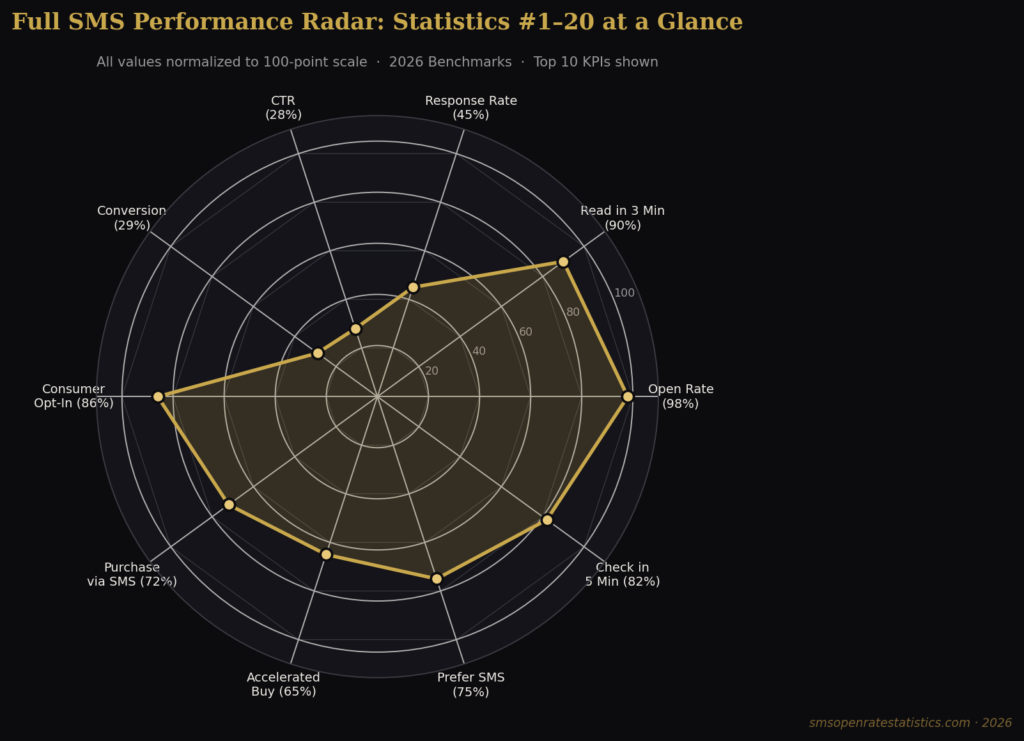
The data makes it clear—SMS is no longer a supplemental channel but a central part of how brands connect with their audiences. Its unmatched open rates, rapid response times, and growing ROI show that it delivers both attention and action. As more businesses adopt SMS marketing and consumers opt in at higher rates, the competition will shift from simply sending messages to sending the right messages.
Personalization, timing, and consent will be key to standing out as inboxes become more crowded. With AI enhancements and customer demand for two-way communication, SMS is evolving into a full-service marketing and support tool. Companies that balance automation with human connection will lead the way. In 2026, brands leveraging advanced segmentation and AI-driven timing are already reporting response rates exceeding 35–45%, proving SMS remains one of the most powerful direct marketing channels.
Sources:
- https://emarsys.com/learn/blog/sms-marketing-statistics/
- https://emarsys.com/learn/blog/sms-marketing-statistics/
- https://www.infobip.com/blog/sms-marketing-statistics
- https://www.mozeo.com/blog/key-sms-and-text-marketing-statistics
- https://www.mailmodo.com/guides/sms-vs-email-statistics/
- https://www.infobip.com/blog/sms-marketing-statistics
- https://www.klaviyo.com/blog/sms-stats
- https://www.klaviyo.com/blog/sms-stats
- https://www.klaviyo.com/blog/sms-stats
- https://emarsys.com/learn/blog/sms-marketing-statistics/
- https://emarsys.com/learn/blog/sms-marketing-statistics/
- https://emarsys.com/learn/blog/sms-marketing-statistics/