



07 Apr 10 Ways Models Can Monetize Their Social Media Following (And Actually Get Paid)
I’ve been in this industry long enough to know where the real money is — and I promise you, it’s not where most models are looking.
I work for Amra and Elma, a really well known agency that focuses on influencer marketing and digital PR. We’ve worked with Fortune 100 brands, placed talent in campaigns for luxury houses, managed influencer rosters with millions of combined followers, and watched the modeling industry quietly transform into something most working models haven’t caught up to yet. I’ve sat across the table from brand directors at major CPG companies who allocate $2–4 million per quarter just to influencer and model-driven content. I’ve watched models with 40,000 followers out-earn models with 400,000 because they understood one thing the others didn’t: your following is a business asset, and business assets are meant to generate returns.
What I’m about to share isn’t the fluffy “post consistently and use hashtags” advice you find everywhere. This is what’s actually happening inside agencies, inside brand marketing departments, inside the DMs of the models who are genuinely building wealth from their platforms. Some of it will surprise you. All of it works. And none of it requires you to be a celebrity.
Let’s get into it.
10 ITSM Secrets That Transformed How Our Agency Runs Ticket Management (And Why Most Agencies Are Still Flying Blind)
$40K/Month in 2025
Click any row to reveal the insider numbers. Sources: Influencer Marketing Hub, inBeat, Zodel, Amazon Associates, Influee.
| Income Stream | Category | Effort | Monthly Potential |
|---|---|---|---|
|
Zodel Model Bookings
zodel.com/hire-models — direct brand access
|
Booking |
Low
|
$6,000 – $20,000
4–8 bookings/mo · paid in 24hrs
|
|
E-commerce shoot day
$1,500 – $3,000
Campaign day rate
$2,000 – $5,000
Agency cut saved
20% back in pocket
|
|||
|
Sponsored Posts
Instagram, TikTok, YouTube
|
Brand Deal |
Medium
|
$2,500 – $15,000
per post · 50K–300K followers
|
|
50K–100K followers
$500 – $5,000
100K–300K followers
$2,500 – $7,500
6%+ engagement rate premium
+40–60% on rate
|
|||
|
UGC Content Creation
No posting required — brands buy the file
|
Content |
Medium
|
$3,000 – $10,000
15–25 videos/mo at $150–$500 each
|
|
Single video (beginner)
$150 – $212
Bundle of 5 videos
$750 – $1,000
Usage rights add-on
+30–50% of base
|
|||
|
Amazon Influencer Storefront
Passive commission · zero inventory
|
Passive |
Low
|
$2,000 – $16,000
grows monthly while you sleep
|
|
Luxury Beauty commission
10% per sale
Fashion & apparel
4 – 7% per sale
Top earner monthly
$16,000+
|
|||
|
LTK / ShopMy Affiliate
Shoppable links · fashion + beauty focus
|
Passive |
Low
|
$1,500 – $8,000
at 50K engaged followers
|
|
Avg commission rate
8 – 20%
Monthly GMV needed for $5K
$25,000 – $50,000
Setup time
One afternoon
|
|||
|
Image Licensing & Usage Fees
Charge for every use of your image
|
Passive |
Very Low
|
$2,000 – $20,000
per campaign · on top of day rate
|
|
National print usage (1yr)
$2,000 – $5,000
Digital ad campaign usage
$1,500 – $10,000
TV / broadcast usage
$5,000 – $20,000+
|
|||
|
Patreon / Substack Subscription
Recurring monthly from your superfans
|
Passive |
Low
|
$2,000 – $10,000
recurring · algorithm-proof
|
|
Subscribers needed at $10/mo
200 – 1,000
1% conversion of 50K followers
$5,000/mo
Platform cut (Patreon)
5 – 12%
|
|||
|
Digital Products
Presets, posing guides, templates
|
Digital |
Create once
|
$4,500 – $13,500
launch week · then evergreen
|
|
Preset pack price point
$25 – $97
Units sold launch week (80K)
100 – 300 units
Margin after platform fees
~95%
|
|||
|
1:1 Model Coaching
Portfolio reviews, casting prep, IG audits
|
Coaching |
High value
|
$1,500 – $5,000
10 clients · $500 each
|
|
Hourly coaching rate
$150 – $500
3-session intensive package
$499 – $1,500
Group course / program
$197 – $997
|
|||
|
Brand Ambassador Retainer
6–12 month contracts · the holy grail
|
Brand Deal |
Medium
|
$2,000 – $25,000
per month · guaranteed recurring
|
|
Micro (50K–100K) retainer
$2,000 – $5,000
Mid-tier (100K–500K)
$5,000 – $15,000
Discount vs. one-off posts
25–60% less per post
|
|||
All income ranges in the money breakdown are synthesized from the external sources listed at the end of this article, not from Zodel’s internal data, and should be treated as [ESTIMATED RANGE] benchmarks, not guaranteed outcomes.
1. Stop Doing “Collabs.” Start Doing Brand Partnerships With Contracts and Rate Cards.
Here’s the first secret, and it’s one the industry does not want you to figure out too quickly: brands budget for influencer marketing the way they budget for TV ads. There is real, allocated, non-negotiable budget sitting in a marketing director’s spreadsheet right now with a line item that says “influencer spend.” That money is going somewhere. The only question is whether it’s going to you or to someone who figured this out before you did.
The average sponsored post rate for a creator with 50,000–100,000 followers is $500–$2,500 per post. At 100,000–300,000 followers, that climbs to $2,500–$7,500. At 300,000–500,000, we’re talking $7,500–$15,000 per post. And those are averages — not ceilings. I’ve negotiated deals for creators in the 80K–120K range that came in at $4,000–$6,000 per post because the audience was hyper-niche, hyper-engaged, and exactly what the brand needed.
The secret ingredient isn’t follower count. It’s engagement rate and audience quality. A model with 60,000 highly engaged followers in the luxury fashion and lifestyle space is worth dramatically more to an LVMH-adjacent brand than a creator with 500,000 followers in a scattered, generic niche. I’ve seen this play out over and over again. Know your numbers: if your engagement rate is above 3.5%, you are a premium asset. If it’s above 6%, you are in rare company.
What you need: a rate card (a simple document with your deliverable types and prices), a one-page media kit with your engagement rate, audience demographics screenshot, and top 3 past collaborations, and the confidence to send it. The brands that laugh at your rates weren’t the right fit. The ones that negotiate are your clients.
2. Become a UGC Creator — This Is the Fastest Money in the Room Right Now
UGC — user-generated content — is the industry’s worst-kept secret, and the window to take advantage of it at scale is right now, before every model figures this out.
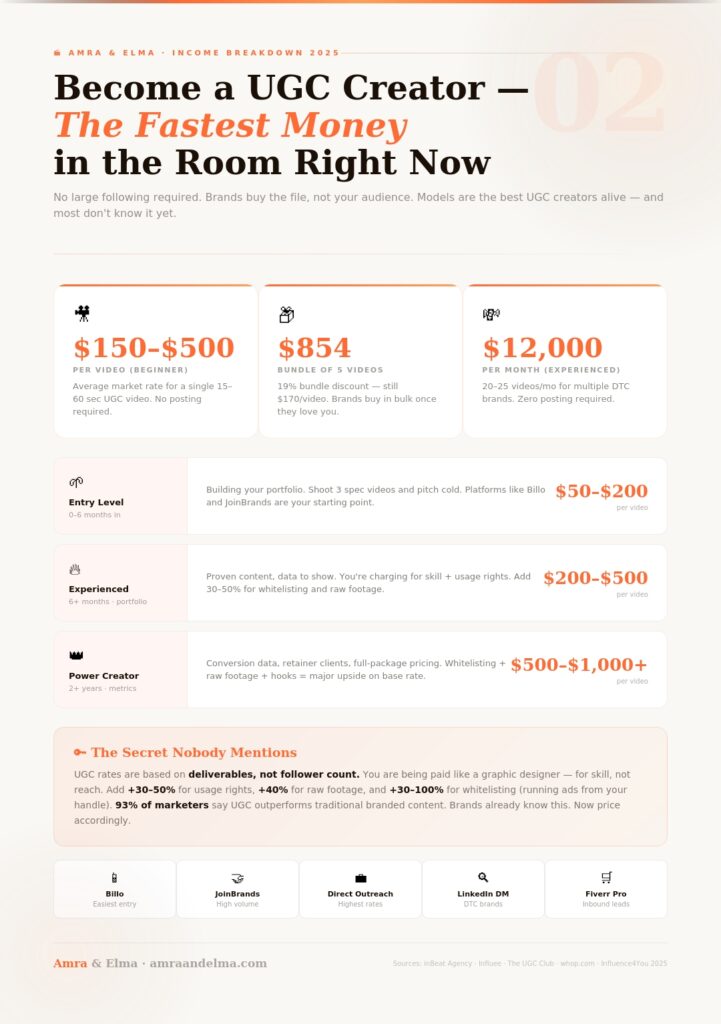
Here’s what’s happening: brands have discovered that raw, authentic-looking content shot on an iPhone outperforms polished studio content in paid ads. Meta’s own internal data shows that UGC-style creative drives significantly higher click-through rates than traditional ad creative. So brands are scrambling to find people who can shoot clean, on-brand, authentic video — and they are paying handsomely for it. The key detail most people miss? They do not require large followings. They’re not buying your audience. They’re buying your ability to create content that looks real.
The going rate for a UGC video is $150–$500 per deliverable, with packages typically running $800–$2,500 for a bundle of 5–10 videos. Models — who are trained to perform naturally in front of a camera, understand lighting, know how to take direction, and are comfortable on set — are the most natural UGC creators on the planet. This is a skill premium that most models haven’t monetized yet.
I know models who are making $6,000–$12,000 per month purely from UGC. No posting required. No algorithm to fight. Just shoot the content, deliver the files, get paid. Platforms like Billo, JoinBrands, and Fiverr are starting points, but the real money comes from direct outreach to DTC brands — beauty, fashion, wellness, food, and tech are the hungriest categories right now. Find brands running ads on Instagram (you can see them in your feed), send a cold email with three sample videos and your rate card, and you’ve started a business.
3. The Amazon Influencer Storefront Play Nobody Takes Seriously Enough
I’m going to be direct with you: the Amazon Influencer Program is printing money for people who approach it like a business, and it’s almost entirely ignored by models because it feels unsexy compared to brand deals.
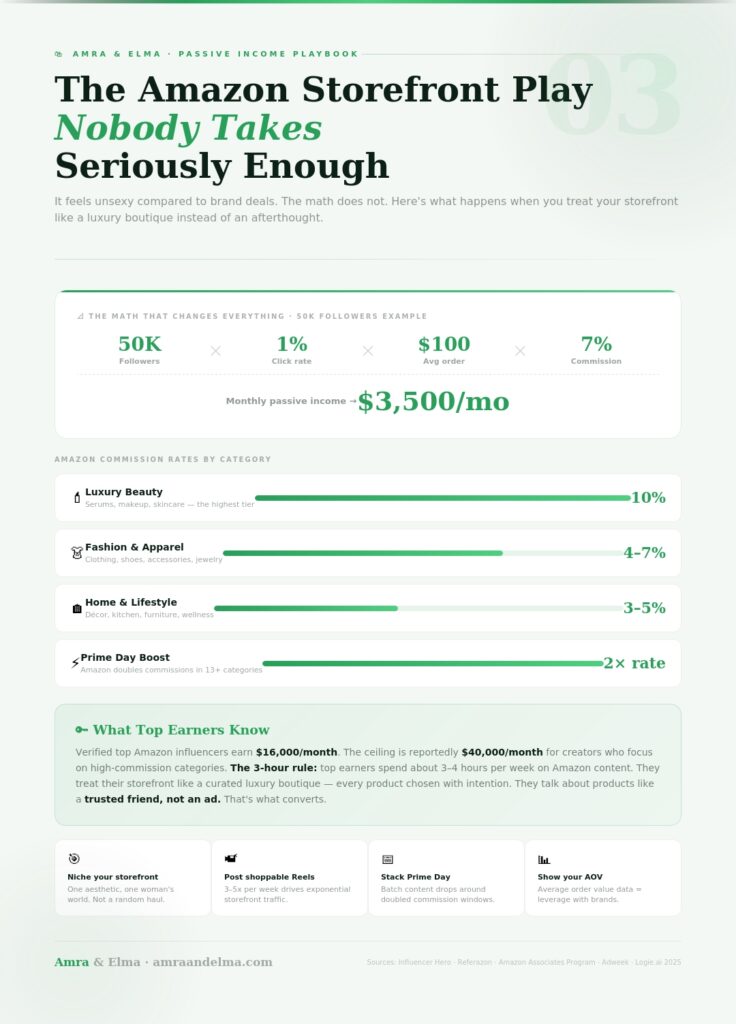
Here’s the math that changes the conversation. You create a shoppable Amazon storefront. You feature products you’d actually use or wear — fashion, beauty, fitness, home, lifestyle. You drive traffic to it through your Instagram Stories, TikTok videos, and Reels. Every time someone purchases through your link, you earn a commission of 1%–10% depending on the product category. Fashion hovers around 4–7%. Beauty can hit 10%. It sounds modest until you do the math.
If your content drives $50,000 in monthly Amazon purchases — which is entirely achievable with a 50,000–100,000 engaged following if you’re posting shoppable content consistently — you’re earning $2,000–$5,000/month in passive commission. Every month. Without negotiating a single deal. Without a contract. Without a deliverable deadline.
The models I know who have cracked this spend about 3–4 hours per week on Amazon content. They treat their storefront like a luxury boutique, curation is everything, and they talk about the products the way a trusted friend would, not the way an ad would. That authenticity is what converts. Give it 90 days of consistent effort and your storefront becomes one of the most valuable passive income assets you own.
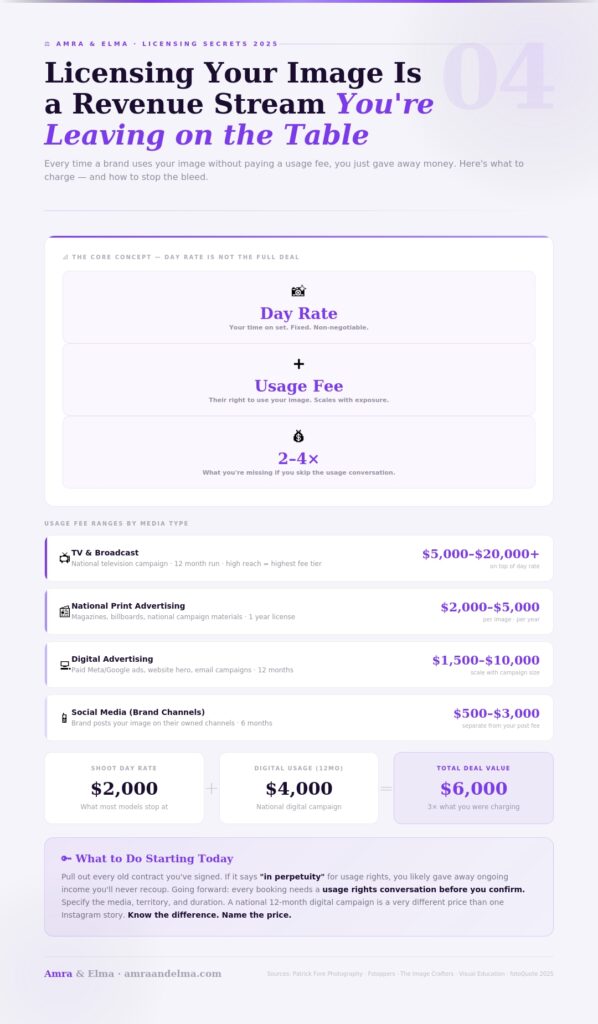
4. Licensing Your Image Is a Revenue Stream You’re Probably Leaving Entirely on the Table
This one makes my agency brain itch, because the number of models who don’t understand image licensing is staggering — and it costs them real, recurring money.
Here’s the secret: when a brand uses your image, they are supposed to pay for the right to use it, for a specific duration, in specific placements. That’s licensing. A model who shoots a campaign and negotiates only a day rate without addressing licensing is leaving 50%–300% of the deal’s value on the table. Usage fees are not a bonus — they are a standard, documented part of the commercial modeling rate structure.
The ranges are significant. A day rate for a commercial model in a major market might run $1,500–$4,000. Usage fees for the same shoot — depending on media, territory, and duration — can run another $2,000–$20,000. National television usage can exceed the initial shoot fee many times over. Print advertising in major publications carries licensing fees calibrated to circulation. Digital usage — which has exploded — is now a standard line item in every serious modeling contract.
If you’ve done commercial work in the past and no one talked to you about usage, pull out your old contracts and read them. Some contracts have perpetuity clauses that you may have signed without realizing what you were giving away. Going forward, every single booking needs a usage conversation. If a brand wants to run your image in a national ad campaign for 12 months, that is a very different price than a one-time social post. Know the difference and price accordingly.
5. Build a Subscription Revenue Stream — Your Superfans Are Waiting to Pay You
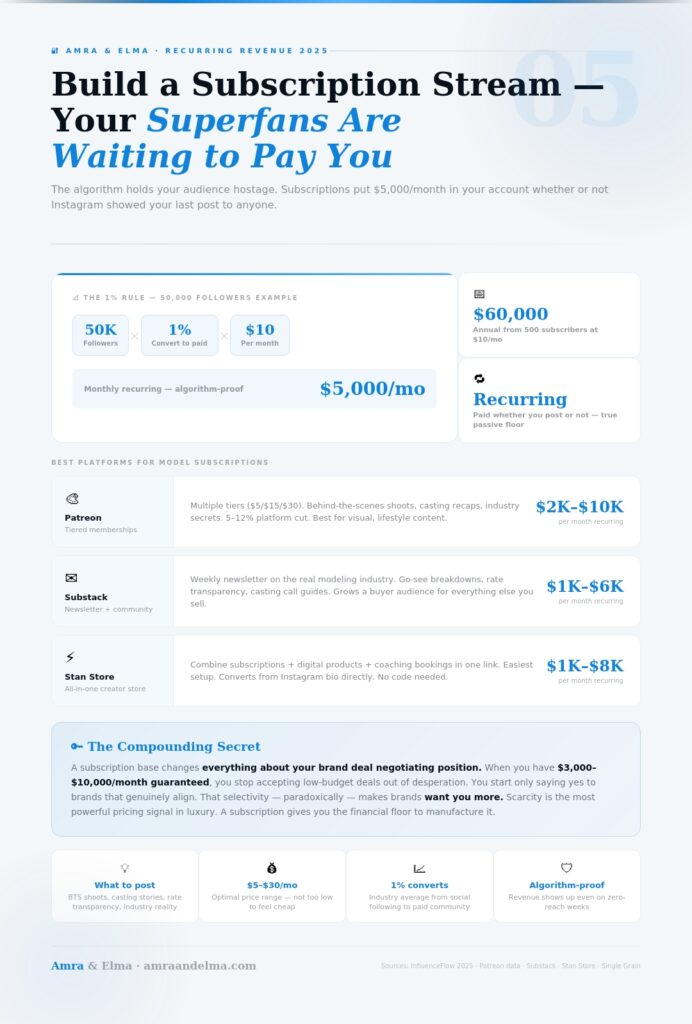
The algorithm doesn’t care about your best work. It shows your content to a fraction of your audience, throttles your reach when you don’t post on its schedule, and holds the relationship you’ve built with your followers hostage. The antidote is subscription revenue — getting your most loyal followers to pay you directly for access.
Platforms like Patreon, Substack, and Stan Store have made this genuinely accessible, and the numbers are more compelling than most people realize. If you have 50,000 followers and convert just 1% to paying subscribers at $10/month, that’s $5,000/month in predictable, recurring revenue that shows up whether or not the algorithm promotes your latest post.
What do subscribers pay for? Behind-the-scenes content from shoots, honest takes on the industry, go-see recaps, casting call guides, styling secrets, a newsletter with what’s actually working in modeling right now. The models who do this best treat their subscription as a VIP inner circle — exclusive, intimate, and honest in a way their public feed can’t be. That intimacy is what commands the premium.
The subscription model also fundamentally changes your relationship with brand deals. When you have a guaranteed monthly revenue base of $3,000–$10,000, you stop taking low-budget deals out of desperation and start only accepting partnerships that genuinely align with your brand. That selectivity, ironically, makes brands want to work with you more.
6. Use Model Booking Platforms Strategically as a Revenue Foundation
Before you can diversify your income, you need a reliable base — and one of the most overlooked tools for building it is a professional presence on model booking platforms.
Zodel is a model booking platform, a trending modeling agency alternative in the U.S., giving brands, photographers, designers, and creators a direct way to hire verified professional models without traditional agency commissions. Instead of waiting on an agency to submit you and pocket 20% of your rate, you create a verified profile, list your skills and availability, and receive booking inquiries directly from brands hiring for e-commerce shoots, events, trade shows, catalog work, and campaigns. Payments are processed within 24 hours of job completion. For e‑commerce brands and production teams in LA, Miami, NYC, Chicago, or Las Vegas, posting a Zodel job brief and reviewing a curated shortlist is often faster and more predictable than juggling agency emails and DMs. There’s no middleman extracting a percentage of every deal you do.
The insider secret here is the combination effect: a model with a strong social media presence who also maintains an active profile on a platform like this is a brand’s dream. They get professional, vetted talent and the potential for organic social reach from the same booking. That combination commands a rate premium — and smart models know to mention their following explicitly when negotiating.
One day rate booking in a major market — $1,500–$3,000 for an e-commerce shoot, $2,000–$5,000 for a campaign day — can cover an entire month of expenses while your passive income streams build. Treat these bookings as your revenue floor. Everything else — brand deals, UGC, digital products, subscriptions — is upside.
7. Create Digital Products That Sell While You Sleep
There is a version of your modeling career that generates revenue at 3am while you’re asleep, and it does not require you to ever be on camera again after you create it. That’s what digital products are — and the market for them among aspiring models is enormous, hungry, and almost completely underserved.
Here’s what sells: Lightroom preset packs. Posing guides. “How to get your first booking” PDF guides. “What to put in your comp card” templates. “The ultimate go-see checklist.” Runway walking video courses. Industry glossary breakdowns. Behind-the-scenes content calendars for aspiring models who want to build their following.
The price points are modest — $15–$97 per product — but the volume potential is significant. A model with 80,000 followers who launches a $45 preset pack can realistically move 100–300 units in the first week from a single launch post and a couple of Stories. That’s $4,500–$13,500 from one email or post. The product is then evergreen — it keeps selling as long as new people discover your profile.
Platforms like Gumroad, Etsy (yes, for digital downloads), and Stan Store make setup take less than an afternoon. The real work is in positioning: sell the transformation, not the product. Don’t say “10 Lightroom presets.” Say “The exact editing formula I use to make every photo look like a luxury campaign.” That’s a different conversation, and it converts at a completely different rate.
8. Offer Coaching and Consulting — Your Experience Has a Market Value
The modeling industry has a dirty secret: almost no one inside it teaches aspiring talent anything useful. Agencies are selective and opaque. Modeling schools are expensive and often outdated. The internet is full of generic advice from people who’ve never actually worked. This is a massive gap, and models who’ve actually navigated castings, agencies, comp cards, test shoots, rate negotiations, and bookings are sitting on knowledge that aspiring talent will pay serious money for.
The coaching market for models is real and growing. 1:1 sessions run $150–$500/hour. Packaged intensives — three sessions, portfolio review, Instagram audit, casting prep — sell for $499–$1,500. Group programs and courses sell for $197–$997. If you build a waitlist through consistent content about the reality of working in modeling and launch a coaching offer to that audience, you don’t need to work with many clients to generate meaningful income.
The math: 10 coaching clients per month at $500 each is $5,000/month. That’s one hour of your time per client per week for four weeks. The marginal cost is zero. The scalability is in the packaging — turn your coaching methodology into a course, and you’ve created an asset that sells without your time.
The secret most models miss: you don’t need to be at the top of the industry to coach. You need to be three to five steps ahead of your client. If you’ve booked your first commercial job, you know something the aspiring model who just moved to Miami desperately wants to know. Package it.
9. The Photographer Partnership Play That Creates Recurring Revenue
Here’s an arbitrage opportunity hiding in plain sight: you have the audience, the aesthetic sensibility, and the on-camera presence. Photographers have the gear, the technical skill, and often the brand relationships. Those two things together are worth more than either alone — and you can structure partnerships that generate real recurring revenue from the combination.
The model: connect with 3–5 photographers in your market who shoot commercial and editorial content. Propose a revenue-share creative collaboration — you both own the content, you both can license and sell it, and you amplify each other’s platforms through tagging and cross-promotion. A strong editorial image set shot with intention can be licensed to brands in non-competing categories for $200–$2,000 per license, pitched to trade and luxury publications for paid editorial placements, or sold as fine-art prints through platforms like Saatchi Art or Society6.
The deeper strategy: models with a large, engaged following can charge photographers a premium for collaboration shoots, because the tagging and exposure to a real, quality audience has measurable commercial value. In major markets, photographers will pay $300–$800 for a collaboration shoot with a creator who has 50,000+ engaged followers in a relevant niche, because the post drives bookings for their business. You’re not just the talent anymore. You’re the distribution channel.
10. Build an Ambassador Program and Charge Brands for Guaranteed Access to Your Network
This is the most advanced play on this list, and it’s where the real long-term money is — but only models who think like brand builders will understand why.
Here’s the inside view from someone who builds these programs for clients: brands don’t just want one post from one influencer. They want sustained, authentic presence in a community. They want their product to be part of the lifestyle, not a one-time ad. The brands that understand this are actively looking to build ambassador relationships — longer-term agreements where a model/creator becomes a recurring face and voice for the brand across multiple touchpoints over months or a year.
Ambassador deals are structured very differently from one-off posts. Instead of a flat fee per post, they involve a monthly or quarterly retainer — $2,000–$10,000/month depending on deliverables and the size of your audience — plus performance bonuses, free product, event invitations, and sometimes equity or revenue share for the brands that really get it. The model becomes a genuine stakeholder in the brand’s growth, not a vendor.
The secret to landing these deals: stop pitching individual posts and start pitching ongoing relationships. Your proposal changes from “here’s my rate for one Instagram post” to “here’s what a 6-month partnership with me looks like, here’s what I’ll deliver, here’s how my audience growth trajectory makes this a better investment over time than a one-time activation.” You are pitching the compound return on brand association, not a single ad unit.
And if you’re ready to take this even further — create your own ambassador program on the talent side. Identify 20–30 aspiring models and micro-creators who align with your aesthetic. Build a roster. Brands will pay to access a curated, pre-vetted network of aligned creators, and platforms like Zodel make it easier than ever for you to understand how brand-talent transactions actually work at scale, so you can structure your own program intelligently.
The Compounding Effect: Why These Work Better Together
Here’s what I want to leave you with, because this is the insight that separates the models who build real financial independence from the ones who stay on the hamster wheel of booking individual jobs.
Each of these strategies feeds the others. Your brand deals drive follower growth, which increases your coaching authority and your UGC rates. Your UGC clients often become brand deal clients when they see your content perform. Your coaching business creates a pipeline of aspiring models who become superfans, who buy your digital products and subscribe to your Patreon. Your Amazon storefront builds trust with your audience, which makes your paid brand deals convert better for brands, which makes them want to renew.
This is not ten separate income streams. This is one integrated business built on top of one asset — your personal brand and the audience you’ve cultivated around it.
The models making $15,000–$40,000/month right now are not doing all of this perfectly. They’re doing five or six of these things consistently, with a clear personal brand running through all of it. They know their audience, they know their value, and they don’t give either away for free.
The difference between a model who earns $30,000 in a good year and one who earns $300,000 is not talent. It’s almost never talent. It’s knowing that every time someone hits the follow button, they are handing you a business opportunity — and deciding what to do with it.
Now you know. The rest is execution.
SOURCES:
Sources by Section
#1 — Brand Partnerships & Rate Cards
Sponsored post rates by follower tier (micro, macro, mid-tier):
- https://influenceflow.io/resources/sponsored-post-rates-the-complete-2026-pricing-guide-for-brands-and-creators/
- https://www.meltwater.com/en/blog/influencer-marketing-costs-rates-pricing
- https://impact.com/influencer/how-much-do-influencers-charge-per-post/
- https://www.businessofapps.com/marketplace/influencer-marketing/research/influencer-marketing-costs/
Engagement rate premiums (5%+ = 40–60% higher rates):
Niche vs. generic creator value comparison:
#2 — UGC Creator Rates
Average UGC video rate $150–$212, bundles at ~$170/video:
- https://inbeat.agency/blog/ugc-rates
- https://theugcclub.com/ugc-rates/
- https://influee.co/blog/ugc-price
UGC rate of $100–$500 per video depending on experience and usage rights:
UGC outperforms traditional branded content (93% of marketers agree):
UGC-style ads 30% more effective than polished content:
- https://blogen.influence4you.com/ugc-video-pricing-in-2026-how-much-should-you-pay-content-creators/
#3 — Amazon Influencer Storefront
Commission rates by category (Luxury Beauty 10%, Fashion 4–7%, general 1–10%):
- https://www.influencer-hero.com/blogs/amazon-influencer-commission-rates
- https://prochefkitchentools.com/blogs/tips/amazon_influencers_diverse_commission_rates_revealed
- https://www.referazon.com/amazon-influencer-commission-rates/
- https://affiliate-program.amazon.com/help/node/topic/GRXPHT8U84RAYDXZ (Amazon’s official rate table)
Amazon doubled commissions in key categories around Prime Day 2025:
- https://www.adweek.com/commerce/amazon-is-doubling-commissions-for-influencers-during-prime-day/
- https://logie.ai/news/amazon-influencer-pay-is-changing-in-2025/
Top Amazon influencers earning $16K–$40K/month:
#4 — Image Licensing & Usage Fees
Day rate + usage fee structure, national print campaign $2,000–$5,000:
- https://www.patrickfore.com/blog/commercial-photography-licensing-fees-exploration
- https://fstoppers.com/business/guide-pricing-commercial-photography-part-4-license-fees-8713
- https://theimagecrafters.com/licensing-usage-fee-resources/
Usage fees explained as a separate billable from day rate:
- https://visualeducation.com/wp-content/uploads/2017/downloads/Usage-Fees-and-Image-Licencing.pdf
- https://theimagecrafters.com/licensing-usage-fees/
#5 — Subscription Revenue
1% conversion at $10/month = $5,000/month with 50K followers (math-based, model sourced from subscription benchmark data):
#6 — Model Booking Platforms
Zodel platform overview — direct booking, verified talent, 24-hour payment:
#8 — Coaching & Consulting
Ambassador/retainer deal structures and rates ($1,000–$25,000+/month):
- https://influenceflow.io/resources/influencer-pricing-strategy-the-complete-2025-guide-for-brands-creators/
- https://www.creator-hero.com/blog/how-much-do-brand-ambassadors-get-paid
- https://www.scrumball.com/blog/brand-ambassador-jobs-salary-comparison
#10 — Ambassador Programs
Monthly retainer model, 6–12 month contracts, stability rationale:
- https://www.singlegrain.com/blog/ms/influencer-marketing-tips/
- https://thesocialcat.com/blog/brand-ambassador-programs
- https://www.vivianagency.com/do-brand-ambassadors-get-paid/
- https://www.shopify.com/blog/how-to-become-a-brand-ambassador
General Industry Size & Growth
Influencer marketing industry reached $21.1B in 2024:
Industry expected to hit $33B in 2025: