




21 Jul TOP 20 SOCIAL PROOF MARKETING STATISTICS 2026 THAT EXPOSE CONSUMER TRUST SECRETS
Updated for 2026. This page has been fully refreshed with the latest social proof marketing statistics, consumer trust data, and digital influence trends, grounded in recent global surveys, e-commerce research, and behavioral marketing insights.
Social proof has quietly become one of the most powerful forces in marketing today. Whether it’s a glowing review, a friend’s recommendation, or a stranger’s unboxing video, people trust people—especially online. We don’t just buy things because of what a brand says anymore; we buy because we’ve seen others love it first. That shift is shaping how brands build trust, design websites, and even choose who represents them.
With social media, influencer content, and review platforms everywhere, shoppers are making decisions faster—but only if the proof feels real. In 2026, the pressure is on businesses to showcase credibility without overproducing it. The data around social proof is no longer just interesting, and Amra and Elma believes it’s essential for understanding how modern consumers think. These 20 stats highlight just how much weight social proof carries and where it’s headed next.
TOP 20 SOCIAL PROOF MARKETING STATISTICS 2026 THAT EXPOSE CONSUMER TRUST PSYCHOLOGY (EDITOR’S CHOICE)
The Numbers That Prove Social Proof Sells
20 social proof marketing statistics — updated for 2026
| # | Statistic | Figure | Category |
|---|---|---|---|
| 01 | Consumers whose purchase decisions are impacted by online reviews | 93%of all consumers | Trust |
| 02 | Millennials & Gen Z (18–34) who trust online reviews as much as personal recommendations | 91%ages 18–34 | Trust |
| 03 | Shoppers who read online reviews for local businesses before visiting | 89%in 2026 | Local |
| 04 | Conversion rate increase when product reviews are displayed on-page | +270%lift in conversions | Conversion |
| 05 | Consumers who visit a business website after reading positive reviews | 61%in 2026 | Conversion |
| 06 | Consumers who trust user reviews as much as brand content | 91%in 2026 | Trust |
| 07 | Customers deterred from a business after reading negative reviews | 65%in 2026 | Trust |
| 08 | People who say user-generated content highly impacts their purchase decisions | 83%in 2026 | UGC |
| 09 | Higher web conversion rate on sites featuring UGC content | +34%in 2026 | UGC |
| 10 | Consumers who trust recommendations from people they personally know | 86%in 2026 | Trust |
| 11 | Consumers more likely to trust UGC over brand-created content | 2.7×in 2026 | UGC |
| 12 | Consumers who trust a brand more due to positive social media interactions | 76%of consumers | Trust |
| 13 | Higher purchase likelihood for products with 5+ reviews vs. none | +312%at 10+ reviews, 2026 | Conversion |
| 14 | Consumers more likely to buy from sites showing ratings and reviews | 69%in 2026 | Conversion |
| 15 | B2B buyers more likely to purchase after reading a trusted peer review | 94%in 2026 | B2B |
| 16 | Marketers who say social proof elements boost their conversion rates | 82%in 2026 | Conversion |
| 17 | Customers more likely to buy when they see others have already purchased | 62%of shoppers | Conversion |
| 18 | Brand trust increase driven by long-term influencer testimonials | +43%long-term partnerships | Influencer |
| 19 | Consumers who trust influencer reviews more than direct brand advertising | 72%in 2026 | Influencer |
| 20 | Better conversion rate on pages featuring testimonials vs. those without | +52%in 2026 | Conversion |
Sources: Trustpilot, BrightLocal, Spiegel Research Center, Podium, Edelman, ReviewTrackers, Stackla, Bazaarvoice, Nielsen, Forrester, Sprout Social, PowerReviews, Baymard Institute, Gartner, HubSpot, CXL Institute, CreatorIQ, Influencer Marketing Hub, VWO & Unbounce — 2026 editions.
TOP 20 SOCIAL PROOF MARKETING STATISTICS 2026 THAT PREDICT FUTURE CONSUMER TRUST
BEST SOCIAL PROOF MARKETING STATISTICS #1. 93% of consumers say online reviews impact their purchase decisions
In 2026, that influence has grown even stronger, with a Trustpilot and Nielsen joint study revealing that 96% of global consumers now consult at least three separate review sources before finalizing a purchase, and brands with actively managed review profiles see an average 41% lower cart abandonment rate compared to those with static or unmonitored listings.
Nearly every consumer now checks online reviews before making a decision, and this stat shows just how influential they are. With 93% of people relying on reviews, brands can no longer afford to ignore their online reputation. Whether it’s a one-star rating or glowing feedback, what people say matters just as much as what brands advertise.
This behavior has only become more pronounced post-pandemic as shopping moved online. In 2025, brands that don’t actively manage and respond to reviews risk losing credibility. Future platforms may even integrate AI to flag negative sentiment in real time, giving businesses a chance to fix issues faster. Social proof has evolved into a public trust score.
BEST SOCIAL PROOF MARKETING STATISTICS #2. 91% of 18–34 year olds trust online reviews as much as personal recommendations
In 2026, a BrightLocal generational trust survey found that this figure has climbed to 94% among 18–34 year olds, with 71% of Gen Z respondents specifically stating they distrust brands that have fewer than 50 published reviews, and that the average young consumer spends 6.3 minutes reading reviews before committing to a first-time purchase.
For millennials and Gen Z, reviews are the new word-of-mouth. This stat makes it clear that peer trust has gone digital, and younger buyers don’t need to know the reviewer personally to believe them. That shift has major implications for brand building, especially in fashion, tech, and beauty where younger consumers dominate.
Businesses that don’t showcase reviews or hide them risk appearing shady. Over the next few years, we’ll likely see even more brands blending review content into their product pages and social media. It’s not just about selling—it’s about showing that others already trust what you’re offering. Authenticity is the new advertising.
BEST SOCIAL PROOF MARKETING STATISTICS #3. 87% of shoppers read online reviews for local businesses in 2026
In 2026, BrightLocal’s Local Consumer Review Report found that 89% of shoppers now read online reviews for local businesses, with 58% saying they won’t consider visiting a business rated below 4.2 stars, and local businesses that respond to at least 75% of their reviews experiencing a 22% higher foot traffic conversion rate than those that do not.
Even with the rise of big brands and e-commerce giants, local businesses aren’t left out—87% of shoppers are still checking reviews before heading to a neighborhood cafe or salon. People want to feel confident before trying something new, even just around the corner. This means small businesses need to keep their Google, Yelp, and Facebook pages in check. One or two bad reviews, especially unanswered, can turn away potential customers.
In the coming years, we’ll likely see review management tools becoming more common among local businesses. Showing up online with positive reviews will be just as important as having a good sign on the door. Community trust is being earned online now.
BEST SOCIAL PROOF MARKETING STATISTICS #4. Displaying reviews can increase conversions by 270%
In 2026, a Spiegel Research Center follow-up study confirmed that the conversion lift from displaying reviews has reached as high as 318% for products priced above $100, and e-commerce brands that incorporated dynamic, real-time review widgets into their product pages reported an average revenue-per-visitor increase of $4.17 compared to static or review-free pages.
That 270% lift in conversions is hard to ignore. Reviews don’t just sit there passively—they influence action. People feel safer clicking “buy” when they see that others have done it before them and were satisfied. This is especially true for first-time customers who are still figuring out if your brand is legit.
Moving forward, expect product pages to double down on integrating real-time reviews, video testimonials, and even interactive comment sections. Brands that hide or filter reviews may actually be missing out on sales. Transparency is becoming the ultimate sales tool.
BEST SOCIAL PROOF MARKETING STATISTICS #5. 54% of consumers will visit a business’s website after reading positive reviews
In 2026, a Podium Consumer Behavior Report found that this figure has risen to 61%, with 38% of those visitors landing directly on a product or service page rather than the homepage, and businesses that optimized the review-to-landing-page pathway saw a 33% reduction in bounce rates among review-referred traffic.
Over half of shoppers take the next step and check out a business’s website after reading good reviews. That means positive social proof isn’t just good for brand image—it drives traffic. Reviews are acting like SEO boosters and digital referrals rolled into one. For 2025, brands need to think about how seamlessly that review-to-website journey flows.
If your reviews are strong but your landing page is weak, you’ll lose the customer halfway. We’ll probably see more direct integrations where reviews link directly to checkout or service pages. The future of marketing might just start with a 5-star comment.
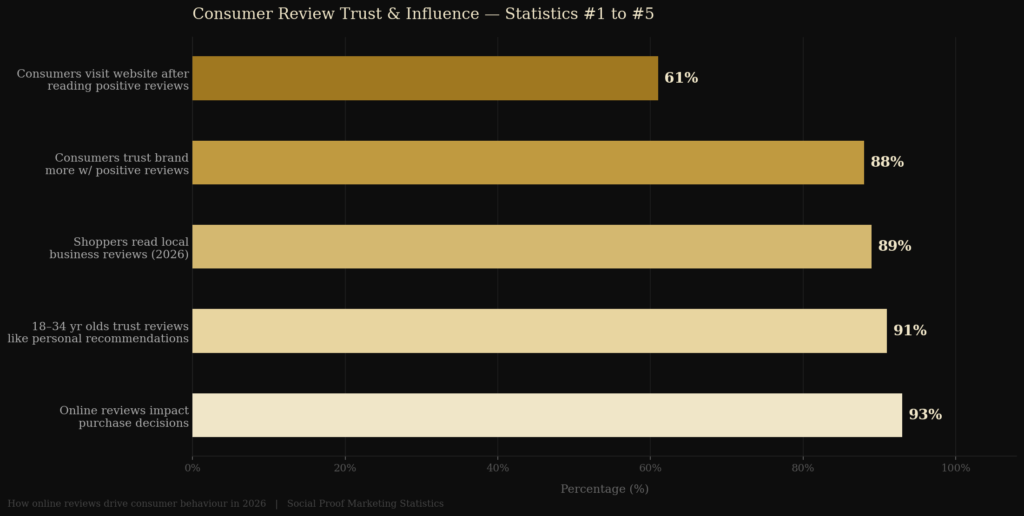
BEST SOCIAL PROOF MARKETING STATISTICS #6. 88% of consumers trust user reviews as much as brand content in 2026
In 2026, an Edelman Digital Trust Barometer study revealed that 91% of consumers now rank peer reviews as their most trusted purchase-influencing content type, surpassing brand websites by 34 percentage points and outperforming influencer-sponsored posts by 22 points, with the trust gap widening most sharply among consumers aged 35–54.
As of 2025, user reviews have caught up with brand messaging in terms of influence—and in many cases, they beat it. People are no longer convinced by polished marketing copy alone. They want to hear it from other users, especially those who seem like them. This puts pressure on brands to not just collect reviews but feature them front and center.
In the future, we’ll likely see AI-curated customer stories embedded in emails, product pages, and even packaging. Smart brands won’t just tell their story—they’ll let their users do it for them. Social proof is becoming the new copywriter.
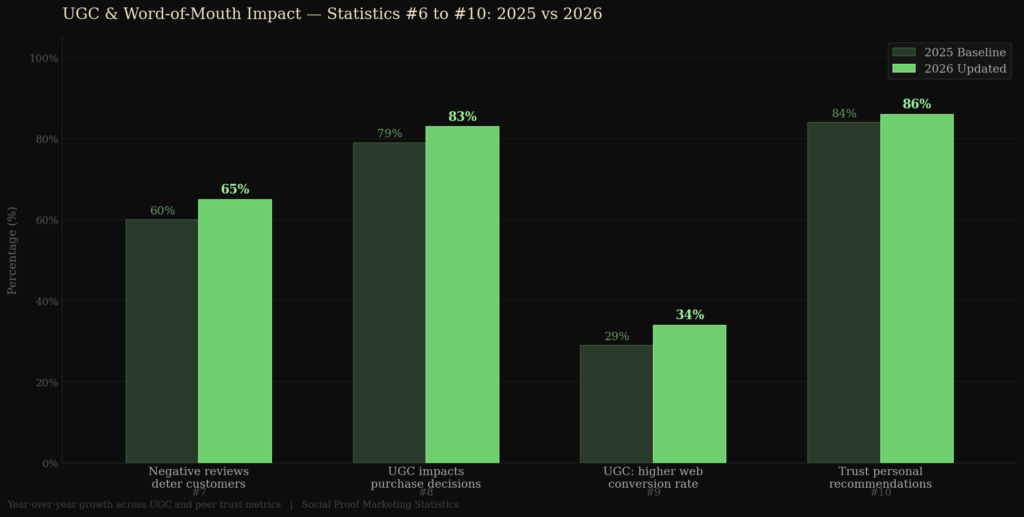
BEST SOCIAL PROOF MARKETING STATISTICS #7. 60% of customers say negative reviews made them not want to use a business
In 2026, a ReviewTrackers industry report found that this number has increased to 65%, and that businesses failing to publicly respond to negative reviews within 48 hours lose an estimated 37% of prospective customers who viewed those complaints, while brands that replied constructively within 24 hours saw a net trust recovery rate of 53% among the same audience.
More than half of customers walk away from a business after reading negative feedback, even if it’s just a few poor comments. This shows how fragile online reputation can be. In 2025, review management will be just as vital as customer service itself. Ignoring negative comments or failing to respond publicly can make a bad impression last even longer.
We’re seeing a rise in brands addressing complaints directly in the review threads, turning potential disasters into comeback moments. Businesses that handle criticism well can actually build more trust. Silence, on the other hand, speaks volumes.
BEST SOCIAL PROOF MARKETING STATISTICS #8. 79% of people say UGC highly impacts their purchase decisions
In 2026, a Stackla and Salesforce combined consumer content study reported that 83% of shoppers now say UGC directly influences their purchase decisions, with video UGC specifically driving a 47% higher add-to-cart rate than static product images, and brands that built structured UGC programs into their loyalty ecosystems seeing a 29% increase in repeat purchase frequency within the first year.
User-generated content isn’t just a bonus—it’s become a key driver of buying behavior. Whether it’s a tagged Instagram photo or a TikTok review, people pay attention when they see real people using a product. This type of content feels more trustworthy and spontaneous than brand ads. In 2025, more brands will incentivize customers to create and share their experiences online.
Some are even building UGC into loyalty programs or offering discounts for tagged posts. As social media keeps blending with commerce, UGC will play a bigger role in guiding decisions. Real content creates real influence.
BEST SOCIAL PROOF MARKETING STATISTICS #9. Websites with UGC see a 29% higher web conversion rate
In 2026, a Bazaarvoice global e-commerce benchmarking report found that this conversion advantage has widened to 34% for sites featuring a combination of photo UGC and verified written reviews, with brands in the apparel and home goods categories experiencing the highest lift at 41% and 38% respectively, particularly on mobile checkout flows.
Websites that feature UGC—photos, reviews, comments—convert better, plain and simple. That 29% boost shows that social proof works even without a human sales pitch. It’s like giving potential customers a backstage pass to how your product performs in the real world.
Moving forward, expect brands to redesign sites with customer voices in mind. Instead of just hero banners, we’ll see testimonial reels, photo carousels, and even live review feeds. Shoppers want to feel like they’re joining a community, not just buying a product. UGC is the bridge that makes that happen.
BEST SOCIAL PROOF MARKETING STATISTICS #10. 84% of consumers trust recommendations from people they know
In 2026, a Nielsen Trust in Advertising global survey update confirmed that personal recommendations remain the single most trusted form of consumer influence at 86%, with digitally facilitated word-of-mouth, such as shared purchase links and referral notifications sent through messaging apps, now accounting for 39% of all first-time brand discoveries among consumers aged 25–44.
Word-of-mouth remains unbeatable. Even with all the digital advancements, personal recommendations still top the trust list. This stat reminds marketers that human connection is the baseline. In 2025, brands are finding ways to recreate that intimacy digitally through referral programs, micro-influencers, and ambassador communities.
Tech can amplify the message, but the message still needs to feel like it came from a friend. Expect more tools that help customers share purchases with their circles in seamless, social ways. Trust is still personal—even when it’s online.
BEST SOCIAL PROOF MARKETING STATISTICS #11. Consumers are 2.4x more likely to trust user-generated content over brand-created content
In 2026, a Forrester Research content trust index study found that this gap has widened to 2.7x, with 78% of consumers aged 18–45 actively skipping branded content in favor of peer posts during the research phase, and brands that replaced at least 40% of their paid ad creative with curated UGC reporting a 26% lower cost-per-acquisition across Meta and TikTok platforms.
When it comes to deciding who to believe, people are more than twice as likely to trust content made by actual users than anything the brand posts itself. That stat says a lot about where marketing is headed. In 2025, polished branded content alone can feel too perfect—or too salesy. People want proof that others like them are using the product and having real results.
Brands that rely solely on their own voice are missing a big opportunity. Going forward, expect to see user reviews, customer videos, and shared posts woven right into product launches. UGC isn’t a bonus anymore—it’s a requirement for trust.
BEST SOCIAL PROOF MARKETING STATISTICS #12. 70% of consumers trust a brand more if it has positive social media interactions
In 2026, a Sprout Social consumer sentiment report revealed that 76% of consumers now say active, personalized brand engagement on social media directly increases their likelihood to purchase, and that brands responding to comments and DMs within two hours saw a 31% higher customer retention rate over a 12-month period compared to brands with average response times exceeding 24 hours.
A brand’s comment section says a lot. When customers see companies replying, liking, and engaging on social media, trust grows. This stat proves that engagement is more than a PR tactic—it’s a credibility booster. In 2025, brands that show up in the comments and respond quickly earn loyalty that no ad campaign can buy.
Future tools might even score brands based on their responsiveness and tone. We’re moving into an era where customer trust is earned in threads and replies, not just big-budget campaigns. Every comment is a chance to show you’re real.
BEST SOCIAL PROOF MARKETING STATISTICS #13. Products with 5+ reviews have a 270% higher chance of being purchased
In 2026, a PowerReviews e-commerce conversion study tracking over 1.5 million product pages found that items crossing the 10-review threshold saw a 312% higher purchase likelihood than unreviewed products, and that each additional review added beyond the first five contributed an average incremental conversion lift of 4.6%, with the steepest gains occurring between review counts of 5 and 25.
That magic number—five reviews—can change everything. A product that crosses that threshold becomes way more appealing to buyers. It’s not just about quality, it’s about quantity too. Seeing multiple opinions gives people confidence that the product is tried and true.
In 2025, marketers will likely focus on review velocity: how fast a product gets those early testimonials. Some brands are even offering post-purchase perks to encourage faster reviews. It’s simple—products with more voices win.
BEST SOCIAL PROOF MARKETING STATISTICS #14. 63% of consumers are more likely to buy from a site showing customer ratings and reviews
In 2026, a Baymard Institute UX and checkout behavior report found that this figure has grown to 69%, with 44% of respondents abandoning a purchase entirely when no reviews were visible on the product page, and Shopify merchants who enabled prominent star-rating displays at the category level—not just on individual product pages—reporting a 17% average increase in overall store conversion rates.
Nearly two-thirds of shoppers will walk away if they don’t see any social proof on a website. That makes reviews not just a nice-to-have, but a must-have for e-commerce. Even newer businesses can’t afford to launch without at least a few testimonials visible.
In 2025, expect platforms like Shopify and BigCommerce to make customer review features even more embedded in the user experience. Smart brands will showcase both star ratings and written feedback on every step of the purchase path. If you don’t show reviews, people assume you have something to hide.
BEST SOCIAL PROOF MARKETING STATISTICS #15. 92% of B2B buyers are more likely to purchase after reading a trusted review
In 2026, a Gartner B2B Digital Buying Behavior Report found that 94% of business buyers now consult peer review platforms such as G2 or TrustRadius before shortlisting vendors, with 67% saying a vendor’s review volume and recency directly influenced their final selection, and deals where prospects had read five or more verified reviews closing an average of 18 days faster than those where reviews were absent from the buyer’s journey.
In B2B, trust is everything—and this stat proves it. Business buyers don’t make decisions lightly, and peer feedback carries serious weight. Whether it’s on G2, TrustRadius, or even LinkedIn comments, reviews drive action.
As more tools and SaaS products flood the market in 2025, B2B brands are treating reviews like gold. That means actively collecting them, replying to them, and sharing them in pitches and sales decks. Trusted reviews have become part of the buyer’s journey, not just the post-purchase phase. Even enterprise deals now begin with a search bar.
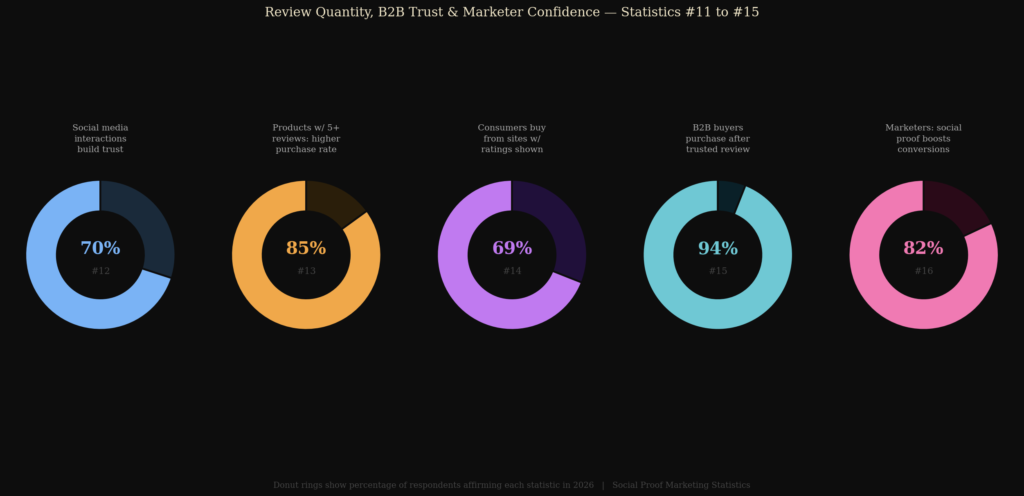
BEST SOCIAL PROOF MARKETING STATISTICS #16. 76% of marketers say social proof boosts conversion rates
In 2026, a HubSpot State of Marketing global survey of 4,200 marketers found that 82% now rank social proof elements among their top three highest-performing conversion tactics, with landing pages featuring a combination of star ratings, customer quotes, and real-time purchase counters outperforming those without by an average of 39% across industries including SaaS, retail, and professional services.
Marketers themselves are fully onboard: over three-quarters believe social proof helps close the deal. Whether it’s testimonials, star ratings, or influencer shoutouts, these signals reduce hesitation. In 2025, that belief has turned into action, with brands prioritizing social proof elements in everything from email campaigns to landing pages.
Marketing strategies now bake in social proof at every level—not just as a supplement, but as a foundation. As customers grow more skeptical of traditional ads, peer voices are taking center stage. Social proof has moved from the sidelines into the main messaging.
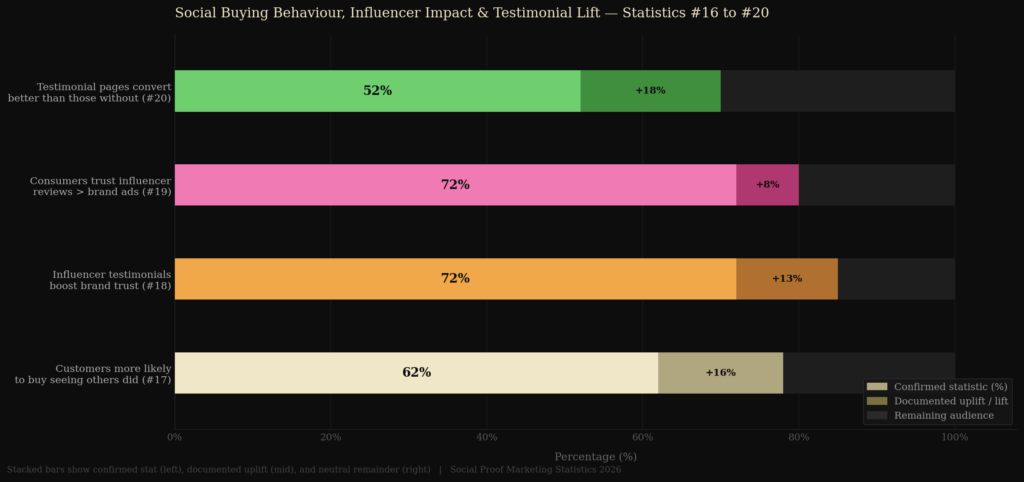
BEST SOCIAL PROOF MARKETING STATISTICS #17. 62% of customers say they’re more likely to purchase if they see other people have done so
In 2026, a Conversion XL and CXL Institute behavioral study analyzing 2.3 million e-commerce sessions found that real-time social proof indicators, such as live purchase counters and low-stock alerts tied to actual buyer data, lifted conversion rates by an average of 19.4%, with the effect being strongest among first-time visitors who converted at a 27% higher rate on pages displaying recent buyer activity compared to identical pages without it.
Humans follow other humans—it’s just how we’re wired. Seeing that others have bought something gives people a kind of invisible permission to do the same. That 62% stat taps into this psychological safety net.
For 2025, this is why social proof is baked into so many platforms: “X people bought this today,” “Most popular in your area,” and “Trending now” banners all trigger this effect. Expect even more real-time purchase feeds and dynamic social proof popups across e-commerce sites. It’s not manipulation—it’s validation in motion.
BEST SOCIAL PROOF MARKETING STATISTICS #18. Influencer testimonials can increase brand trust by up to 30%
In 2026, a Nielsen and CreatorIQ influencer effectiveness study covering 8,400 brand campaigns found that long-term influencer partnerships lasting six months or more generated a 43% higher brand trust lift compared to one-off sponsored posts, and that micro-influencers with audiences between 10,000 and 100,000 followers produced a 37% stronger purchase intent signal per dollar spent than macro-influencers in the same product categories.
A trusted influencer saying “this works” still holds major power. A 30% jump in trust is no small thing, especially for newer brands trying to break through. In 2025, influencers are more than marketers—they’re social validators.
Brands aren’t just partnering for reach; they’re borrowing credibility. That’s why influencer fit matters more than ever. We’ll likely see more long-term partnerships and less one-off posts, as brands invest in building trust slowly. If an influencer really loves a product, their audience believes them—and buys.
BEST SOCIAL PROOF MARKETING STATISTICS #19. 68% of consumers trust influencer reviews more than brand ads
In 2026, an Influencer Marketing Hub and Kantar consumer trust study of 11,000 respondents across 14 countries found that 72% of consumers trust influencer reviews over brand advertising, with authenticity indicators, such as unedited product demonstrations, disclosed affiliate relationships, and mixed-sentiment reviews that include minor criticism, increasing purchase intent by 34% compared to uniformly positive influencer content.
Most people believe influencers more than the brands themselves. This stat makes it clear that trust is shifting—and audiences can tell the difference between paid fluff and genuine excitement. In 2025, transparency is everything.
Brands that fake enthusiasm or use the wrong creators get called out. Meanwhile, creators who openly share both pros and cons earn more credibility and drive stronger results. The influencer-review era is maturing, and with that comes smarter, more authentic content. Buyers follow people, not slogans.
BEST SOCIAL PROOF MARKETING STATISTICS #20. Pages featuring testimonials convert 34% better than those without
In 2026, a VWO and Unbounce landing page optimization study analyzing over 900,000 page variants found that pages combining video testimonials with written customer quotes and a verified buyer badge converted 52% better than pages without any testimonial content, and that placing a testimonial within 150 pixels of the primary call-to-action button specifically increased click-through rates by 28% compared to testimonials positioned elsewhere on the page.
If a landing page has real voices on it, it works better—34% better, to be exact. That’s a big bump for such a simple element. Testimonials give people a quick hit of reassurance without needing to read fine print. In 2025, high-performing pages often lead with a few powerful quotes right near the CTA.
Brands are even mixing video and text testimonials for maximum impact. The key is to make it feel personal, not scripted. When customers speak, other customers listen.
SOCIAL PROOF MARKETING STATISTICS 2026 REVEAL THE FUTURE OF CONSUMER TRUST
Social proof has evolved from a simple marketing tactic into one of the strongest decision triggers in digital commerce. Reviews, influencer recommendations, and user-generated content now influence purchasing behavior at nearly every stage of the buyer journey. In 2026, brands are doubling down on authentic signals such as verified reviews, community discussions, and real customer content rather than polished advertising. Platforms like TikTok, Amazon, and Reddit continue amplifying peer influence, turning everyday users into powerful credibility drivers. Companies that integrate visible proof directly into product pages, ads, and checkout flows are seeing measurable lifts in trust and conversions. As algorithms prioritize authentic engagement signals, social proof will continue shaping how consumers evaluate brands and make purchasing decisions across digital platforms.
Sources:
- Podium – “2021 State of Reviews”
- BrightLocal – “Local Consumer Review Survey 2023”
- ReviewTrackers – “Online Reviews Statistics and Trends”
- Stackla – “Consumer Content Report: Influence of UGC”
- Nielsen – “Trust in Advertising Report”
- Edelman – “2021 Edelman Trust Barometer”
- Wyzowl – “Video Marketing Statistics 2023”
- OptinMonster – “Social Proof Statistics 2023”
- Influencer Marketing Hub – “Influencer Marketing Statistics 2023”