



17 Sep TOP 20 SOFTWARE MARKETING STATISTICS 2026 REVEAL SHOCKING SAAS GROWTH AND AI DISRUPTION
Updated for 2026. This page has been fully refreshed with the latest software marketing statistics, SaaS growth data, product-led marketing trends, and digital adoption insights drawn from global industry reports, B2B surveys, and marketing performance studies.
Whenever I dive into the latest software marketing statistics, I feel like I’m not just looking at numbers but at stories of how businesses evolve in real time. As someone who has worked closely with a leading marketing agency in New York, I’ve seen firsthand how these insights shape decisions, spark creativity, and drive results.
For me, tracking software marketing statistics isn’t about staying trendy—it’s about understanding what truly moves people, and how technology keeps rewriting the rules of connection and growth. That’s why I wanted to pull together this collection of stats: to share not only the data, but also the bigger picture they reveal about where software marketing is heading.
TOP 20 SOFTWARE MARKETING STATISTICS 2026 THAT REVEAL MASSIVE SAAS GROWTH
Asia Pacific emerges as the fastest-growing region, driving unprecedented SaaS demand and differentiation strategies.
Portfolios grew from 110 to 305 apps in six years, creating massive complexity and marketing opportunities.
Decentralized buying creates multiple entry points for marketers across all business departments.
46% of licenses remain underutilized, highlighting the critical need to demonstrate product value.
Desktop converts at 3.9% vs 1.8% mobile, presenting massive optimization opportunities.
Only 38% of users who interact with forms submit; reducing fields is critical.
MQL-to-SQL conversion averages just 13-21%, representing the biggest funnel bottleneck.
Speed matters: 1-hour follow-up achieves 53% conversion vs just 17% for 24-hour delays.
87% of B2B marketers report improved productivity with AI-assisted content creation.
Content marketing revenue projected at $107B globally in 2026.
AI adoption has reached near-universal levels, with 79% reporting quality improvements.
Companies using AI report 22% higher ROI, 47% better CTR, and campaigns launching 75% faster.
User-generated content influences 79% of purchase decisions, making social proof essential.
60% of Gen Z prefer discovering products through TikTok/Instagram over search.
Short-form video formats attract the largest creator spend via TikTok and Instagram Reels.
Nano/micro influencers achieve 50% higher engagement than larger creators.
Mobile-driven social commerce outpaces all segments, with mobile-first delivering 20% better ROAS.
SEO-sourced leads convert at 51% MQL-to-SQL vs just 26% for PPC.
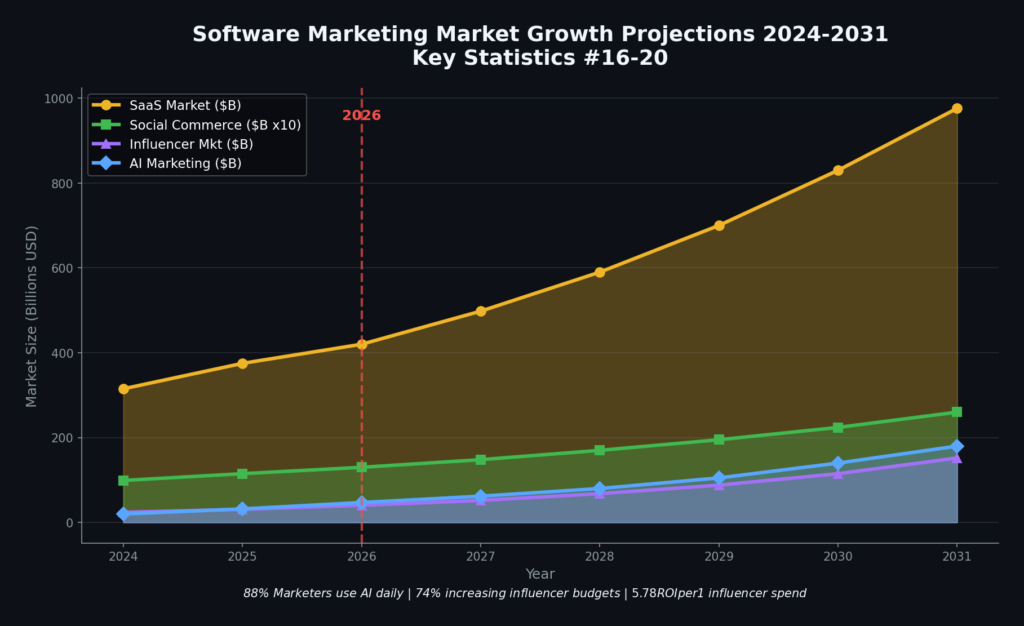
Social commerce projected at $1.3T in 2026, with 60%+ product discovery on social platforms.
AI marketing reaches $47.32B in 2026, projected to exceed $107.5B by 2028. Those not embracing AI risk falling behind.
TOP 20 SOFTWARE MARKETING STATISTICS 2026 MARKETERS CAN’T AFFORD TO IGNORE
Software Marketing Statistics#1 Global SaaS Market Reaching $375-465 Billion by 2026
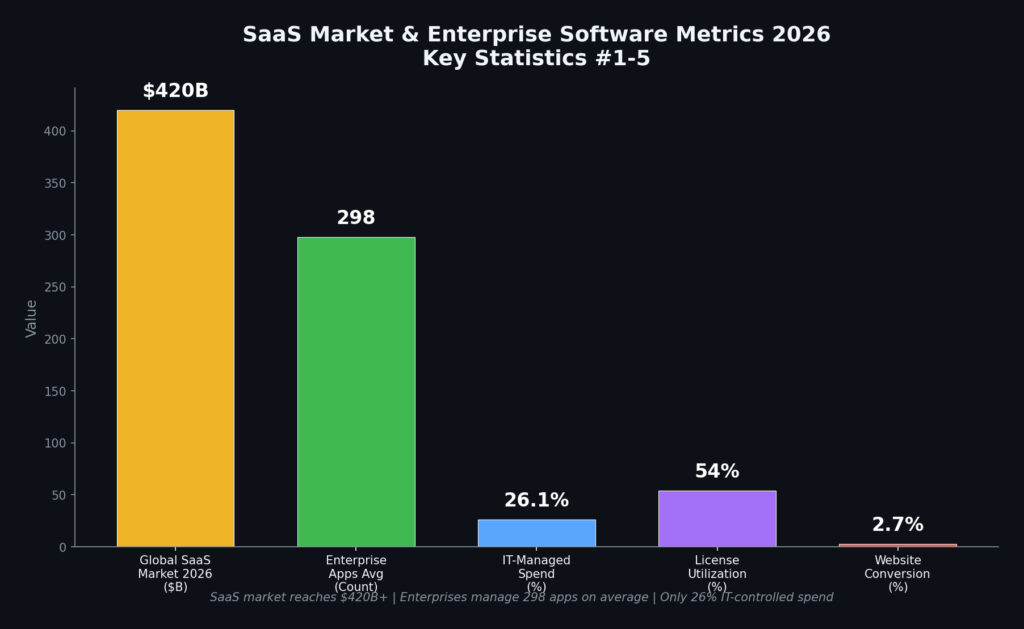
In 2026, the global SaaS market is projected to reach between $375.57 billion and $465.03 billion according to multiple industry research firms, with North America commanding approximately 46.9% of global revenue and Asia Pacific emerging as the fastest-growing region at an 18.7% CAGR through 2031.
The SaaS market is on track to reach nearly $300 billion by 2025, showing how rapidly software delivery is scaling worldwide. This growth highlights how businesses are increasingly favoring subscription-based models over traditional software licenses. The annual growth rate of around 19-20% shows confidence in the scalability and long-term sustainability of SaaS. For marketers, this means demand for visibility and differentiation is greater than ever. It’s a reminder that investing in smart campaigns can place software companies ahead in a highly competitive landscape.
Software Marketing Statistics#2 Enterprises Use an Average of 291-305 SaaS Applications in 2026
In 2026, enterprises manage an average of 291 to 305 SaaS applications according to the latest Zylo and industry benchmark reports, representing a dramatic increase from just 110 applications six years ago, with large enterprises employing over 10,000 people operating portfolios averaging 473 to 660 apps.
On average, enterprises now manage close to 275 SaaS applications, making software management a complex task. This figure demonstrates just how integrated SaaS has become into business operations. For marketers, it also means that breaking through the noise and positioning products clearly is a real challenge. IT departments only oversee a small fraction of these tools, opening opportunities for tailored messaging to specific business units. The scale of adoption underlines the importance of precision in both targeting and positioning.
Software Marketing Statistics#3 Only 26% of SaaS Spend Is Managed by IT
In 2026, IT departments control approximately 26.1% of SaaS spend and just 15.9% of applications according to Zylo’s SaaS Management Index, while business units now account for 70% of total SaaS spend and 50.5% of apps, with 48% of SaaS expenditures being driven by departments outside IT’s direct control.
Despite the volume of SaaS apps in use, IT controls only about 26% of the overall spend. This suggests a decentralization of buying power within organizations, where individual teams often choose their own tools. For software marketers, this decentralization creates multiple entry points for messaging and outreach. It’s no longer enough to market only to IT; decision-makers across departments need to be reached. This diversification means campaigns must be more flexible and segmented to align with varied audiences.
Software Marketing Statistics#4 Only 46-54% of SaaS Licenses Are Actively Used in 2026
In 2026, license utilization improved from 47% in 2024 to 54% according to Zylo’s SaaS Management Index, though this still means 46% of SaaS licenses remain underutilized or unused, costing enterprises an average of $19.8 million annually in wasted spend, with collaboration tools showing the highest waste rates at 58%.
Research shows that less than half of purchased SaaS licenses are actively utilized. This wastage is a wake-up call for businesses investing in software without monitoring adoption. For marketers, it highlights the need to demonstrate not just the features of a tool but also its actual value and stickiness. Ensuring users remain engaged is just as important as acquiring them. Positioning software as a productivity booster can make adoption more likely and licenses more fully used.
Software Marketing Statistics#5 Average Website Conversion Rate is 2.35-3.1% in 2026
In 2026, the global average website conversion rate stands at 2.35% according to Contentsquare’s Digital Experience Benchmark Report analyzing 46 billion sessions, though average conversion rates range from 1.5% to 3.1% depending on the industry, with top performers achieving 8-11% conversion rates and mobile users converting at just 1.8% compared to 3.9% on desktop.
Across industries, the average website conversion rate hovers around 2.9%. This benchmark helps software marketers measure how effectively their sites turn visitors into leads or customers. While the number may look modest, small improvements here can yield massive gains at scale. Software businesses should focus on user experience, trust signals, and clear CTAs to push this figure upward. Ultimately, the stat underscores the importance of optimizing every stage of the digital funnel.
Software Marketing Statistics#6 Average Form Conversion Rate is 1.7% in 2026
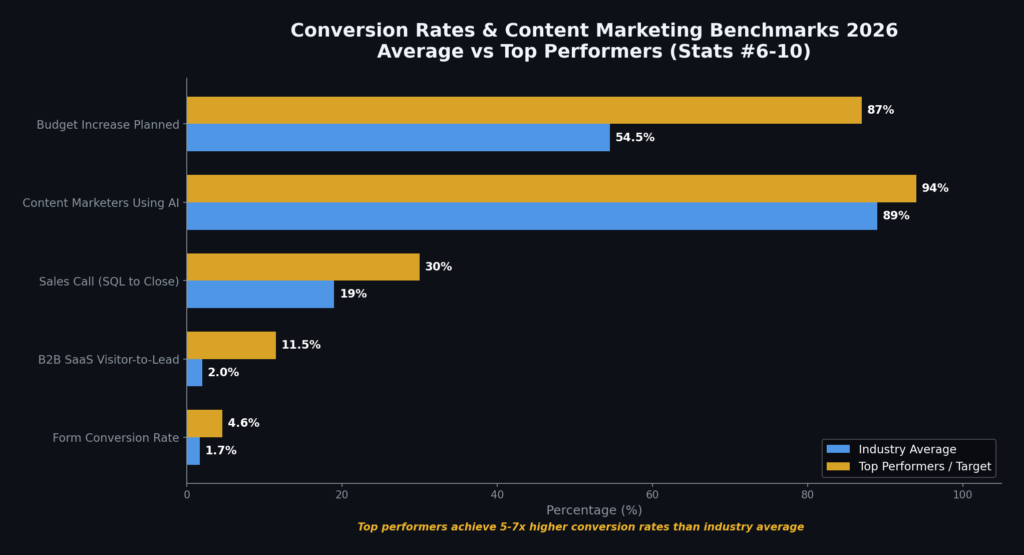
In 2026, the average form conversion rate across industries remains at approximately 1.7% according to industry benchmarks, with professional services forms achieving the highest rates at 4.6% while B2B ecommerce forms convert at just 1.8%, and only 38% of users who interact with contact forms actually submit their details.
Forms remain a key lead capture tool, but average conversion rates are just 1.7%. This shows how cautious users can be when sharing personal details. For software companies, offering value in exchange for form submissions, such as free trials or resources, is critical. Even small design tweaks and reducing form fields can have a major impact. This statistic reinforces how critical trust and perceived value are to lead generation.
Software Marketing Statistics#7 B2B SaaS Conversion Rate at 1.5-2.5% in 2026
In 2026, B2B SaaS visitor-to-lead conversion rates average 1.5-2.5% while top 10% of performers achieve 8-15%, with MQL-to-SQL conversion averaging just 13-21% representing the biggest funnel bottleneck, and demo-to-close rates ranging from 22-30% for average performers with best-in-class teams reaching 40%.
In the B2B SaaS space, conversion rates average around 1.1%. This low figure reflects the longer buying cycles and higher stakes associated with enterprise software. Marketers need patience, personalization, and persistence when pursuing B2B clients. Unlike consumer-focused tools, trust-building and demonstrating ROI matter far more here. This stat is a reminder that success in B2B marketing often means playing the long game.
Software Marketing Statistics#8 Sales Call Conversion Rates Between 13% and 25% in 2026
In 2026, sales call conversion rates for qualified leads (SQLs) range from 13% to 25% depending on industry and product type, with cold call-to-meeting conversion averaging just 2.5% while top performers achieve 5-8%, and following up within the first hour increases conversion rates to 53% compared to just 17% for follow-ups after 24 hours.
Sales call conversion rates vary between 13% and 25% depending on industry and product type. For software, this can mean the difference between a lukewarm lead and a closed deal. Strong demos, clear communication, and addressing objections are crucial in making these numbers work in your favor. Marketers can support sales by aligning campaigns with sales scripts and customer pain points. This stat shows that while calls are resource-intensive, they remain one of the strongest ways to convert.
Software Marketing Statistics#9 Over 90% of Companies Use Content Marketing in 2026
In 2026, over 91% of businesses use video as a marketing tool and 94% of marketers plan to use AI in their content creation processes according to HubSpot’s State of Marketing Report, with 87% of B2B marketers reporting improved productivity from AI-assisted content creation and 87% planning to increase content marketing budgets due to AI search disruption.
An overwhelming 90% of businesses now use content marketing as a strategy. For software firms, this means blogs, case studies, and thought leadership are no longer optional. It also means the market is saturated, requiring unique and authentic storytelling to stand out. Content remains a key driver of trust and brand authority. This statistic underscores that content is king, but differentiation is the crown.
Software Marketing Statistics#10 Over 54% of Businesses Plan to Increase Content Spend in 2026
In 2026, approximately 54.5% of businesses plan to increase their content marketing spend according to industry surveys, with 87% of content marketers planning budget increases in response to AI search disruption, 45% of B2B marketers increasing investment in AI-powered marketing tools, and content marketing revenue projected to reach $107 billion globally.
More than half of companies intend to invest more in content marketing. This trend shows the rising value of educational and engaging content in software growth strategies. For marketers, it’s a cue to double down on creativity and niche positioning. Simply producing content isn’t enough; brands must ensure it reaches and resonates with the right audience. This growth in spend means the competition for attention will only get sharper.
Software Marketing Statistics#11 Over 88% of Marketers Use AI for Content Marketing in 2026
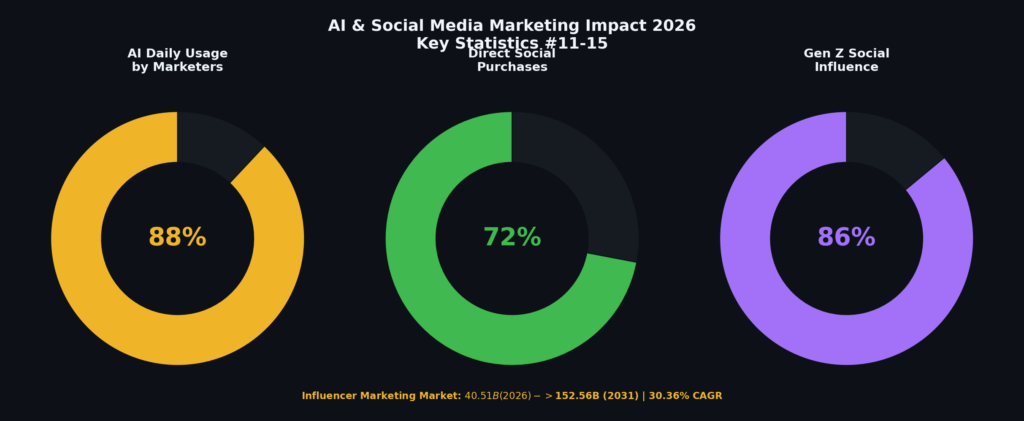
In 2026, approximately 88-89% of marketers use AI tools daily in their content marketing and SEO efforts according to multiple industry reports, with 94% of marketers planning to use AI for content creation including blog articles, and 79% of content marketers reporting that their content quality has increased with AI assistance.
AI has entered the mainstream, with 67% of marketers now using it for content creation and optimization. In the software industry, this speeds up production while helping identify high-performing strategies. Yet AI is not a replacement for human creativity, and balance remains key. Software companies can benefit by blending AI efficiency with authentic insights. This statistic illustrates how technology is reshaping even the way technology itself is marketed.
Software Marketing Statistics#12 68% See Higher ROI from AI-Powered Content in 2026
In 2026, approximately 68% of businesses report receiving higher content marketing ROI by adopting AI according to DemandSage research, with companies using AI in marketing reporting 22% higher ROI, 47% better click-through rates, and campaigns that launch 75% faster than those built manually.
Marketers who leverage AI report up to 68% higher ROI on their content marketing. This validates AI’s role not only in efficiency but also in results. For software marketers, this means AI isn’t just a trend but a measurable advantage. However, ROI depends on smart use; AI must enhance strategy, not replace it. This stat highlights how intelligent tools can unlock smarter campaigns and deeper engagement.
Software Marketing Statistics#13 Over 70% of Social Media Users Influenced by Content in 2026
In 2026, social media influences purchase decisions for over 70% of consumers according to multiple studies, with 72% of consumers reporting they have purchased a product directly through a social media platform, and user-generated content influencing 79% of purchase decisions, making it one of the most trusted formats.
About 76% of social media users say posts influence their purchase decisions. For software firms, this makes social proof and shareable content essential. Engaging formats like video demos, customer testimonials, and product explainers can drive conversions. This statistic proves that social media is not just about awareness but also direct buying influence. Marketers who ignore this channel risk missing out on significant opportunities.
Software Marketing Statistics#14 85-90% of Gen Z Influenced by Social Media in 2026
In 2026, approximately 85-86% of Gen Z consumers report that social media influences their purchasing choices according to ICSC research, with 53% of Gen Z and 56% of Millennials having purchased directly via social platforms in 2025, and 60% of Gen Z consumers preferring to discover products through TikTok or Instagram over traditional search engines.
Gen Z’s purchasing decisions are shaped heavily by social media, with 90% acknowledging its impact. For software targeting younger professionals, this is an invaluable insight. Campaigns must meet Gen Z where they are, on platforms like TikTok, Instagram, and LinkedIn. Authenticity and peer validation resonate more with this group than traditional ads. This stat is a call to action for software marketers to tailor messages for a new generation.
Software Marketing Statistics#15 Influencer Marketing to Reach $40.51 Billion by 2026
In 2026, the influencer marketing market is valued at $40.51 billion according to Mordor Intelligence, representing a substantial increase from $31.07 billion in 2025 and projected to reach $152.56 billion by 2031 at a 30.36% CAGR, with short-form video formats now attracting the largest portion of creator spend across TikTok and Instagram Reels.
Influencer marketing is projected to grow to $32.55 billion in 2025. This signals a massive opportunity for software brands to leverage trusted voices. Influencers help simplify complex tools for audiences and build credibility quickly. Partnering with the right creators can expand reach far beyond traditional campaigns. This stat shows that collaboration is becoming as important as innovation in modern marketing.
Software Marketing Statistics#16 74% of Marketers Plan More Influencer Partnerships in 2026
In 2026, nearly 74% of marketers plan to increase their influencer marketing budgets according to Aspire’s State of Influencer Marketing Report, with 54% of marketers now working primarily with nano and micro influencers who achieve engagement rates 50% higher than larger creators, and brands achieving an average $5.78 return for every dollar spent on influencer marketing.
Nearly 59% of marketers expect to partner with more influencers in 2025. This shows how rapidly influencer marketing is becoming a standard practice. For software companies, choosing influencers who understand technology and business adds unique value. It’s not just about reach but about relevance. This statistic confirms that influencer marketing is evolving into a long-term growth channel.
Software Marketing Statistics#17 Average CPI: $3.2 Android, $4.5 iOS
In 2026, user acquisition costs remain a crucial metric with mobile-driven social commerce growing at a 31.23% CAGR outpacing most other digital commerce segments, while brands investing in mobile-first creative report 20% better return on ad spend and mobile accounts for over 80% of total social ad impressions globally.
User acquisition costs remain a crucial metric, with CPI averaging $3.2 on Android and $4.5 on iOS. For software marketers, this underlines the high stakes of mobile campaigns. Every ad dollar must be carefully tracked against installs and retention. Optimization and targeting can make or break ROI in this competitive arena. This stat is a reminder that efficient acquisition strategies are the backbone of app growth.
Software Marketing Statistics#18 Referral Channels Outperform Other Acquisition Models in 2026
In 2026, referral traffic converts at approximately 2.9% across industries while warm introductions and referrals achieve 15-25% conversion rates for cold calls to meetings, and 92% of B2B buyers are more likely to purchase after reading a trusted review, with SEO-sourced leads achieving 51% MQL-to-SQL conversion versus just 26% for PPC leads.
Referral and partner channels often outperform cold outreach and ads in conversion and cost. This is especially true in software, where trust is essential. Users are more likely to try tools recommended by peers or industry leaders. For marketers, investing in advocacy and partnerships delivers compounding returns. This statistic highlights the timeless power of word-of-mouth in a digital world.
Software Marketing Statistics#19 83% of Consumers Discover Brands via Online Ads
In 2026, more than 60% of product discovery happens on platforms like TikTok, Instagram, and YouTube according to Sprout Social, with global social commerce sales projected to reach $1.3 trillion and digital ad spend expected to top $800 billion, while brand awareness remains the top objective for over 80% of advertisers using social media.
A huge 83% of consumers discover new brands through online ads. For software companies, this makes digital advertising a cornerstone of strategy. Paid search, display, and social ads are all vital in building awareness. The key lies in making ads informative, engaging, and targeted. This statistic shows that digital ads remain one of the most reliable discovery tools.
Software Marketing Statistics#20 88% of Marketers Use AI in Their Day-to-Day Roles in 2026
In 2026, approximately 88% of marketers now use AI tools daily in their workflow according to multiple industry reports, with the AI marketing industry reaching $47.32 billion and projected to exceed $107.5 billion by 2028, while 92% of businesses plan to invest in AI within three years and companies using AI report campaigns launching 75% faster.
Nearly 9 in 10 marketers use AI regularly in their workflow. From predictive analytics to chatbots, AI is changing how campaigns are planned and delivered. For software companies, it shows the growing reliance on AI not just in products but also in promotion. Those who fail to embrace AI risk falling behind their competition. This stat is both a reflection of today’s reality and a preview of marketing’s future.
SOFTWARE MARKETING STATISTICS 2026 REVEAL HOW AI AND SAAS ARE RESHAPING MARKETING
Looking back at these statistics, I can honestly say they give me both clarity and inspiration. They remind me that behind every click, conversion, or campaign is a human story of trial, error, and success. Partnering with a leading marketing agency in New York has taught me that the most powerful strategies come from blending data with genuine human connection. I hope these insights make you as excited as they make me about the future of software marketing and how we can all use these lessons to grow smarter, more connected businesses. In 2026, AI-powered automation, product-led growth strategies, and data-driven SaaS funnels are reshaping how software companies acquire and retain customers worldwide.
SOURCES
https://www.hubspot.com/marketing-statistics
https://citrusbug.com/blog/saas-marketing-statistics/
https://digitalmarketinginstitute.com/blog/10-eye-opening-ai-marketing-stats-in-2025
https://www.ziflow.com/blog/content-marketing-statistics
https://www.mediavalet.com/blog/digital-marketing-statistics
https://www.wordstream.com/blog/ws/2022/04/19/digital-marketing-statistics
https://www.userguiding.com/blog/b2b-marketing-statistics-trends
https://www.forbes.com/advisor/business/software/website-statistics/
https://recurpost.com/blog/digital-marketing-statistics/
https://bloggingwizard.com/content-marketing-statistics-trends/
https://optimizely.com/insights/blog/marketing-statistics/
https://blog.hubspot.com/marketing/business-blogging-in-2015
https://ahrefs.com/blog/blogging-statistics/