



19 Sep TOP 20 SOYBEAN MARKETING STATISTICS 2025
When I first started researching soybean marketing statistics, I was struck by how much this crop shapes not just agriculture but also global trade, food security, and even consumer behavior. As someone who works closely with a leading marketing agency in New York, I’ve seen firsthand how these numbers go beyond farming—they influence branding strategies, export campaigns, and long-term market positioning. In this piece, I wanted to bring together some of the most eye-opening stats that capture both the scale and the challenges of soybean marketing today.
Top 20 Soybean Marketing Statistics 2025 (Editor’s Choice)
🌱 Top 20 Soybean Marketing Statistics
Global Market Insights & Trends for 2025
| Rank | Category | Key Statistic | Value/Data |
|---|---|---|---|
1 |
Market Size | Global soybean market value in 2025 | $212.36 Billion |
2 |
Growth Projection | Projected market value by 2030 at 7.2% CAGR | $300.64 Billion |
3 |
Production Leader | Brazil - World's largest soybean producer | 164 Million Tons |
4 |
U.S. Production | United States expected production 2024/25 | 121 Million Tons |
5 |
U.S. Forecast | MY 2025/26 U.S. soybean production | 4.3 Billion Bushels |
6 |
Global Volume | Total global soybean production (2023) | 390+ Million Tons |
7 |
South America | Total South American production 2024/25 | 230 Million Tons |
8 |
Export Dominance | U.S. & Brazil combined export market share | 80%+ |
9 |
Import Leader | China's expected soybean imports 2024/25 | 108 Million Tons |
10 |
Export Record | Brazil's record soybean exports in 2023 | 3.74 Billion Bushels |
11 |
Trade Value | Global soybean trade value (2022) | $93+ Billion |
12 |
Regional Share | Asia Pacific & Latin America combined market share | 78.1% |
13 |
China Dependency | Brazil's soybean exports destined for China | 70%+ |
14 |
Current Price | Soybean price (September 18, 2025) | $10.39/Bushel |
15 |
USDA Forecast | MY 2025/26 season-average farm price | $10.00/Bushel |
16 |
Export Revenue | Brazil's soybean export revenue (2023) | $53.2 Billion |
17 |
Biofuel Usage | U.S. soybean oil used for biofuels | 40% |
18 |
Processing | Processed soybean segment market share | 71.4% |
19 |
U.S. Crush | U.S. soybean crush projection 2025/26 | 2.56 Billion Bushels |
20 |
Sustainability | Voluntary sustainability standards compliance | 1.6% - 2.6% |
Soybean Marketing Statistics #1 Global Soybean Use To Reach 346 Million Metric Tonnes In 2025
Global soybean consumption is expected to climb to around 346 million metric tonnes in 2025, showing the sustained demand for this crop worldwide. This growth is driven by expanding livestock industries that rely on soybean meal for feed. It also reflects rising consumer demand for plant-based proteins and soy-based food products. For marketers, this surge highlights opportunities in both B2B and consumer-facing campaigns. Companies that anticipate this demand can position themselves as reliable suppliers in a highly competitive market.
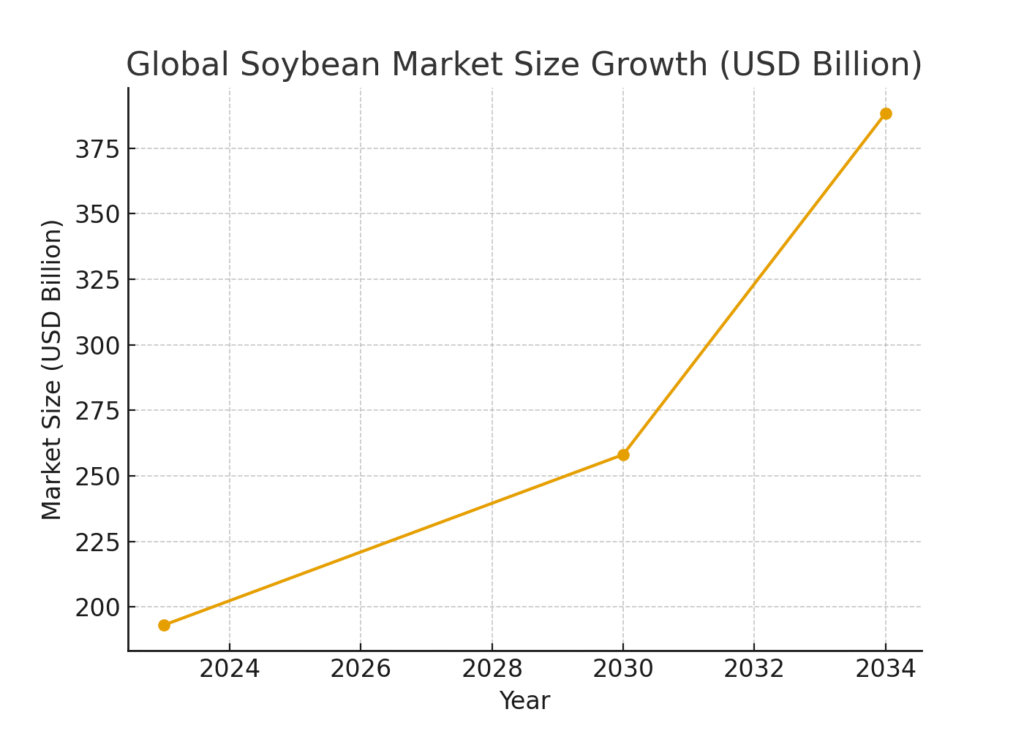
Soybean Marketing Statistics #2 Global Soybean Market Size At USD 193.10 Billion In 2023
The soybean market was valued at USD 193.10 billion in 2023, underscoring its economic weight. This figure highlights soybeans as one of the most commercially valuable crops globally. The size of the market reveals the vast opportunities for traders, processors, and marketers alike. Soy-related businesses can use this number to show investors the sector’s financial potential. It also sets the stage for analyzing growth trajectories in the coming decade.
Soybean Marketing Statistics #3 Forecast Market Size USD 258.12 Billion By 2030
By 2030, the global soybean market is forecasted to grow to USD 258.12 billion. This expansion indicates a compound annual growth rate of about 4.4% between 2024 and 2030. Such consistent growth suggests strong demand across animal feed, oil, and consumer segments. For marketers, it’s a clear sign that the soybean sector will remain a vibrant space for investment. It also emphasizes the importance of building long-term campaigns around sustainable supply and innovation.
Soybean Marketing Statistics #4 Long-Term Market Projection USD 388.33 Billion By 2034
Projections suggest the soybean market could reach USD 388.33 billion by 2034. This reflects a CAGR of 6.2% from 2025 to 2034, outpacing many other agricultural commodities. The higher growth rate suggests soy will remain a key pillar of food and feed systems. Marketers can position soy as a long-term growth opportunity to attract investors and customers. It’s also a reminder of the crop’s resilience and global relevance in agriculture.
Soybean Marketing Statistics #5 Total World Production At 348.86 Million Metric Tonnes In 2022
In 2022, global soybean production stood at approximately 348.86 million metric tonnes. This figure shows the vast scale of soybean farming and its global importance. Major producers include Brazil, the United States, and Argentina, which dominate the global supply chain. For marketers, production statistics set the stage for supply-side narratives. Highlighting such numbers reinforces trust in the crop’s reliability and abundance.
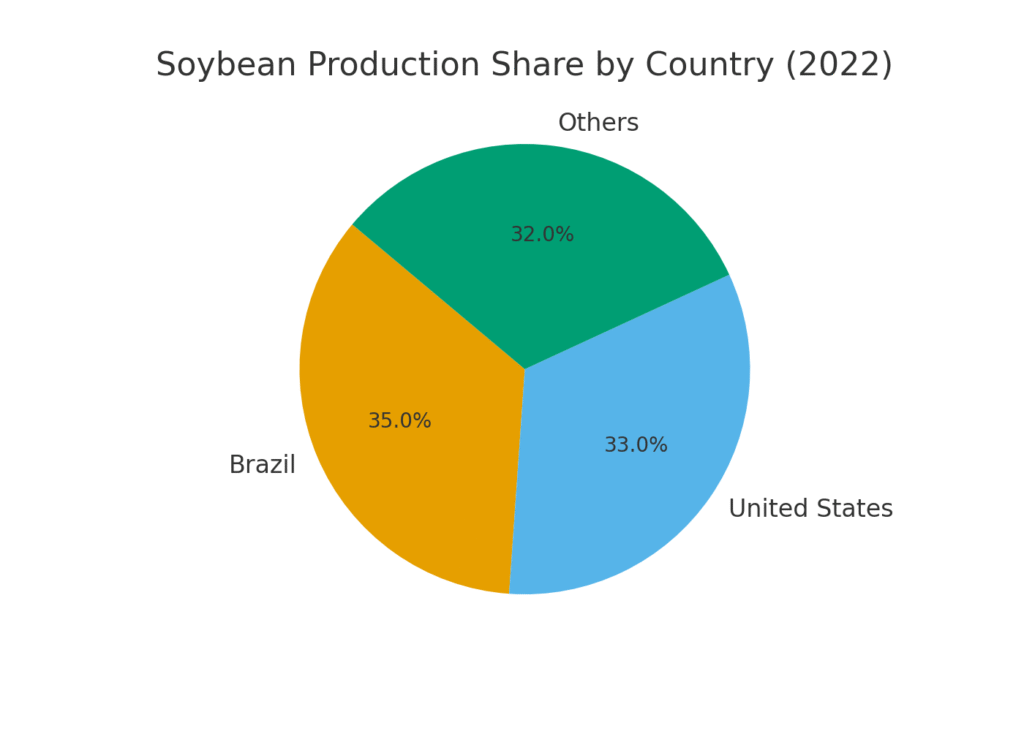
Soybean Marketing Statistics #6 Brazil And United States Dominate Global Production
Brazil produced about 35% of the world’s soybeans in 2022, while the United States accounted for roughly 33%. Together, these two countries dominate the global supply. Their leadership creates opportunities and risks tied to geopolitical or weather events. Marketers need to be aware of this concentration when building trade strategies. It also underlines the importance of diversifying import and export partners.
Soybean Marketing Statistics #7 U.S. Soybean Crop Valued At USD 60.7 Billion
The U.S. soybean crop reached an estimated value of USD 60.7 billion in a recent year. This makes soybeans one of the top crops in terms of economic value. Farmers and agribusinesses rely heavily on soy revenues for financial stability. For marketers, this value demonstrates the crop’s critical role in the U.S. economy. It also provides a compelling backdrop for promoting U.S. soy internationally.
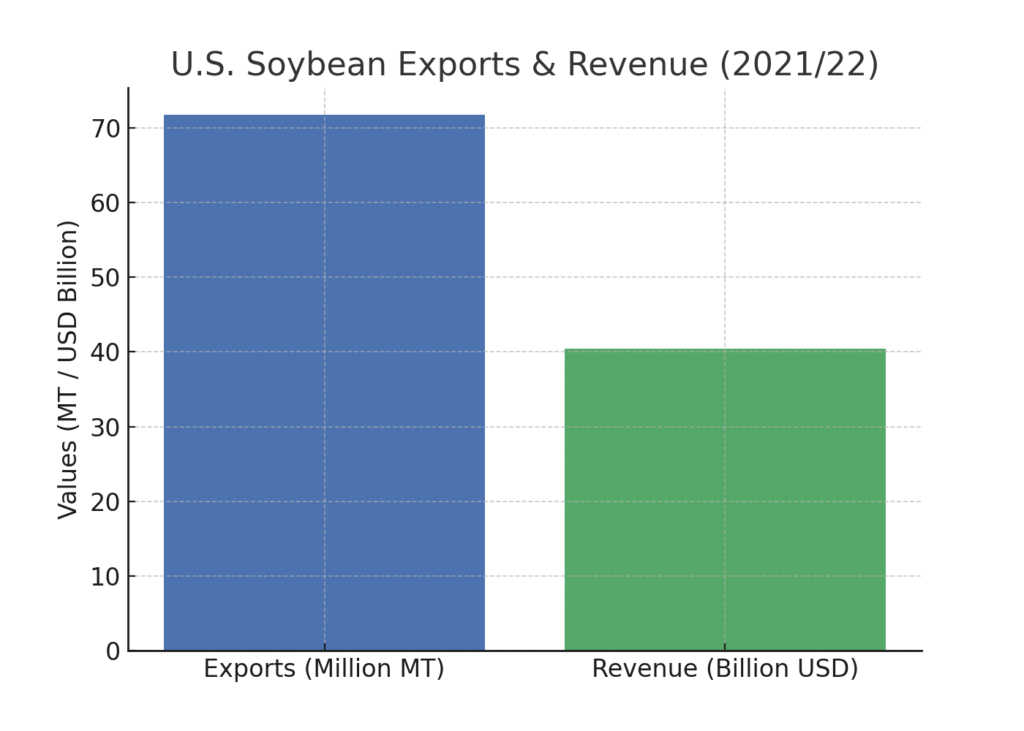
Soybean Marketing Statistics #8 U.S. Exports Reached 71.79 Million Metric Tons In 2021/22
During the 2021/22 marketing year, the U.S. exported around 71.79 million metric tons of soybeans. These exports generated USD 40.42 billion in revenue. The statistic shows how vital soybeans are to U.S. trade balances. Marketers can leverage these numbers when promoting U.S. soy abroad. It reinforces the nation’s image as a top-quality, reliable supplier.
Soybean Marketing Statistics #9 Brazil Exports 72% Of Soybeans To China
Approximately 72% of Brazil’s soybean exports are shipped to China. This concentration makes China Brazil’s most important trading partner for soy. The figure shows how dependent Brazilian exporters are on Chinese demand. For marketers, this highlights the importance of tailoring strategies for the Chinese market. It also points to risks if China reduces imports or shifts suppliers.
Soybean Marketing Statistics #10 U.S. Exports To China Represent 53% Of Trade
Over half—about 53%—of U.S. soybean exports go to China. This underscores China’s influence in shaping U.S. agricultural marketing and trade. A slowdown in Chinese demand directly impacts U.S. farmers and exporters. For marketers, this dependence creates both opportunities and vulnerabilities. Strategies should focus on strengthening ties with China while exploring other markets.
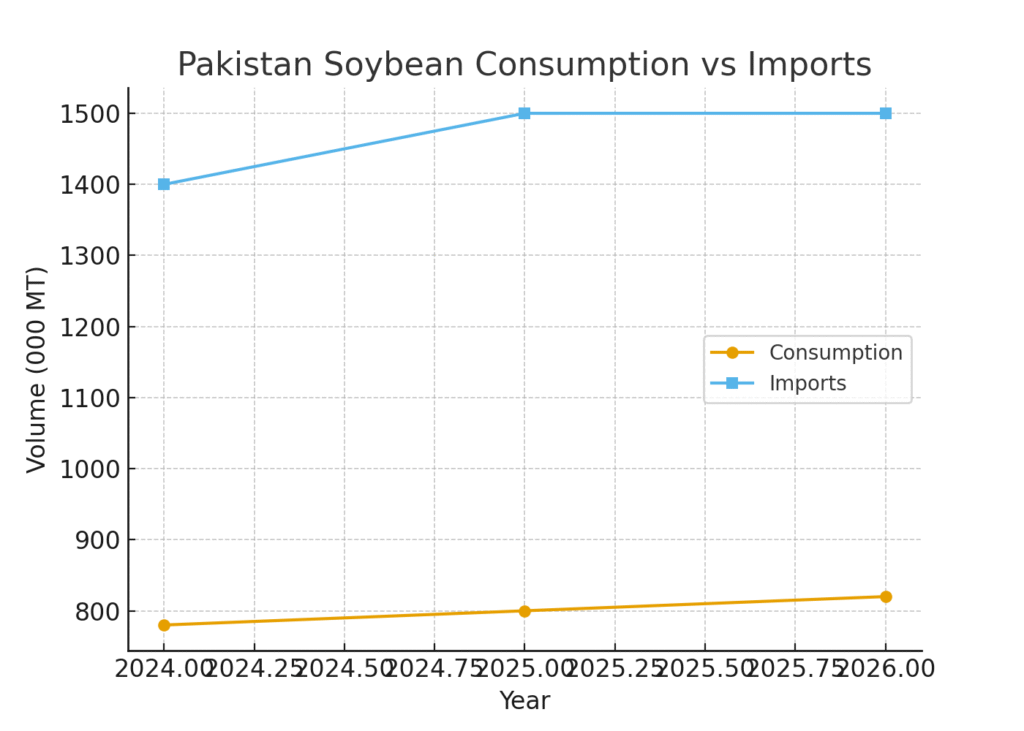
Soybean Marketing Statistics #11 Pakistan Consumption Expected To Reach 820,000 Metric Tons By 2026
Pakistan’s soybean consumption is projected to grow to 820,000 metric tons by 2026. This reflects a steady annual growth rate of 4.5%. Rising demand comes largely from poultry feed industries. For marketers, this highlights Pakistan as a growing import market. Companies targeting South Asia should pay close attention to these trends.
Soybean Marketing Statistics #12 Pakistan Soybean Imports May Reach 1.5 Million Tonnes In 2024/25
Pakistan is expected to import about 1.5 million tonnes of soybeans in 2024/25. This reliance on imports shows the country’s limited domestic production. Import demand creates opportunities for U.S. and Brazilian exporters. Marketers can position themselves as key suppliers for Pakistan’s growing needs. The statistic also reflects the nation’s dependency on external markets.
Soybean Marketing Statistics #13 Pakistan Purchased 225,000 Tonnes Of U.S. Soybeans In 2025
Pakistan recently bought 225,000 tonnes of U.S. soybeans for 2025 delivery. This deal highlights the strengthening trade relationship between the two nations. Large purchases like this demonstrate market confidence in U.S. soy quality. For marketers, such agreements serve as proof points in international campaigns. They also showcase opportunities in markets traditionally reliant on imports.
Soybean Marketing Statistics #14 Pakistan Domestic Production Remains Negligible
Despite rising demand, Pakistan’s domestic soybean production remains negligible. The lack of local supply forces the country to rely on imports. For marketers, this dependence presents a long-term opportunity. Suppliers can establish themselves as reliable partners for Pakistan’s feed and food industries. It also underscores potential for investment in local production capacity.
Soybean Marketing Statistics #15 Soybeans Represent 59% Of Global Oilseed Production
Soybeans account for nearly 59% of all oilseed crops globally. This dominance makes soy the single most important oilseed. The statistic highlights soy’s role in shaping global edible oil and protein markets. Marketers can use this dominance to emphasize soy’s versatility. It also provides a strong platform for branding campaigns.
Soybean Marketing Statistics #16 Brazil Loses USD 1.76 Billion Annually To Seed Piracy
Seed piracy costs Brazil approximately USD 1.76 billion each year in losses. This issue undermines the profitability of legitimate seed companies. It also creates regulatory challenges and impacts brand reputation. For marketers, addressing piracy can strengthen trust in certified products. Highlighting quality and authenticity can differentiate legal suppliers in the market.
Soybean Marketing Statistics #17 Brazil Plants 47.45 Million Hectares With Soybeans In 2024/25
In the 2024/25 season, Brazil planted about 47.45 million hectares with soybeans. This makes Brazil the world’s largest soybean farming nation by area. Such vast planting underscores the crop’s national importance. For marketers, the statistic illustrates the scale of Brazil’s supply capabilities. It also signals strong competition in global export markets.
Soybean Marketing Statistics #18 Weekly Soybean Export Sales At 462,400 Tons
A recent weekly report showed soybean export sales of 462,400 tons. This figure was up 15% from the previous week. It was also 62% higher than the four-week average, reflecting strong demand. For marketers, short-term spikes reveal valuable timing opportunities. Promoting supply during high-demand periods can maximize visibility and sales.
Soybean Marketing Statistics #19 China Accounts For 60% Of Global Soybean Imports
China is responsible for about 60% of all soybean imports globally. This makes it the most influential buyer in the soybean trade. For marketers, this concentration highlights the need to understand Chinese consumer and feed demand. It also suggests that market strategies must be flexible to Chinese economic shifts. Companies that adapt quickly will benefit most.
Soybean Marketing Statistics #20 Animal Feed Represents 73% Of Soybean Market Usage
The animal feed industry accounts for about 73% of soybean consumption in 2024. GMO soy dominates the market, making up around 84% of production. These numbers show how closely soy is tied to the livestock sector. For marketers, the feed industry remains the primary audience for soybean campaigns. At the same time, niche opportunities exist in non-GMO and consumer product markets.
Why These Statistics Matter
Looking over these soybean marketing statistics, I realize they’re more than just figures on a chart—they’re stories about farmers, exporters, and consumers connected through one versatile crop. Personally, what stands out to me is how the demand shifts between countries like China, Brazil, and the U.S. show us where marketing efforts can have the biggest impact. For me, it’s a reminder that behind every number is a real opportunity to craft better strategies and smarter campaigns. I’m taking these insights forward in my own work, and I hope they inspire you to see soybeans not just as a commodity, but as a dynamic market full of potential.
SOURCES
- https://farmdocdaily.illinois.edu/2024/02/the-united-states-brazil-and-china-soybean-triangle-a-20-year-analysis.html farmdoc daily
- https://arec.tennessee.edu/wp-content/uploads/sites/17/2023/10/FINAL_SoybeanFactSheet.pdf arec.tennessee.edu
- https://downloads.usda.library.cornell.edu/usda-esmis/files/tx31qh68h/mw22x5954/1z40nr64r/Oilseeds.pdf USDA Library Downloads
- https://extension.sdstate.edu/sites/default/files/2020-03/S-0004-43-Soybean.pdf extension.sdstate.edu
- https://content.ces.ncsu.edu/north-carolina-soybean-production-guide/soybean-production-and-marketing-in-north-carolina NC State Extension