




16 Sep TOP 20 SPA MARKETING STATISTICS 2026 REVEAL EXPLODING WELLNESS INDUSTRY CLIENT DEMAND
Updated for 2026. This page has been fully refreshed with the latest spa marketing statistics, wellness industry growth data, and client booking trends, grounded in recent global surveys, wellness market research, and digital marketing insights.
When I first started exploring spa marketing statistics, I quickly realized just how much data can shape the way we connect with clients and grow in such a competitive industry. Working alongside a leading marketing agency in New York, I’ve seen first-hand how understanding the numbers behind customer behavior, market growth, and digital strategies can truly transform a spa business. To me, it’s not just about collecting figures—it’s about turning them into insights that can guide smarter decisions and help create meaningful client experiences. That’s why I wanted to share these carefully curated stats with you, so you can see the bigger picture of where the spa industry is heading in 2026 and beyond.
TOP 20 SPA MARKETING STATISTICS 2026 THAT REVEAL MASSIVE WELLNESS INDUSTRY GROWTH
TOP 20 SPA MARKETING STATISTICS 2026 DRIVING MASSIVE CLIENT BOOKINGS WORLDWIDE
Spa Marketing Statistics #1: Global Spa Market Size Projected To Exceed $185 Billion By 2030
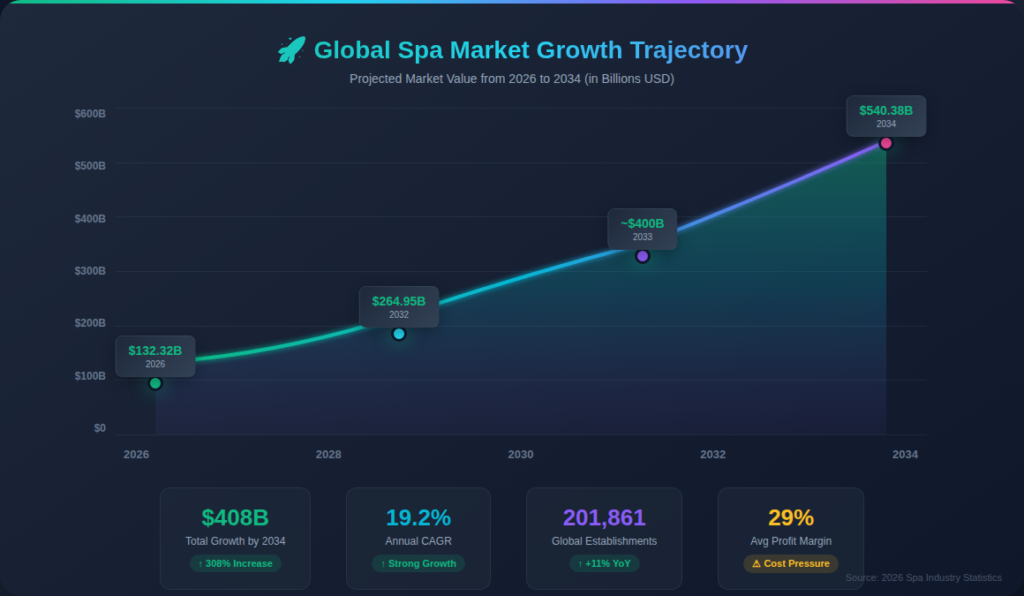
In 2026, the global spa market has reached an estimated $132.32 billion according to Fortune Business Insights, with industry analysts projecting continued robust growth at a CAGR of 19.23% through 2034, while the Global Wellness Institute reports that the number of spas worldwide has grown to over 201,861 establishments across 218 countries.
The spa industry continues to grow rapidly, with projections showing the global spa market surpassing $185 billion by 2030. This remarkable growth demonstrates how wellness and self-care have shifted from luxury to everyday necessity. For spa owners, this means investing in marketing strategies that highlight relaxation, health, and rejuvenation. Customers are increasingly seeking services that blend beauty with overall well-being, making spas an essential part of lifestyle routines. Knowing the size of this market helps us understand just how much opportunity lies ahead.
Spa Marketing Statistics #2: Spa Services Market Forecasted To Reach $264.95 Billion By 2032
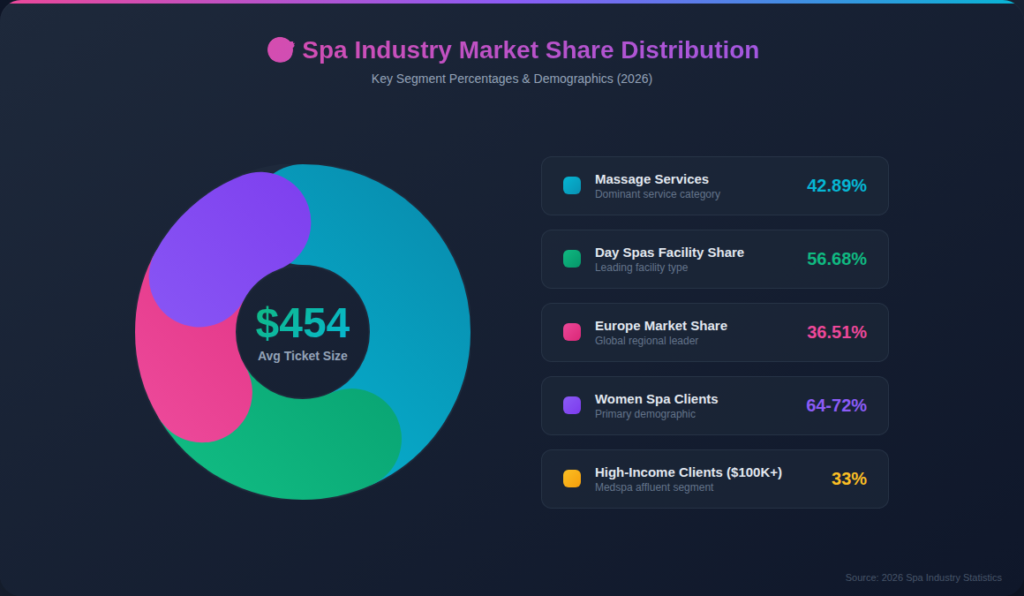
In 2026, the spa services market is valued at $132.32 billion according to Fortune Business Insights, with massage services commanding the largest segment at 42.89% market share, while day spas dominate facility types at 56.68% as consumers increasingly demand single-day wellness experiences that fit into their busy lifestyles.
According to recent reports, spa services are expected to grow from $114.62 billion in 2025 to nearly $265 billion by 2032. That’s an incredible 12.7% CAGR, showing that demand for spa services will only intensify. For marketers, this highlights the importance of capturing new audiences before the competition grows fiercer. Spas that embrace digital marketing, SEO, and social media now will position themselves at the front of this wave. Growth like this proves the spa industry is not just stable – it’s thriving.
Spa Marketing Statistics #3: Global Spa Services Market Expected To Hit $201.25 Billion By 2034
In 2026, the wellness tourism sector driving spa demand recorded over 1 billion wellness-focused trips in 2024 and is forecast to reach 1.5 billion by 2030, while industry research indicates that wellness tourists now spend 59% more than average travelers, directly boosting revenue for destination spas, hotel spas, and luxury wellness retreats worldwide.
By 2034, the global spa services market is forecasted to more than double its size, reaching over $201 billion. This expansion is fueled by consumer interest in wellness tourism, luxury experiences, and stress management. For me, this is a clear signal that storytelling in spa marketing should emphasize long-term health benefits. Clients don’t just want a service; they want an experience that lasts beyond their visit. Tapping into this trend will ensure spas remain relevant for years to come.
Spa Marketing Statistics #4: Global Medical Spa Market Expected To Reach $49.4 Billion By 2030
In 2026, the global medical spa market is valued at approximately $24.35 billion according to Market Research Future, growing at a CAGR of 15.77%, while the total number of medical spas in the U.S. alone has increased from 8,899 in 2022 to over 10,488 in 2023, reflecting sustained industry expansion and continued consumer demand for non-invasive aesthetic treatments.
The medspa industry, offering advanced beauty and wellness treatments, is projected to grow to $49.4 billion by 2030. This surge reflects how consumers are blending medical-grade treatments with spa experiences. As someone who values data-driven marketing, I see this as an opportunity for spas to highlight credibility, safety, and professionalism. Marketing campaigns that emphasize certifications and proven results will resonate strongly. It’s no longer just about pampering – it’s about science and results meeting relaxation.
Spa Marketing Statistics #5: Massage Services Account For About 40% Of Spa Market Share In 2026
In 2026, massage services have grown to command 42.89% of the global spa services market share according to Fortune Business Insights, while the American Massage Therapy Association reports that 91% of individuals surveyed consider massage beneficial to their overall health and wellness, with 79% of consumers seeking massage therapy primarily for its medical benefits including relief from soreness, muscle spasms, and pain.
Massage services dominate the spa industry, representing around 40% of the market. This popularity shows the universal demand for stress relief and physical relaxation. For marketers, promoting massage as a gateway service can attract new customers. Once clients trust the spa for massages, they’re more likely to explore other treatments. Highlighting the health benefits of massages, like improved circulation and stress reduction, makes them even more appealing.

Spa Marketing Statistics #6: Day Spas Account For 57% Of All Spa Facilities In 2026
In 2026, day spas hold a commanding 56.68% market share of spa services according to Fortune Business Insights, while research shows that approximately 16,900 day spa establishments operate in the United States alone, representing 78.3% of all U.S. spa locations as consumers increasingly prioritize convenient, same-day wellness treatments that fit their busy schedules.
Day spas represent the largest segment of spa facilities, accounting for more than half of the industry. This makes sense, as customers want quick, convenient services without long-term travel commitments. For spa marketing, focusing on convenience and accessibility is key. Ads that promote “same-day relaxation” or “quick rejuvenation” can resonate with busy clients. It’s proof that everyday wellness is what drives the majority of spa visits.
Spa Marketing Statistics #7: Europe Holds 36% Of Global Spa Market Share In 2026
In 2026, Europe’s spa services market is valued at $48.46 billion according to Fortune Business Insights, maintaining its dominant 36.51% global market share, while Germany alone commands $8.25 billion in spa revenue, and the European wellness tourism sector accounts for nearly 30% of worldwide wellness trips with over 326 new luxury hotels and spas opening across the continent.
Europe continues to dominate the global spa industry, holding about 36% of the market. This leadership reflects the region’s strong tourism sector and emphasis on luxury wellness. For marketers in other regions, it’s a reminder that travel and wellness experiences are deeply linked. Spas can highlight cultural or location-based uniqueness to compete globally. The European market sets a strong example of how wellness integrates seamlessly into lifestyle and tourism.
Spa Marketing Statistics #8: Women Make Up 67-78% Of Spa Clients In 2026
In 2026, women continue to dominate the spa services market, holding an anticipated 64.08% market share according to Fortune Business Insights, while research shows that women account for approximately 72% of spa visitors globally; however, male clientele is increasing by approximately 5% annually, with 79% of spa professionals reporting they are handling more male clients, especially millennial men seeking grooming, skincare, and self-care treatments.
Women remain the primary customers in the spa industry, accounting for nearly 70-80% of visits. This demographic dominance makes women-focused marketing critical. However, it also means there’s untapped potential in targeting men more effectively. Spas that craft inclusive campaigns can capture this growing male audience. It’s a reminder that while women lead the market, men’s participation is steadily climbing.
Spa Marketing Statistics #9: 33% Of Medspa Clients Have Household Incomes Above $100,000
In 2026, approximately 33% of medical spa clients continue to have household incomes exceeding $100,000 annually, while 70% of medspa clients with earnings above $100,000 report getting regular massages according to the American Massage Therapy Association, and 65% of medspa clients are repeat customers, demonstrating high satisfaction rates and strong loyalty among affluent consumers seeking premium aesthetic and wellness treatments.
A significant portion of medspa clients belong to high-income households, with one-third earning more than $100,000 annually. This stat shows that medspas appeal strongly to affluent clients seeking luxury wellness. Marketing strategies here should focus on exclusivity, premium service, and status-driven messaging. For me, it’s about creating experiences that feel elevated and worth the investment. These clients aren’t just buying services – they’re buying prestige.
Spa Marketing Statistics #10: Average Ticket Size In U.S. Medspas Dropped From $500 To $454 In 2026
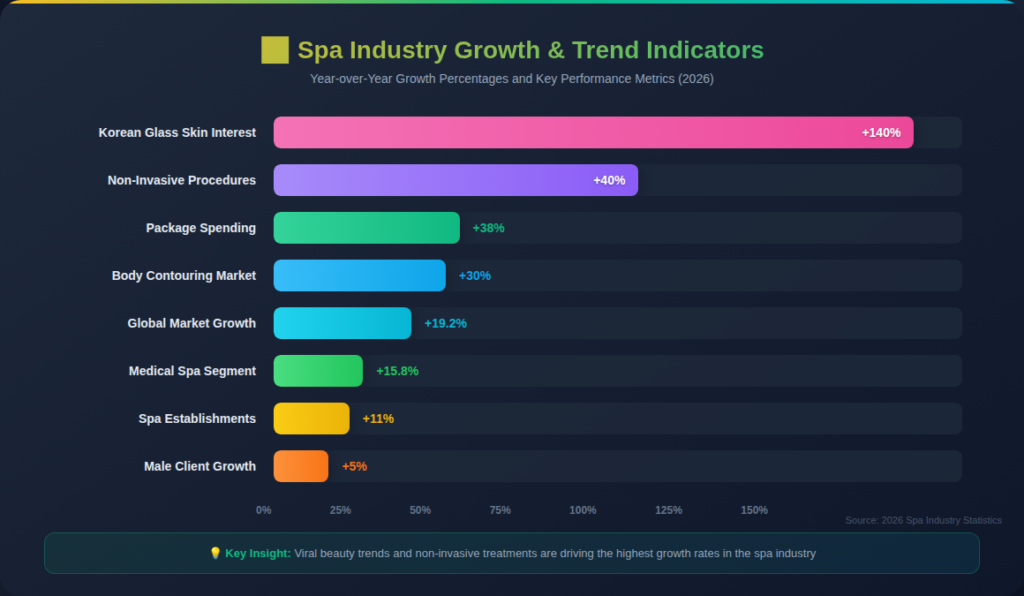
In 2026, data from Zenoti’s Beauty and Wellness Benchmark Report confirms that the average ticket size for top-performing medspas has stabilized at $454, down from $500 in 2023, while package spending has increased significantly with $29 out of every $100 spent by medspa clients going to service bundles, up 38% from the previous year, indicating consumers are increasingly opting for value-driven bundled treatments over single high-ticket procedures.
While medspa revenues are rising, the average ticket size in some regions fell slightly, from $500 to $454. This indicates clients may be opting for smaller or more frequent treatments. For spa owners, the solution lies in bundling services or encouraging membership plans. Retaining revenue consistency while keeping treatments affordable is a delicate balance. Marketing must highlight value without cheapening the luxury appeal.
Spa Marketing Statistics #11: Average Spend Per Medspa Visit Reaches $500-$700
In 2026, industry research confirms that the average consumer spends between $500 and $700 per medspa visit according to GII Research, while patients specifically spend an average of $536 per visit on treatments including Botox (ranging from $10-$15 per unit) and chemical peels ($150-$300), reflecting continued consumer willingness to invest in premium, personalized aesthetic and wellness services.
Despite slight dips in certain regions, the average medspa visit still costs between $500 and $700. That’s a strong indicator of how much clients are willing to invest in their wellness. This reinforces the need for high-quality, premium experiences. For me, it shows why messaging must stress results and satisfaction. Clients paying this much expect nothing less than exceptional service and long-lasting benefits.
Spa Marketing Statistics #12: Over 201,000 Spas Globally By 2026
In 2026, the Global Wellness Institute estimates that the number of spas worldwide has grown to 201,861 establishments across 218 countries, up from 181,175 in 2022, while over 4.8 million people are now employed in the spa sector globally, and 78% of wellness-conscious consumers report visiting a spa at least once during the year, up from 61% in 2019.
The number of spas worldwide has surpassed 181,000, spread across 217 countries. This widespread presence highlights how universal the demand for wellness has become. For spa marketers, standing out in such a crowded space requires creativity and differentiation. Local branding and personalized experiences become crucial. The global boom shows wellness isn’t a passing trend – it’s a worldwide lifestyle.
Spa Marketing Statistics #13: Non-Invasive Treatments Drive Medspa Growth In 2026
In 2026, the International Society of Aesthetic Plastic Surgery (ISAPS) reports that over 34.9 million aesthetic treatments were performed worldwide in 2023, with non-surgical procedures outnumbering surgical ones by more than 19 million, while the non-invasive segment has risen by 40% in just four years, and the injectable segment alone holds a commanding 79.04% market share in the non-invasive aesthetic treatment market.
Non-invasive treatments like Botox and fillers are among the top drivers of medspa revenue growth. These services attract clients looking for results without downtime. Marketing these treatments requires balancing professionalism with aspirational outcomes. Safety, convenience, and visible results should be at the core of messaging. Personally, I think these treatments show how science and beauty are merging seamlessly.
Spa Marketing Statistics #14: 50% Of Medspas Invest In Digital Marketing In 2026
In 2026, approximately 50% of medspas continue to invest in digital marketing initiatives according to industry surveys, while 60% of consumers research symptoms and treatments online before consulting a doctor, and email marketing delivers an average return of $36-$42 for every $1 spent according to Litmus data, making it one of the highest-return channels for medspa client acquisition and retention.
Half of medspas now dedicate budgets to digital marketing channels. This shows how critical online presence has become in client acquisition. Social media, SEO, and paid ads are no longer optional – they’re essential. For me, this emphasizes that spas must meet clients where they spend time online. Digital marketing is now just as important as physical ambiance.
Spa Marketing Statistics #15: Membership Sales Increased By 24% In Medspas
In 2026, Zenoti’s Beauty and Wellness Benchmark Report confirms that membership programs and package spending continue to surge, with clients now allocating $29 out of every $100 spent to service packages, a 38% increase from the previous year, while industry data shows that 65% of medspa clients are repeat customers, demonstrating that membership-based models are successfully converting occasional visitors into loyal, long-term clients.
Membership programs are becoming increasingly popular, with medspas reporting a 24% increase in sales. These programs create loyalty and ensure consistent revenue. For spa marketing, emphasizing exclusive perks and savings makes memberships more appealing. I believe this trend reflects how clients want ongoing relationships, not just one-off visits. Memberships give both clients and spas a sense of stability.
Spa Marketing Statistics #16: Search Interest In “Japanese Head Spas” Increased By 233% In 2026
In 2026, Japanese head spas continue to trend globally, with SpaSeekers reporting a sustained 48% increase in search interest in their 2026 Spa Trends Report, following the explosive 233% surge recorded in 2025, while Korean glass skin facials have emerged as the top trending treatment with a 140% rise in search interest and biohacking spa experiences have doubled in popularity as consumers seek innovative wellness technologies.
Online search data shows Japanese head spas saw a 233% increase in interest recently. This proves how fast trends can spread and reshape demand. Marketers need to be agile, jumping on trends before competitors. Highlighting unique treatments can attract curious clients seeking novelty. For me, this is proof that innovation fuels growth in the spa industry.
Spa Marketing Statistics #17: Body Treatment Segments Growing At 8-10% CAGR In 2026
In 2026, non-invasive body contouring treatments have experienced a 30% year-over-year surge in demand according to Zenoti research, with cryolipolysis treatments alone commanding over 40% of the body sculpting market, while the global body contouring device market has grown from $1.5 billion in 2023 and is projected to reach $3.86 billion by 2030, reflecting sustained consumer appetite for fat reduction and toning treatments with no downtime.
Body treatments such as scrubs and wraps are growing steadily at 8-10% annually. Clients are expanding beyond facials and massages, seeking whole-body wellness. This diversification offers spas opportunities to upsell and cross-promote services. Marketing campaigns that emphasize rejuvenation and detox benefits resonate well. I see this as proof that clients want variety and full-body care.
Spa Marketing Statistics #18: Sustainability And Clean Beauty Becoming Major Priorities In 2026
In 2026, sustainability has become a central differentiator for spa businesses as consumers increasingly prioritize environmental responsibility, with research showing that natural ingredients, clean formulations, and environmentally conscious production are now among the top factors influencing spa selection, while major luxury spa brands including Six Senses and Mandarin Oriental have integrated eco-friendly practices and organic products as core elements of their wellness offerings.
Clients increasingly care about sustainability, clean beauty, and ethical sourcing. Spas that emphasize eco-friendly practices stand out in the market. For me, this means storytelling in marketing should highlight both wellness and responsibility. Consumers want guilt-free indulgence that aligns with their values. Sustainable branding is no longer a bonus – it’s expected.
Spa Marketing Statistics #19: Loyalty Programs Improve Client Retention Rates In 2026
In 2026, well-designed spa loyalty programs have been shown to boost client retention rates by 30-50% according to industry benchmarks, while 73% of salon and spa clients report they would be more loyal to businesses with easier booking and communication options, and 65% of medspa clients are repeat customers, demonstrating that loyalty programs combined with seamless digital experiences are essential for building lifelong client relationships.
Loyalty and rewards programs are proven to boost repeat visits in spas and medspas. Clients who feel valued are more likely to return regularly. Marketing campaigns can highlight exclusive perks, discounts, or points systems. I believe loyalty programs are the bridge between occasional visits and lifelong clients. Retention is just as important as acquisition in today’s competitive spa world.
Spa Marketing Statistics #20: Rising Operational Costs Put Pressure On Spa Margins In 2026
In 2026, high labor costs, therapist shortages, and seasonal demand fluctuations continue to challenge spa operators, with Mordor Intelligence reporting these factors are collectively trimming expected CAGR by up to 2.3 percentage points, while 70% of U.S. spas have been affected by persistent labor shortages, and the industry-wide average profit margin for medspas remains at approximately 29% as operators balance rising wages, product costs, and equipment investments.
Despite strong growth, spas face challenges from rising operational costs. Staff wages, product costs, and equipment investments are climbing. For marketers, it’s important to emphasize value and justify premium pricing. Spas must balance affordability with maintaining quality. Personally, I think this stat reminds us that success in the spa industry is about strategy as much as service.
SPA MARKETING STATISTICS THAT REVEAL THE FUTURE OF WELLNESS IN 2026
Looking back at these spa marketing statistics, I feel inspired by how much potential there is for growth and innovation in this industry. Whether you’re running a small day spa or managing a large wellness brand, the insights here can serve as a roadmap to sharpen your strategies and build stronger connections with your clients. I personally believe that numbers are only as powerful as the stories they tell—and these stats tell a story of an industry that’s evolving quickly, with plenty of opportunities for those ready to adapt. My hope is that you walk away not just informed, but motivated to use these insights to shape your spa’s success story. In 2026, spa brands are increasingly leveraging online booking platforms, wellness influencers, and personalized treatment marketing to attract higher-value clients.
SOURCES