



28 Sep TOP 20 SPACE SCIENCE MARKETING STATISTICS 2025
As someone deeply passionate about the cosmos and its impact on modern business, I wanted to share some fascinating insights on space science marketing statistics. Working closely with a leading marketing agency in New York, I’ve seen firsthand how space technology and exploration have become not just scientific marvels but also powerful marketing opportunities. From satellite innovations to the booming space tourism sector, these statistics reveal the dynamic growth and emerging trends that brands and investors cannot ignore. I’ve compiled the top 20 space science marketing statistics for 2025, highlighting everything from investment patterns to market forecasts. My goal is to provide a clear, actionable picture that anyone interested in the intersection of space and business can understand and leverage.
Top 20 Space Science Marketing Statistics 2025 (Editor’s Choice)
| # | Statistic | Insight | Source |
|---|---|---|---|
| 1 | Global Space Economy reached $613B in 2024 | 7.8% YoY growth shows rapid expansion | spacefoundation.org |
| 2 | Projected growth to $944B by 2033 | Driven by satellite data applications | nova.space |
| 3 | Commercial activities accounted for 78% of space economy | Private sector drives market growth | spacefoundation.org |
| 4 | Global space technology market valued at $466.1B in 2024 | Projected to reach $769.7B by 2030 | grandviewresearch.com |
| 5 | North America held 46% market share in 2024 | Asia Pacific fastest-growing region | grandviewresearch.com |
| 6 | Satellite systems represent 38% of market share | Navigation and mapping lead demand | grandviewresearch.com |
| 7 | AI in Space Exploration projected to $35B by 2033 | 32.4% CAGR shows massive AI adoption | market.us |
| 8 | Earth Observation Market $5B in 2024 | Expected to exceed $8B by 2033 | reuters.com |
| 9 | Deep Space Exploration Market $28.35B in 2024 | Expected $44.03B by 2033, 5.1% CAGR | grandviewresearch.com |
| 10 | U.S. Space Economy $131.8B in 2022 | Private sector compensation $54.5B | apps.bea.gov |
Top 20 Space Science Marketing Statistics 2025
Space Science Marketing Statistics #1: Global Space Economy Reached $613 Billion in 2024
The global space economy hit an all-time high of $613 billion in 2024, marking a 7.8% year-over-year increase. This growth reflects the combined efforts of government agencies, commercial enterprises, and emerging startups. Satellite deployment and data-driven services were the primary drivers behind this surge. Companies are increasingly leveraging space technology to enhance communication, navigation, and environmental monitoring. Understanding this rapid expansion is essential for businesses seeking to enter or invest in the space sector.
Space Science Marketing Statistics #2: Projected Growth to $944 Billion by 2033
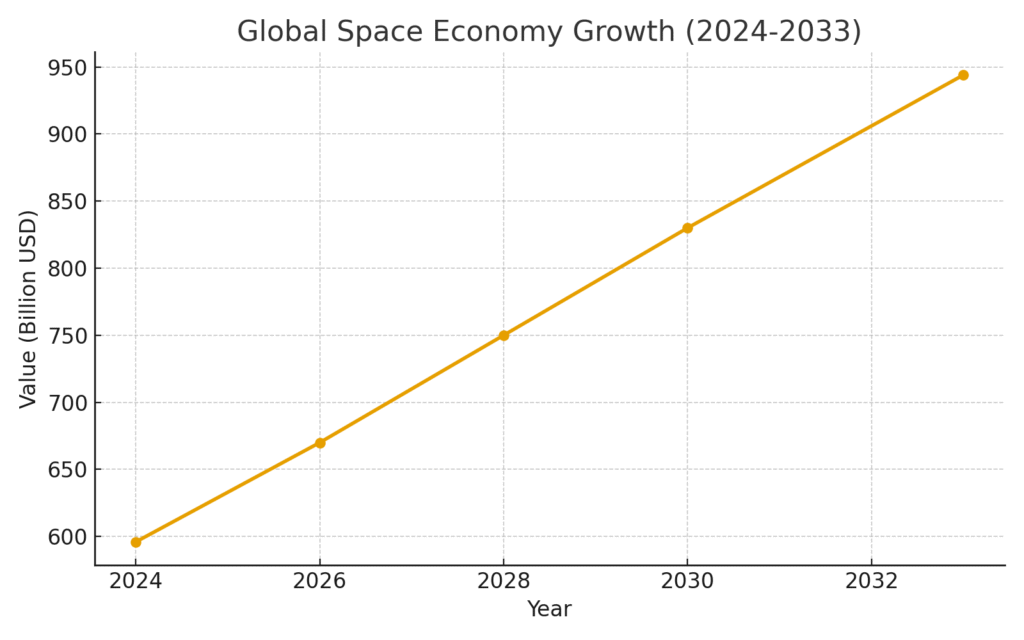
The space economy is projected to grow from $596 billion in 2024 to $944 billion by 2033. This growth is largely driven by advancements in satellite applications and commercial space services. Industries ranging from agriculture to telecommunications are adopting space-enabled solutions at an accelerating pace. Investors are eyeing new opportunities in both private and public space initiatives. These projections highlight the enormous potential for companies positioning themselves in this sector.
Space Science Marketing Statistics #3: Commercial Activities Accounted for 78% of Space Economy
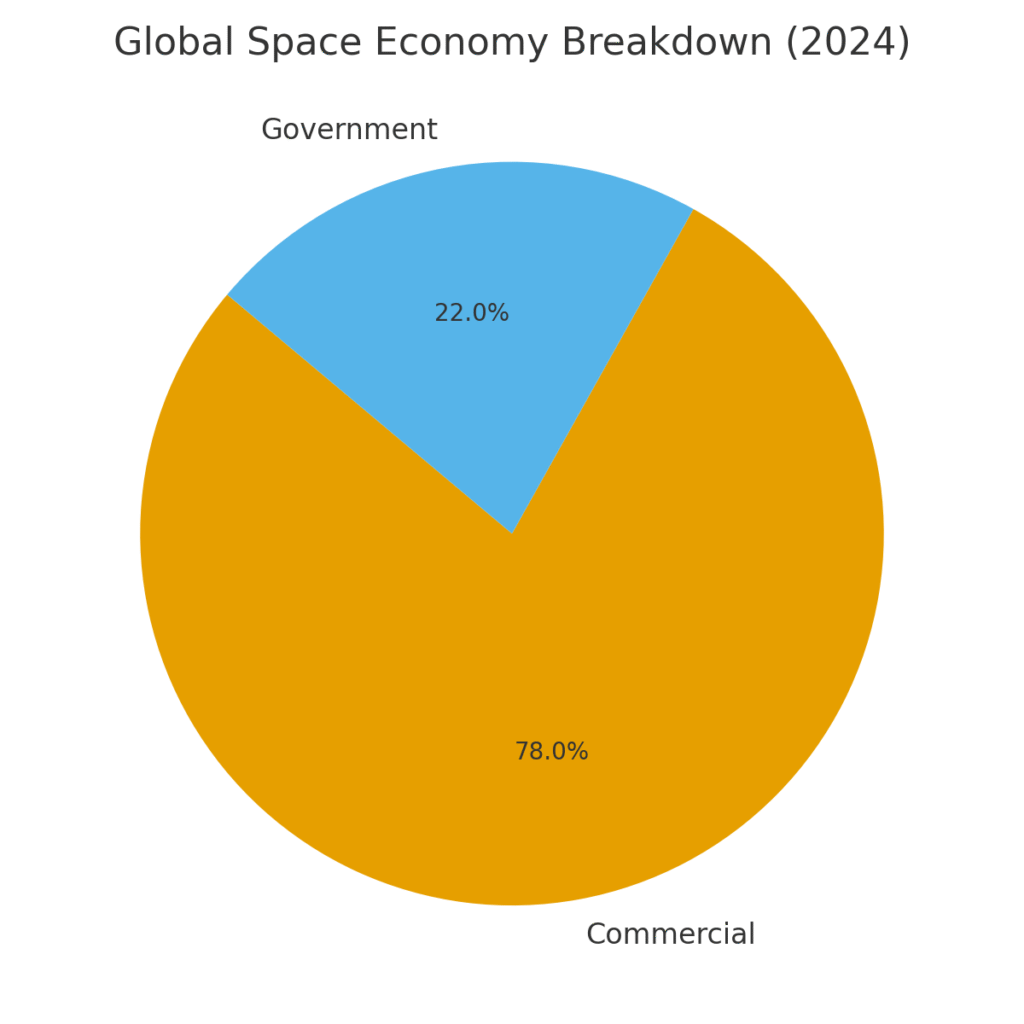
Commercial operations contributed to 78% of the global space economy in 2024. Private companies are playing an increasingly pivotal role, shaping the direction of innovation. Launch services, satellite manufacturing, and space tourism have all seen significant growth. This dominance demonstrates a shift from purely government-led programs to market-driven initiatives. Understanding commercial trends is crucial for anyone analyzing space science marketing opportunities.
Space Science Marketing Statistics #4: Global Space Technology Market Valued at $466.1 Billion in 2024
The global space technology market was valued at $466.1 billion in 2024. This market encompasses satellite systems, launch vehicles, and ground support technologies. Analysts predict a rapid increase to $769.7 billion by 2030 due to technological innovations. Emerging players are challenging established giants by offering innovative solutions. Companies focusing on research and development will likely benefit from this expansive market.
Space Science Marketing Statistics #5: North America Held 46% Market Share in 2024
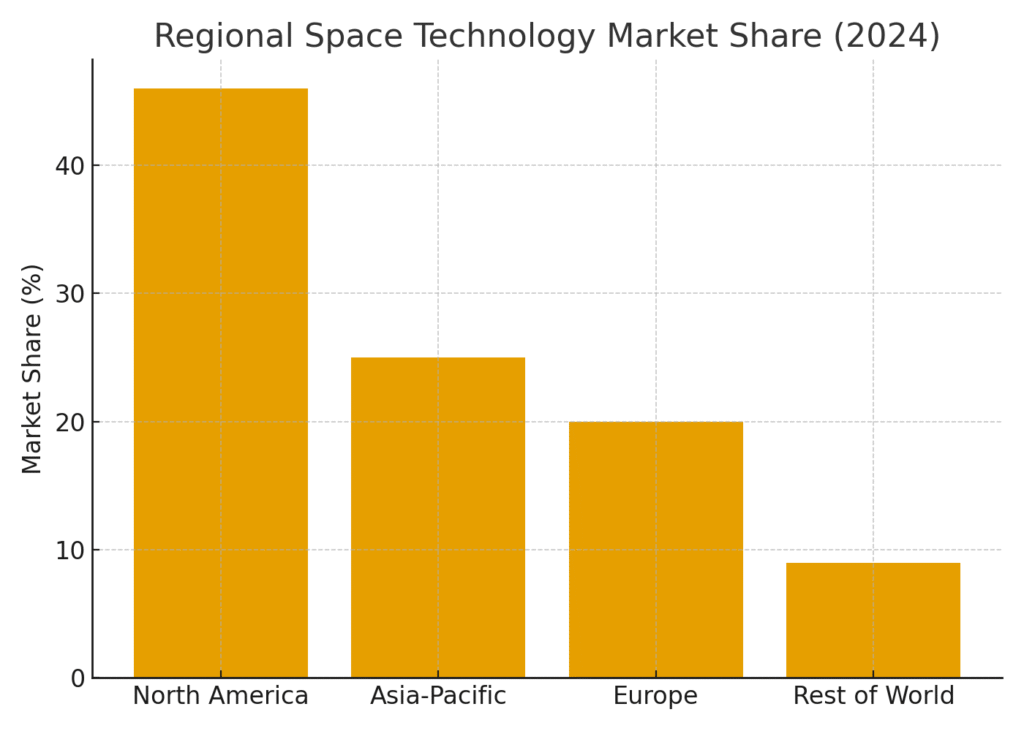
North America accounted for 46% of the global space technology market in 2024. The region benefits from robust government funding and a strong commercial ecosystem. The United States, in particular, leads in satellite deployments and launch frequency. However, Asia-Pacific is emerging as the fastest-growing region, driven by investments from China, India, and Japan. Market share analysis helps investors understand regional opportunities and challenges.
Space Science Marketing Statistics #6: Satellite Systems Represent 38% of Market Share
Satellite systems hold more than 38% of the space technology market. Applications such as navigation, communication, and Earth observation are driving demand. Companies providing satellite solutions are increasingly collaborating with private and governmental clients. This segment is expected to continue dominating due to technological advancements. Satellite market trends serve as a benchmark for space-focused investment strategies.
Space Science Marketing Statistics #7: AI in Space Exploration Projected to $35 Billion by 2033
The AI in space exploration sector is expected to reach $35 billion by 2033. This represents a remarkable CAGR of 32.4%, showing the growing importance of artificial intelligence. AI applications include autonomous spacecraft, data analysis, and predictive maintenance. Companies investing in AI technologies are enhancing mission efficiency and reducing operational costs. This rapid expansion indicates a critical intersection between AI and space science marketing.
Space Science Marketing Statistics #8: Earth Observation Market Valued at $5 Billion in 2024
Earth observation technology was valued at $5 billion in 2024. This market is projected to exceed $8 billion by 2033, driven by defense and commercial imaging applications. High-resolution satellite imagery is increasingly used for agriculture, disaster monitoring, and environmental research. Private companies and government agencies are expanding contracts and collaborations in this sector. The growth of Earth observation reinforces its importance in global space marketing strategies.
Space Science Marketing Statistics #9: Deep Space Exploration Market $28.35 Billion in 2024
Deep space exploration generated $28.35 billion in 2024. The market is expected to reach $44.03 billion by 2033, growing at a 5.1% CAGR. Key drivers include robotic missions, planetary research, and commercial exploration initiatives. Investments from private space companies have accelerated scientific discovery. Understanding this market is essential for marketing strategies targeting deep space technologies.
Space Science Marketing Statistics #10: U.S. Space Economy Accounted for $131.8 Billion in 2022
The U.S. space economy contributed $131.8 billion in 2022, representing 0.5% of national GDP. Private-sector compensation amounted to $54.5 billion, highlighting employment growth. The U.S. remains a leader in space technology development and commercialization. Strong governmental support ensures continued expansion and innovation. Marketers can leverage these insights to identify investment trends in the American space sector.
Space Science Marketing Statistics #11: India Approves $119 Million Fund for Space Startups
India approved a $119 million fund to support 40 space startups in 2024. The government aims to quintuple its commercial space market to $44 billion by 2033. Startups are focusing on satellite services, space tourism, and data analytics. This initiative fosters innovation and positions India as a competitive player globally. Investors and marketers should track these developments for emerging opportunities.
Space Science Marketing Statistics #12: European Union Proposes Space Act
The European Union proposed a Space Act to regulate the fast-expanding space sector. The legislation aims to simplify regulatory procedures and promote technological innovation. Companies will benefit from clearer frameworks and enhanced collaboration opportunities. The act also emphasizes sustainable and responsible space operations. Marketers can use this as a basis for targeting EU-based space technology investments.
Space Science Marketing Statistics #13: Global Space Economy Market Forecasted to $511.2 Billion by 2029
The global space economy is expected to grow at a 4% CAGR, reaching $511.2 billion by 2029. Satellite deployment and data services are key growth drivers. Market participants are increasingly focusing on commercial opportunities. Technological advancements and cost reductions are accelerating adoption. Understanding this forecast is critical for long-term marketing and investment planning.
Space Science Marketing Statistics #14: Space Technology Market CAGR 6.7% (2024–2032)
The space technology market is projected to grow at a 6.7% CAGR during 2024–2032. Innovations in launch vehicles, satellite communications, and AI integration are fueling growth. Companies offering cutting-edge solutions are well-positioned for expansion. Regional diversification is enabling access to emerging markets. Marketers must stay abreast of these trends to identify opportunities and partnerships.
Space Science Marketing Statistics #15: Astronomy and Space Sciences Market Projected to Reach $1.4 Trillion by 2025
The astronomy and space sciences market is projected to reach $1.4 trillion by 2025. Rising investments in research, satellites, and exploration drive this growth. Public-private partnerships are fostering innovation and commercialization. Technological breakthroughs are enabling broader applications. This massive market presents substantial opportunities for marketers and investors alike.
Space Research Marketing Statistics#16 U.S. Space Economy Contribution To GDP
The U.S. space economy contributed $142.5 billion to GDP in 2023, representing 0.5% of total output. This emphasizes the economic importance of space research in national development. Companies and marketers can leverage U.S. leadership as a trust-building strategy. Growth in this sector drives both employment and innovation. The GDP contribution highlights the commercial and strategic significance of space activities.
Space Research Marketing Statistics#17 Private-Sector Space Jobs In U.S.
The space economy supported 373,000 private-sector jobs in the U.S. in 2023. These positions span engineering, manufacturing, research, and marketing roles. Job growth reflects increased demand for skilled professionals and innovative companies. Marketers can use this data to target potential talent and showcase industry expansion. Employment trends signal strong sector health and opportunity.
Space Research Marketing Statistics#18 Private-Sector Compensation In U.S.
Private-sector compensation in the U.S. space economy totaled $57.9 billion in 2023. Salaries reflect highly skilled workforces engaged in advanced technologies. High compensation underscores the value and investment in the space sector. Marketers can leverage compensation data to attract top talent and position brands competitively. The robust payroll demonstrates a thriving, professionalized industry.
Space Research Marketing Statistics#19 India Space Industry Funding Decline
India’s space industry funding fell 55% to $59.1 million in 2024, down from $130.2 million in 2023. This decline reflects shifting government priorities and investment cycles. Startups and private players face challenges in scaling operations under reduced funding. Marketing strategies can emphasize cost-efficient solutions and partnership opportunities. The funding trend highlights regional differences in space market development.
Space Research Marketing Statistics#20 Indian Government Fund For Space Startups
In 2024, the Indian government approved a $119 million fund to support 40 space startups. This initiative fosters innovation and strengthens private sector participation. Startups can leverage this funding to accelerate R&D and commercial projects. Marketing campaigns can highlight these initiatives to attract investors and partners. Government support emphasizes the potential for growth in emerging space markets.
Wrapping Up the Top 20 Space Science Marketing Statistics 2025
Exploring the top 20 space science marketing statistics has been an eye-opening journey, revealing the immense potential and rapid evolution of the space economy. From North America’s market dominance to India’s bold startup investments, these numbers showcase both opportunity and innovation on a global scale. Personally, it’s incredible to see how the insights from a leading marketing agency in New York can be applied to real-world strategies for brands looking to enter or expand in the space sector. Whether you’re a marketer, investor, or simply a space enthusiast, understanding these trends is key to making informed decisions. I hope this compilation inspires you to explore the limitless possibilities that space science marketing offers.
SOURCES
- https://www.spacefoundation.org/2025/07/22/the-space-report-2025-q2/
- https://www.thespacereport.org/
- https://apps.bea.gov/scb/issues/2025/03-march/0325-space-economy.htm
- https://space-economy.esa.int/article/287/esa-report-on-the-space-economy-2025
- https://www.pwc.com/us/en/industries/industrial-products/library/space-industry-trends.html
- https://www.bea.gov/data/special-topics/space-economy
- https://www.nasa.gov/organizations/otps/new-report-analyzes-long-history-of-nasa-support-for-commercial-space/
- https://www.thespacereport.org/?taxonomy=topic&term=economy-interactive-tables-and-charts
- https://www.marketsandmarkets.com/space-industry-market-research-268.html
- https://space-economy.esa.int/
- https://www.weforum.org/stories/2024/04/space-economy-technology-invest-rocket-opportunity/
- https://www.weforum.org/publications/space-the-1-8-trillion-opportunity-for-global-economic-growth/
- https://patentpc.com/blog/commercial-spaceflight-trends-how-fast-is-the-market-expanding-latest-data
- https://nova.space/hub/product/space-economy-report/
- https://www.nasa.gov/
- https://arxiv.org/abs/2503.03113
- https://arxiv.org/abs/2410.07285