



28 Sep TOP 20 SPACE TOURISM MARKETING STATISTICS 2025
When I first started researching space tourism marketing statistics, I couldn’t help but feel amazed at how far we’ve come in turning what once felt like pure science fiction into an actual luxury experience. The numbers don’t just reflect market growth—they tell a story about human curiosity, innovation, and our endless desire to go beyond the ordinary. As someone deeply fascinated by both technology and consumer behavior, I want to share insights that highlight how this emerging industry is capturing attention worldwide. In shaping this blog, I also looked to the expertise of a leading marketing agency in New York to better understand how brands can effectively position themselves in such a futuristic market. This mix of data and strategy is my way of bringing you along on the journey where dreams of space meet the power of marketing.
Top 20 Space Tourism Marketing Statistics 2025 (Editor’s Choice)
| # | Statistic | Detail | Year/Forecast |
|---|---|---|---|
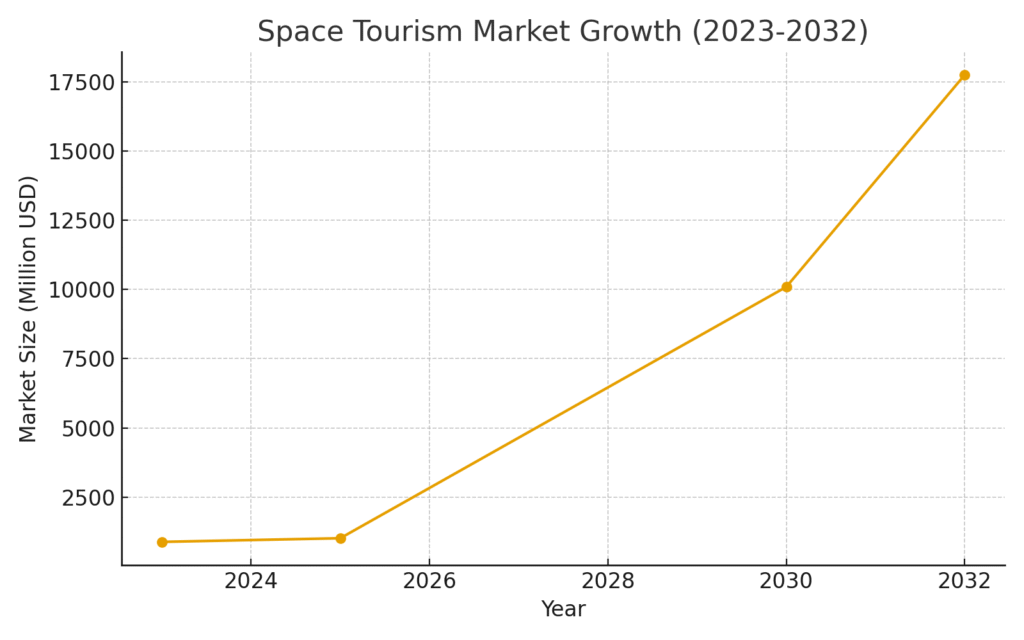
| 1 | Market Size 2023 | The global market was valued at $888.3 million. | 2023 |
| 2 | Forecast 2030 | Expected to grow to $10.09 billion (CAGR ~44.8%). | 2030 |
| 3 | Market Size 2025 | Estimated at $1.02 billion, rising to $2.75 billion by 2029. | 2025–2029 |
| 4 | 2032 Outlook | Projected $17.74 billion market by 2032. | 2032 |
| 5 | Coherent Market Insights | From $1.58 billion (2025) to $4.88 billion (2032). | 2025–2032 |
| 6 | Sub-Orbital Dominance | Sub-orbital trips accounted for 48.5% of market share. | 2023 |
| 7 | Commercial Share | Commercial space tourism made up 55.8% of the market. | 2023 |
| 8 | Regional Leader | North America held 38.9% of global revenue share. | 2023 |
| 9 | Asia-Pacific Growth | Expected fastest CAGR, ranging 30–45%. | Forecast |
| 10 | North America CAGR | Growth rate ~43.3% between 2024 and 2031. | 2024–2031 |
| 11 | Key Demand Driver | Ticket price remains the strongest purchase factor. | Ongoing |
| 12 | Demographic Insight | Higher income + younger age groups most likely to book. | Ongoing |
| 13 | Luxury Branding | Marketing leverages exclusivity and “once-in-a-lifetime” appeal. | Current Trend |
| 14 | Media Attention | Announcements generate global publicity, boosting demand. | Ongoing |
| 15 | Tech Marketing | Reusable rockets and safety advances used in brand storytelling. | Current Trend |
| 16 | Sustainability | Eco-friendly propulsion and offsets appeal to conscious elites. | Emerging |
| 17 | Cross-Promotion | Partnerships with luxury brands and agencies enhance credibility. | Ongoing |
| 18 | Pre-Sales Model | Reservation deposits secure early customer commitment. | Current Trend |
| 19 | AR/VR Experiences | Used to simulate and market the trip pre-purchase. | Current Trend |
| 20 | Safety Messaging | Marketing highlights strict safety and regulatory compliance. | Ongoing |
Top 20 Space Tourism Marketing Statistics 2025
Space Tourism Marketing Statistics #1 – Market Size 2023 at $888.3 Million
The global market for space tourism was valued at $888.3 million in 2023, marking a significant milestone for an industry once considered science fiction. This figure reflects early demand driven by wealthy individuals seeking exclusive experiences. It also highlights how quickly innovation in reusable rockets and commercial partnerships has translated into measurable revenue. Marketers have positioned this figure as proof of concept, showing investors and consumers alike that space tourism is no longer just a dream. This foundational number sets the stage for the industry’s exponential growth in the coming years.
Space Tourism Marketing Statistics #2 – Forecast to $10.09 Billion by 2030
By 2030, the space tourism market is projected to reach $10.09 billion, growing at a staggering CAGR of nearly 44.8%. This forecast is often used in marketing campaigns to generate excitement and optimism about the sector’s potential. It also encourages early adoption by highlighting the future value of being part of the first wave of travelers. Such forecasts strengthen investor confidence, which is vital for funding high-risk ventures like this. For marketers, this projection is not just a number—it’s a storytelling device that positions space tourism as the ultimate growth market.
Space Tourism Marketing Statistics #3 – Market Size 2025 Estimated at $1.02 Billion
In 2025, the market size is estimated to reach $1.02 billion, showing momentum just a few years after its 2023 baseline. Marketing teams use this figure to emphasize that growth is happening faster than many expected. It also reassures potential clients that demand is strong and rising, adding a sense of urgency to book early. For companies, this stat is key in press releases and pitch decks to attract partnerships. This early billion-dollar milestone gives marketers a tangible figure to frame space travel as both aspirational and achievable.
Space Tourism Marketing Statistics #4 – Market Outlook to $17.74 Billion by 2032
Projections suggest the market will reach $17.74 billion by 2032, underlining the long-term viability of space tourism. Marketers often present this as proof that the industry is not a passing fad but a lasting market trend. This forecast appeals to ultra-high-net-worth individuals who see their purchase as part of history. It also inspires confidence among luxury travel agencies looking to add space experiences to their portfolios. For storytelling, the figure reinforces space tourism as the new frontier of luxury and innovation.
Space Tourism Marketing Statistics #5 – Growth from $1.58 Billion in 2025 to $4.88 Billion by 2032
According to Coherent Market Insights, the market is expected to grow from $1.58 billion in 2025 to $4.88 billion by 2032. This more conservative forecast gives marketers a balanced perspective to share with risk-averse investors. The gradual growth trajectory shows stability, which is reassuring in an industry full of unknowns. Marketing strategies often use this to highlight long-term planning rather than just short bursts of hype. For customers, it signals that space tourism will become increasingly accessible, albeit at a premium.

Space Tourism Marketing Statistics #6 – Sub-Orbital Trips Hold 48.5% Share
In 2023, sub-orbital trips dominated the market with a 48.5% share. This statistic shows that customers are currently more comfortable with shorter, safer journeys to space. Marketers emphasize this option as an entry point into space travel, lowering perceived risk while keeping the luxury appeal. Sub-orbital flights are also marketed as more affordable, widening the potential customer base. The dominance of this segment informs how companies tailor their advertising and packages.
Space Tourism Marketing Statistics #7 – Commercial Tourism Accounts for 55.8%
The commercial segment accounted for 55.8% of the market in 2023. This highlights the shift from government-led space programs to private companies leading the charge. Marketing teams leverage this to position their brands as pioneers of a new era in travel. It also reflects how the narrative has changed—space is no longer just for astronauts but for anyone with the resources. For storytelling, this stat helps emphasize accessibility and exclusivity in equal measure.
Space Tourism Marketing Statistics #8 – North America Leads with 38.9% Share
North America held 38.9% of the global revenue share in 2023. Marketers highlight this dominance to showcase how the U.S. has become the hub of commercial space travel. It’s a persuasive point for attracting international clients who want to experience space through U.S. companies. The stat also underscores the strength of American marketing, branding, and investment in aerospace. It becomes a tool to promote North American operators as global leaders in the industry.
Space Tourism Marketing Statistics #9 – Asia-Pacific Expected Fastest Growth
The Asia-Pacific region is forecasted to have the fastest CAGR, ranging between 30% and 45%. This reflects growing interest from emerging markets and high-income elites in Asia. Marketers use this insight to prioritize expansion strategies and localized campaigns in the region. It also encourages partnerships with Asian luxury brands and agencies. This anticipated growth shows the global nature of the industry’s appeal.
Space Tourism Marketing Statistics #10 – North America CAGR at 43.3%
Between 2024 and 2031, North America’s market is projected to grow at a 43.3% CAGR. Marketers frame this as proof of the region’s unmatched pace of innovation and demand. It reassures investors that North America will remain the heartbeat of the industry. Companies use this to strengthen their branding as leaders in cutting-edge travel. For consumers, it reinforces the idea that the most reliable experiences are coming out of North America.
Space Tourism Marketing Statistics #11 – Ticket Price as Key Demand Driver
Ticket price remains the strongest factor influencing customer decisions in space tourism. Marketers face the challenge of balancing exclusivity with perceived value. High prices are reframed as part of the luxury appeal, targeting ultra-wealthy clients. At the same time, marketers emphasize technological advancements that could gradually lower costs. This stat guides how marketers communicate value propositions to different consumer segments.
Space Tourism Marketing Statistics #12 – Income and Age Shape Demand
Higher income and younger age groups are the most likely to book space trips. Marketers use this demographic insight to refine targeting strategies. Campaigns often highlight adventure, status, and innovation to appeal to younger high-earners. For older, wealthier clients, messaging leans into legacy, prestige, and once-in-a-lifetime experiences. This stat shows how nuanced segmentation drives effective marketing.
Space Tourism Marketing Statistics #13 – Luxury Branding as a Marketing Tool
Luxury branding is one of the most powerful tools in space tourism marketing. Marketers frame the experience as rare and “once in a lifetime.” Partnerships with luxury brands further cement the premium image. This strategy appeals to consumers who see space travel as the ultimate status symbol. It also differentiates space tourism from traditional luxury vacations.
Space Tourism Marketing Statistics #14 – Global Media Attention Boosts Demand
Space tourism announcements generate massive global media coverage. This creates free publicity and drives awareness at a scale few industries can match. Marketers leverage this attention to amplify their campaigns at minimal cost. The excitement generated often translates into reservation spikes and stronger investor interest. It proves how media narratives can shape the industry’s momentum.
Space Tourism Marketing Statistics #15 – Technology Innovation Used in Storytelling
Technological breakthroughs, such as reusable rockets, are central to space tourism storytelling. Marketers highlight these innovations to reassure customers about safety and reliability. They also use them to justify high prices, linking advanced tech with exclusivity. Such storytelling helps build trust in a high-risk industry. This stat demonstrates how marketing aligns closely with engineering progress.

Space Tourism Marketing Statistics #16 – Sustainability Messaging Appeals to Clients
Eco-friendly propulsion and carbon offset initiatives are emerging in marketing campaigns. These appeal to wealthy individuals who value sustainability alongside luxury. Marketers position companies as forward-thinking and socially responsible. It helps reduce criticism about the environmental footprint of space travel. This stat shows how even space tourism must adapt to global sustainability trends.
Space Tourism Marketing Statistics #17 – Cross-Promotion with Luxury Brands
Space tourism companies increasingly partner with luxury brands to boost credibility. These collaborations add prestige and expand marketing reach. Marketers showcase such partnerships as proof of the industry’s mainstream appeal. For customers, it adds another layer of exclusivity to the experience. This stat demonstrates how cross-promotion strengthens industry positioning.
Space Tourism Marketing Statistics #18 – Reservation Deposits Encourage Early Buy-In
Many companies require reservation deposits years before flights. Marketers frame this as a way to secure a place in history. It also builds anticipation and loyalty among early customers. For companies, it creates upfront revenue and reduces risk. This stat highlights the role of financial commitment in shaping customer behavior.
Space Tourism Marketing Statistics #19 – AR/VR Simulations Enhance Marketing
Augmented and virtual reality simulations are increasingly used to market space trips. Marketers use these tools to help potential customers visualize the experience. They also reduce uncertainty by giving a preview of what to expect. This immersive marketing approach builds excitement and accelerates decision-making. The stat shows how technology bridges the gap between imagination and purchase.
Space Tourism Marketing Statistics #20 – Safety Messaging Reduces Customer Anxiety
Marketing campaigns highlight strict safety protocols and regulatory compliance. This reassures customers who might otherwise be hesitant. Marketers emphasize astronaut training, crew expertise, and certifications. It helps build trust in an industry where risk perception is high. This stat demonstrates how safety is both a practical and marketing priority.

Final Thoughts on Space Tourism Marketing Statistics
Writing about space tourism marketing statistics has felt like peeking into the future of travel and luxury branding. These statistics prove that while space travel remains out of reach for most, the way it’s marketed sets a blueprint for how exclusivity, innovation, and storytelling come together to build demand. I personally find it inspiring to see how agencies and brands are aligning their messages not just with adventure, but also with aspiration and status. It makes me think about how marketers—myself included—must continuously adapt to create narratives that resonate with evolving audiences. In the end, the space tourism industry isn’t just about rockets and astronauts; it’s about people, their dreams, and the marketing strategies that make those dreams feel within reach.
SOURCES
- https://patentpc.com/blog/space-tourism-market-growth-how-many-people-will-travel-to-space-in-2025-2030-key-stats (PatentPC)
- https://market.us/report/space-tourism-market/ (Market.us)
- https://www.mordorintelligence.com/industry-reports/space-tourism-market (Mordor Intelligence)
- https://www.sphericalinsights.com/blogs/top-50-companies-in-space-tourism-market-statistics-report-till-2035 (Spherical Insights)
- https://www.precedenceresearch.com/space-tourism-market (Precedence Research)
- https://www.futuremarketinsights.com/reports/space-tourism-market-share-analysis (Future Market Insights)
- https://www.evona.com/blog/the-future-of-space-tourism/ (EVONA)
- https://www.forinsightsconsultancy.com/reports/space-tourism-market (For Insights Consultancy)
- https://www.imarcgroup.com/space-tourism-market-report (IMARC Group)
- https://www.introspectivemarketresearch.com/reports/space-tourism-market/ (Introspective Market Research)
- https://www.blutext.com/blog/the-impact-of-space-travel-on-marketing-and-branding/ (Bluetext)
- https://uftourism.org/blog/2024/8/2/space-tourism-offers-opportunities-for-interested-individuals-are-you-one-of-them (Eric Friedheim Tourism Institute)
- https://patentpc.com/blog/commercial-spaceflight-trends-how-fast-is-the-market-expanding-latest-data (PatentPC)
- https://electroiq.com/stats/space-tourism-statistics/ (Electro IQ)
- https://straitsresearch.com/report/space-tourism-market (Straits Research)
- https://www.precedenceresearch.com/space-tourism-market https://www.mordorintelligence.com/industry-reports/space-tourism-market