



28 Sep TOP 20 SPACE TRAVEL MARKETING STATISTICS 2025
When I first started diving into space travel marketing statistics, I was amazed at how quickly this industry is evolving. What once felt like pure science fiction is now shaping into a thriving market where brands, investors, and adventurous travelers are all paying attention. As someone who loves keeping track of trends that push the boundaries of possibility, I can’t help but be fascinated by the numbers driving this sector forward. With insights from a marketing agency in New York, I’ve come to see how these statistics can guide businesses in positioning themselves within one of the most exciting frontiers of our time. It’s not just about rockets and spaceports—it’s about how we connect with people’s imagination and inspire them to dream bigger.
Top 20 Space Travel Marketing Statistics 2025 (Editor’s Choice)
| # | Statistic | Insight |
|---|---|---|
| 1 | USD 888.3M Market Value (2023) | The global space tourism market was valued at nearly $888.3 million in 2023. |
| 2 | USD 10.09B by 2030 | Market projected to grow to $10.09 billion by 2030 with ~44.8% CAGR. |
| 3 | USD 20.1B by 2033 | IMARC forecasts growth from $1.3B in 2024 to $20.1B by 2033 (34% CAGR). |
| 4 | USD 28.48B by 2033 | Straits Research expects growth from $1.23B (2024) to $28.48B by 2033. |
| 5 | USD 12.9B VC Funding (2022) | Venture capital investments into space totaled $12.9 billion in 2022. |
| 6 | 46.5% U.S. Equity Share | The U.S. accounts for nearly half of global equity investments in space firms. |
| 7 | 30% Share for SpaceX | SpaceX represents nearly 30% of startup deals in the space industry. |
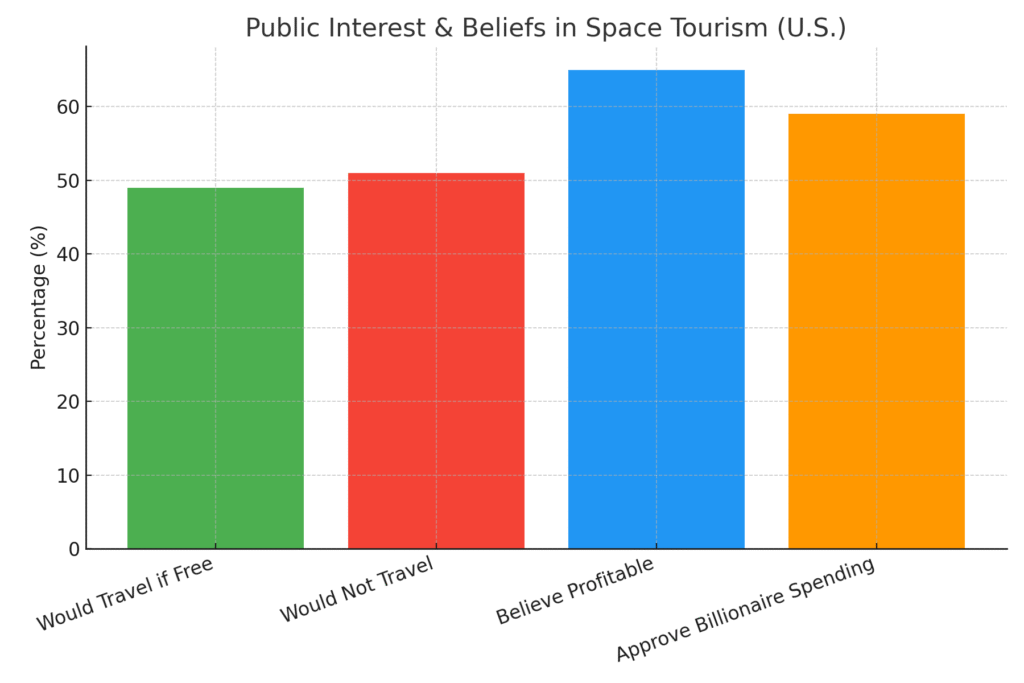
| 8 | 49% Interested in Space Travel | Nearly half of U.S. adults say they would go to space if money wasn’t a barrier. |
| 9 | 51% Not Interested | A majority say they would not want to travel to space even at no cost. |
| 10 | 56% Men vs 44% Women | Men are more likely than women to express interest in space travel. |
| 11 | 65% Believe in Profitability | Over half believe space tourism firms will be profitable within a decade. |
| 12 | 59% Approve Billionaire Spending | Most respondents support billionaires spending money on space travel. |
| 13 | $385M Orbital Revenue (2021) | Orbital space travel generated ~$385 million, projected $555M by 2030. |
| 14 | $36.7M to $293.9M Suborbital | Suborbital vehicles projected to grow eightfold by 2031. |
| 15 | 49.1% Suborbital Share (2023) | Suborbital tourism dominated nearly half of the market in 2023. |
| 16 | 57% Commercial End Users | Commercial consumers represent the largest segment of the market. |
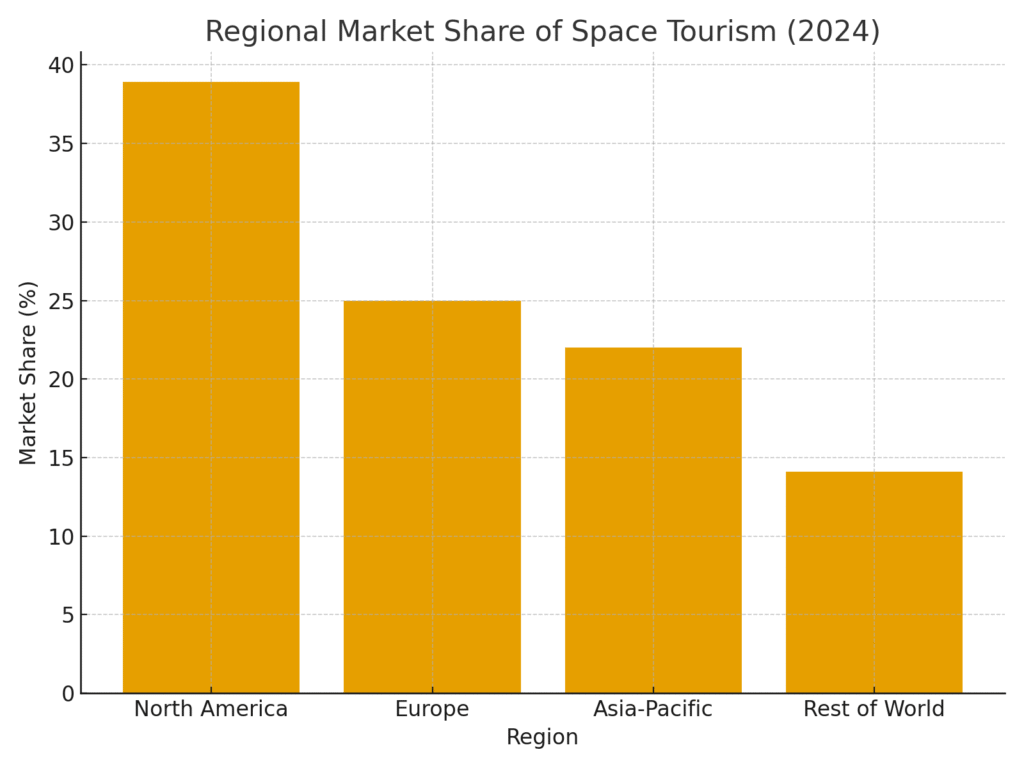
| 17 | 38.9% North America Share | North America leads with nearly 39% of global space tourism market share. |
| 18 | 48.5% Sub-Orbital in 2023 | Sub-orbital accounted for almost half of space tourism in 2023. |
| 19 | 55% Expect Common Tourism | Over half of Americans believe space tourism will be common within 50 years. |
| 20 | AI Model Predicts Travelers | AI models like SpaceNet predict likelihood of choosing space travel with 82% accuracy. |
Top 20 Space Travel Marketing Statistics 2025
Space Travel Marketing Statistics #1: USD 888.3M Market Value (2023)
The global space tourism market reached a valuation of $888.3 million in 2023. This figure represents the growing interest in commercial space travel as more private companies enter the sector. For marketers, this milestone is a strong indicator of increasing consumer curiosity and willingness to invest in extraordinary experiences. It also highlights how niche luxury travel is evolving into a futuristic industry with real financial momentum. Brands can leverage this data point to show exclusivity and forward-thinking values in their campaigns.
Space Travel Marketing Statistics #2: USD 10.09B By 2030
By 2030, the space travel market is projected to soar to $10.09 billion. This massive growth reflects a compound annual growth rate of nearly 45% between 2024 and 2030. Such rapid expansion provides marketers with an evolving audience of high-net-worth individuals who are seeking once-in-a-lifetime experiences. It demonstrates that space travel is moving from a rare event into a scalable luxury market. Marketers should position offerings as future-ready to resonate with aspirational consumers.
Space Travel Marketing Statistics #3: USD 20.1B By 2033
Forecasts suggest that the space tourism market will hit $20.1 billion by 2033. This prediction is based on a steady CAGR of about 34%, which emphasizes the long-term sustainability of the industry. For marketers, this presents an opportunity to create campaigns that highlight the future-oriented nature of space tourism. The projection also signals strong investor confidence, making space travel an attractive arena for partnerships and brand alignment. Early adoption in this sector can build lasting recognition.
Space Travel Marketing Statistics #4: USD 28.48B By 2033
According to Straits Research, space tourism could expand from $1.23 billion in 2024 to $28.48 billion by 2033. This reflects an even higher CAGR of 42.2%, showing how aggressively the industry may evolve. Such projections indicate not only consumer demand but also technological readiness to scale offerings. For marketers, this reinforces the importance of futuristic branding and positioning. By aligning with the idea of limitless growth, companies can captivate audiences intrigued by innovation.
Space Travel Marketing Statistics #5: USD 12.9B VC Funding (2022)
In 2022, venture capital investments into space reached $12.9 billion. This demonstrates strong financial backing and confidence in space travel as a market of the future. For marketers, the high level of funding means opportunities to highlight credibility, security, and growth potential. It also signals that businesses entering the space sector are perceived as stable investments. Highlighting such funding in campaigns can strengthen brand trust among early adopters.

Space Travel Marketing Statistics #6: 46.5% U.S. Equity Share
The United States accounted for 46.5% of all global equity investments in space firms. This confirms the U.S. as the leading hub for space travel innovation and growth. Marketers targeting this region can emphasize national leadership and pride in technological advancements. It also points to strong consumer demand within the U.S. that can be leveraged in marketing campaigns. Associating with U.S. dominance in space exploration reinforces authority and reliability.
Space Travel Marketing Statistics #7: 30% Share For SpaceX
SpaceX holds nearly 30% of startup deals in the space sector. This illustrates the company’s dominant influence on the future of space travel. For marketers, aligning with or referencing industry leaders like SpaceX can enhance credibility. It also creates opportunities for co-branding and collaborative storytelling. The statistic demonstrates the importance of leveraging big names to amplify marketing appeal.
Space Travel Marketing Statistics #8: 49% Interested In Space Travel
Nearly half of U.S. adults say they would travel to space if money wasn’t a barrier. This reflects significant consumer interest in the concept of space tourism. For marketers, this means that pricing and accessibility are the main hurdles, not desire. Campaigns that highlight aspirational experiences and financing models can attract dreamers who want to participate. This statistic reveals a huge untapped audience that may become active as costs drop.
Space Travel Marketing Statistics #9: 51% Not Interested
While many dream of space travel, 51% of respondents said they would not want to go even if it were free. This highlights a strong psychological barrier tied to risk, fear, or disinterest. Marketers need to address these concerns through storytelling that emphasizes safety, comfort, and emotional fulfillment. Building trust and reassurance is just as important as promoting excitement. Acknowledging these hesitations can make campaigns feel more authentic.
Space Travel Marketing Statistics #10: 56% Men Vs 44% Women
Surveys show that 56% of men and 44% of women express interest in space travel. This gender split highlights differences in adventurousness and willingness to take risks. Marketers can tailor campaigns to appeal to both groups, addressing specific motivators. For men, emphasis on exploration and achievement may resonate, while for women, safety and inclusivity messaging could be key. Understanding these distinctions can help campaigns connect more effectively.

Space Travel Marketing Statistics #11: 65% Believe In Profitability
Around 65% of respondents believe space tourism companies will be profitable within the next decade. This indicates that consumers and investors alike see strong commercial potential. Marketers can highlight this belief to emphasize long-term stability and growth. It also opens the door for consumer trust in booking experiences with new providers. This optimism can be used to build momentum and brand confidence.
Space Travel Marketing Statistics #12: 59% Approve Billionaire Spending
Nearly 59% of people say billionaires are entitled to spend money on space travel. This reflects public acceptance of wealthy individuals as early adopters. For marketers, this means campaigns can confidently target high-net-worth individuals without backlash. It also creates opportunities to frame space travel as aspirational, something people admire even if they cannot yet afford it. By celebrating pioneers, brands can position themselves as part of an elite experience.
Space Travel Marketing Statistics #13: $385M Orbital Revenue (2021)
In 2021, orbital space travel generated about $385 million in revenue. This is expected to grow to $555 million by 2030. For marketers, these figures prove that orbital experiences are already contributing significantly to the economy. Campaigns can use this growth trajectory to build anticipation and highlight industry momentum. The numbers also reinforce consumer trust in the viability of orbital travel.
Space Travel Marketing Statistics #14: $36.7M To $293.9M Suborbital
Suborbital reusable vehicles grew from $36.7 million in 2021 and are projected to hit $293.9 million by 2031. This massive growth reflects the increasing demand for shorter, more affordable space experiences. For marketers, suborbital flights can be positioned as the entry-level gateway into space tourism. These experiences appeal to a wider audience and can be marketed as more accessible. The growth projection highlights a lucrative niche for early campaigns.
Space Travel Marketing Statistics #15: 49.1% Suborbital Share (2023)
Suborbital tourism accounted for 49.1% of the market in 2023. This dominance underscores consumer preference for shorter, less expensive journeys. Marketers can highlight suborbital travel as the most popular form of space tourism. It also reflects the trend of starting small before moving into full orbital experiences. Campaigns that stress affordability and thrill can resonate well with mass audiences.
Space Travel Marketing Statistics #16: 57% Commercial End Users
In 2022, commercial end users represented 57% of the space tourism market. This indicates that businesses, not just individuals, are driving demand. For marketers, this creates opportunities to target corporations for sponsorships, research, or team-building experiences. It also means campaigns should emphasize business benefits alongside personal adventure. Highlighting commercial use cases builds credibility with larger audiences.
Space Travel Marketing Statistics #17: 38.9% North America Share
North America accounts for 38.9% of the global space tourism market. This dominance highlights the region as a major hub for marketing campaigns. Brands operating in the U.S. and Canada can use this to their advantage in positioning themselves as industry leaders. It also provides reassurance for global consumers looking at North America as the starting point of safe space travel. Marketers can highlight this regional dominance to attract international travelers.
Space Travel Marketing Statistics #18: 48.5% Sub-Orbital In 2023
In 2023, sub-orbital travel made up 48.5% of the industry’s market share. This confirms its popularity among early adopters. For marketers, it suggests that promotional focus should lean toward sub-orbital trips before orbital experiences. Campaigns can showcase these trips as exciting yet accessible, bridging imagination with reality. The statistic highlights a proven demand that marketers can capitalize on immediately.
Space Travel Marketing Statistics #19: 55% Expect Common Tourism
More than 55% of Americans expect space tourism to become common in the next 50 years. This shows that public perception is optimistic about the future of the industry. For marketers, this provides an opportunity to align messaging with long-term aspirations. Brands can emphasize being “ahead of the curve” by investing early. This belief strengthens the narrative that space travel is not just a fantasy, but an inevitable future.
Space Travel Marketing Statistics #20: AI Model Predicts Travelers
AI models like SpaceNet can predict whether individuals would choose space travel with 82% accuracy. This reflects the growing role of artificial intelligence in consumer behavior analysis. For marketers, AI offers tools to better segment and target audiences. It can help identify likely customers based on income, demographics, and psychological factors. This statistic shows how technology will drive personalization in space tourism marketing.
Why These Numbers Matter
Looking back at these space travel marketing statistics, I feel a genuine excitement about where the future is headed. For me, these numbers aren’t just dry figures; they represent opportunities for creativity, innovation, and even reshaping how humanity sees itself. They also show that businesses who adapt early can be part of something much bigger than just selling an experience—they can help build a legacy. As I reflect on these insights, I’m convinced that this is more than a passing trend; it’s the start of a long-term shift in consumer aspirations. And being part of that journey, even from the marketing side, feels like standing at the edge of history in the making.
SOURCES
- https://www.imarcgroup.com/space-tourism-market-report
- https://www.forinsightsconsultancy.com/reports/space-tourism-market
- https://www.spacecapital.com/space-iq
- https://www.spacecapital.com/publications
- https://finance.yahoo.com/news/space-tourism-industry-research-report-115500771.html
- https://www.espi.or.at/wp-content/uploads/2024/05/ESPI_Space_Venture_2023.pdf
- https://brycetech.com/reports/report-documents/start_up_space_2025/BryceTech_Start_Up_Space_2025.pdf
- https://www.newspace.capital/wp-content/uploads/2023/11/Space-Industry-Review_Q2-2023_compressed.pdf
- https://scoop.market.us/space-tourism-statistics/
- https://www.pewresearch.org/science/2023/07/20/americans-views-of-space-u-s-role-nasa-priorities-and-impact-of-private-companies/
- https://arxiv.org/abs/2503.03113
- https://www.mordorintelligence.com/industry-reports/space-tourism-market
- https://www.bloomberg.com/news/newsletters/2024-05-15/space-startups-fueled-by-venture-capital-investments
- https://www.reuters.com/technology/space/space-startups-see-funding-surge-government-spending-remains-high-report-says-2024-04-11/
- https://www.reuters.com/science/chinese-state-backed-company-launch-space-tourism-flights-by-2028-2024-05-17/
- https://www.cbinsights.com/research/report/venture-trends-q1-2025/
- https://www.spacefund.com/wp-content/uploads/2024/07/Space-is-an-Uncorrelated-Investment-Sector-Final-AIAA-July-24-2024.pdf