




19 Sep TOP 20 Spice Marketing Statistics 2025
When I first started diving into spice marketing statistics, I was amazed at how much these everyday ingredients shape global trade, consumer trends, and even cultural tastes. Spices aren’t just about flavor—they’re a bridge between tradition and innovation, and the data behind their growth tells a fascinating story. As someone who follows industry shifts closely and works alongside a leading marketing agency in New York, I’ve seen how numbers like these can transform how we think about branding, consumer behavior, and product positioning. In this piece, I’ve gathered the most important stats that paint a clear picture of where the spice market stands today and where it’s heading next.
Top 20 Spice Marketing Statistics 2025 (Editor’s Choice)
🌶️ Top 20 Spice Marketing Statistics
Essential Market Insights for 2024-2025
| # | Category | Statistic | Key Value |
|---|---|---|---|
| 1 | Market Size | Global spices and seasonings market projected growth from 2024 to 2032 | $20.19B → $29.57B (4.89% CAGR) |
| 2 | Market Size | Alternative projection - Global spice market expected value by 2033 | $41+ Billion (~5% annual growth) |
| 3 | Market Size | Global spices market growth trajectory (2025-2033) | $17.36B → $26.65B (5.5% CAGR) |
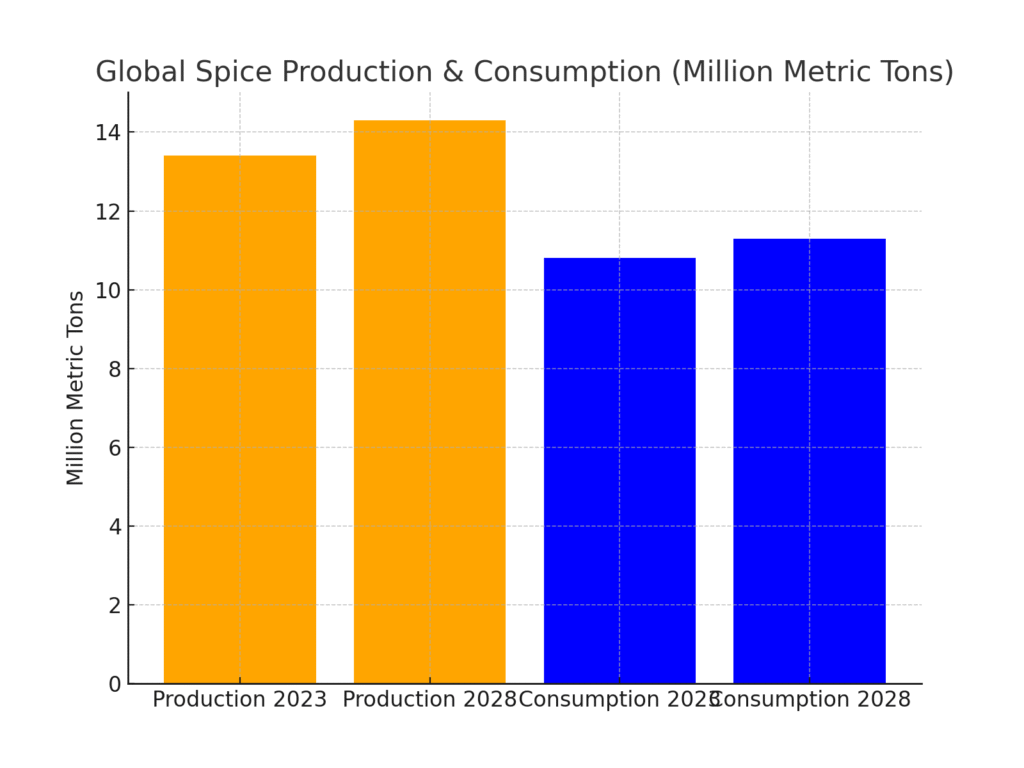
| 4 | Market Volume | Global spice consumption volume projection by 2028 | 11.3M Metric Tons (0.8% annual growth) |
| 5 | Regional Share | North America's dominance in global spices market (2023) | 40.47% Market Share |
| 6 | Regional Growth | U.S. spices and seasonings market value by 2032 | $6.91 Billion Projected Value |
| 7 | Regional Share | Asia-Pacific market share with Europe growth outlook | 38.73% APAC 6.78% Europe CAGR |
| 8 | Production | Asia-Pacific's share of global spice production | 75% Global Production |
| 9 | Consumer Trend | U.S. chile pepper consumption growth since 1980 | 3 lbs → 7+ lbs Per Person/Year |
| 10 | Menu Trends | Percentage of American menus featuring "spicy" items | 70%+ All Cuisines |
| 11 | Food Preference | American consumers who enjoy eating wings | 75% Consumer Base |
| 12 | Flavor Trend | Growth in demand for barbecue-style wings (annual) | 373% Annual Growth |
| 13 | Product Segment | Spices segment's dominance in global market (2024) | 55.65% Market Share |
| 14 | Regional Product | Spices segment share in North American market (2024) | 62% Market Share |
| 15 | Product Category | Conventional vs Organic products market distribution | 81.11% Conventional 7.44% Organic CAGR |
| 16 | Application | Meat & seafood application segment in North America (2024) | 28% Market Share |
| 17 | End-Use | Retail vs other channels for spice usage (2023) | 79% Retail Share |
| 18 | Foodservice | Projected growth in foodservice spice demand (2024-2030) | 8.9% CAGR |
| 19 | Brand Distribution | National brands vs private label market share (2023) | 87% National Brands |
| 20 | Growth Trend | Private label seasoning & spices growth projection (2024-2030) | 10.1% CAGR |
Spice Marketing Statistics #1 – Global Market Size At USD 19.30 Billion In 2023
The global spices and seasonings market reached a valuation of USD 19.30 billion in 2023. This figure reflects the steady demand for spices across both developed and emerging markets. Consumers are increasingly seeking bold flavors, which fuels continuous growth. For marketers, this signals the importance of highlighting diversity and authenticity in product offerings. Brands that showcase heritage and origin stories are particularly well-positioned to capture consumer attention.
Spice Marketing Statistics #2 – Market To Reach USD 29.57 Billion By 2032 (CAGR 4.89%)
Projections suggest the spices and seasonings market will grow to USD 29.57 billion by 2032, with a CAGR of 4.89%. This growth highlights how stable consumer demand is, even in uncertain economies. The relatively steady CAGR makes spices a reliable sector for investment and expansion. Marketers can leverage this by planning long-term campaigns that emphasize consistency and value. Growth-driven storytelling can reinforce consumer trust and brand loyalty.
Spice Marketing Statistics #3 – Market At USD 21.69 Billion In 2023, Forecast USD 34.31 Billion By 2030 (CAGR 6.8%)
Another study valued the market at USD 21.69 billion in 2023, projecting growth to USD 34.31 billion by 2030. This projection is slightly higher than others, suggesting optimistic growth. A 6.8% CAGR demonstrates rapid expansion opportunities in certain segments like blends and organics. For marketers, the takeaway is that agility matters—brands must pivot to capture these fast-growing niches. Differentiation through unique flavors can become a key driver in this environment.
Spice Marketing Statistics #4 – Asia-Pacific Holding 78.3% Market Share In 2023
Asia-Pacific dominated with 78.3% of the global seasoning and spices revenue in 2023. This reflects the region’s deep cultural ties to spice consumption. It also highlights how Asia serves as both the largest producer and consumer hub. Marketers targeting this region should focus on authenticity and tradition, as cultural resonance drives loyalty. Global brands looking to expand here need to respect local tastes and cooking methods.
Spice Marketing Statistics #5 – Spices Segment Representing 63% Of Market In 2023
In 2023, spices (excluding salt substitutes) made up 63% of the seasoning and spices market. This shows how critical spices are compared to broader condiments. Consumers are actively choosing diverse spices for cooking at home. For marketers, this indicates strong opportunities for campaigns around flavor experimentation. Highlighting exotic or less-known spices could attract adventurous consumers.

Spice Marketing Statistics #6 – Retail Accounted For 79% Of End-Use In 2023
Retail dominated the spice market with 79% of the end-use share in 2023. This reflects a growing trend of consumers purchasing spices for home cooking. With the rise of cooking shows and recipe content online, households are experimenting more. Marketers can capitalize on this by collaborating with recipe platforms and food influencers. Offering smaller, affordable packs could further boost retail-driven sales.
Spice Marketing Statistics #7 – National Brands Holding 87% Market Share In 2023
National brands maintained an 87% revenue share in 2023. This shows that consumers still trust established names over private labels. The dominance also suggests that branding power is strong in this sector. Marketers in smaller companies should focus on niche positioning or storytelling to compete. Meanwhile, large brands can continue leveraging their established trust with premium and organic product lines.
Spice Marketing Statistics #8 – Global Spice Market Valued At USD 26.14 Billion In 2024, Projected USD 41.43 Billion By 2033 (CAGR 5.25%)
The spice market was valued at USD 26.14 billion in 2024 and is projected to reach USD 41.43 billion by 2033. This indicates a solid CAGR of 5.25%. Growth like this showcases a steadily rising demand for spices worldwide. For marketers, the opportunity lies in aligning with consumer preferences for premium and sustainably sourced products. Highlighting ethical sourcing can particularly resonate with socially conscious consumers.
Spice Marketing Statistics #9 – Spice Blends Identified As Fastest-Growing Product Segment
Spice blends are expected to be the fastest-growing product segment. Consumers prefer ready-to-use mixes for convenience and consistency. This trend is particularly strong among younger demographics who cook at home but value time-saving solutions. Marketers can emphasize creativity and lifestyle fit when promoting blends. Positioning blends as both traditional and innovative can reach a wide consumer base.
Spice Marketing Statistics #10 – U.S. Market Valued At USD 216.35 Million In 2024, Forecast USD 358.13 Million By 2033 (CAGR 5.76%)
The U.S. spice market stood at USD 216.35 million in 2024, projected to grow to USD 358.13 million by 2033. This CAGR of 5.76% highlights steady growth in a developed market. American consumers are drawn to exotic and global flavors, reflecting broader cultural shifts. Marketers can focus on authenticity and storytelling to connect with these consumers. Packaging that emphasizes origin and transparency will likely perform well.

Spice Marketing Statistics #11 – North American Market Growing From USD 3.93 Billion In 2024 To USD 6.15 Billion By 2033 (CAGR 5.10%)
The North American spice and seasonings market is forecast to grow from USD 3.93 billion in 2024 to USD 6.15 billion in 2033. This growth signals strong consumer demand for diverse flavor experiences. Health-conscious consumers are also driving sales of organic and clean-label spices. For marketers, positioning spices as both flavorful and healthy is key. Campaigns that connect food to wellness are increasingly effective.
Spice Marketing Statistics #12 – Meat And Poultry Products Holding 38.2% Market Share By Application
By application, meat and poultry account for 38.2% of spice and seasoning usage globally. This makes it the single largest segment for spice applications. Consumers associate spices strongly with enhancing protein-based dishes. Marketers in this sector can benefit from recipes and promotions tied to grilling, BBQ, and festive cooking. Highlighting convenience and flavor can boost engagement in this category.
Spice Marketing Statistics #13 – Market To Reach USD 39.5 Billion By 2034 (From USD 24.0 Billion In 2024)
The market is expected to grow from USD 24.0 billion in 2024 to USD 39.5 billion by 2034. This substantial increase emphasizes how consistent demand will continue over the decade. The growth trajectory shows opportunity across retail, foodservice, and online channels. Marketers should prepare for fierce competition as more brands enter the market. Differentiation and storytelling will remain essential.
Spice Marketing Statistics #14 – Global Spice Production At 13.4 Million Metric Tons In 2023, Forecast 14.3 Million Metric Tons By 2028
Global spice production stood at 13.4 million metric tons in 2023. By 2028, it is forecast to rise to 14.3 million metric tons. This increase highlights rising agricultural output to meet growing demand. For marketers, reliable supply supports opportunities to launch new product lines. However, they must also emphasize sustainability in production to build long-term consumer trust.
Spice Marketing Statistics #15 – Global Consumption At 10.8 Million Metric Tons In 2023, Growing To 11.3 Million Metric Tons By 2028
Global spice consumption was estimated at 10.8 million metric tons in 2023. By 2028, this is projected to rise to 11.3 million metric tons. The steady increase indicates a healthy market driven by household use and foodservice. For marketers, consumption growth validates investments in retail packaging and distribution. Ensuring availability across both physical and online channels will be critical.
Spice Marketing Statistics #16 – 12% Of Tested Indian Spice Samples Failed Quality Standards In 2024
In India, around 12% of tested spice samples failed to meet quality and safety standards. Out of 4,054 samples tested, 474 were found non-compliant. This raises significant concerns about consumer trust and product safety. For marketers, it emphasizes the importance of transparency and strict quality assurance. Brands that can certify and communicate quality will gain consumer confidence.
Spice Marketing Statistics #17 – Rising Demand For Organic, Non-GMO, And Clean-Label Spices
Consumer demand for organic, non-GMO, and clean-label spices is increasing globally. Shoppers are willing to pay more for products they perceive as healthier and more sustainable. This trend reflects broader lifestyle changes, particularly among millennials and Gen Z. For marketers, eco-conscious branding and certifications are powerful tools. Transparency in sourcing can become a major differentiator in crowded markets.
Spice Marketing Statistics #18 – Growing Popularity Of Bold, Spicy, And Ethnic Flavors In Western Markets
Bold, spicy, and ethnic flavors are gaining popularity in North America and Europe. Consumers are increasingly adventurous, looking to replicate global cuisines at home. This trend benefits brands offering authentic spice blends and imports. Marketers can capitalize on cultural storytelling and recipe inspiration. Highlighting origin and tradition helps build authenticity and trust.
Spice Marketing Statistics #19 – E-Commerce Becoming A Major Growth Channel For Spices
Online retail is emerging as one of the fastest-growing distribution channels for spices. Consumers enjoy the convenience of home delivery and the ability to explore niche products. This shift is accelerated by lifestyle changes and digital adoption. For marketers, digital-first campaigns, SEO, and influencer collaborations become critical. Direct-to-consumer branding strategies will be essential for growth.
Spice Marketing Statistics #20 – North American Growth Driven By Home Cooking, Health Trends, And Bold Flavors
In North America, market growth is driven by home cooking, health-conscious diets, and bold flavors. Consumers are experimenting more in their kitchens, leading to higher spice demand. Health benefits of spices such as turmeric and ginger are especially attractive. For marketers, messaging that connects wellness and taste resonates strongly. Campaigns blending education with inspiration are likely to succeed.

My Takeaway on the Spice Market
Looking over these statistics, I can’t help but feel both inspired and curious about what lies ahead for the spice industry. The steady rise in demand, the consumer push for organic and clean-label products, and the regional differences all highlight how much room there is for creative marketing approaches. For me, the most exciting part is how data doesn’t just sit on a page—it gives us a way to connect the dots between culture, commerce, and taste. If you’re as fascinated as I am, these insights are a reminder that behind every pinch of spice is a world of opportunity for businesses and marketers alike.
SOURCES
- https://www.globenewswire.com/news-release/2025/07/02/3109067/28124/en/North-America-Seasonings-and-Spices-Market-Analysis-Report-2025-2033-Bold-Flavors-Health-Trends-and-Home-Cooking-Spur-Growth.html GlobeNewswire
- https://www.thebusinessresearchcompany.com/market-insights/spices-and-seasonings-market-overview-2025 The Business Research Company
- https://www.futuremarketinsights.com/reports/united-states-herbs-and-spices-market Future Market Insights
- https://majesticspice.com/2025-spice-industry-outlook-what-buyers-and-sellers-should-know/ majesticspice.com
- https://www.spglobal.com/market-intelligence/en/news-insights/research/2025/09/spice-trade-growth-outlook S&P Global
- https://www.reuters.com/world/india/near-12-indias-tested-spice-samples-fail-quality-safety-standards-2024-08-18/ Reuters