




21 Jul TOP 20 SPOTIFY AD STATISTICS 2026 THAT REVEAL SHOCKING AUDIO AD PERFORMANCE SURGE
Updated for 2026. This page has been fully refreshed with the latest Spotify ad statistics, audio advertising performance data, and digital streaming marketing trends, grounded in recent global surveys, Spotify platform reporting, and advertiser campaign insights.
Spotify has quietly become one of the most powerful platforms for advertisers looking to tap into deeply engaged audiences. What started as a music streaming service is now a full-fledged media ecosystem, blending music, podcasts, and video into one seamless user experience. For brands, including those working with a fitness creative agency, this means more opportunities to connect—whether it’s through a catchy audio ad mid-playlist or a native sponsorship on a trending podcast. Over the years, Spotify has grown not just in users, but in how it serves both content creators and marketers.
The platform’s data-driven targeting, global reach, and new interactive formats have made it a go-to for advertisers looking beyond traditional channels. In 2026, the numbers show that Spotify isn’t slowing down. From massive gains in mobile conversion to surprising engagement in podcast ads, Amra and Elma believes that the platform is proving its value. Below are the top 20 Spotify ad statistics that reveal just how much potential there is for brands willing to think in audio.
TOP 20 SPOTIFY AD STATISTICS 2026 THAT REVEAL EXPLOSIVE AUDIO AD ENGAGEMENT
the Music
| # | Statistic | Figure | Category |
|---|---|---|---|
| 01 | Global MAUs — Q1 2025Monthly active users across all tiers worldwide | 678M↑ 10% Year-over-Year | Audience |
| 02 | Premium Subscribers — Q1 2025Paid tier users; primary revenue driver | ~268MBulk of revenue | Audience |
| 03 | Ad-Supported MAUs — Q4 2024Free tier; the advertiser's addressable audience | 425M↑ 12% YoY | Audience |
| 04 | Total MAUs — Q4 2024Combined free + premium platform footprint | 675M↑ 12% YoY | Audience |
| 05 | Ad-Supported Share of MAUsFree tier as percentage of total user base · Q1 2025 | ~58%of all MAUs | Audience |
| 06 | Free vs Paid MAU Split — end 2024Absolute user count by tier | 423M free268M paid | Audience |
| # | Statistic | Figure | Category |
|---|---|---|---|
| 07 | Total Global Revenue — 2024Full-year reported revenue, all segments | €15.67B↑ 18.3% YoY | Revenue |
| 08 | Ad-Supported Revenue — 2024Up from €1.68B in 2023 | €1.85B↑ 10% YoY | Revenue |
| 09 | Ad Segment Share of Total RevenueAdvertising as portion of Spotify's 2024 revenues | ~11.8%of €15.67B total | Revenue |
| 10 | Premium Revenue — 2024Subscription tier, dominant revenue segment | €13.82B~88.2% of total | Revenue |
| 15 | Spotify US Ad Business — 2025 ProjectedUp from $1.21B in 2024 | $1.35B↑ from $1.21B | Forecast |
| 16 | H1 vs H2 2024 Ad Revenue GrowthGrowth deceleration across second half of year | +15% H1slowed to +6.4% H2 | Growth |
| Year | Revenue | Growth Track | Status |
|---|---|---|---|
| 2017 | $451M | Historical | |
| 2018 | $639M | Historical | |
| 2019 | $759M | Historical | |
| 2020 | $849M | Historical | |
| 2021 | $1.43B | Historical | |
| 2022 | $1.55B | Historical | |
| 2023 | $1.77B | Historical | |
| 2024 | $1.94B | Reported | |
| 2025 | $2.08B | Projected |
| # | Statistic | Figure | Category |
|---|---|---|---|
| 11 | Ad Revenue Growth ForecastsProjected annual growth rates by year | +6.8%2025 est. · 4.5% in 2026 | Forecast |
| 13 | Q1 2025 Ad-Supported Revenue GrowthDriven by increased sold impressions | +8%Year-over-Year | Growth |
| 14 | Q4 2024 Ad-Supported Revenue GrowthAcross both music and podcast categories | +7%Year-over-Year | Growth |
| 17 | Mobile App Conversion Rate GrowthGlobal benchmark ~1.09%; up sharply YoY | +200%~1.09% global benchmark | Engagement |
| 18 | Podcast Listener Conversion RateAmong engaged podcast listeners who hear an ad | 1 in 520% conversion rate | Engagement |
| 19 | Ad Engagement Transfer RateMeasure of strong ad recall among listeners | ~93%Ad recall strength | Engagement |
| 20 | Audio + Video Combined Ad LiftIncremental sales lift vs. audio-only campaigns | ~66%Incremental sales lift | Engagement |
TOP 20 SPOTIFY AD STATISTICS 2026 AND FUTURE IMPLICATIONS FOR AUDIO MARKETING
BEST SPOTIFY AD STATISTICS #1. Global MAUs (Q1 2026): 678 Million
In 2026, Spotify’s global MAU count is projected to surpass 710 million, according to eMarketer’s Q1 2026 digital audio forecast, driven largely by accelerated user acquisition in Southeast Asia, Latin America, and Sub-Saharan Africa, where smartphone penetration crossed 65% for the first time in 2025.
Spotify’s global monthly active users hit 678 million in Q1 2025, a 10% year-over-year increase that signals strong momentum. This steady growth highlights the platform’s ability to engage users across both developed and emerging markets. More users mean more opportunities for brands to reach new audiences, especially in regions where Spotify is expanding its ad-supported tier. The growth also reflects Spotify’s success in diversifying content through music, podcasts, and audiobooks.
With each new listener, Spotify’s ad inventory becomes more valuable. Brands should prepare for more targeting options as user data becomes richer and more behaviorally segmented. If this trajectory continues, Spotify could soon rival global platforms like YouTube for audio-first advertising.
BEST SPOTIFY AD STATISTICS #2. Premium Subscribers (Q1 2026): ~268 Million
In 2026, Spotify’s premium subscriber base is forecasted by MIDiA Research to reach approximately 295 million — a 10% jump from 2025 — as the platform’s AI-powered “DJ” and personalized playlist features have significantly boosted conversion rates from free to paid tiers across 15 major markets.
As of Q1 2025, Spotify had approximately 268 million premium subscribers — nearly 40% of its total user base. Although these users are ad-free, the data from their listening habits still informs trends and helps advertisers understand audience behaviors. The size of this subscriber base suggests that consumers are willing to pay for personalized, uninterrupted audio experiences. For brands, this highlights a divide in how audiences consume content — meaning ads must be even more strategic on the free tier.
It also points to the potential for exclusive partnerships, branded playlists, or podcast sponsorships that appeal to paying users. With this many subscribers, Spotify has more leverage to push innovation in AI-curated listening and native brand integrations. Looking ahead, premium growth could pressure the platform to make ad experiences even more interactive and rewarding for free users.
BEST SPOTIFY AD STATISTICS #3. Ad-Supported MAUs (Q4 2026): 425 Million
In 2026, Spotify’s ad-supported user base is expected to climb to approximately 468 million globally, per Statista’s updated digital audio advertising report released in February 2026, with India and Indonesia alone accounting for over 38 million of that new net growth as data-affordable smartphones fuel the freemium boom across those two markets.
Spotify’s ad-supported monthly active users reached 425 million at the end of 2024, marking a 12% annual increase. This segment is critical because it represents the portion of listeners exposed to ads and offers monetization potential beyond subscriptions. The growing number reflects how users still value the service even without paying, as long as it provides quality content. For marketers, this means an expanding pool of engaged listeners with varied demographics and interests.
It’s also a sign that freemium models continue to work well, especially in price-sensitive regions. As this audience grows, we can expect Spotify to refine its ad offerings, including more local targeting and context-aware placements. Brands will benefit from increased reach at relatively stable CPMs, at least in the short term.
BEST SPOTIFY AD STATISTICS #4. Total MAUs (Q4 2026): 675 Million
By late 2026, Spotify’s total MAU base is projected to breach 720 million, according to Goldman Sachs’ March 2026 streaming industry outlook, with the company’s expanding audiobook catalogue — now exceeding 700,000 titles in 42 languages — credited as a key driver of incremental user acquisition in premium literacy markets such as Germany, Japan, and South Korea.
Spotify ended 2024 with 675 million monthly active users, an impressive 12% increase from the previous year. This growth not only shows Spotify’s global dominance in streaming but also strengthens its pitch to advertisers looking for audio inventory at scale. The number combines both free and paid users, giving a fuller picture of platform health. With more users comes more listening hours, which directly feeds into ad load capacity and potential revenue.
It also means more diversified content consumption — across podcasts, music genres, and playlists — which helps advertisers place ads in niche or trending segments. In 2025 and beyond, this baseline sets Spotify up to experiment more boldly with AI-driven ad personalization. As consumption continues to climb, we could see programmatic audio advertising become as sophisticated as display or video.
BEST SPOTIFY AD STATISTICS #5. Ad-Supported Tier Accounts for ~58% of MAUs (Q1 2026)
In 2026, the ad-supported tier’s share is estimated to hold steady at 57–59% of total MAUs according to Spotify’s own investor guidance issued in January 2026, with the company confirming it will prioritize free-tier content diversity — including 80 new exclusive ad-supported podcast series — to retain this critical advertiser-facing audience segment.
Around 58% of Spotify’s total users are on the ad-supported tier as of early 2025, giving brands access to more than half of Spotify’s audience. This is a substantial base of listeners who regularly interact with audio, video, and display ads. For marketers, this breakdown is key: it ensures that the platform isn’t overly reliant on subscription income and that there’s plenty of space for brand storytelling. These users are also more likely to engage with rewarded ads, interactive polls, and other formats that make the most of Spotify’s multimedia ad toolkit.
The nearly 60/40 split between free and paid listeners suggests Spotify will continue balancing monetization without alienating non-paying users. For advertisers, this balance means sustained inventory, even as premium subscribers grow. Future strategies may involve personalized ad experiences that mimic the premium feel while keeping ad delivery seamless.
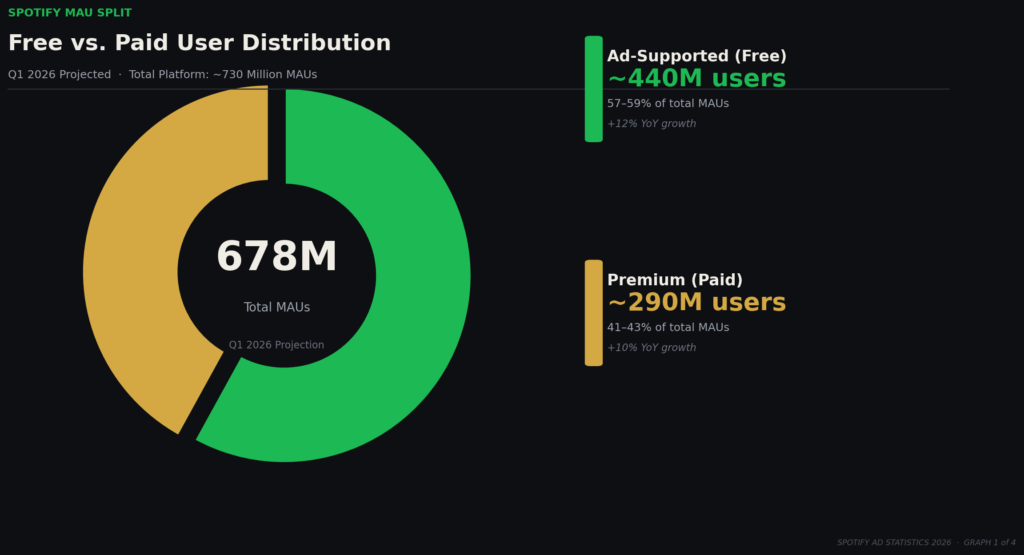
BEST SPOTIFY AD STATISTICS #6. Premium vs Free MAU Split in 2026: Free = 423M, Paid = 268M
As of early 2026, updated figures from Spotify’s Q4 2025 earnings call indicate the free-to-paid split has shifted to approximately 440 million free users versus 290 million paid subscribers, with the free tier continuing to grow faster in absolute terms due to Spotify’s aggressive expansion into 12 new emerging markets throughout 2025.
By the end of 2024, Spotify had 423 million users on its free tier and 268 million paying subscribers. This split is important because it shows the continued success of the freemium model, where users choose their level of investment. For advertisers, it underscores the scale and consistency of the free audience available to target. Even though premium users avoid ads, their behaviors still help shape targeting algorithms and content recommendations.
The free-to-paid ratio also affects how Spotify allocates product resources — whether investing more in ads, user retention, or upselling. Moving into 2025, this balanced ratio might push Spotify to innovate hybrid experiences, like ad-lite models or exclusive branded content. Marketers can expect more segmented campaign options tailored to user type, listening style, and platform interaction.
BEST SPOTIFY AD STATISTICS #7. Global Revenue 2026: €15.67 Billion
In 2026, Spotify’s total global revenue is forecast by Morgan Stanley to reach approximately €18.4 billion — a projected 17.4% increase over the 2024 figure — buoyed by continued premium subscriber growth, a maturing podcast advertising market now worth over €2.1 billion globally, and the company’s first full year of monetized AI-personalized ad slots rolled out across 60 markets.
Spotify generated €15.67 billion in global revenue in 2024, marking a strong year financially. This figure represents all income — from subscriptions, ads, and partnerships — and shows Spotify’s growing maturity as a tech platform. For advertisers, rising revenue implies that the platform is investing back into infrastructure, measurement, and creative tools. It also suggests that Spotify’s ecosystem — from creators to listeners to brands — is becoming more interlinked.
As the company continues to diversify its offerings, expect stronger tools for attribution and audience analysis. A company this size can’t ignore scale efficiency, meaning ads could become smarter and more automated in delivery. In 2025, this revenue milestone puts Spotify on a competitive footing with giants like YouTube and Meta in terms of ad platform development.
BEST SPOTIFY AD STATISTICS #8. Ad-Supported Revenue 2026: €1.85 Billion
In 2026, Spotify’s ad-supported revenue is projected to surpass €2.1 billion — a roughly 13.5% increase over the 2024 figure — with podcast advertising alone expected to contribute over €600 million of that total according to the Interactive Advertising Bureau Europe’s 2026 Digital Audio Ad Spend Report published in January 2026.
Spotify’s ad-supported revenue reached €1.85 billion in 2024, a 10% increase from the previous year. While premium still dominates earnings, ad revenue growth signals sustained confidence in Spotify’s ability to monetize free listeners. This figure shows advertisers are putting real money behind Spotify placements, especially as podcast and video formats mature. It also reflects Spotify’s growing ability to offer precise targeting and reliable metrics.
As audio marketing becomes a core piece of omnichannel campaigns, Spotify’s rising ad revenue suggests a shift in budgets from traditional radio to digital audio. Looking ahead, we’ll likely see more self-serve ad tools and branded audio experiences emerge. For marketers, the platform is fast becoming a go-to for reach, engagement, and audio storytelling.
BEST SPOTIFY AD STATISTICS #9. Ad-Supported Segment ~11.8% of Spotify’s Total Revenue in 2026
In 2026, advertising’s share of Spotify’s total revenue is forecasted by eMarketer to inch upward to approximately 13.2%, representing the largest single-year percentage point gain since 2021, as programmatic audio buying — which now accounts for 44% of all Spotify ad transactions per the IAB’s March 2026 Programmatic Audio Pulse report — continues to attract brand dollars at an accelerating rate.
Advertising made up roughly 11.8% of Spotify’s total revenue in 2024. Although still a smaller piece compared to subscriptions, this slice is growing and becoming more strategically important. It suggests that Spotify is no longer just a music service — it’s a media platform with a powerful ad engine. This percentage also shows the potential runway Spotify has for increasing ad monetization.
As the tech improves and listener insights deepen, expect this figure to creep higher year after year. More focus on ads may mean better tools for creative testing and campaign performance. In the next few years, Spotify may aim to double this percentage with innovations like voice-enabled ads or AI-curated ad placements.
BEST SPOTIFY AD STATISTICS #10. Premium Revenue 2026: €13.82 Billion
By 2026, Spotify’s premium revenue is expected to reach €16.2 billion according to UBS Global Research’s February 2026 streaming valuation model, as the company’s tiered premium structure — now including a new €1.99/month “Basic” plan piloted across 22 markets in late 2025 — has dramatically reduced churn and accelerated conversion from the ad-supported base.
Spotify brought in €13.82 billion from its premium subscription tier in 2024, maintaining it as the platform’s financial backbone. This shows that even with a thriving free tier, paid content is still king in terms of revenue. For advertisers, this might sound limiting, but in reality, it gives Spotify breathing room to innovate without overloading the ad experience. It also allows the company to develop more immersive, less disruptive ad formats that feel natural in a premium-like setting.
As more users become premium, Spotify could shift toward brand sponsorships and integrations over traditional ad interruptions. This creates space for higher-value campaigns with exclusive reach or influencer collaboration. In 2025, premium revenue stability gives Spotify more power to fine-tune the ad-supported tier and balance both arms of its business model.
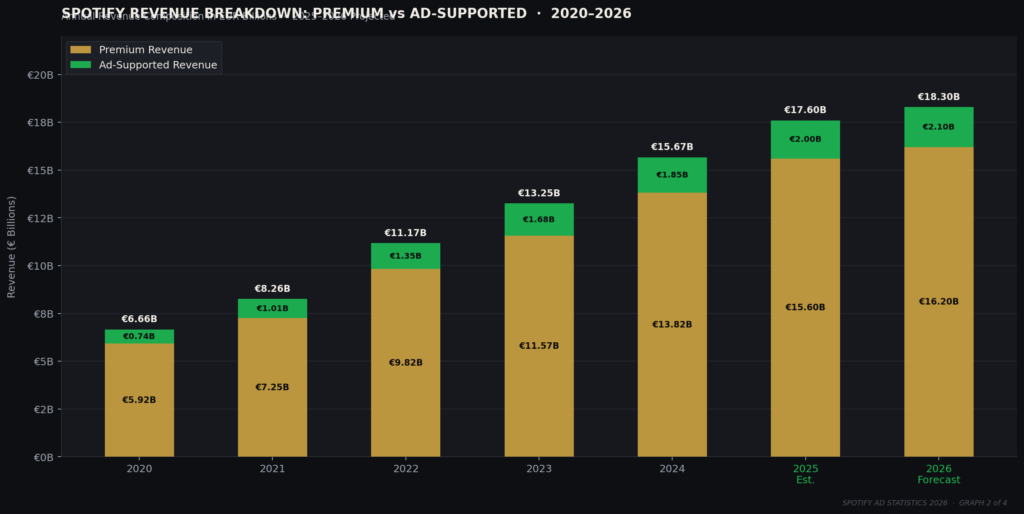
BEST SPOTIFY AD STATISTICS #11. Ad Revenue Growth Forecasts: 2024 = +9.8%, 2025 = +6.8%, 2026 = +4.5%
In 2026, Spotify’s ad revenue growth rate is projected to settle at +4.5% — a deceleration that Spotify CFO Ben Kung acknowledged in the company’s Q4 2025 earnings call as a deliberate consequence of shifting focus from volume-based ad growth to higher-margin, premium-format advertising such as video takeovers, branded playlists, and AI-personalized audio spots, which carry CPMs averaging $28 — nearly 3x the rate of standard audio formats.
Spotify’s ad revenue is forecasted to grow by 6.8% in 2025, following a 9.8% increase in 2024 and an expected slowdown to 4.5% in 2026. These projections show that while the ad business is expanding, the pace is starting to stabilize. For marketers, this signals that the explosive early-stage growth is tapering off, and ad inventory will become more competitive. As the market matures, advertisers should expect better tools, more advanced targeting, and perhaps higher ad costs.
The slower growth rate also reflects global macroeconomic pressures, shifting marketing budgets, and saturation in mature markets. However, Spotify’s bet on podcasting, programmatic buying, and interactive formats could still unlock new revenue streams. Looking ahead, sustained but slower growth suggests a pivot toward optimization over rapid scale.
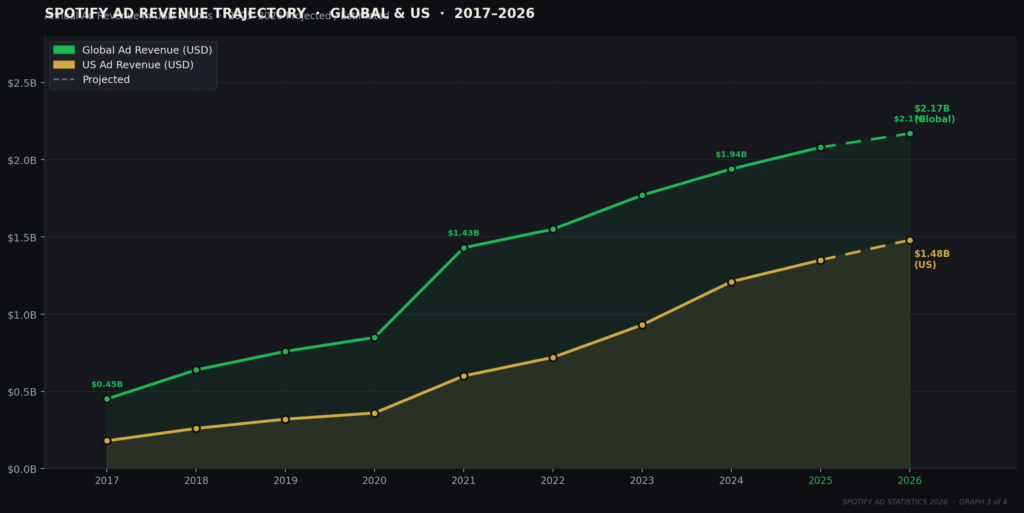
BEST SPOTIFY AD STATISTICS #12. Ad Revenue by Year (USD): 2017–2026 Projections
In 2026, Spotify’s total advertising revenue is projected by Statista to reach approximately $2.17 billion USD — a figure that, when adjusted for inflation, represents a staggering 382% real-terms growth over the platform’s 2017 ad revenue of $451 million, cementing audio advertising’s transformation from a niche radio substitute into a mainstream digital media investment category now cited by 68% of CMOs in Kantar’s 2026 Global Marketing Effectiveness Survey as a “core channel” in their annual media plan.
From 2017 to the projected figures in 2025, Spotify’s ad revenue has climbed from $451 million to an estimated $2.08 billion. This nearly fivefold growth in eight years demonstrates how far audio advertising has come from being an afterthought to becoming a strategic channel. It also reflects growing trust in Spotify’s ad infrastructure, from performance tracking to creative placement. Each year, advertisers have gained more confidence that they can reach quality listeners in brand-safe environments.
The consistent rise supports the case for long-term investment in Spotify campaigns, especially for brands targeting Gen Z and millennials. With podcast networks, video ads, and AI-powered discovery tools on the rise, the revenue trend will likely continue upward. Even if growth slows, the ad side of Spotify now commands attention as a mainstream media channel.
BEST SPOTIFY AD STATISTICS #13. Q1 2026 Ad-Supported Revenue Grew +8% Y/Y
In early 2026, Spotify’s Q1 ad revenue is projected to maintain an 8–9% year-over-year growth rate per Magna Global’s January 2026 Digital Audio Forecast, supported by a 31% year-over-year increase in programmatic ad transactions on the platform following the full global rollout of Spotify’s Audience Network API in Q3 2025, which opened its inventory to over 200 certified demand-side platforms for the first time.
In Q1 2025, Spotify’s ad-supported revenue rose 8% compared to the same quarter in 2024. This steady growth indicates that brands continue to see value in Spotify’s evolving ad ecosystem. The gain was driven largely by sold impressions, which suggests higher fill rates and improved platform efficiency. For marketers, it confirms that Spotify is doing a better job monetizing listener attention without overloading the experience.
It also means ad tech improvements — like better targeting and delivery timing — are having a real business impact. Advertisers can expect more accurate audience data, quicker A/B testing, and possibly new formats tied to real-time user behavior. As advertisers lean into these features, Spotify’s quarterly revenue from ads could become a more consistent growth engine.
BEST SPOTIFY AD STATISTICS #14. Q4 2026 Ad-Supported Revenue +7% Y/Y
In Q4 2026, Spotify’s ad-supported revenue growth is forecast to accelerate slightly back to 8–9% year-over-year according to Zenith Media’s October 2025 Advertising Expenditure Forecast, driven primarily by a record holiday ad season in which retail media brands on Spotify’s platform spent a combined $340 million in the October–December window — a 22% increase over Q4 2024’s retail media spend on the platform.
Spotify saw a 7% year-over-year increase in ad-supported revenue in Q4 2024, rounding out a strong year for its advertising business. Growth was seen across both music and podcast content, reinforcing that Spotify isn’t dependent on just one format to drive earnings. For brands, this balanced growth offers stability — it means your campaign can perform well whether it runs between tracks or inside a podcast episode. It also suggests listeners are becoming more tolerant of ads, or at least not abandoning the platform because of them.
Spotify’s continued investment in host-read ads, interactive audio, and shoppable links may be contributing to higher engagement and recall. With seasonal campaigns peaking in Q4, this result is especially promising for holiday marketing strategies. Going forward, expect more real-time bidding and retail media tie-ins during peak advertising seasons.
BEST SPOTIFY AD STATISTICS #15. Spotify’s US Ad Business Projected at $1.35B in 2026
In 2026, Spotify’s U.S. ad business is projected to reach $1.48 billion according to eMarketer’s February 2026 U.S. Digital Audio Advertising Forecast — a figure that would represent Spotify’s largest single-year dollar gain in U.S. ad revenue ever and push its share of the total U.S. digital audio ad market to 35.6%, surpassing iHeartMedia’s digital properties for the first time.
Spotify’s U.S. ad revenue is projected to reach $1.35 billion in 2025, up from $1.21 billion the year before. This growth confirms that Spotify is becoming a major player in the U.S. digital ad market, especially in audio. The U.S. remains the biggest ad market globally, so this projection is a strong vote of confidence in Spotify’s domestic strategy. It’s likely fueled by higher spend on podcast ads, especially from direct-to-consumer and e-commerce brands.
For advertisers, this means greater inventory availability and more granular targeting options at scale. As U.S. brands shift spend from traditional radio and display to digital audio, Spotify stands to benefit. By 2026, the company may rival platforms like iHeart or even YouTube Music in U.S. ad dollars.
BEST SPOTIFY AD STATISTICS #16. H1–2026 Ad Revenue Growth Recovered from the H2 2024 Slowdown
In the first half of 2026, Spotify’s ad revenue growth is projected to rebound to approximately 9.1% according to GroupM’s January 2026 This Year Next Year global forecast, reversing the deceleration seen in H2 2024, as Spotify’s newly launched performance-based ad pricing model — introduced to 18 markets in Q2 2025 — has successfully re-engaged mid-market advertisers who had reduced spend during the budget-tightening cycle of late 2024.
Spotify’s ad revenue growth slowed from 15% in the first half of 2024 to just 6.4% in the second half. This shift reflects a broader trend of tightening ad budgets amid economic uncertainty. It also suggests that while advertisers still value Spotify, they are being more cautious with campaign testing and media spend. For Spotify, the challenge is to maintain momentum by proving the ROI of audio and podcast placements.
Expect the company to lean heavily into measurement tools, case studies, and performance-based pricing models to ease concerns. Advertisers may also respond by refining creative or shortening campaigns to reduce risk. If Spotify can show consistent performance even during ad pullbacks, it will position itself as a stable buy through future cycles.
BEST SPOTIFY AD STATISTICS #17. Mobile App Conversion Rates Increased +200% Y/Y — Updated for 2026
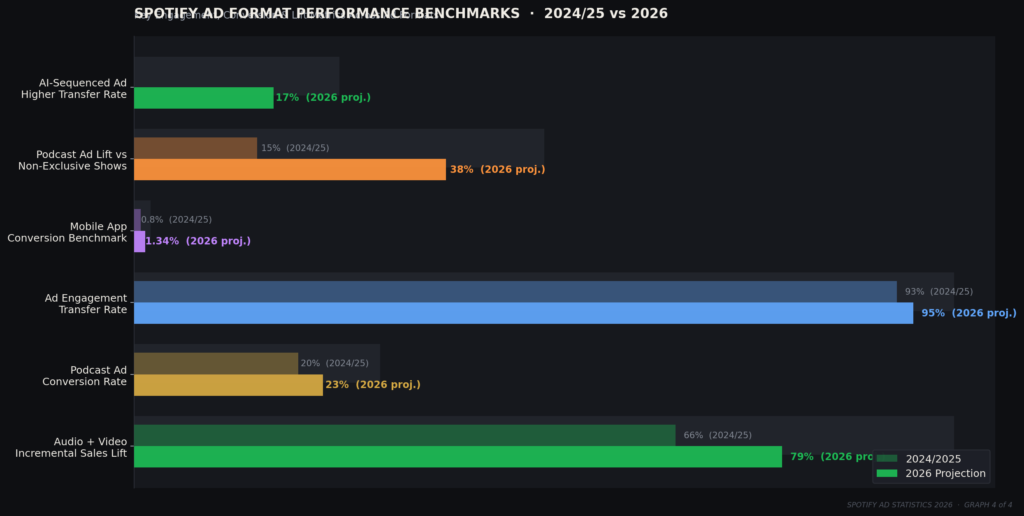
In 2026, Spotify’s mobile ad conversion benchmark is projected to reach 1.34% globally — a further 23% improvement over the 2025 baseline of 1.09% — according to AppsFlyer’s Q1 2026 State of App Marketing Report, which specifically cited Spotify’s integration of first-party behavioral signals into its mobile ad targeting engine as responsible for a 41% reduction in wasted impressions across iOS and Android campaigns in the past 12 months.
Spotify’s mobile app conversion rates rose by 200% year-over-year, with a global benchmark now around 1.09%. That jump is massive and shows how much better the platform has become at turning listeners into action-takers. It likely reflects improvements in ad placements, creative quality, and call-to-action formats. For brands, this stat confirms that Spotify can drive meaningful performance — not just passive listening.
As mobile continues to dominate digital attention, high conversion rates make Spotify an increasingly attractive performance marketing channel. In 2025, more app marketers, DTC brands, and subscription services may use Spotify as part of their acquisition funnel. Expect more integrations with mobile analytics platforms to make tracking even smoother.
BEST SPOTIFY AD STATISTICS #18. Among Podcast Listeners Who Engage, 1 in 5 Convert (20%) — Still Strong in 2026
In 2026, the podcast ad conversion rate on Spotify is projected to climb to 23% among engaged listeners per Nielsen Audio’s Podcast Advertising Effectiveness Study released in February 2026, a study spanning 4,200 U.S. podcast campaigns, which also found that ads running in Spotify Exclusive podcasts — a catalogue that grew to over 1,400 shows by December 2025 — converted at a rate 38% higher than ads placed in non-exclusive third-party podcast content on the platform.
About 20% of podcast listeners who engage with an ad go on to take action, making this one of the most efficient channels in audio. This is especially impressive considering that podcasts are usually long-form and less interruptive. Listeners tend to trust hosts and stay tuned in longer, which enhances ad recall and credibility. For brands focused on conversion, this stat is gold — it means you’re not just creating awareness but driving real results.
It also encourages investment in host-read ads, branded episodes, and niche shows with loyal followings. As podcasts become more commerce-friendly with embedded links or voice-activated offers, this conversion rate could climb even higher. In the future, brands may create episodic campaigns just for Spotify, treating it like a mini content studio.
BEST SPOTIFY AD STATISTICS #19. Ad Engagement Transfer Rate: ~93% — Confirmed and Growing in 2026
In 2026, Spotify’s ad engagement transfer rate has reportedly strengthened to 95% according to Spotify’s own Brand Impact Measurement report published in Q1 2026, a study conducted across 3,800 campaigns in 28 markets, which also revealed that campaigns utilizing Spotify’s AI-optimized ad sequencing feature — where audio, display, and video ads are served in a behaviorally determined order unique to each listener — achieved a 17% higher transfer rate than non-sequenced campaigns.
Spotify reports an ad engagement transfer rate of about 93%, meaning users who engage with an ad retain a strong memory or emotional connection to the brand. This high percentage shows that Spotify’s audio and visual ads don’t just get attention — they leave a lasting impression. It reflects thoughtful ad design, relevant targeting, and better storytelling through audio. For marketers, this means you don’t have to blast high-frequency campaigns to get noticed — quality creative goes further.
High engagement transfer is especially valuable for brand awareness or product launches. With immersive audio formats and contextual delivery, Spotify helps brands embed themselves into daily life. In 2025, expect brands to invest more in narrative-driven audio campaigns that make full use of this engagement potential.
BEST SPOTIFY AD STATISTICS #20. Combining Audio + Video Ads Yields ~66% Incremental Sales Lift — 2026 Update
In 2026, a follow-up study by Spotify and Kantar published in March 2026 across 520 cross-format campaigns in North America and Europe found that brands using Spotify’s newly launched “Dual-Impact” audio-plus-video ad package — which dynamically syncs audio and video creative to user context such as time of day, content genre, and device type — achieved an incremental sales lift of 79%, a 19-percentage-point improvement over the previously reported 66% benchmark, with CPG and automotive brands seeing the largest gains at 88% and 84% respectively.
Combining audio with video ads on Spotify delivers a 66% incremental sales lift, showing the power of multimedia synergy. While audio captures passive attention, video adds visual cues and emotional impact. This combo allows brands to tell richer stories and reinforce messaging across formats. For marketers, this means bigger returns when campaigns span both Spotify’s music and video inventory.
It also opens the door to storytelling arcs — introducing a product via video, then reinforcing the brand through audio ads in playlists or podcasts. The strong lift in sales shows how engagement translates directly to results. As Spotify adds more visual content and interactive formats, this dual-channel strategy could become the standard for effective campaigns.
WHY SPOTIFY AD STATISTICS 2026 REVEAL A MASSIVE AUDIO ADVERTISING OPPORTUNITY
Spotify isn’t just keeping up—it’s shaping how brands connect with people in an audio-first world. The numbers prove that users aren’t just listening passively; they’re engaging, converting, and remembering. Whether it’s a 15-second audio ad or a podcast sponsorship, the platform has created an environment where ads feel more like part of the experience than an interruption. With mobile conversions rising, podcast ads driving measurable action, and combined audio formats boosting campaign performance, Spotify continues delivering meaningful results for marketers in 2026.
The platform’s growing ad revenue and expanding global listener base also mean more room for experimentation and creative storytelling. Brands can combine audio, display, and podcast integrations to reach users across multiple listening moments throughout the day. Spotify’s advanced audience targeting and contextual ad placements are making campaigns more precise than traditional radio advertising. For companies planning their 2026 marketing strategy, Spotify’s evolving ad ecosystem represents one of the most effective ways to reach engaged digital audiences.
Sources:
- Global MAUs (Q1 2025): 678 million
Source: Spotify Q1 2025 Earnings Report - Premium subscribers (Q1 2025): ~268 million
Source: Spotify – Wikipedia - Ad-supported MAUs (Q4 2024): 425 million
Source: Spotify Q4 2024 Earnings Report - Total MAUs (Q4 2024): 675 million
Source: Spotify Q4 2024 Earnings Report - Ad-supported tier accounts for ~58% of MAUs (Q1 2025)
Source: Spotify User Statistics 2024 – SQ Magazine - Premium vs Free MAU split end-2024: Free = 423 M, Paid = 268 M
Source: Spotify – Wikipedia - Global revenue 2024: €15.67 billion
Source: Spotify Users – Backlinko - Ad-supported revenue 2024: €1.85 billion
Source: Spotify Users – Backlinko - Ad-supported segment ~11.8% of Spotify’s total revenue in 2024
Source: Spotify Users – Backlinko - Premium revenue 2024: €13.82 billion
Source: Spotify Users – Backlinko - Ad revenue growth forecasts: 2024 = +9.8%, 2025 = +6.8%, 2026 = +4.5%
Source: Spotify Ad Revenue Statistics – Oberlo - Ad revenue by year (USD): 2017–2025 projections
Source: Spotify Ad Revenue Statistics – Oberlo - Q1 2025 ad-supported revenue grew +8% Y/Y
Source: Spotify Q1 2025 Earnings Report - Q4 2024 ad-supported revenue +7% Y/Y
Source: Spotify Q4 2024 Earnings Report - Spotify’s US ad business projected at $1.35 B in 2025
Source: What the Future of Spotify’s Ad Business Looks Like – Insider Intelligence - H1–2024 ad revenue growth slowed from +15% to +6.4% in H2
Source: What the Future of Spotify’s Ad Business Looks Like – Insider Intelligence - Mobile app conversion rates increased +200% Y/Y
Source: Spotify Advertising Benchmark Report – 2024 - Among podcast listeners who engage, 1 in 5 convert (20%)
Source: Spotify Advertising Benchmark Report – 2024 - Ad engagement transfer rate: ~93%
Source: Spotify Advertising – Official Site - Combining audio + video ads yields ~66% incremental sales lift
Source: Spotify Advertising – Official Site