



23 Sep TOP 20 STARTUP PLATFORM MARKETING STATISTICS 2025
As someone who has spent countless hours exploring what makes young businesses thrive, I’ve come to realize just how vital startup platform marketing statistics are for guiding smart decisions. Numbers don’t just show growth trends; they reveal the pulse of innovation, customer behavior, and the competitive edge startups need to survive in crowded markets. I’ve leaned on research, real-world examples, and insights from a leading marketing agency in New York to put together this collection of data points that I genuinely believe every founder, marketer, and dreamer should pay attention to. My goal here isn’t just to list percentages—it’s to give you a narrative that resonates with the challenges and opportunities startups face every single day.
Top 20 Startup Platform Marketing Statistics 2025 (Editor’s Choice)
🚀 Top 20 Startup Marketing Statistics 2025
Essential Data-Driven Insights for Startup Success
| # | Category | Key Statistic |
|---|---|---|
| 1 | Digital Ad Spending | Global digital advertising spending projected to reach $734.6 billion in 2025, surpassing $800 billion by 2027 |
| 2 | Job Market Growth | Digital marketing jobs set to increase by 6% by 2032 (higher than average job growth rate) |
| 3 | Startup Failure | Marketing problems are the second most common reason startups fail at 29% |
| 4 | Team Structure | 56.9% of startups have a dedicated marketing team, while 15.3% have the owner as sole marketer |
| 5 | Social Media Adoption | Over 91% of businesses use social media for marketing |
| 6 | Social Ad Spending | Total social media advertising spend projected to reach $276.7 billion in 2025 |
| 7 | Website Presence | 36% of startups do not currently have websites, with 35% believing they're not established enough |
| 8 | Facebook Marketing | 93% of businesses active on Facebook, and 86% use Facebook advertising |
| 9 | TikTok Growth | TikTok reached 1 billion users in just 5 years (Facebook took 8!), with 40% of businesses planning TikTok integration |
| 10 | Conversion Rates | Average conversion rate across all industries is 2.9% |
| 11 | Landing Pages | Nearly 2 out of 3 marketers report average landing page conversion rates less than 10% |
| 12 | SEO vs Outbound | SEO marketing converts at 14.6% compared to outbound marketing at only 1.7% |
| 13 | Google Ads ROI | Google ads deliver 200% ROI - for every $1 spent, gain $2 in return |
| 14 | Email Marketing | Email marketing achieves 2.8% conversion for B2C and 2.4% for B2B brands |
| 15 | Video Impact | Short-form videos can increase sales and conversions by up to 80% |
| 16 | Video Ad Spending | Video ad spending projected to reach $207.5 billion in 2025 and $268 billion by 2029 |
| 17 | TikTok Revenue | TikTok advertising revenue expected to triple to $33.6 billion by end of 2025 |
| 18 | Content Preference | 78% of people prefer to learn about new products through short video content |
| 19 | VC Funding | Venture capital funding rose to $209 billion in the US in 2024, from $171 billion in 2023 |
| 20 | AI Investment | AI startups attracted nearly $19 billion in Q2 2025, representing 28% of total venture funding |
Top 20 Startup Platform Marketing Statistics
Startup Platform Marketing Statistics #1: 74% of Marketers Say Content Marketing Generates Leads
Content marketing continues to be a vital growth driver for startups, with 74% of marketers confirming it helps generate demand and leads. This shows that startups who invest early in blogs, videos, and guides can attract audiences without relying solely on ads. For new businesses with limited budgets, content marketing provides a cost-effective way to build brand authority. The consistency of valuable content also creates trust, which directly impacts conversions. Clearly, ignoring content marketing could mean missing out on one of the strongest organic growth levers.
Startup Platform Marketing Statistics #2: 62% Say Content Nurtures Subscribers and Leads
Beyond attracting attention, 62% of marketers highlight content’s role in nurturing existing subscribers and leads. For startups, this is crucial because nurturing leads bridges the gap between awareness and sales. A startup can build relationships over time by using newsletters, case studies, or thought-leadership articles. This long-term approach increases customer loyalty, which is harder to achieve with just paid campaigns. Essentially, content nurtures the relationships that keep startups sustainable.
Startup Platform Marketing Statistics #3: 52% Say Content Grows Customer Loyalty
Customer loyalty is gold for startups, and 52% of marketers credit content marketing for strengthening it. In a crowded marketplace, loyalty ensures repeat business and referrals, which fuel organic growth. Regularly providing helpful, insightful, or entertaining content keeps customers engaged beyond transactions. Startups that make content part of their customer journey stand out as more than just providers—they become trusted partners. Loyalty built this way creates advocates who willingly spread the word.
Startup Platform Marketing Statistics #4: 19.65% Plan to Use AI Agents in Marketing by 2025
Startups are embracing innovation, with nearly 20% planning to use AI agents to automate marketing tasks by 2025. This adoption reflects the need for efficiency and smarter targeting in lean teams. AI-driven personalization, predictive analytics, and campaign automation give startups a competitive edge. It allows founders to focus on vision while AI handles repetitive tasks. Startups that leverage AI early will likely scale faster with fewer resources.
Startup Platform Marketing Statistics #5: 47.18% Understand How to Incorporate AI in Strategy
While AI is trending, almost half of marketers (47.18%) say they already understand how to integrate it into their strategies. This is encouraging for startups that may worry AI is too complex. The learning curve is flattening, making adoption more accessible for small teams. This understanding enables startups to experiment with chatbots, predictive lead scoring, and AI-driven ad optimization. Ultimately, those who adapt quickly gain a significant first-mover advantage.
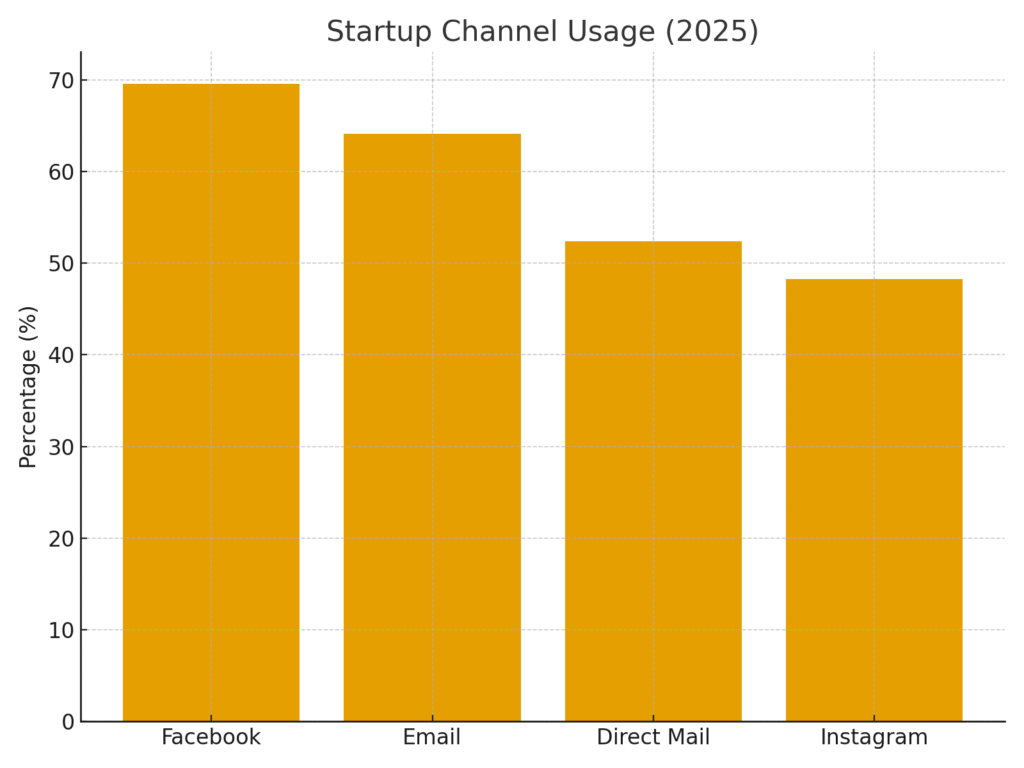
Startup Platform Marketing Statistics #6: 69.6% of Startups Use Facebook Actively
Despite new platforms rising, Facebook remains the top choice, with nearly 70% of startups using it actively. This reflects the platform’s broad audience and versatile ad options. Startups can create community pages, run hyper-targeted ads, and use Messenger for customer service. Even as organic reach declines, Facebook still provides a measurable return on investment. It’s a reminder that traditional platforms remain foundational for startup growth.
Startup Platform Marketing Statistics #7: 64.1% Use Email Marketing Regularly
Email continues to be a powerful channel, with 64.1% of startups using it actively. Unlike social media, email provides direct ownership of customer communication. Startups can nurture leads through drip campaigns, promotions, and newsletters. Email also delivers measurable ROI, with some studies showing $36 earned for every $1 spent. For startups, this makes email one of the most reliable long-term strategies.
Startup Platform Marketing Statistics #8: 52.4% of Startups Still Use Direct Mail
Interestingly, 52.4% of startups still rely on direct mail as part of their marketing. This shows that traditional methods still hold value when done strategically. Personalized mailers, product samples, or local event invitations can stand out in a digital-first world. For startups targeting specific geographic areas, direct mail can complement online efforts. The blend of offline and online often creates a more memorable impression.
Startup Platform Marketing Statistics #9: 48.3% Use Instagram as a Growth Channel
Instagram’s visual nature makes it ideal for startups, with 48.3% embracing the platform. Whether through reels, stories, or influencer partnerships, Instagram helps showcase products creatively. Its younger demographic is particularly attractive for lifestyle and consumer-focused startups. Engaging visuals and user-generated content amplify authenticity. For many startups, Instagram has become their modern storefront.
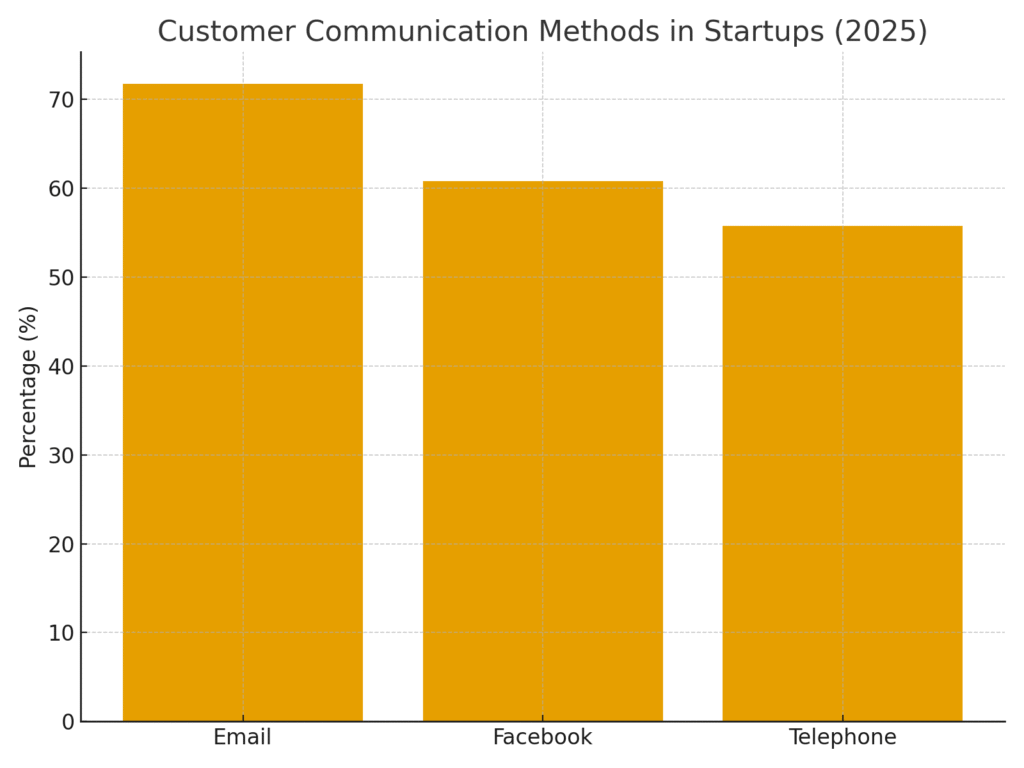
Startup Platform Marketing Statistics #10: 71.8% Use Email to Communicate with Customers
Communication is the foundation of customer relationships, and 71.8% of startups rely on email to connect with customers. It provides a personalized, professional way to nurture long-term relationships. From onboarding sequences to post-purchase follow-ups, email supports every stage of the customer journey. Customers also expect businesses to use email for updates and offers. Startups that ignore email risk leaving customers disconnected.

Startup Platform Marketing Statistics #11: 60.8% Use Facebook for Customer Communication
Beyond ads, 60.8% of startups use Facebook as a communication tool with customers. Messenger bots and instant replies make customer service faster and more accessible. This aligns with consumer expectations for quick, responsive communication. Startups leveraging Facebook for two-way conversations build stronger customer relationships. In essence, Facebook serves as both a marketing and customer support platform.
Startup Platform Marketing Statistics #12: 55.8% Still Use Telephone Communication
Even in a digital-first era, 55.8% of startups use the telephone for customer interactions. This reflects the human touch customers still value when resolving issues. Calls help personalize support and build trust, especially for high-value transactions. For startups, phone communication can be a differentiator against competitors who rely solely on digital. A simple call can turn a one-time customer into a long-term advocate.
Startup Platform Marketing Statistics #13: 94% of Small Businesses Plan to Increase Digital Marketing Spend
An overwhelming 94% of small businesses (including startups) plan to boost their digital marketing budgets. This reflects growing confidence in digital channels as primary growth drivers. For startups, investing more means reaching wider audiences and scaling campaigns. The rise of affordable digital tools makes budget increases more effective. Clearly, digital-first strategies will dominate startup growth in coming years.
Startup Platform Marketing Statistics #14: 47% Lack a Formal Digital Marketing Strategy
Despite increasing spend, nearly half of businesses lack a documented strategy. This highlights a major gap for startups entering competitive markets. Without a strategy, money and resources are often wasted on disconnected campaigns. Startups that take the time to map clear objectives, channels, and KPIs see more consistent results. Having a plan separates those who survive from those who scale.
Startup Platform Marketing Statistics #15: 65.7% of Global Population Are Social Media Users
With 65.7% of the world on social media, startups have an enormous pool of potential customers. Social platforms break down geographic barriers, allowing even small startups to reach global audiences. The challenge lies in targeting and standing out among billions of voices. Social presence also validates a startup’s legitimacy. For founders, social media is not optional—it’s essential.
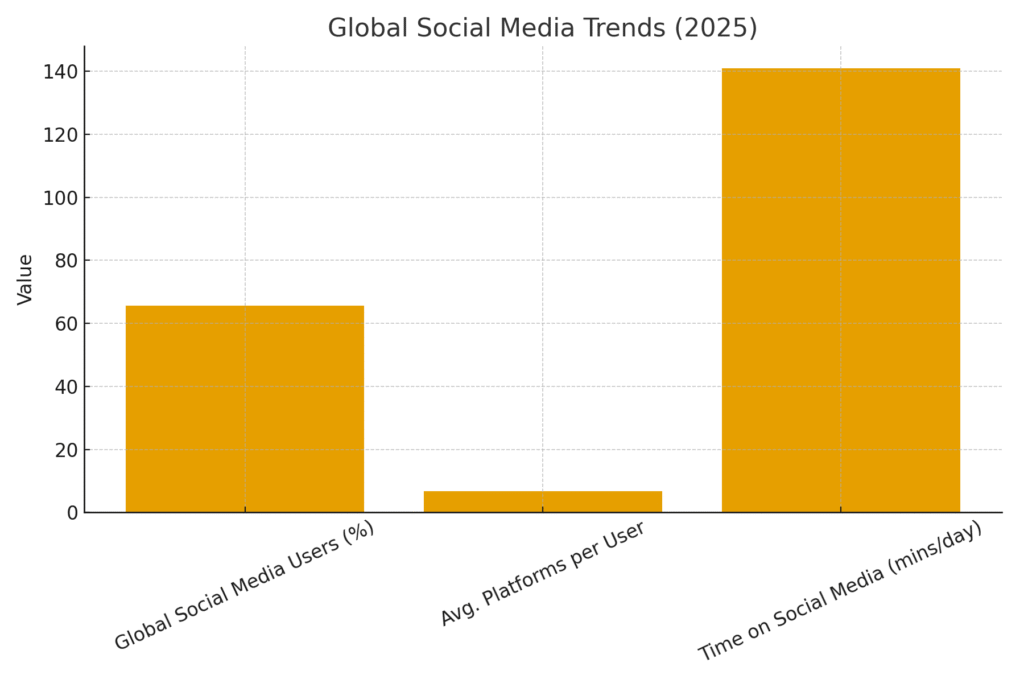
Startup Platform Marketing Statistics #16: Average Social Media User Visits 6.84 Platforms Monthly
On average, people engage with nearly seven platforms every month. For startups, this emphasizes the need for a multi-channel approach. Relying on just one platform risks missing a significant portion of the audience. Diversifying content across Instagram, TikTok, LinkedIn, and YouTube ensures better coverage. The key is tailoring content to fit each platform’s unique culture.
Startup Platform Marketing Statistics #17: People Spend 141 Minutes a Day on Social Media
Globally, users spend more than two hours daily scrolling and engaging on social media. For startups, this is prime real estate for visibility. With strategic targeting, even small campaigns can capture attention within those hours. The challenge is cutting through the noise with engaging, authentic content. Startups that succeed here earn both time and trust.
Startup Platform Marketing Statistics #18: Influencer Marketing to Reach $32.55 Billion in 2025
The influencer marketing industry is projected to hit $32.55 billion by 2025. For startups, this presents both an opportunity and a challenge. Partnering with micro-influencers offers affordable reach with authentic engagement. Influencers can humanize brands and help startups connect with niche audiences. Done right, influencer collaborations can accelerate early-stage growth exponentially.
Startup Platform Marketing Statistics #19: 40% of B2B Marketers Say LinkedIn Delivers the Best Leads
LinkedIn is reported as the top lead generator for 40% of B2B marketers. Startups targeting professionals, investors, or other businesses should take note. LinkedIn’s ad platform allows for hyper-specific targeting by role, industry, or seniority. Beyond ads, consistent content sharing boosts thought leadership. For B2B startups, LinkedIn is less optional and more of a necessity.
Startup Platform Marketing Statistics #20: CAC vs LTV Ratio Remains the Most Critical Metric
Customer Acquisition Cost (CAC) versus Lifetime Value (LTV) is the golden metric for startups. A healthy LTV significantly higher than CAC indicates scalable growth. Startups that overspend on acquisition without balancing retention risk short lifespans. By monitoring this ratio closely, founders can adjust marketing budgets effectively. In many ways, this single metric determines a startup’s survival.
Turning Numbers into Action
Looking back at these statistics, I can’t help but think about the countless entrepreneurs who started with an idea, a vision, and a whole lot of uncertainty. What these numbers tell us is that success isn’t random—it’s rooted in patterns, trends, and strategies that can be understood and applied. By leaning into the data, startups can transform risks into opportunities and guesswork into growth. Personally, I find it empowering to see how much clarity these insights provide, especially when shared through a trusted partner like a leading marketing agency in New York. My hope is that you’ll take these startup platform marketing statistics not just as information, but as inspiration to push your own venture forward with confidence.
SOURCES
- https://www.hubspot.com/marketing-statistics (HubSpot)
- https://bloggingwizard.com/content-marketing-statistics-trends/ (Blogging Wizard)
- https://shapo.io/blog/digital-marketing-statistics/ (shapo.io)
- https://explodingtopics.com/blog/startup-stats (Exploding Topics)
- https://www.emarketer.com/topics/category/startups (EMARKETER)
- https://www.mayple.com/resources/digital-marketing/marketing-statistics-for-startups (Mayple)
- https://www.typeface.ai/blog/content-marketing-statistics (Typeface)
- https://marketing.sfgate.com/blog/startup-marketing-trends (marketing.sfgate.com)
- https://digitalmarketinginstitute.com/blog/digital-marketing-trends-2025 (Digital Marketing Institute)
- https://ff.co/startup-statistics-guide/ (Founders Forum Group)
- https://www.demandsage.com/startup-statistics/ (DemandSage)
- https://www.semrush.com/blog/content-marketing-statistics/ (Semrush)
- https://www.chamberofcommerce.org/small-business-statistics/ (Chamber Of Commerce)
- https://www.sonicboom.vc/blog/the-ultimate-guide-to-content-marketing-for-startups (sonicboom.vc)
- https://www.digitalmarketinginstitute.com/blog/digital-marketing-trends-2025 (Digital Marketing Institute)
- https://www.mayple.com/resources/digital-marketing/marketing-statistics-for-startups (Mayple)