



19 Sep TOP 20 SUGAR MARKETING STATISTICS 2025
When I first started digging into sugar marketing statistics, I was surprised at just how much this everyday ingredient shapes global business and consumer behavior. From production forecasts in India to rising health concerns across Latin America, the story of sugar is far more than numbers on a chart — it’s about culture, habits, and shifting trends that affect all of us. As someone who has collaborated closely with a leading marketing agency in New York, I’ve seen firsthand how data like this can completely transform the way campaigns are planned and executed. In this blog, I’ll walk you through 20 powerful insights that highlight not just where the sugar market stands today, but also where it’s heading in the near future.
Top 20 Sugar Marketing Statistics 2025 (Editor’s Choice)
🍯 Top 20 Sugar Marketing Statistics
Comprehensive Market Data & Consumer Insights for 2024-2025
| Rank | Category | Key Statistic | Key Value |
|---|---|---|---|
| 1 | Global Market | Sugar market value projected to reach $142.1 Billion by 2035, growing at 6.6% CAGR from 2025-2035 | $142.1B |
| 2 | Market Growth | Global sugar market estimated at $66.39 billion in 2023 and projected to reach $102.32 billion by 2030 | 6.5% CAGR |
| 3 | Market Forecast | Sugar market growth projected at 2.58% CAGR to reach $75.243 billion by 2029 | $75.2B |
| 4 | Volume Sales | Global sugar market valued at 194.9 Million Tons in 2024, estimated to reach 223.1 Million Tons by 2033 | 194.9M Tons |
| 5 | Production Volume | Sugar market reached 182.11 Million Tons in 2024 and projected to grow at 1.00% CAGR | 182.1M Tons |
| 6 | Global Consumption | Worldwide sugar consumption was 177.33 million metric tons in 2023/24, projected to increase to 178.79 million metric tons by 2024/25 | 177.3M Tons |
| 7 | Regional Dominance | Asia Pacific dominated the sugar market with the largest revenue share of 42.1% in 2023 | 42.1% |
| 8 | Country Leadership | Brazil currently dominates the global sugar market, holding a significant market share of 25.0% in 2024 | 25.0% |
| 9 | Fastest Growth | China's sugar market expected to grow at the fastest CAGR of 7.2% from 2024 to 2030 | 7.2% CAGR |
| 10 | Industrial Market | Asia Pacific dominated the industrial sugar market with 43.67% share in 2023 | 43.67% |
| 11 | Sugar Source | Sugarcane segment held the market with the largest revenue share of 77.9% in 2023 | 77.9% |
| 12 | Product Type | White sugar dominates the sugar market with 67.5% market share in 2024 | 67.5% |
| 13 | Segment Growth | Brown sugar segment expected to grow at the fastest CAGR of 6.9% from 2024 to 2030 | 6.9% CAGR |
| 14 | End-Use Market | Food & beverages segment led the market with the largest revenue share of 45.6% in 2023 | 45.6% |
| 15 | US Consumption | Average American consumes around 17 teaspoons (71.14 grams) of added sugar per day | 17 tsp/day |
| 16 | Beverage Consumption | Nationally, 63% of US adults reported drinking sugar-sweetened beverages one or more times daily | 63% |
| 17 | Global Leader | Mexico has one of the highest sugar-sweetened beverage consumption rates with 163 liters per person per year | 163L/year |
| 18 | Health Trends | Most consumers (72%) are looking to limit or avoid sugar altogether according to 2023 Food and Health survey | 72% |
| 19 | Zero-Sugar Market | Global zero-sugar food and beverage market expected to grow from $19.17bn in 2023 to $23.30bn in 2028 | 3.98% CAGR |
| 20 | Organic Sugar | Organic sugar market set to grow by $1.18 billion at 6.28% CAGR from 2023 to 2028 | 6.28% CAGR |
Top 20 Sugar Marketing Statistics 2025
Sugar Marketing Statistics #1: Global Sugar Market Worth $66.39 Billion In 2023, Projected $102.32 Billion By 2030
The global sugar market stood strong at $66.39 billion in 2023. Projections indicate it will climb to $102.32 billion by 2030, showcasing steady compound growth. This upward trend highlights how sugar continues to be a resilient commodity despite rising health concerns. Marketers see this as a signal to develop new campaigns and product innovations to ride this wave. The steady growth also ensures long-term opportunities for companies operating in the sugar and sweetener industries.
Sugar Marketing Statistics #2: Asia-Pacific Holds 42.1% Of The Sugar Market Share
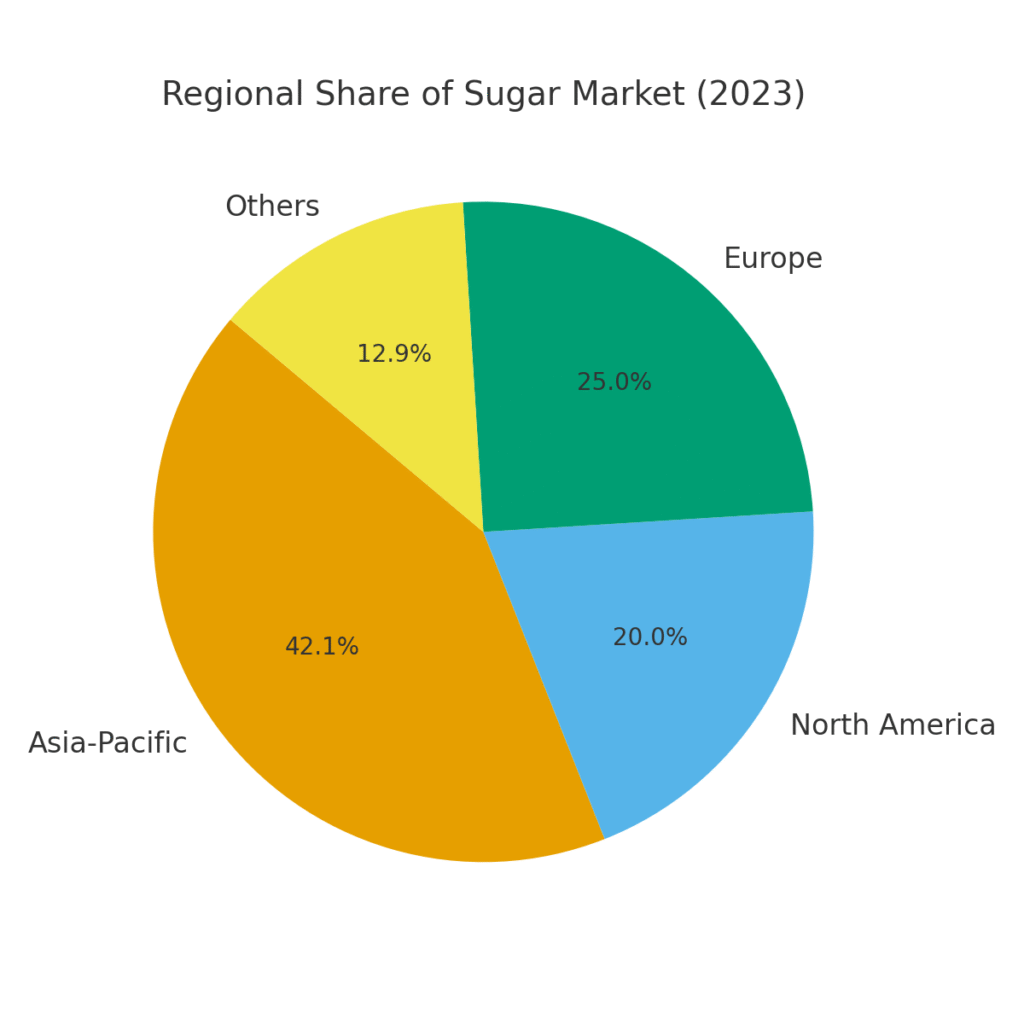
Asia-Pacific claimed 42.1% of the global sugar market share in 2023. This dominance is largely driven by high demand in countries like India, China, and Indonesia. It indicates that marketing strategies tailored to this region will likely bring the highest returns. The statistic also highlights how cultural preferences for sweets and beverages fuel the market. For brands, Asia-Pacific remains the most influential region for sugar-focused campaigns.
Sugar Marketing Statistics #3: 176 Million Metric Tons Of Sugar Produced In 2022/23
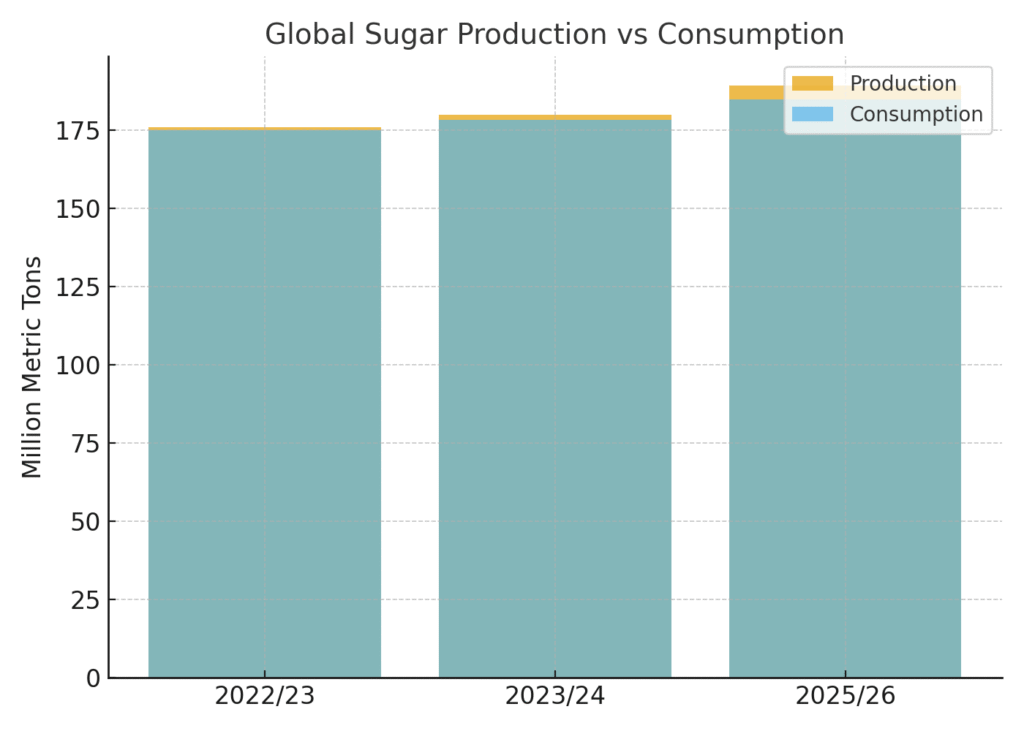
Global sugar production reached 176 million metric tons in the 2022/23 season. This steady supply ensures the stability of industries such as beverages, bakery, and confectionery. Marketing professionals can rely on this volume to forecast product availability and plan promotions. While production levels are strong, competition among producers means differentiation through branding is essential. The number also highlights sugar’s role as a staple commodity worldwide.
Sugar Marketing Statistics #4: U.S. Sugar Supply Forecast At 14.3 Million Short Tons
The U.S. sugar supply for 2025/26 is projected to be 14.3 million short tons. Much of this comes from record-high beet sugar production. For marketers, this ensures that American consumers will continue to enjoy an abundant supply at stable prices. Companies can confidently launch campaigns without fear of sudden shortages. This forecast also reinforces the U.S. as a self-sufficient sugar market.
Sugar Marketing Statistics #5: Global Sugar Production Projected At 189.3 Million Tons In 2025/26
By 2025/26, global sugar production is expected to reach 189.3 million tons. Brazil and India will lead this expansion, strengthening their positions in global trade. For marketers, this abundance opens opportunities to create new products and export strategies. Higher production levels also make sugar more accessible in diverse markets. This growth aligns with long-term consumer demand for sugar-based goods.
Sugar Marketing Statistics #6: Global Sugar Consumption Estimated At 178.4 Million Tonnes
Global sugar consumption is forecasted at 178.4 million tonnes in 2024. Although slightly slowing, demand remains robust due to its presence in nearly every food sector. Health awareness movements may reduce consumption in some regions, but the overall market remains strong. Marketers must balance indulgence messaging with health-conscious branding. The statistic shows sugar’s continued central role in food culture worldwide.
Sugar Marketing Statistics #7: Institutional Sugar Consumption In India At 60–65%
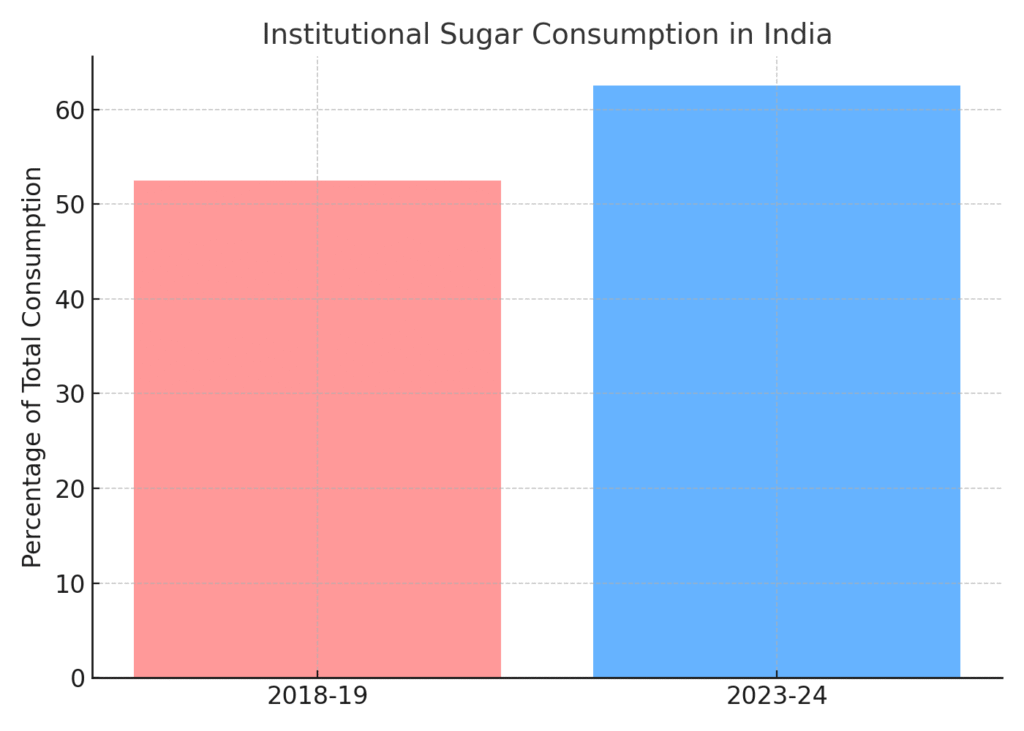
Institutional consumption of sugar in India rose to 60–65% in 2023/24. This means industries like bakeries, confectioneries, and dairy are using the majority of sugar produced. For marketers, B2B opportunities are growing as businesses rely more on sugar. The shift highlights how sugar is moving beyond households into industrial use. This trend demands marketing efforts tailored to wholesale and industrial buyers.
Sugar Marketing Statistics #8: Sugary Drinks Cause 2.2 Million Diabetes Cases Annually
Sugary drinks are linked to 2.2 million new diabetes cases globally each year. This alarming figure puts beverage companies under intense scrutiny. Marketers are being pushed to pivot towards healthier alternatives or responsible campaigns. The statistic shows the growing conflict between profit and public health. As a result, health-focused marketing strategies are becoming increasingly vital.
Sugar Marketing Statistics #9: 24% Of New Diabetes Cases Linked To Sugary Drinks In Latin America
In Latin America, 24% of new type-2 diabetes cases are tied to sugary drinks. This makes the region a major focus for health-driven policies. Marketers operating here must consider the regulatory environment and changing consumer habits. Campaigns emphasizing reduced sugar or alternative sweeteners may resonate more. The statistic highlights how public health challenges directly influence marketing strategies.
Sugar Marketing Statistics #10: 21% Of New Diabetes Cases In Sub-Saharan Africa Linked To Sugary Drinks
Sub-Saharan Africa faces 21% of new diabetes cases due to sugary drinks. Additionally, 11% of cardiovascular disease cases are linked to the same products. This creates a dual challenge for marketers targeting this region. Responsible messaging and promoting balance become critical. The statistic shows how sugar marketing must adapt to unique regional health challenges.

Sugar Marketing Statistics #11: 17 Kilograms Of Sugar Consumed Per Person Annually
On average, people worldwide consume 17 kilograms of sugar annually. This makes sugar one of the most universally consumed food commodities. Marketers can leverage this widespread use to position products as staples. However, it also opens the door for conversations about moderation and healthier choices. The statistic demonstrates sugar’s immense reach into daily lives.
Sugar Marketing Statistics #12: Natural Sweeteners Market Projected At $45.1 Billion By 2033
The natural sweeteners market is expected to reach $45.1 billion by 2033. This surge reflects consumers shifting toward healthier alternatives. For marketers, this means opportunities to introduce innovative sugar replacements. The trend doesn’t eliminate sugar’s role but complements it with variety. This statistic emphasizes the need for diversified product marketing.
Sugar Marketing Statistics #13: Americans Consume 70 Grams Of Added Sugar Daily
In the U.S., average daily sugar intake is over 70 grams. This surpasses recommended dietary guidelines significantly. Marketers in the U.S. face growing criticism for promoting sugar-heavy products. Yet, this also highlights strong consumer preference for sweet goods. The statistic shows the tension between consumer habits and health advocacy.
Sugar Marketing Statistics #14: Climate Change May Increase Sugar Intake By 3 Grams Daily
By 2095, rising temperatures may increase U.S. sugar intake by about 3 grams per day. Hotter climates push consumers toward frozen desserts and sugary beverages. Marketers will see seasonal opportunities for product promotions. This creates a long-term link between climate trends and consumer behavior. The statistic shows how external factors like weather impact sugar marketing.
Sugar Marketing Statistics #15: Children Exposed To High Levels Of Food Advertising
Children worldwide are heavily exposed to food and sugary product advertising. This exposure has been linked to increased consumption of unhealthy products. Marketers targeting children must balance appeal with responsibility. Regulations are being considered in many countries to limit advertising exposure. The statistic stresses the need for ethical marketing approaches.
Sugar Marketing Statistics #16: Children In Australia See 827 Unhealthy Ads Per Year
Children aged 5–8 in Australia are exposed to over 827 unhealthy food ads annually. This staggering number highlights how influential advertising is at a young age. For marketers, it reflects both an opportunity and a regulatory risk. Parents and policymakers are becoming more critical of such practices. The statistic pushes for a careful balance between marketing creativity and social responsibility.
Sugar Marketing Statistics #17: Teens In Australia See 17 Unhealthy Ads Per Hour Online
Teenagers in Australia see an average of 17 unhealthy food ads per hour online. The digital space has become a major battleground for sugary product marketing. Marketers must understand that younger audiences are highly impressionable online. Ethical advertising and transparent labeling are increasingly demanded. This statistic highlights the growing importance of digital marketing ethics.
Sugar Marketing Statistics #18: Demand Growth Driven By Asia And Africa
Sugar demand growth is expected to be driven by Asia and Africa. Rising incomes and population growth fuel this trend. For marketers, these regions present unmatched opportunities for expansion. However, cultural sensitivities and health concerns must be addressed. The statistic underscores where the next marketing frontier lies.
Sugar Marketing Statistics #19: Food And Beverage Segment Accounts For 45.6% Of Sugar Use
Food and beverage accounted for 45.6% of sugar use in 2023. This segment remains the largest consumer of sugar globally. Marketers see endless opportunities in product development here. From soft drinks to baked goods, the applications are vast. The statistic highlights sugar’s dominance in the F&B industry.
Sugar Marketing Statistics #20: India Faces Sugar Output Shortfall Against Consumption
India produced 25.8 million tons of sugar compared to 29 million tons consumed in 2024/25. This marks the country’s first shortfall in eight years. For marketers, this shortage could drive higher prices and change buying habits. Campaigns may need to address affordability and scarcity. The statistic reflects how supply-demand gaps shape marketing decisions.
Why These Numbers Matter for Us
Looking back at these 20 sugar marketing statistics, what stands out to me most is how deeply sugar is tied to both opportunity and responsibility. On one hand, the growth numbers in Asia and Africa point to exciting new markets where creative strategies can thrive. On the other, the health impacts remind me that good marketing has to balance profit with accountability. Personally, I feel that these stats challenge us — not just as marketers but as people — to rethink how sugar fits into everyday lives. My hope is that by sharing these insights, you’ll walk away with both fresh ideas and a more thoughtful perspective on how to approach sugar marketing in your own work.