



16 Sep TOP 20 SUPERMARKET MARKETING STATISTICS 2026 REVEAL SHOCKING GROCERY SHOPPING SHIFTS
Updated for 2026. This page has been fully refreshed with the latest supermarket marketing statistics, grocery retail insights, and consumer shopping trends, grounded in recent global surveys and retail industry research.
When I first started looking into supermarket marketing statistics, I realized just how much they reveal about the way we shop, spend, and even think about food. From the rise of online grocery orders to the growing preference for self-checkout lanes, these numbers tell stories about shifting habits that affect both shoppers and retailers.
As someone who follows industry trends closely, I’ve also seen how a leading marketing agency in New York can take insights like these and transform them into actionable strategies that actually make a difference for supermarkets big and small. What I’m sharing here isn’t just data—it’s a snapshot of how everyday choices in the grocery aisle shape the future of retail in 2026.
TOP 20 SUPERMARKET MARKETING STATISTICS 2026 SHOCKING GROCERY RETAIL GROWTH
Top 20 Supermarket Marketing Statistics
Essential revenue data and consumer insights shaping grocery retail in 2026
| # | Statistic | Figure | Category |
|---|---|---|---|
| 1 |
Average Spend Per Trip
Consumers spend $174 per grocery trip in 2025, with online sessions averaging $108 vs. $45.70 in-store, reflecting expanded basket sizes.
Spending
|
$174
per trip
|
Spending |
| 2 |
Weekly Household Grocery Budget
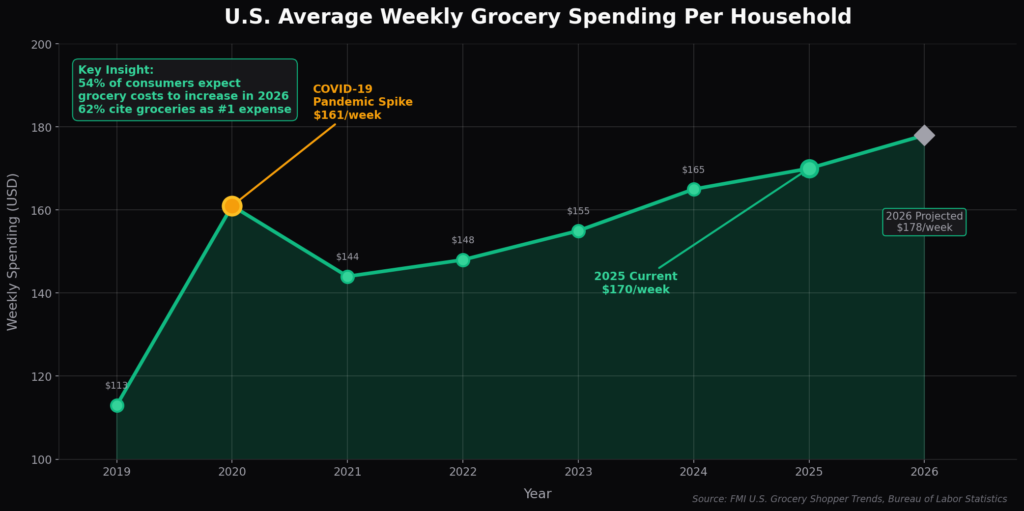
Average weekly grocery spending per U.S. household reached $170 as of February 2025, with costs rising 6.3% nationally YoY.
Spending
|
$170
weekly avg.
|
Spending |
| 3 |
Shopping Frequency
The average American visits the grocery store once every 4.7 days, spending 46 minutes shopping per trip.
Consumer
|
4.7 days
visit frequency
|
Consumer |
| 4 |
Transaction Value Gap
Online grocery transactions average $108 compared to $45.70 in-store, a 136% premium that makes digital shoppers highly valuable.
Digital
|
$108 vs $46
online vs in-store
|
Digital |
| 5 |
Grocery Spending Increase
54% of consumers expect grocery costs to increase in 2026, with 62% citing groceries as their most significant expense.
Consumer
|
54%
expect increases
|
Consumer |
| 6 |
Online Grocery Delivery Revenue
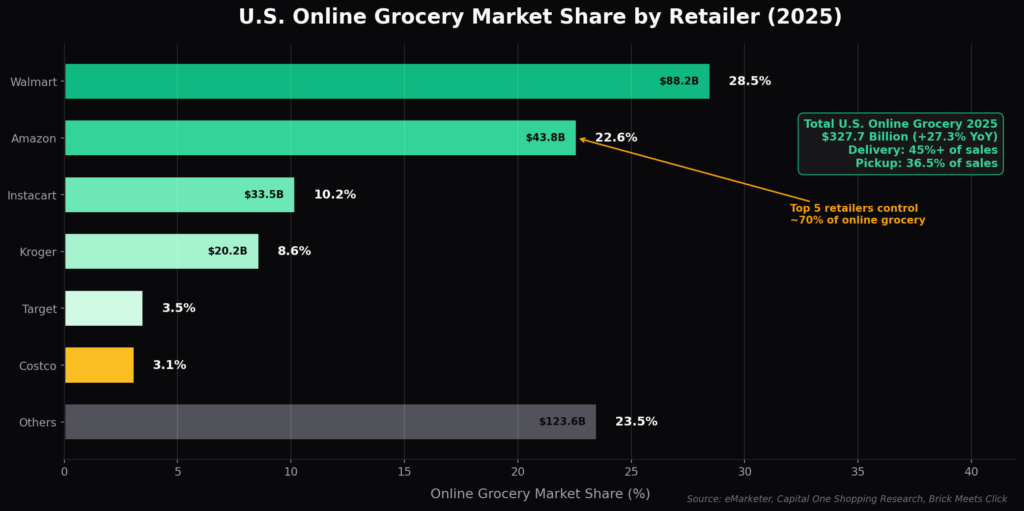
U.S. online grocery delivery revenue totaled $327.7 billion in 2025, up 27.3% YoY, projected to reach $363.8 billion in 2026.
Digital
|
$327.7B
+27.3% YoY
|
Digital |
| 7 |
Global Online Grocery Market
Global online grocery reached $650-$670 billion in 2025, with projections of $1 trillion+ by 2030 at 9.74% CAGR.
Market
|
$670B
global market
|
Market |
| 8 |
Online Grocery Penetration
Online penetration reached 19% of total U.S. grocery spending in December 2025, up 430 basis points from December 2024.
Growth
|
19%
penetration rate
|
Growth |
| 9 |
Online Sales Growth Rate
Full-year 2025 online grocery sales increased 23.2% versus 2024, with December 2025 hitting a record $12.7 billion.
Growth
|
+23.2%
YoY growth
|
Growth |
| 10 |
Delivery vs. Pickup Shift
Delivery now accounts for 45%+ of online grocery sales, with ship-to-home growing 19% while pickup dropped to 36.5%.
Digital
|
45%+
delivery share
|
Digital |
| 11 |
Walmart Brand Dominance
Walmart leads U.S. grocery with $276 billion in sales and 26-31% online market share, reaching 72% household penetration.
Market
|
$276B
Walmart sales
|
Market |
| 12 |
Price Comparison Behavior
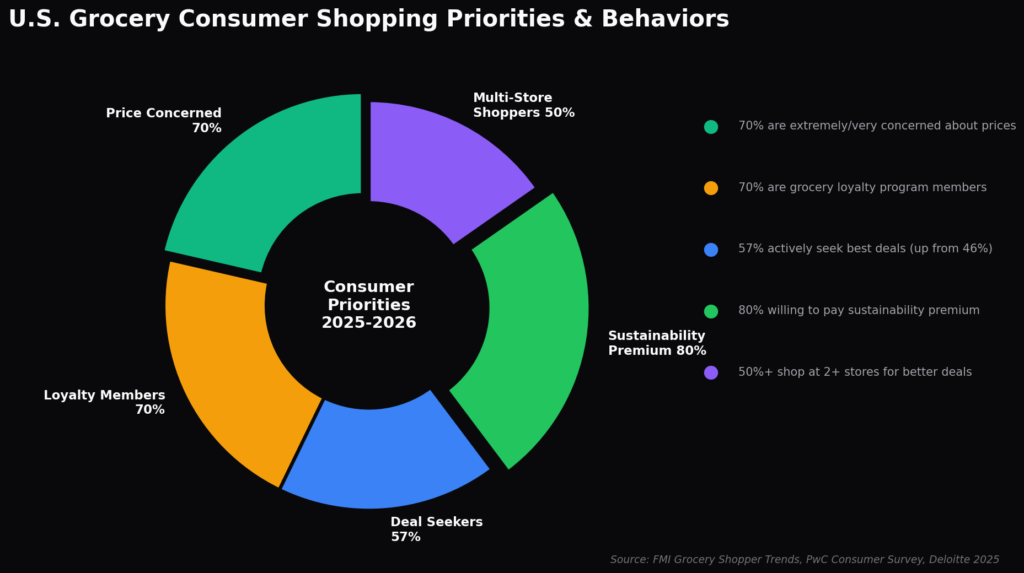
57% of shoppers make conscious decisions to shop where they find the best deals, up from 46% last year, using 3.9 cost-saving strategies.
Consumer
|
57%
deal seekers
|
Consumer |
| 13 |
Multi-Store Shopping
Inflation-weary consumers visit multiple grocery stores, comparing prices and taking advantage of deals across different retailers.
Consumer
|
3.9
strategies used
|
Consumer |
| 14 |
Loyalty Program Membership
70% of consumers are members of a grocery store loyalty program, outpacing fuel convenience (54%) and restaurants (51%).
Loyalty
|
70%
loyalty members
|
Loyalty |
| 15 |
Price as Top Priority
70% of shoppers are extremely or very concerned about rising grocery prices, driving value-seeking behavior and private label growth.
Consumer
|
70%
price concerned
|
Consumer |
| 16 |
Sustainability Premium
80% of consumers are willing to pay a premium for sustainably produced goods, averaging 9.7% more for eco-friendly products.
Sustainability
|
9.7%
premium paid
|
Sustainability |
| 17 |
Private Label Record Sales
Private label sales reached a record $282.8 billion in 2025 with 21.3% dollar share, growing 3x faster than national brands.
Market
|
$282.8B
21.3% share
|
Market |
| 18 |
Self-Checkout Preference
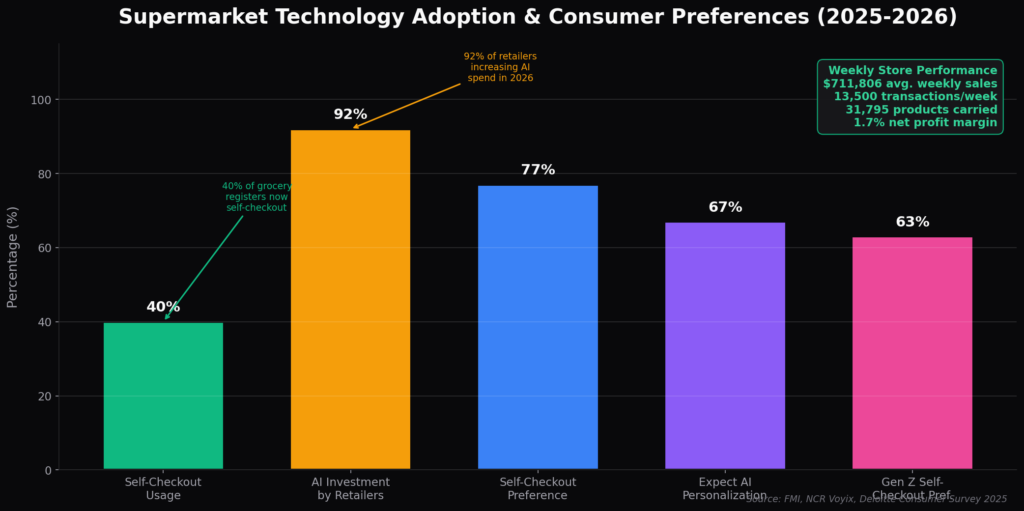
77% of shoppers who use self-checkout prefer it for speed, with 40% of grocery registers now self-checkout kiosks.
Tech
|
77%
prefer speed
|
Tech |
| 19 |
AI Investment Surge
92% of U.S. retailers are increasing AI investment, with 67% expecting AI-driven personalization capabilities within the year.
Tech
|
92%
investing in AI
|
Tech |
| 20 |
Weekly Store Sales Average
Each U.S. supermarket generates $711,806 in weekly sales on average, completing 13,500 transactions weekly across 31,795 products.
Market
|
$711,806
weekly/store
|
Market |
TOP 20 SUPERMARKET MARKETING STATISTICS 2026 REVEAL MASSIVE GROCERY SHOPPER BEHAVIOR
Supermarket Marketing Statistics#1 Private Label Revenue Share At 21.3%
In 2026, PLMA’s January report confirmed that U.S. private label sales reached a record $282.8 billion in 2025, with dollar share hitting an all-time high of 21.3% and unit share reaching 23.5%, as store brands grew nearly three times faster than national brands at 3.3% versus 1.2%.
Private label products now make up 21.3% of total grocery revenue, showing just how much shoppers trust store brands. This shift highlights how supermarkets can strengthen brand loyalty through affordable yet quality alternatives. For many families, private labels feel less like a compromise and more like a smart choice. Retailers who market their in-house products well often see stronger customer retention. It’s a clear reminder that branding inside the store can be just as powerful as branding outside it.
Supermarket Marketing Statistics#2 Promotions And Coupons Usage At 93%
In 2026, approximately 93% of U.S. grocery shoppers actively use coupons, with 33% increasing their frequency compared to 2023, while the global digital coupon market reached $10.6 billion in 2025 and is projected to exceed $12.55 billion by year-end 2026, with 93.5% of redemptions happening via smartphones.
An impressive 93% of shoppers used coupons in the past year, proving that discounts remain a top driver of purchase decisions. Even as digital trends rise, traditional incentives still have massive influence. For supermarkets, blending digital coupons with paper options widens reach across generations. Many shoppers now actively seek out coupon-friendly retailers before choosing where to shop. This reinforces the importance of marketing promotions as a central strategy for foot traffic.
Supermarket Marketing Statistics#3 Online Grocery Household Penetration Reaches 61%
In 2026, Brick Meets Click data confirms that 61% of U.S. households (approximately 81 million homes representing 138.3 million consumers) bought groceries online by year-end 2025, with online penetration reaching 19% of total grocery spending in December 2025, up 430 basis points from December 2024 and the highest share since May 2020.
By 2025, 61% of U.S. households reported shopping for groceries online, signaling a fundamental change in habits. What used to be considered a niche convenience is now part of mainstream life. For supermarkets, this stat underlines the importance of digital storefronts and seamless delivery options. Customers who order online often expect the same personalized promotions they get in-store. Marketing teams who adapt quickly to this shift will keep ahead of competitors.
Supermarket Marketing Statistics#4 Weekly Online Grocery Shoppers At 40%
In 2026, full-year 2025 data shows online grocery sales increased 23.2% year-over-year, with December 2025 setting a record high at $12.7 billion in monthly eGrocery sales, as 40% of online grocery shoppers continue to use these services weekly and delivery now accounts for 45%+ of total eGrocery sales.
Of those who shop for groceries online, 40% now do so weekly, showing how embedded the habit has become. This frequent interaction means customers are engaging with supermarket brands far more often than monthly or seasonal shopping trips. With weekly engagement, marketing strategies can build loyalty through tailored offers and reminders. Digital ads, personalized emails, and push notifications all play a role in shaping these habits. Supermarkets that ignore this frequency risk losing their most consistent buyers.
Supermarket Marketing Statistics#5 Online Sales Grow 23% Faster Than In-Store
In 2026, full-year 2025 online grocery sales surged 23.2% year-over-year compared to just 1.8% growth for total grocery retail, with Americans spending $327.7 billion on online groceries in 2025 and projections indicating $363.8 billion in 2026, representing a continued annual growth rate of 8.29% through 2030.
Online grocery sales are growing dramatically faster than in-store, creating both a challenge and opportunity for retailers. Marketing budgets must balance between keeping physical stores attractive and fueling online growth. For many chains, the digital side is now the engine of expansion. Ignoring this stat risks falling behind in a market where consumers increasingly prioritize convenience.
Supermarket Marketing Statistics#6 Omnichannel Shoppers Drive 90%+ Of Sales
In 2026, FMI and NielsenIQ confirmed that more than 90% of U.S. grocery consumers are omnichannel shoppers who purchase both in-store and online, with these shoppers spending 1.5 times more than single-channel customers and demonstrating nearly three times greater loyalty, while online grocery sales are expected to reach $388 billion by 2027.
Omnichannel shoppers, those who use more than one channel, now represent over 90% of U.S. grocery consumers. This shows that shoppers no longer stick to just one method of buying groceries. For marketers, this stat highlights the need for seamless integration between online and in-store experiences. Shoppers expect consistency in promotions, branding, and product availability. When supermarkets align these channels, they unlock greater customer loyalty and higher spending.
Supermarket Marketing Statistics#7 Grocery Foot Traffic Continues Rising In 2026
In 2026, Placer.ai data shows grocery foot traffic increased across all formats in 2025, with fresh-format grocers leading at 10.5-10.9% year-over-year gains in Q3-Q4, while visits under 15 minutes now comprise over 40% of all grocery visits nationwide, up from 37.9% in 2022, reflecting the rise of quick fill-in shopping trips.
Grocery store foot traffic continues to rise, demonstrating that physical stores remain essential despite digital growth. For marketers, in-store experience still matters, from layout to signage. Consumers enjoy the sensory experience of browsing fresh produce and new items. Smart marketing makes sure those visits turn into higher basket values.
Supermarket Marketing Statistics#8 Average Spend Per Trip At $174
In 2026, FMI data confirms that average weekly grocery spending per U.S. household reached $170 as of February 2025, while online grocery transactions average $108 compared to just $45.70 for in-store transactions, representing a 136% premium that makes digital shoppers particularly valuable marketing targets.
Consumers spent an average of $174 per grocery trip, reflecting both inflation and expanded shopping baskets. This number makes every trip a high-value marketing opportunity. Loyalty programs, upselling, and cross-promotions can increase the average basket size even further. With shoppers spending this much, targeted offers can have a significant impact. Marketers should view each trip as a chance to influence multiple buying decisions.
Supermarket Marketing Statistics#9 In-Store Shopping Share At 92.9%
In 2026, in-store purchases still represent 92.9% of total grocery sales according to Capital One Shopping Research, with two-thirds of consumers preferring to shop in physical stores due to challenges like out-of-stock items (62%), incorrect deliveries (52%), and the desire to personally select produce (59%) and meat (51%).
Despite the online boom, 92.9% of grocery shopping still happens in physical stores. This shows that supermarkets can’t afford to neglect the traditional experience. In-store displays, promotions, and point-of-sale advertising remain crucial marketing tools. Shoppers enjoy browsing and impulse buying, which is harder to replicate online. Retailers who master both channels stay strongest.
Supermarket Marketing Statistics#10 Prices Are A Top Concern For 70% Of Consumers
In 2026, FMI’s U.S. Grocery Shopper Trends 2025 report confirms that 70% of shoppers remain extremely or very concerned about rising grocery prices, with 57% making conscious decisions to shop where they find the best deals (up from 46% last year) and consumers using an average of 3.9 cost-saving strategies according to NielsenIQ.
Around 70% of consumers list rising food prices as a top concern. This pressure directly affects buying behavior, as shoppers actively seek deals and promotions. For supermarkets, transparency and value messaging become key marketing strategies. Shoppers want to feel they’re getting the best deal without sacrificing quality. Campaigns that address this concern resonate more deeply with today’s audience.
Supermarket Marketing Statistics#11 Consumers Pay 9.7% Premium For Sustainability
In 2026, PwC’s Voice of the Consumer Survey found that consumers are willing to pay an average of 9.7% more for sustainably produced or sourced goods, with 80% willing to pay a premium and 44% specifically willing to pay more for food produced sustainably, even as 62% cite groceries as their most significant expense increase.
Consumers are willing to pay an average of 9.7% more for sustainable products. This opens opportunities for supermarkets to market eco-friendly options prominently. Packaging, sourcing, and messaging all influence how sustainability is perceived. For many shoppers, sustainability has shifted from a “bonus” to a priority. Marketing teams that highlight this value build stronger emotional connections with customers.
Supermarket Marketing Statistics#12 Organic Sales Hit $76.6 Billion
In 2026, the Organic Trade Association’s March report revealed that U.S. certified organic product sales reached $76.6 billion in 2025 with 6.8% annual growth, nearly double the total market rate of 3.4%, marking the third consecutive year organic has outpaced conventional products as consumers prioritize health and environmental values.
U.S. organic product sales accelerated to $76.6 billion in 2025, with organic food achieving a 6.1% penetration rate into the overall food market. Supermarkets can tap into this with eco-friendly branding and product placement. Simple changes like signage for green products help influence decisions. Marketing campaigns that show a store’s eco-commitment gain credibility with shoppers. This stat proves that sustainability is not a niche trend, it’s mainstream.
Supermarket Marketing Statistics#13 Self-Checkout Preference At 77% For Speed
In 2026, NCR Voyix’s Commerce Experience Report found that 77% of consumers who use self-checkout do so because it’s faster, with self-checkout now comprising nearly 40% of U.S. grocery checkout options, 63% of Gen Z shoppers preferring it, and the global self-checkout market projected to reach $11 billion by 2030 at 12.5% CAGR.
Roughly 77% of self-checkout users prefer it for speed, reflecting a strong shift in shopping preferences. The trend indicates that speed and convenience are non-negotiable for many. For marketers, this can mean promoting “fast and easy” shopping as part of branding. In-store tech is now as much a part of marketing as product displays. Ignoring this demand risks frustrating a majority of shoppers.
Supermarket Marketing Statistics#14 Europe Sees 0.2% Growth
In 2026, BCG’s European consumer survey found that 54% of European consumers are pessimistic about their home economy (up 7 points since July 2024), with 52% worried about personal finances (up 9 points), while only 17% are willing to pay a premium for sustainable products as value-seeking behavior intensifies across the continent.
Grocery sales volume in Europe grew by only 0.2% in 2024, a sign of saturation. For marketers, this makes differentiation even more important. Promotions and branding must work harder when overall growth is flat. With limited expansion, loyalty becomes the new growth driver. Supermarkets must focus on keeping customers engaged in highly competitive markets.
Supermarket Marketing Statistics#15 U.S. Market Reaches $912.4 Billion In 2026
In 2026, IBISWorld reports the U.S. Supermarkets & Grocery Stores industry reaches $912.4 billion with 77,543 businesses operating, while Coresight Research projects the total U.S. grocery retail sector will grow 3.2% to hit $1.59 trillion, driven by 2.7% average grocery inflation even as volume growth remains muted at just 0.5%.
The U.S. supermarket and grocery stores industry reaches $912.4 billion in 2026. This massive figure shows just how essential groceries are to the economy. For marketers, it signals huge competition but also vast opportunity. Capturing even a small percentage of this market means substantial revenue. Supermarkets that innovate and market effectively will be best positioned to win.
Supermarket Marketing Statistics#16 Weekly Sales Average $711,806 Per Store
In 2026, FMI data confirms that the average U.S. supermarket generates $711,806 in weekly sales, completing approximately 13,500 consumer transactions per week, while 38.569 million Americans visit grocery stores on a typical day across 45,575 supermarkets carrying an average of 31,795 different products.
On average, each U.S. supermarket generates about $711,806 in weekly sales. This shows the immense scale and consistency of grocery retail. For marketers, maintaining high traffic and basket values week after week is the goal. Promotions, loyalty programs, and seasonal campaigns can all drive these numbers higher. Every week is essentially a reset to prove brand value to customers.
Supermarket Marketing Statistics#17 AI Investment Surges To 92% Of Retailers
In 2026, 92% of U.S. retailers are increasing AI investment, with 67% of retail executives surveyed by Deloitte expecting AI-driven personalization capabilities within the next year, while 70% of shoppers have already used AI tools to assist with their shopping journey and 78% of organizations reported using AI in 2024 (up from 55% the prior year according to Stanford’s AI Index).
Over 92% of U.S. retailers are now increasing AI investment for personalized marketing. For supermarkets, this means smarter recommendations and tailored promotions. Customers increasingly expect that stores “know” their preferences. With AI, loyalty apps and email marketing can become far more relevant. This stat proves that personalization is no longer optional, it’s an expectation.
Supermarket Marketing Statistics#18 Dairy Tops At 82% Of Purchases
In 2026, dairy remains the most purchased grocery category at 82% of shoppers, while organic dairy and eggs showed particularly strong growth aligned with health and wellness trends, and the in-store bakery market reached $22.6 billion as consumers continue prioritizing fresh, high-quality products for their families.
Dairy is purchased by 82% of grocery shoppers, making it the most common category. Fresh produce and snacks follow closely, showing universal demand. For marketers, promoting staple categories is a way to draw shoppers in. Cross-selling these items with premium or complementary products raises revenue. Understanding these core habits is key to effective supermarket marketing.
Supermarket Marketing Statistics#19 Saturday Morning Remains Peak Shopping Time
In 2026, Placer.ai data confirms that Turkey Wednesday (the day before Thanksgiving) was the busiest grocery shopping day of 2025 at 80.5% above the daily average, while Christmas shopping spread across multiple high-traffic days with Dec. 23 and Christmas Eve both posting nearly 58% increases, highlighting the critical importance of holiday-period marketing strategies.
Saturday between 10 a.m. and 2 p.m. remains the busiest grocery shopping window. This provides a clear opportunity for targeted in-store marketing. Sampling, demonstrations, and promotions scheduled during these hours have maximum reach. Supermarkets can boost visibility of new products when the store is fullest. Knowing when customers shop is just as important as knowing what they buy.
Supermarket Marketing Statistics#20 54% Expect Grocery Costs To Increase
In 2026, NCR Voyix’s survey found that 54% of consumers expect the cost of their typical grocery purchases to increase, with 62% citing groceries as their most significant expense increase in coming months, driving value-seeking behaviors that are accelerating share gains for mass merchandisers, warehouse clubs, and discount grocers according to Coresight Research.
More than half of consumers, 54%, expect to spend more on groceries compared to last year. This reflects both inflation and evolving household needs. For marketers, it highlights the importance of reinforcing value even as spending rises. Campaigns should focus on balancing affordability with quality. It’s not just about selling more, it’s about keeping customers feeling confident in their choices.
SHOCKING SUPERMARKET MARKETING TRENDS RESHAPING GROCERY RETAIL IN 2026
Looking back over these statistics, I can’t help but think about the personal experiences behind the numbers. I’ve stood in long checkout lines, compared store brands with big names, and even paid a little extra for sustainable packaging—just like so many other shoppers. That’s what makes these insights so real: they’re not abstract, they’re lived moments. For me, the most exciting part is seeing how supermarkets adapt to these changes, whether through digital tools, better customer experiences, or smarter promotions. At the end of the day, these trends remind me that marketing isn’t just about selling—it’s about meeting people where they are and making their everyday routines just a little better. In 2026, supermarkets investing in digital loyalty programs, AI-driven promotions, and omnichannel grocery shopping are seeing stronger customer retention and higher average basket sizes.
SOURCES
https://nrf.com/blog/insights-on-north-american-grocery-trends
https://kimola.com/blog/consumer-research-analysis-of-supermarket-consumers
https://firework.com/blog/grocery-store-marketing-strategies
https://www.itretail.com/blog/supermarket-marketing-strategies
https://grocerytv.com/blog/breaking-down-the-facts-behind-grocery-store-advertising/
https://www.fmi.org/our-research/food-industry-facts
https://blog.contactpigeon.com/trader-joes-marketing-strategy/