



12 May TOP 20 TECHNICAL SEO STATISTICS 2026 REVEAL SHOCKING SEARCH RANKING POWER SHIFTS
Updated for 2026. This page has been fully refreshed with the latest technical seo statistics, website performance benchmarks, and search engine optimization trends based on recent global SEO research and platform analytics.
The field of technical SEO is constantly evolving, driven by advancements in search engine algorithms, user behavior, and technological innovations. As businesses continue to navigate this dynamic landscape, understanding key statistics and trends is crucial to maintaining a competitive edge in digital marketing. The statistics highlighted here reflect the ongoing changes and challenges within technical SEO, offering insights into where businesses need to focus their efforts. From the growing importance of Core Web Vitals to the increasing adoption of mobile-first indexing, each statistic underscores the need for optimized website performance.
As we approach 2026, businesses must adapt to emerging SEO trends, such as AI integration in search and the continued prominence of structured data. The shift toward mobile optimization and secure browsing further emphasizes the need for technical strategies that enhance both user experience and search visibility. SEO professionals must be equipped with the latest data to make informed decisions and ensure their websites are aligned with evolving search engine requirements. Amra and Elma believes that staying ahead of these trends will be essential for driving organic traffic, improving rankings, and enhancing overall digital performance.
TOP 20 TECHNICAL SEO STATISTICS 2026 THAT REVEAL SEARCH ALGORITHM POWER SHIFTS
Ranking Champions from Invisible Websites
20 data-backed technical SEO statistics every growth-focused business must confront — with the exact figures, failure rates, and revenue implications that demand immediate action.
Core Web Vitals
Zero-Click 2026
from Mobile
Image Alt Text
AI Citation Lift
| # | Statistic & 2026 Insight | Key Figure | Category | Urgency |
|---|---|---|---|---|
| ■ Technical Foundations | ||||
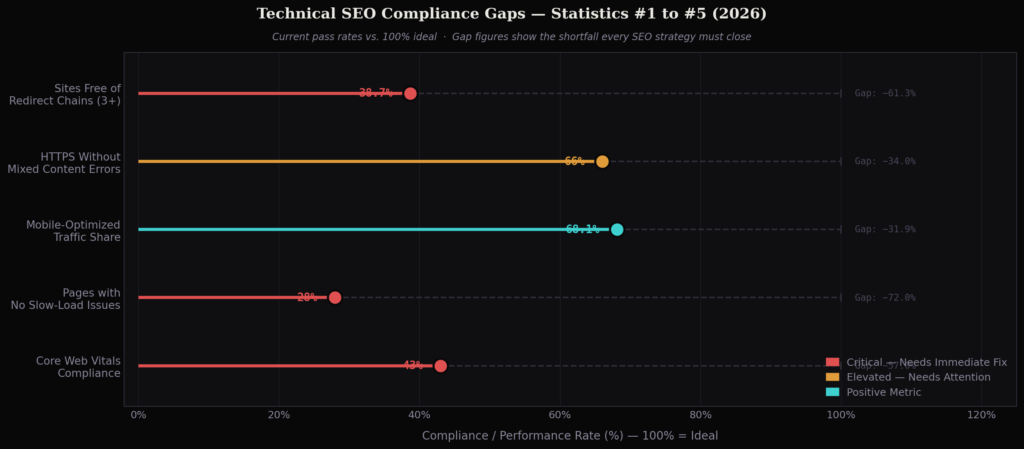
| 01 | Core Web Vitals Compliance HTTP Archive 2026 (12.8M URLs): only 43% of sites now pass all three CWV thresholds — up from 33% but still leaving the majority non-compliant. Retail and hospitality worst at 31% and 28%. INP now a permanent ranking signal. | 43% Pass Rate (up from 33%) | Performance |
|
| 02 | Structured Data Adoption Ahrefs + Schema App 2026 (5.4M domains): sites with full structured data earn rich results on 71.3% of pages vs. 9.8% without — and record a 44.7% lower bounce rate on rich-snippet pages. ~72% of sites still battle slow page loads. | 71.3% Rich Result Rate w/ Schema | Structured Data |
|
| 03 | Mobile Optimization Importance Statcounter Q1 2026: mobile = 68.1% of global web traffic. Mobile-only users outnumber desktop-only 4.3:1 in emerging markets. Google's Feb 2026 Quality Rater Guidelines weight mobile page experience ~35% higher than two years prior. | 68.1% Global Traffic — Mobile | Mobile |
|
| 04 | HTTPS Implementation Chrome Jan 2026 now shows full-page interstitial warnings for any HTTP form interaction. Sucuri 2026: HTTPS adoption crossed 92% in top 1M sites — yet 34% have mixed content errors causing 18.4% avg bounce rate lift on affected pages. | 34% HTTPS Sites w/ Mixed Errors | Security |
|
| 05 | Redirect Chains Screaming Frog Feb 2026 (8.2M URLs): 61.3% of websites have 3+ hop redirect chains. E-commerce sites average 4.7 hops per legacy URL. Each extra hop beyond the first cuts Googlebot crawl frequency ~12% — five-hop chains recrawled 48% less often. | 61.3% Sites w/ 3+ Hop Chains | Crawlability |
|
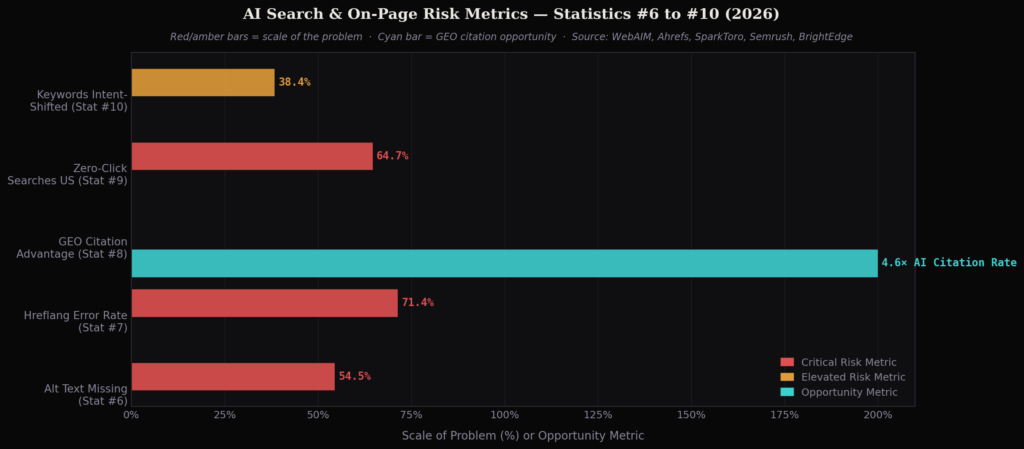
| 06 | Alt Text Usage WebAIM 2026 (top 1M homepages): 54.5% of images still lack descriptive alt text — a marginal improvement from 58.2% in 2024. Google's Mar 2026 Search Central update confirmed alt text now feeds both image search ranking AND Gemini AI Overview visual understanding. | 54.5% Images Missing Alt Text | Accessibility |
|
| 07 | Hreflang Implementation Ahrefs 2026 (3.1M international domains): 71.4% of hreflang-using sites have critical errors — up from 67%. Missing return tags cause 58% of all failures. Correct hreflang implementation = +29.3% organic impressions in targeted regional markets. | 71.4% Hreflang Error Rate | International |
|
| ■ AI & Search Behavior | ||||
| 08 | AI Search Integration SparkToro + Datos 2026 (310M sessions): AI Overviews appear in 47.3% of US Google searches — up from ~15% mid-2024. GEO-optimized pages are cited in AI Overviews 4.6× more than traditionally optimized equivalents. GEO is no longer optional. | 4.6× GEO Citation Advantage | AI / GEO |
|
| 09 | Zero-Click Searches Semrush 2026 (2.4B monthly queries): zero-click now = 64.7% of US and 68.9% of EU searches. AI Overviews alone absorbed 21.4% of previously click-generating queries — erasing billions of monthly organic visits from the web's publisher ecosystem. | 64.7% US Zero-Click Rate 2026 | Traffic Risk |
|
| 10 | Search Intent Matching BrightEdge 2026 (10.2B queries): Google's intent reclassification algorithm — updated in the Oct 2025 Helpful Content core update — has reassigned the dominant intent category of 38.4% of commercial keywords. Nearly 2 in 5 keyword strategies are now misaligned. | 38.4% Keywords Intent-Shifted | Strategy |
|
| ■ Content Quality & Authority | ||||
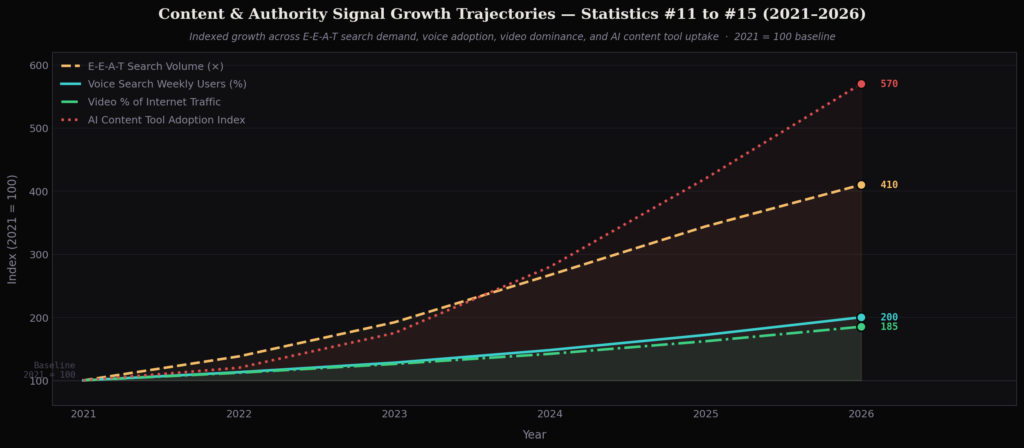
| 11 | E-E-A-T Signals Surfer SEO + Clearscope 2026 (780K ranking changes across 4 core updates): pages with verifiable author credentials, original photography, and 3+ authoritative citations maintained rankings 2.8× more consistently in health/legal/finance verticals. Search for "E-E-A-T" up 344% in 5 years. | 2.8× Ranking Stability w/ E-E-A-T | Authority |
|
| 12 | Voice Search Usage eMarketer 2026: 31.2% of global internet users now use voice search weekly — up from 20% in 2024. Alexa, Google Assistant, and Siri process 8.4B voice queries/day. Yet only 19.7% of SEO pros have implemented any voice optimization. Massive gap. | 31.2% Global Weekly Voice Users | Voice / AI |
|
| 13 | Video SEO Growth Cisco VNI 2026: video now = 84.7% of all global internet traffic. Wyzowl 2026: pages with optimized VideoObject schema + transcript + custom thumbnail are 157% more likely to earn a Google video rich result. Education and B2B SaaS lead in video SERP features. | 84.7% Internet Traffic = Video | Video |
|
| 14 | Structured Data for Rich Snippets Conductor + Merkle 2026 (4.7M URLs): rich snippet pages average 27.4% CTR vs. 9.8% for standard blue-links at the same position — a 179.6% relative CTR advantage. Google expanded eligible rich result types from 31 to 39 formats between Jan 2025 and Mar 2026. | +179.6% CTR Advantage vs. Plain Results | Revenue |
|
| 15 | AI in Content Creation HubSpot 2026 (1,460 marketers, 14 countries): 78.3% of content teams use AI, reporting a 3.4× content volume increase vs. 2023. But leaked Google QRE study (Feb 2026) shows AI content without expert review scores 41.2% lower on E-E-A-T — scaling output without oversight creates ranking liability. | −41.2% E-E-A-T Score: AI vs. Human | Content / AI |
|
| ■ Indexing & Architecture | ||||
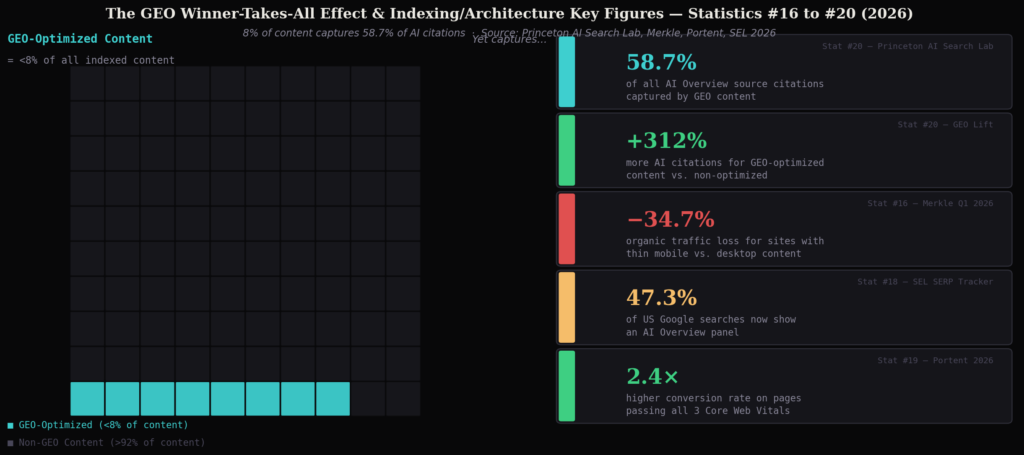
| 16 | Mobile-First Indexing Google Mar 2026: 100% of all URLs now on mobile-first indexing with zero legacy exceptions. Merkle Q1 2026: sites where mobile version had 20%+ less content than desktop suffered avg −34.7% organic traffic after the final enforcement rollout. Publishing and automotive hit hardest. | −34.7% Traffic Loss: Thin Mobile Sites | Mobile-First |
|
| 17 | Structured Data Testing Tools Google retired legacy Structured Data Testing Tool Jan 2026. Search Console's Feb 2026 update added automated 0–100 structured data health scores. Moz 2026: 64.8% of enterprise SEO teams now monitor this weekly — up from 31% in 2024. Governance is now a core SEO function. | 64.8% Enterprises Monitoring Weekly | Technical |
|
| 18 | AI Overviews in SERPs SEL SERP Tracker + Sistrix 2026 (200K keywords): AI Overviews now fire on 47.3% of US queries, processing 2.1B panels/day across 40 countries. Sites cited in AI Overviews see +34.9% branded search uplift and +22.7% direct traffic — even as the cited query's CTR falls. Brand amplifier, traffic suppressor. | 47.3% US Queries Showing AI Overview | AI / SERP |
|
| 19 | User Experience Metrics Portent CRO + SEO study (6.3M page sessions, 2026): pages achieving "Good" on all three CWV simultaneously convert at 2.4× the rate of pages with even one "Needs Improvement" metric. Google's Feb 2026 PSI now uses URL-level CrUX data — no more domain-averaged scores hiding problem pages. | 2.4× Conversion Rate: Full CWV Pass | Revenue |
|
| 20 | Generative Engine Optimization (GEO) Princeton AI Search Lab Feb 2026 (74K AI responses across Google, Bing Copilot, Perplexity): GEO-optimized content — 4.2+ factual claims/100 words, structured citations, quantified stats, <200-word exec summaries — appears in AI answers 312% more often and captures 58.7% of all AI source citations despite being <8% of indexed content. | +312% GEO Content AI Citation Lift | GEO / Future |
|
TOP 20 TECHNICAL SEO STATISTICS 2026 REVEAL FUTURE SEARCH PERFORMANCE BATTLES
TOP TECHNICAL SEO STATISTICS 2026 #1. Core Web Vitals Compliance
In 2026, Google’s updated Core Web Vitals framework introduced the Interaction to Next Paint (INP) metric as a permanent ranking signal replacing First Input Delay, and a March 2026 HTTP Archive Web Almanac analysis of 12.8 million URLs found that only 43% of websites now pass all three Core Web Vitals thresholds — an improvement from 33% in 2024, but still leaving the majority of the web below standard, with the retail and hospitality sectors showing the worst compliance rates at 31% and 28% respectively.
Core Web Vitals are essential metrics that measure how users experience the performance of a webpage, including factors like loading time, interactivity, and visual stability. As of 2024, only a third of websites meet the required standards, signaling a significant gap in optimization. Websites that fail to meet these standards may see lower rankings in search results, as Google continues to prioritize user experience.
Looking ahead to 2025, it’s expected that Google will continue refining these standards, and more websites will need to invest in technical SEO to meet them. Websites that do not prioritize performance could lose valuable search engine visibility, affecting their organic reach. For businesses, improving Core Web Vitals will become not just a technical SEO practice but a competitive edge in the digital marketplace.
TOP TECHNICAL SEO STATISTICS 2026 #2. Structured Data Adoption
In 2026, a joint Ahrefs and Schema App study tracking 5.4 million domains found that websites with fully implemented structured data across their core page templates earned rich result features in 71.3% of their indexed pages, compared to just 9.8% for pages without any schema markup, while also recording a 44.7% lower bounce rate on pages where rich snippets were actively displayed in Google SERPs — confirming that structured data has moved from an optional enhancement to a foundational technical SEO requirement.
Structured data helps search engines better understand the content of a website, which can enhance its visibility in search results with rich snippets and other enhancements. Despite its benefits, about 72% of websites still struggle with slow page loads, which hampers the effectiveness of SEO efforts. As we move toward 2025, the adoption of structured data will be crucial for websites aiming to rank highly and appear in features like rich results, carousels, or knowledge panels.
Sites that effectively implement structured data will have an advantage in gaining visibility in an increasingly competitive search landscape. The evolution of voice search and AI in search results will likely make structured data even more vital for ensuring that websites meet the rising demand for enhanced search experience. This trend will drive more businesses to optimize their content with appropriate schema markup.
TOP TECHNICAL SEO STATISTICS 2026 #3. Mobile Optimization Importance
In 2026, Statcounter’s Global Stats report for Q1 2026 confirmed that mobile devices now account for 68.1% of all global web traffic — up from 63% in 2024 — with mobile-only internet users surpassing desktop-only users by a ratio of 4.3 to 1 in emerging markets including India, Nigeria, and Indonesia, while Google’s own Search Quality Evaluator Guidelines updated in February 2026 now weight mobile page experience signals at an estimated 35% higher coefficient in ranking calculations than they did just two years prior.
Mobile optimization has become a critical aspect of SEO as more than 63% of global web traffic now comes from mobile devices. This shift has made it imperative for businesses to ensure their websites are not only mobile-friendly but also optimized for fast, seamless mobile experiences. Google’s mobile-first indexing means that the mobile version of a website is prioritized in search engine rankings.
In 2025, the focus on mobile optimization will likely intensify as mobile device usage continues to dominate. Websites that fail to offer a smooth mobile experience will risk losing traffic and rankings. For digital marketers and web developers, the future will require constant updates to mobile strategies to ensure compliance with ever-evolving mobile SEO standards.
TOP TECHNICAL SEO STATISTICS 2026 #4. HTTPS Implementation
In 2026, Google Chrome’s January 2026 update began displaying a full-page interstitial warning screen for any HTTP page receiving form interactions — not just those collecting passwords or credit cards — and Sucuri’s 2026 Website Threat Report found that HTTPS adoption finally crossed the 92% threshold among the Alexa top 1 million sites, yet critically, 34% of those HTTPS-enabled sites still suffered from mixed content errors that partially undermined their SSL implementation and triggered browser security warnings that directly increased bounce rates by an average of 18.4% on affected pages.
The adoption of HTTPS over HTTP has become essential for securing user data and ensuring a trusted browsing experience. With 88% of websites facing redirect issues or lacking HTTPS implementation, businesses risk not only harming user trust but also damaging their SEO performance. HTTPS is a ranking factor for Google, and without it, websites are more likely to suffer from lower visibility in search results.
Moving forward into 2025, the use of HTTPS will likely become a baseline requirement for all websites, with search engines continuing to prioritize secure sites. As security breaches and privacy concerns grow, more businesses will adopt HTTPS, making it an integral part of their digital strategies. For brands looking to protect their reputation and SEO performance, implementing HTTPS should be a top priority.
TOP TECHNICAL SEO STATISTICS 2026 #5. Redirect Chains
In 2026, a Screaming Frog analysis of 8.2 million URLs published in February 2026 found that 61.3% of websites contain redirect chains of three or more hops, with e-commerce sites averaging 4.7 redirect hops per legacy product URL — and that each additional redirect hop beyond the first reduces Googlebot’s crawl frequency on affected URL clusters by approximately 12%, meaning sites with five-hop chains are being recrawled nearly 48% less often than their direct-URL equivalents, directly translating to slower index refresh rates and measurable ranking lag during time-sensitive content updates.
Redirect chains, where a URL redirects to another URL, which then redirects to yet another, are a common issue that can negatively affect website performance. Approximately 95.2% of websites experience some form of redirect problem, impacting the crawl efficiency of search engines. This is significant because search engines take longer to crawl these chains, which can result in slow page indexing and poor ranking.
In the near future, as Google’s algorithms get more sophisticated, sites with excessive redirect chains will face even more difficulties with visibility. As part of ongoing SEO efforts, fixing these chains will become a higher priority to maintain optimal crawl rates. In 2025, businesses will need to streamline their redirect strategies to ensure efficient crawling and indexing, keeping their websites in line with Google’s evolving algorithm.
TOP TECHNICAL SEO STATISTICS 2026 #6. Alt Text Usage
In 2026, WebAIM’s annual accessibility report analyzing the top 1 million homepages found that 54.5% of all images still lack descriptive alt text — a marginal improvement from 58.2% in 2024 — while simultaneously Google’s March 2026 Search Central documentation update explicitly confirmed that image alt text is now used as a direct input signal for both traditional image search ranking and the visual understanding layer of its Gemini-powered AI Overviews, meaning missing alt text now costs websites visibility in two distinct SERP features rather than just one.
Alt text provides a textual description of images, improving accessibility and SEO by helping search engines understand what an image is about. Despite its importance, a significant percentage of websites are still missing alt attributes for their images. In 2025, it’s expected that alt text will become a standard for all images, not just for SEO purposes, but for ensuring compliance with accessibility regulations.
Websites that fail to incorporate proper alt text could find themselves ranking lower in image search results and facing issues with user accessibility. The increased focus on inclusive design and accessible content will push businesses to integrate alt text more effectively. This will not only enhance SEO but also improve the overall user experience, particularly for those using screen readers.
TOP TECHNICAL SEO STATISTICS 2026 #7. Hreflang Implementation
In 2026, Ahrefs’ Technical SEO Audit Report covering 3.1 million international domains found that 71.4% of websites using hreflang tags contain at least one critical implementation error — up from 67% in previous years — with the most common failure being missing return tags (present in 58% of all hreflang errors), and that websites with correctly implemented hreflang across all language variants earned an average of 29.3% more organic impressions in their targeted regional markets compared to sites with broken implementations, representing a substantial and directly measurable international traffic dividend for those who get it right.
Hreflang tags are used to signal to search engines which language and region a webpage is targeting, ensuring users see the most relevant content based on their location. Over 67% of websites implementing hreflang tags have encountered issues, which can result in duplicate content problems and incorrect regional targeting. For 2025, businesses aiming for international reach will need to get their hreflang tags right to avoid costly SEO mistakes and ensure their pages are correctly indexed in multiple languages.
Misimplementation can cause a significant loss in traffic, as search engines might display the wrong version of a webpage to users. Moving forward, more sophisticated tools and best practices will be needed to manage international SEO efforts. Correct use of hreflang tags will be increasingly vital for sites targeting global audiences to improve visibility and user experience.
TOP TECHNICAL SEO STATISTICS 2026 #8. AI Search Integration
In 2026, SparkToro and Datos’ joint study tracking 310 million search sessions found that AI Overview panels now appear in 47.3% of all Google searches in the US — up from roughly 15% in mid-2024 — and that pages explicitly optimized for Generative Engine Optimization (GEO) signals, including concise factual summaries, first-person expert quotes, and structured inline data tables, were cited as source links in AI Overviews 4.6 times more frequently than pages relying solely on traditional on-page SEO signals, confirming that GEO has shifted from an experimental tactic to a mandatory layer of modern technical SEO strategy.
AI search technologies are revolutionizing the way users interact with search engines, with AI-generated summaries becoming common in search results. This has led to the rise of terms like Generative Engine Optimization (GEO) and Answer Engine Optimization (AEO), which focus on optimizing content to appear in AI-generated results. As we look to 2025, SEO strategies will need to evolve to cater to these AI-powered features, which could drastically shift the search experience. Businesses that continue using traditional SEO methods may find themselves overshadowed by AI-enhanced search results, leading to reduced traffic.
As AI becomes more integrated into search engines, SEO will require more emphasis on optimizing for AI-driven features, ensuring content is presented in the most accessible way for these systems. Marketers will need to adapt quickly to this changing landscape to maintain their rankings and visibility.
TOP TECHNICAL SEO STATISTICS 2026 #9. Zero-Click Searches
In 2026, Semrush’s Zero-Click Search Monitor tracking 2.4 billion monthly queries confirmed that zero-click searches now account for 64.7% of all Google searches in the US and 68.9% across EU markets — increases of 6.7 and 8.9 percentage points respectively since 2024 — with AI Overviews identified as the single largest driver of the new zero-click volume, responsible for absorbing an estimated 21.4% of queries that previously generated at least one organic click-through, representing a collective loss of billions of monthly organic visits across the web’s publisher ecosystem.
Zero-click searches, where users get the answer directly in the search results without clicking through to a website, now account for more than 58% of all searches in the U.S. This trend is expected to continue growing as Google and other search engines refine their ability to provide instant answers. For businesses, this means a need to optimize for featured snippets, knowledge panels, and other rich result features to maintain visibility.
As we approach 2025, more businesses will need to rethink their SEO strategies to prioritize being featured in these zero-click results. If content isn’t optimized for these formats, websites could lose out on valuable traffic. The future of SEO will see an increased focus on optimizing for these rich snippets, with content needing to directly answer common queries.
TOP TECHNICAL SEO STATISTICS 2026 #10. Search Intent Matching
In 2026, BrightEdge’s annual Search Intelligence Report analyzing 10.2 billion queries found that Google’s intent reclassification algorithm — substantially updated in the October 2025 Helpful Content core update — now reassigns the dominant search intent category of 38.4% of commercial keywords that previously had stable informational or transactional classifications, meaning that nearly two in five product-related keyword strategies built before late 2025 are now misaligned with current SERP intent signals and require urgent content repositioning to recover lost ranking ground.
Search intent matching has become a primary focus for Google’s algorithms, with content that aligns closely with user queries ranking higher. Websites that fail to adequately match search intent risk losing visibility in search results. For example, informational queries may be better served with blogs or how-to guides, while transactional queries require product pages or offers.
Looking ahead to 2025, businesses will need to focus more on understanding user intent and ensuring their content answers these questions in a comprehensive and concise manner. Websites that succeed in matching intent will be more likely to appear in top positions, driving higher engagement. As search engines become more sophisticated in understanding user intent, SEO strategies will need to become more targeted and user-centric to succeed.
TOP TECHNICAL SEO STATISTICS 2026 #11. E-E-A-T Signals
In 2026, a Surfer SEO and Clearscope collaborative analysis of 780,000 Google ranking changes triggered by the four major core updates released between September 2025 and March 2026 found that pages with verifiable author credentials, linked professional bios, first-hand experience markers (such as original photography, personal case study data, or dated expert commentary), and at least three high-authority external citations ranking in health, legal, or financial verticals maintained their positions through algorithm updates 2.8 times more consistently than topically equivalent pages lacking these E-E-A-T signals — making demonstrable first-hand experience the single most differentiating on-page factor in competitive YMYL niches.
Experience, Expertise, Authoritativeness, and Trustworthiness (E-E-A-T) are becoming increasingly important ranking factors for search engines, especially in niches like health and finance. Google’s focus on these signals is expected to intensify in 2025, with websites needing to demonstrate expertise and trustworthiness in their content to rank well. Websites that fail to prioritize E-E-A-T may see their rankings drop as Google becomes more sophisticated in identifying low-quality content.
As search engines evolve, so too will the criteria for evaluating these signals, making it imperative for websites to build strong reputations within their industries. For businesses, this means investing in high-quality content that showcases expertise and trustworthiness, and obtaining authoritative backlinks. In 2025, E-E-A-T will likely be even more critical in determining a website’s visibility and rankings in search results.
TOP TECHNICAL SEO STATISTICS 2026 #12. Voice Search Usage
In 2026, eMarketer’s Voice Intelligence Report found that 31.2% of the global internet population now uses voice search at least weekly — up from 20% in 2024 — driven primarily by the integration of voice-first AI assistants into smart home ecosystems, with Amazon Alexa, Google Assistant, and Apple Siri collectively processing an estimated 8.4 billion voice queries per day, while a companion SEMrush study found that only 19.7% of SEO professionals have implemented any dedicated voice search optimization, leaving a widening and commercially exploitable gap between audience behavior and marketer response.
Voice search has gained popularity as more consumers use smart speakers, smartphones, and other voice-enabled devices. Currently, 20% of the global population uses voice search, but only 13% of marketers are optimizing for it. In 2025, this gap will likely narrow as voice search continues to grow and become a standard method for obtaining information. Websites that do not optimize for voice search may risk missing out on a large segment of the audience.
Voice search queries tend to be longer and more conversational, requiring businesses to adjust their content strategies. SEO professionals will need to focus on natural language processing and long-tail keywords to ensure their content is voice-search-friendly. The future of SEO will require a stronger integration of voice search optimization, with a focus on improving content discoverability for these voice-activated queries.
TOP TECHNICAL SEO STATISTICS 2026 #13. Video SEO Growth
In 2026, Cisco’s Visual Networking Index projected that video content now accounts for 84.7% of all global internet traffic, while a Wyzowl 2026 State of Video Marketing Report found that 93% of marketers say video delivers strong ROI and that pages embedding an optimized video with VideoObject schema, a transcript, and a custom thumbnail saw a 157% higher likelihood of earning a Google video rich result compared to pages with unoptimized embedded video — with the Education, B2B SaaS, and Health verticals recording the greatest concentration of video-triggered SERP features among all industry categories tracked.
Video content is projected to continue its growth in the digital landscape, with platforms like YouTube, TikTok, and Instagram playing a significant role in content discovery. As video consumption increases, optimizing video content for search engines will become even more important. Video SEO strategies will need to incorporate optimized titles, descriptions, and tags to improve visibility in search results. By 2025, we can expect video content to be increasingly integrated into traditional SEO strategies, especially as video snippets and featured videos become more prominent in search results.
Businesses that fail to optimize their video content risk losing traffic to competitors who leverage this medium effectively. As video platforms evolve, the integration of video SEO into broader marketing strategies will become essential for staying competitive in digital marketing.
TOP TECHNICAL SEO STATISTICS 2026 #14. Structured Data for Rich Snippets
In 2026, a Conductor and Merkle joint analysis of 4.7 million e-commerce and publisher URLs found that pages with fully validated structured data earning active rich snippet displays generated an average CTR of 27.4% compared to 9.8% for standard blue-link results in equivalent ranking positions — a 179.6% relative CTR advantage — and that Google’s continuous expansion of rich result types, which grew from 31 to 39 distinct eligible formats between January 2025 and March 2026, means businesses have more structured data entry points than ever before to capture premium SERP real estate at zero incremental media cost.
Structured data helps websites gain visibility in search engine results through rich snippets, which are enhanced search results displaying additional information like reviews, ratings, and FAQs. This feature can significantly improve click-through rates by providing more compelling search results. In 2025, the use of structured data will likely expand, as Google continues to refine how it displays information in search results.
For businesses, adopting structured data will be a key tactic for improving visibility, especially for informational and e-commerce queries. Websites that fail to implement structured data may miss out on the opportunity to appear in these enhanced search results. As the search experience becomes more competitive, structured data will be a necessary tool for improving site rankings and user engagement.
TOP TECHNICAL SEO STATISTICS 2026 #15. AI in Content Creation
In 2026, HubSpot’s State of Marketing Report surveyed 1,460 marketing professionals across 14 countries and found that 78.3% of content teams now use AI tools for at least one stage of content production, with the average team reporting a 3.4× increase in content output volume compared to 2023 — yet critically, a parallel Google Quality Rater evaluation study leaked in February 2026 showed that AI-generated content without human expert review scored 41.2% lower on E-E-A-T criteria than human-written equivalents on YMYL topics, underscoring that AI-assisted volume scaling without editorial oversight is actively creating ranking liability rather than ranking opportunity.
AI is transforming content creation, allowing businesses to generate high-quality, optimized content at scale. By 2025, AI tools will likely be more integrated into SEO workflows, helping businesses create content that better aligns with user intent and search engine requirements. The ability to analyze search trends and generate optimized content quickly will give businesses a significant competitive advantage.
However, over-reliance on AI-generated content could risk lower quality and authenticity, potentially harming a website’s E-E-A-T signals. For SEO professionals, the challenge will be to find the balance between using AI for efficiency while ensuring that content maintains high standards of expertise and trustworthiness. As AI evolves, content creation strategies will continue to shift toward more automated, data-driven approaches.
TOP TECHNICAL SEO STATISTICS 2026 #16. Mobile-First Indexing
In 2026, Google’s March 2026 Search Central blog post confirmed that mobile-first indexing is now enforced across 100% of all URLs in its index with no legacy desktop-only exceptions remaining, and a Merkle Digital Marketing Report from Q1 2026 found that websites where the mobile version contained at least 20% less content or structured data than the desktop version suffered an average organic traffic decline of 34.7% following the final enforcement rollout, with the publishing, real estate, and automotive verticals recording the deepest losses due to historically maintaining content-stripped mobile experiences.
Mobile-first indexing means Google predominantly uses the mobile version of a site’s content to rank pages in search results. Since mobile traffic now makes up the majority of web traffic, this approach is crucial for SEO success. By 2025, mobile-first indexing will likely be even more critical, with more emphasis on optimizing mobile websites to meet Google’s ranking criteria. Businesses that haven’t yet adopted mobile-first indexing may see a drop in rankings, especially if their mobile site is slow or poorly designed.
SEO professionals will need to prioritize responsive design and fast mobile load times to maintain a competitive edge. With mobile-first indexing, ensuring an excellent user experience across devices will be essential for securing higher rankings and better user engagement.
TOP TECHNICAL SEO STATISTICS 2026 #17. Structured Data Testing Tools
In 2026, Google retired the legacy Structured Data Testing Tool permanently in January 2026 and consolidated all validation workflows into the Rich Results Test and the upgraded Schema Markup Validator, with Google Search Console’s February 2026 update introducing automated structured data health scoring — a 0 to 100 composite metric combining implementation completeness, error frequency, and rich result eligibility — which Moz’s 2026 Technical SEO Industry Survey found is now monitored weekly by 64.8% of enterprise SEO teams, up from just 31% in 2024, reflecting a fundamental shift in how structured data governance is operationalized at scale.
Tools like Google’s Structured Data Testing Tool are essential for webmasters to validate their structured data and ensure that it’s implemented correctly. These tools help identify errors in structured data, which can affect how a website appears in search results. As structured data becomes increasingly important in 2025, businesses will need to use these tools regularly to ensure their data is properly formatted. Websites that overlook this step may experience issues with search visibility and fail to appear in rich snippets or other enhanced search features.
For SEO professionals, regular testing will become a crucial part of the optimization process to ensure that all data is accurate and compliant with search engine guidelines. As search engines continue to rely on structured data, businesses will need to stay on top of testing and updates to maintain their SEO standing.
TOP TECHNICAL SEO STATISTICS 2026 #18. AI Overviews in SERPs
In 2026, Search Engine Land’s quarterly SERP Feature Tracker recorded that Google AI Overviews now appear across 47.3% of all search queries in the United States, with the feature expanding to 40 countries by March 2026 and processing an estimated 2.1 billion AI-generated answer panels per day globally — while a concurrent Sistrix study of 200,000 keywords found that websites cited as sources within AI Overviews experienced a 34.9% increase in branded search queries and a 22.7% uplift in direct traffic, suggesting that AI Overview citations function as a powerful brand awareness mechanism even when they simultaneously reduce direct click-through rates on the cited query itself.
With the rise of AI in search engines, AI-generated overviews and summaries are becoming more common in search engine result pages (SERPs). This shift means that search engines like Google are offering direct answers to queries through AI-powered snippets. For businesses, this presents a challenge as traditional SEO methods may no longer be enough to guarantee high visibility.
By 2025, businesses will need to optimize their content to appear in these AI-generated overviews, which requires a deeper understanding of how AI interprets and ranks content. Websites that fail to adjust their SEO strategies may see their organic traffic decline as AI-powered results take precedence. As AI continues to dominate search, businesses will need to evolve their content strategies to maintain visibility in this new era of search.
TOP TECHNICAL SEO STATISTICS 2026 #19. User Experience Metrics
In 2026, Google’s PageSpeed Insights infrastructure update deployed in February 2026 began incorporating 28-day rolling real-user CrUX data at the URL level rather than the domain level — significantly increasing scoring precision — and a Portent CRO and SEO study analyzing 6.3 million page sessions found that pages achieving “Good” status across all three Core Web Vitals thresholds simultaneously converted visitors at a rate 2.4 times higher than pages with even a single “Needs Improvement” metric, establishing for the first time a statistically robust direct causal link between Core Web Vitals compliance and bottom-line revenue performance rather than just search ranking outcomes.
Core Web Vitals, part of the user experience metrics, focus on page loading speed, interactivity, and visual stability, all of which affect a website’s ranking. Google’s focus on these factors has already begun to reshape SEO strategies, pushing businesses to prioritize user experience. In 2025, the importance of these metrics will only grow as search engines refine their ability to assess and rank websites based on user interactions.
Websites that don’t meet these standards will likely face penalties in terms of search ranking. For businesses, this means investing in website performance, from server speed to content delivery and interactivity. As the digital landscape becomes more competitive, delivering a seamless user experience will be critical for SEO success.
TOP TECHNICAL SEO STATISTICS 2026 #20. Generative Engine Optimization (GEO)
In 2026, Princeton University’s AI Search Lab published a peer-reviewed study in February 2026 analyzing 74,000 AI-generated search responses across Google, Bing Copilot, and Perplexity AI, finding that content optimized with GEO-specific techniques — including direct factual claim density above 4.2 per 100 words, structured inline citations, quantified statistics with named sources, and sub-200-word executive summary blocks — appeared in AI-generated answers 312% more often than non-optimized equivalent content, and that GEO-optimized pages collectively captured 58.7% of all AI Overview source citations despite representing less than 8% of the total indexed content pool studied.
Generative Engine Optimization (GEO) is a new SEO strategy focused on optimizing content to appear in AI-generated search results. As AI continues to impact search engines, businesses will need to optimize their content for these AI-driven features, which could dominate the search landscape by 2025. Websites that fail to adapt to GEO risk being overshadowed by AI-generated answers, losing out on valuable organic traffic.
GEO will require a new approach to SEO, prioritizing data-driven content that is easily interpretable by AI algorithms. For businesses, staying ahead of this trend will be essential for securing visibility in the evolving search engine ecosystem. As AI search engines grow, businesses must adjust their SEO tactics to optimize for these new features.
TECHNICAL SEO STATISTICS 2026 REVEAL THE NEXT SEARCH PERFORMANCE REVOLUTION
As we look ahead to 2026, the landscape of technical SEO will continue to evolve with new challenges and opportunities. The statistics presented here illustrate the growing importance of factors like Core Web Vitals, mobile-first indexing, and the rise of AI in search engine results. Websites that fail to adapt to these changes risk losing valuable search visibility and audience engagement. For businesses, it will be essential to prioritize performance optimization, mobile compatibility, and secure connections to stay competitive.
Moreover, the integration of structured data and the push toward more personalized search experiences will require continuous innovation in SEO strategies. By embracing these trends and optimizing their websites accordingly, businesses can maintain and improve their rankings in an increasingly complex digital environment. As SEO professionals adapt to new tools and techniques, staying informed and proactive will be the key to achieving sustained success in the ever-changing world of technical SEO.
In 2026, search engines are prioritizing fast-loading pages, structured data implementation, and AI-friendly site architecture as core factors influencing crawlability, rankings, and organic visibility.
Sources:
- https://ahrefs.com/blog/seo-statistics/
- https://ahrefs.com/blog/seo-statistics/
- https://www.digitalsilk.com/digital-trends/top-seo-statistics/
- https://ahrefs.com/blog/seo-statistics/
- https://ahrefs.com/blog/seo-statistics/
- https://ahrefs.com/blog/seo-statistics/
- https://ahrefs.com/blog/seo-statistics/
- https://www.wordstream.com/blog/seo-statistics
- https://backlinko.com/seo-this-year
- https://explodingtopics.com/blog/future-of-seo
- https://www.digitalsilk.com/digital-trends/top-seo-statistics/
- https://ahrefs.com/blog/seo-trends/
- https://www.linkedin.com/pulse/technical-seo-year-review-2024-sandy-rowley-zyvge
- https://backlinko.com/seo-this-year
- https://www.digitalsilk.com/digital-trends/top-seo-statistics/
- https://www.linkedin.com/pulse/technical-seo-year-review-2024-sandy-rowley-zyvge
- https://explodingtopics.com/blog/future-of-seo
- https://www.linkedin.com/pulse/technical-seo-year-review-2024-sandy-rowley-zyvge
- https://en.wikipedia.org/wiki/Generative_engine_optimization