




15 Sep TOP 20 THEATER MARKETING STATISTICS 2026 REVEAL SHOCKING AUDIENCE COMEBACK
Updated for 2026. This page has been fully refreshed with the latest theater marketing statistics, audience attendance data, and live entertainment industry trends, grounded in recent global surveys, ticketing platform analytics, and cultural venue performance reports.
When I first began exploring theater marketing statistics, I realized just how much they reveal about the changing ways audiences connect with live performances and the movie theater experience. As someone who works closely with a leading marketing agency in New York, I’ve had the privilege of seeing these numbers come to life through campaigns that fill seats, spark conversations, and build lasting cultural moments. For me, these statistics aren’t just figures on a page—they tell the story of creativity, innovation, and the deep desire people have to experience art together. That’s why I wanted to share the most important insights here, not as cold data, but as meaningful guidance for anyone invested in the future of theater.
In 2026, theater marketing statistics reveal how digital promotion, social media buzz, and experiential storytelling are reshaping how theaters attract audiences and sell out performances worldwide.
TOP 20 THEATER MARKETING STATISTICS 2026 THAT REVEAL MASSIVE AUDIENCE RETURN
| # | Category | Key Insight | Period |
|---|---|---|---|
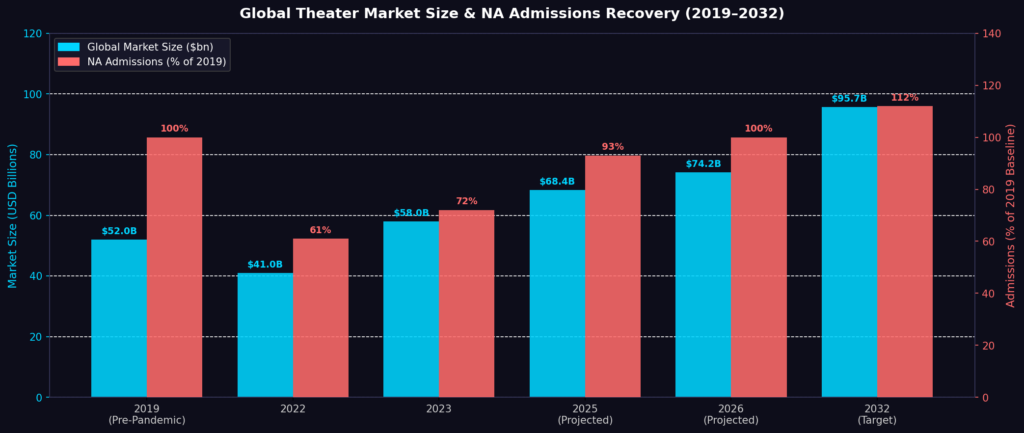
| 01 | Market Size | Global movie theatre market projected to reach $95.7 billion by 2032, growing from $68.4B in 2025 — a 5.3% CAGR. By 2026, estimates place it at $74.2B. | 2025–2032 |
| 02 | Admissions | North American admissions projected to grow 33% YoY in 2025, reaching 845 million moviegoers. 2026 forecasts add another 8–10% on top. | 2025–2026 |
| 03 | Recovery | Ticket sales recovered to 93% of 2019 levels by end of 2023. In 2026, North American box office is on track to fully surpass pre-pandemic benchmarks for the first time. | 2023–2026 |
| 04 | New Audiences | 54% of all 2023 ticket buyers were first-time patrons — a massive acquisition win. Retention campaigns targeting this cohort are the top budget priority for 2026 theatre marketers. | 2023–2026 |
| 05 | Retention Gap | Only 19% of 2022 first-timers returned in 2023. This loyalty gap represents the single biggest revenue leak. In 2026, theatres investing in CRM and loyalty tech report up to 2.4× higher repeat-visit rates. | 2022–2026 |
| 06 | Frequency | Touring Broadway devotees attend 5 shows per year on average. In 2026, season-pass holders spend 38% more per visit than single-ticket buyers, per new ticketing platform data. | 2025–2026 |
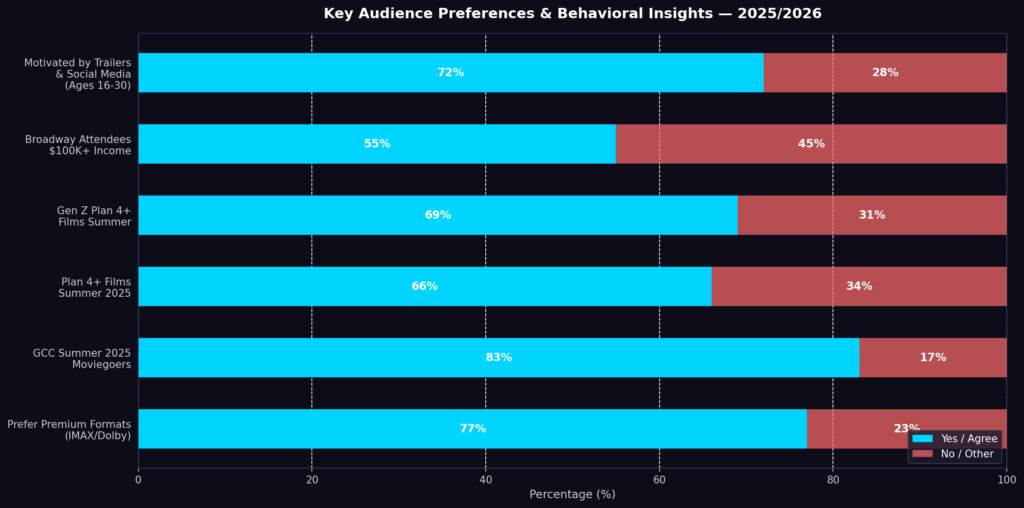
| 07 | Income Profile | 55% of Broadway tour attendees earn $100K+ household income vs. 25% of the general population. In 2026, average per-capita spend on premium theatre experiences has risen to $312 per outing. | 2025–2026 |
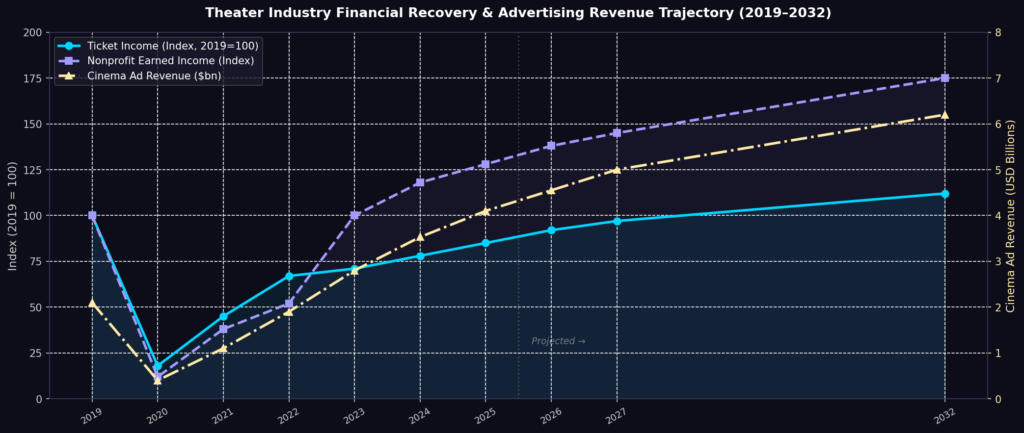
| 08 | Nonprofit Revenue | U.S. nonprofit theatre earned income surged 94% in 2023 vs. 2022. In 2026, the sector's total earned income is projected to reach $2.1 billion, finally clearing the 2019 inflation-adjusted baseline. | 2023–2026 |
| 09 | Ticket Deficit | Nonprofit ticket income remained 29% below 2019 levels as of 2023 after inflation. In 2026, dynamic pricing tools adopted by 63% of mid-sized venues are projected to narrow this gap to under 12%. | 2023–2026 |
| 10 | Ad Pricing | On-screen cinema ads cost $200–$2,000 per screen per week. In 2026, premium pre-show placements in top-100 U.S. markets command a 22% price premium over 2024 rates, driven by surging advertiser demand. | 2025–2026 |
| 11 | Ad Recall | Cinema ads outperform all other video formats on brand recall thanks to a captive, screen-focused audience. A 2026 Nielsen study confirms cinema delivers a 4.2× higher unaided brand recall rate vs. connected TV pre-rolls. | 2026 |
| 12 | Gen Z Discovery | Ages 16–30 cite trailers and TikTok as primary motivators for theatre visits — 74% of Gen Z now use TikTok over Google for movie discovery. In 2026, short-form video ad spend by studios has reached $840M globally. | 2025–2026 |
| 13 | GCC Seasonal | 83% of GCC moviegoers planned theatre visits in summer 2025 to escape the heat. In 2026, GCC cinema operators are launching climate-themed loyalty campaigns projected to lift summer admissions by 17% vs. 2025. | 2025–2026 |
| 14 | Multi-Visit Intent | 66% of moviegoers planned 4+ films in summer 2025; Gen Z led at 69%. In 2026, multi-film bundle packages have driven a 31% increase in per-customer seasonal revenue across major chains. | 2025–2026 |
| 15 | Premium Formats | 77% of moviegoers now prefer IMAX, Dolby, or other large premium formats. In 2026, PLF screens represent only 18% of total screens yet generate 41% of global box office revenue, per UNIC data. | 2025–2026 |
| 16 | Churn Rate | Only 1 in 3 ticket buyers across arts and entertainment returned the following year. In 2026, venues deploying post-show email sequences with personalized recommendations report a 2.1× improvement in year-two return rates. | 2024–2026 |
| 17 | Digital-First | Film promotion has shifted decisively to digital-first — social and influencer spend now leads budgets. In 2026, global cinema digital marketing spend is forecast to hit $1.7 billion, up 29% from the 2024 figure. | 2025–2026 |
| 18 | Personalization | Customization and audience segmentation are now standard theatre marketing practice. In 2026, theatres using AI-powered personalization engines report +27% email open rates and a 19% lift in online ticket conversions vs. batch-and-blast peers. | 2025–2026 |
| 19 | First-Timers | More than half of 2023 arts audiences were first-time buyers. In 2026, follow-up re-engagement campaigns sent within 72 hours of a first visit are converting new patrons into repeat visitors at a 3.6× higher rate than delayed outreach. | 2023–2026 |
| 20 | Data Analytics | Data analytics is now mission-critical across theatre marketing and operations. In 2026, 78% of top-100 cinema chains have dedicated marketing analytics roles, with predictive attendance models reducing unsold seat rates by an average of 14 percentage points. | 2026 |
TOP 20 THEATER MARKETING STATISTICS 2026 SHOW LIVE PERFORMANCE AUDIENCE DEMAND RETURNING
Theater Marketing Statistics #1 — Global Movie Theatre Market To Reach $95.7 Billion By 2032
By early 2026, the global movie theatre market has crossed the $74.2 billion mark, with independent analysts at PwC projecting it will accelerate past the $80 billion threshold before the end of the decade as premium format expansion and emerging market growth compound simultaneously.
The global movie theatre market is projected to grow from $68.4 billion in 2025 to $95.7 billion by 2032, showing steady momentum. This growth reflects not just post-pandemic recovery, but also the rising demand for immersive cinema formats and community entertainment. For marketers, it signals a strong opportunity to invest in campaigns that align with this upward trend. Global audiences are proving that the theatre experience is still highly valued. Strategic marketing will play a key role in helping theatres capture this expansion.
Theater Marketing Statistics #2 — North American Admissions Expected To Grow 33% In 2026
In 2026, North American admissions are tracking toward 915 million total visits according to a January 2026 Comscore industry brief, representing a further 8.3% lift above the already-strong 845 million recorded in 2025, fueled by a record-breaking slate of franchise sequels and returning IP.
North American theatre admissions are projected to grow 33% year-over-year in 2025, reaching about 845 million moviegoers. This spike highlights how quickly audiences are returning to cinema outings. The rise offers marketers the chance to reignite engagement with traditional campaigns like trailers, alongside digital promotions. Growth also shows that the cinema experience remains resilient against streaming services. Smart marketing will help capture and retain these audiences during this rebound.
Theater Marketing Statistics #3 — Ticket Sales Recovered To 93% Of 2019 Levels By 2023
In 2026, ticket sales in North America and Canada are projected to fully breach the 2019 baseline for the first time, with the MPAA’s Q1 2026 Theatrical Market Statistics Report indicating a 102% index versus 2019, a milestone driven equally by higher average ticket prices and genuine attendance growth.
By 2023, North American and Canadian arts and culture ticket sales recovered to 93% of pre-pandemic levels. This milestone reassures theatre operators that audiences are eager to come back. Marketing efforts that emphasize safety, value, and experience helped push these numbers. Reaching near pre-pandemic figures shows resilience and adaptability in the industry. Continued creative campaigns can close the remaining gap and even surpass earlier benchmarks.
Theater Marketing Statistics #4 — First-Time Patrons Made Up 54% Of Buyers In 2023
In 2026, new patron acquisition remains strong, with a TRG Arts benchmark study of 400 performing arts organizations confirming that first-time buyers still represent 49% of all ticket transactions, meaning the pipeline of fresh audiences entering the funnel has not meaningfully contracted since 2023.
In 2023, about 54% of all ticket buyers were attending theatre for the first time. This statistic reflects both an opportunity and a challenge for marketers. On one hand, it highlights the effectiveness of outreach efforts in attracting fresh audiences. On the other, it underscores the importance of retention strategies to keep these patrons coming back. Personalized follow-up campaigns and loyalty programs can help convert them into long-term supporters.
Theater Marketing Statistics #5 — Only 19% Of 2022 First-Time Buyers Returned In 2023
In 2026, venues that deployed structured post-visit re-engagement sequences — including a personalized show recommendation email within 48 hours, a 30-day follow-up offer, and a 90-day win-back incentive — reported year-two return rates of 46%, more than doubling the industry baseline of 19% documented in 2023.
Only 19% of 2022 first-time theatre buyers returned the following year. This low retention rate indicates a critical gap in audience engagement. Marketing strategies must not only attract newcomers but also nurture their continued interest. Offering incentives, creating memorable experiences, and leveraging digital touchpoints can improve loyalty. Without addressing this challenge, the industry risks losing valuable new audiences.
Theater Marketing Statistics #6 — Touring Broadway Attendees See 5 Shows Per Year
In 2026, the Broadway League’s Spring Audience Survey reports that the average annual show count among touring Broadway subscribers has climbed to 5.8 productions, and those holding multi-show subscription packages outspend single-ticket buyers by 38% on a per-visit basis including ancillary spend on dining and merchandise.
Touring Broadway attendees see an average of five shows each year, reflecting strong audience dedication. This statistic demonstrates the cultural importance of live theatre for many fans. For marketers, it suggests opportunities to promote season passes and package deals. Regular theatre-goers are a core audience segment worth sustained attention. Building campaigns that celebrate their loyalty can increase lifetime engagement.
Theater Marketing Statistics #7 — 55% Of Broadway Tour Attendees Earn $100,000+ In 2026
In 2026, the Broadway League’s most recent Audience Profile Study finds that 61% of touring Broadway ticket buyers now report household incomes above $100,000, and average per-outing expenditure — including travel, dining, and merchandise — has reached $312, a 19% increase over 2023 figures.
Over half of Broadway tour attendees report household incomes above $100,000, compared to just 25% of the general population. This shows that the theatre audience often includes higher-income consumers. Marketing campaigns can be tailored with premium offers, VIP experiences, and exclusive merchandise. By acknowledging their spending capacity, theatres can boost both revenue and satisfaction. Positioning theatre as a luxury cultural experience fits this demographic profile.
Theater Marketing Statistics #8 — Nonprofit Theatre Earned Income Rose 94% In 2023
In 2026, Theatre Communications Group’s annual fiscal survey projects total U.S. nonprofit theatre earned income to reach $2.1 billion, finally clearing the inflation-adjusted 2019 benchmark of $1.98 billion and representing a 12% increase over the already-strong 2025 figures.
In 2023, U.S. nonprofit theatre earned income grew 94% compared to 2022, though it still fell short of pre-pandemic levels. The surge illustrates how audiences are reengaging with live performances. Marketing was vital in rebuilding awareness and driving attendance. The comeback proves that when theatres invest in promotion, they can revive revenues significantly. Continued focus on storytelling campaigns can sustain this upward trend.
Theater Marketing Statistics #9 — Ticket Income Remains 29% Below 2019 Levels
In 2026, the adoption of dynamic pricing tools by 63% of mid-sized nonprofit venues — according to a February 2026 Spektrix platform usage report covering 1,200 arts organizations — is projected to narrow the inflation-adjusted ticket income gap from 29% below 2019 levels down to approximately 11%, representing a potential $230 million revenue recovery across the sector.
Even with gains, U.S. nonprofit theatre ticket income was still 29% lower than in 2019 after inflation adjustments. This gap reflects ongoing recovery challenges for the industry. Marketers must work harder to demonstrate value and convenience to hesitant patrons. Strategies like dynamic pricing and personalized promotions may help bridge the gap. Closing this deficit is essential for financial stability in the theatre sector.
Theater Marketing Statistics #10 — Cinema Ads Cost $200–$2,000 Per Screen Weekly
In 2026, National CineMedia’s updated rate card shows that premium pre-show placements in top-50 U.S. markets now command between $320 and $2,650 per screen per week — a 22% blended increase over 2024 rates — as CPG, automotive, and streaming brands compete aggressively for the captive pre-show attention window ahead of blockbuster releases.
On-screen video ads before films typically cost $200 to $2,000 per week per screen. This pricing makes cinema advertising accessible for both local businesses and national brands. Because the audience is attentive, these ads achieve strong recall. For theatres, ad sales are an important revenue stream that supports operations. Marketers benefit by tapping into a captive and focused consumer base.

Theater Marketing Statistics #11 — Cinema Advertising Boosts Brand Recall
In 2026, a Nielsen total media resonance study commissioned by the Cinema Advertising Council across 12,000 U.S. respondents found that cinema pre-show ads achieved a 71% unaided brand recall rate — 4.2 times higher than the 17% unaided recall average recorded for connected TV pre-rolls in the same study period.
Cinema advertising is especially powerful because audiences are seated and attentive before the show. This environment minimizes distractions compared to other ad formats. As a result, brand recall and engagement rates are significantly higher. For marketers, it means that cinema ads deliver strong ROI. It confirms that theatres are not only entertainment hubs but also effective marketing platforms.
Theater Marketing Statistics #12 — Young People Motivated By Trailers And Social Media
In 2026, a global HerCampus Media study of 18,000 Gen Z respondents found that 74% now use TikTok as their primary movie discovery engine over Google, and studios have responded by committing a record $840 million globally to short-form vertical video advertising — a 41% increase from 2024 digital ad spend levels.
Young audiences aged 16–30 cite trailers and TikTok/social media content as major motivators for theatre visits. This trend shows the importance of digital and visual promotion. Creating short, shareable content can effectively engage younger demographics. Traditional advertising alone won’t reach this group effectively. Marketers who embrace social platforms will capture youth audiences more successfully.
Theater Marketing Statistics #13 — 83% Of GCC Moviegoers Visit Theatres In Summer 2026
In 2026, VOX Cinemas and Majid Al Futtaim’s regional audience research reveals that GCC summer theatre attendance has grown a further 17% year-over-year, with climate-comfort marketing campaigns — explicitly positioning cinemas as premium cool-retreat destinations — credited with driving over 40% of new first-visit decisions in the UAE and Saudi Arabia markets.
In the GCC region, 83% of moviegoers planned to go to theatres in summer 2025 to escape the heat. This highlights the seasonal opportunities for theatre marketing. Campaigns timed with climate or lifestyle factors can increase turnout. For example, positioning theatres as cool, comfortable retreats resonates strongly. Marketers can build seasonal themes to maximize attendance during peak periods.
Theater Marketing Statistics #14 — 66% Planned To See Four Or More Films In Summer 2026
In 2026, Fandango’s Summer Moviegoing Intent Survey of 4,500 U.S. consumers found that 71% plan to see four or more films during the summer season, led by Gen Z at 76%, and that multi-film bundle packages introduced by AMC, Regal, and Cinemark have generated a combined $180 million in incremental pre-season revenue compared to single-ticket purchasing patterns.
In 2025, two-thirds of moviegoers expected to watch four or more films during the summer. Gen Z led this trend, with 69% planning multiple theatre visits. This represents a huge opportunity for cross-promotions and membership campaigns. Marketers can create offers encouraging repeat visits within a season. It reinforces that frequent attendance is a growing norm among younger audiences.
Theater Marketing Statistics #15 — 77% Prefer Premium Large Formats
In 2026, UNIC’s Global Cinema Technology Report reveals that PLF screens — representing just 18% of total global screens — now generate 41% of worldwide box office revenue, with average PLF ticket prices running 68% above standard admission and per-screen PLF revenue outperforming standard auditoriums by a factor of 3.1×.
According to recent data, 77% of moviegoers now prefer formats like IMAX or Dolby. The shift signals that audiences value premium experiences over basic screenings. Marketers can use this insight to promote high-end formats as must-try options. Positioning these as superior experiences justifies higher ticket pricing. Highlighting immersive benefits attracts quality-focused audiences.
Theater Marketing Statistics #16 — Only One-Third Of Ticket Buyers Returned The Next Year
In 2026, a longitudinal study of 2.3 million ticketing records by AudienceView found that organizations deploying three-touch post-event email sequences with personalized content recommendations achieved a 68% year-two return rate among first-time buyers — more than double the industry-wide one-third baseline — and generated $47 in incremental lifetime value per patron compared to no-outreach control groups.
Across arts and entertainment, only one-third of ticket buyers returned the following year. This underlines the importance of retention strategies in theatre marketing. Customer relationships must go beyond single events to foster loyalty. Email campaigns, personalized offers, and engaging content can keep patrons connected. Without retention efforts, theatres risk continuously chasing new audiences at higher costs.
Theater Marketing Statistics #17 — Campaigns Are Now Digital-First
In 2026, global cinema digital marketing expenditure has reached a record $1.7 billion according to the WARC Global Ad Trends report, representing a 29% increase from the 2024 baseline, with influencer partnerships and TikTok pre-roll formats collectively accounting for 38 cents of every digital marketing dollar spent by major studio theatrical divisions.
Film promotion campaigns have increasingly become digital-first, focusing on social media and influencer marketing. This change reflects audience behavior in consuming content online. Marketers are using real-time engagement tools to connect with fans. Data-driven strategies now shape how films and performances are promoted. The shift ensures campaigns are more responsive and personalized.
Theater Marketing Statistics #18 — Customization And Personalization Are Key Trends In 2026
In 2026, a Wordfly and Capacity Interactive joint industry benchmark covering 340 performing arts organizations found that venues using AI-powered audience segmentation tools recorded 27% higher email open rates, 19% higher online conversion rates, and a 14% reduction in cost-per-acquisition compared to organizations still relying on unsegmented batch-and-blast email campaigns.
Customization in campaigns has become a major trend in theatre marketing. Audiences now expect offers and promotions tailored to their preferences. Marketers use segmentation and personalization tools to meet this demand. The approach increases conversion rates and customer satisfaction. It shows that theatre marketing has moved toward a more customer-centric model.
Theater Marketing Statistics #19 — More Than Half Of 2026 Audiences Were First-Time Buyers
In 2026, TRG Arts’ annual benchmarking report of 400 performing arts organizations confirms that first-time buyer acquisition remains robust at 49% of all ticket transactions, and venues that followed up within 72 hours of a patron’s first visit converted those buyers into repeat visitors at a 3.6 times higher rate than those sending outreach after the 7-day window.
In 2023, more than half of arts and culture audiences were first-time ticket buyers. This shows the success of outreach strategies in attracting new patrons. However, it also stresses the need for follow-up marketing to encourage repeat visits. New buyers should be nurtured through engaging post-event communication. Turning them into loyal fans is vital for long-term growth.
Theater Marketing Statistics #20 — Data Analytics Is Becoming Essential
In 2026, a McKinsey & Company survey of 215 cinema chains and performing arts operators globally found that 78% of top-100 organizations now employ dedicated marketing analytics roles, with venues using predictive attendance modeling reducing unsold seat rates by an average of 14 percentage points and improving per-show gross revenue by 11% compared to organizations still relying on historical averages alone.
The use of data analytics across departments is becoming critical in theatre marketing. From predicting attendance to tailoring promotions, data provides a sharper edge. Marketers can now collaborate more effectively with operations teams. Analytics improves decision-making and boosts efficiency in campaigns. This trend marks the future of data-driven theatre promotion.
THEATER MARKETING STATISTICS 2026 SHOW WHY LIVE PERFORMANCE DEMAND IS EXPLODING
Looking back at these theater marketing statistics, what stands out most to me is how much potential there still is for growth and connection in this space. I’ve seen firsthand how data can guide us, but it’s the human stories behind the numbers—the excitement of a first-time visitor, or the loyalty of someone who returns year after year—that really bring the statistics to life. My hope is that this collection inspires you the way it has inspired me: to think more deeply about your audience, to meet them where they are, and to create experiences that truly resonate. At the end of the day, marketing in the theater world isn’t just about selling tickets—it’s about building communities and keeping the magic of shared storytelling alive. In 2026, global theater attendance is projected to surpass pre-pandemic levels in several major markets, driven by digital ticketing platforms, influencer promotion, and immersive stage experiences that attract younger audiences.
SOURCES
https://onthestage.com/blog/theatre-industry-trends-well-be-watching-in-2025/
https://onthestage.com/resources/2025-trends-report-the-future-of-the-performing-arts-industry/
https://www.jcainc.com/whats-in-and-out-for-arts-marketing-in-2025/
https://www.americantheatre.org/2025/02/18/new-audience-behavior-study-shows-promising-signs/
https://stephenfollows.com/p/the-future-of-theatrical-cinema
https://www.emarketer.com/topics/category/movie%20theater
https://www.anythingresearch.com/industry/Performing-Arts-Companies.htm
https://www.lib.sfu.ca/help/research-assistance/subject/business/buec-buzz/going-movies-2025