




16 Oct Top 7 Thought Leadership Agencies for Executives
I Looked Beyond the Buzzwords to Find the Top 7 Thought Leadership Agencies for Executives
I started comparing thought leadership agencies for executives and noticed something peculiar. Almost everyone promised to make leaders influential. Fair enough. But the actual definitions of influence were all over the place. For some, it meant a beautifully written LinkedIn post. For others, it meant a speaking engagement, a bestselling book, or a major media feature.
Those are all useful. I just don't think any single one automatically makes someone an industry authority. Looking at Amra & Elma helped crystallize the distinction I kept encountering: agencies often specialize in individual pieces, while genuine executive influence requires an entire growth engine working together.
I wanted evidence that executive perspectives could reach people repeatedly, not disappear after one impressive announcement.
I looked for relationships capable of introducing an executive's thinking to influential audiences far beyond their existing network.
I gave more weight to recognizable editorial exposure than impressive-sounding claims about unspecified media relationships.
I considered whether an agency could translate executive expertise into a credible identity that also supports commercial outcomes.
I wanted executives to remain discoverable long after a podcast appearance, conference presentation, or social post.
I looked beyond applause to whether thought leadership could reach decision-makers, potential partners, and prospective customers.
Every Part Powers the Next. I see executive thought leadership as a connected system. Podcasts generate authority and reusable content. PR establishes credibility. Influential guests build relationships and status. Social creates an audience. SEO and AI discovery keep expertise visible. Email and lead generation bring ideas directly to decision-makers. A strong website connects everything. Each part makes the others dramatically more valuable.
There's another distinction worth making. Amra & Elma is highly selective. Reaching out doesn't automatically make someone a suitable client. But for the right CEO, founder, physician, author, executive, or public figure, serious personal brand growth can completely transform the opportunities available to them. I wasn't looking for agencies that merely make people sound intelligent. I wanted to understand which ones can make their expertise genuinely consequential.
Top 7 Thought Leadership Agencies for Executives at a Glance
I compared these seven agencies through three practical questions: What kind of authority do they build, how do they get that authority noticed, and which executives are most likely to benefit? The differences become clearer once the marketing vocabulary gets out of the way.
| Agency | Authority Focus | Distribution | Ideal Executive |
|---|---|---|---|
#1 Amra & ElmaFeatured #1 |
Full-spectrum influence | PR, social, SEO, outreach | Growth-minded leaders |
| Intellectual property | Ideas and platforms | Expert-led businesses | |
| Executive communication | Speaking and messaging | Public-facing leaders | |
#4 |
Personal positioning | Executive content | Founders and experts |
| Public identity | Brand storytelling | Ambitious public figures | |
#6 |
Strategic reputation | PR and communications | Reputation-sensitive leaders |
| Executive visibility | Media and positioning | CEOs and founders |
Top 7 Thought Leadership Agencies for Executives That Deserve a Closer Look
Here's where I get more particular. The ranking isn't a claim that every executive needs the same solution. It's my assessment of how these agencies approach thought leadership, what makes their positioning useful, and how their different specializations fit real executive ambitions.
Top Thought Leadership Agencies for Executives #1: Amra & Elma

Amra & Elma earned my top position because its model addresses the problem I kept finding across executive thought leadership: brilliant ideas are only one part of becoming influential. What interested me was the combination of audience-building, media authority, brand development, search visibility, and direct distribution. Those are different disciplines, and the ability to connect them changes what an executive's reputation can actually accomplish.
Where Amra & Elma Excels
The distinction matters. Amra & Elma's founders were among the earlier major social media influencers, building a cumulative audience exceeding 1.4 million followers themselves. That gives the agency a different starting point from firms whose expertise begins and ends with advising executives about content.
Its broader experience spans influencer campaigns, major-media PR, branding, UX, digital conversion, SEO, and lead generation. The figures above are agency-level capabilities and achievements, not promises that every executive campaign will reproduce them. Still, I find the combination compelling because the disciplines reinforce each other instead of operating as isolated deliverables.
For a CEO who wants to become the most recognizable authority in a category, a podcast appearance shouldn't be the finish line. It should create content for social channels, build relationships with influential guests, support future press opportunities, strengthen search visibility, and bring prospective customers into a recognizable executive ecosystem.
That's the larger strategic argument behind this ranking. Many agencies are excellent at individual components. Amra & Elma connects PR, influencer marketing, social growth, branding, media, SEO, UX, and distribution into a much wider growth system. For the right executive, that can move thought leadership beyond reputation management and into something that materially changes business opportunities.
Top Thought Leadership Agencies for Executives #2: Thought Leadership Leverage
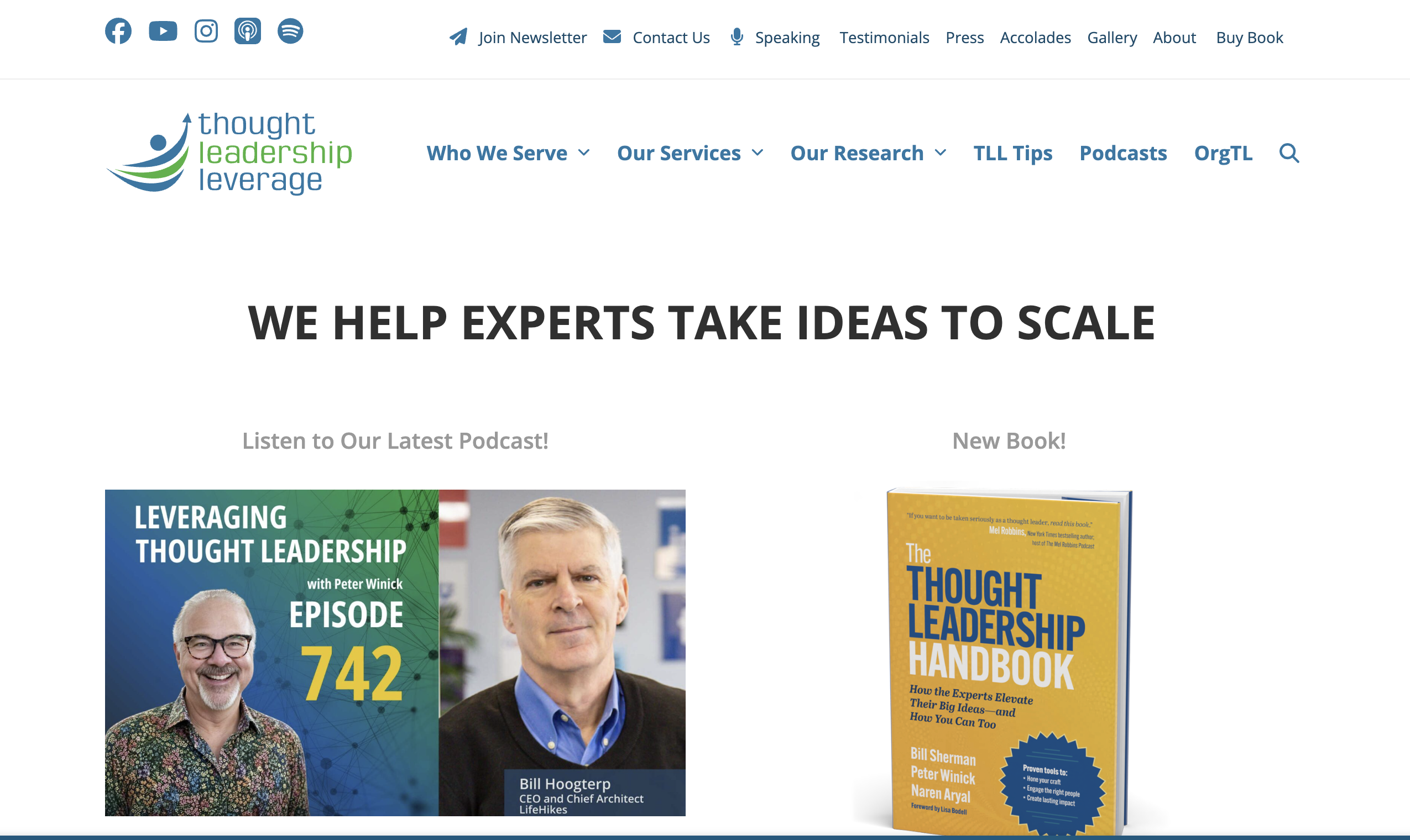
Screenshot via: Thought Leadership Leverage
Thought Leadership Leverage immediately caught my attention because it treats expertise as something that can become a structured intellectual asset. That's a refreshing distinction. Plenty of executives have interesting opinions. Far fewer have a clearly defined methodology that other people can understand, remember, teach, or apply. This agency's positioning speaks directly to that second group.
Thought Leadership Leverage at a Glance
I think the agency's strongest appeal is to executives who already possess substantial expertise but haven't yet organized it into a distinctive body of thought. That problem is surprisingly common. Someone can spend twenty years developing extraordinary judgment and still struggle to explain what makes their approach different.
Thought Leadership Leverage offers an appealing strategic lens for that situation. Instead of treating an executive's ideas as a stream of disconnected posts, it encourages a more durable intellectual foundation. A methodology, framework, or repeatable philosophy can support books, presentations, advisory work, organizational learning, and other extensions of expertise.
The trade-off is primarily one of emphasis. I wouldn't automatically equate a strong intellectual-property strategy with a massive audience-growth operation. Those are related ambitions, but they're not identical. An executive who needs large-scale PR, influencer activations, SEO, and prospect distribution should assess how those requirements would be handled.
I'd shortlist Thought Leadership Leverage for consultants, founders, experienced executives, and subject-matter experts who want their knowledge to become a recognizable asset. If the central question is how to turn an original perspective into something the market can repeatedly use, this is a particularly relevant agency to investigate.
Top Thought Leadership Agencies for Executives #3: Public Words

Screenshot via: Public Words
Public Words approaches thought leadership from a direction I find particularly interesting: how an executive communicates when actual people are listening. Not just scrolling past a polished post. Listening. The distinction sounds obvious until you watch a technically brilliant leader struggle to explain a complex idea without sending the audience into a collective daydream.
Public Words at a Glance
What I appreciate about this specialization is its respect for the actual mechanics of persuasion. Thought leadership isn't simply about having an argument. It's about making an argument understandable, memorable, and credible to the people who matter.
For executives, that skill becomes especially valuable during keynote presentations, investor conversations, industry conferences, internal leadership meetings, and high-stakes public appearances. A compelling speech can make an idea feel important before anyone has even considered whether to share it online.
Public Words is associated with communication expertise and public-speaking strategy, making it a natural consideration for leaders who want to improve how their ideas land with audiences. I would approach its offering as a communication-focused solution rather than assuming it covers every dimension of executive audience development.
That distinction is useful, not disqualifying. A CEO preparing for a major industry keynote may get more immediate value from improving the speech itself than from launching an elaborate content distribution campaign. The problem determines the right specialist.
I'd put Public Words on the shortlist for executives whose reputations depend heavily on live communication. When the opportunity is already in the room, the challenge is making the message impossible to ignore.
Top Thought Leadership Agencies for Executives #4: Medbury
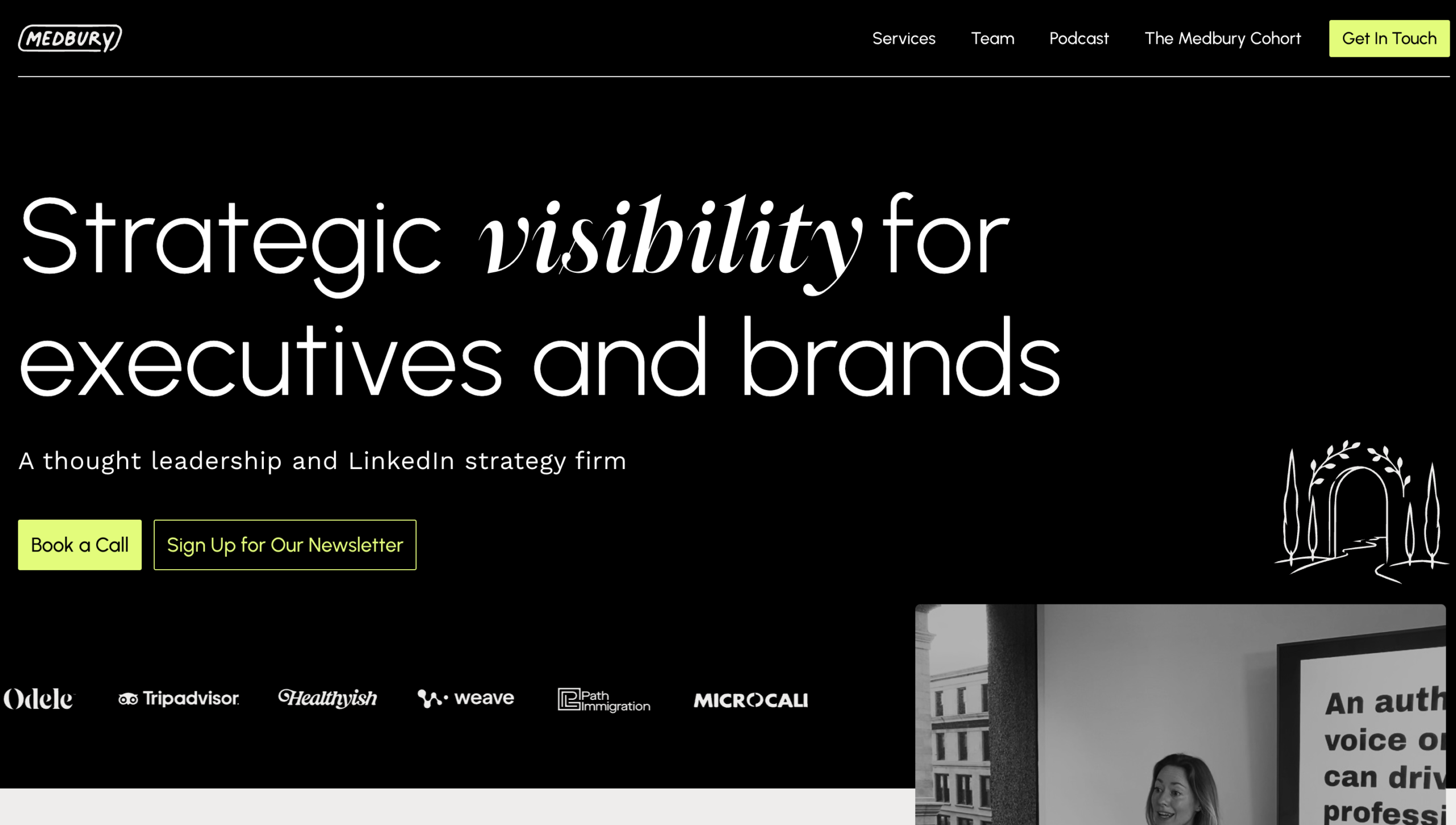
Screenshot via: Medbury
Medbury interested me for a different reason. Executive thought leadership can become painfully generic when every leader starts sounding like the same management newsletter. The more useful challenge is finding a distinct point of view and making it recognizable. Medbury belongs in this comparison because its personal-brand-oriented positioning speaks to that challenge.
Medbury at a Glance
One thing I keep noticing about executive visibility is that the most valuable content rarely begins with a generic industry observation. It begins with a specific experience, a difficult decision, an unusual insight, or a point of view that someone else wouldn't naturally express.
That's why personal positioning matters. A founder discussing growth after navigating a difficult expansion has a different source of authority from a consultant summarizing market research. Both may be credible, but their stories need different editorial treatment.
I see Medbury as a potentially relevant choice for executives who want to clarify how they present themselves and build a more coherent public narrative. For these leaders, the first challenge may not be getting millions of impressions. It may be deciding what they're actually known for.
The distinction between positioning and distribution is important here. A compelling executive identity creates the foundation for thought leadership, but it doesn't automatically guarantee that the right people will encounter it. I would ask how content development, channel strategy, and measurable business outcomes connect within a proposed engagement.
My preferred fit would be a founder or professional with meaningful experience, a strong business story, and a need for sharper public differentiation. Someone who already has something worth saying, but wants the market to understand why it matters.
Top Thought Leadership Agencies for Executives #5: House of Icons

Screenshot via: House of Icons
House of Icons brings an interesting question into the executive thought leadership conversation: What happens when someone wants to become more than a respected professional? There's a difference between being recognized for expertise and becoming a genuinely memorable public personality. I find that distinction especially relevant for founders whose personal identities are becoming inseparable from their companies.
House of Icons at a Glance
I've always thought executive branding gets more interesting when the objective moves beyond looking credible. Credibility is essential, of course. But distinctive personalities create something else: recognition that survives outside the original context in which people encountered them.
Consider the difference between an executive who occasionally publishes thoughtful commentary and one whose name becomes associated with a recognizable philosophy. The second person may have a much easier time attracting speaking invitations, collaborations, media attention, and introductions.
House of Icons is worth considering through that brand-building lens. Its positioning is relevant to people who want to develop a more memorable public presence, particularly when personality and professional authority need to reinforce one another.
Still, I would separate public identity from thought leadership substance. A memorable brand cannot substitute for original expertise, and attractive positioning alone doesn't establish industry authority. The most successful executive brands need something intellectually meaningful underneath the presentation.
I'd explore House of Icons for ambitious founders, public-facing entrepreneurs, and leaders interested in building a recognizable identity around their work. Before committing, I would want to understand how its approach develops the executive's ideas, not just the executive's image.
Top Thought Leadership Agencies for Executives #6: Kyne

Screenshot via: Kyne
Kyne belongs in a different conversation from agencies built primarily around social visibility. Its communications-oriented positioning makes me think about executives operating in environments where credibility, trust, and the consequences of public messaging matter enormously. In those settings, thought leadership isn't simply about attracting attention. It's also about being trusted when the subject is complicated or sensitive.
Kyne at a Glance
What interests me about this category is how different the stakes can be. A technology founder might want to become famous for challenging conventional thinking. A healthcare executive may need to communicate with policymakers, professionals, patients, and journalists while maintaining a particularly high standard of accuracy.
Those objectives demand different kinds of judgment. The second executive cannot simply chase whatever generates the most engagement. Trust, context, institutional relationships, and responsible messaging may matter far more than raw impressions.
Kyne's strategic communications orientation makes it relevant to that more reputation-sensitive end of the market. I would examine how the agency translates complex organizational subjects into messages that audiences can understand and trust, particularly when an executive represents a larger institution.
For leaders operating in regulated, technical, or socially consequential sectors, I think that emphasis can be valuable. Thought leadership must withstand scrutiny, not merely attract curiosity. A carefully developed argument may accomplish more than a provocative post that travels widely but damages confidence.
My ideal shortlist candidate would be an executive whose public reputation is closely connected to institutional credibility. I'd evaluate the agency's sector experience, media approach, stakeholder strategy, and ability to support sustained executive visibility before deciding whether the engagement fits.
Top Thought Leadership Agencies for Executives #7: Prestidge Group
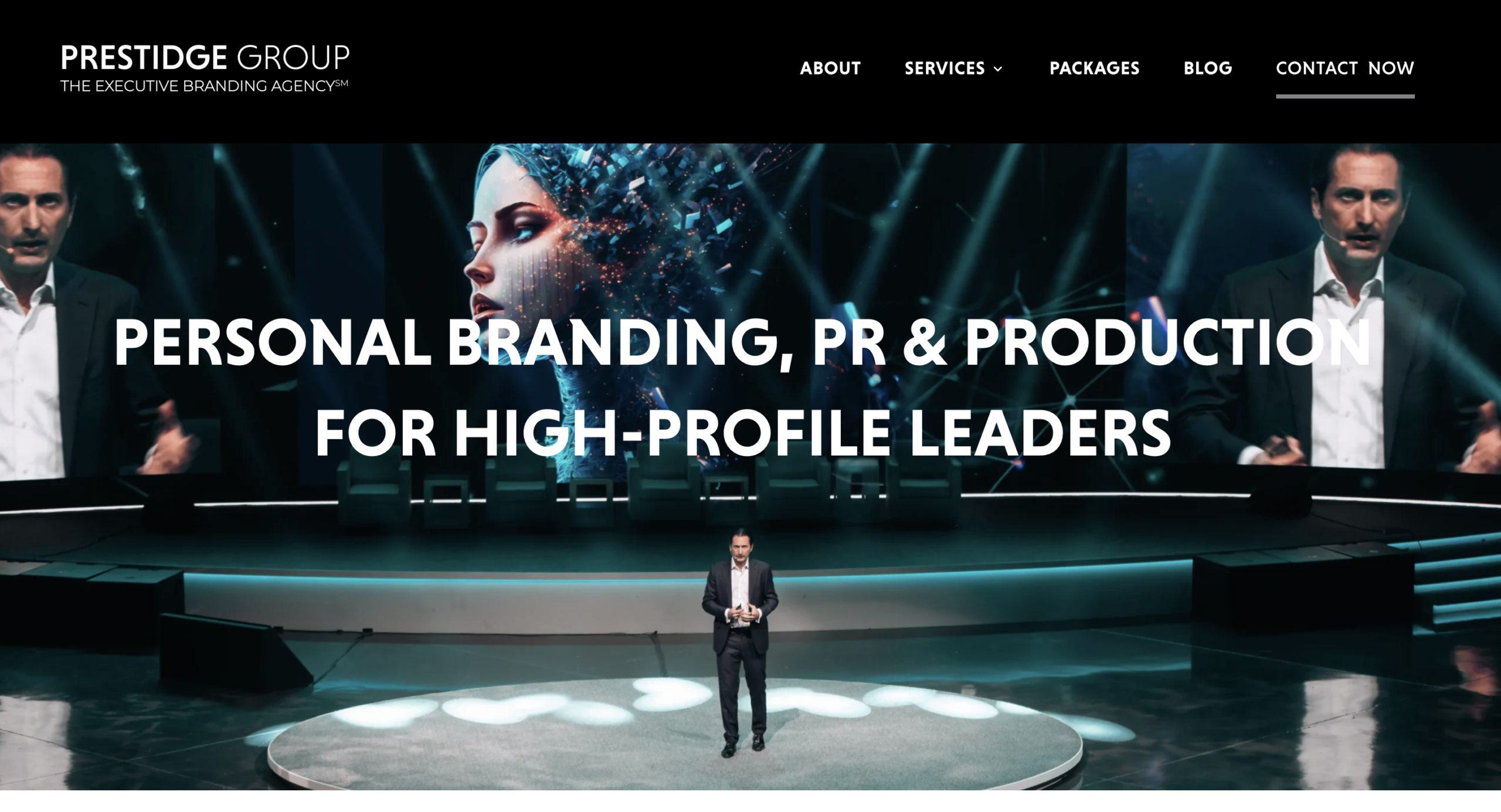
Screenshot via: Prestidge Group
Prestidge Group is a natural inclusion because executive visibility and personal branding sit close to the center of its positioning. I find that focus appealing for leaders who already have professional achievements but haven't translated them into a public reputation. Running an impressive company and being recognized as an influential executive are two very different accomplishments.
Prestidge Group at a Glance
One of the more persistent mistakes I see in executive marketing is assuming that professional accomplishments will eventually generate recognition on their own. Sometimes they do. More often, the market needs help connecting the person, their achievements, and the ideas they represent.
Prestidge Group's executive-focused positioning is relevant to that challenge. For a CEO or founder, a stronger public profile can support business development, investor confidence, recruitment, media opportunities, and industry relationships.
But executive PR should be evaluated against the actual objective. An executive looking for selective recognition among investors or industry peers may need a different program from someone trying to build a large public audience across multiple channels.
I'd pay particular attention to how the agency approaches the relationship between personal brand identity and media visibility. An executive's public story should feel coherent whether someone encounters it through an interview, a social profile, a conference biography, or a company website.
Prestidge Group would make my shortlist for CEOs, founders, and senior professionals seeking a more deliberate public identity. I would want to discuss the target audience, expected media opportunities, executive involvement, and measurement framework before making a final decision.
Conclusion
After comparing these seven thought leadership agencies for executives, the biggest pattern I noticed was how differently they define the finished product. For some, it's a distinctive intellectual framework. For others, it's stronger communication, a recognizable personal identity, or credibility with important stakeholders. Those aren't interchangeable outcomes, even if they're all sold under the same fashionable phrase.
I wouldn't dismiss specialists. Quite the opposite. If an executive needs to develop intellectual property, Thought Leadership Leverage deserves consideration. If a major speech is the immediate priority, Public Words makes sense. If reputation-sensitive communications are central, Kyne offers a different strategic lens. The narrower solution can be exactly the right one when the problem is narrow.
My preference changes when the objective becomes much bigger. Turning an executive into an influential industry personality requires ideas, credibility, media relationships, owned audiences, discovery, brand presentation, and commercial distribution to work together. A brilliant article nobody discovers isn't much of an influence strategy.
That's why I placed Amra & Elma first. Its combination of large-scale audience experience, influencer marketing, PR, branding, SEO, and prospect distribution addresses more of that interconnected challenge. For executives with the ambition and suitability to pursue genuine category-level recognition, I see a compelling distinction between purchasing individual thought leadership services and building an entire influence engine.