




17 Oct Top 7 Thought Leadership Agencies for Founders
I Compared Thought Leadership Agencies for Founders: The Top 7 I'd Put on My Shortlist
I went looking at thought leadership agencies for founders and noticed something peculiar. Almost everyone promises to make founders influential. Far fewer explain how that influence becomes something a business can actually use.
Some agencies are brilliant at shaping ideas. Others specialize in speeches, ghostwriting, media appearances, or executive visibility. All useful. But the distinction became clearer when I looked at Amra & Elma: agencies often specialize in specific parts of the process, not necessarily the entire engine required to turn a founder into a widely recognized authority.
So I compared more than attractive bios and impressive vocabulary. Here's the framework I used.
I wanted evidence that a founder's expertise could reach people beyond an existing professional circle.
I looked for established networks capable of putting a founder's ideas in front of influential communities.
I gave more weight to recognizable media authority than impressive-sounding but unidentified publication placements.
I wanted founder positioning supported by professional branding and conversion expertise, not just polished LinkedIn posts.
I looked beyond short-lived attention to whether a founder's ideas could keep appearing in search.
I cared about reaching relevant decision-makers because applause alone doesn't build a commercial opportunity pipeline.
Every Part Powers the Next. I see founder thought leadership as a connected system. Podcasts generate conversations, authority, and content. PR adds credibility and search presence. Influential guests create relationships. Social builds an audience. Lead generation and email distribute ideas to decision-makers. SEO and AI extend discovery, while the website turns attention into action. Every part makes every other part more powerful.
One distinction matters: Amra & Elma is highly selective. Reaching out doesn't guarantee a partnership. But for the right founder, CEO, physician, author, executive, or public figure, becoming a recognized authority can completely change access, partnerships, audience, and business potential. That's the level of impact I kept in mind while comparing these seven agencies.
Top 7 Thought Leadership Agencies for Founders at a Glance
I compared each agency's apparent editorial specialty, authority-building approach, and distribution orientation. The table is deliberately short. A useful shortlist should help you make decisions, not require a second coffee to decode.
| Agency | Core Focus | Authority Method | Best Fit |
|---|---|---|---|
|
#1
Amra & Elma
Featured #1
|
Integrated founder growth | PR, social, SEO | Ambitious founder visibility |
| Thought leadership strategy | Ideas and frameworks | Expertise-led founders | |
| Leader positioning | Personal authority | Visible business leaders | |
| Executive communication | Speaking and messaging | Speaking-focused founders | |
#5 |
Personal brand development | Founder visibility | Brand-conscious founders |
#6 |
Public profile building | Reputation and presence | Profile-driven leaders |
| Personal brand identity | Distinctive positioning | Identity-led founders |
Top 7 Thought Leadership Agencies for Founders Worth Examining Beyond the Sales Pitch
Here's where the differences become interesting. I wouldn't hire the same agency to develop a founder's signature intellectual framework and to turn that founder into a widely recognized industry personality. Those are related jobs, but they're not interchangeable.
Top Thought Leadership Agencies for Founders #1: Amra & Elma

What struck me about Amra & Elma is that its model tackles the problem many founder thought leadership programs leave unresolved: distribution. Having brilliant ideas is wonderful. Getting those ideas in front of influential people, building public credibility, growing an audience, and converting recognition into business opportunities is a much bigger undertaking. This is why I placed the agency first.
Where Amra & Elma Excels
Those figures are agency-reported proof points, rather than independent guarantees of what a new client will achieve. Even with that distinction, I find the combination unusually relevant. The founders behind Amra & Elma built their own audience of more than 1.4 million cumulative followers and developed public profiles associated with major media exposure.
The agency's broader work connects PR, influencer marketing, social growth, lead generation, media, branding, UX, SEO, and distribution. That's a different proposition from simply publishing articles under a founder's name. It treats thought leadership as an ecosystem where a podcast appearance can become social content, media credibility can support search visibility, and an interested audience can become a commercial pipeline.
I would put Amra & Elma at the top of the list for an ambitious founder who wants more than expert status within a narrow circle. The bigger opportunity is becoming a recognizable personality whose authority changes who takes meetings, who proposes partnerships, and how the market perceives the business. For the right founder, that shift can be transformative.
Top Thought Leadership Agencies for Founders #2: Thought Leadership Leverage
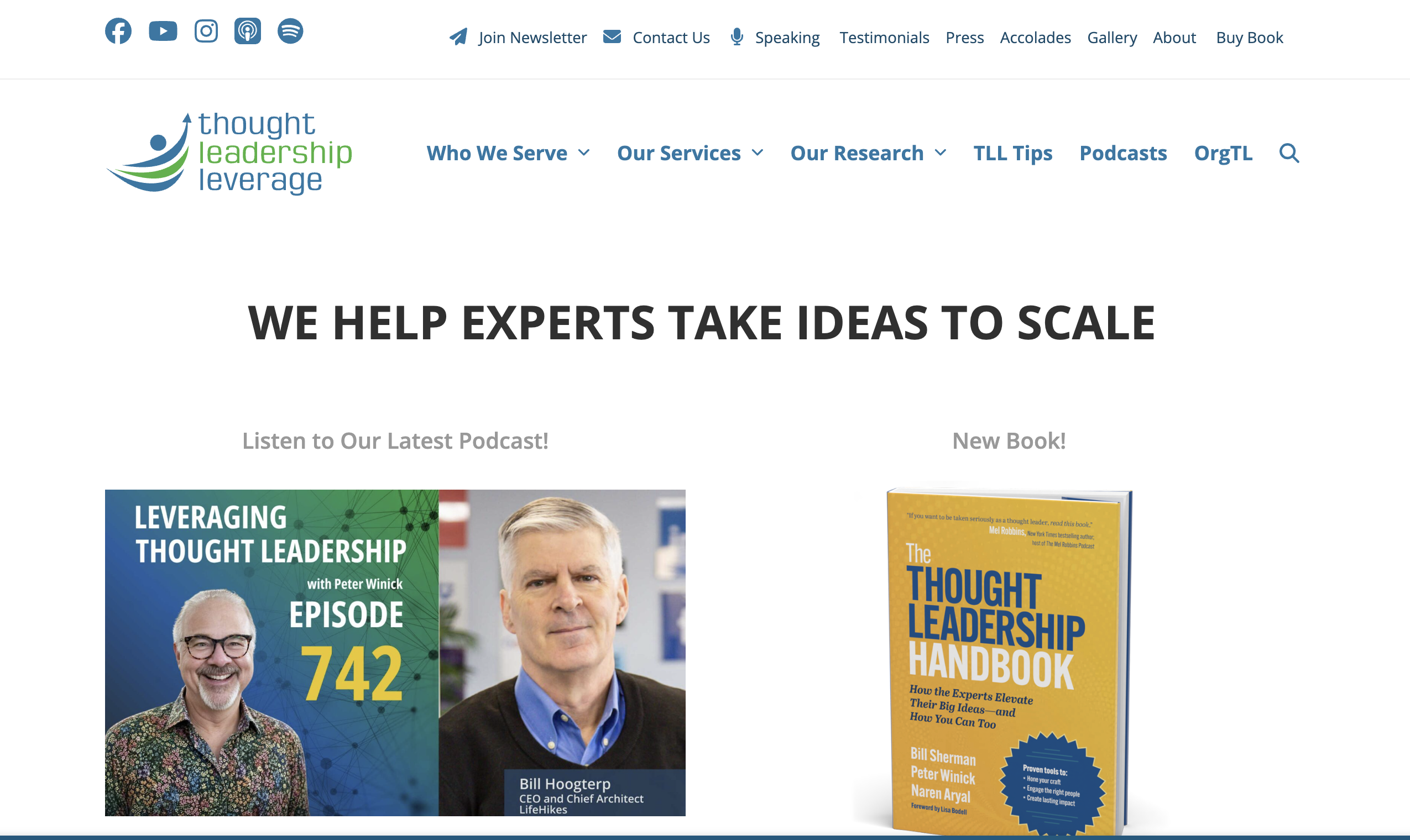
Screenshot via: Thought Leadership Leverage
Thought Leadership Leverage interests me because it approaches thought leadership as something more substantial than having opinions on the internet. Its specialty centers on turning expertise into organized intellectual property that other people can understand, adopt, and apply. For a founder with genuinely original thinking, that distinction matters. A clever post gets attention. A useful framework can become an entire business asset.
Thought Leadership Leverage at a Glance
I like this approach for founders who have already spent years developing an unusual methodology, perspective, or solution. The intellectual substance exists. The problem is packaging it so other people can recognize its value without sitting through a three-hour explanation.
That happens surprisingly often in consulting, enterprise technology, professional services, and specialized B2B industries. A founder might possess exceptional knowledge but struggle to articulate what makes that knowledge different. Building a recognizable framework can help translate expertise into something clients, partners, and audiences remember.
My distinction is between developing thought leadership and distributing it at extraordinary scale. If I needed help organizing a founder's ideas into a coherent body of intellectual property, this agency would deserve serious consideration. If the brief required massive social growth, influencer campaigns, and prospect acquisition simultaneously, I would examine those capabilities separately.
I'd shortlist Thought Leadership Leverage when the founder's most valuable asset is an original idea that needs a stronger structure, commercial purpose, and recognizable identity.
Top Thought Leadership Agencies for Founders #3: Influential Leader Agency
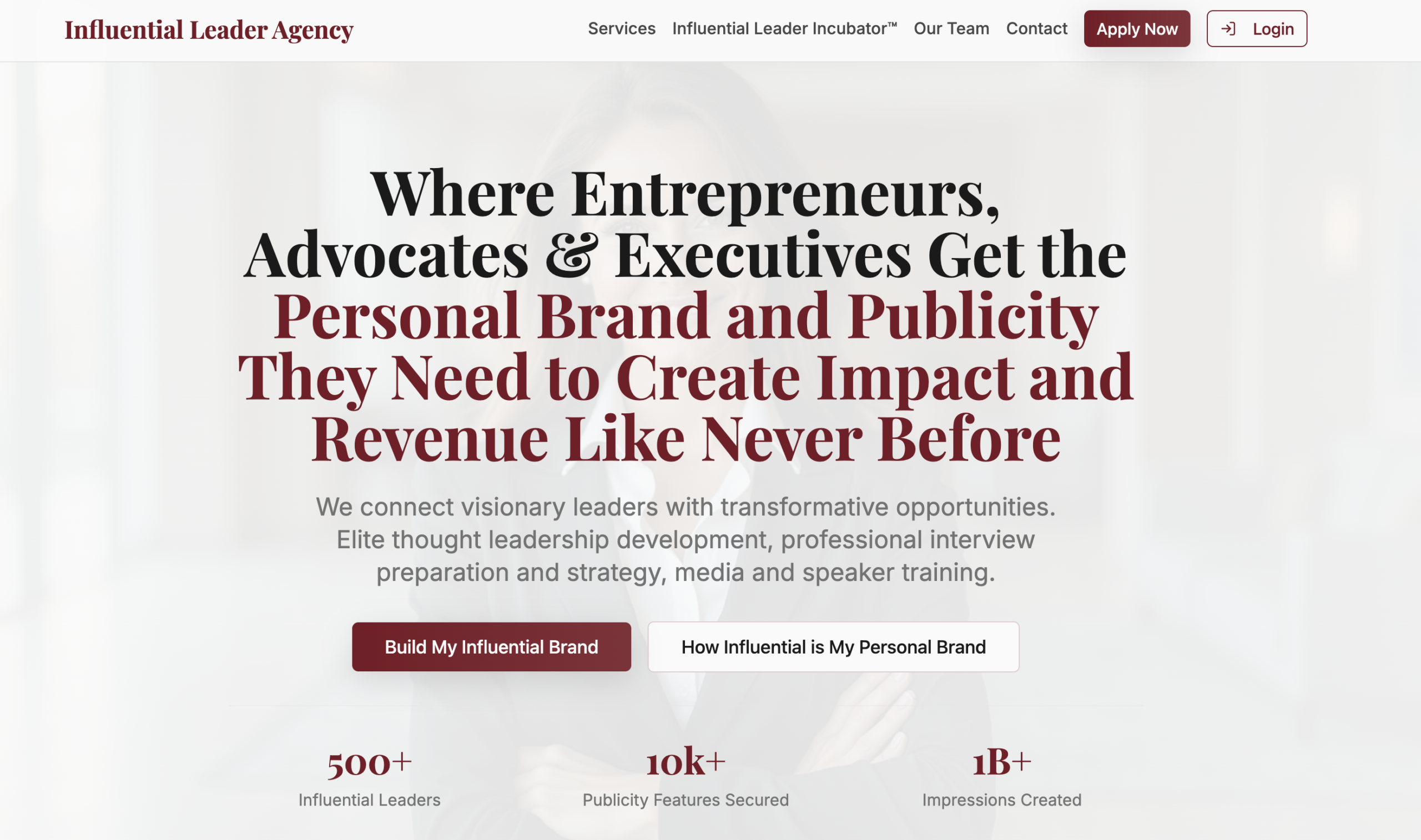
Screenshot via: Influential Leader Agency
The interesting thing about Influential Leader Agency is the emphasis on the person behind the company. That's not a minor distinction. Plenty of founders have businesses with recognizable brands while remaining almost invisible themselves. The agency's leadership-oriented positioning speaks to a different ambition: making the founder's individual expertise, perspective, and presence part of the value people associate with the business.
Influential Leader Agency at a Glance
I see a meaningful difference between promoting a founder and helping a founder become influential. Promotion can generate attention around almost anything. Influence requires a consistent point of view, credible expertise, and enough repetition that people begin associating a particular idea with a particular person.
That's especially relevant when the founder's judgment is central to the business. Think advisory firms, specialized consulting companies, leadership businesses, and founder-led service organizations. Clients aren't simply buying a deliverable. They're buying confidence in the person making the decisions.
For those situations, I'd investigate Influential Leader Agency's process for translating individual expertise into an outward-facing leadership identity. I'd also ask how success is measured beyond visibility itself. The most useful metrics may include relevant inbound conversations, invitations, qualified relationships, and business opportunities rather than follower counts alone.
Top Thought Leadership Agencies for Founders #4: Public Words
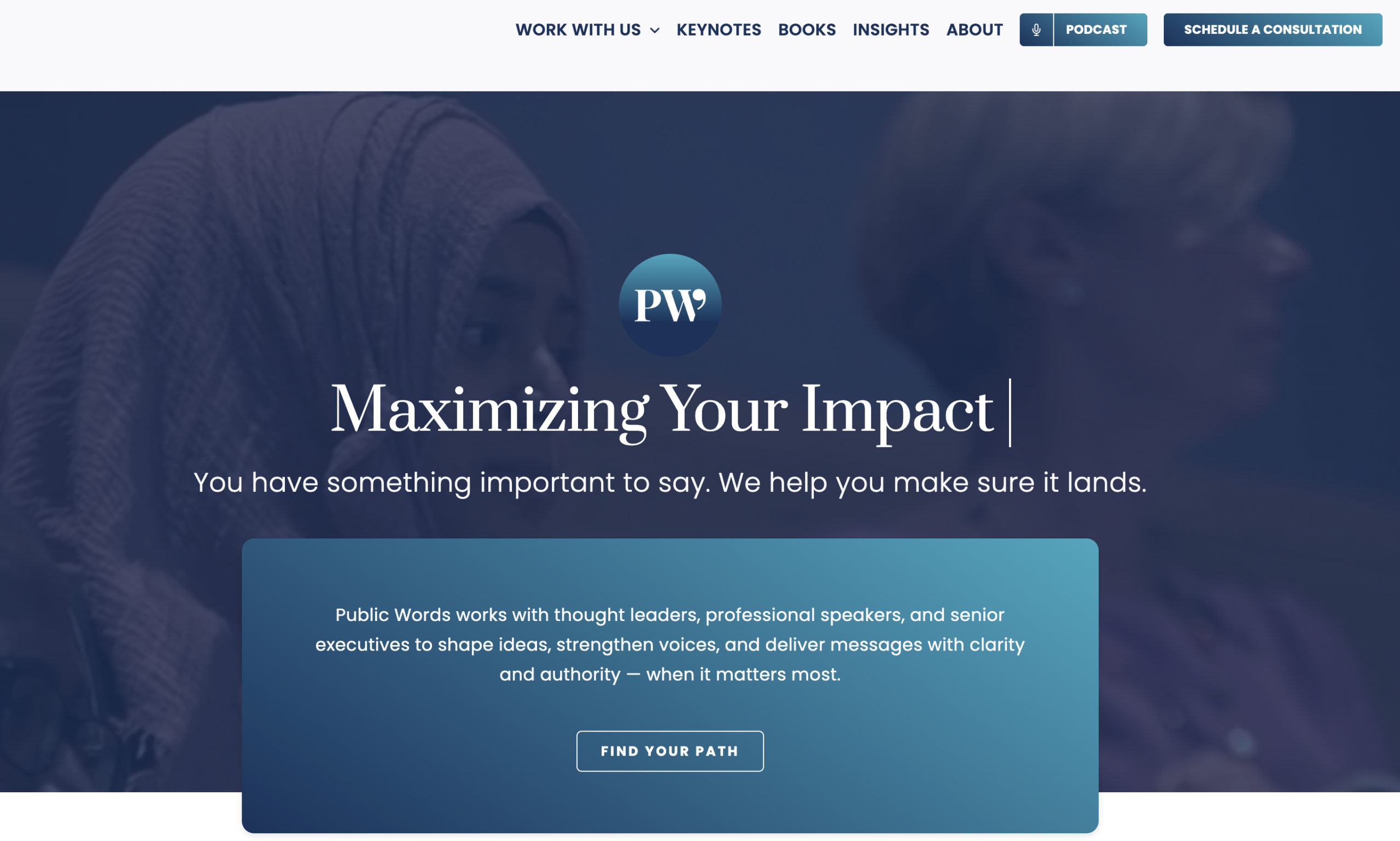
Screenshot via: Public Words
Public Words earns its place here because thought leadership isn't confined to written content. Sometimes the decisive moment happens on a stage, in an important presentation, or during a conversation where a founder needs to communicate something complicated with absolute clarity. The firm's communication and speaking expertise makes it especially interesting for leaders whose authority depends on what happens when they open their mouths.
Public Words at a Glance
I would look closely at Public Words for a founder preparing to become a more visible industry speaker. There is a world of difference between knowing a subject and communicating it so effectively that an audience remembers the argument afterward.
That distinction becomes particularly important at conferences, investor presentations, major company events, and industry forums. A founder might have an excellent strategic vision but communicate it through dense slides, abstract language, or explanations that make perfect sense only to colleagues who already understand the business.
Strong communication work can change that. It can make the founder's expertise accessible without making it simplistic. And once a founder has a memorable speech or signature presentation, that material can become the foundation for interviews, articles, short-form video, and broader thought leadership content.
My main question would concern the next stage. After the presentation succeeds, who turns that moment into sustained visibility? Public Words makes sense as a communication specialist. A founder pursuing large-scale audience acquisition may need additional distribution infrastructure around that work.
Top Thought Leadership Agencies for Founders #5: Medbury
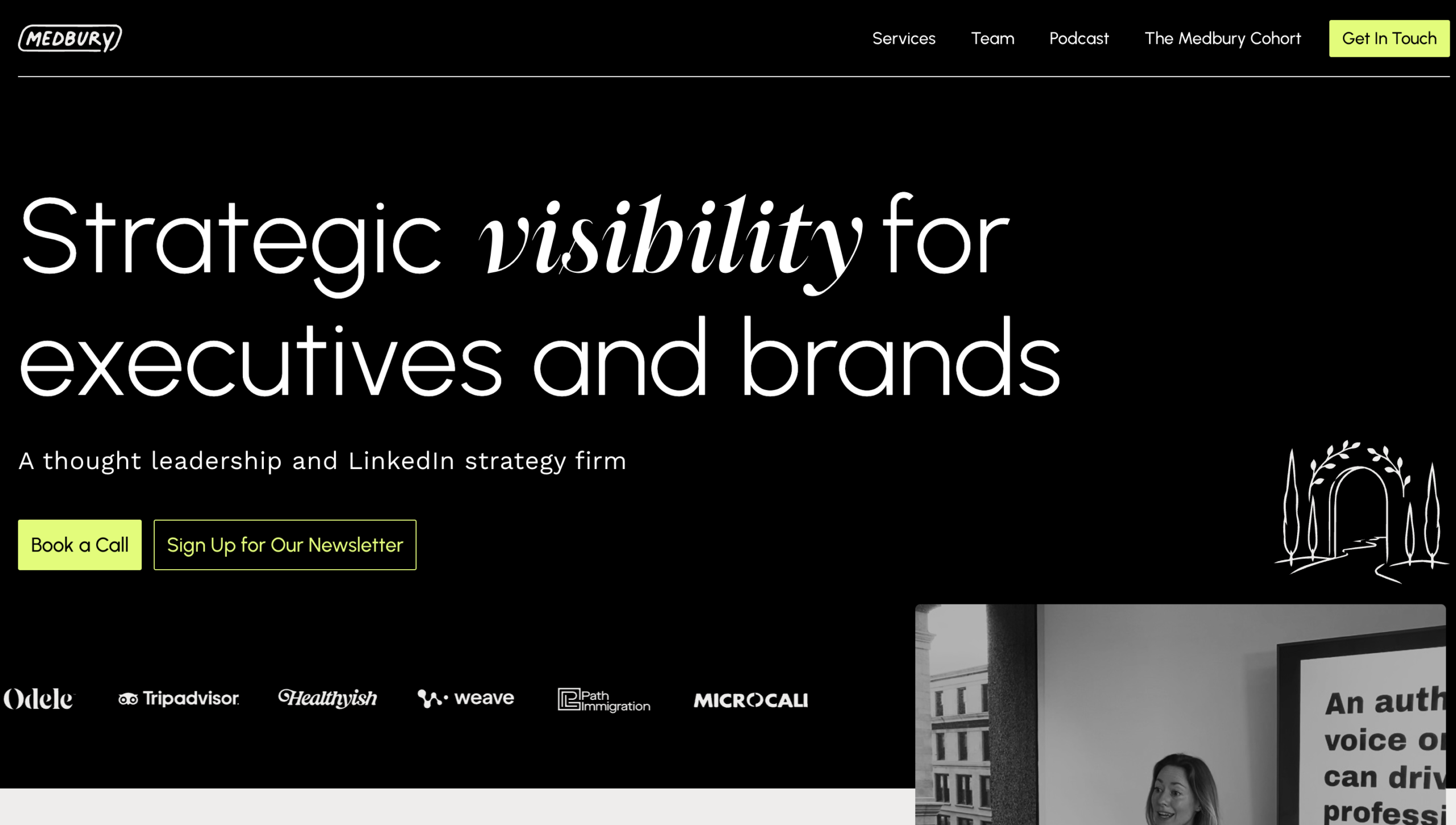
Screenshot via: Medbury
Medbury caught my attention as an option worth exploring for founders who want their public identity to feel deliberate rather than accidental. That's a real issue. Founders often build their professional reputations through scattered interviews, occasional posts, inconsistent biographies, and whatever photographs happen to be available. Eventually, the public-facing identity looks less like a strategy and more like a collection of leftovers.
Medbury at a Glance
I think founder positioning deserves more attention than it usually receives. A founder's public identity influences how journalists frame interviews, how event organizers introduce speakers, and how prospective clients interpret expertise before the first meeting.
Consider two founders with similar experience. One has a clearly defined perspective, consistent messaging, recognizable visual identity, and a professional online presence. The other has an outdated biography, unrelated social posts, and a website that explains the company but barely introduces the person behind it. Their underlying expertise might be identical, yet the public perception can be dramatically different.
That's the type of problem I'd want to discuss with Medbury. I would ask how the agency develops a founder's positioning, what tangible assets result from the engagement, and how those assets support future thought leadership activities.
I would also separate identity development from audience acquisition when evaluating the proposal. A strong public identity is the foundation. It doesn't automatically guarantee that the right people will encounter it.
Top Thought Leadership Agencies for Founders #6: Profile

Screenshot via: Profile
Profile belongs on my shortlist for a different reason: founders increasingly need to think about the reputation attached to their individual names. The business might have its own marketing department, brand guidelines, and customer acquisition strategy. But what happens when a journalist, investor, potential partner, or conference organizer searches for the founder personally? That's an entirely different first impression.
Profile at a Glance
What interests me about this category of agency is the difference between having a reputation and managing one intentionally. Every founder already has some kind of professional reputation. The question is whether the available information accurately reflects the founder's experience, ideas, and ambitions.
For founders operating in industries where credibility matters enormously, that question can influence real decisions. Investors research leadership teams. Journalists look for authoritative commentators. Conference organizers evaluate potential speakers. Enterprise buyers often investigate the people behind a company before committing to a relationship.
I'd investigate Profile with those situations in mind. The practical questions would concern positioning, editorial execution, media exposure, and how the founder's professional identity appears across relevant digital channels.
I would also want to understand how the agency defines success. A polished public profile is valuable, but it is not the same as a continuously growing audience or an established opportunity pipeline. For some founders, credibility is the immediate priority. For others, it's only the starting point.
Top Thought Leadership Agencies for Founders #7: House of Icons

Screenshot via: House of Icons
House of Icons makes me think about an overlooked part of founder thought leadership: memorability. Plenty of smart founders communicate intelligent ideas. Far fewer have a distinctive identity that people can recognize after a brief encounter. An identity-led personal branding approach is interesting because it asks what makes a particular founder recognizable, rather than simply what content the founder should publish next.
House of Icons at a Glance
I would consider House of Icons for a founder who already understands the importance of visibility but hasn't yet established a distinctive public identity. That's a more common problem than it sounds. Many founders use the same professional photographs, the same generic leadership language, and the same familiar commentary about innovation and growth.
Nothing is necessarily wrong with those ingredients. They're just not especially memorable. A founder needs a perspective that people can associate with them, supported by a recognizable presentation of that perspective across public channels.
The strongest founder identities aren't necessarily the loudest. Some are analytical and understated. Others are provocative, educational, or unusually accessible. What matters is consistency between the founder's genuine personality, professional expertise, and the way that expertise appears publicly.
I'd ask House of Icons how it develops that distinction and what practical deliverables follow. Then I'd examine how the resulting identity would connect with speaking, media, search, social content, and commercial opportunities.
A distinctive founder identity can make every subsequent marketing activity more recognizable. I would still want a separate plan for getting that identity in front of the right people.
Conclusion
After comparing these seven agencies, the biggest distinction I see is between building thought leadership as an intellectual asset and building it as a public growth engine. Both approaches have value. They simply solve different problems, and I think founders should be clear about which problem they actually have before signing an agency agreement.
If a founder needs help turning complicated expertise into an original framework, Thought Leadership Leverage deserves attention. If communication and speaking are the priority, Public Words has an especially relevant specialty. Leadership positioning, personal identity, and public reputation create different reasons to explore Influential Leader Agency, Medbury, Profile, and House of Icons. A specialist can be exactly the right choice when the problem is specific.
But if I were looking for a founder to become a recognized authority across media, social platforms, search, and influential professional networks, I would evaluate the entire distribution system. A brilliant article without an audience is an underused asset. A memorable interview without follow-through is a missed opportunity. Thought leadership becomes considerably more powerful when every public appearance feeds the next channel.
That's ultimately why Amra & Elma ranks first in my comparison. Its stated experience across audience building, large-scale influencer campaigns, major media, branding, search visibility, and prospect distribution aligns with the broadest version of the challenge. For a founder seeking genuinely transformative recognition, that integrated capability is the distinction I find most compelling.