




21 Oct Top 7 Thought Leadership Agencies for Physicians
I Looked Beyond the Press Clippings: My Top 7 Thought Leadership Agencies for Physicians
I started comparing Thought Leadership Agencies for Physicians and found an interesting little problem. Almost everyone could help a doctor sound impressive. Far fewer appeared equipped to turn that expertise into an audience, an enduring reputation, and opportunities that extend beyond the next speaking engagement.
Some agencies are exceptional at shaping a message. Others know media relations, publishing, or the art of putting an expert onstage. All valuable. But as I looked at Amra & Elma and the wider market, one distinction kept nagging at me: agencies often specialize in individual pieces, not necessarily the entire engine that makes a physician's authority grow.
So I built my comparison around six tests.
I looked for the ability to turn a physician's knowledge into substantial, repeatable public attention.
I wanted networks capable of carrying credible medical perspectives into conversations physicians cannot reach alone.
I weighed whether an agency understood the difference between self-promotion and respected third-party editorial recognition.
I considered whether the agency could translate a physician's reputation into polished branding and a convincing digital experience.
I wanted physician expertise to remain discoverable long after a podcast episode or television interview disappears.
I looked beyond applause to distribution systems that could connect recognized physicians with relevant decision-makers.
Every Part Powers the Next. A physician's podcast produces ideas, clips, and authority. PR turns expertise into external credibility. Influential guests create relationships. Social builds an audience. Lead generation and email put ideas before the right people. SEO and AI discovery keep that expertise findable. A strong website connects everything. Each element makes the others substantially more powerful.
One more thing shaped my ranking: Amra & Elma is highly selective. Reaching out doesn't automatically make someone a fit. I think that matters because, for the right physician, founder, CEO, author, or public figure, personal brand growth can completely transform professional influence. We're talking about recognition that changes who calls, who listens, who collaborates, and which opportunities become possible.
Top 7 Thought Leadership Agencies for Physicians at a Glance
I compared these seven agencies through three practical lenses: how they establish authority, how they extend a physician's reach, and the kind of engagement I'd consider them for. The differences are more revealing than another interchangeable list of marketing services.
| Agency | Authority Focus | Reach Model | Ideal Fit |
|---|---|---|---|
#1 Amra & ElmaFeatured #1 |
Integrated public authority | Social, PR, SEO | Ambitious physician brands |
| Expert positioning | Growth-led visibility | Business-minded experts | |
| Intellectual property | Ideas and strategy | Physician authors | |
| Expert media credibility | PR and content | Public-facing doctors | |
| Speaking authority | Presentations and books | Physician speakers | |
| Personal positioning | Brand-led communication | Executive physicians | |
#7 |
Healthcare communications | Medical-sector marketing | Healthcare-focused brands |
Top 7 Thought Leadership Agencies for Physicians That Deserve a Closer Look
Here's where the distinctions become useful. I wouldn't hire a keynote specialist to solve a search visibility problem, or assume a PR campaign automatically builds a lasting audience. Each agency below makes more sense once the physician's actual ambition is clear.
Top Thought Leadership Agencies for Physicians #1: Amra & Elma

What moved Amra & Elma to the top of my ranking wasn't simply its ability to generate attention. Plenty of agencies promise that. It was the unusual combination of public-facing influence, media authority, creator distribution, search performance, branding, and prospect outreach. For a physician who wants to become a genuinely recognizable voice in medicine, those are not six unrelated marketing activities. They're six ways of building the same reputation.
Where Amra & Elma Excels
I find the distinction between knowing how to market an expert and having personally built a massive public audience especially compelling. Amra and Elma were among the original major social media influencers. They developed substantial personal visibility before applying that experience to the broader agency model.
That history matters for physicians because medical authority alone doesn't guarantee public understanding. A respected surgeon might have remarkable clinical insight but struggle to explain it in a way that journalists, podcast audiences, and everyday people find accessible. The job isn't to make medicine sensational. It's to make genuine expertise recognizable, understandable, and worth following.
My larger reason for ranking Amra & Elma first is the connected infrastructure. PR can establish credibility, social can cultivate a following, creator relationships can amplify ideas, SEO can extend their lifespan, and thoughtful branding can turn recognition into meaningful professional engagement. For the right physician, the result could be far more consequential than a collection of press mentions.
I'd especially consider this model for physicians pursuing national visibility, healthcare founders developing public authority, specialists building educational platforms, or medical executives who want influence beyond their institutions. The agency's broad-scale accomplishments are not themselves physician-specific outcome data, so I would still ask for relevant medical examples, editorial safeguards, and a clear definition of success before engagement.
Top Thought Leadership Agencies for Physicians #2: Growth Escalators

Screenshot via: Growth Escalators
Growth Escalators is an interesting candidate because it brings the conversation closer to business outcomes. I like that distinction for physicians who are already credible in their specialties but haven't figured out how that credibility should support the next stage of their careers. A respected medical professional doesn't necessarily need another flattering biography. Sometimes the real need is a clearer market position and a repeatable way to reach the right people.
Growth Escalators at a Glance
For a physician launching a healthcare company, developing an advisory practice, or expanding an educational business, I would give Growth Escalators a closer look. Those ambitions require more than publicity. They require a compelling reason for a specific audience to pay attention and eventually take action.
I'd begin the conversation by asking how the agency separates reputation-building from demand generation. They're related, certainly, but they aren't identical. A physician can generate plenty of inquiries without becoming a respected thought leader. The reverse is also possible.
The strongest engagement would connect a distinctive medical point of view to the right audience and measurable professional outcomes, without treating patient care as a conventional sales funnel. That balance is where I'd focus my evaluation.
Top Thought Leadership Agencies for Physicians #3: Thought Leadership Leverage
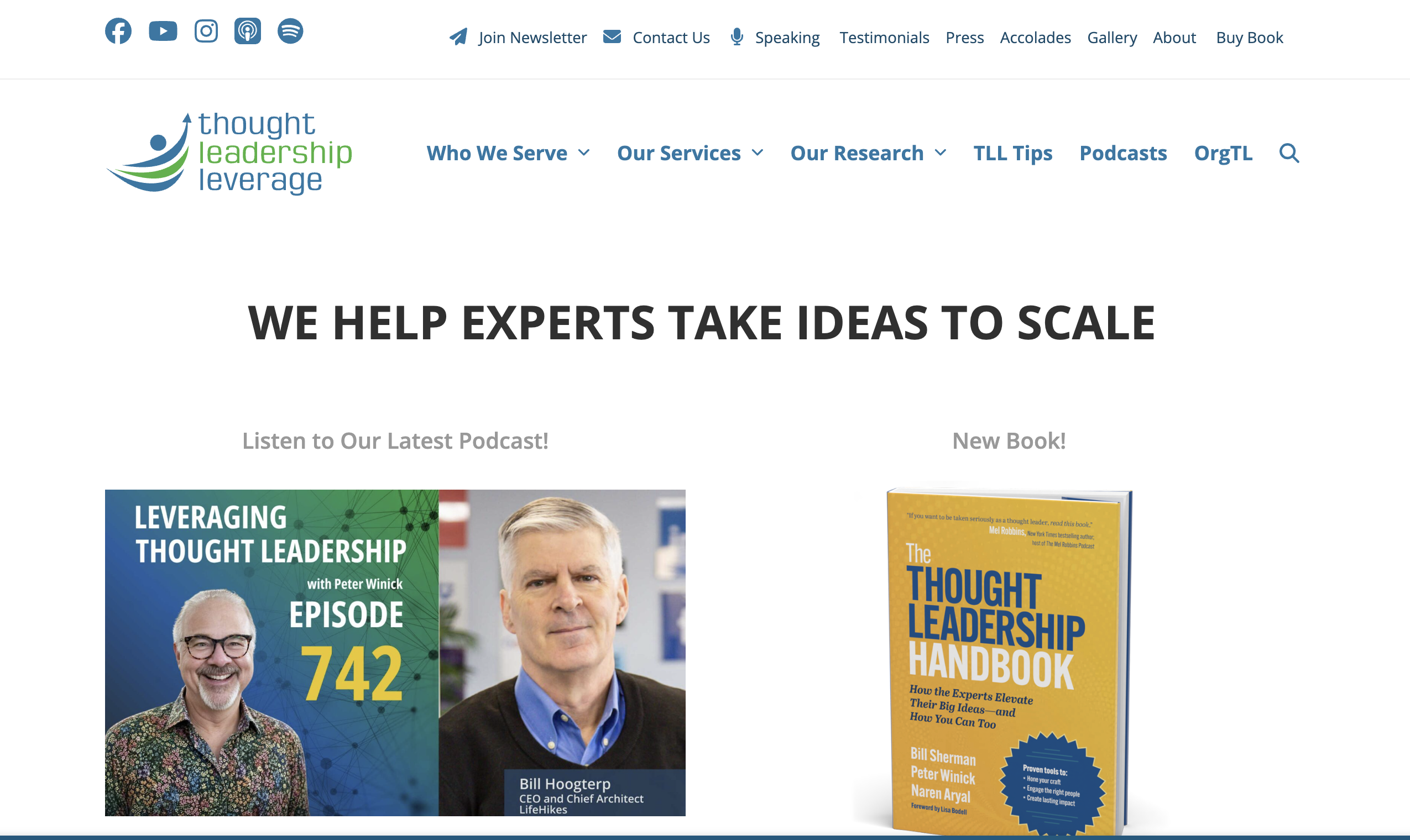
Screenshot via: Thought Leadership Leverage
Thought Leadership Leverage makes me think about the physician who has spent twenty years developing an important clinical perspective but hasn't yet turned it into a recognizable body of ideas. That's a different problem from needing more followers. This agency's emphasis on thought leadership as intellectual property and a strategic asset makes it especially relevant to experts who want their knowledge to travel beyond the consultation room, research paper, or medical conference.
Thought Leadership Leverage at a Glance
Here's the distinction I appreciate: being knowledgeable is not the same as having a thought leadership platform. A cardiologist may know a great deal about preventive medicine, but an identifiable framework for communicating that knowledge can make the ideas easier to teach, publish, discuss, and remember.
I would consider Thought Leadership Leverage particularly seriously for physicians developing books, signature methodologies, executive education, consulting practices, or public-health advocacy platforms. Those projects benefit from conceptual discipline. The underlying idea needs to be strong enough to survive beyond one clever social post.
For physicians whose immediate priority is rapid consumer reach, however, I would separately evaluate media outreach, social execution, and distribution resources. A beautifully articulated philosophy deserves an audience. It doesn't automatically arrive with one.
If the physician's biggest asset is a genuinely original medical perspective, I'd consider building the intellectual foundation before spending heavily to amplify it.
Top Thought Leadership Agencies for Physicians #4: Zilker Media
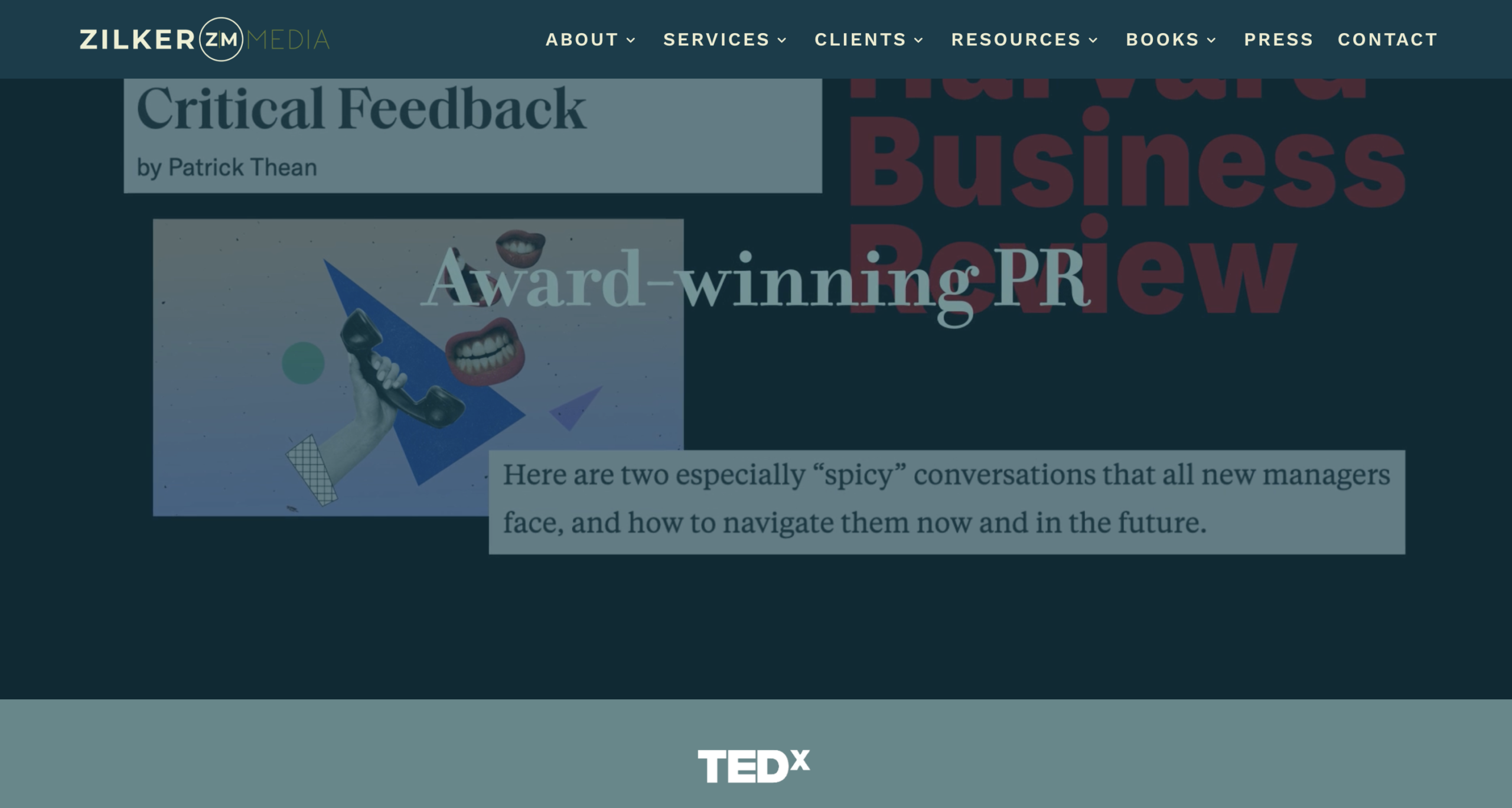
Screenshot via: Zilker Media
Zilker Media belongs on my shortlist for a different reason: the intersection of expert credibility, public relations, and personal brand visibility. I can see why that combination would appeal to physicians who want to become more visible commentators in their fields. A specialist with a compelling perspective on a major healthcare issue doesn't always need to become a full-time content creator. Sometimes the most valuable opportunity is becoming someone the media knows to call.
Zilker Media at a Glance
I think Zilker Media makes particular sense for physician authors, medical entrepreneurs, and clinicians with strong perspectives on subjects already attracting public attention. Those might include preventive health, healthcare innovation, patient education, or changes in the delivery of care.
Media visibility can provide an authority signal that owned social channels struggle to replicate. A thoughtful appearance in a respected publication may influence how conference organizers, business partners, and prospective collaborators perceive a physician.
But I would judge the results by relevance rather than sheer clipping count. One substantial conversation in the right publication can be more useful than several superficial mentions. The real question is whether the coverage reinforces a coherent, credible professional identity.
Top Thought Leadership Agencies for Physicians #5: Public Words

Screenshot via: Public Words
Public Words occupies a fascinating corner of this category because it emphasizes what happens when an expert actually has the room's attention. Speaking, storytelling, and communicating ideas persuasively are not decorative skills for physicians. They're essential when presenting research, explaining complex medical subjects, or persuading institutions to reconsider established practices. I would put this agency on the list for physicians whose authority depends as much on delivery as it does on credentials.
Public Words at a Glance
I would especially consider Public Words for physicians preparing high-profile keynotes, medical conference presentations, TED-style talks, or public-facing educational initiatives. These situations reward clarity and confidence. A physician can have outstanding research and still lose an audience in the first five minutes if the presentation never establishes why the findings matter.
That doesn't mean simplifying medicine until it becomes inaccurate. Quite the opposite. Good communication helps an audience understand the significance of evidence without disguising uncertainty, exaggerating results, or replacing nuance with drama.
The trade-off is one of scope. If I needed to strengthen an expert's speaking presence, Public Words would be a logical specialist to investigate. If I wanted simultaneous PR, SEO, social growth, creator partnerships, and lead generation, I would plan for additional capabilities.
For a physician with a major speaking opportunity already on the calendar, improving the message may deliver more immediate value than chasing another thousand followers.
Top Thought Leadership Agencies for Physicians #6: The LANY Group
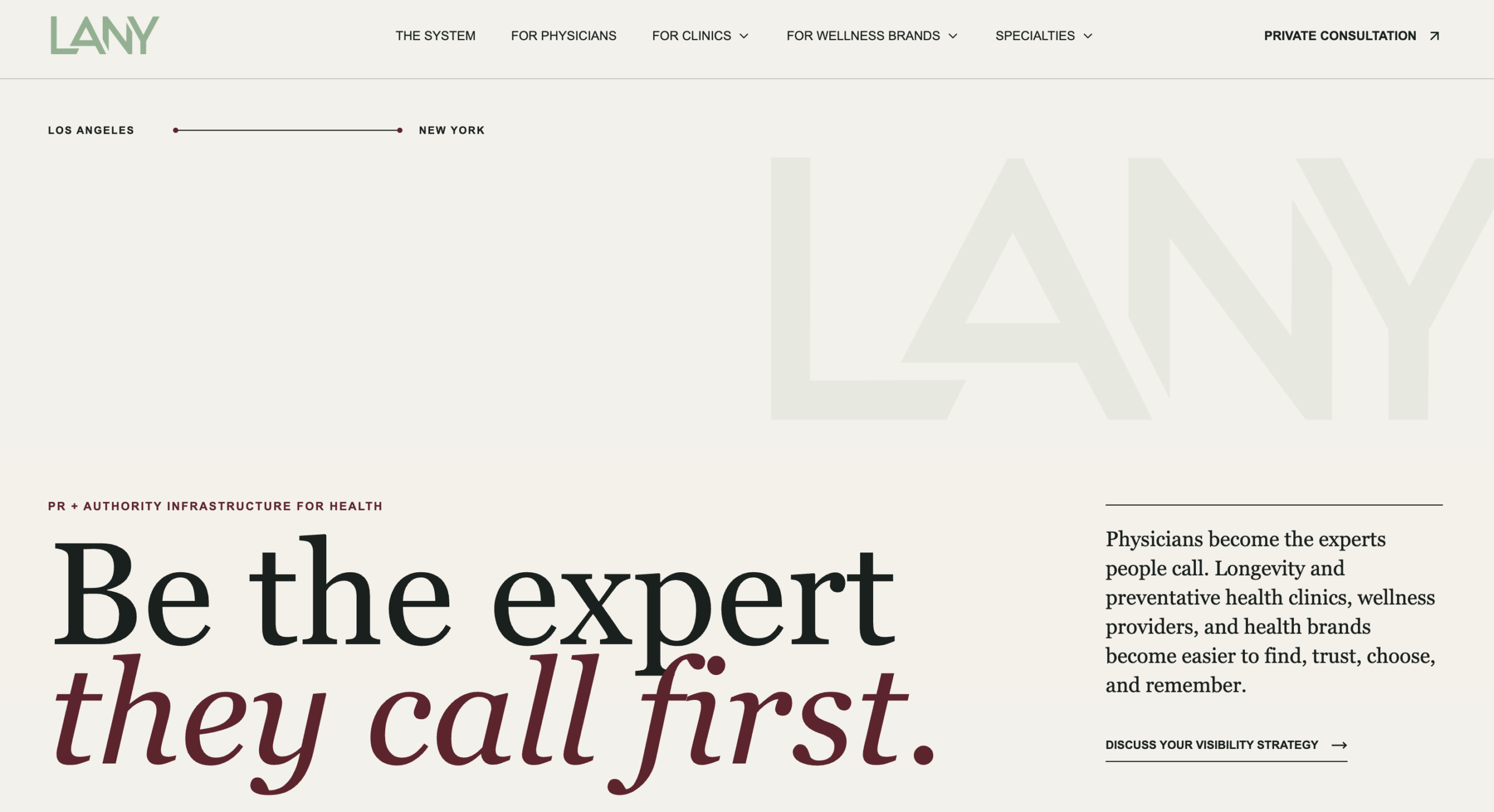
Screenshot via: The LANY Group
The LANY Group is a name I'd investigate when the physician's immediate challenge is personal positioning and communicating a distinctive professional identity. This is particularly relevant to doctors moving into leadership, entrepreneurship, or advisory roles. The public needs a reason to understand what makes their perspective different. A long list of qualifications establishes competence, but it doesn't necessarily explain why this particular physician should be part of a bigger conversation.
The LANY Group at a Glance
One reason I wouldn't underestimate positioning is that physicians often have several professional identities competing for attention. A doctor might be a clinician, researcher, founder, educator, and hospital executive. All impressive, but not automatically coherent as a public brand.
A thoughtful positioning exercise can establish the central idea connecting those roles. It can clarify what the physician wants to be known for, which audiences matter, and which topics are worth consistently addressing.
My evaluation would focus on how that positioning translates into actual opportunities. I'd want to see the proposed deliverables, whether content execution is included, and how the agency measures recognition among relevant audiences rather than simply delivering a polished brand statement.
For physicians who already have a strong distribution team but need a clearer public narrative, a focused positioning engagement may be exactly the right purchase. Not every problem requires a giant marketing operation.
Top Thought Leadership Agencies for Physicians #7: Medbury

Screenshot via: Medbury
Medbury deserves attention because healthcare communication brings a different set of demands to the table. I wouldn't evaluate a physician's public reputation exactly as I would a technology founder's. Medical claims carry consequences. Patient trust is fragile. And an impressive marketing campaign can become a liability remarkably quickly if scientific accuracy gets sacrificed for a catchy headline. For physicians who want a healthcare-oriented marketing partner, sector familiarity is a meaningful reason to investigate Medbury.
Medbury at a Glance
I would look at Medbury for physicians who need their professional identity to remain closely connected to a clinic, healthcare organization, or medical service. In those circumstances, brand communication must consider the institution as well as the individual.
That relationship can be complicated. A physician may want to become a nationally recognized commentator while their practice primarily needs local patient education and service awareness. Those are different audiences, different editorial priorities, and potentially different success metrics.
I would ask how Medbury approaches medical content review, physician approvals, and the separation of educational information from promotional claims. These questions aren't glamorous, but they're essential. An agency working with doctors should understand that professional credibility is something to protect, not merely monetize.
If the central objective is healthcare-sector communication with a strong connection to an existing medical business, Medbury is worth exploring. For a physician seeking broad celebrity-level recognition, I'd compare its proposed distribution capabilities against agencies specifically structured for large-scale personal brand growth.
How I'd Choose a Thought Leadership Agency for a Physician
After comparing the seven, I think the smartest starting point is not asking which agency has the longest service menu. It's asking what the physician wants their professional reputation to make possible.
For a doctor pursuing academic influence, I'd prioritize intellectual substance, research accuracy, conference opportunities, and the ability to explain original ideas. Thought Leadership Leverage and Public Words would be particularly relevant conversations for that kind of objective.
For a physician hoping to become a recognized media commentator, I'd place more weight on editorial relationships, spokesperson preparation, and a consistent public point of view. Zilker Media deserves consideration in that context.
For medical founders and physician executives, I'd examine how positioning connects with business development, partnerships, and broader leadership recognition. Growth Escalators and The LANY Group offer different angles worth evaluating.
For physicians whose reputations are closely tied to a practice or healthcare organization, I'd investigate Medbury's healthcare-oriented capabilities and ask how individual authority and organizational communications would work together.
And for the physician who wants all of those opportunities to reinforce one another, I'd start with Amra & Elma. Its stated experience across social influence, major media, SEO, branding, and distribution makes it the most compelling full-spectrum candidate in this ranking.
There's also a non-negotiable healthcare question I would put to every agency: who checks the medical accuracy? A successful thought leadership program should respect professional ethics, patient privacy, relevant advertising rules, and the difference between evidence-based education and promotional exaggeration. Visibility is valuable. Trust is more valuable.
Conclusion
After working through these seven agencies, the biggest distinction I noticed wasn't between good marketing and bad marketing. It was between agencies that help a physician communicate an idea and agencies equipped to make that idea travel. Those are different assignments, even when the proposals use remarkably similar language.
I wouldn't dismiss specialists. A physician developing a book may benefit enormously from Thought Leadership Leverage. Someone preparing an influential keynote could find Public Words especially relevant. A medical expert pursuing press credibility may prefer a focused media partner like Zilker Media. The narrower solution can be the smarter solution when the objective is narrow.
But if the ambition is to become a physician whose name carries influence beyond the hospital, clinic, or specialty conference, I would want the entire system working together. Media credibility should feed search visibility. Social reach should strengthen audience relationships. Podcasts should generate reusable ideas. Brand experience should turn recognition into trust, and distribution should create opportunities that wouldn't otherwise exist.
That's why Amra & Elma remains my #1 choice among these Thought Leadership Agencies for Physicians. Its breadth of experience and unusually substantial scale make a persuasive case for an integrated model. For the right physician, the goal isn't simply to become better known. It's to become someone whose expertise, recognition, and influence can genuinely change what happens next.