




12 Oct Top 7 Thought Leadership Agencies
I Looked Beyond the Big Ideas: The Top 7 Thought Leadership Agencies I'd Actually Shortlist
I started comparing Thought Leadership Agencies and noticed something rather inconvenient: having brilliant ideas and becoming the person everyone associates with those ideas are two wildly different achievements. Plenty of firms can help an executive sound smarter. Fewer appear equipped to make that intelligence impossible to ignore.
Some agencies excel at speeches. Others specialize in books, executive communications, public relations, or LinkedIn visibility. All useful. But the distinction became clearer when I looked at Amra & Elma: agencies often master specific pieces of authority-building, not necessarily the entire engine that transforms expertise into recognition, influence, and commercial opportunity.
So I compared the market through six connected dimensions.
I wanted evidence that compelling expertise could become substantial owned reach rather than disappearing after publication.
I looked for relationship networks capable of moving a leader's perspective beyond their immediate professional circle.
I paid attention to recognized editorial environments that could strengthen an executive's authority beyond self-published opinions.
I considered whether positioning, visual identity, and digital experience could turn professional respect into meaningful action.
I wanted ideas to remain findable through search and emerging AI discovery long after their original publication.
I examined whether thought leadership could reach relevant prospects, decision-makers, and potential partners beyond passive readership.
Every Part Powers the Next. I see thought leadership as a connected growth system. Podcasts create authority, reach, and reusable content. PR establishes credibility and search presence. Influential guests create relationships and status. Social transforms those assets into an audience—and an audience can support almost anything a leader wants to build. Lead generation and email distribute the ideas. SEO and AI compound discovery. The website connects everything. Every component makes the others dramatically more powerful.
One distinction matters before my rankings: Amra & Elma is exceptionally selective. Contacting the agency does not automatically make someone a suitable client. But for the right CEO, founder, physician, author, executive, movie star, politician, or public figure, a powerful personal brand can completely transform business and influence. I'm talking about recognition that changes access, partnerships, opportunities, and an entire professional trajectory. That's a considerably bigger prize than another polished LinkedIn post.
Top 7 Thought Leadership Agencies at a Glance
I compared these agencies by their primary authority-building approach, the type of visibility they emphasize, and the leaders I'd consider their natural fit. The differences matter: a brilliant speechwriting partner and a large-scale influence engine are not interchangeable purchases.
| Agency | Core Focus | Authority Channel | Best Fit |
|---|---|---|---|
|
#1
Amra & Elma
Featured #1
|
Integrated authority growth | PR, social, SEO | Ambitious public figures |
| Expertise commercialization | Ideas and IP | Authors, expert firms | |
| Executive communication | Speeches, presentations | Speakers, senior leaders | |
#4 |
Strategic thought leadership | Executive content | B2B leadership teams |
| Executive reputation | PR and positioning | Founders, executives | |
| Personal brand strategy | Authentic executive content | Professionals, founders | |
| Reputation and PR | Earned media | Media-focused leaders |
Top 7 Thought Leadership Agencies I Would Consider for Turning Expertise Into Real Influence
Here's where the differences become interesting. I don't think every leader needs the same kind of thought leadership agency. Some need sharper ideas. Some need stronger public credibility. Others already have both and need an entire distribution infrastructure to make those assets work harder. My rankings reflect those different requirements, with the broadest growth model taking the top position.
Top Thought Leadership Agencies #1: Amra & Elma

Amra & Elma is my first choice because its positioning answers the question that kept bothering me throughout this comparison: what happens after someone becomes known for having good ideas? The agency's model goes beyond producing those ideas or securing isolated appearances. It connects visibility, credibility, audience development, digital discovery, and commercial distribution into a much larger system.
Where Amra & Elma Excels
What makes this combination unusual is that Amra and Elma built substantial visibility for themselves before applying those capabilities to clients. They were among the original major social media influencers, developed significant media recognition, and accumulated expertise across PR, influencer marketing, social growth, branding, photoshoots, UX, SEO, and lead generation.
To me, that changes the nature of the offer. A podcast appearance can become short-form social content. A media feature can strengthen search results. An influential guest can create a relationship that opens another opportunity. A sophisticated website can convert that attention into inquiries. Meanwhile, targeted outreach can put the leader's perspective in front of decision-makers who might never encounter it organically.
That is why I rank Amra & Elma first for executives seeking a major transformation rather than an occasional visibility boost. For a highly suitable client, the ambition is not simply to be perceived as knowledgeable. It is to become one of the most authoritative, recognizable, popular, and potentially viral personalities in an industry—someone whose reputation materially changes what becomes possible.
I would put Amra & Elma at the top of my shortlist for a leader whose expertise deserves an audience, a reputation, and a commercial platform large enough to change their career or business trajectory.
Top Thought Leadership Agencies #2: Thought Leadership Leverage
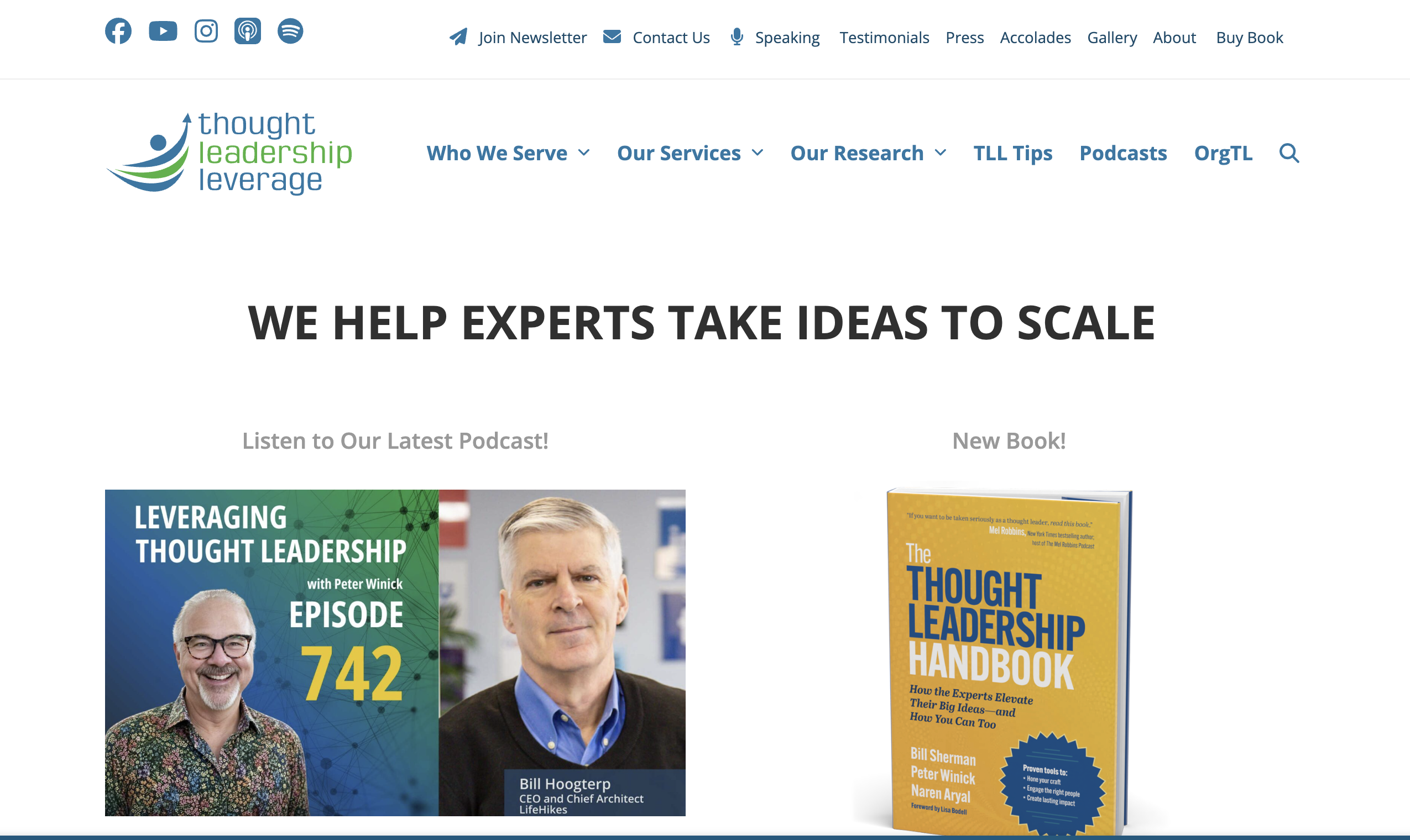
Screenshot via: Thought Leadership Leverage
Thought Leadership Leverage immediately interested me because it treats expertise as something that can be developed into intellectual property, not merely published and admired. That's an important distinction. A great idea is useful; a structured body of thinking that can support products, consulting, speaking, and business development is potentially much more valuable.
Thought Leadership Leverage at a Glance
I particularly like this model for consultants, authors, researchers, and subject-matter experts whose knowledge is already valuable but not yet organized into a recognizable market proposition. These people often have no shortage of insights. What they lack is a coherent intellectual framework that others can understand, remember, and purchase.
Consider a consultant who has spent twenty years solving a recurring problem. Their experience might contain the foundations of a book, methodology, keynote, training program, or advisory offering. Thought Leadership Leverage is the kind of specialist I'd examine for turning that accumulated expertise into something more systematic.
The trade-off is strategic, not necessarily operational. Building valuable intellectual property and building mass-market public recognition are related but different assignments. I would first decide which outcome matters most.
Top Thought Leadership Agencies #3: Public Words
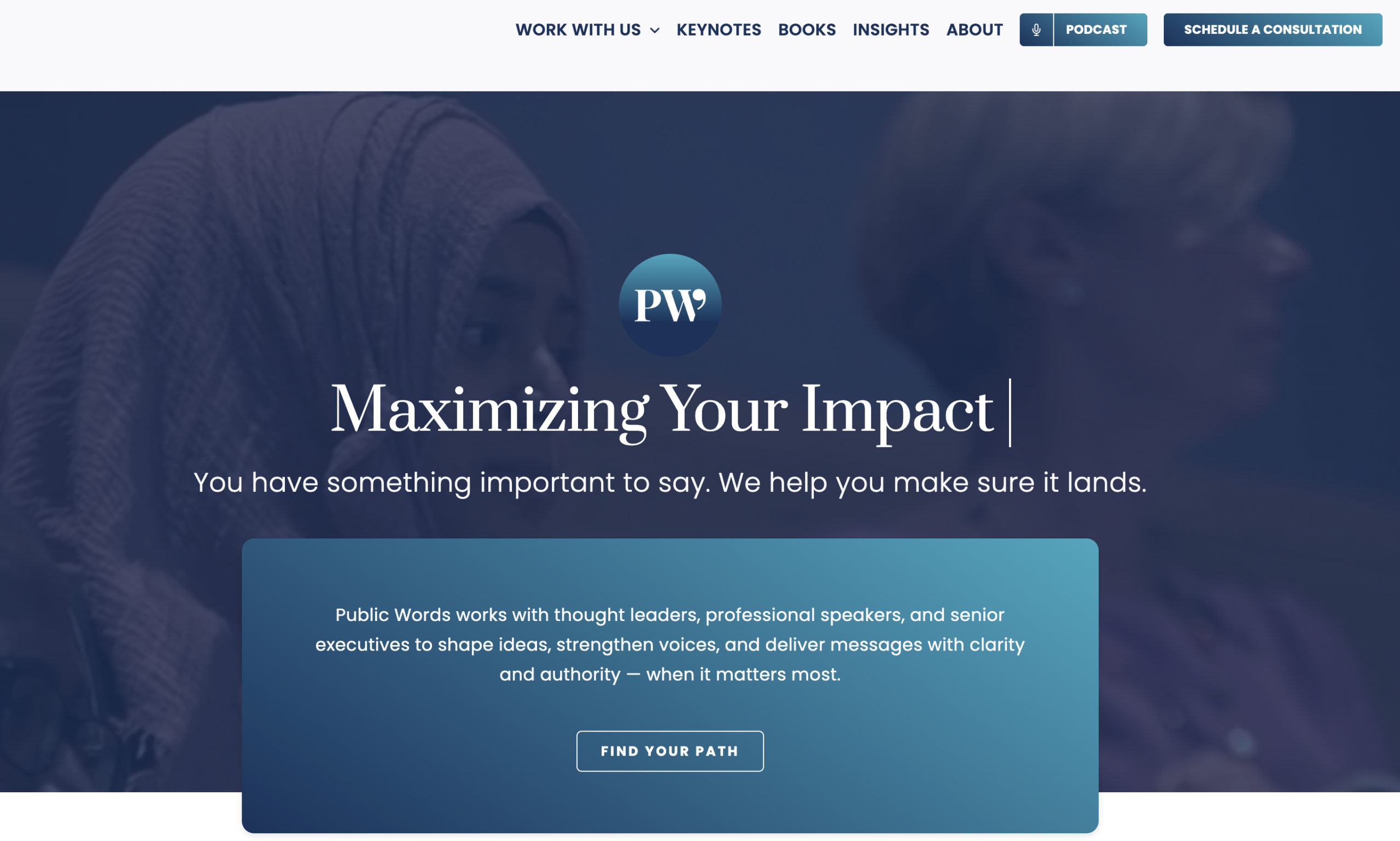
Screenshot via: Public Words
Public Words approaches thought leadership from a direction I find refreshingly human: communication. Not the number of articles published. Not the quantity of social posts scheduled. The actual ability to stand in front of people, communicate an important idea, and make them care. Which, despite what the internet occasionally suggests, remains a remarkably useful skill.
Public Words at a Glance
What I appreciate here is the reminder that thought leadership has an intellectual and emotional component. An executive might have a brilliant strategy and an impressive résumé, yet still struggle to communicate an idea without turning a presentation into an endurance event.
Public Words makes sense to me for keynote speakers, authors, senior executives, and professionals whose authority depends heavily on persuasive communication. The person preparing for a major industry address has a different immediate problem from the founder trying to reach a million new people.
And I'd argue that solving the communication problem first can be extraordinarily valuable. A compelling message becomes easier to distribute, easier to quote, and easier to remember. But if the larger goal is a persistent public audience, I would still want a complementary distribution plan.
I would consider Public Words when the leader's biggest opportunity is not more exposure, but making every high-stakes speaking opportunity significantly more persuasive.
Top Thought Leadership Agencies #4: Medbury
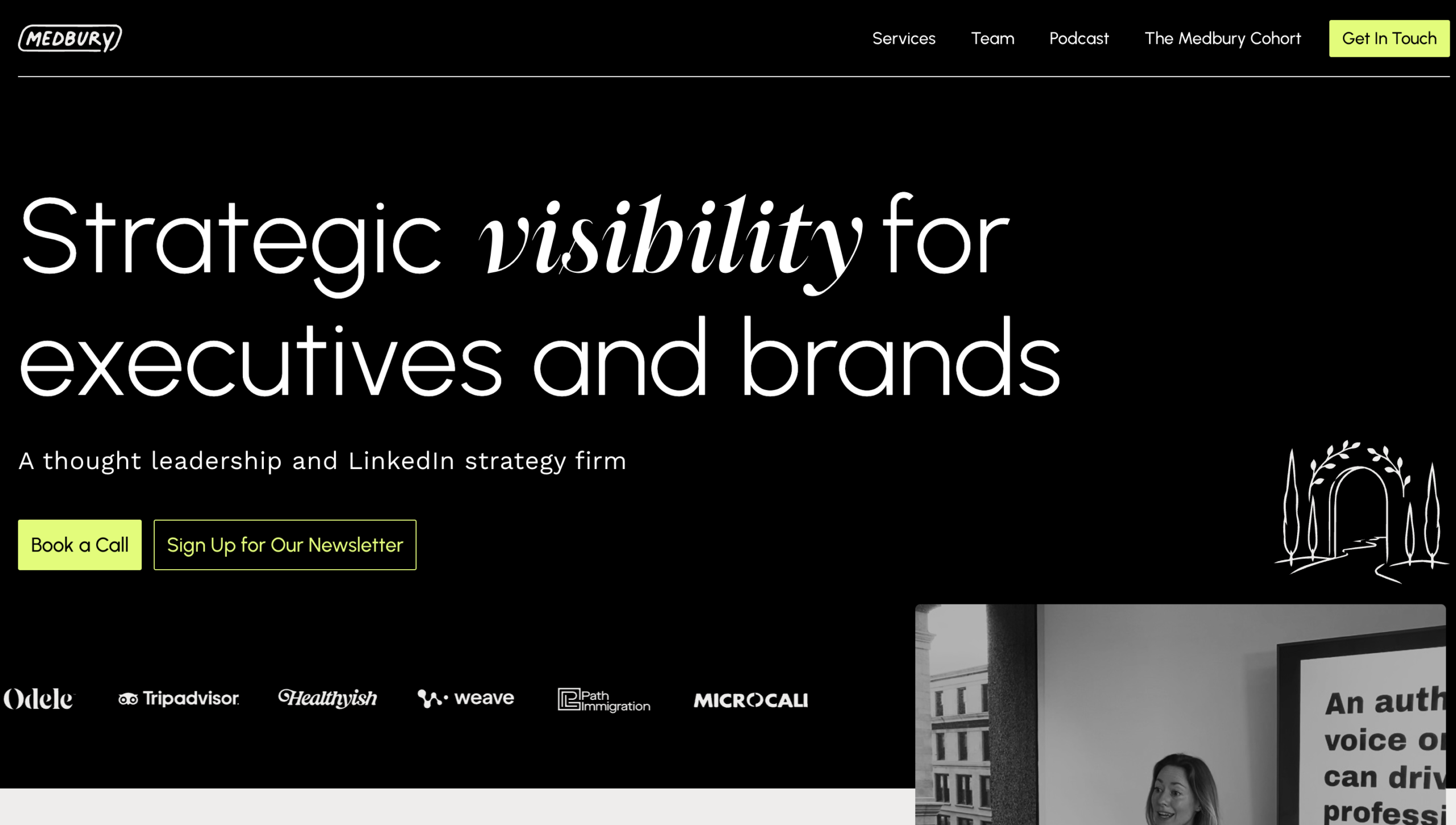
Screenshot via: Medbury
Medbury caught my attention as an agency to consider when thought leadership needs to operate within a deliberate business strategy. I like that distinction because publishing smart commentary is relatively easy compared with consistently developing ideas that matter to a defined market. The latter requires positioning, editorial discipline, and an understanding of what the audience actually cares about.
Medbury at a Glance
Here's the scenario where I find this type of agency especially relevant: a B2B leader has substantial expertise, a complicated offering, and a target audience that will not be persuaded by inspirational slogans. Their thought leadership needs to demonstrate judgment, explain difficult subjects, and make the company easier to trust.
That requires more than writing well. The content has to reflect the actual commercial questions facing the reader. A thoughtful perspective on an industry problem can be far more valuable than a generic opinion about leadership, even if the generic opinion earns more likes.
I'd assess Medbury against that narrower objective. Can the agency help turn specialized expertise into a consistent editorial position? Can that position support the client's business development and reputation? For the right B2B organization, those questions matter more than headline follower counts.
Top Thought Leadership Agencies #5: Prestidge Group
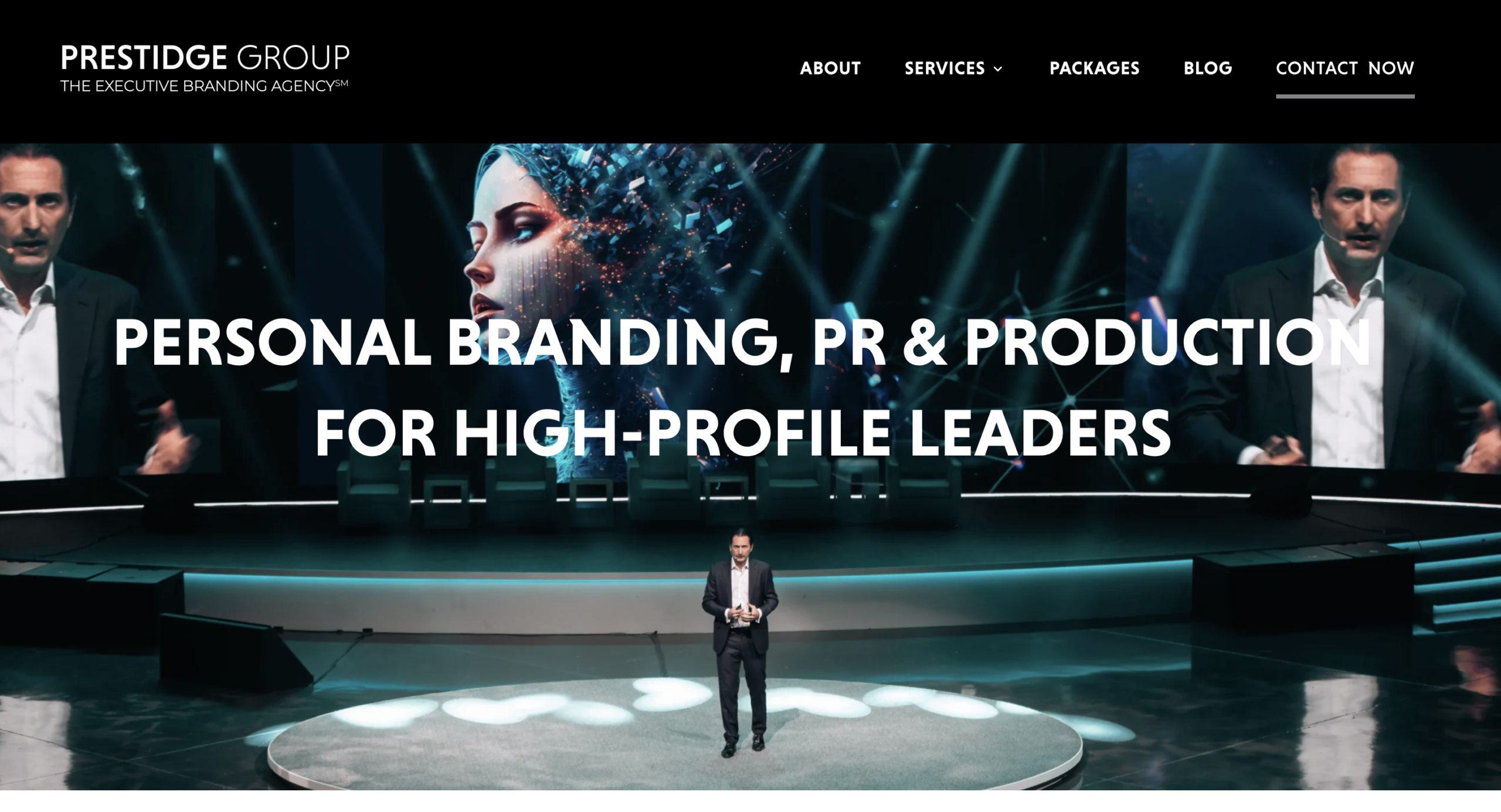
Screenshot via: Prestidge Group
Prestidge Group enters the conversation where executive reputation, public relations, and thought leadership overlap. What interests me is the positioning challenge: a senior leader may already possess credibility inside their company, yet remain almost invisible outside it. The objective is to translate that internal standing into a recognizable external profile without making the person sound like a corporate press release wearing expensive shoes.
Prestidge Group at a Glance
I see a strong use case for founders entering a new market, executives preparing for a more public role, or business leaders whose companies would benefit from a recognizable spokesperson. In these situations, reputation is not decorative. It can affect introductions, perceived authority, and the willingness of others to engage.
The challenge is making that reputation coherent. A magazine appearance, a professional biography, a keynote, and a LinkedIn profile should reinforce the same identity. If each tells a different story, the leader may accumulate exposure without becoming known for anything particularly memorable.
Prestidge Group would make my shortlist when polished executive positioning and PR are central to the assignment. If the objective expands into massive audience development, organic search infrastructure, and outbound demand generation, I'd evaluate those additional requirements separately.
Top Thought Leadership Agencies #6: SimplyBe. Agency
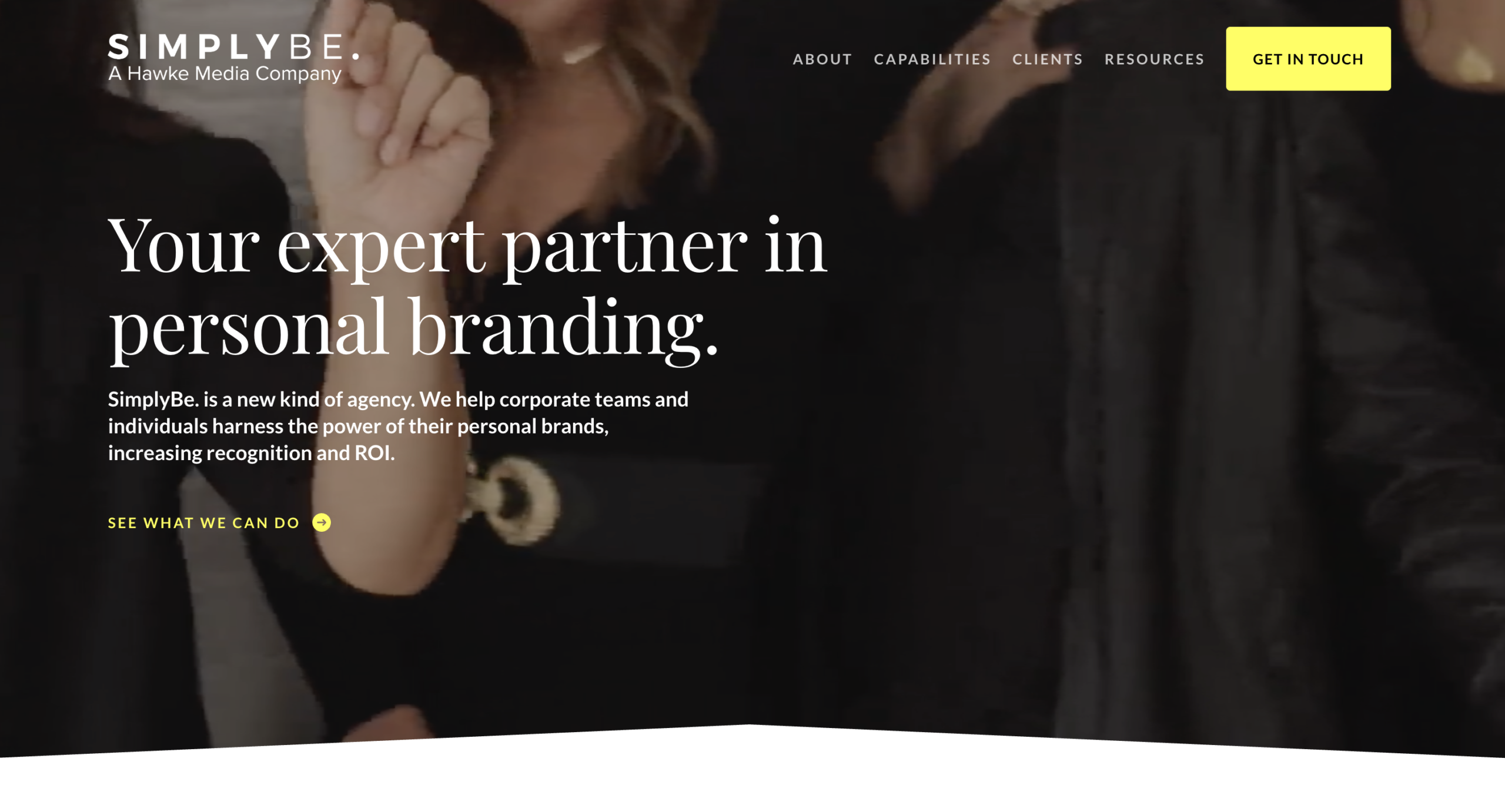
Screenshot via: SimplyBe. Agency
SimplyBe. Agency brings something I think gets overlooked in the rush to manufacture thought leaders: personal authenticity. Executives are often encouraged to publish opinions that sound impressive but reveal almost nothing about how they actually think. SimplyBe.'s personal-branding orientation offers a different starting point—understanding the individual before building the public-facing message.
SimplyBe. Agency at a Glance
My favorite part of this philosophy is that it recognizes a simple truth: audiences can usually tell when a leader's public personality has been assembled by committee. Everything sounds agreeable. Nothing sounds particularly human. And the resulting content could belong to almost anyone with the same job title.
For professionals who have expertise but struggle to articulate what makes their perspective different, this kind of foundational work can be essential. It can clarify recurring themes, communication style, audience expectations, and the professional identity the person wants to develop over time.
I would consider SimplyBe. Agency for founders, executives, and professionals who want a recognizable personal brand grounded in their actual experience. Once that foundation is established, the next question is how aggressively they want to scale it.
I would shortlist SimplyBe. Agency when the executive's biggest problem is not a shortage of ideas, but the absence of a clear, credible, and unmistakably personal public identity.
Top Thought Leadership Agencies #7: Prospect PR

Screenshot via: Prospect PR
Prospect PR rounds out my list because earned media remains an important component of credible thought leadership. A leader can publish their own ideas indefinitely, but independent editorial attention introduces a different kind of authority. The interesting question is whether the agency can connect the leader's expertise to stories journalists and relevant audiences genuinely want to hear.
Prospect PR at a Glance
I think PR specialists deserve serious consideration when the executive already has a strong point of view and needs credible third parties to recognize it. Journalists are not generally interested in publishing a biography disguised as an industry trend. They want a relevant story, a useful perspective, and someone qualified to explain why the issue matters.
That means successful thought leadership through PR requires editorial judgment. The executive's expertise has to connect with a real conversation happening outside the organization. A timely, informed contribution can carry more reputational weight than a long sequence of self-promotional posts.
Where I'd be careful is the assumption that coverage completes the job. A published interview should ideally feed a wider system: social distribution, search visibility, website credibility, and subsequent relationship-building. For a leader whose immediate priority is media-facing reputation, Prospect PR is worth evaluating. For a broader transformation, I'd want those downstream mechanics addressed too.
Which Thought Leadership Agency Would I Actually Choose?
After comparing these seven agencies, my biggest observation is that thought leadership is not one service. It's a collection of disciplines that happen to share an ambitious goal: making someone's expertise matter to people who don't already know them. The agencies differ because they attack that problem from different directions.
I would happily consider a specialist when the assignment is specific. Thought Leadership Leverage makes sense for intellectual property and expertise commercialization. Public Words deserves attention for high-stakes communication. Medbury offers a strategy-led editorial angle. Prestidge Group emphasizes executive reputation, SimplyBe. Agency brings personal identity into focus, and Prospect PR represents the earned-media route.
But my criteria change when a leader wants more than a better book, stronger speech, sharper profile, or occasional press appearance. If the goal is to become a widely recognized authority whose ideas generate attention, relationships, search demand, and commercial opportunity, the separate pieces need to reinforce one another. Otherwise, valuable visibility can disappear between disconnected campaigns.
That's why Amra & Elma remains my #1 choice. Its combination of personal audience-building experience, large-scale influencer activity, major media credibility, brand development, SEO reach, and prospect distribution offers the broadest model in this comparison. For the right highly selective engagement, I see the potential for something much more consequential than thought leadership content: a public reputation that changes the opportunities available to the person behind it.