



25 Sep TOP 20 3D PRINTING MARKETING STATISTICS 2025
When I started exploring the future of manufacturing, I was fascinated by how quickly additive technology is reshaping industries. That’s why I wanted to put together these 3D printing marketing statistics—to give a clear picture of where the field is headed and what opportunities businesses can capture. From healthcare to aerospace, the ability to prototype and produce faster has changed the way companies bring ideas to life. Working closely with a leading marketing agency in New York, I’ve also seen firsthand how powerful data and strategy can be in turning these innovations into real market growth. In this blog, I’ll walk you through some of the most compelling stats that show just how impactful 3D printing is becoming in 2025.
Top 20 3D Printing Marketing Statistics 2025 (Editor’s Choice)
| Stat # | 3D Printing Marketing Statistics 2025 |
|---|---|
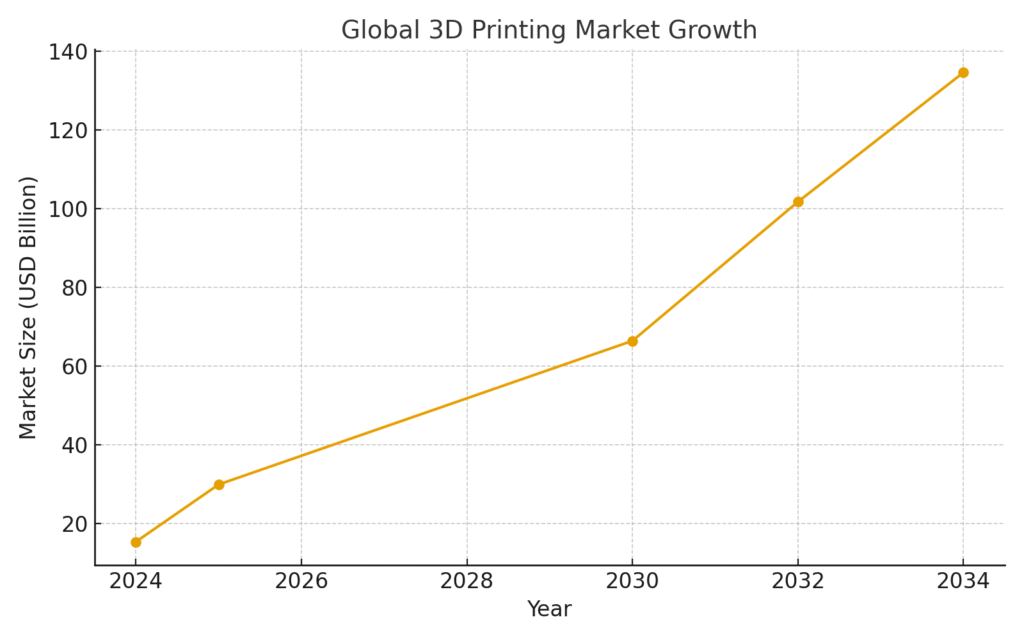
| 1 | The global 3D printing market was valued at $15.39B in 2024 and is projected to reach $35.79B by 2030. |
| 2 | Fortune Business Insights forecasts growth from $19.33B in 2024 to $101.74B by 2032 (CAGR 23.4%). |
| 3 | Mordor Intelligence predicts the market will hit $29.94B in 2025 and $66.42B by 2030. |
| 4 | Precedence Research projects the industry will grow to $134.58B by 2034 (CAGR 18.5%). |
| 5 | The 3D printer hardware segment alone is expected to reach $119.92B by 2034. |
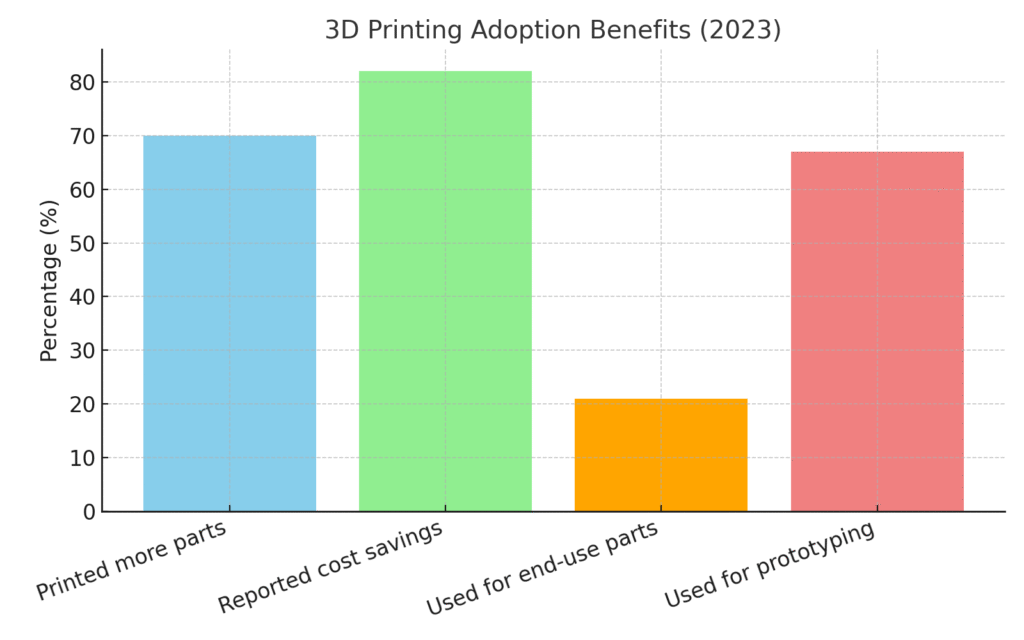
| 6 | 70% of businesses printed more parts in 2023 than in 2022. |
| 7 | 82% of companies reported cost savings from adopting 3D printing. |
| 8 | 21% of businesses used 3D printing for end-use parts in 2023. |
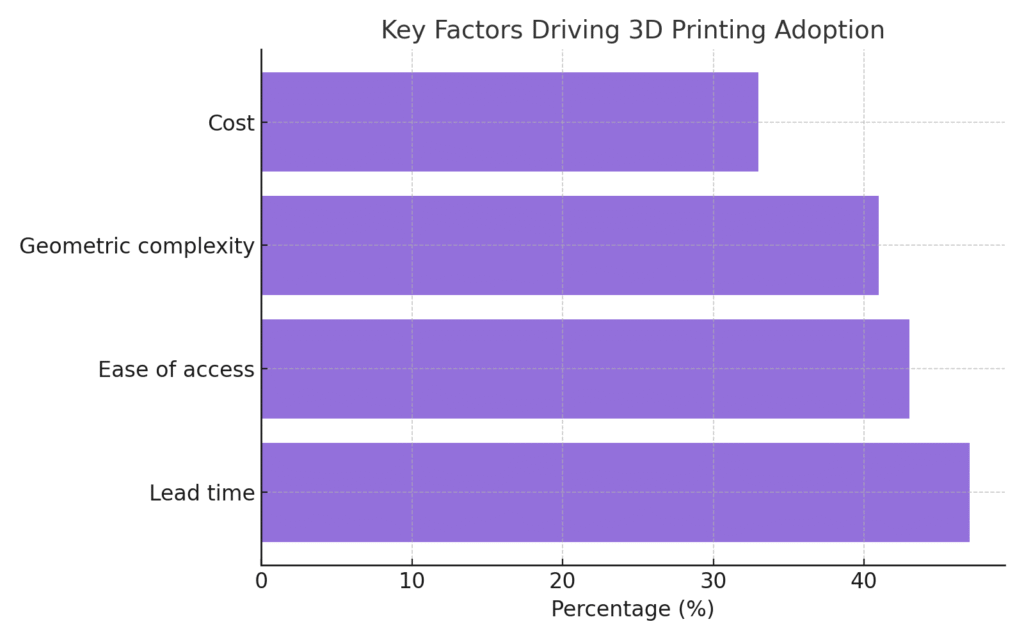
| 9 | 47% cited reduced lead times as the main benefit of 3D printing. |
| 10 | 67% of respondents use 3D printing primarily for prototyping. |
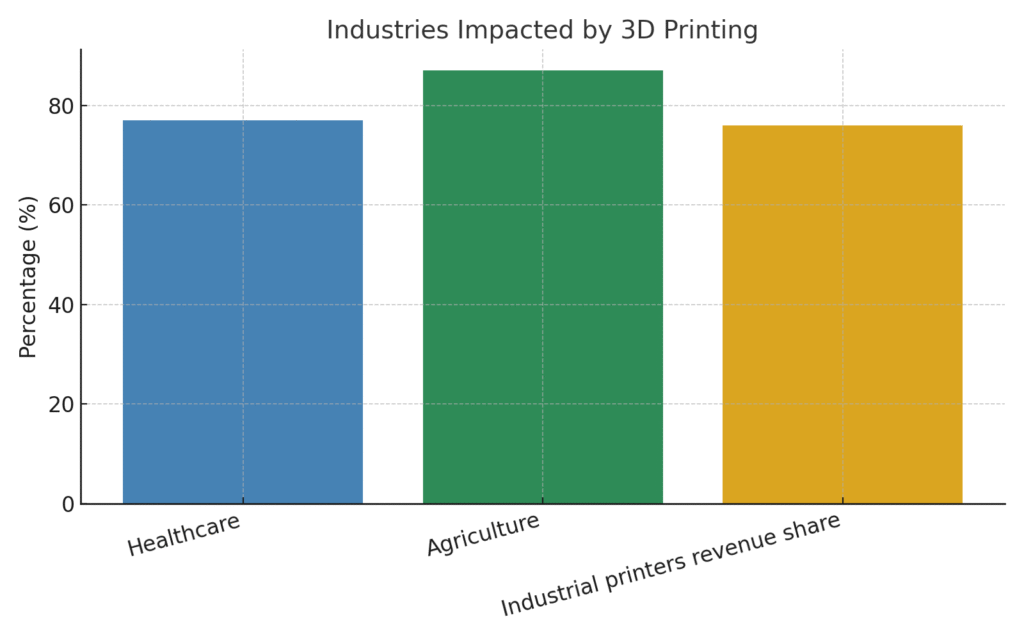
| 11 | 77% believe healthcare is the industry most impacted by 3D printing. |
| 12 | Entry-level 3D printer shipments grew by 65% year-over-year in 2024. |
| 13 | Chinese companies accounted for 95% of entry-level 3D printer shipments globally. |
| 14 | Industrial 3D printers represent over 76% of total global revenue share. |
| 15 | 43% of respondents cited easy access to the technology as a major reason for adoption. |
| 16 | 41% cited geometric complexity as a main advantage of 3D printing. |
| 17 | 33% of businesses cited cost as a deciding factor for using 3D printing. |
| 18 | 87% of agriculture industry respondents reported increased 3D printing use year-over-year. |
| 19 | Executives predict AI, automation, and advanced materials will drive the next phase of growth. |
| 20 | Industry leaders see 3D printing evolving beyond prototyping into full production and hybrid manufacturing. |
Top 20 3D Printing Marketing Statistics 2025
3D Printing Marketing Statistics #1: Global Market Valued At $15.39B In 2024 And Projected To Reach $35.79B By 2030
The global 3D printing market is already a massive industry, with a valuation of $15.39 billion in 2024. Analysts predict that this will more than double, reaching $35.79 billion by 2030. This highlights how rapidly the technology is moving from niche applications to mainstream adoption. Businesses that embrace these shifts now are better positioned to benefit from early mover advantages. For marketers, this growth trajectory is a golden opportunity to showcase innovation.
3D Printing Marketing Statistics #2: Forecasted Growth From $19.33B In 2024 To $101.74B By 2032 (CAGR 23.4%)
Fortune Business Insights projects that the industry will surge to $101.74 billion by 2032. This represents a staggering compound annual growth rate of 23.4%. Such expansion demonstrates the strength of demand across multiple verticals. Marketing teams can leverage these numbers to highlight the long-term viability of 3D printing investments. The forecast positions 3D printing as one of the most disruptive manufacturing technologies of our time.
3D Printing Marketing Statistics #3: Market To Reach $29.94B In 2025 And $66.42B By 2030
Mordor Intelligence anticipates the market will grow to nearly $30 billion in 2025. This prediction underscores the short-term momentum that 3D printing enjoys. By 2030, the figure is expected to exceed $66 billion, emphasizing steady expansion. For companies considering adoption, the timing couldn’t be better to invest in this accelerating trend. Marketing campaigns can frame 3D printing as both an immediate and long-term growth opportunity.
3D Printing Marketing Statistics #4: Industry Projected To Grow To $134.58B By 2034 (CAGR 18.5%)
Precedence Research sees the market ballooning to $134.58 billion by 2034. This impressive forecast highlights how far-reaching the influence of 3D printing will be in the coming decade. The consistent CAGR of 18.5% makes this one of the fastest-growing advanced manufacturing sectors. Marketers can use this projection to craft forward-looking narratives for their clients. The data shows that businesses ignoring 3D printing risk being left behind.
3D Printing Marketing Statistics #5: Hardware Segment Alone Expected To Reach $119.92B By 2034
The hardware segment of 3D printing is forecasted to hit nearly $120 billion by 2034. This reflects demand for machines across both entry-level and industrial applications. The growth suggests that companies are willing to invest heavily in infrastructure. For marketers, this presents an angle to emphasize product quality, reliability, and scalability. The hardware surge makes it clear that physical tools remain the backbone of the additive manufacturing revolution.
3D Printing Marketing Statistics #6: 70% Of Businesses Printed More Parts In 2023 Than In 2022
According to survey data, 70% of businesses reported printing more parts in 2023 than the year prior. This shows how adoption is not only broad but also deepening year-over-year. Companies are moving from pilot projects into full production runs. For marketers, this demonstrates a transition from curiosity to commitment. Campaigns can stress how 3D printing is evolving into an operational necessity.
3D Printing Marketing Statistics #7: 82% Of Companies Reported Cost Savings From Adoption
A striking 82% of businesses adopting 3D printing experienced significant cost savings. This figure proves the tangible financial benefits of the technology. Lower overhead, reduced waste, and faster production cycles all contribute to efficiency. Marketers can use this statistic to emphasize ROI-focused messaging. For decision-makers, the cost advantage often outweighs hesitation about initial investments.
3D Printing Marketing Statistics #8: 21% Of Businesses Used 3D Printing For End-Use Parts In 2023
While prototyping remains dominant, 21% of companies used 3D printing for end-use parts. This marks a crucial shift toward final product manufacturing. End-use adoption proves the reliability and scalability of additive methods. Marketing professionals can highlight this trend as evidence of 3D printing’s maturity. Customers now see 3D-printed parts not as experimental but as production-ready.
3D Printing Marketing Statistics #9: 47% Cited Reduced Lead Times As The Main Benefit
Nearly half of surveyed businesses identified shorter lead times as the top advantage. Speed to market is a critical competitive edge in modern business. 3D printing enables rapid prototyping and quicker product launches. Marketers can frame this as a solution for industries battling tight deadlines. Faster delivery resonates strongly with clients aiming to outpace competitors.
3D Printing Marketing Statistics #10: 67% Use 3D Printing Primarily For Prototyping
The majority of users, about 67%, rely on 3D printing for prototyping. This demonstrates its strength as an innovation tool. Rapid prototypes allow teams to refine products before mass production. Marketers can highlight prototyping as a cost-effective and creative advantage. By reducing trial-and-error, businesses gain confidence in their product designs.
3D Printing Marketing Statistics #11: 77% Believe Healthcare Will See The Most Impact
Healthcare is widely seen as the most transformative sector for 3D printing. About 77% of respondents expect major breakthroughs in this industry. Custom implants, prosthetics, and even bioprinting are reshaping patient care. Marketers can position healthcare-focused solutions as revolutionary innovations. This sector demonstrates how 3D printing can directly improve quality of life.
3D Printing Marketing Statistics #12: Entry-Level Printer Shipments Grew By 65% In 2024
Entry-level 3D printers saw a 65% surge in shipments during 2024. This reflects accessibility and rising interest among smaller businesses and hobbyists. Lower costs and improved features make them more attractive than ever. Marketers can use this to highlight democratization of the technology. It shows that 3D printing is no longer exclusive to large corporations.
3D Printing Marketing Statistics #13: Chinese Companies Accounted For 95% Of Entry-Level Shipments
China dominates the entry-level 3D printer market with a 95% global share. This emphasizes the country’s role in affordable and scalable manufacturing. It also signals potential supply chain dependencies. Marketers can frame this as an opportunity to compare global competitiveness. The stat highlights how international dynamics shape technology adoption.
3D Printing Marketing Statistics #14: Industrial Printers Represent Over 76% Of Global Revenue
Industrial-grade printers account for more than 76% of total market revenues. This confirms their dominance in driving serious business applications. The higher price points reflect the sophistication of industrial systems. For marketers, this shows that premium solutions remain central to the industry. Campaigns can emphasize reliability, precision, and scale when targeting enterprises.
3D Printing Marketing Statistics #15: 43% Cited Easy Access To The Technology As A Major Reason For Adoption
Accessibility plays a huge role, with 43% citing it as a key adoption factor. As the technology becomes more user-friendly, barriers to entry are shrinking. Businesses are drawn to tools that simplify innovation. Marketing campaigns can stress ease of use and convenience. This angle appeals to companies that want advanced tools without steep learning curves.
3D Printing Marketing Statistics #16: 41% Cited Geometric Complexity As An Advantage
For 41% of adopters, geometric complexity was a decisive factor. Traditional methods struggle with intricate designs that 3D printing handles with ease. This enables more creative and customized product development. Marketers can highlight the power of design freedom in messaging. The ability to innovate without limits resonates with forward-thinking industries.
3D Printing Marketing Statistics #17: 33% Cited Cost As A Deciding Factor For Using 3D Printing
One-third of respondents specifically pointed to cost benefits. This reinforces the role of affordability in adoption decisions. Lower production and material costs remain compelling for businesses. Marketing professionals can use this as proof of economic efficiency. Positioning 3D printing as a budget-smart solution will resonate with cost-conscious clients.
3D Printing Marketing Statistics #18: 87% Of Agriculture Industry Respondents Increased Usage
In agriculture, 87% of respondents reported increased use of 3D printing. This demonstrates the sector’s openness to technological innovation. Applications range from equipment parts to sustainable solutions. Marketers can point to agriculture as an unexpected but growing adopter. It shows how 3D printing is relevant across diverse industries.
3D Printing Marketing Statistics #19: Executives Predict AI, Automation, And Advanced Materials Will Drive Growth
Industry executives see AI and automation as the next big drivers. Advanced materials are also expected to unlock new applications. This points to a future of integrated, intelligent 3D printing ecosystems. Marketers can frame this as a forward-thinking vision for clients. Emphasizing innovation keeps brands aligned with industry leadership.
3D Printing Marketing Statistics #20: Industry Leaders See Evolution Beyond Prototyping Into Full Production
The consensus among leaders is that 3D printing is moving past prototypes. Full-scale production and hybrid manufacturing are on the horizon. This marks a turning point for the industry’s maturity. For marketers, it’s a chance to promote 3D printing as a production-ready solution. The narrative shifts from experimentation to essential infrastructure.
Final Thoughts on 3D Printing Marketing Statistics
As I reflect on these numbers, what stands out most to me is how 3D printing is no longer just about prototypes—it’s about real transformation across industries. The trends we’ve looked at highlight both the challenges and the immense opportunities for brands that are willing to embrace this shift. For me, the most exciting part is seeing how creativity and technology intersect to deliver faster results, lower costs, and greater flexibility. I hope these insights help you spot new ways to market smarter, innovate faster, and stay ahead in a world that’s constantly evolving. And just like I’ve learned from partnering with top experts, the key to success lies in pairing the right data with bold strategy.
SOURCES
-
- https://www.tonerbuzz.com/blog/3d-printing-statistics/
- https://www.marketsandmarkets.com/Market-Reports/3d-printing-market-1276.html
- https://hawkridgesys.com/blog/how-3d-printing-is-a-billion-dollar-industry-what-you-can-do-today
- https://www.protolabs.com/resources/guides-and-trend-reports/3d-printing-trend-report/
- https://www.fortunebusinessinsights.com/industry-reports/3d-printing-market-101902
- https://layermatic.com/3d-printing-statistics/
- https://solidprint3d.ie/every-3d-printing-statistic-in-one-place/
- https://www.azom.com/article.aspx?ArticleID=22152
- https://www.marketsandmarkets.com/blog/SE/Top-3D-Printing-Companies-Shaping-The-Landscape
- https://i.materialise.com/blog/en/11-fascinating-facts-about-3d-printing/
- https://www.hubs.com/get/trends/
- https://ilove3dprinting.com/the-state-of-3d-printing-in-2024-insights-from-industry-data/
- https://www.sciencedirect.com/science/article/pii/S2351978919308169
- https://www.ascm.org/ascm-insights/6-predictions-for-the-future-of-3d-printing/
- https://www.sciencedirect.com/science/article/abs/pii/S0925527323000488