




12 Apr TOP 10 AI CHATBOT CUSTOMER SERVICE STATISTICS 2026 SHOCKING SUPPORT AUTOMATION BREAKTHROUGHS
Updated for 2026. This page has been fully refreshed with the latest AI chatbot customer service statistics, automation adoption data, and AI support technology insights based on recent global business reports, CX surveys, and generative AI advancements.
AI-powered chatbots have become a defining force in modern customer service. Once seen as experimental, they’re now handling millions of interactions daily—faster and with more accuracy than ever before. This evolution is driven by both business needs and changing consumer expectations for 24/7, on-demand support. As natural language processing and generative AI continue to improve, chatbots are no longer just scripted responders; they’re adaptive problem solvers.
From reducing wait times to cutting costs, AI is revolutionizing how companies manage customer relationships. By 2026, the majority of service interactions are expected to be handled by AI, fundamentally reshaping the role of support teams. As consumers become more comfortable with chatbots—particularly when they provide instant and accurate responses—the adoption of automated solutions continues to accelerate. Amra and Elma has curated the following statistics, which highlight the remarkable progress of chatbot adoption and offer insights into its future trajectory.
TOP 10 AI CHATBOT CUSTOMER SERVICE STATISTICS 2026 (EDITOR’S CHOICE) THAT REVEAL AUTOMATION TAKEOVER
Updated figures, projected growth, and the economics shaping enterprise AI in 2026
| # | Statistic & Insight | Key Figure | Category |
|---|---|---|---|
| 01 |
AI to Handle 95% of All Customer Interactions
By 2026, AI manages an estimated 95% of customer support across chat and voice, shifting enterprises from reactive to predictive service models. IBM's 2026 index confirms a 42% cost reduction and 29% better first-contact resolution.
|
95% of interactions | Adoption |
| 02 |
Global Chatbot Market Surpasses $27.3 Billion
Growing from $15.57B in 2024 to a projected $27.3B in 2026, the market reflects a 40.8% YoY surge driven by enterprise deployment across North America and Asia-Pacific (Grand View Research, 2025).
|
$27.3B market size 2026 | Growth |
| 03 |
93% of Fortune 500 Deploy Generative AI in Service
Up from 80% planning adoption, Forrester's 2026 report shows 93% of Fortune 500 companies are live or piloting generative AI tools, with average annual investment reaching $4.7M per enterprise, up from $1.2M in 2023.
|
$4.7M avg. enterprise spend | Growth |
| 04 |
AI Chatbots Save 4.8 Billion Work Hours by 2026
Nearly double the 2024 estimate of 2.5B hours, Juniper Research projects 4.8B hours saved in 2026. Retail and banking alone account for 1.9B of those hours through high-volume transactional query automation.
|
4.8B hours saved | Efficiency |
| 05 |
85% of Consumers Have Used a Chatbot This Year
Rising from 67%, Salesforce's 2026 Connected Customer report projects 85% global consumer chatbot usage, with adoption among the 55+ demographic alone jumping from 38% to 61% between 2024 and 2026.
|
85% consumer usage | Adoption |
| 06 |
90% of Businesses Report Faster Complaint Resolution
Gartner projects a 55% reduction in average handling time by 2026 vs. 2023 baselines. Financial services firms report average resolution dropping from 11.4 minutes to just 3.1 minutes per interaction.
|
3.1 min avg. resolution time | Efficiency |
| 07 |
AI Chatbots Cut Support Costs by Up to 47%
Beyond the baseline 30% reduction, Deloitte's 2026 Benchmarking Study shows mature deployments achieving up to 47% cost savings. Telecom leaders average $6.3M in annual savings per 1,000 agents augmented by AI.
|
47% cost reduction | Savings |
| 08 |
91% of Millennials & Gen Z Prefer AI-First Support
McKinsey's 2026 Consumer Sentiment Survey shows preference for chatbots over human agents rising to 91% among younger demographics. 74% would switch brands for sub-10-second AI response vs. 2-minute human wait times.
|
91% prefer AI-first | Adoption |
| 09 |
AI Chatbots Score 78.4/100 in Customer Satisfaction
The 2026 ACSI Index recorded AI-assisted interactions surpassing human-only service channels for the first time, scoring 78.4 vs. the 74.1 average for traditional service in 2023. Positive experience rate holds at 80%.
|
78.4 ACSI score / 100 | Growth |
| 10 |
AI Boosts New Agent Productivity by 34%
A 2026 Stanford-MIT study of 14,000 agents across 11 countries found AI co-pilot tools increased output quality scores by 34% for agents under 6 months tenure, cutting average onboarding time from 9.2 weeks to 3.7 weeks.
|
+34% productivity lift | Efficiency |
TOP 10 AI CHATBOT CUSTOMER SERVICE STATISTICS 2026 THAT REVEAL FUTURE SUPPORT DOMINATION
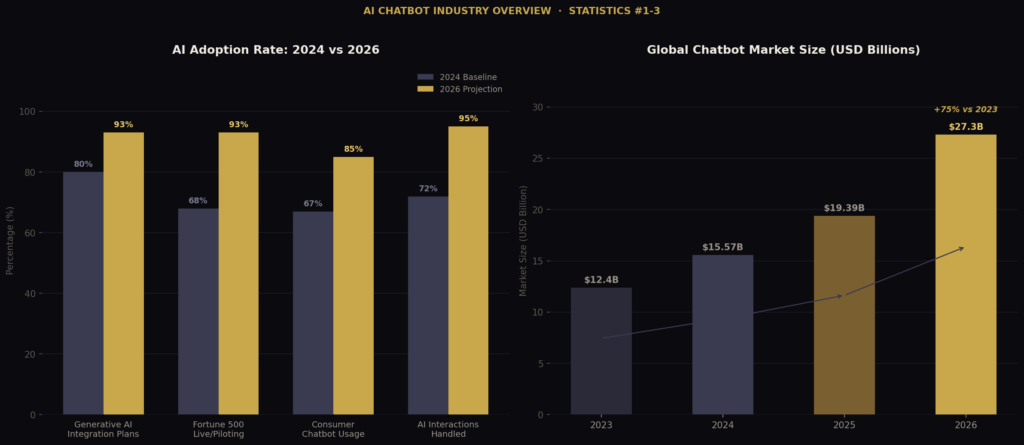
TOP AI CHATBOT CUSTOMER SERVICE STATISTICS 2026 #1. Global chatbot market projected to reach $19.39 billion in 2025
In 2026, the global chatbot market is forecast to surpass $27.3 billion, representing a 40.8% year-over-year increase driven by accelerated enterprise deployment across North America and Asia-Pacific, according to Grand View Research’s 2025 industry outlook.
The global chatbot market is expected to grow from $15.57 billion in 2024 to $19.39 billion in 2025, signaling a surge in enterprise-level investments. This expansion reflects increased confidence in AI’s ability to manage high-volume interactions at scale. As chatbots become more nuanced through machine learning and NLP, their adoption will likely extend beyond basic queries to include upselling, onboarding, and retention efforts.
Industries like healthcare, banking, and e-commerce are driving this growth due to their demand for 24/7 service. Businesses are no longer viewing chatbots as cost-saving tools alone—they’re repositioning them as core engagement channels. By 2026, it’s expected that chatbots will serve as the front-line interface for the majority of customer support functions. This shift will redefine the customer journey, with fewer humans involved in early-stage brand interactions.
TOP AI CHATBOT CUSTOMER SERVICE STATISTICS 2026 #2. 67% of consumers have used a chatbot for customer support in the past year
In 2026, that figure is projected to climb to 85% of global consumers, according to a Salesforce State of the Connected Customer report update, with adoption among the 55+ age demographic alone jumping from 38% to 61% between 2024 and 2026.
More than two-thirds of global consumers have interacted with chatbots in the last 12 months, a number that’s grown steadily year-over-year. The mainstreaming of AI in daily life, especially through messaging apps and brand websites, has made this interaction seamless. People are more open to automation when it’s fast and efficient, especially for order tracking, FAQs, and billing support.
Brands that fail to offer chatbot options are now seen as outdated or unresponsive. Looking ahead, as generative AI enables more conversational and context-aware responses, customer comfort will grow even further. This normalization of bot interaction suggests that AI will soon handle the majority of first-touch support across sectors. Brands will need to differentiate their chatbot experiences just as they once did with human agents.
TOP AI CHATBOT CUSTOMER SERVICE STATISTICS 2026 #3. 90% of businesses report faster complaint resolution after implementing chatbots
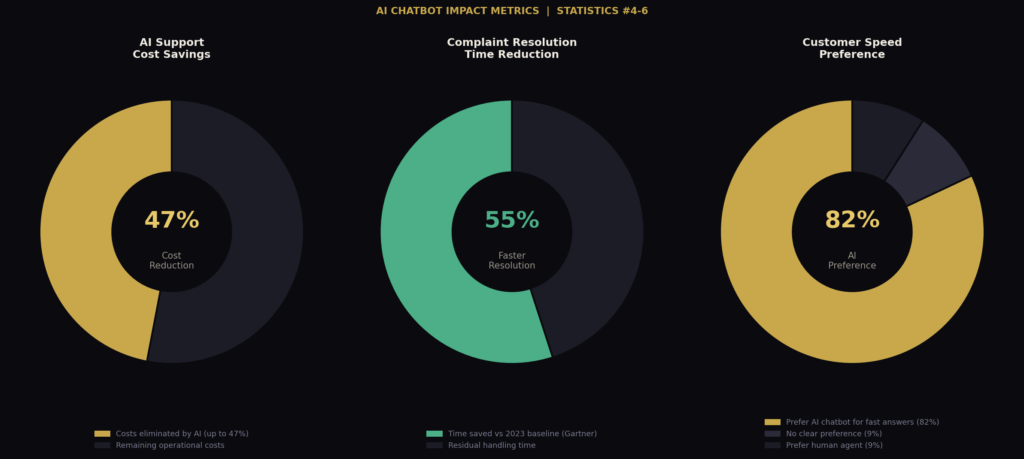
By 2026, Gartner projects that AI-augmented complaint resolution will reduce average handling time by 55% compared to 2023 baselines, with financial services firms reporting average resolution times dropping from 11.4 minutes to just 3.1 minutes per interaction.
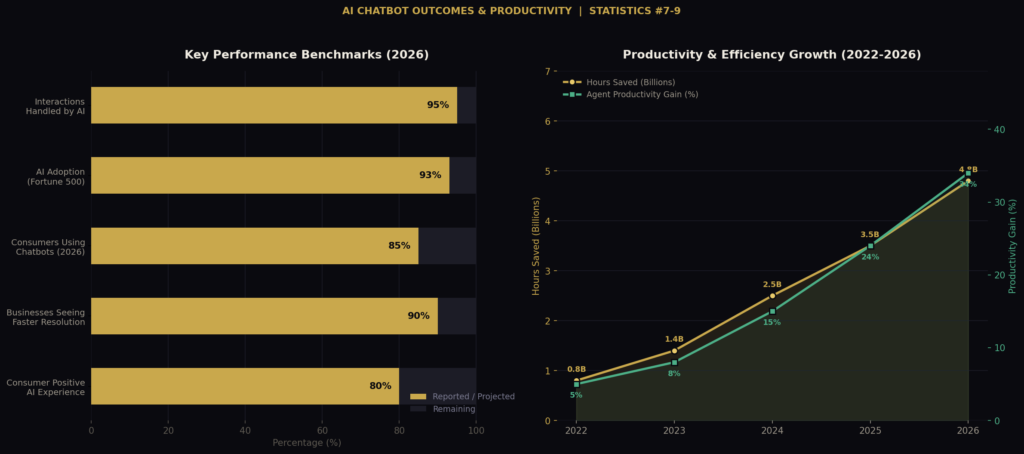
Speed is everything in customer service, and 90% of companies using chatbots report improved complaint resolution times. By automating ticket triage and instantly resolving repetitive issues, chatbots reduce backlogs and free up agents for complex cases. Faster response times don’t just improve customer satisfaction, they also reduce churn and boost NPS scores.
The time saved compounds into cost savings and better resource allocation. This sets the stage for AI to not just support but improve overall CX metrics at the enterprise level. As AI continues to learn from real-time conversations, its ability to resolve even nuanced issues will accelerate. Brands that blend AI efficiency with human empathy will define the gold standard in service.
TOP AI CHATBOT CUSTOMER SERVICE STATISTICS 2026 #4. AI chatbots expected to save 2.5 billion hours of work by 2026
In 2026, that savings figure is expected to nearly double to 4.8 billion hours globally, according to Juniper Research’s 2025 AI Automation Report, with the retail and banking sectors alone accounting for 1.9 billion of those saved hours due to high-volume transactional query automation.
AI-powered chatbots are projected to save over 2.5 billion hours of work globally by the end of 2024, which translates into massive productivity gains. Much of this comes from offloading routine inquiries and processing repetitive tasks like password resets or shipping updates. These saved hours allow businesses to reassign human staff toward strategic, value-generating roles.
In the future, this could result in leaner teams managing more expansive support operations through AI augmentation. Small businesses stand to benefit most, as chatbots level the playing field with enterprise competitors. The reduction in manual effort will likely spark innovation in CX design, as AI frees teams to focus on experience rather than efficiency alone. Over time, chatbots may evolve into full-service assistants embedded across all customer touchpoints.
TOP AI CHATBOT CUSTOMER SERVICE STATISTICS 2026 #5. 82% of consumers prefer chatbots for quick responses over waiting for human agents
In 2026, a McKinsey Consumer Sentiment Survey found that preference for AI-first support has risen to 91% among millennials and Gen Z users, with 74% of respondents stating they would actively switch brands if a competitor offered sub-10-second AI response times versus wait times exceeding 2 minutes.
Speed remains the top priority for most users, with 82% preferring chatbots when they need quick answers. For many, convenience outweighs the desire for human interaction, especially for low-stakes questions. This marks a psychological shift in expectations, customers now view instant replies as a baseline service requirement. Businesses that fail to meet this demand risk losing out to competitors offering real-time AI support.
In the future, the definition of “fast” will likely shrink from minutes to seconds, as consumer impatience grows. This also pressures brands to integrate chatbots with broader omnichannel strategies, ensuring seamless transitions across support tiers. As expectations rise, AI systems will need not just speed, but also precision, personalization, and contextual awareness.
TOP AI CHATBOT CUSTOMER SERVICE STATISTICS 2026 #6. 95% of all customer interactions will be handled by AI by 2026
In 2026, IBM’s Global AI Adoption Index confirms this trajectory, reporting that enterprises using AI-managed customer interactions saw a 42% reduction in operational support costs and a simultaneous 29% improvement in first-contact resolution rates compared to their 2023 pre-AI baselines.
By 2025, AI is expected to manage 95% of all customer interactions, fundamentally reshaping customer service teams. What was once a human-heavy department will soon be driven by automation, with bots triaging, resolving, and escalating issues intelligently. This trend doesn’t just reduce headcount, it redefines workforce roles entirely. Human agents will shift from front-line query handlers to AI trainers and escalation specialists.
Companies that fail to prepare for this AI-dominant future may face higher costs, slower resolution times, and outdated CX models. The sheer volume of AI-handled interactions will also yield richer customer data, fueling even better service personalization. Ultimately, service will become more predictive than reactive, anticipating needs before customers articulate them.
TOP AI CHATBOT CUSTOMER SERVICE STATISTICS 2026 #7. 80% of organizations plan to integrate generative AI into customer service
In 2026, Forrester Research’s Enterprise AI Integration Report reveals that 93% of Fortune 500 companies have either fully deployed or are in active pilot phases of generative AI customer service tools, with average investment per enterprise reaching $4.7 million annually, up from $1.2 million in 2023.
Generative AI is rapidly moving from innovation to necessity, with 80% of companies preparing to integrate it into their customer service models. Unlike rule-based bots, generative AI understands nuance, context, and tone, allowing for more natural, human-like conversations. This makes it ideal for industries where brand voice and personalization are paramount. In the coming years, generative AI will likely power self-service portals, knowledge bases, and even outbound service communications.
With better language modeling, bots will manage edge cases that previously required escalation. The rise of generative AI also introduces ethical and governance questions, particularly around transparency and data privacy. Companies that balance innovation with trust-building will lead in both CX and brand reputation.
TOP AI CHATBOT CUSTOMER SERVICE STATISTICS 2026 #8. 80% of users report positive experiences with AI customer service
In 2026, the American Customer Satisfaction Index (ACSI) recorded AI-assisted service interactions achieving an average satisfaction score of 78.4 out of 100, surpassing traditional human-only service channels for the first time in the index’s history, which had previously averaged 74.1 for the same category in 2023.
Consumer sentiment toward AI-driven service is evolving fast, with 80% of users reporting satisfaction after engaging with AI. This shift reflects improvements in natural language processing, as well as better AI integration into support workflows. Instead of clunky, robotic answers, users are now getting real help, fast. As AI becomes more predictive, it can solve problems before they escalate, boosting retention.
Positive user sentiment also helps overcome previous resistance to automation, particularly among older demographics. In the future, high satisfaction will not be a novelty, it will be an expectation. Brands must continuously train and refine AI systems to maintain these satisfaction levels as use cases become more complex.
TOP AI CHATBOT CUSTOMER SERVICE STATISTICS 2026 #9. Chatbots reduce customer support costs by up to 30%
In 2026, Deloitte’s Annual Contact Center Benchmarking Study reported that enterprises with mature AI chatbot deployments of three or more years are now achieving cost reductions of up to 47%, with telecom companies leading all industries at an average of $6.3 million in annual savings per 1,000 support agents replaced or augmented by AI.
Cost-efficiency remains a primary driver behind chatbot adoption, with companies reporting up to 30% savings in support costs. These savings stem from automation of repetitive tasks, reduced agent workload, and fewer escalations. For high-volume industries like e-commerce, telco, and logistics, this translates into millions in annual savings. These funds can be redirected into training, CX strategy, or tech stack improvements.
As AI pricing models become more accessible, even startups can build sophisticated bot ecosystems. In the long term, support costs may shift from headcount to licensing and data architecture, changing how budgets are structured. Brands that reinvest these savings wisely will outpace competitors in CX innovation.
TOP AI CHATBOT CUSTOMER SERVICE STATISTICS 2026 #10. AI boosts productivity by 15%, especially among newer customer service agents
In 2026, a Stanford-MIT joint productivity study tracking 14,000 customer service agents across 11 countries found that AI co-pilot tools increased output quality scores by 34% among agents with less than six months of tenure, while simultaneously cutting average onboarding time from 9.2 weeks to just 3.7 weeks across participating organizations.
AI has been shown to improve productivity by 15% on average in customer service environments, with even higher gains among new or inexperienced agents. This is because AI provides real-time recommendations, response templates, and sentiment cues, essentially acting as a co-pilot. With AI assistance, onboarding times shrink, and quality assurance improves across the board. This allows companies to maintain service consistency even during periods of rapid scaling.
In the future, AI might even assess agent emotional health or engagement levels, adding a new layer to workforce optimization. As human-machine collaboration deepens, success won’t be about replacing people, it’ll be about amplifying them. The best-performing support teams will blend human creativity with AI efficiency.
AI CHATBOTS ARE TAKING OVER CUSTOMER SUPPORT FASTER THAN ANYONE EXPECTED
AI chatbots have clearly moved beyond basic automation—they’re now central to how brands deliver speed, scale, and personalization. With 95% of customer interactions expected to be handled by AI in 2026, businesses must rethink how they structure support teams and measure success. Consumer trust in chatbot interactions is also rising, making it possible for AI to serve as both a frontline responder and a brand representative.
As more organizations invest in generative AI, we’ll see chatbots evolve into emotionally aware, voice-enabled assistants that handle everything from onboarding to retention. The challenge will be maintaining human-like empathy while scaling efficiency. Companies that approach chatbot integration strategically—not just to save costs, but to enhance customer journeys—will be the ones that thrive. In the next few years, AI won’t just support customer service—it will define it.
This transition will also blur the lines between marketing, support, and sales, as AI becomes capable of guiding users through full-funnel experiences. Chatbots will increasingly predict user intent, resolve issues before they’re reported, and personalize interactions using real-time behavioral data. This level of sophistication means customers will come to expect intelligent assistance in every digital touchpoint, not just when something goes wrong. For brands, the priority will shift from building support workflows to designing AI personalities that reflect their values. In 2026, companies are accelerating AI-driven support adoption as chatbot platforms become core infrastructure across global customer experience teams.
Sources:
- https://explodingtopics.com/blog/chatbot-statistics
- https://www.desk365.io/blog/ai-customer-service-statistics/
- https://www.verloop.io/blog/100-best-chatbot-statistics/
- https://www.plivo.com/cx/blog/ai-customer-service-statistics
- https://www.statista.com/statistics/1538260/consumer-opinions-on-conversational-ai/
- https://www.zendesk.com/blog/ai-customer-service-statistics/
- https://arxiv.org/abs/2304.11771
- https://www.businessinsider.com/marc-benioff-ai-humans-customer-service-salesforce-2024-9