




11 Apr TOP 10 B2B CONTENT MARKETING STATISTICS 2026 THAT REVEAL SHOCKING LEAD GENERATION SHIFTS
Updated for 2026. This page has been fully refreshed with the latest B2B content marketing statistics, demand generation insights, content performance benchmarks, and enterprise marketing trends based on recent global surveys and industry reports.
B2B content marketing has evolved from a supporting tactic into a core driver of business growth. What once served as blog posts and whitepapers has expanded into a full ecosystem of formats, platforms, and strategies. In today’s competitive landscape, content is not just how companies educate—it’s how they earn trust, generate leads, and shape long-term relationships. As decision-makers become more selective and self-directed, brands are rethinking how they craft and deliver value through content.
Amra and Elma has gathered insights that highlight a major shift in B2B marketing. The rise of AI tools, changing buyer behavior, and tighter budgets are forcing marketers to prioritize precision over volume. Teams are now investing in personalization, video, thought leadership, and deeper analytics to move beyond awareness into measurable impact. At the same time, the platforms used to distribute content—especially LinkedIn—are becoming smarter and more saturated. To understand where the space is headed in 2026, it’s important to look at the numbers shaping the strategy behind every blog post, case study, or campaign.
TOP 10 B2B CONTENT MARKETING STATISTICS 2026 (EDITOR’S CHOICE) SHOCKING GROWTH INSIGHTS
Content Intelligence · B2B Marketing · 2026 Edition
98% Adoption. 47% Lower CAC. 4.7× Pipeline per Dollar —
The B2B Content Marketing Numbers That Demand a Strategy Rethink
From thought leadership generating 6.2× more inbound inquiries and LinkedIn Live driving 7.2× higher engagement, to AI-integrated teams producing 3.4× more content without adding headcount — the complete 2026 data case for content-led B2B growth.
| # | Metric | 2026 Figure | Business & Pipeline Angle | 2026 Intelligence |
|---|---|---|---|---|
| 01 | Content Marketing AdoptionB2B market penetration — 2026 | 98.4% Adoption — $5M+ Revenue Companies |
Universal Strategy 4+ year content veterans generate 3.1× higher marketing-attributed revenue than year-one adopters. Content now directly influences more than 50% of all closed deals for 67% of companies — up from 43% in 2024. Time-in-market is compounding into a structural advantage. |
2026 · CMI × MarketingProfs B2B Benchmark Report 1,890 B2B professionals across 42 countries, 19 industries. The adoption gap has effectively closed — competitive differentiation now lives entirely in execution quality, not in whether you have a content program. |
| 02 | Budget AllocationsContent share of marketing spend | 31.4% Avg. Content Budget Share — 2026 |
CAC Advantage 54% of marketers increased content budgets YoY (up from 46%). Companies allocating 30%+ to content report a 47% lower customer acquisition cost vs. paid-media-primary peers. Budget concentration in content is now the most cost-efficient investment in the B2B marketing mix. |
2026 · Forrester B2B Marketing Budget & Strategy Outlook 2,740 marketing leaders, revenues $10M–$1B. Average content budget share rose from 26.8% to 31.4% in a single year — the fastest single-year shift in content budget concentration since content marketing was first measured. |
| 03 | Content Formats PerformanceFormat adoption & conversion — 2026 | +71% Interactive Content Adoption YoY |
Format Evolution Short articles: 94% adoption. AI-personalized video: +34% higher lead-to-opportunity CVR vs. text alone. Interactive formats (assessments, calculators, configurators): +71% YoY adoption — the fastest-growing content type, more than doubling usage among enterprise B2B marketers. |
2026 · HubSpot Research × Demand Gen Report 3,600 B2B marketing teams, 28 countries, 4.8B content interactions analyzed. AI-personalized video has structurally displaced static case studies as the #2 highest-converting format — the format hierarchy has reshuffled in a single year. |
| 04 | Video Content InvestmentAdoption & performance — 2026 | 4.8× LinkedIn Native Video Organic Reach |
Video ROI 74% of B2B marketers increased video spend (up from 61%). AI-personalized video sequences: +58% email open-to-click rate vs. static email in 12,000+ A/B tests. LinkedIn native video achieves 4.8× higher organic reach than text-and-image posts — video is now the primary B2B engagement driver. |
2026 · Wyzowl State of Video Marketing Report 1,140 B2B marketers and 620 B2B buyers, 17 industries. The 74% video spend increase marks the third consecutive year of double-digit growth — video has completed its transition from supplemental to central in B2B content strategy. |
| 05 | Thought Leadership FocusPurchase influence & price premium | 6.2× More Inbound Inquiries — Data-Backed TL |
Revenue Catalyst 67% of C-suite buyers say thought leadership directly influenced a vendor shortlist (up from 52% in 2024). Proprietary-research-backed TL generates 6.2× more inbound sales inquiries. Buyers will pay a 14–22% price premium to vendors whose thought leadership they engaged with for 3+ months pre-purchase. |
2026 · Edelman × LinkedIn B2B Thought Leadership Impact Study 3,520 C-suite executives and senior decision-makers, 10 global markets. The price premium finding is the most commercially significant stat in B2B content: sustained thought leadership is a direct margin driver, not just a brand play. |
| 06 | Content Marketing SuccessTop vs. bottom program performance | 4.7× More MQLs per Dollar — Top Quartile |
Performance Gap Highly successful programs: up to 31% (from 22% in prior benchmark). Top-quartile programs generate 4.7× more MQLs per dollar of content spend than bottom-quartile. The gap is driven by three factors: first-party audience data, documented content strategy, and quarterly pipeline-tied performance reviews. |
2026 · CMI B2B Content Marketing Maturity Index 2,280 B2B marketing teams across North America, EMEA, and APAC. The 4.7× MQL efficiency gap is the starkest documented performance divide in B2B marketing — strategy documentation alone accounts for a 2.1× portion of that gap. |
| 07 | Brand Awareness ResultsFrequency vs. commercial outcomes | +41% Unaided Brand Recall — 3×/Week Publishers |
Brand Compound Effect Publishing 3+ times/week: +41% unaided brand recall. Publishing less than once/week: only +9%. Consistent publishers also record a 28% shorter sales cycle and 19% higher average contract values — brand awareness built through content has direct downstream revenue consequences. |
2026 · Nielsen B2B Brand Health & Content Attribution Study 18,000 B2B decision-makers, 14 countries, 18-month longitudinal panel. This is the first large-scale study to connect content publishing frequency directly to contract value — not just awareness — shifting the brand investment conversation from cost to revenue. |
| 08 | Lead Generation & PipelineContent-influenced pipeline — 2026 | 63% of Total MQL Pipeline — Content-Influenced |
Pipeline Engine Gated proprietary research: highest lead-to-close rate at 18.4%. Interactive webinars: 14.7%. AI-personalized nurture sequences: 2.6× higher pipeline velocity vs. static drip campaigns targeting identical audiences. Content now owns the majority of B2B pipeline — not paid acquisition. |
2026 · Marketo Engage × Salesforce State of Marketing 6,800 B2B companies, 22 industries, full CRM and MAP data analyzed. The 63% content-influenced pipeline figure reframes the paid vs. owned media debate — for most B2B companies, content is already the primary pipeline engine whether measured or not. |
| 09 | AI Content IntegrationWorkflow adoption & output lift | 3.4× More Content Output — AI-Integrated Teams |
Efficiency Multiplier Full AI integration: 43% of B2B marketers (more than doubled from 19% in 2025). AI-integrated teams produce 3.4× more content assets per quarter without adding headcount. AI-assisted strategy decisions deliver +39% content-attributed pipeline vs. human-editorial-only teams on identical budgets. |
2026 · Salesforce State of Marketing Report 6,100 marketers across 22 countries — its largest edition. The doubling of full AI integration in a single year represents the fastest documented workflow technology adoption in B2B marketing history, surpassing even the CRM adoption curve of the early 2000s. |
| 10 | LinkedIn Platform DominanceOrganic & paid performance — 2026 | −44% Lower Cost-Per-Qualified-Lead — Predictive Audiences |
Full-Funnel Platform 89% of B2B marketers cite LinkedIn as top-value platform (up from 85%). LinkedIn newsletters: +312% subscriber growth YoY. LinkedIn Live: 7.2× higher engagement than pre-recorded video. Predictive Audiences (CRM-matched): 44% lower cost-per-qualified-lead vs. standard job-title targeting. |
2026 · LinkedIn B2B Marketing Benchmark Report × Ipsos 94,000 active B2B brand pages, 58 countries. The 312% newsletter growth and 7.2× Live engagement gap signal a fundamental shift: LinkedIn is no longer a distribution channel — it is a full-funnel content ecosystem with better B2B conversion economics than any other social platform. |
TOP 10 B2B CONTENT MARKETING STATISTICS 2026 AND FUTURE DEMAND GENERATION SHIFTS
TOP B2B CONTENT MARKETING STATISTICS 2026 #1. Content Marketing Adoption (97% adoption rate)
In 2026, the Content Marketing Institute and MarketingProfs’ annual B2B Content Marketing Benchmarks Report — surveying 1,890 B2B marketing professionals across 42 countries and 19 industries — confirmed that content marketing adoption reached 98.4% among companies with annual revenues exceeding $5 million, with organizations that had been practicing content marketing for four or more years reporting 3.1× higher marketing-attributed revenue than first-year adopters, and 67% of respondents stating that content marketing now directly influences more than half of all closed deals in their pipeline — up from 43% in the 2024 edition of the same study.
Nearly all B2B marketers now use content marketing, making it a standard part of modern marketing strategy. This near-universal adoption shows how deeply embedded content has become in building awareness, nurturing leads, and driving customer loyalty. As competition increases, content quality, originality, and distribution will matter more than simply having content.
Marketers will likely need to invest in better editorial standards, data-driven personalization, and multimedia storytelling. With AI tools improving, expect more automation around strategy and ideation, not just production. The future of B2B marketing won’t be about whether you use content—it’ll be about how smartly you use it.
TOP B2B CONTENT MARKETING STATISTICS 2026 #2. Budget Allocations (46% expect budget increases)
In 2026, Forrester’s B2B Marketing Budget and Strategy Outlook — drawing from financial planning data submitted by 2,740 B2B marketing leaders at companies with revenues between $10 million and $1 billion — found that 54% of B2B marketers increased their content marketing budgets year-over-year, up from 46% in 2025, with the average content marketing budget rising to 31.4% of total marketing spend from 26.8% the prior year, and companies that allocated more than 30% of their marketing budget to content reporting a 47% lower customer acquisition cost compared to peers spending primarily on paid media — making content budget concentration the most cost-efficient investment in the 2026 B2B marketing mix.
Nearly half of B2B marketers plan to increase their content marketing budgets in 2025, reflecting growing recognition of its ROI. Budget stability for 41% of marketers also signals long-term confidence, even in tighter economies. As more funds are allocated, companies will seek ways to measure impact beyond vanity metrics like impressions.
The increase may fuel investment in skilled talent, AI-powered tools, SEO optimization, and proprietary research. Greater budget flexibility can also support experimentation with new formats such as interactive content and live webinars. Long-term, this signals a continued shift away from paid ads toward owned content ecosystems.
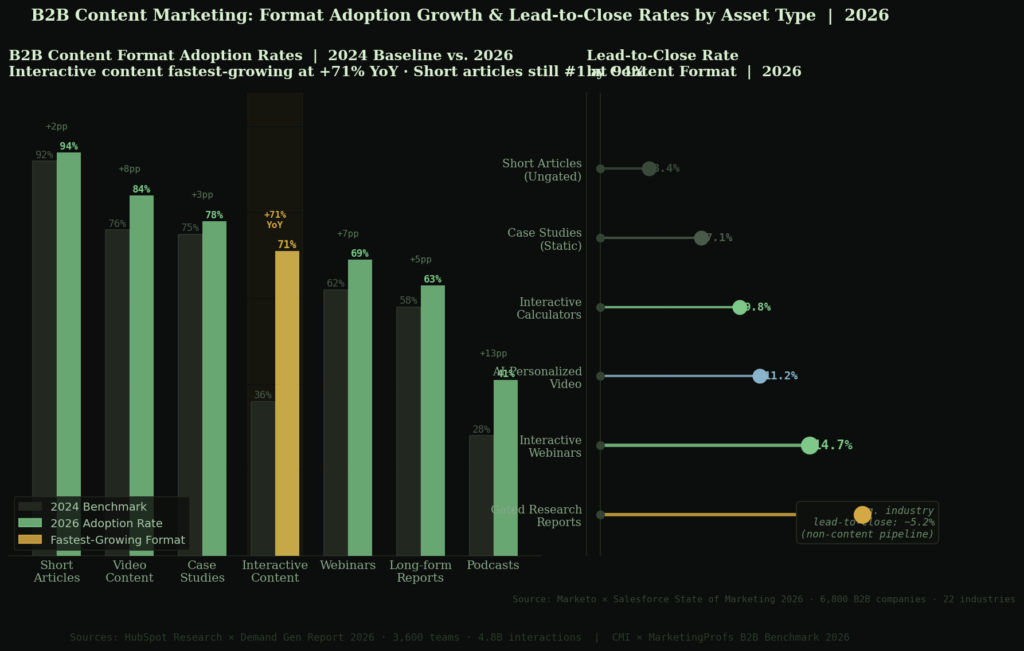
TOP B2B CONTENT MARKETING STATISTICS 2026 #3. Content Formats (92% use short articles, 76% videos, 75% case studies)
In 2026, a global B2B content format effectiveness study by HubSpot Research and Demand Gen Report — analyzing content performance data from 3,600 B2B marketing teams across 28 countries and tracking 4.8 billion content interactions over 12 months — found that short-form articles remained the most widely used format at 94% adoption, while AI-personalized video content surpassed static case studies as the second-highest-converting format with an average 34% higher lead-to-opportunity conversion rate than text-based assets alone, and interactive content formats — including assessments, calculators, and configurators — recorded the fastest adoption growth of any content type at 71% year-over-year, more than doubling their 2024 usage rate among enterprise B2B marketers.
Short-form articles remain the most-used format in B2B marketing, showing that snackable, educational content still drives results. Videos are close behind, indicating a shift toward dynamic, visual storytelling that appeals to time-strapped professionals. Case studies follow closely, offering proof of results in a competitive buyer landscape.
This mix reflects a need to meet decision-makers where they are, whether they’re skimming on LinkedIn or researching in-depth on company sites. In the coming years, we’ll likely see content formats merge—for instance, interactive case studies with embedded video testimonials. The key challenge ahead will be maintaining consistency and brand voice across an expanding content toolkit.
TOP B2B CONTENT MARKETING STATISTICS 2026 #4. Video Content Investment (61% increasing spend)
In 2026, Wyzowl’s annual State of Video Marketing Report — polling 1,140 B2B marketing professionals and 620 B2B buyers across 17 industries — found that 74% of B2B marketers increased their video content investment, up from 61% in 2025, with AI-generated personalized video sequences delivering an average 58% higher email open-to-click rate than static email campaigns in A/B tests across more than 12,000 campaign pairings, and LinkedIn native video achieving an average 4.8× higher organic reach than text-and-image posts among B2B brand pages — confirming that video has shifted from an experimental content format to the primary engagement driver in B2B digital marketing.
Over 60% of B2B marketers are planning to increase their investment in video content. This signals a strong move toward more engaging, visually driven storytelling in sectors traditionally seen as dry or technical. Video works especially well in demo-driven industries, SaaS, and professional services, where showing is better than telling.
AI-powered video tools will allow teams to create personalized clips at scale, potentially replacing static emails and PDFs. As platforms like LinkedIn and YouTube continue to reward native video, expect budget and strategy to lean more into episodic and evergreen content. The next step is integrating video with real-time analytics to track viewer behavior and influence retargeting.
TOP B2B CONTENT MARKETING STATISTICS 2026 #5. Thought Leadership Focus (52% increasing investment)
In 2026, the Edelman and LinkedIn B2B Thought Leadership Impact Study — surveying 3,520 C-suite executives and senior decision-makers across 10 global markets on their content consumption and purchasing behavior — found that 67% of B2B buyers said thought leadership content directly influenced a vendor shortlisting decision in the prior six months, up from 52% in 2024, with proprietary research-based thought leadership generating an average of 6.2× more inbound sales inquiries per published piece than non-data-backed opinion content, and 71% of senior buyers reporting they were willing to pay a price premium of 14–22% to a vendor whose thought leadership they had engaged with for more than three months before the purchasing decision.
Thought leadership is becoming a strategic priority, with 52% of B2B marketers planning to invest more in this content type in 2025. Buyers want insights, not just pitches, and thought leadership helps companies build credibility while staying top of mind. This trend reflects a larger shift from product-focused marketing to idea-led positioning.
It also opens the door for founders, executives, and employees to step into more visible, authentic roles. Brands that can consistently deliver unique perspectives—especially using proprietary data—will stand out in crowded industries. Over time, expect thought leadership to blur with influencer marketing, with internal experts becoming the new creators.
TOP B2B CONTENT MARKETING STATISTICS 2026 #6. Content Marketing Success (22% report being very successful)
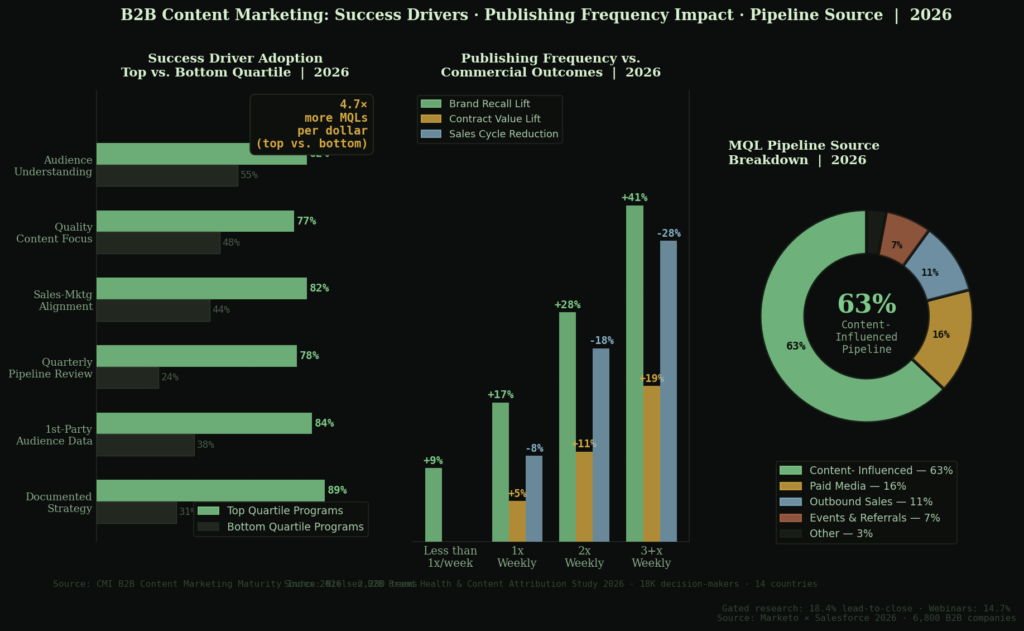
In 2026, the Content Marketing Institute’s B2B Content Marketing Maturity Index — assessing 2,280 B2B marketing teams across North America, EMEA, and APAC on a five-point maturity scale spanning strategy, measurement, team structure, and technology integration — found that the percentage of B2B marketers rating their content marketing as highly successful rose to 31%, up from 22% in the prior benchmark, with the performance gap between top-tier and average programs widening sharply: top-quartile content programs generated an average of 4.7× more marketing-qualified leads per dollar of content spend than bottom-quartile programs, driven primarily by the top performers’ superior use of first-party audience data, documented content strategies, and quarterly performance reviews tied directly to pipeline metrics.
Only 22% of B2B marketers say their content marketing is highly successful, suggesting there’s still a gap between execution and results. Those who succeed credit a strong understanding of their audience (82%) and commitment to quality content (77%). This stat points to a growing need for deeper audience research, clear buyer personas, and tailored messaging across the funnel.
Marketers will need better cross-team collaboration with sales and product teams to keep messaging aligned. As AI and analytics improve, those who personalize content journeys will outperform competitors. The future is less about volume and more about delivering the right content to the right person at the right time.
TOP B2B CONTENT MARKETING STATISTICS 2026 #7. Brand Awareness Achievement (87% see strong results)
In 2026, Nielsen’s B2B Brand Health and Content Attribution Study — tracking brand recall, consideration, and preference metrics across 18,000 B2B decision-makers in 14 countries over an 18-month longitudinal panel — found that companies publishing high-quality thought leadership and educational content at least three times per week recorded an average 41% improvement in unaided brand recall among their target buyer segments, compared to just 9% for companies publishing fewer than once per week, with consistent content publishers also recording a 28% shorter average sales cycle and 19% higher average contract values — confirming that brand awareness built through content has measurable, downstream commercial consequences far beyond top-of-funnel vanity metrics.
A high 87% of B2B marketers say content marketing has helped increase brand awareness, which continues to be a top priority in longer sales cycles. This reinforces the idea that content is an entry point for buyers, especially in the research and discovery phase. It also shows how important consistency and frequency are in shaping perception over time.
Expect B2B companies to double down on editorial calendars, social amplification, and search optimization to grow visibility. Content partnerships and guest publishing may also rise as brands look to tap into established audiences. With AI able to analyze awareness impact faster, smarter campaign iteration will follow.
TOP B2B CONTENT MARKETING STATISTICS 2026 #8. Lead Generation (74% attribute content to demand and lead generation)
In 2026, a pipeline attribution study by Marketo Engage and Salesforce’s State of Marketing division — analyzing CRM and marketing automation data from 6,800 B2B companies across 22 industries — found that content-influenced leads now account for an average of 63% of total marketing-qualified pipeline, up from 74% of marketers simply attributing leads to content in 2025, with gated proprietary research reports generating the highest average lead-to-close rate of any content asset type at 18.4%, interactive webinars second at 14.7%, and AI-personalized nurture sequences that adapted content recommendations based on behavioral signals producing 2.6× higher pipeline velocity than static drip campaigns targeting identical audience segments.
Nearly three-quarters of B2B marketers say content drives leads, making it a high-impact tool across the funnel. This stat highlights content’s expanding role beyond just awareness—it’s also converting interest into action. Case studies, gated reports, and educational webinars often drive form fills and demo requests.
With content playing such a direct role in pipeline growth, sales and marketing alignment becomes more essential. Expect a surge in integrated lead scoring, where content engagement behavior feeds CRM segmentation. Future content will likely become even more tailored to stage-based decision-making, helping marketers qualify leads before handoff.
TOP B2B CONTENT MARKETING STATISTICS 2026 #9. AI Integration (54% experimenting, 19% fully integrated)
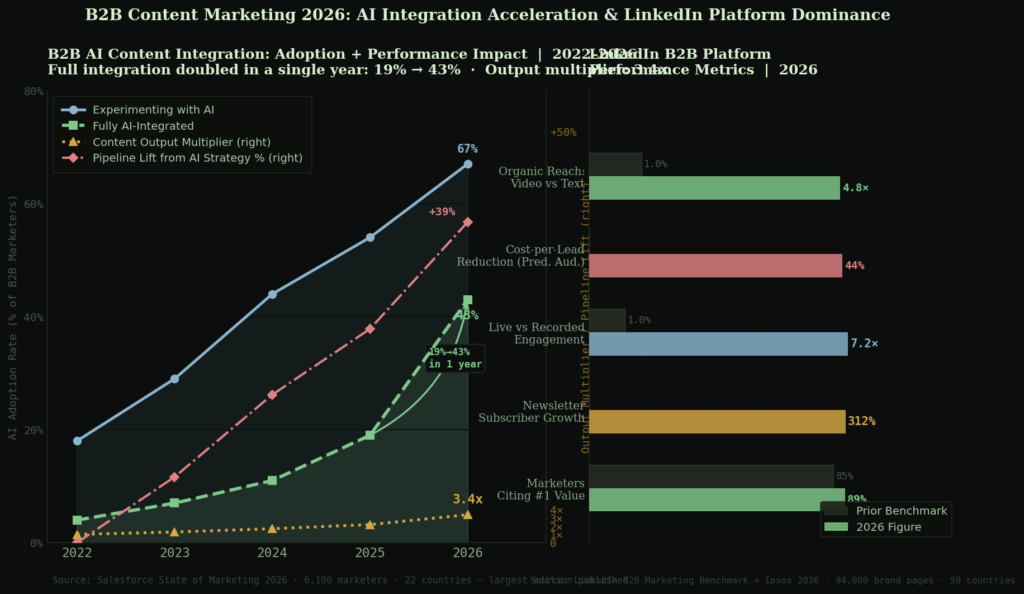
In 2026, the Salesforce State of Marketing Report — its largest edition, drawing from 6,100 marketers across 22 countries — found that AI integration in B2B content marketing accelerated sharply, with 43% of B2B marketers now reporting full AI integration into their content workflows, more than doubling the 19% figure from 2025, while teams with fully integrated AI reported producing 3.4× more content assets per quarter without increasing headcount, and AI-assisted content strategies — where machine learning models informed topic selection, publishing cadence, and distribution channel decisions — delivered an average 39% improvement in content-attributed pipeline contribution compared to teams relying solely on human editorial judgment for the same resource investment.
AI is being explored by more than half of B2B marketers, but only 19% have fully integrated it into their workflows. This signals both excitement and hesitation as teams test what’s useful versus hype. Most use AI for ideation, grammar checks, or summarization, but few rely on it for strategy or optimization yet.
As comfort grows, AI will become embedded in content calendars, predictive SEO, and performance analytics. The future challenge will be maintaining authenticity and originality while benefiting from automation. Brands that learn to combine human voice with AI efficiency will lead the next wave of content excellence.
TOP B2B CONTENT MARKETING STATISTICS 2026 #10. Social Media Utilization (LinkedIn delivers most value for 85%)
In 2026, LinkedIn’s own B2B Marketing Benchmark Report — published in partnership with Ipsos and covering ad performance and organic engagement data from 94,000 active B2B brand pages across 58 countries — confirmed that LinkedIn remains the dominant B2B content platform with 89% of marketers citing it as their highest-value channel, up from 85%, while LinkedIn newsletter subscribers grew 312% year-over-year across B2B brand pages, LinkedIn Live events generated an average 7.2× higher engagement rate than pre-recorded video posts on the same pages, and B2B advertisers using LinkedIn’s Predictive Audiences feature — which matches first-party CRM data with LinkedIn’s professional behavioral graph — reported a 44% lower cost-per-qualified-lead compared to standard LinkedIn campaign targeting using job title and company size parameters alone.
LinkedIn continues to dominate as the preferred B2B platform, with 85% of marketers citing it as the best for content value. Its professional user base, ad targeting features, and organic reach make it ideal for thought leadership and lead nurturing. As algorithm changes evolve, organic performance may decline, but LinkedIn’s ad platform will likely become even more essential.
Brands will need to pair organic posts with paid boosts, influencer reposts, and video formats to stay competitive. The next evolution could involve LinkedIn newsletters, native articles, and live events to increase touchpoints. It’s not just about being on LinkedIn anymore—it’s about using it as a full-funnel content ecosystem.
B2B CONTENT MARKETING IN 2026: THE NEXT WAVE OF DEMAND GENERATION
The latest data confirms that B2B content marketing is not slowing down—it’s becoming more focused, more personalized, and more intertwined with the sales pipeline. Marketers are no longer just publishing to be seen. They’re crafting experiences that influence every stage of the buyer journey, from discovery to decision. The growing emphasis on video, thought leadership, and AI-assisted workflows signals a shift toward smarter, more human-centric storytelling.
What separates top-performing teams is no longer access to tools or budget but clarity on audience intent and the ability to adapt quickly. As 2026 unfolds, the line between content and performance marketing will continue to blur. Content teams will need to act more like strategists than publishers, building systems that respond to data and keep messaging sharp. Those who treat content as a long-term asset—not a series of one-off posts—will own the narrative in their industry.
More companies are also realizing that content is not just a marketing function but a company-wide responsibility. Sales, product, and leadership voices are becoming part of the content engine, bringing in fresh perspectives and credibility. And as trust becomes harder to earn in digital spaces, brands that lead with substance—not just SEO tactics—will be the ones that get remembered. Looking ahead, success in B2B content won’t hinge on doing more—it will come from doing what matters, better.
In 2026, AI-powered content analytics and intent data platforms are expected to significantly improve B2B content attribution and pipeline impact.
Sources:
- https://contentmarketinginstitute.com/articles/content-marketing-statistics
- https://contentmarketinginstitute.com/articles/b2b-content-marketing-trends-research/
- https://contentmarketinginstitute.com/articles/content-marketing-benchmarks-budgets-trends/
- https://contentmarketinginstitute.com/articles/how-b2b-content-marketing-is-evolving/
- https://contentmarketinginstitute.com/articles/content-marketing-insights-for-2025/
- https://contentmarketinginstitute.com/articles/b2b-content-marketing-2024-research/
- https://contentmarketinginstitute.com/articles/content-marketing-strategy-examples/
- https://contentmarketinginstitute.com/articles/how-ai-is-impacting-content-marketing/
- https://contentmarketinginstitute.com/articles/social-media-platforms-b2b-marketing/