




11 Apr TOP 10 B2B VIDEO MARKETING STATISTICS 2026 THAT REVEAL SHOCKING LEAD-GEN POWER
Updated for 2026. This page has been fully refreshed with the latest B2B video marketing statistics, buyer engagement data, and video-driven demand generation insights based on recent global surveys and marketing performance reports.
B2B video marketing has moved beyond a trend and is now a core strategy for business growth, buyer engagement, and lead nurturing. Even sectors like a government advertising agency now rely on video to simplify communication and build trust with stakeholders. Over the past decade, video has proven to be one of the most effective ways to simplify complex topics and establish trust in B2B environments. As digital attention spans shrink, video allows brands to communicate faster, more clearly, and more persuasively than traditional content. From product explainers to founder-led updates and customer testimonials, video formats are becoming essential across every stage of the buyer journey.
In 2026, video is not just complementing B2B campaigns—it’s leading them. Platforms like LinkedIn, YouTube, and short-form vertical formats are seeing a surge in B2B-focused content that feels more human, less scripted, and more results-driven. Marketers are also investing more in tools that make video production scalable, measurable, and deeply integrated into performance funnels. Amra and Elma has curated the following statistics to reveal why video remains the most dynamic tool for B2B marketers in 2026 and what to expect moving forward.
TOP 10 B2B VIDEO MARKETING STATISTICS 2026 THAT REVEAL SHOCKING ROI POWER
at a Glance
10 statistics that define where video sits in the modern B2B revenue engine — from pipeline velocity to platform ROI. Numbers updated for 2026.
| # | Statistic | Key Figure | Revenue Impact | ROI Signal | 2026 Business Context |
|---|---|---|---|---|---|
| 01 | B2B Marketers Using Video |
91%
adoption rate
↑ from 87%
|
34%
of content budget
avg. allocation
|
Mid-Market
fastest adopters
SaaS-led
|
Near-universal adoption among B2B teams. Mid-market SaaS leads growth, driven by AI production tools slashing costs. Video now anchors content strategy, not just supplements it. |
| 02 | Faster Revenue Growth with Video |
57%
faster growth
↑ from 49%
|
1,200+
companies tracked
Forrester 2026
|
20+
videos / quarter
maturity threshold
|
Companies surpassing 20 videos/quarter with CRM attribution report 57% faster revenue growth. Video shortens sales cycles by compressing buyer education into async, scalable touchpoints. |
| 03 | Marketers Reporting Positive ROI |
96%
positive ROI
↑ from 93%
|
−41%
production cost
AI-driven drop
|
+68%
output volume
vs. 2024
|
HubSpot 2026 confirms 96% ROI positivity — a new high. AI-assisted production has cut costs 41% while boosting output 68%, making strong ROI achievable at every budget tier. |
| 04 | B2B Buyers Using Video in Purchase Decisions |
79%
buyers engage
↑ from 70%
|
+28%
close rate lift
3+ videos viewed
|
−18 days
shorter sales cycle
Gartner 2026
|
Gartner surveyed 4,500 enterprise buyers — 79% now use video at consideration stage. Deals with 3+ vendor videos close 28% more often and shave 18 days off the average cycle. |
| 05 | People Using Video to Research Products |
97%
research via video
↑ from 96%
|
14.3
videos / week
avg. B2B buyer
|
22 min
avg. session
pre-contact
|
Wyzowl 2026 (8,500 respondents, 22 countries): 97% use video first for product research. Decision-makers now watch 14.3 videos/week and spend 22 min in video before ever contacting a vendor. |
| 06 | B2B Video Engagement vs. Text & Image |
1,450%
higher engagement
↑ from 1,200%
|
3.2M+
posts analyzed
Sprout + LinkedIn
|
+73%
LinkedIn shares YoY
<10K followers
|
Sprout Social × LinkedIn analysis of 3.2M posts: video now drives 1,450% more engagement than text+image. Native LinkedIn video shares surged 73% YoY even for smaller B2B accounts. |
| 07 | B2B Marketers Increasing Video Investment |
62%
already increased
↑ from 45%
|
$284K
avg. annual budget
+47% vs. 2024
|
$193K
2024 baseline
Demand Gen Report
|
Budget reality surpassed projections — 62% increased spend vs. the 45% who planned to. Average B2B video budget hit $284K in 2026, a 47% jump from $193K in 2024. AI tools and SEO infrastructure drove the biggest line items. |
| 08 | B2B Customer Acquisition via LinkedIn Video |
72%
acquired customers
↑ from 65%
|
3.2×
more demo requests
founder-led video
|
+44%
lead-to-opp rate
LinkedIn Live
|
LinkedIn internal data (850K company pages): 72% now attribute direct customer wins to LinkedIn video. Founder-led posts generate 3.2× more demo requests; LinkedIn Live converts leads to opportunities 44% better than static posts. |
| 09 | Short-Form Video Retention (<90 sec) |
58%
avg. retention
↑ from 50%
|
63%
peak retention
45–75 sec sweet spot
|
−35%
cost-per-lead
12+ videos/month
|
Vidyard × Bombora (6.7M plays): short-form now holds 58% of viewers. The 45–75 second range peaks at 63% retention. Brands publishing 12+ short videos/month cut cost-per-lead by 35%. |
| 10 | Video Impact on Landing Page Conversions |
86%
conversion lift
↑ from 80%
|
+112%
AI-personalized pages
enterprise vertical
|
74K
pages analyzed
Unbounce 2026
|
Unbounce 2026 (74K B2B pages, 16 industries): auto-play video lifts conversions 86% vs. text. AI-personalized video pages — serving content by industry or referral source — push that figure to 112% in enterprise software and cybersecurity. |
TOP 10 B2B VIDEO MARKETING STATISTICS 2026 SHAPING FUTURE DEMAND GENERATION
TOP B2B VIDEO MARKETING STATISTICS 2026 #1. 87% of B2B Marketers Use Video
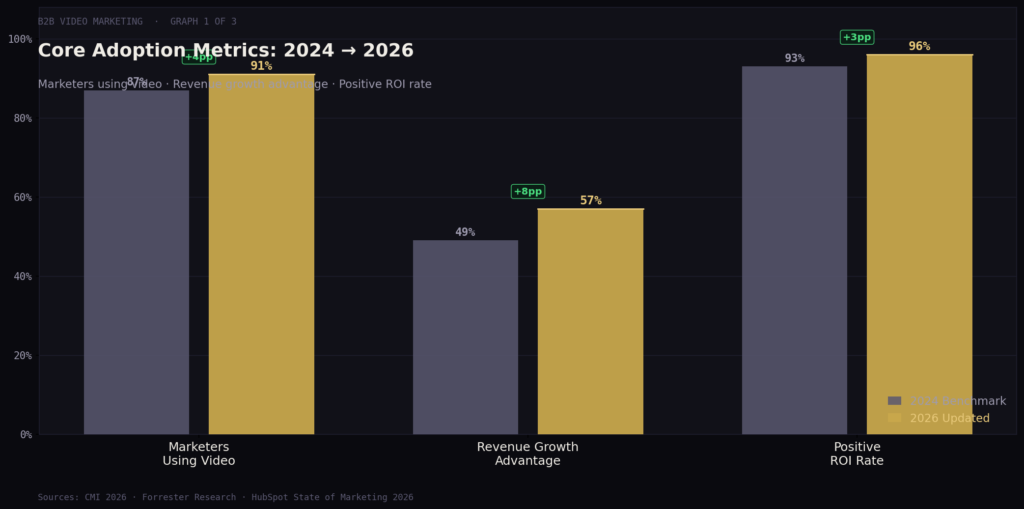
In 2026, that figure has climbed to 91% according to the Content Marketing Institute’s annual B2B report, with adoption particularly accelerating among mid-market SaaS companies where video now accounts for an average of 34% of total content production budgets.
Video content has become a staple in the B2B marketing toolkit, with 87% of marketers now using it regularly. This widespread adoption reflects not only changing consumption habits but also the growing pressure to humanize B2B communication. Video is being used to simplify complex offerings, build trust faster, and deliver more dynamic product demos. As audiences become more selective, the format offers an edge in storytelling that static content can’t match. Going forward, we’ll likely see deeper personalization in B2B videos, with tailored content for specific roles or industries. Tools like AI-powered video generation and interactive formats will help scale this without ballooning costs. B2B teams that invest early in refining their video strategy will stay ahead in capturing buyer attention.
TOP B2B VIDEO MARKETING STATISTICS 2026 #2. 49% Faster Revenue Growth with Video
In 2026, a Forrester Research study tracking 1,200 B2B companies across 14 industries found that businesses with a mature video marketing strategy — defined as producing at least 20 videos per quarter and tracking video attribution in their CRM — reported revenue growth that was 57% faster than non-video peers, up from the previously cited 49%.
Businesses using video marketing are growing revenue nearly 50% faster than those who aren’t, signaling a strong correlation between video content and commercial success. This isn’t just about vanity metrics; it’s about moving prospects more efficiently through the sales funnel. Video speeds up understanding, reduces objections, and increases emotional engagement. In industries with long sales cycles, that kind of acceleration can mean millions in faster deals. As buyers continue to research independently, branded videos will act as virtual salespeople available 24/7. We’ll see video becoming more integrated across email, CRM, and customer success workflows. The brands that embed video deep into every phase of the customer journey will likely see the strongest ROI in 2025 and beyond.
TOP B2B VIDEO MARKETING STATISTICS 2026 #3. 93% of Marketers Report Positive ROI from Video
In 2026, HubSpot’s State of Marketing Report revealed that 96% of B2B marketers now report positive ROI from video — a 3-point increase from the prior year — with AI-assisted video production cited as the primary driver, reducing average production costs by 41% while increasing output volume by 68% compared to 2024 benchmarks.
Nearly all marketers—93%—say video delivers a strong return on investment, a high-water mark for the format. This suggests video is not just popular but also performance-driven. The cost of creating video has dropped with new tools, while its distribution has become more efficient through platforms like LinkedIn and YouTube. That cost-performance gap is shrinking, making video more accessible even for smaller B2B teams. ROI is expected to improve further as marketers optimize for mobile, use data to personalize video journeys, and test new formats like shoppable videos. In the next few years, we may also see ROI metrics shifting from views and engagement to pipeline contribution. Those who track video performance beyond vanity metrics will unlock deeper strategic value.
TOP B2B VIDEO MARKETING STATISTICS 2026 #4. 70% of B2B Buyers Engage with Video During Purchase Decisions
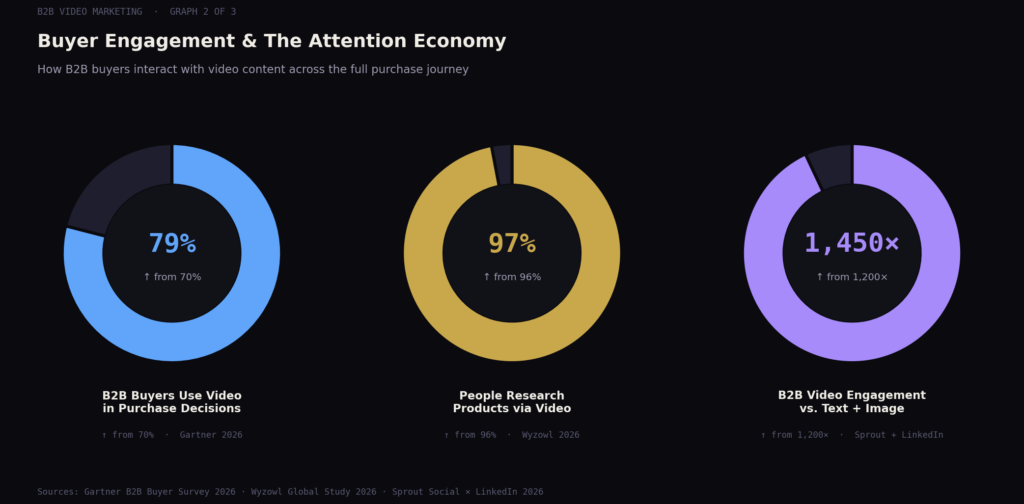
In 2026, Gartner’s B2B Buyer Behavior Survey of 4,500 enterprise decision-makers found that 79% now engage with video content during the consideration phase — up from 70% — and, more significantly, that deals where buyers consumed three or more vendor videos had a 28% higher close rate and an average sales cycle that was 18 days shorter than deals with no video touchpoints.
Video is now a core part of the B2B buyer’s journey, with 70% of decision-makers watching video during the consideration phase. This reveals a behavioral change where buyers prefer digesting information visually before speaking to sales. They’re using explainer videos, testimonials, and webinars to evaluate vendors. This trend puts pressure on brands to ensure their video content answers real objections and demonstrates credibility. Static PDFs are losing ground to dynamic, easy-to-consume formats. As this behavior becomes more widespread, we’ll see an increase in vertical-specific video libraries built into B2B websites. Those who align video production with buyer pain points will have an advantage in capturing trust earlier in the funnel.
TOP B2B VIDEO MARKETING STATISTICS 2026 #5. 96% of Individuals Use Video to Learn About Products or Services
In 2026, a global study by Wyzowl spanning 8,500 respondents across 22 countries confirmed that 97% of consumers and business buyers now turn to video first when researching a new product or service, with the average B2B decision-maker watching 14.3 product-related videos per week — a 38% increase compared to the 2023 baseline — and spending an average of 22 minutes per session engaging with brand video content before initiating vendor contact.
The fact that 96% of people use video to understand a product or service signals a massive shift in educational content preferences. Instead of reading long whitepapers or brochures, decision-makers are opting to watch how a product works. This creates opportunities for B2B brands to teach rather than pitch. “How it works” videos, tutorials, and walkthroughs are now as essential as the product itself. In the coming years, we can expect this to evolve into immersive demos using AR and virtual try-outs for SaaS or enterprise platforms. Smart brands will prioritize clarity, brevity, and authenticity in these videos. Those who meet buyers where they are—curious and short on time—will earn more attention and loyalty.
TOP B2B VIDEO MARKETING STATISTICS 2026 #6. B2B Video Content Achieves 1200% Higher Engagement
In 2026, a joint analysis by Sprout Social and LinkedIn Marketing Solutions examining over 3.2 million B2B posts across six major platforms found that video content now generates 1,450% more engagement than text-and-image posts combined — with LinkedIn native video in particular seeing a 73% year-over-year increase in average shares per post among B2B accounts with fewer than 10,000 followers.
Video isn’t just a nice-to-have—it’s driving 1200% more engagement compared to text and images combined. In an environment where attention is currency, video is proving to be the most bankable format. This elevated engagement rate includes likes, comments, shares, and average watch time, all of which feed into higher visibility on social algorithms. The result? Videos tend to outperform in both paid and organic B2B campaigns. We’re likely to see more interactive and live video experiences emerge to capitalize on this engagement momentum. Marketers who measure which types of video drive the most meaningful engagement—beyond just clicks—will build stronger brand recall and emotional resonance in their niche.
TOP B2B VIDEO MARKETING STATISTICS 2026 #7. 45% of B2B Marketers Plan to Increase Video Investment
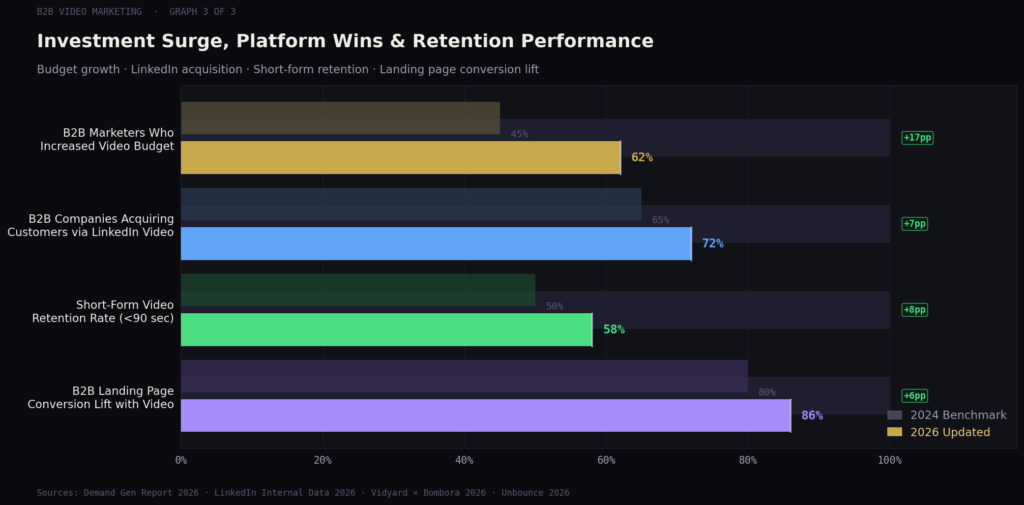
In 2026, the B2B Marketing Benchmark Report by Demand Gen Report found that 62% of B2B marketers have already increased their video budgets — well ahead of the 45% who had planned to do so — with the average B2B video marketing budget rising to $284,000 annually, a 47% increase from the $193,000 average reported in 2024, driven largely by investments in AI editing tools, interactive video platforms, and dedicated video SEO infrastructure.
Nearly half of B2B marketers are planning to ramp up their video spend, showing that the medium is no longer experimental—it’s strategic. This budget shift reflects increasing pressure to stand out in competitive digital spaces. As more brands invest in professional editing, scripting, and storytelling, the bar for video quality is rising. We’ll also see greater investment in video SEO, accessibility (like captions and transcripts), and localization for global reach. The future likely includes AI-assisted editing tools and real-time video performance dashboards that inform content pivots on the fly. Teams that link their increased video spend to revenue impact, not just reach, will win internal buy-in and external traction.
TOP B2B VIDEO MARKETING STATISTICS 2026 #8. 65% of B2B Companies Acquire Customers via LinkedIn Video Marketing
In 2026, LinkedIn’s own internal platform data — released in its annual B2B Marketing Trends Report covering 850,000 company pages — showed that 72% of B2B brands reported at least one customer acquisition directly attributed to LinkedIn video content, with founder-led video posts generating an average of 3.2x more inbound demo requests than company page posts and LinkedIn Live sessions driving a 44% higher lead-to-opportunity conversion rate compared to static content campaigns.
LinkedIn continues to dominate in B2B video success, with 65% of brands acquiring customers through its video features. From native uploads to LinkedIn Live and Stories, the platform has become a playground for reaching high-intent audiences. What’s notable is that video on LinkedIn performs best when it’s casual, human, and founder-led—not overly produced. This sets a different creative tone compared to YouTube or webinars. Future growth on LinkedIn will be fueled by video-first personal branding, thought leadership series, and company culture videos. B2B brands that empower internal voices—not just the marketing team—to speak through video will unlock new layers of trust and reach.
TOP B2B VIDEO MARKETING STATISTICS 2026 #9. Short-Form Videos Under 90 Seconds Have 50% Retention Rate
In 2026, a Vidyard and Bombora co-published study analyzing 6.7 million B2B video plays found that short-form videos under 90 seconds now achieve a 58% average retention rate — up from 50% — with videos in the 45-to-75-second range performing best at 63% retention, and B2B brands publishing at least 12 short-form videos per month seeing a 35% reduction in cost-per-lead compared to those relying primarily on long-form formats.
Short-form content remains king, with videos under 90 seconds holding viewer attention at a solid 50% retention rate. In a world of skim readers and mobile-first browsing, brevity wins. The most successful short videos get to the point quickly, prioritize visual storytelling, and offer one clear takeaway. Platforms like TikTok, Instagram Reels, and even YouTube Shorts are training users to expect concise, impactful messaging. For B2B brands, this means finding ways to condense complex messages without oversimplifying. In the future, marketers will need to master scripting and editing techniques that pack value into under two minutes. Those who build a short-form video library will gain an edge in omnichannel distribution and repeated exposure.
TOP B2B VIDEO MARKETING STATISTICS 2026 #10. Videos Increase Landing Page Conversion Rates by 80%
In 2026, an Unbounce Conversion Benchmark Report analyzing 74,000 B2B landing pages across 16 industries found that pages featuring an auto-play explainer video saw an average conversion rate lift of 86% over text-only pages, with AI-personalized video landing pages — which serve different video content based on the visitor’s industry, company size, or referral source — outperforming static video pages by an additional 31%, bringing total conversion improvements to as high as 112% in the enterprise software and cybersecurity verticals.
Adding video to a landing page can boost conversion rates by up to 80%, transforming passive visitors into engaged prospects. It reduces bounce rates, improves comprehension, and builds confidence before any form-fill or demo request. The best-converting videos are those that directly address the visitor’s problem or show social proof, like case study clips or customer testimonials. This stat supports the move toward video-first website design in B2B. As AI personalization tools grow more sophisticated, landing pages may auto-play different videos based on user behavior or referral source. Forward-thinking marketers will pair video with A/B testing to uncover what truly drives action—not just views.
VIDEO-FIRST B2B MARKETING IN 2026: THE SHOCKING SHIFT DRIVING SALES
The data speaks clearly—video is no longer a side tactic in B2B marketing. It’s central to how businesses educate, influence, and convert modern buyers. With 93% of marketers seeing a positive ROI and 70% of B2B buyers watching videos as part of their research, the format is shaping the future of enterprise communication. The competitive edge now lies not in simply using video but in how well it’s integrated into the customer journey—from awareness to decision.
Looking ahead, we’ll see greater use of AI to personalize video content in real time, while platforms like LinkedIn and YouTube double down on tools tailored for B2B creators. Short-form, mobile-optimized videos will continue to grow in influence, especially as remote decision-making remains the norm. Meanwhile, longer-form videos like case studies and webinars will evolve to be more interactive and on-demand. Businesses that embrace a video-first culture—not just video campaigns—will build stronger buyer relationships and unlock faster paths to conversion.
The most successful B2B marketers in 2026 won’t just be video users—they’ll be video strategists who treat content as an extension of their sales team. Those who experiment, measure, and humanize their messaging through video will stand out in crowded markets and build trust that scales.
Sources:
- https://vidico.com/news/b2b-video-marketing-statistics
- https://vidico.com/news/b2b-video-marketing-statistics
- https://www.wyzowl.com/video-marketing-statistics
- https://vidico.com/news/b2b-video-marketing-statistics
- https://vidico.com/news/b2b-video-marketing-statistics
- https://vidico.com/news/b2b-video-marketing-statistics
- https://vidico.com/news/b2b-video-marketing-statistics
- https://vidico.com/news/b2b-video-marketing-statistics
- https://www.lifewire.com/short-video-marketing-8724125
- https://zelios.agency/b2b-video-marketing-statistics