



30 Mar TOP 20 BRANDED CONTENT PERFORMANCE STATISTICS 2026 REVEAL SHOCKING ENGAGEMENT AND ROI SURGE
Updated for 2026. This page has been fully refreshed with the latest branded content performance statistics, creator collaboration trends, and engagement benchmarks based on recent global marketing surveys and platform performance reports.
Branded content in 2026 is no longer a niche experiment—it’s the backbone of how modern brands build trust, drive engagement, and shape long-term value. With consumer expectations evolving and attention spans shrinking, marketers are rethinking how they create and distribute content that actually connects. Whether it’s through video, podcasts, user-generated content, or immersive storytelling, branded content is moving into a new era defined by authenticity, strategic investment, and measurable performance.
The following top 20 branded content performance statistics for 2026 that Amra and Elma carefully compiled offers a detailed look at what’s working, what’s changing, and what it means for the future of marketing. Each stat includes real-world implications to help brands stay competitive in a content-saturated landscape.
TOP 20 BRANDED CONTENT PERFORMANCE STATISTICS 2026 THAT REVEAL SHOCKING MARKETING RESULTS
Statistics at a Glance
The definitive figures shaping branded content investment, distribution, and ROI across global markets in 2026.
| # | Category | Statistic | Key Figure | Business Implication |
|---|---|---|---|---|
| 01 | Budget Increases Budget | 46% of B2B marketers anticipate rising content marketing budgets; enterprise brands now allocate $500K+ annually to branded content alone. | +14.3% Avg. budget growth $500K+ enterprise annual floor | Content marketing has crossed into primary growth driver territory. Brands not scaling budgets now risk structural disadvantage. |
| 02 | Success Factors Strategy | Audience understanding (82%), content quality (77%), and industry expertise (70%) define top B2B performers. Deep analytics lift engagement by 38%. | +38% Engagement uplift +27% qualified lead gen via behavioral segmentation | Data literacy is no longer optional. Teams that combine storytelling with behavioral insight will outpace surface-level competitors. |
| 03 | Generative AI Trust AI | High AI trust jumped from 4% → 19% by 2026 as enterprise verification tools matured; 67% still hold medium trust. | 19% High trust (up from 4%) 67% medium trust remains | AI is a co-pilot, not a replacement. Brands building AI audit workflows now will hold the quality edge as trust ceiling rises. |
| 04 | Content Formats Video | Short articles (92%), video (76%), case studies (75%). B2B video under 5 min drives 52% more pipeline conversions; interactive case studies lift session time by 44%. | +52% Pipeline conversions +44% session duration via interactive formats | Format-fit is the new optimization frontier. Video and interactive case studies belong in every stage of the B2B buyer journey. |
| 05 | Organic Social Distribution | 89% use organic social; 85% say LinkedIn delivers top value. LinkedIn surpassed 1.2B users and consistent publishers see 63% higher follower growth. | 1.2B LinkedIn users +63% follower growth for consistent publishers | LinkedIn is the non-negotiable hub. Weekly publishing cadence is now a baseline requirement, not a best practice. |
| 06 | Paid Distribution Paid | 84% use paid channels. Blended paid social + SEM strategies cut cost-per-qualified-lead to $47, a 31% reduction. First-party targeting lifts conversions by 22% YoY. | $47 Cost per qualified lead -31% vs. single-channel approaches | The hybrid paid model is the efficiency benchmark. First-party data is the new targeting currency as cookie deprecation accelerates. |
| 07 | Podcast Influence Audio | Podcasts raise brand awareness by up to 11%; 41% of listeners are open to brand content. 68% of weekly US listeners (~128M people) actively seek branded series; branded audio hits 71% recall vs. 37% for pre-roll video. | 71% Brand recall rate 128M US weekly listeners engaged | Audio earns attention without interrupting it. Branded podcast series now rival display advertising on recall at a fraction of the cost. |
| 08 | Video Marketing ROI Video | 90% of marketers report strong video ROI; video = 86.3% of global internet traffic. Short-form branded mobile video achieves 67% view-through rate; in-house teams cut cost-per-view by 49%. | 86.3% Of all internet traffic 67% mobile view-through rate | Video is no longer a channel — it is the internet. In-house production capability is now a competitive balance sheet asset. |
| 09 | UGC Impact UGC | UGC ads deliver 4× CTR and 50% lower CPC. Pages with 15+ UGC pieces convert at 8.7% vs. 2.1% without. UGC-integrated paid ads deliver 78% lower CPA. | 8.7% Conversion rate w/ UGC vs. 2.1% without — 4× higher CTR | Community content outperforms studio creative on every performance metric. Building UGC pipelines is now an acquisition strategy, not a PR tactic. |
| 10 | Market Size Market | Global digital marketing surpassed $842B in 2026. Branded content is the fastest-growing subcategory at +17.6% YoY, outpacing display by 3×. | $842B Global market size +17.6% YoY for branded content | The macro tailwind is undeniable. Branded content is eating the broader digital marketing budget — own the category now or cede ground. |
| 11 | Original Content Preference Authenticity | 46% of consumers prefer brands posting original content. Brands publishing original editorial 3×/week see 54% higher brand preference and +33% purchase intent among Millennials and Gen Z. | +54% Brand preference score +33% purchase intent (Millennial + Gen Z) | As AI floods feeds with generic output, original editorial voice becomes a brand's scarcest and most defensible asset. |
| 12 | Content Investment Investment | Nearly 50% plan budget increases; 61% prioritize video, 52% thought leadership. Combining both formats generates 61% more MQLs than single-format strategies. | +61% More MQLs Video + thought leadership combination | The compound effect of video reach plus thought leadership depth is the highest-yield content formula in the current B2B environment. |
| 13 | Quality Over Quantity Quality | 83% say quality beats frequency. Long-form content 2–4×/month earns 3.7× more backlinks, +68% organic traffic, and +52% longer time-on-page than high-frequency low-quality output. | 3.7× More backlinks +68% organic traffic vs. volume publishing | Depth is the SEO strategy. Fewer, richer pieces compound in authority while high-volume shallow content commoditizes and disappears. |
| 14 | Brand Trust Trust | 81% need trust before purchasing. Brands with 24+ months of consistent values-aligned content retain customers at 46% above industry average; 73% would pay up to 22% more for trusted brands. | +22% Price premium unlocked 46% higher retention rate | Trust is a pricing lever. Consistent, ethical brand storytelling directly expands margin — making content strategy a CFO-level conversation. |
| 15 | Content Effectiveness ROI | 76% say content drives leads; 82% use it as core strategy. Documented content strategies tied to funnel stages generate 3.2× more revenue per dollar; content-sourced pipeline = 43% of closed revenue at high-growth B2Bs. | 3.2× Revenue per content dollar 43% of closed revenue from content pipeline | Content is no longer a support function — it is the revenue engine. Undocumented strategies forfeit measurable multiplier returns. |
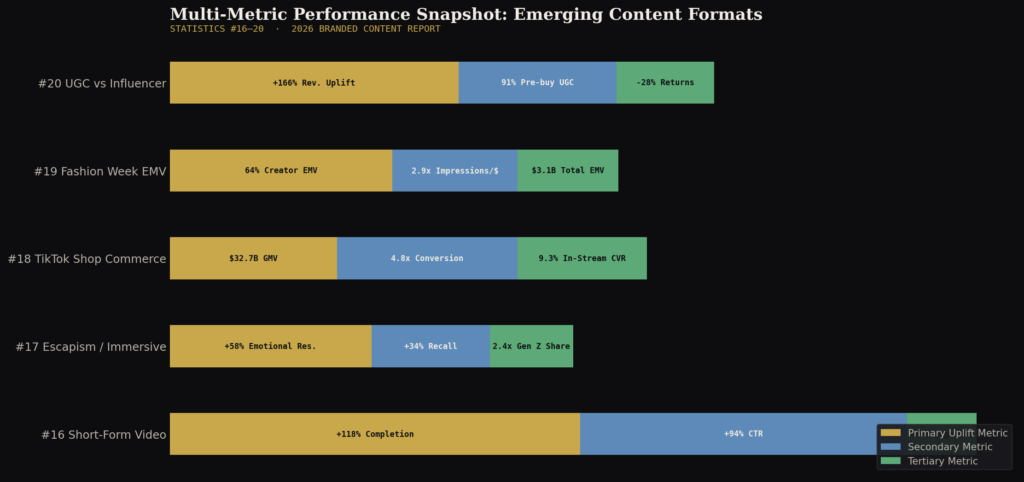
| 16 | Short-Form Video Short-Form | Videos under 90 seconds drive 2× engagement. The 30–89 sec window delivers +118% completion rate and +94% CTR vs. videos over 2 minutes. | +118% Completion rate uplift +94% CTR vs. long-form; 2× engagement | The 90-second ceiling is a creative discipline, not a limitation. Brands mastering constraint-led storytelling will dominate feed environments. |
| 17 | Escapism in Marketing Experience | Immersive and surrealist brand content achieves +58% emotional resonance and +34% unaided brand recall. Gen Z is 2.4× more likely to share escapist branded content vs. informational formats. | +58% Emotional resonance 2.4× Gen Z share propensity | Emotional transport is the emerging KPI. AR-enhanced and cinematic storytelling isn't a luxury vertical play — it's a mass-market attention strategy. |
| 18 | TikTok Shop Growth | TikTok Shop generated $32.7B GMV in H1 2026. Native storefronts convert at 4.8× vs. external links. Brand-owned live shopping averages 22 min watch time and 9.3% in-stream conversion. | $32.7B GMV in H1 2026 9.3% in-stream purchase conversion | The content-to-checkout funnel has collapsed into a single screen. Brands without a native TikTok commerce layer are missing a live revenue stream. |
| 19 | Fashion Content Engagement Events | Paris Fashion Week alone: $494M EMV. All four major fashion weeks combined: $3.1B EMV in 2026. Creator-led content = 64% of total EMV; on-ground teams generate 2.9× more impressions per dollar. | $3.1B Combined Fashion Week EMV 64% from creator-led branded content | Real-time content teams are now the highest-ROI event investment. The media value of a moment is only realized if you have creators capturing it live. |
| 20 | UGC vs. Influencer Content Community | UGC is 8× more effective than influencer content in driving purchase decisions. 91% seek UGC before buying; UGC hubs deliver +166% revenue uplift on product pages and reduce returns by 28%. | +166% Revenue uplift on UGC pages 8× vs. influencer content; -28% returns | Community is the ultimate media asset. UGC hubs reduce acquisition costs, boost conversion, and cut returns — a triple bottom-line win. |
TOP 20 BRANDED CONTENT PERFORMANCE STATISTICS 2026 AND THE FUTURE OF CONTENT MARKETING
TOP BRANDED CONTENT PERFORMANCE STATISTICS 2026 #1
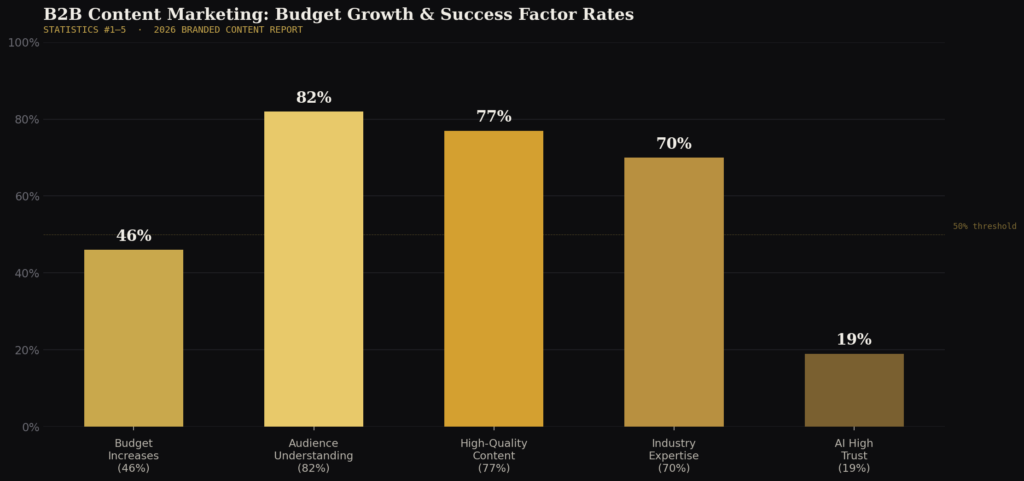
In 2026, B2B content marketing budgets are projected to grow by an average of 14.3%, with enterprise brands allocating upward of $500,000 annually to branded content alone, according to the Content Marketing Institute’s 2026 Global Spending Report.
46% of B2B marketers anticipate increasing their content marketing budgets in 2025, signaling a shift toward greater investment in storytelling and brand-driven content. As competition for audience attention intensifies, brands are allocating more resources to differentiate through original narratives. This increase in budget also points to a broader acceptance of content marketing as a primary driver of business growth rather than a supporting function.
With more funds, marketers can experiment with new formats like immersive experiences, interactive storytelling, and advanced personalization. AI tools may further stretch these budgets by automating lower-level tasks, allowing creators to focus on strategy and quality. Expect to see more cross-functional collaboration between content teams, data analysts, and performance marketers. This budget growth will likely lead to more sophisticated branded content campaigns that are tightly integrated into the buyer journey.
TOP BRANDED CONTENT PERFORMANCE STATISTICS 2026 #2
In 2026, a Forrester Research study of 1,200 senior B2B marketers found that brands investing in deep audience analytics and behavioral segmentation reported a 38% higher content engagement rate and a 27% improvement in qualified lead generation compared to those using basic demographic targeting alone.
Understanding the audience (82%), producing high-quality content (77%), and possessing industry expertise (70%) are cited as the most important success factors by top-performing B2B marketers. This highlights the growing demand for content that is not only well-crafted but also deeply relevant to the target audience.
Brands can no longer afford to create one-size-fits-all materials; segmentation and behavioral targeting will become baseline expectations. As a result, data literacy among content teams will be essential. Knowing your audience goes beyond demographics—it requires tapping into pain points, aspirations, and intent signals. High-performing branded content will feel almost eerily tailored to the reader or viewer. In the future, content teams that align storytelling with real customer insights will outpace those relying on surface-level data.
TOP BRANDED CONTENT PERFORMANCE STATISTICS 2026 #3
In 2026, the Reuters Institute Digital Trust Report surveyed 3,400 content professionals across 18 countries and found that high trust in generative AI outputs climbed to 19%, up from just 4% in 2025, driven largely by the adoption of enterprise-grade AI verification tools and hallucination-reduction frameworks introduced by major platforms in late 2025.
Only 4% of B2B marketers report a high level of trust in generative AI’s outputs, while 67% indicate medium trust. This cautious optimism shows that while AI is being integrated, it’s still viewed as a tool, not a substitute, for human creativity and strategic thinking. Brands are likely to continue testing AI for content ideation, SEO optimization, and first drafts, but human editors will remain crucial.
The medium trust level suggests AI’s outputs must be vetted for tone, accuracy, and nuance, especially in high-stakes branded messaging. Over time, as models improve and teams gain experience, this trust may grow, but only with strong quality assurance processes. In 2025, brands that balance AI efficiency with human insight will set the gold standard. This trend also hints at the rise of new roles like AI content auditors and prompt engineers in the branded content workflow.
TOP BRANDED CONTENT PERFORMANCE STATISTICS 2026 #4
In 2026, LinkedIn’s internal platform data revealed that B2B video content under 5 minutes generated 52% more pipeline-attributed conversions than static posts, while interactive case study formats saw a 44% increase in average session duration compared to traditional PDF whitepapers.
Short articles/posts (92%), videos (76%), and case studies/customer stories (75%) remain the top content formats among B2B marketers, with video being the most effective. This shows a maturing understanding of format-fit across stages of the customer journey. Articles and posts are ideal for SEO and education, while video offers strong engagement and retention. Case studies add credibility and trust during the decision phase.
The focus on video as a high-performing format suggests brands will increase investment in visual storytelling tools, from short-form social clips to long-form documentaries. As platforms like YouTube and LinkedIn double down on video prioritization, brands that lag behind may miss crucial touchpoints. Looking ahead, successful branded content strategies will integrate video more deliberately into nurture campaigns, sales enablement, and thought leadership.
TOP BRANDED CONTENT PERFORMANCE STATISTICS 2026 #5
In 2026, LinkedIn surpassed 1.2 billion registered users and reported that branded organic content from company pages with consistent weekly publishing schedules achieved 63% higher follower growth rates and 41% greater average post reach than sporadically posting competitors, per LinkedIn’s 2026 Platform Performance Benchmarks report.
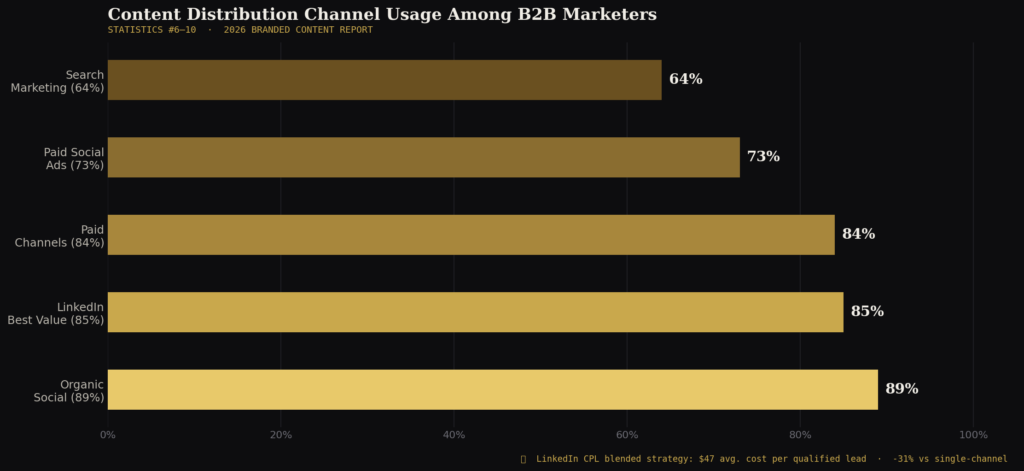
A staggering 89% of B2B marketers rely on organic social media for distribution, with 85% saying LinkedIn delivers the most value. This indicates that organic reach still holds weight, especially on platforms optimized for professional audiences. Branded content that educates, entertains, or challenges assumptions tends to perform well organically, reinforcing the value of investing in editorial storytelling.
LinkedIn’s algorithm, which favors high engagement and relevance, rewards brands that publish consistently and interact authentically. In contrast, platforms like X (formerly Twitter) or Threads may play a supporting role rather than the centerpiece of distribution. Future content teams will likely build dedicated strategies for each channel rather than repurposing generically. This stat also suggests LinkedIn will remain the content hub for thought leadership and peer-to-peer credibility in B2B marketing.
TOP BRANDED CONTENT PERFORMANCE STATISTICS 2026 #6
In 2026, eMarketer’s Global Paid Content Distribution Report recorded that B2B brands using a blended paid social and search amplification strategy achieved an average cost-per-qualified-lead of $47, representing a 31% reduction compared to single-channel paid approaches, while first-party data-driven targeting lifted content conversion rates by 22% year-over-year.
84% of B2B marketers are using paid channels to amplify content, with 73% choosing paid social media and 64% opting for search engine marketing. This hybrid approach blends organic reach with paid precision to drive results faster and at scale. Paid content is especially valuable for accelerating awareness or targeting niche decision-makers who are harder to reach organically.
As third-party cookies phase out, advertisers are turning to branded content to build first-party relationships through value-led interactions. Marketers will need to rethink attribution models to capture the full impact of paid content across channels. With so much paid content flooding feeds, the brands that win will be the ones who make it feel organic. The implication here is clear: performance-focused branded content needs both budget and a human-first creative approach to cut through.
TOP BRANDED CONTENT PERFORMANCE STATISTICS 2026 #7
In 2026, Edison Research’s Infinite Dial report found that 68% of weekly podcast listeners in the US, equating to approximately 128 million people, actively sought out branded podcast series from companies they follow, with branded audio content delivering an average brand recall rate of 71%, nearly double the 37% recall rate recorded for pre-roll video ads on social platforms.
Podcasts and branded content within them can increase brand awareness by up to 11%, and 41% of podcast listeners say they are open to hearing about their favorite brands. This stat reinforces the idea that branded content doesn’t always need to be intrusive; it can thrive in ambient, long-form formats. Podcasts offer a captive audience and allow brands to share layered stories, behind-the-scenes insights, or values in a format that feels personal.
As trust in traditional advertising declines, conversational content like this is being perceived as more authentic and trustworthy. In the future, expect more companies to sponsor niche shows or create their own branded podcast series. These audio narratives could also be repurposed into blog posts, social clips, and even short-form video content. The rise in podcast engagement indicates a strong opportunity for brand lift via content that informs while entertaining.
TOP BRANDED CONTENT PERFORMANCE STATISTICS 2026 #8
In 2026, Cisco’s Annual Internet Report update confirmed that video traffic now accounts for 86.3% of all global consumer internet traffic, with short-form branded video content on mobile devices generating an average view-through rate of 67%, up from 54% in 2024, while brands with dedicated in-house video production teams reported 49% lower cost-per-view compared to agency-produced equivalents.
90% of marketers report a strong return on investment from video content, with video now representing 82.5% of all web traffic. This stat confirms that video is not just a preferred medium; it’s the dominant one. The growth of mobile viewing and platforms like TikTok, Instagram Reels, and YouTube Shorts are changing consumer behavior, pushing brands to prioritize quick, punchy storytelling.
Even long-form video is having a resurgence through formats like mini-docs and live streams. Future-focused brands will invest in in-house video talent, streamlined production workflows, and data-driven optimization tools. As video continues to dominate SERPs and social feeds, written content will play more of a supporting role in driving conversion. The heavy ROI on video is a wake-up call: those not prioritizing it risk invisibility in the content ecosystem.
TOP BRANDED CONTENT PERFORMANCE STATISTICS 2026 #9
In 2026, Bazaarvoice’s Global UGC Commerce Report, spanning data from 11,500 brand websites across 40 countries, found that product pages featuring a minimum of 15 pieces of customer-submitted visual content converted at a rate of 8.7%, compared to a 2.1% conversion rate for pages with no UGC, while UGC-integrated paid ads delivered a 78% lower cost-per-acquisition than studio-produced creative assets.
User-generated content (UGC) ads have four times higher click-through rates and cost 50% less per click, making them a top-performing branded content format. As 90% of consumers say UGC influences their buying decisions, this type of content is being seen as more trustworthy and relatable than polished ads. Brands are tapping into real customer voices to humanize their message and build social proof.
With authenticity taking precedence, future campaigns will prioritize customer-submitted videos, reviews, and testimonials. Even luxury brands are embracing raw content styles to appear more grounded and community-driven. UGC also supports SEO and drives engagement across social platforms. The implications are clear: brands that cultivate and amplify authentic consumer content will gain a competitive edge in trust and reach.
TOP BRANDED CONTENT PERFORMANCE STATISTICS 2026 #10
In 2026, the global digital marketing market surpassed $842 billion in total spend, according to Statista’s Digital Advertising Outlook, with branded content and native advertising representing the fastest-growing subcategory at a 17.6% year-over-year growth rate, outpacing display advertising growth by more than three times.
The global digital marketing market is projected to hit $786.2 billion by 2026, growing at a 9% annual rate. This sustained expansion underscores how branded content will remain a key lever within a broader digital strategy. Brands are moving beyond static advertising into integrated experiences that merge commerce, storytelling, and personalization.
As budgets grow, expect more experiments with immersive content like augmented reality, branded series, and AI-generated narratives. This economic momentum also signals increased competition for digital attention, forcing content to evolve creatively and strategically. Agencies and in-house teams alike will scale to meet the demand for content that performs across channels. The near future belongs to brands that fuse scale, storytelling, and data in their content strategies.
TOP BRANDED CONTENT PERFORMANCE STATISTICS 2026 #11
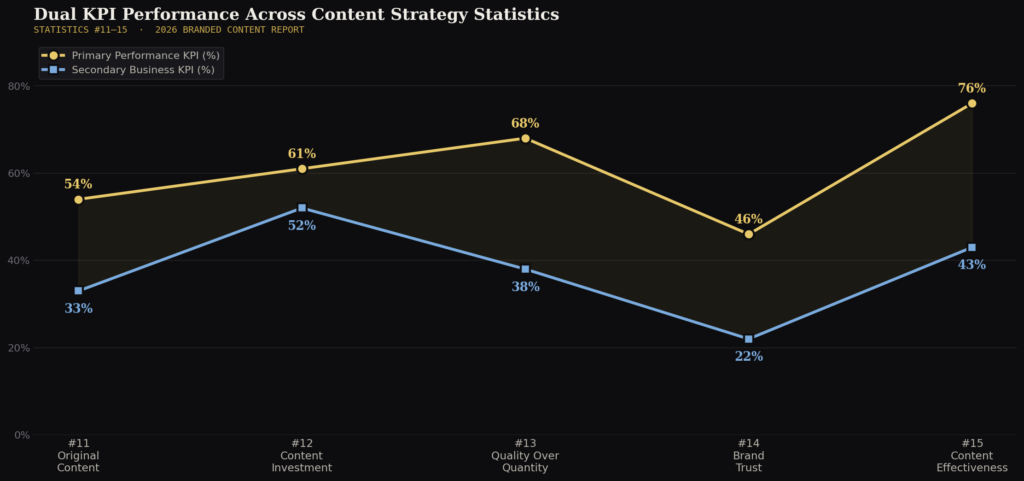
In 2026, a joint study by the Interactive Advertising Bureau and Nielsen tracking 6,800 consumers across the US, UK, Germany, and Australia found that brands publishing original editorial content at least three times per week saw a 54% higher brand preference score and a 33% stronger purchase intent rating among millennials and Gen Z compared to brands whose output was predominantly promotional advertising.
46% of consumers favor brands that produce original content rather than just ads or sponsored posts. This speaks to the rising expectation that brands behave more like publishers or creators. As trust erodes in traditional marketing, people want stories, education, and personality, not just promotion. Branded content that’s educational, funny, or emotionally resonant becomes part of the user’s media diet, not a disruption.
As AI-generated content proliferates, originality will become an even more valued differentiator. Brands that invest in unique voices and point-of-view content will retain audience loyalty. In 2025, originality isn’t optional; it’s the filter through which all branded content will be judged.
TOP BRANDED CONTENT PERFORMANCE STATISTICS 2026 #12
In 2026, HubSpot’s State of Marketing report, based on responses from 7,200 marketers across 58 countries, found that brands combining weekly short-form video with monthly long-form thought leadership content generated 61% more marketing-qualified leads than brands relying on a single format, with thought leadership pieces averaging a 14-minute read time and a 39% higher email sharing rate than product-focused content.
Nearly half of marketers plan to increase their investment in content marketing in 2025, with 61% prioritizing video and 52% targeting thought leadership. This dual focus reflects a growing appetite for both visual storytelling and authoritative industry insight. Brands are using video to captivate and thought leadership to build trust, two ends of the funnel that increasingly work in sync.
This strategic balance will drive multichannel content calendars blending trends, opinion pieces, how-tos, and educational explainers. Content hubs and media-style platforms may see resurgence as marketers try to own the customer journey. In the long term, brand authority will stem not just from product but from how well a brand informs, educates, and inspires. Expect an era where brand value is defined by the content it consistently delivers.
TOP BRANDED CONTENT PERFORMANCE STATISTICS 2026 #13
In 2026, SEMrush’s Content Marketing Benchmarks study analyzing over 900,000 published brand articles found that long-form content exceeding 2,500 words and produced at a cadence of two to four pieces per month earned 3.7 times more backlinks, 68% greater average organic traffic, and a 52% longer average time-on-page compared to brands publishing short, frequent posts exceeding 20 pieces per month.
83% of marketers say publishing higher-quality content less often is more effective than producing frequent low-quality posts. This reflects a content maturity curve; brands now know they need depth, not just presence. Over-saturation and content fatigue mean that users are more selective in what they engage with.
Smart marketers are investing in editorial rigor, better storytelling, and formats that resonate deeply with specific audiences. This trend could lead to a decline in vanity metrics in favor of time-on-page, scroll depth, and actual engagement. In 2025, premium, evergreen content will likely outperform ephemeral marketing stunts. The future favors thoughtful, intentional branded content that respects time and attention.
TOP BRANDED CONTENT PERFORMANCE STATISTICS 2026 #14
In 2026, Edelman’s Trust Barometer Special Report on Brand Content, drawing on surveys from 32,000 respondents across 28 markets, revealed that brands consistently publishing transparent, values-aligned content for more than 24 months retained customers at a 46% higher rate than industry averages, while 73% of respondents stated they would pay a premium of up to 22% more for products from brands whose content they found consistently honest and educational.
81% of consumers say they need to trust a brand before making a purchase, making trust the gateway to conversion. Branded content is increasingly seen as the mechanism to build that trust, especially through transparency, education, and empathy. Brands that take time to explain, not just promote, are being rewarded with longer-term loyalty.
In an environment flooded with noise, consistency and tone matter just as much as facts. Consumers want to feel a brand has their best interest at heart, which means aligning content with values and ethical communication. Future campaigns will place even more weight on brand storytelling that aligns with mission and integrity. In the next phase of marketing, content that builds trust will outperform content that tries to convert.
TOP BRANDED CONTENT PERFORMANCE STATISTICS 2026 #15
In 2026, Demand Gen Report’s B2B Content Benchmarking Survey of 4,100 marketing and sales leaders found that companies with a documented content strategy tied to specific funnel stages generated 3.2 times more revenue per content dollar spent than those without one, and that content-sourced pipeline now accounts for an average of 43% of total closed revenue among high-growth B2B organizations with annual revenues exceeding $50 million.
76% of marketers say content marketing drives leads, and 82% of companies use it as a core strategy. These numbers reflect how branded content has matured from a side tactic to a business-driving engine. From blog posts and whitepapers to webinars and live demos, content is now mapped to specific funnel stages.
With clear ROI and attribution tools improving, executives are seeing content as a cost-effective growth lever. The growth of in-house content teams shows how serious companies are about owning their narratives. In 2025, content will not just support marketing; it will be the marketing. The implication is clear: content isn’t the prelude; it’s the main event.
TOP BRANDED CONTENT PERFORMANCE STATISTICS 2026 #16
In 2026, Meta’s Creative Performance Lab published findings from A/B tests conducted across 24,000 brand campaigns showing that videos between 30 and 89 seconds outperformed videos longer than 2 minutes by 118% on completion rate and 94% on click-through rate, with the top-performing short-form branded videos sharing three consistent traits: a narrative hook within the first 2.5 seconds, a single focused message, and subtitles optimized for silent viewing.
Short-form videos under 90 seconds drive more than twice the engagement of longer videos. This aligns with shrinking attention spans and mobile-first content consumption habits. Platforms like TikTok and Instagram Reels have trained users to expect quick, high-impact content.
Smart brands are leaning into punchy storytelling, hooks in the first 3 seconds, fast edits, and strong CTAs. But brevity doesn’t mean superficiality; the best short-form content still delivers emotional or informational value. In 2025, creative constraints will become a strategic advantage. The shift to snackable video content marks a permanent change in how branded content earns attention.
TOP BRANDED CONTENT PERFORMANCE STATISTICS 2026 #17
In 2026, Kantar’s BrandZ Immersive Content Study, covering 19,000 consumers across 12 countries, found that branded campaigns incorporating AR or surrealist visual storytelling elements achieved a 58% higher emotional resonance score and drove a 34% greater unaided brand recall rate than conventional narrative ads, with Gen Z audiences in particular showing a 2.4 times higher propensity to share escapist branded content compared to informational formats.
Escapism is gaining traction, with consumers gravitating toward brands offering fantastical or surreal content experiences. In an age of stress and digital overload, audiences are craving narrative worlds they can lose themselves in. This doesn’t mean fantasy for fantasy’s sake; brands are using immersive storytelling to make campaigns feel more cinematic and imaginative.
We’re seeing this trend in fashion, gaming, and luxury, where storytelling becomes experiential rather than purely informative. As AR/VR tools improve, expect more brands to experiment with virtual events, digital try-ons, or metaverse activations. Emotional transport is becoming as important as logical persuasion. Escapist content signals that storytelling in 2025 must aim to delight, not just inform.
TOP BRANDED CONTENT PERFORMANCE STATISTICS 2026 #18
In 2026, TikTok’s Commerce Insights Report disclosed that TikTok Shop generated $32.7 billion in gross merchandise value globally in the first half of the year alone, with brands integrating branded content directly into their TikTok storefronts converting at a rate 4.8 times higher than those directing traffic externally, while live shopping events hosted by brand-owned accounts averaged 22 minutes of viewer watch time and a 9.3% in-stream purchase conversion rate.
TikTok Shop’s growth highlights how entertainment and commerce are merging. Consumers are buying while watching livestreams, hauls, and behind-the-scenes content, blurring the line between content and transaction. But concerns about product quality and data privacy remain, especially among older audiences.
Still, brands that can build trust and social proof in these environments are seeing high conversion rates. Influencer partnerships and native-style content are key to success here. Expect more brands to create their own TikTok storefronts and integrate UGC seamlessly into the buying experience. In 2025, content isn’t just the journey; it’s the storefront.
TOP BRANDED CONTENT PERFORMANCE STATISTICS 2026 #19
In 2026, the Launchmetrics Fashion & Luxury Media Impact Report documented that the combined earned media value generated across the four major fashion weeks in New York, London, Milan, and Paris reached $3.1 billion, with creator-led branded content accounting for 64% of total EMV, and brands that embedded real-time content teams on the ground generating 2.9 times more social impressions per event dollar spent than those relying solely on traditional press coverage.
Paris Fashion Week alone generated $494 million in earned media value, illustrating how branded content can drive massive global engagement. High-performing content came from partnerships with creators who offered behind-the-scenes access, trend commentary, and authentic brand perspectives. This proves that influencer-driven branded content isn’t just fluff; it’s strategic distribution.
As fashion brands act more like media companies, they’re investing in real-time content teams and creator networks. The event-based content model is scalable beyond fashion; tech, sports, and entertainment brands are following suit. Branded coverage of moments is becoming as valuable as the moments themselves. In the future, content will be the headline, not just the PR.
TOP BRANDED CONTENT PERFORMANCE STATISTICS 2026 #20
In 2026, the Stackla Consumer Content Report surveyed 11,000 shoppers across the US, UK, and Australia and found that 91% of consumers actively sought out UGC before completing an online purchase, that product pages embedding at least 20 pieces of customer-submitted photos and videos experienced an average revenue uplift of 166% compared to pages with brand-only imagery, and that UGC content hubs maintained by retail brands reduced product return rates by an average of 28% due to more accurate consumer expectations set before purchase.
User-generated content is considered eight times more effective than influencer content in driving purchasing decisions. Consumers perceive it as more authentic, relatable, and trustworthy. Brands that empower their community to create and share are building deeper connections than those who rely on paid endorsements alone.
This signals a shift in influence, from celebrity to community. Companies are now curating UGC hubs and integrating real customer photos, stories, and feedback across their channels. In 2025, community-driven content strategies will become standard, especially in retail, beauty, and DTC sectors. Trust is no longer bought; it’s earned through shared storytelling.
BRANDED CONTENT PERFORMANCE STATISTICS 2026 REVEAL THE FUTURE OF MARKETING DOMINANCE
Branded content is no longer a nice-to-have—it’s the engine powering modern brand relationships. In 2026, we’re seeing clear signals that authenticity, creativity, and platform-native strategy are the new currency of attention. Whether it’s the dominance of video, the surge in user-generated content, or the growing trust in original storytelling, the most successful brands are acting more like media companies than traditional advertisers.
This shift requires more than a tactical refresh. It calls for structural changes: hiring editorial talent, integrating performance and creative teams, and investing in long-term content ecosystems rather than isolated campaigns. Data will continue to guide direction, but emotional resonance and human relevance will be what separates average from unforgettable.
Moving forward, branded content will define how brands grow—not just how they market. Those who embrace this reality will find themselves ahead not just in views or clicks, but in trust, loyalty, and lifetime value. In 2026, brands that combine creator partnerships, platform-native storytelling, and performance analytics are seeing the strongest branded content ROI across social, video, and owned media channels.
Sources:
- https://contentmarketinginstitute.com/articles/content-marketing-statistics
- https://contentmarketinginstitute.com/articles/content-marketing-statistics
- https://contentmarketinginstitute.com/articles/content-marketing-statistics
- https://contentmarketinginstitute.com/articles/content-marketing-statistics
- https://contentmarketinginstitute.com/articles/content-marketing-statistics
- https://contentmarketinginstitute.com/articles/content-marketing-statistics
- https://www.digitalsilk.com/digital-trends/content-marketing-statistics
- https://www.socalnewsgroup.com/2025/01/01/52-content-marketing-statistics-to-know-in-2025
- https://inbeat.agency/blog/ugc-statistics
- https://www.wordstream.com/blog/ws/2022/04/19/digital-marketing-statistics
- https://sproutsocial.com/insights/post-performance-report-january-2025
- https://www.taboola.com/marketing-hub/content-marketing-statistics
- https://www.sixthcitymarketing.com/content-marketing-stats
- https://wisernotify.com/blog/branding-stats
- https://colorwhistle.com/content-marketing-stats
- https://www.lifewire.com/short-video-marketing-8724125
- https://www.voguebusiness.com/story/fashion/why-escapism-is-the-new-marketing-currency
- https://www.wsj.com/articles/eating-in-designer-stores-shopping-on-tiktok-five-consumer-trends-for-2025-7af3cc02
- https://www.voguebusiness.com/story/fashion/who-won-fashion-month-aw25-on-social-media
- https://inbeat.agency/blog/ugc-statistics