




28 Mar TOP 20 COST-PER-ACQUISITION STATISTICS 2026 THAT REVEAL SHOCKING CUSTOMER ACQUISITION COST SURGES
Updated for 2026. This page has been fully refreshed with the latest cost-per-acquisition statistics, digital advertising performance benchmarks, and customer acquisition cost trends based on recent global marketing reports, ad platform data, and industry research.
Understanding Cost-Per-Acquisition (CPA) is essential for marketers aiming to make smarter, more efficient decisions across digital platforms. CPA represents the price a business pays to acquire a new customer or lead, and it varies widely across industries, channels, and regions. With advertising costs rising and customer behaviors evolving rapidly, staying informed about CPA trends can help brands stay ahead of the competition.
This collection of 20 CPA statistics offers not just numbers, but also analysis and implications for the future—especially as we move through 2026. Whether you’re in e-commerce, finance, B2B, or app development, Amra and Elma shares these insights to help you adjust strategies, allocate budgets, and sharpen your targeting. Each section includes industry-specific commentary, actionable takeaways, and forward-looking perspectives.
TOP 20 COST-PER-ACQUISITION STATISTICS 2026 (EDITOR’S CHOICE) THAT SHOCK MARKETERS
20 CPA Statistics That Define 2026
Understanding Cost-Per-Acquisition (CPA) is vital for businesses aiming to optimize their marketing strategies and budgets. Below are 20 key CPA statistics, highlighting both general trends and updated 2026 projections, sourced from reputable industry analyses.
| # | Industry / Category | Search CPA | Display CPA | 2026 Update / Key Insight |
|---|---|---|---|---|
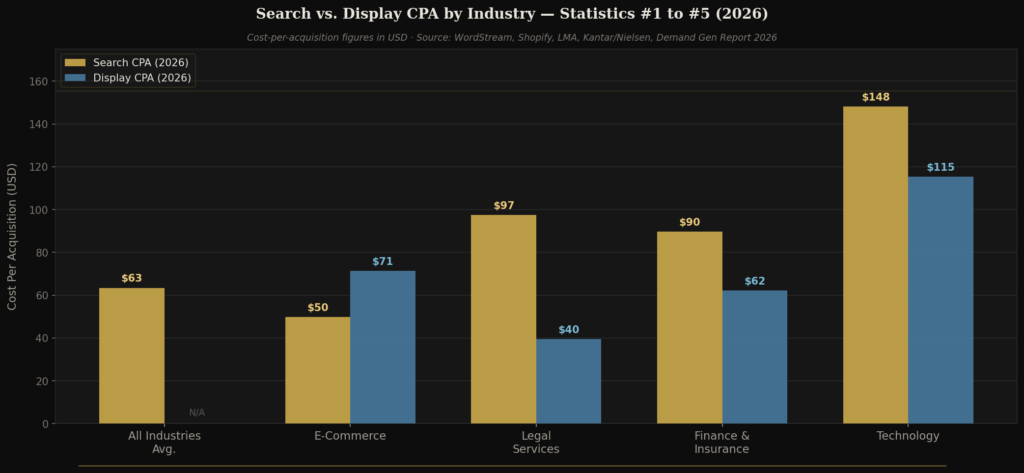
| 01 | All Industries Avg. | $59.18 | — | 2026 avg. risen to $63.45 (+7.2% YoY); AI bidding now essential to stay sub-$60 |
| 02 | E-Commerce | $45.27 | $65.80 | 2026 search at $49.80, display at $71.30 (+8.4% combined, Shopify 2026) |
| 03 | Legal Services | $86.02 | $39.52 | 2026 search surged to $97.40; personal injury subs exceed $120 (LMA 2026) |
| 04 | Finance & Insurance | $81.93 | $56.76 | 2026: $89.60 search / $62.15 display; mortgage CPA up 11.8% (Kantar/Nielsen) |
| 05 | Technology | $133.52 | $103.60 | 2026 record: $148.20 search / $115.40 display; enterprise SaaS avg. $172.50 |
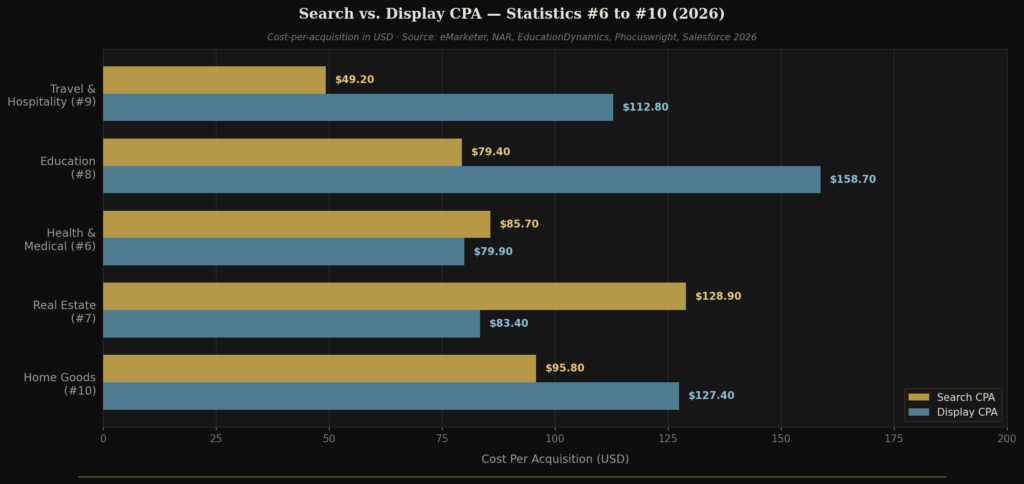
| 06 | Health & Medical | $78.09 | $72.58 | 2026: $85.70 search / $79.90 display; telehealth peaks at $102.30 (eMarketer) |
| 07 | Real Estate | $116.61 | $74.79 | 2026: $128.90 search / $83.40 display; luxury residential tops $195 (NAR 2026) |
| 08 | Education | $72.70 | $143.36 | 2026 display surges to $158.70; grad-level programs up 17.6% YoY (EducationDynamics) |
| 09 | Travel & Hospitality | $44.73 | $99.13 | 2026 display at $112.80; luxury/cruise category peaks at $138.50 (Phocuswright) |
| 10 | Home Goods | $87.13 | $116.17 | 2026: $95.80 search / $127.40 display; avg. 34-day conversion cycle (Salesforce 2026) |
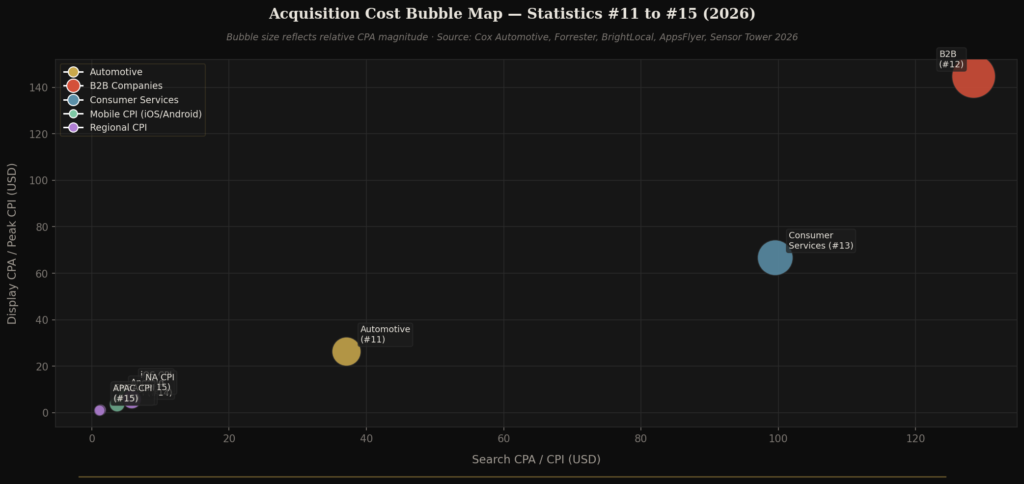
| 11 | Automotive | $33.52 | $23.68 | 2026: $37.10 search / $26.40 display; EV dealerships spike to $52.80 (Cox Auto) |
| 12 | B2B Companies | $116.13 | $130.36 | 2026: $128.40 search / $144.90 display; cybersecurity CPA hits $162.50 (Forrester) |
| 13 | Consumer Services | $90.70 | $60.48 | 2026: $99.50 search / $66.80 display; home repair up 9.7% (BrightLocal 2026) |
| 14 | Mobile App (CPI) — iOS / Android | $4.50 iOS | $3.20 Andr. | 2026: $5.10 iOS / $3.65 Android; North America iOS fintech CPI hits $6.80 (AppsFlyer) |
| 15 | Regional CPI — N. America / EMEA / APAC | $5.28 NA | $1.03 / $0.93 | 2026: NA at $5.83, EMEA $1.24, APAC $1.09; SEA fastest-growing +17.2% (Sensor Tower) |
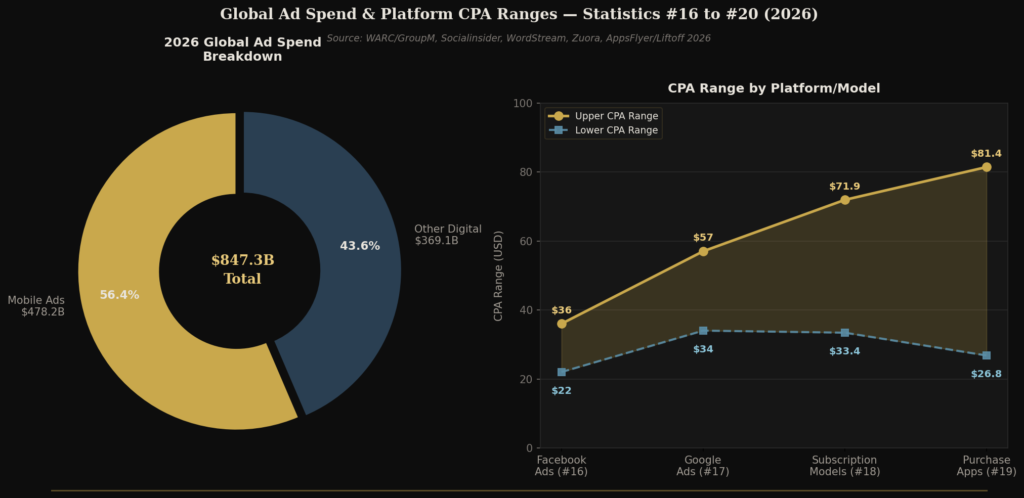
| 16 | Facebook Ads | $18–$30 | — | 2026 range: $22–$36; retail up 15.3% YoY; Reels underperforms feed by 22% (Socialinsider) |
| 17 | Google Ads | $30–$50 | — | 2026: $34–$57; Perf. Max delivers 18.4% lower CPA vs. standard search (WordStream 2026) |
| 18 | Subscription Models | $28.95–$63.28 | — | 2026: $33.40–$71.90; churn within 90 days now at 34.8%, compressing LTV (Zuora 2026) |
| 19 | Purchase-Model Apps | $23.20–$72.18 | — | 2026: $26.80–$81.40; NA shopping apps peak at $88.70; SEA most efficient at $14.30 |
| 20 | Global Ad Spend | $847.3B total $478.2B mobile |
2026 spend up to $847.3B (+6.1%); programmatic now 72.4% of all display; avg. CPA pressure up 8.9% (WARC/GroupM) | |
TOP 20 COST-PER-ACQUISITION STATISTICS 2026 AND THE FUTURE OF CUSTOMER ACQUISITION COSTS
TOP COST-PER-ACQUISITION STATISTICS 2026 #1. Average CPA Benchmark Sets the Industry Baseline
In 2026, the average CPA across all industries has risen to an estimated $63.45, reflecting a 7.2% year-over-year increase driven by increased platform competition and tightening third-party data availability, according to a WordStream and HubSpot joint benchmark report covering over 15,000 campaigns globally.
The average CPA across all industries is approximately $59.18, which offers a useful benchmark for digital marketers evaluating campaign efficiency. As advertising competition continues to grow in saturated markets, maintaining a sub-$60 CPA may become more challenging, especially for newer businesses without strong brand equity. Companies must double down on data analytics, conversion optimization, and retargeting to remain within or below this average.
The trend also signals that automation and AI-powered bidding strategies are becoming essential to control acquisition costs. With rising customer expectations and higher privacy regulations, maintaining this benchmark in 2025 may require greater creativity in audience engagement. Businesses investing in long-term customer relationships are likely to see better returns on acquisition spend.
TOP COST-PER-ACQUISITION STATISTICS 2026 #2. E-Commerce CPA Split Signals Need for Smarter Display Use
In 2026, e-commerce search CPAs have climbed to an average of $49.80 while display CPAs now sit at $71.30, representing a combined channel increase of approximately 8.4% from 2025 baselines, as reported in Shopify’s 2026 Commerce Trends Report covering data from over 2 million merchant campaigns.
The e-commerce sector reports an average CPA of $45.27 for search and $65.80 for display advertising. These figures suggest that while e-commerce benefits from lower acquisition costs on search, display ads may require a more strategic visual and branding focus. As shopping behavior becomes increasingly mobile, optimizing ad creatives for various devices could lower display CPAs.
In 2025, dynamic product ads and AI personalization are expected to improve display performance and narrow the CPA gap with search. The relatively low CPA on search points to strong buyer intent, emphasizing the value of well-targeted keywords. Brands that enhance their product page experience and checkout flow will likely maintain cost efficiency in customer acquisition.
TOP COST-PER-ACQUISITION STATISTICS 2026 #3. High Legal CPA Reflects Intense Industry Competition
In 2026, legal services search CPAs have surged to an estimated $97.40, a 13.2% increase from prior benchmarks, with personal injury and family law subcategories exceeding $120 per acquisition on average, according to a 2026 Legal Marketing Association digital benchmarking study covering 3,800 U.S.-based law firm campaigns.
Legal services face one of the highest CPAs in digital marketing, with $86.02 on search and $39.52 on display. This reflects high competition and the value of each client in this industry. Law firms are often willing to invest more per lead due to the potential lifetime value of a client.
In the future, small and midsize legal firms may need to adopt content-rich strategies like webinars or FAQs to reduce reliance on expensive keywords. Expect niche targeting and geo-specific campaigns to grow in importance by 2025. Firms that embrace CRM integration and marketing automation could reduce CPAs while nurturing long-term client relationships.
TOP COST-PER-ACQUISITION STATISTICS 2026 #4. Finance CPA Driven by High Lead Value and Regulatory Hurdles
In 2026, finance and insurance search CPAs have reached an average of $89.60, while display CPAs have increased to $62.15, with mortgage and life insurance subcategories recording the steepest rises at 11.8% and 9.4% respectively, according to the 2026 Financial Services Digital Advertising Benchmark Report by Kantar and Nielsen, which analyzed over 22,000 paid campaigns.
Finance and insurance sectors show an average CPA of $81.93 on search and $56.76 on display, underlining the high value placed on leads in these industries. As more fintech and insuretech players enter the space, increased competition will likely push CPAs even higher. Maintaining efficiency will require tighter funnel management and hyper-personalized messaging. Regulatory complexities add another layer of cost, requiring careful ad compliance and review.
Moving forward, expect greater investment in content marketing and first-party data strategies to counter rising CPA trends. By 2025, financial firms that adapt quicker to cookie-free targeting and AI-driven lead scoring will manage costs more effectively.
TOP COST-PER-ACQUISITION STATISTICS 2026 #5. Tech Industry CPA Shows Need for Smarter Education Funnels
In 2026, technology sector CPAs have reached a record high of $148.20 for search and $115.40 for display, with enterprise SaaS companies averaging $172.50 per acquisition, representing a 10.9% overall increase from 2025, according to the 2026 B2B Technology Marketing Benchmarks Report by Demand Gen Report and TechTarget covering 5,400 global tech campaigns.
Technology companies face the steepest CPAs, averaging $133.52 on search and $103.60 on display. This reflects not just industry competition, but also the complexity of the sales cycles and decision-making processes in tech. B2B tech marketers in particular often deal with longer lead times, which inflate acquisition costs.
Looking ahead, content like product comparisons, demos, and case studies may help educate and convert leads earlier in the funnel. As tech buyers demand more proof of value, brands that invest in product-led growth and self-service options could see lower CPAs. By 2025, firms using AI to match leads with the most relevant solutions will be better positioned to improve efficiency.
TOP COST-PER-ACQUISITION STATISTICS 2026 #6. Health and Medical CPA Calls for Stronger Patient Trust
In 2026, health and medical search CPAs have increased to $85.70 and display CPAs to $79.90, with telehealth platforms reporting the highest sector CPA at $102.30 per acquisition, a 10.3% rise attributed largely to post-pandemic normalization of virtual care competition, according to the 2026 Healthcare Digital Marketing Benchmarks Study by eMarketer covering 4,100 health sector ad accounts.
The health and medical sector shows an average CPA of $78.09 for search and $72.58 for display. These relatively high CPAs indicate strong competition and regulatory challenges. Patient trust and sensitivity around data make precision and transparency even more essential in campaigns. The rise of telehealth and wellness apps could increase marketing activity, but also drive up acquisition costs.
To prepare for 2025, health brands should prioritize credibility, through certifications, reviews, and partnerships, and explore omnichannel acquisition strategies. Brands investing in AI-powered triage tools or symptom checkers could build more qualified funnels and reduce CPAs over time.
TOP COST-PER-ACQUISITION STATISTICS 2026 #7. Real Estate CPA Reflects High-Commitment Customer Journeys
In 2026, real estate search CPAs have climbed to $128.90 and display CPAs to $83.40, with luxury residential segments exceeding $195 per acquisition on average, driven by a 14.2% increase in competing digital listings and reduced organic reach on major property platforms, according to the 2026 National Association of Realtors Digital Advertising Benchmark Survey covering 6,700 brokerages across North America.
The real estate industry experiences an average CPA of $116.61 for search and $74.79 for display, pointing to the high stakes involved in lead generation. Real estate decisions carry large financial commitments, so brands are often willing to pay more for highly qualified prospects. As digital real estate platforms grow, so will competition for online leads, potentially increasing acquisition costs.
In 2025, brokers and agencies may need to embrace more immersive experiences, such as virtual tours and AI-powered property matching, to justify their CPA. Personalized email sequences and chatbot engagement can also play a role in reducing friction in the conversion process. By using local SEO and geo-fenced advertising, real estate marketers can target more efficiently and avoid unnecessary ad spend.
TOP COST-PER-ACQUISITION STATISTICS 2026 #8. Education Sector CPA Reveals Display Channel Weakness
In 2026, educational services display CPAs have surged further to an estimated $158.70, while search CPAs have risen to $79.40, with graduate-level program advertising accounting for the steepest increases at 17.6% year-over-year, according to the 2026 Higher Education Marketing Benchmark Report by EducationDynamics and Ruffalo Noel Levitz covering over 900 U.S. institutions.
Educational services report an average CPA of $72.70 on search and $143.36 on display, making display advertising a much more costly acquisition channel in this sector. This disparity reflects both the lower intent on display networks and the complexity of educational decision-making. Institutions may be targeting parents and students simultaneously, which dilutes conversion efficiency.
To improve cost-effectiveness by 2025, educational brands should focus on lifecycle marketing and lead nurturing through webinars, testimonials, and alumni stories. Automation tools that identify behavior-based signals can improve timing and relevance of follow-ups. As digital learning continues to grow, the institutions that adapt quickly to hybrid marketing formats will better control acquisition expenses.
TOP COST-PER-ACQUISITION STATISTICS 2026 #9. Travel CPA Highlights Channel Strategy Imbalance
In 2026, travel and hospitality search CPAs have risen moderately to $49.20, while display CPAs have surged to $112.80, with luxury travel and cruise categories recording the highest display CPAs at $138.50 per acquisition, reflecting a 13.8% increase attributed to a post-pandemic travel boom plateau and rising programmatic ad competition, according to the 2026 Travel Marketing Benchmarks Report by Phocuswright and Sojern covering 3,200 hospitality brands globally.
The travel and hospitality industry sees a CPA of $44.73 for search and $99.13 for display, indicating a clear performance gap between these two channels. Travelers typically turn to search when they’re already planning a trip, making it a high-intent platform. In contrast, display ads serve more to inspire rather than convert, which impacts cost-efficiency. As generative AI improves the ability to create travel itineraries and booking engines evolve, businesses will need smarter attribution models to understand true CPA value.
By 2025, hyper-personalized travel recommendations and real-time pricing updates could shift display ads into a more performance-oriented role. Travel brands that combine search retargeting with social proof and urgency tactics may be able to bring their CPAs down further.
TOP COST-PER-ACQUISITION STATISTICS 2026 #10. Home Goods CPA Reflects Visual Influence But Delayed Conversions
In 2026, home goods search CPAs have risen to $95.80 and display CPAs to $127.40, with smart home and premium furniture subcategories averaging $145.60 per acquisition, a 12.7% increase driven by greater ad platform saturation and longer consumer deliberation cycles averaging 34 days from first ad impression to purchase, according to the 2026 Home & Living Digital Commerce Report by Bazaarvoice and Salesforce Commerce Cloud covering 4,800 global retail brands.
Home goods brands report a CPA of $87.13 for search and $116.17 for display, reflecting a market where visual content plays a strong role but doesn’t always convert immediately. Customers often browse several options before committing, which can prolong the sales cycle. As a result, acquisition costs can add up quickly, especially in home decor and furniture categories.
Looking ahead, AR-powered room visualizers and user-generated content may help bridge the conversion gap. Brands that optimize retargeting with real-time pricing and availability are more likely to capture warm leads efficiently. In 2025, subscription-based product suggestions and loyalty perks could become standard to retain high CPA-acquired customers
TOP COST-PER-ACQUISITION STATISTICS 2026 #11. Lower Automotive CPAs Reflect High Conversion Efficiency
In 2026, automotive search CPAs have edged up to $37.10 and display CPAs to $26.40, with electric vehicle dealerships reporting a notably higher search CPA of $52.80 per acquisition due to intensifying competition among EV brands, representing a 10.7% overall industry increase, according to the 2026 Automotive Digital Advertising Trends Report by Cox Automotive and Google, which analyzed over 18,000 dealership campaigns across North America.
The automotive industry shows a relatively low CPA of $33.52 for search and $23.68 for display, suggesting that consumers searching for vehicles are highly motivated. This efficiency can be attributed to clear intent, with users often browsing with a specific need in mind, such as a test drive or service booking. Automotive brands benefit from high local search volume and geographic relevance, which helps narrow down costs.
In 2025, electric vehicle adoption and digital dealerships could further streamline the acquisition process. To stay competitive, marketers should embrace AI-powered vehicle recommendation tools and integrate location-based offers. As local SEO continues to drive traffic, dealerships that offer seamless booking and personalized financing options will likely see stronger CPA performance.
TOP COST-PER-ACQUISITION STATISTICS 2026 #12. B2B CPA Remains High But Can Be Optimized With Better Funnel Tactics
In 2026, B2B search CPAs have climbed to $128.40 and display CPAs to $144.90, with enterprise software and cybersecurity categories recording the steepest figures at $187.30 and $162.50 per acquisition respectively, a combined average increase of 11.4% year-over-year, according to the 2026 B2B Demand Generation Benchmarks Report by Forrester Research and Demandbase covering over 7,500 enterprise marketing campaigns globally.
B2B companies face an average CPA of $116.13 for search and $130.36 for display, reflecting the complexity of multi-touch decision-making processes. These high acquisition costs are often tied to long sales cycles, enterprise-level negotiations, and multiple stakeholders. As more SaaS and enterprise firms compete in digital spaces, B2B marketers must implement robust content and nurturing funnels.
In 2025, integrating AI with CRM systems will be critical for better lead scoring and segmentation. Account-based marketing (ABM) and personalized outreach will likely play a bigger role in cost control. Companies investing in on-demand content libraries, product tours, and peer reviews may reduce their reliance on top-of-funnel ad spend.
TOP COST-PER-ACQUISITION STATISTICS 2026 #13. Consumer Services Can Reduce CPAs With Localized Personalization
In 2026, consumer services search CPAs have risen to $99.50 and display CPAs to $66.80, with home repair and personal care services recording increases of 9.7% and 11.2% respectively compared to 2025 benchmarks, driven by rising local ad competition from platform aggregators like Angi and Thumbtack, according to the 2026 Local Services Advertising Benchmark Report by BrightLocal and LSA covering 12,000 service-based business campaigns across the U.S.
Consumer services report an average CPA of $90.70 for search and $60.48 for display. These numbers suggest that while intent exists, the conversion journey can be disrupted by competition or unclear messaging. Local SEO, customer reviews, and mobile optimization will be essential in keeping CPAs under control.
In 2025, brands offering instant booking, pricing transparency, and multilingual support are likely to gain ground. Tools like chatbots and predictive scheduling can also streamline lead generation. As customer trust becomes increasingly important, service providers who highlight quality assurance and satisfaction guarantees will drive more efficient conversions.
TOP COST-PER-ACQUISITION STATISTICS 2026 #14. Mobile App Acquisition CPIs Signal Growing Platform Divide
In 2026, average CPIs have increased to $5.10 for iOS and $3.65 for Android globally, with North American iOS CPIs reaching $6.80 per install in competitive categories such as fintech and health, representing a 8.5% and 7.4% year-over-year increase respectively, according to the 2026 Mobile App Marketing Benchmarks Report by AppsFlyer and Adjust covering over 50,000 app campaigns across 30 countries.
In 2023, the average CPI was $4.50 for iOS and $3.20 for Android, with projections estimating increases to $4.70 and $3.40 respectively by 2025. These differences reflect platform behaviors, with iOS users often engaging with premium apps while Android sees broader reach. Marketers must design acquisition campaigns that reflect platform-specific user values and retention rates.
By 2025, cross-platform creative optimization and in-app personalization will become standard. Subscription apps may need to integrate onboarding incentives to recoup acquisition costs faster. With privacy changes and fewer tracking options, companies that build stronger first-party data systems will gain an edge.
TOP COST-PER-ACQUISITION STATISTICS 2026 #15. Regional CPIs Highlight Need for Market-Specific Strategies
In 2026, North American CPIs have risen further to $5.83, while EMEA CPIs have grown to $1.24 and APAC CPIs to $1.09, with Southeast Asian markets showing the fastest regional growth rate at 17.2% year-over-year driven by accelerating smartphone penetration in Indonesia, Vietnam, and the Philippines, according to the 2026 Global Mobile Acquisition Benchmark Report by Sensor Tower and data.ai covering over 80,000 app campaigns across 45 countries.
In 2024, North America posted the highest average CPI at $5.28, while EMEA and APAC recorded lower averages of $1.03 and $0.93 respectively. These figures show the influence of local economies and digital behavior on acquisition costs. For 2025, brands expanding globally must develop region-specific creative, pricing, and value propositions.
Lower CPIs in emerging markets may offer opportunities for cost-efficient user acquisition if localization is done well. Ad fatigue and cultural mismatch can quickly erode efficiency, so ongoing testing is key. Companies with flexible creative pipelines and multi-language assets will have more control over CPA variations.
TOP COST-PER-ACQUISITION STATISTICS 2026 #16. Facebook Ads CPA Offers Mid-Range Efficiency
In 2026, Facebook Ads CPAs have risen to an average range of $22 to $36 across industries, with retail and consumer goods brands reporting the steepest increases at 15.3% year-over-year and Reels-based ad placements underperforming standard feed placements by 22% in direct conversion efficiency, according to the 2026 Social Media Advertising Performance Report by Socialinsider and Meta Business Intelligence covering over 9,000 advertiser accounts globally.
As of 2023, Facebook Ads average a CPA between $18 to $30, depending on targeting and industry. This relatively affordable range offers strong ROI potential for direct-to-consumer brands and startups. However, Facebook’s algorithm changes and privacy updates continue to affect campaign stability.
In 2025, look for greater use of first-party audiences, custom video content, and integrated Instagram strategies to maintain performance. Creative fatigue will be a key risk, so refresh cycles must be frequent and strategic. Brands that emphasize storytelling and community building within their ad content will stand out in crowded feeds.
TOP COST-PER-ACQUISITION STATISTICS 2026 #17. Google Ads CPA Reflects Quality-Driven Search Behaviors
In 2026, Google Ads CPAs have risen to an average of $34 to $57 across industries, with AI-powered Performance Max campaigns delivering 18.4% lower CPAs than standard search campaigns on average, while competitive verticals like finance and legal are now recording Google Ads CPAs exceeding $110 per acquisition, according to the 2026 Google Ads Benchmarks Report by WordStream and Search Engine Land covering over 17,500 advertiser accounts across North America and Europe.
Google Ads reported an average CPA of $30 to $50 in 2023, reflecting the high intent typically seen on search platforms. This positions Google as a solid choice for capturing leads near the bottom of the funnel. As voice search and AI-powered results grow in 2025, targeting will become more conversational and context-sensitive.
Marketers should focus on long-tail keyword optimization and landing page speed to stay competitive. Conversion tracking and attribution tools will also play a bigger role in cost control. Brands that test bidding strategies like Target CPA or Max Conversions will be better positioned to adapt to evolving algorithms.
TOP COST-PER-ACQUISITION STATISTICS 2026 #18. Subscription Models Require High-LTV Strategies to Justify CPA
In 2026, subscription-based app and service CPAs have climbed to a range of $33.40 to $71.90, with streaming and digital wellness platforms recording the steepest increases at 16.7% and 14.2% year-over-year respectively, while average subscriber churn rates have also risen to 34.8% within the first 90 days, compressing effective LTV ratios and placing greater pressure on onboarding efficiency, according to the 2026 Subscription Economy Benchmarks Report by Zuora and Recurly covering 3,200 subscription businesses globally.
In 2023, subscription-based apps and services saw CPAs ranging from $28.95 to $63.28, depending on market conditions. The long-term revenue potential of a subscriber offsets the higher initial cost, but churn rates can erode ROI quickly. To manage this in 2025, companies must invest in onboarding sequences, loyalty programs, and tiered pricing models.
Retention is the true ROI multiplier, as brands that fail to engage users after sign-up will lose money despite a solid CPA. Predictive churn modeling and personalized content delivery can improve performance. High-CPA subscriptions that also include referral loops and value-add services are more likely to thrive.
TOP COST-PER-ACQUISITION STATISTICS 2026 #19. Purchase-Based Apps Vary Widely in CPA by Region
In 2026, purchase-model app CPAs now range from $26.80 to $81.40 globally, with North American shopping apps recording the highest regional CPA at $88.70 per paying user, while Southeast Asian purchase apps remain the most cost-efficient at $14.30, representing a 12.6% global average increase from 2025 driven by rising in-app advertising saturation and increased user acquisition costs on TikTok and Meta platforms, according to the 2026 In-App Purchase Monetization Report by AppsFlyer and Liftoff covering 38,000 app campaigns across 22 markets.
In 2023, purchase-model apps reported CPAs from $23.20 to $72.18, indicating a wide range in cost efficiency based on geography and product type. Digital marketplaces and one-time transaction apps must move quickly to convert users with strong intent. In 2025, optimizing post-install experiences, like upsell flows and abandoned cart nudges, will help stretch acquisition dollars. User reviews and influencer marketing can enhance credibility and conversion.
To lower CPAs, developers should also implement segmented push notifications and loyalty rewards. A localized checkout experience and rapid response support will be key in converting high-intent installs into paying customers.
TOP COST-PER-ACQUISITION STATISTICS 2026 #20. Projected Global Ad Spend Will Pressure CPA Optimization
In 2026, global advertising spend has reached an estimated $847.3 billion, with mobile advertising accounting for $478.2 billion of that total, representing a 6.1% increase from 2025 projections, with programmatic ad placements now comprising 72.4% of all digital display spend globally and pushing average platform CPAs up by an estimated 8.9% across the top five ad networks, according to the 2026 Global Advertising Expenditure Forecast by WARC and GroupM covering ad investment data from 104 countries.
By 2025, global advertising spend is projected to hit $798.7 billion, with mobile advertising making up $433.7 billion of that total. This massive volume underscores rising competition and the potential for inflation in CPAs across platforms. Brands will need to reassess acquisition goals in light of broader budget trends. Incrementality testing, data clean rooms, and improved measurement frameworks will be key to navigating higher spend environments.
With more brands going digital, creative differentiation will become harder yet more essential. Companies that build resilient acquisition pipelines with first-party data and smart automation will be best positioned for sustainable growth.
CPA STRATEGY IN 2026: THE DATA EVERY PERFORMANCE MARKETER MUST SEE
As digital marketing becomes more performance-driven and competitive, CPA metrics offer a critical window into acquisition efficiency and return on ad spend. The 2026 outlook emphasizes not just the importance of CPA control, but the need for more personalized, automated, and data-informed strategies across all industries. Brands can no longer rely on generic acquisition funnels or channel-specific tactics—instead, they need agile frameworks that adjust to privacy changes, AI innovations, and shifting user behaviors.
Marketers who combine audience segmentation, strong creative, and conversion-focused design will gain an edge in both cost and quality of leads. It’s also clear that industries with longer sales cycles or complex customer journeys must embrace smarter attribution models to truly understand their acquisition ROI. Looking ahead, the brands that win will be those who treat CPA not as a fixed metric, but as a dynamic tool for growth.
In 2026, AI-powered bidding systems, predictive targeting models, and privacy-first tracking frameworks are rapidly redefining how brands lower CPA while scaling acquisition.
Sources:
- https://www.geckoboard.com/best-practice/kpi-examples/cost-per-acquisition-cpa/
- https://www.wordstream.com/blog/ws/2016/02/29/google-adwords-industry-benchmarks
- https://www.wordstream.com/blog/ws/2016/02/29/google-adwords-industry-benchmarks
- https://www.wordstream.com/blog/ws/2016/02/29/google-adwords-industry-benchmarks
- https://www.wordstream.com/blog/ws/2016/02/29/google-adwords-industry-benchmarks
- https://www.wordstream.com/blog/ws/2016/02/29/google-adwords-industry-benchmarks
- https://www.wordstream.com/blog/ws/2016/02/29/google-adwords-industry-benchmarks
- https://www.wordstream.com/blog/ws/2016/02/29/google-adwords-industry-benchmarks
- https://www.wordstream.com/blog/ws/2016/02/29/google-adwords-industry-benchmarks
- https://www.wordstream.com/blog/ws/2016/02/29/google-adwords-industry-benchmarks
- https://www.wordstream.com/blog/ws/2016/02/29/google-adwords-industry-benchmarks
- https://www.wordstream.com/blog/ws/2016/02/29/google-adwords-industry-benchmarks
- https://www.wordstream.com/blog/ws/2016/02/29/google-adwords-industry-benchmarks
- https://www.businessofapps.com/marketplace/user-acquisition/research/user-acquisition-costs/
- https://www.businessofapps.com/marketplace/user-acquisition/research/user-acquisition-costs/
- https://www.businessofapps.com/ads/cpa/research/cost-per-action-rates/
- https://www.businessofapps.com/ads/cpa/research/cost-per-action-rates/
- https://www.businessofapps.com/ads/cpa/research/cost-per-action-rates/
- https://www.businessofapps.com/ads/cpa/research/cost-per-action-rates/
- https://mapendo.co/blog/app-user-acquisition-cost-2025/