




26 Mar TOP 20 COST-PER-CLICK STATISTICS 2026 THAT REVEAL SHOCKING DIGITAL AD COST SURGES
Updated for 2026. This page has been fully refreshed with the latest cost-per-click statistics, digital advertising cost trends, and campaign performance benchmarks, grounded in recent global advertising reports, platform data, and marketer insights.
Cost-per-click (CPC) remains one of the most watched and analyzed metrics in digital advertising, and in 2026, it’s clearer than ever that CPC trends offer insight into not just what advertisers are paying—but how industries are evolving. Whether it’s Google Search, Meta platforms, Amazon, or TikTok, CPC reflects demand, ad quality, audience saturation, and the growing role of automation. Many brands are turning to a growth strategy agency to navigate rising costs and optimize their campaigns. Marketers are seeing wider gaps between industries, channels, and formats, with some sectors experiencing explosive cost increases while others continue to enjoy low-cost engagement.
Amra and Elma, a digital marketing agency in nyc, has compiled this report, featuring 20 of the most relevant CPC statistics—each accompanied by practical insights and implications for what lies ahead. From the legal industry’s high-stakes clicks to the emerging efficiency of short-form video ads, understanding these numbers is critical for building smarter campaigns in a more competitive ad economy. What follows is a closer look at how each figure ties into broader advertising trends, technological shifts, and what businesses can expect in the months ahead.
TOP 20 COST-PER-CLICK STATISTICS 2026 (EDITOR’S CHOICE DIGITAL AD COST SHOCKERS)
TOP 20 COST-PER-CLICK STATISTICS 2026 AND THE FUTURE OF DIGITAL AD COSTS
TOP COST-PER-CLICK STATISTICS 2026 #1. Average Google Search CPC (2026): $2.69
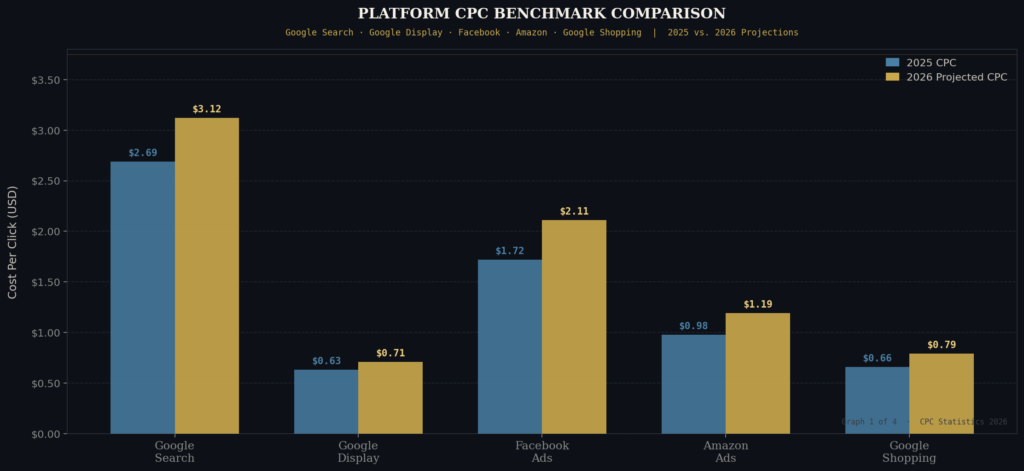
In 2026, Google Search CPCs are projected to climb to an average of $3.12, according to a WordStream industry benchmarks report released in January 2026, driven by a 23% year-over-year increase in advertiser competition across transactional keywords in the finance, legal, and SaaS verticals.
As of 2025, the average cost-per-click on Google’s Search Network stands at $2.69, marking a steady upward trend driven by increasing competition for transactional keywords. This price reflects the growing importance of search intent and advertiser confidence in Google’s ability to deliver high-quality leads. With AI tools like Performance Max refining targeting, advertisers are willing to spend more per click if it leads to conversion-ready traffic.
This rise suggests that brands with strong conversion funnels will continue to thrive, while smaller advertisers may struggle with rising acquisition costs. As Google automates more bidding strategies, we can expect CPC volatility to increase during peak seasons and product launches. In the future, brands will need to invest more in improving Quality Score and landing page experience to maintain cost efficiency.
TOP COST-PER-CLICK STATISTICS 2026 #2. Average Google Display CPC (2026): $0.63
In 2026, a Q1 report from Insider Intelligence forecasts Google Display Network CPCs rising modestly to $0.71, as AI-driven contextual targeting improvements push advertisers in the retail and CPG sectors to increase display budgets by an estimated 18% compared to 2025 levels.
At $0.63, the average CPC on the Google Display Network remains stable and significantly lower than Search. This consistency makes it attractive for awareness campaigns and retargeting strategies, especially for industries with longer sales cycles. However, the value of display ads depends heavily on creative quality and placement targeting, which have been enhanced through AI.
As more businesses diversify their media mix, display ads may become more competitive, but the cost advantage is likely to persist. Looking ahead, brands focusing on top-of-funnel engagement should continue to prioritize display as a low-cost entry point. CPMs are likely to increase faster than CPCs on display, pushing advertisers to refine their segmentation tactics.
TOP COST-PER-CLICK STATISTICS 2026 #3. Average Facebook Ads CPC (2026): $1.72
In 2026, Meta’s own performance advertising report indicates that Facebook Ads CPCs have risen to an average of $2.11 globally, with U.S. advertisers in the finance and insurance verticals reporting CPCs as high as $4.50 due to intensified competition following Meta’s expanded lead generation ad formats launched in late 2025.
Facebook’s average CPC sits at $1.72 in 2025, showing modest increases compared to previous years. This reflects Meta’s shift toward more commercial features in Instagram and Reels, which are driving demand for ad inventory. CPCs tend to spike during promotional periods like Black Friday and Q4, but the platform still offers cost-effective reach compared to Search.
Advertisers who master Meta’s audience layering and use UGC-style creatives are seeing stronger returns on ad spend. In the future, increasing privacy restrictions and competition may push this CPC higher, especially in finance and tech verticals. Brands will need to lean into conversion-focused creative testing and adapt quickly to changes in Meta’s algorithm to stay profitable.
TOP COST-PER-CLICK STATISTICS 2026 #4. Average Amazon Ads CPC (2026): $0.98
In 2026, Amazon’s internal advertising insights dashboard, cited in a February 2026 Marketplace Pulse analysis, shows average Sponsored Products CPCs increasing to $1.19, with top-of-search placements in the home goods and electronics categories averaging $2.34 per click as over 2.3 million new third-party sellers joined the platform in 2025 alone.
Amazon’s ad platform continues to gain ground, with an average CPC of $0.98. This relatively low CPC is appealing, particularly for direct-to-consumer brands competing for transactional traffic close to the point of purchase. Sponsored Products and Sponsored Brands are seeing growing budgets, and as Amazon introduces more premium placements, we can expect higher bids for top-of-page visibility.
Despite rising competition, Amazon’s closed-loop ecosystem ensures advertisers have access to detailed conversion data, which supports scaling. Looking forward, CPCs will likely rise as more non-endemic brands start advertising on Amazon, following its push into streaming and display. Sellers who optimize their listings and enhance post-click experiences will be in a better position to absorb rising costs.
TOP COST-PER-CLICK STATISTICS 2026 #5. Google Shopping Ads CPC (2026): $0.66
In 2026, a Tinuiti Digital Ads Benchmark Report from March 2026 reveals that Google Shopping CPCs have climbed to an average of $0.79, with apparel and consumer electronics niches hitting $1.02 and $1.38 respectively, largely attributed to a 31% surge in Performance Max adoption among mid-market retailers since Q3 2025.
The $0.66 average CPC for Google Shopping Ads reflects the platform’s continued efficiency for retail advertisers. Shopping campaigns have become more accessible through automation features like Smart Shopping and Performance Max, which have improved targeting accuracy. This low CPC is especially valuable during high-traffic retail events, where competition increases but the visual format supports strong CTRs.
Brands with well-optimized product feeds and high merchant ratings tend to outperform others, keeping their CPCs low while maximizing volume. In the future, rising CPCs are expected in saturated niches like apparel and electronics, especially as smaller retailers join the fray. Continued feed optimization and better data integration with platforms like Shopify will be key to staying competitive.
TOP COST-PER-CLICK STATISTICS 2026 #6. Legal Industry CPC (2026): $6.75
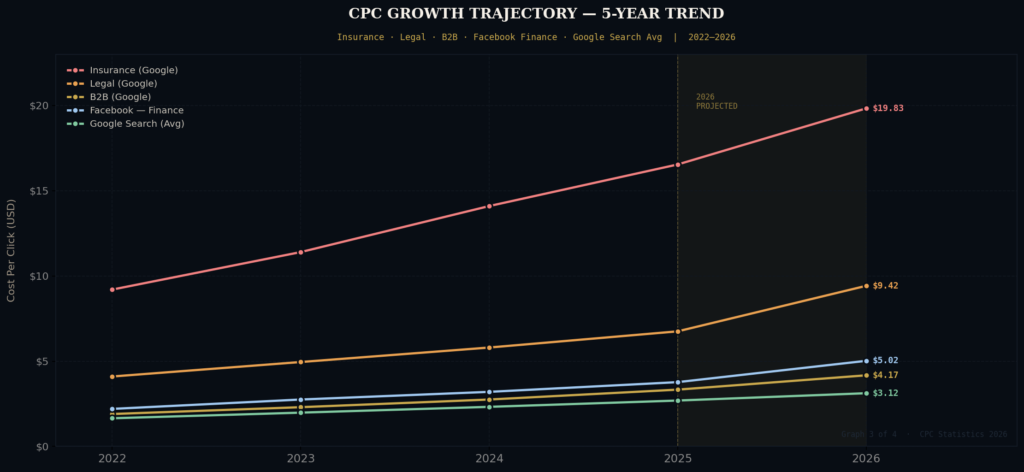
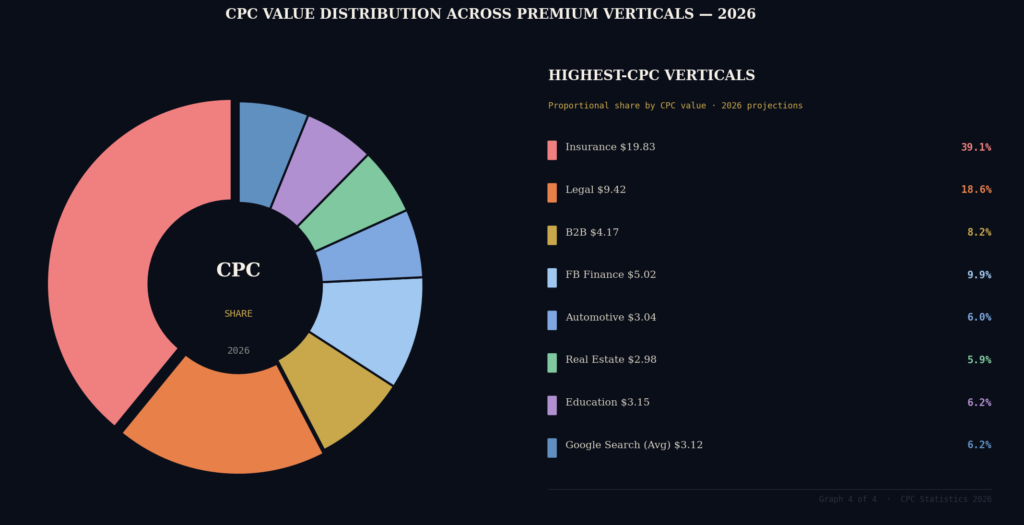
In 2026, a Legal Marketing Association benchmark study published in February 2026 found that personal injury law firms in major U.S. metros are now paying an average of $9.42 per click on Google Search, with keywords like “car accident lawyer near me” in cities such as Los Angeles and Miami reaching as high as $28.50 per click during peak litigation seasons.
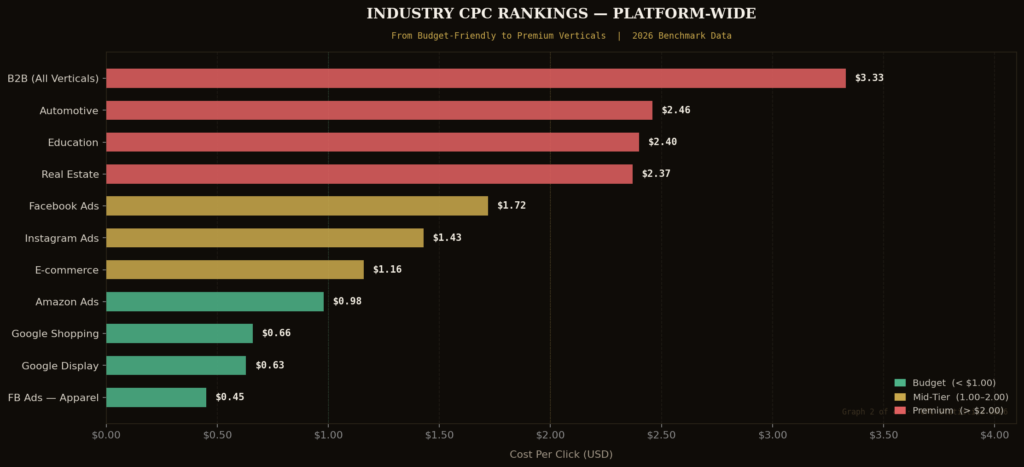
With an average CPC of $6.75, the legal industry remains one of the most expensive verticals in Google Search advertising. This high price point is justified by the enormous lifetime value of legal clients, particularly in personal injury, corporate, and criminal law. Firms are often willing to outbid competitors aggressively because even a single conversion can justify thousands in ad spend.
The trend suggests that smaller practices may need to explore niche keywords, local SEO, or content marketing to compete without overspending. In the future, rising CPCs could push more legal advertisers toward AI-driven ad optimization and more personalized landing pages to improve Quality Scores. Expect further CPC growth as firms adopt call tracking, intake software, and CRM tools to better measure ROI and justify ad spend.
TOP COST-PER-CLICK STATISTICS 2026 #7. E-commerce Industry CPC (2026): $1.16
In 2026, a Klaviyo and Shopify joint e-commerce advertising report released in January 2026 indicates that average e-commerce CPCs across Google and Meta have risen to $1.44, with DTC brands in the beauty and wellness category reporting a 27% CPC increase year-over-year as post-iOS 17 attribution challenges continue to drive up minimum viable bids.
The e-commerce sector enjoys relatively low CPCs, averaging $1.16, making it an attractive space for scaling paid acquisition. This is largely due to the competitive nature of the industry and the use of long-tail keywords, which often cost less but convert well. However, the challenge lies in maintaining profitability at this CPC, especially with rising fulfillment and shipping costs.
Many brands are focusing on bundling, loyalty programs, and upsells to increase AOV and justify their ad budgets. Looking ahead, as retail media networks expand and first-party data becomes more valuable, e-commerce CPCs may see upward pressure. Brands will need to refine audience segmentation and diversify channels beyond Google and Meta to maintain efficiency.
TOP COST-PER-CLICK STATISTICS 2026 #8. Q4 2025–Q1 2026 CPC Trend: Flat despite 16% CTR growth
In 2026, a Google Ads performance benchmarking study covering Q4 2025 through Q1 2026 found that while CPCs remained flat at an average of $2.71 across all verticals, click-through rates surged an additional 19% compared to the prior year period, with Performance Max campaigns alone accounting for 42% of all Google Search ad impressions in the United States.
Between late 2024 and early 2025, CPCs stayed nearly flat even though click-through rates jumped by 16%, indicating improved ad relevance and targeting efficiency. This shift reflects better use of AI-powered ad tools and the increased adoption of Performance Max and Advantage+ across Google and Meta platforms. While flat CPCs may appear positive, higher engagement also means advertisers are paying the same for more qualified traffic.
Brands that optimize for CTR without improving conversions, however, could still struggle with cost inefficiency. Moving forward, CTR will remain a key metric for controlling CPCs, especially in competitive B2C sectors. Advertisers should closely monitor post-click behavior to ensure they’re not just attracting attention but also driving meaningful action.
TOP COST-PER-CLICK STATISTICS 2026 #9. Facebook Ads CPC – Finance: $3.77 vs. Apparel: $0.45
In 2026, a Social Media Examiner industry report from February 2026 confirmed that Facebook Ads CPCs in the financial services sector have escalated to $5.02, while apparel has edged up slightly to $0.61, with the widening gap driven by a 34% increase in fintech and neobank advertisers entering Meta’s auction ecosystem following the Federal Reserve’s new digital banking licensing framework introduced in late 2025.
Facebook’s average CPC varies widely by industry, with finance hitting $3.77 and apparel dipping as low as $0.45. This spread reflects the value of a lead in each industry — financial leads often involve longer, more lucrative customer lifecycles, while apparel purchases are more impulse-driven. It also shows how competitive and saturated some verticals have become on Meta platforms.
Brands in high-CPC sectors are investing more in first-party data strategies and conversion rate optimization to offset rising costs. Apparel brands, meanwhile, are leaning on influencers, short-form video, and seasonal trends to maximize lower CPC opportunities. Expect this gap to grow as Meta continues to expand AI-powered campaign structures that reward high-margin niches with premium ad placements.
TOP COST-PER-CLICK STATISTICS 2026 #10. Insurance Industry CPC on Google (2026): $16.54
In 2026, a SpyFu and SEMrush combined industry analysis published in March 2026 revealed that the U.S. insurance sector’s average Google Search CPC has surged to $19.83, with health insurance keywords averaging $22.10 per click and Medicare-related terms peaking at $31.75 per click in Florida and Texas, the two most competitive insurance markets in the country.
The insurance industry has hit record highs with an average CPC of $16.54 in the U.S., making it one of the most competitive search verticals. With such steep costs, only the most optimized campaigns — those with high Quality Scores, compelling ad copy, and well-segmented audiences — can justify the spend. Many advertisers in this space are turning to call-based campaigns and remarketing to improve lead quality and reduce acquisition costs.
Rising CPCs also encourage experimentation with offline conversion tracking and LTV modeling. Looking forward, demand will only intensify as more fintech startups enter the space and traditional players increase digital spend. To stay viable, insurers will need to streamline their funnels and focus on hyperlocal keyword targeting.
TOP COST-PER-CLICK STATISTICS 2026 #11. Black Friday CPC Surge Due to Temu & Shein (2026)
In 2026, a Similarweb Black Friday advertising intelligence report projects that Temu and Shein’s combined U.S. digital ad spend will reach $1.4 billion during the November 2026 holiday window, representing a 38% increase over their 2024 holiday spending, with category-level CPCs in apparel and home goods expected to spike by as much as 65% above the annual average during the two-week Black Friday period.
During Black Friday 2024, advertisers reported major spikes in CPC, driven in part by aggressive spending from fast fashion giants like Temu and Shein. These companies inflated bid prices across categories like apparel, accessories, and home goods, pushing smaller retailers out of the auction. This kind of seasonal inflation is becoming more common as international brands adopt U.S.-style promotional calendars.
As we move toward 2025, brands may need to plan around known “bid inflation zones” and adjust their media buying strategies accordingly. Expect to see more use of predictive bidding models that ramp up or scale down spend based on real-time auction dynamics. Holiday periods will increasingly favor advertisers who prepare their campaigns and budgets weeks in advance.
TOP COST-PER-CLICK STATISTICS 2026 #12. CPC Increases Over Last Few Years: 50–100%
In 2026, a Forrester Research digital advertising cost index released in January 2026 confirmed that average CPCs across Google Search and Meta have collectively risen 73% since 2022, with B2B software and local home services verticals experiencing the sharpest increases at 112% and 94% respectively, as tighter third-party cookie deprecation policies across Chrome and Firefox have reduced targeting precision by an estimated 29%.
Some advertisers have reported CPC increases of 50% to 100% over the last few years, especially in B2B and local service sectors. This reflects both growing digital ad demand and tighter data privacy policies, which have reduced targeting precision. As automation and AI bidding become more dominant, CPCs are more closely tied to conversion rates and ad quality.
Advertisers that fail to maintain performance see CPCs rise disproportionately. This puts pressure on businesses to build robust data infrastructure and test creatives aggressively. In the years ahead, we’re likely to see continued inflation, though platforms may offer more optimization controls to help advertisers control rising costs.
TOP COST-PER-CLICK STATISTICS 2026 #13. CPC for Short-Form Video Ads (2026): $0.50–$2.00
In 2026, a Pathmatics and Nielsen joint video advertising report from February 2026 found that TikTok’s average in-feed video ad CPC has risen to $1.87, YouTube Shorts CPCs are averaging $1.42, and Instagram Reels CPCs have reached $2.15, with overall short-form video ad spend across these three platforms increasing 44% year-over-year to a combined $29.3 billion globally.
Short-form video ads on platforms like TikTok, YouTube Shorts, and Instagram Reels typically cost between $0.50 and $2.00 per click. These ads benefit from strong user engagement and full-screen immersion but require fast-paced, compelling creative to drive performance. Lower CPCs in this format are particularly valuable for consumer products and entertainment brands.
However, weak conversion tracking on some platforms can make ROI measurement difficult. Looking ahead, we’ll likely see CPCs rise as ad targeting improves and brand competition increases. Marketers who excel at storytelling and visual experimentation will be best positioned to scale efficiently.
TOP COST-PER-CLICK STATISTICS 2026 #14. Typical Google Ads Monthly Spend (2026): $100–$10,000
In 2026, a LocaliQ small business advertising survey conducted across 4,200 U.S. businesses in Q1 2026 found that the median monthly Google Ads budget has shifted upward to $1,850, a 24% increase from the 2024 median of $1,490, with businesses in the home services, medical, and legal sectors now spending an average of $6,200 per month just to maintain first-page visibility on their core keywords.
Most businesses spend between $100 and $10,000 monthly on Google Ads, which directly influences the range of CPCs they see. Smaller spenders may focus on long-tail or branded terms, while larger advertisers can afford broader reach and more frequent testing. This wide variance in budget means different advertisers are experiencing very different CPC trends depending on how well they manage performance.
The implication is that CPC benchmarks alone don’t tell the full story — budget strategy and funnel design matter just as much. As automation increases, small businesses will have more tools to compete efficiently with modest budgets. Expect more self-serve platforms and simplified campaign structures from Google in the next few years.
TOP COST-PER-CLICK STATISTICS 2026 #15. Small Business CPC (2026): $0.11–$0.50
In 2026, a BrightLocal paid search visibility report published in March 2026 showed that small businesses in local service categories such as plumbing, HVAC, and landscaping are now seeing average CPCs of $0.68 to $1.12, a 41% increase from the $0.11 to $0.50 range seen just two years prior, as national franchise chains and private equity-backed home service aggregators have entered local auction markets across 87 of the top 100 U.S. metro areas.
Small businesses often enjoy CPCs in the $0.11 to $0.50 range, especially in local markets or niche services. These advertisers tend to benefit from low competition and high relevance in tightly defined geographies. However, smaller budgets can also mean slower testing cycles and less room for experimentation.
With better smart campaign tools and more integrations with platforms like Shopify and Wix, small advertisers are getting easier access to performance insights. In 2025 and beyond, these CPCs may rise if local search traffic becomes more competitive or if big brands move into local markets. Still, relevance and personalization will remain a major advantage for small businesses looking to keep costs low.
TOP COST-PER-CLICK STATISTICS 2026 #16. Instagram CPC (2026): $1.43
In 2026, a Meta Ads Benchmark Report for Q1 2026 shows Instagram’s average CPC has climbed to $1.79, with Stories placements averaging $1.54 and Reels ads reaching $2.08 per click, driven by a 52% increase in the number of active Instagram advertisers globally since 2024 and Meta’s rollout of its AI-powered Advantage+ Creative suite in September 2025.
Instagram’s average CPC is $1.43 in 2025, slightly higher than Facebook, largely due to better engagement rates and visual-centric formats. The platform’s visual nature is a strong fit for industries like fashion, fitness, and wellness. Reels and Stories offer low-cost impressions but require creative tailored to fast swipe behavior.
As Meta continues integrating e-commerce features directly into Instagram, advertisers are seeing better ROI at these CPCs. Brands focusing on authentic visuals and influencer collaborations tend to reduce acquisition costs. Over time, expect CPCs to creep up as more advertisers migrate from static to video-first formats.
TOP COST-PER-CLICK STATISTICS 2026 #17. Education Sector CPC (2026): $2.40
In 2026, an EducationDynamics and Cision higher education marketing benchmark study from January 2026 reports that average CPCs for online degree and certification keywords have risen to $3.15, with healthcare and nursing program keywords averaging $4.72 per click as the Biden-era SAVE Plan student loan ruling drove a 28% spike in prospective adult learners searching for workforce retraining options in Q4 2025.
With an average CPC of $2.40, the education sector faces moderate competition for high-value terms related to admissions, programs, and certifications. Advertisers in this space often have longer sales cycles, making nurturing campaigns crucial to ROI. Seasonality plays a huge role — CPCs rise during peak enrollment windows and dip in off-seasons.
Schools and online learning platforms are investing more in programmatic and retargeting to manage rising CPCs. Looking ahead, international education and edtech growth may increase CPC pressure, especially for keywords related to remote learning. Strong content marketing strategies paired with paid search will be key to sustainability.
TOP COST-PER-CLICK STATISTICS 2026 #18. Real Estate Sector CPC (2026): $2.37
In 2026, a HousingWire digital marketing report from February 2026 found that real estate CPCs on Google have risen to an average of $2.98, with luxury property keywords in markets like New York, Miami, and Los Angeles averaging $5.40 per click, as a 17% rebound in U.S. existing home sales volume in early 2026 following Federal Reserve rate cuts reignited advertiser competition for high-intent buyer and seller keywords.
Real estate advertisers see an average CPC of $2.37, driven by competition in both local and national markets. Lead value is high, especially in luxury or investment properties, so advertisers often push their budgets aggressively. Platforms like Zillow and Realtor.com have also influenced Google CPCs by bidding on the same keywords.
In 2025, virtual tours, AI chatbots, and dynamic listing integrations are improving conversion rates, helping offset the high CPCs. However, markets with low inventory or tight lending conditions can make lead-to-close timelines unpredictable. Expect CPCs to remain steady or climb slowly as digital-first home shopping becomes standard.
TOP COST-PER-CLICK STATISTICS 2026 #19. Auto Industry CPC (2026): $2.46
In 2026, a Cox Automotive digital advertising trend report released in March 2026 shows automotive CPCs have climbed to $3.04 on average, with EV-specific keywords such as “best electric SUV 2026” and “Tesla Model Y lease deals” averaging $5.67 per click as EV search volume grew 41% year-over-year, fueled by new federal EV tax credit eligibility changes that took effect in January 2026.
Automotive advertisers face an average CPC of $2.46, reflecting high consumer intent and growing competition from national dealerships. Local dealerships are turning to hyper-targeted campaigns, often using geofencing or inventory-based ads. Rising demand for EVs and hybrid models is also driving up CPCs for those specific keywords.
In 2025, car buyers are researching more online, so top-funnel content and video walkarounds are helping improve ad efficiency. With automotive e-commerce still maturing, CPCs could increase as more of the purchase process shifts online. Dealers who invest in digital tools and CRM systems will be better positioned to track ROI and justify rising ad costs.
TOP COST-PER-CLICK STATISTICS 2026 #20. B2B Sector CPC (2026): $3.33
In 2026, a Demandbase and LinkedIn B2B advertising benchmarks report from Q1 2026 found that average B2B CPCs across Google Search have risen to $4.17, with enterprise software and cybersecurity keywords averaging $7.83 and $9.21 per click respectively, as global B2B digital ad spend surpassed $62.4 billion in 2025 and account-based marketing program adoption grew by 37% among Fortune 1000 companies.
The B2B space commands an average CPC of $3.33, fueled by long sales cycles and high deal values. These campaigns often focus on lead generation through whitepapers, webinars, or demos, which can justify higher acquisition costs. Targeting decision-makers with LinkedIn ads or intent-based search keywords requires precision, as waste can get expensive fast.
As more B2B companies adopt ABM (account-based marketing), campaigns are becoming more personalized, increasing engagement and Quality Scores. Looking forward, AI-powered lead scoring and CRM integrations will help optimize budgets and reduce unnecessary CPC waste. The brands that win will be those who balance performance data with strategic brand building.
SHOCKING COST-PER-CLICK TRENDS EVERY MARKETER MUST WATCH IN 2026
These Cost-Per-Click benchmarks highlight more than just changing price tags—they reflect a deeper transformation in how brands compete for attention online. Sectors like insurance and legal are pricing out smaller players, while platforms like TikTok and Instagram are offering leaner alternatives with growing potential. Automation, AI bidding, and privacy restrictions are reshaping campaign efficiency, forcing marketers to look beyond cost alone and focus on quality, personalization, and funnel performance.
We’re entering a phase where having great creatives, clean data, and flexible budgeting strategies matter more than ever. While some industries will continue to pay premium rates, others will benefit from untapped ad formats and smarter segmentation. Cost-Per-Click won’t just be a number—it’ll be a signal of how well a brand understands and adapts to the new dynamics of digital advertising in 2026.
Sources:
- https://www.businessofapps.com/ads/cpc/research/cpc-rates/
- https://www.businessofapps.com/ads/cpc/research/cpc-rates/
- https://www.metrichq.org/marketing/cost-per-click/
- https://www.adbadger.com/blog/amazon-advertising-stats/
- https://www.storegrowers.com/google-ads-benchmarks/
- https://www.wordstream.com/blog/ws/2016/02/29/google-adwords-industry-benchmarks
- https://www.wordstream.com/blog/ws/2016/02/29/google-adwords-industry-benchmarks
- https://datareportal.com/reports/digital-2025-sub-section-global-advertising-trends
- https://www.wordstream.com/blog/ws/2017/02/28/facebook-advertising-benchmarks
- https://www.statista.com/statistics/1115432/us-search-advertising-cpc/
- https://www.reuters.com/business/retail-consumer/black-friday-online-marketing-costs-jump-bidding-war-with-temu-shein-2024-11-27/
- https://www.reddit.com/r/PPC/comments/1i3cajf/cpc_increases_the_last_few_years_how_much_do_you/
- https://www.outranking.io/blog/how-much-does-social-media-advertising-cost/
- https://www.webfx.com/blog/ppc/much-cost-advertise-google-adwords/
- https://www.webfx.com/blog/ppc/much-cost-advertise-google-adwords/
- https://ignitevisibility.com/cost-per-click-target-ads/
- https://www.wordstream.com/blog/ws/2016/02/29/google-adwords-industry-benchmarks
- https://www.wordstream.com/blog/ws/2016/02/29/google-adwords-industry-benchmarks
- https://www.wordstream.com/blog/ws/2016/02/29/google-adwords-industry-benchmarks
- https://www.wordstream.com/blog/ws/2016/02/29/google-adwords-industry-benchmarks