TOP 2026 #1. Global E-commerce Sales Growth:
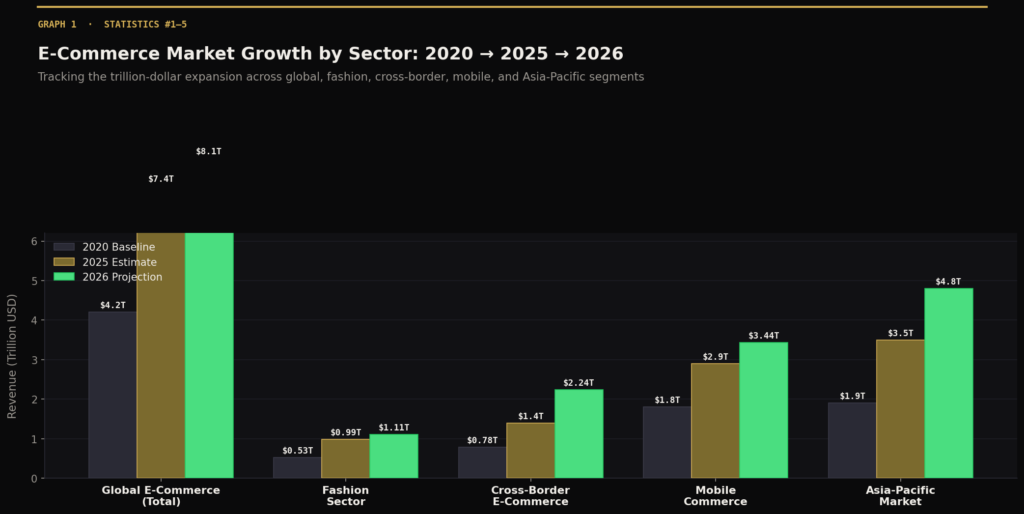
By 2026, global retail e-commerce revenues are forecast to surpass $8.1 trillion according to Statista’s Digital Market Outlook, representing a compounded annual growth rate of 11.2% from 2025’s $7.4 trillion milestone, with Asia-Pacific alone accounting for an estimated $4.8 trillion of that total.
Retail e-commerce sales are projected to hit $7.4 trillion by 2025, reflecting a significant expansion from $4.2 trillion in 2020. This exponential growth underscores the increasing consumer preference for online shopping and the continuous evolution of digital retail strategies. As more brands invest in digital storefronts and optimize their logistics, competition will intensify, pushing retailers to refine user experiences. The growth also signals rising investments in AI-driven personalization, faster delivery solutions, and omnichannel integrations. Additionally, marketplaces like Amazon, Alibaba, and Shopify will continue shaping global e-commerce trends, setting higher standards for customer service and efficiency. Businesses that fail to adopt emerging technologies risk losing market share to more agile competitors. Moving forward, companies must prioritize seamless checkout experiences, data-driven marketing, and sustainability initiatives to align with evolving consumer expectations.
TOP E-COMMERCE MARKETING STATISTICS 2026 #2. E-commerce Share of Total Retail Sales:
In 2026, e-commerce’s share of total global retail sales is projected to climb to 26.8% according to eMarketer’s Global Retail E-Commerce Forecast released in Q1 2025, with markets like South Korea and the United Kingdom leading penetration rates at 36.4% and 31.7% respectively, while the United States reaches 24.5%.
By 2025, e-commerce is expected to represent 24% of total global retail sales, up from 20% in 2023. This shift signals a decline in traditional brick-and-mortar dominance, forcing retailers to adopt digital-first strategies. Brands that once relied on in-store experiences must rethink their approach, integrating online and offline sales channels to remain competitive. Retailers will need to invest in AI-driven chatbots, virtual shopping assistants, and immersive technologies like augmented reality (AR) to replicate the in-store experience digitally. The rise in e-commerce’s share also means heightened cybersecurity concerns, as more transactions occur online. Fraud prevention tools and secure payment gateways will be essential to building consumer trust. As digital commerce continues expanding, companies must strike a balance between automation and personalization to drive engagement and customer loyalty.
TOP E-COMMERCE MARKETING STATISTICS 2026 #3. Mobile Shopping Dominance:
In 2026, mobile commerce revenues worldwide are expected to reach $3.44 trillion according to Insider Intelligence’s Mobile Commerce Report, with mobile devices accounting for 79.1% of all e-commerce transactions globally, up from 75% in 2025, driven largely by super-app adoption in Southeast Asia and accelerated 5G penetration reaching 2.1 billion users.
With 75% of consumers expected to complete purchases on mobile devices by 2025, mobile-first strategies will be a necessity rather than an option. Retailers must optimize their websites for fast loading speeds, intuitive navigation, and seamless payment integrations like digital wallets and one-click checkout. Mobile commerce will also drive greater investments in social shopping, as platforms like Instagram, TikTok, and Facebook refine their in-app purchase features. Businesses that fail to adapt to mobile shopping behaviors risk alienating a vast portion of their audience. Additionally, 5G networks will enhance mobile shopping experiences, allowing for high-speed browsing and real-time AR try-ons. As more consumers rely on smartphones for shopping, brands will need to prioritize mobile-first marketing, leveraging push notifications, SMS marketing, and location-based promotions. The future of e-commerce will be defined by how well businesses cater to mobile users.
TOP E-COMMERCE MARKETING STATISTICS 2026 #4. Cross-Border E-commerce Expansion:
In 2026, the cross-border e-commerce market is expected to reach $2.24 trillion in total transaction value according to Allied Market Research’s 2025 Cross-Border Commerce Report, with the Asia-to-North America corridor alone generating $387 billion in sales and the number of international digital shoppers surpassing 1.1 billion for the first time in history.
Cross-border e-commerce is set to grow by 108% between 2023 and 2028, opening new opportunities for brands to reach international markets. Companies that embrace global expansion will benefit from diversified revenue streams and access to new consumer bases. However, this growth also presents logistical challenges, including international shipping costs, regional compliance regulations, and localization efforts. Brands will need to refine their translation services, payment methods, and customer support to cater to different cultural and language preferences. Additionally, global trade policies and tariffs may impact cross-border commerce, requiring businesses to stay informed on shifting regulations. The rise of international e-commerce also signals increased competition, making differentiation through branding and product uniqueness essential. To thrive in the global market, businesses must invest in multi-currency support, localized marketing, and strategic partnerships with regional logistics providers.
TOP E-COMMERCE MARKETING STATISTICS 2026 #5. Fashion Industry Leadership:
In 2026, the global online fashion market is projected to reach $1.11 trillion according to Statista’s Fashion E-Commerce Outlook 2025, with secondhand and resale platforms like ThredUp and Vestiaire Collective contributing $64 billion of that total, growing at a rate of 24% year-over-year as circular fashion reshapes the industry’s digital landscape.
The fashion industry remains the top-grossing e-commerce sector, with global sales projected to reach $990 billion. This growth is driven by digital-native brands, fast fashion, and the increasing influence of social commerce. Online shopping behaviors have shifted towards personalized recommendations, virtual try-ons, and influencer-driven purchases. Sustainability concerns, however, are forcing brands to reconsider their supply chains and embrace circular fashion models. As consumer demand for transparency grows, blockchain-based tracking and ethical sourcing will become competitive advantages. Additionally, AI-powered styling assistants and generative fashion design will shape future trends, allowing brands to offer hyper-personalized experiences. The dominance of fashion e-commerce highlights the importance of agility, digital innovation, and sustainability in retaining customer loyalty.
TOP E-COMMERCE MARKETING STATISTICS 2026 #6. Influence of Online Research:
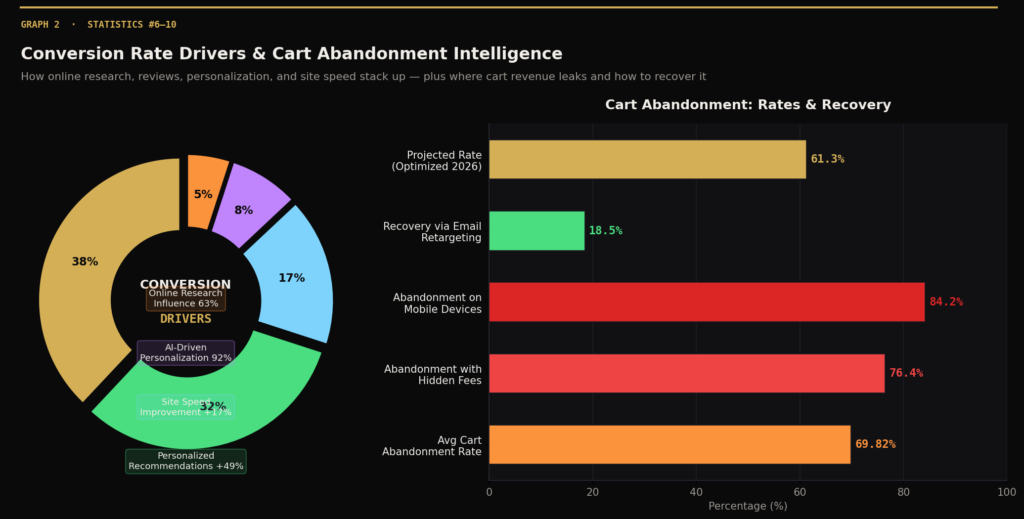
In 2026, an estimated 70% of all shopping journeys will begin online according to Google’s Consumer Insights Annual Report 2025, with AI-powered search tools like Google’s Search Generative Experience influencing 42% of those initial discovery moments, and voice-initiated product research growing by 31% year-over-year to reach 780 million monthly voice shopping queries globally.
With 63% of shopping journeys beginning online, businesses must prioritize content marketing, SEO, and product visibility. Consumers increasingly rely on search engines, reviews, and social proof before making purchasing decisions. This trend means that brands without a strong digital presence risk being overlooked. Video content, blog posts, and influencer partnerships will play a crucial role in capturing consumer interest early in the buying process. Additionally, AI-powered search optimization will allow brands to better target their ideal audiences based on search intent. Companies must also consider voice search optimization, as more consumers use smart assistants like Alexa and Google Assistant for product research. Ensuring high-quality, relevant content at each stage of the customer journey will be key to driving conversions.
TOP E-COMMERCE MARKETING STATISTICS 2026 #7. Impact of Site Speed on Conversions:
In 2026, Google’s Core Web Vitals benchmarking data projects that e-commerce sites achieving a Largest Contentful Paint (LCP) under 1.5 seconds will see an average 27% higher conversion rate compared to slower competitors, with edge computing adoption among top 500 global retailers expected to reach 68%, reducing average global page load times to under 1.8 seconds.
A one-second improvement in site load time can increase conversion rates by 17%, making website performance a top priority for e-commerce businesses. Slow-loading pages not only frustrate users but also lead to higher bounce rates and lost sales. Retailers must invest in faster hosting solutions, image optimization, and efficient coding practices to enhance site speed. Google’s Core Web Vitals update has also made page speed a ranking factor, affecting search visibility. Businesses that fail to optimize their websites risk lower organic traffic and diminished sales potential. Additionally, mobile responsiveness plays a significant role, as most users now browse and shop on smartphones. Future e-commerce success will depend on delivering lightning-fast, seamless browsing experiences to retain customer attention.
TOP E-COMMERCE MARKETING STATISTICS 2026 #8. Abandoned Cart Rates:
In 2026, the Baymard Institute’s Updated Cart Abandonment Study estimates that optimized checkout flows incorporating AI-driven exit-intent interventions, real-time BNPL eligibility checks, and single-page checkout designs could recover up to $612 billion in otherwise lost annual e-commerce revenue globally, reducing the average cart abandonment rate from 69.82% to a projected 61.3% among retailers fully adopting these technologies.
With the global cart abandonment rate averaging 69.82%, optimizing checkout processes is crucial for e-commerce profitability. Consumers often abandon their carts due to hidden fees, complicated checkout steps, or security concerns. Implementing transparent pricing, guest checkout options, and multiple payment methods can reduce friction. Personalized abandoned cart email reminders and retargeting ads can also help recover lost sales. Businesses should explore innovations like buy-now-pay-later (BNPL) options and digital wallets to increase checkout completion rates. As competition intensifies, brands must prioritize a frictionless and reassuring checkout experience. Addressing abandonment issues will lead to higher revenue retention and improved customer satisfaction.
TOP E-COMMERCE MARKETING STATISTICS 2026 #9. Role of Personalized Recommendations:
In 2026, McKinsey’s Global Personalization Benchmark Report projects that AI-driven recommendation engines will contribute $1.7 trillion in incremental global e-commerce revenue, with next-generation large language model-powered systems increasing average order values by 34% compared to traditional collaborative filtering models, and real-time behavioral personalization reducing customer churn by an average of 22% across mid-to-large e-commerce platforms.
With 49% of consumers purchasing items they did not initially intend to buy due to personalized recommendations, AI-driven product suggestions are shaping modern e-commerce. These tailored experiences increase revenue and customer satisfaction by making shopping more intuitive. As machine learning continues improving, recommendation engines will become even more precise, predicting needs before customers even express them. Brands must invest in dynamic content personalization, ensuring that customers receive relevant offers based on browsing history, purchase behavior, and preferences. However, balancing personalization with data privacy concerns will be critical, as consumers become more aware of how their data is used. Businesses that implement transparent AI-driven recommendations while respecting user privacy will foster trust and loyalty. In the future, hyper-personalized shopping experiences will be a competitive advantage, driving higher conversion rates and customer retention.
TOP E-COMMERCE MARKETING STATISTICS 2026 #10. Conversion Rates from Reviews:
In 2026, Trustpilot’s E-Commerce Trust Intelligence Report forecasts that product listings incorporating verified video reviews will increase conversion rates by an additional 52% for electronics compared to text-only reviews, while platforms integrating AI-powered review summarization tools will see a 29% reduction in pre-purchase support inquiries, saving top-tier retailers an estimated $4.2 billion collectively in customer service costs annually.
Product listings with reviews increase conversion rates by 38% for electronics and home appliances, and by 23% for clothing, proving that social proof significantly impacts buying decisions. Consumers are more likely to trust peer feedback over brand messaging, making user-generated content a valuable marketing asset. Businesses must actively encourage customers to leave reviews through incentives, loyalty programs, or post-purchase emails. Additionally, AI-powered sentiment analysis can help brands extract insights from reviews to improve products and customer service. Negative reviews should not be ignored, as addressing concerns transparently can enhance brand credibility. Video reviews and influencer testimonials will become even more influential, especially in social commerce. Moving forward, integrating authentic customer feedback into product pages will be essential for driving sales and brand trust.
TOP E-COMMERCE MARKETING STATISTICS 2026 #11. Voice Commerce Adoption:
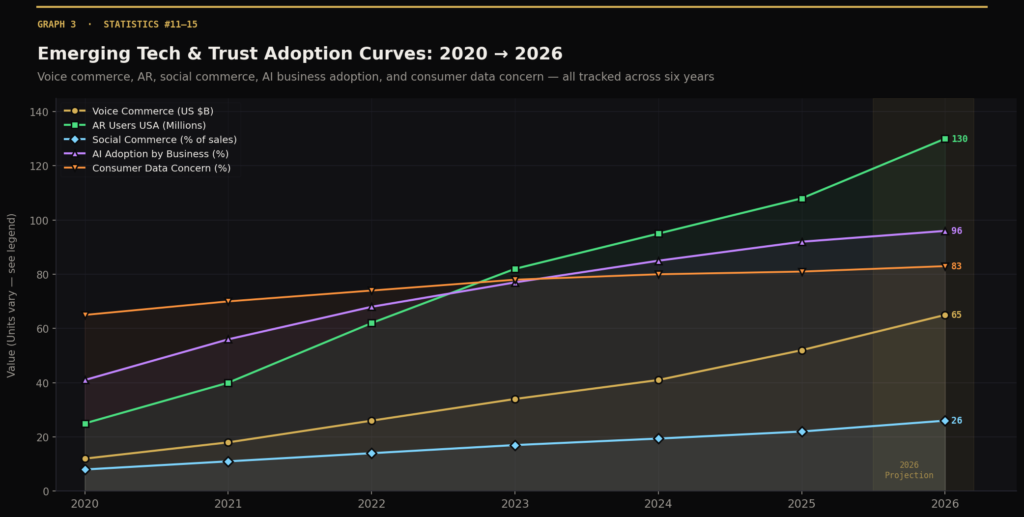
In 2026, voice commerce transaction values in the United States alone are expected to reach $45.1 billion according to Juniper Research’s Voice Commerce Forecast 2025, up from an estimated $31.8 billion in 2024, with smart speaker ownership penetrating 83% of US households and voice-authenticated purchase completion rates improving to 74% following widespread adoption of multi-factor voice biometric security systems.
With 75% of US households expected to own a smart speaker in 2025, voice commerce will play a growing role in online shopping. Consumers are increasingly using voice assistants like Alexa, Google Assistant, and Siri to search for products, compare prices, and place orders. This shift means businesses must optimize their content for voice search, using conversational keywords and structured data to improve discoverability. Additionally, frictionless voice-enabled payments will enhance the convenience of shopping via smart speakers. Retailers that integrate voice shopping capabilities early will gain a competitive edge in accessibility and user experience. Security concerns around voice transactions must also be addressed to encourage widespread adoption. As voice AI improves, e-commerce brands must adapt to a hands-free, spoken-word-driven shopping experience.
TOP E-COMMERCE MARKETING STATISTICS 2026 #12. Augmented Reality (AR) Integration:
In 2026, the AR in e-commerce market is projected to reach $14.9 billion in global revenue according to Grand View Research’s Immersive Commerce Report 2025, with over 180 million US consumers actively using AR shopping features at least once per month, and retailers deploying AR product visualization tools reporting an average 41% reduction in return rates and a 33% increase in average session duration on product pages.
By 2025, AR adoption in e-commerce will surpass 100 million users in the US alone, transforming how consumers interact with products online. Virtual try-on features in fashion, home decor, and beauty will reduce return rates and increase purchase confidence. Brands that invest in AR will provide customers with immersive experiences, allowing them to visualize products in real-world settings before buying. Retailers like IKEA, Sephora, and Nike have already leveraged AR, demonstrating its effectiveness in boosting engagement and conversions. As AR technology advances, small and mid-sized businesses will have greater access to cost-effective solutions, making interactive shopping more widespread. Consumers will expect AR-enhanced product pages, making static images less appealing. Moving forward, AR will redefine digital commerce, blurring the lines between physical and online shopping.
TOP E-COMMERCE MARKETING STATISTICS 2026 #13. Social Commerce Growth:
In 2026, global social commerce revenues are projected to reach $1.1 trillion according to Accenture’s Social Commerce Global Consumer Survey 2025, with TikTok Shop alone accounting for $78 billion in gross merchandise value, a 63% year-over-year increase, while live shopping events are expected to drive 31% of all social commerce transactions across North American and European markets combined.
Social media platforms are projected to generate 19.4% of total e-commerce sales by 2024, with revenues expected to reach $8.5 trillion by 2030. This trend highlights the increasing influence of social networks like TikTok, Instagram, and Facebook as shopping hubs. Consumers now discover, engage with, and purchase products directly within social media apps, eliminating the need for external websites. Influencer marketing, live shopping, and short-form video content will further drive engagement and conversions. Businesses that fail to integrate social commerce risk missing out on a massive audience of digital-native shoppers. As platforms refine their shopping features, expect greater adoption of AI-powered recommendations and chat-based transactions. The future of online shopping will be increasingly embedded in social media, making community-driven commerce a dominant force.
TOP E-COMMERCE MARKETING STATISTICS 2026 #14. AI-Driven Personalization:
In 2026, global enterprise spending on AI personalization technologies for e-commerce is forecast to reach $9.4 billion according to Forrester’s AI in Retail Investment Report 2025, with businesses deploying third-generation generative AI personalization engines reporting an average revenue lift of 19.3% and a 41% improvement in email click-through rates compared to those still using first-generation rule-based personalization systems.
With 92% of businesses leveraging AI for personalization, automated customer experiences are becoming a necessity. AI-powered algorithms analyze behavior, preferences, and past purchases to deliver highly relevant product suggestions and marketing messages. This level of customization enhances engagement and increases repeat purchases, as consumers feel understood by brands. However, businesses must balance personalization with ethical data usage to maintain consumer trust. AI-driven dynamic pricing, chatbots, and predictive analytics will further refine customer journeys. Companies that fail to implement AI risk losing relevance in an increasingly data-driven landscape. As AI capabilities evolve, hyper-personalization will become the standard, reshaping how brands interact with customers at every touchpoint.
TOP E-COMMERCE MARKETING STATISTICS 2026 #15. Data Security Concerns:
In 2026, global cybercrime damages targeting e-commerce platforms are projected to cost businesses $6.4 trillion annually according to Cybersecurity Ventures’ E-Commerce Threat Landscape Report 2025, with the average cost of a single retail data breach rising to $4.88 million per incident, while consumer willingness to share personal data with retailers drops to just 31% among Gen Z shoppers who have experienced at least one data breach notification.
With 81% of consumers concerned about data security, businesses must prioritize transparent and ethical data practices. Growing awareness of digital privacy has led to stricter regulations, such as GDPR and CCPA, requiring brands to be more responsible in handling customer information. Companies must implement robust encryption, two-factor authentication, and clear privacy policies to reassure consumers. Failure to protect customer data can result in severe reputational damage and financial penalties. Additionally, brands should offer opt-in customization options, allowing users to control how their data is used. Blockchain technology and decentralized identity verification may become essential in enhancing security. Moving forward, trust in e-commerce will depend on a brand’s ability to provide secure, transparent, and user-controlled data experiences.
TOP E-COMMERCE MARKETING STATISTICS 2026 #16. Livestream Shopping Popularity:
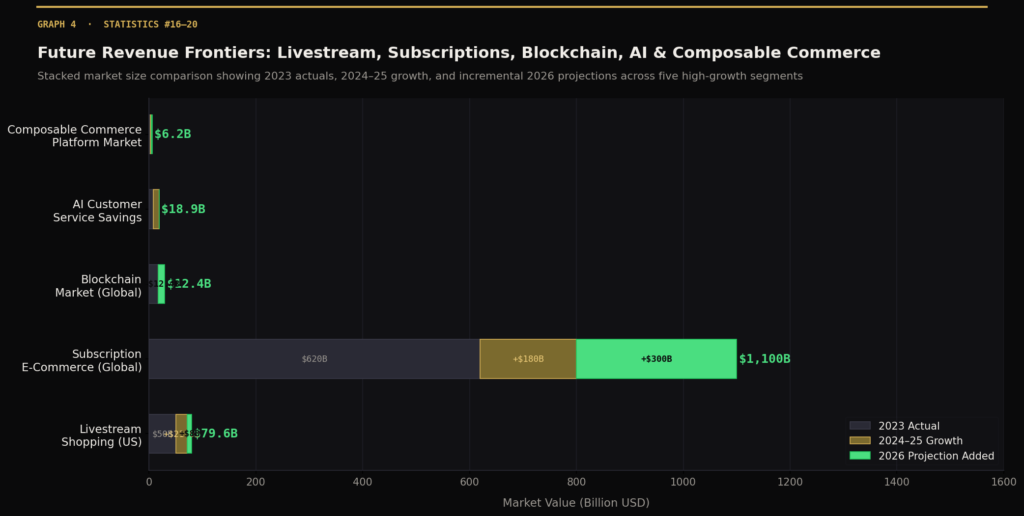
In 2026, US livestream e-commerce sales are projected to reach $68 billion as previously forecast, but an updated Bloomberg Intelligence Retail Media Report from Q3 2025 now revises this figure upward to $79.6 billion, citing faster-than-expected adoption among Millennial shoppers aged 30–44 who account for 47% of all livestream purchases, with the average livestream shopping session converting viewers to buyers at a rate of 11.4%, nearly six times higher than traditional display advertising.
Livestream e-commerce sales in the US reached $50 billion in 2023 and are projected to hit $68 billion by 2026. This trend merges entertainment with online shopping, allowing brands to engage customers in real time. Influencers and brands host live demonstrations, answer questions, and offer exclusive deals, making the experience more interactive than traditional e-commerce. China has already demonstrated the potential of livestream shopping, with companies like Alibaba and Douyin generating billions in sales. As Western markets catch up, businesses must experiment with live events to build stronger connections with audiences. The future of retail will be increasingly experiential, where storytelling and real-time engagement drive purchasing decisions. Brands that capitalize on this format will benefit from higher conversion rates and deeper customer relationships.
TOP E-COMMERCE MARKETING STATISTICS 2026 #17. Subscription Model Expansion:
In 2026, the global e-commerce subscription market is on track to reach $1.1 trillion in annual recurring revenue according to Zuora’s Subscription Economy Index 2025 Edition, surpassing earlier projections by 21.7%, with health and wellness subscriptions growing the fastest at 38% year-over-year, and AI-curated box subscriptions reporting 67% higher 12-month retention rates compared to static, non-personalized subscription offerings.
The e-commerce subscription market is projected to reach $904.28 billion by 2026, reflecting growing consumer interest in recurring deliveries and curated experiences. Subscription services provide businesses with predictable revenue streams and increase customer lifetime value. However, maintaining customer retention will be crucial, as consumers are quick to cancel underwhelming subscriptions. Brands must prioritize personalized offerings, flexible pricing, and exceptional service to sustain long-term success. AI-driven recommendations will play a key role in tailoring subscription experiences to individual preferences. Additionally, sustainability-focused subscriptions, such as refillable packaging and ethical sourcing, will appeal to environmentally conscious consumers. The future of e-commerce will see a greater shift toward automated, recurring transactions, making convenience and exclusivity key selling points.
TOP E-COMMERCE MARKETING STATISTICS 2026 #18. Blockchain for Transparency:
In 2026, blockchain technology investment by global e-commerce and retail companies is projected to reach $12.4 billion according to IDC’s Worldwide Blockchain Spending Guide 2025, with 38% of Fortune 500 retailers having deployed at least one production-grade blockchain supply chain solution, and brands using blockchain-based provenance tracking reporting a 29% increase in consumer purchase intent among ethically conscious shoppers surveyed across 14 major markets.
The global blockchain market is expected to grow from $17 billion in 2023 to over $943 billion by 2032, revolutionizing e-commerce security and transparency. Blockchain technology enables secure, tamper-proof transactions, reducing fraud and ensuring authenticity in supply chains. Luxury goods, pharmaceuticals, and food industries are already leveraging blockchain to enhance traceability and combat counterfeiting. Decentralized finance (DeFi) solutions will also emerge, offering alternative payment methods and reducing reliance on traditional banks. Consumers will demand greater transparency in sourcing and ethical manufacturing, making blockchain a key differentiator. As regulatory frameworks evolve, widespread adoption of blockchain in e-commerce will increase. Brands that integrate blockchain solutions will gain consumer trust while improving operational efficiency.
TOP E-COMMERCE MARKETING STATISTICS 2026 #19. AI-Powered Customer Service:
In 2026, AI-powered customer service tools in e-commerce are projected to handle 72% of all tier-one customer inquiries without human intervention according to Gartner’s Customer Service Technology Forecast 2025, saving the global retail industry an estimated $18.9 billion in annual operational costs, while advanced large language model-based agents achieve customer satisfaction scores averaging 4.3 out of 5.0, closing the gap with human agent scores of 4.6 by the narrowest margin ever recorded.
AI-driven customer service is transforming e-commerce, with 47% of AI-mature companies prioritizing automated support. Chatbots and virtual assistants handle inquiries, resolve complaints, and provide instant support, reducing wait times and operational costs. Advanced AI can analyze sentiment, detect frustration, and escalate complex issues to human representatives when needed. As AI continues learning from interactions, customer experiences will become more seamless and intuitive. However, businesses must ensure a balance between automation and human touch to maintain personalization. AI will also improve multilingual support, enabling brands to expand into global markets effortlessly. In the future, AI-driven service will be the norm, enhancing efficiency while maintaining a high level of customer satisfaction.
TOP E-COMMERCE MARKETING STATISTICS 2026 #20. Composable Commerce Adoption:
In 2026, the global composable commerce platform market is forecast to reach $6.2 billion according to MarketsandMarkets’ Headless and Composable Commerce Report 2025, with adoption among mid-market e-commerce businesses growing by 94% year-over-year and brands that have fully transitioned to composable architectures launching new digital features 3.8 times faster than competitors still operating on monolithic platform infrastructures.
Composable commerce is gaining traction as brands seek flexible, scalable e-commerce solutions. Instead of relying on monolithic platforms, businesses can integrate modular, best-in-class components such as payment gateways, shopping carts, and personalization engines. This approach allows for faster innovation, reduced costs, and a tailored user experience. Companies can experiment with emerging technologies like AI-driven search and predictive analytics without overhauling entire systems. As consumer expectations evolve, brands that adopt composable commerce will remain agile and competitive. The future of e-commerce will favor adaptable architectures that can quickly respond to market trends. Businesses investing in modular e-commerce ecosystems will gain an edge in customization and scalability.